engine control unit NISSAN TIIDA 2009 Service Manual PDF
[x] Cancel search | Manufacturer: NISSAN, Model Year: 2009, Model line: TIIDA, Model: NISSAN TIIDA 2009Pages: 4331, PDF Size: 58.04 MB
Page 2477 of 4331
![NISSAN TIIDA 2009 Service Manual PDF EC
NP
O
FUEL T/TMP SE
[ ° C] or [ °F] • The fuel temperature (determined by the signal voltage of the
fuel tank temperature sensor) is displayed.
INT/A TEMP SE
[ ° C] or [ °F] • The intake ai](/img/5/57398/w960_57398-2476.png "NISSAN TIIDA 2009 Service Manual PDF EC
NP
O
FUEL T/TMP SE
[ ° C] or [ °F] • The fuel temperature (determined by the signal voltage of the
fuel tank temperature sensor) is displayed.
INT/A TEMP SE
[ ° C] or [ °F] • The intake ai")
EC
NP
O
FUEL T/TMP SE
[ ° C] or [ °F] • The fuel temperature (determined by the signal voltage of the
fuel tank temperature sensor) is displayed.
INT/A TEMP SE
[ ° C] or [ °F] • The intake air temperature (determined by the signal voltage
of the intake air temperature sensor) is indicated.
EVAP SYS PRES
[V] • The signal voltage of EVAP control system pressure sensor
is displayed.
FUEL LEVEL SE
[V] • The signal voltage of the fuel level sensor is displayed.
START SIGNAL
[ON/OFF] • Indicates start signal status [ON/OFF] computed by the ECM
according to the signals of engine speed and battery voltage. • After starting the engine, [OFF] is displayed
regardless of the starter signal.
CLSD THL POS
[ON/OFF] • Indicates idle position [ON/OFF] computed by the ECM ac-
cording to the accelerator pedal position sensor signal.
AIR COND SIG
[ON/OFF] • Indicates [ON/OFF] condition of the air conditioner switch as
determined by the air conditioner signal.
P/N POSI SW
[ON/OFF] • Indicates [ON/OFF] condition from the park/neutral position
(PNP) switch signal.
PW/ST SIGNAL
[ON/OFF] • [ON/OFF] condition of the power steering system (deter-
mined by the signal sent from EPS control unit) is indicated.
LOAD SIGNAL
[ON/OFF] • Indicates [ON/OFF] condition from the electrical load signal.
ON: Rear window defogger switch is ON and/or lighting
switch is in 2nd position.
OFF: Both rear window defogger switch and lighting switch
are OFF.
IGNITION SW
[ON/OFF] • Indicates [ON/OFF] condition from ignition switch.
HEATER FAN SW
[ON/OFF] • Indicates [ON/OFF] condition from the heater fan switch sig-
nal.
BRAKE SW
[ON/OFF] • Indicates [ON/OFF] condition from the stop lamp switch sig-
nal.
INJ PULSE-B1
[msec] • Indicates the actual fuel injection pulse width compensated
by ECM according to the input signals. • When the engine is stopped, a certain com-
puted value is indicated.
IGN TIMING
[BTDC] • Indicates the ignition timing computed by ECM according to
the input signals. • When the engine is stopped, a certain value
is indicated.
CAL/LD VALUE
[%] • “Calculated load value” indicates the value of the current air-
flow divided by peak airflow.
MASS AIRFLOW
[g·m/s] • Indicates the mass airflow computed by ECM according to
the signal voltage of the mass air flow sensor.
PURG VOL C/V
[%] • Indicates the EVAP canister purge volume control solenoid
valve control value computed by the ECM according to the in-
put signals.
• The opening becomes larger as the value increases.
INT/V TIM (B1)
[ ° CA] • Indicates [
°CA] of intake camshaft advanced angle.
INT/V SOL (B1)
[%] • The control value of the intake valve timing control solenoid
valve (determined by ECM according to the input signal) is in-
dicated.
• The advance angle becomes larger as the value increases
AIR COND RLY
[ON/OFF] • The air conditioner relay control condition (determined by
ECM according to the input signals) is indicated.
FUEL PUMP RLY
[ON/OFF] • Indicates the fuel pump relay control condition determined by
ECM according to the input signals.
Monitored item [Unit] Description Remarks
Page 2479 of 4331
![NISSAN TIIDA 2009 Service Manual PDF EC
NP
O
NOTE:
Any monitored item that does not match the vehicle being diagnosed is deleted from the display automatically.
ACTIVE TEST MODE
Test Item AT OD CANCEL
[ON/OFF] • Indicates [ON/OFF] cond](/img/5/57398/w960_57398-2478.png "NISSAN TIIDA 2009 Service Manual PDF EC
NP
O
NOTE:
Any monitored item that does not match the vehicle being diagnosed is deleted from the display automatically.
ACTIVE TEST MODE
Test Item AT OD CANCEL
[ON/OFF] • Indicates [ON/OFF] cond")
EC
NP
O
NOTE:
Any monitored item that does not match the vehicle being diagnosed is deleted from the display automatically.
ACTIVE TEST MODE
Test Item AT OD CANCEL
[ON/OFF] • Indicates [ON/OFF] condition of A/T O/D cancel signal sent
from the TCM. • For M/T models always “OFF” is displayed
CRUISE LAMP
[ON/OFF] • Indicates [ON/OFF]
condition of CRUISE lamp determined
by the ECM according to the input signals.
SET LAMP
[ON/OFF] • Indicates [ON/OFF] condition of SET lamp determined by the
ECM according to the input signals.
A/F ADJ-B1 • Indicates the correction factor stored in ECM. The factor is
calculated from the difference between the target air/fuel ratio
stored in ECM and the air/fuel ratio calculated from air fuel ra-
tio (A/F) sensor 1 signal.
Monitored item [Unit] Description Remarks TEST ITEM CONDITION JUDGMENT CHECK ITEM (REMEDY)
FUEL INJEC-
TION • Engine: Return to the original
trouble condition
• Change the amount of fuel injec- tion using CONSULT-III. If trouble symptom disappears, see
CHECK ITEM. • Harness and connectors
• Fuel injector
• Air fuel ratio (A/F) sensor 1
IGNITION TIM-
ING • Engine: Return to the original
trouble condition
• Timing light: Set
• Retard the ignition timing using
CONSULT-III. If trouble symptom disappears, see
CHECK ITEM. • Perform Idle Air Volume Learning.
POWER BAL-
ANCE • Engine: After warming up, idle the
engine.
• A/C switch OFF
• Shift lever: P or N (A/T, CVT), Neutral (M/T)
• Cut off each fuel injector signal
one at a time using CONSULT-III. Engine runs rough or dies.
• Harness and connectors
• Compression
• Fuel injector
• Power transistor
• Spark plug
• Ignition coil
COOLING FAN* • Ignition switch: ON
• Turn the cooling fan “LOW”, “HI” and “OFF” with CONSULT-III. Cooling fan moves and stops. • Harness and connectors
• Cooling fan relay
• Cooling fan motor
ENG COOLANT
TEMP • Engine: Return to the original
trouble condition
• Change the engine coolant tem- perature using CONSULT-III. If trouble symptom disappears, see
CHECK ITEM. • Harness and connectors
• Engine coolant temperature sen-
sor
• Fuel injector
FUEL PUMP RE-
LAY • Ignition switch: ON
(Engine stopped)
• Turn the fuel pump relay ON and OFF using CONSULT-III and lis-
ten to operating sound. Fuel pump relay makes the operat-
ing sound. • Harness and connectors
• Fuel pump relay
PURG VOL
CONT/V • Engine: After warming up, run en-
gine at 1,500 rpm.
• Change the EVAP canister purge volume control solenoid valve
opening percent using CON-
SULT-III. Engine speed changes according to
the opening percent. • Harness and connectors
• EVAP canister purge volume con- trol solenoid valve
FUEL/T TEMP
SEN • Change the fuel tank temperature using CONSULT-III.
Page 2507 of 4331
![NISSAN TIIDA 2009 Service Manual PDF DTC P0011 IVT CONTROL
EC-1151
< SERVICE INFOMATION >
[MR TYPE 2] C
D E
F
G H
I
J
K L
M A EC
NP
O
DTC P0011 IVT CONTROL
Description INFOID:0000000004499967
SYSTEM DESCRIPTION
*: This signal is sent to](/img/5/57398/w960_57398-2506.png "NISSAN TIIDA 2009 Service Manual PDF DTC P0011 IVT CONTROL
EC-1151
< SERVICE INFOMATION >
[MR TYPE 2] C
D E
F
G H
I
J
K L
M A EC
NP
O
DTC P0011 IVT CONTROL
Description INFOID:0000000004499967
SYSTEM DESCRIPTION
*: This signal is sent to")
DTC P0011 IVT CONTROL
EC-1151
< SERVICE INFOMATION >
[MR TYPE 2] C
D E
F
G H
I
J
K L
M A EC
NP
O
DTC P0011 IVT CONTROL
Description INFOID:0000000004499967
SYSTEM DESCRIPTION
*: This signal is sent to the ECM through CAN communication line.
This mechanism hydraulically controls cam phases c ontinuously with the fixed operating angle of the intake
valve. The ECM receives signals such as cranks haft position, camshaft position, engine speed, and engine
coolant temperature. Then, the ECM sends ON/OFF pulse duty signals to the intake valve timing control sole-
noid valve depending on driving status. This makes it po ssible to control the shut/open timing of the intake
valve to increase engine torque in low/mid speed range and output in high-speed range.
CONSULT-III Reference Val ue in Data Monitor Mode INFOID:0000000004499968
Specification data are reference values. Sensor Input signal to ECM ECM function Actuator
Crankshaft position sensor (POS)
Camshaft position sensor (PHASE) Engine speed and piston position
Intake valve
timing control Intake valve timing control
solenoid valve
Engine coolant temperature sensor Engine coolant temperature
ABS actuator and electric unit (control unit)
Vehicle speed*
Combination meter PBIB3333E
MONITOR ITEM CONDITION SPECIFICATION
INT/V TIM (B1) • Engine: After warming up
• Air conditioner switch: OFF
• Shift lever: P or N (A/T, CVT), Neutral (M/T)
• No load Idle
−5 ° - 5 °CA
When revving engine up to 2,000 rpm
quickly Approx. 0
° - 40 °CA
INT/V SOL (B1) • Engine: After warming up
• Air conditioner switch: OFF
• Shift lever: P or N (A/T, CVT), Neutral (M/T)
• No load Idle 0% - 2%
When revving engine up to 2,000 rpm
quickly Approx. 0% - 90%
Page 2521 of 4331
![NISSAN TIIDA 2009 Service Manual PDF DTC P0075 IVT CONTROL SOLENOID VALVE
EC-1165
< SERVICE INFOMATION >
[MR TYPE 2] C
D E
F
G H
I
J
K L
M A EC
NP
O
DTC P0075 IVT CONTROL SOLENOID VALVE
Component Description INFOID:0000000004499990
Intak](/img/5/57398/w960_57398-2520.png "NISSAN TIIDA 2009 Service Manual PDF DTC P0075 IVT CONTROL SOLENOID VALVE
EC-1165
< SERVICE INFOMATION >
[MR TYPE 2] C
D E
F
G H
I
J
K L
M A EC
NP
O
DTC P0075 IVT CONTROL SOLENOID VALVE
Component Description INFOID:0000000004499990
Intak")
DTC P0075 IVT CONTROL SOLENOID VALVE
EC-1165
< SERVICE INFOMATION >
[MR TYPE 2] C
D E
F
G H
I
J
K L
M A EC
NP
O
DTC P0075 IVT CONTROL SOLENOID VALVE
Component Description INFOID:0000000004499990
Intake valve timing control solenoid valve is activated by ON/OFF
pulse duty (ratio) signals from the ECM.
The intake valve timing control solenoid valve changes the oil
amount and direction of flow through intake valve timing control unit
or stops oil flow.
The longer pulse width advances valve angle.
The shorter pulse width retards valve angle.
When ON and OFF pulse widths become equal, the solenoid valve
stops oil pressure flow to fix the intake valve angle at the control
position.
CONSULT-III Reference Val ue in Data Monitor Mode INFOID:0000000004499991
Specification data are reference values.
On Board Diagnosis Logic INFOID:0000000004499992
DTC Confirmation Procedure INFOID:0000000004499993
NOTE:
If DTC Confirmation Procedure h as been previously conducted, alw ays turn ignition switch OFF and
wait at least 10 seconds before conducting the next test.
1. Start engine and let it idle for 5 seconds.
2. Check 1st trip DTC.
3. If 1st trip DTC is detected, go to EC-1167, " Diagnosis Procedure " . PBIB1842E
MONITOR ITEM CONDITION SPECIFICATION
INT/V SOL (B1) • Engine: After warming up
• Air conditioner switch: OFF
• Shift lever: P or N (A/T, CVT), Neu-
tral (M/T)
• No load Idle 0% - 2%
When revving engine up to 2,000 rpm
quickly Approx. 0% - 90%DTC No. Trouble diagnosis name DTC detecting condition Possible cause
P0075
0075 Intake valve timing control
solenoid valve circuit An improper voltage is sent to the ECM
through intake valve timing control solenoid
valve. • Harness or connectors
(Intake valve timing control solenoid valve
circuit is open or shorted.)
• Intake valve timing control solenoid valve
Page 2678 of 4331
![NISSAN TIIDA 2009 Service Manual PDF EC-1322< SERVICE INFOMATION >
[MR TYPE 2]
DTC P0443 EVAP CANISTER PURGE VO
LUME CONTROL SOLENOID VALVE
DTC P0443 EVAP CANISTER PURG E VOLUME CONTROL SOLENOID
VALVE
Description INFOID:0000000004](/img/5/57398/w960_57398-2677.png "NISSAN TIIDA 2009 Service Manual PDF EC-1322< SERVICE INFOMATION >
[MR TYPE 2]
DTC P0443 EVAP CANISTER PURGE VO
LUME CONTROL SOLENOID VALVE
DTC P0443 EVAP CANISTER PURG E VOLUME CONTROL SOLENOID
VALVE
Description INFOID:0000000004")
EC-1322< SERVICE INFOMATION >
[MR TYPE 2]
DTC P0443 EVAP CANISTER PURGE VO
LUME CONTROL SOLENOID VALVE
DTC P0443 EVAP CANISTER PURG E VOLUME CONTROL SOLENOID
VALVE
Description INFOID:0000000004500178
SYSTEM DESCRIPTION
*1: ECM determines the start signal status by the signals of engine speed and battery voltage.
*2: This signal is sent to the ECM though CAN communication line.
This system controls flow rate of fuel vapor from the EVAP canister. The opening of the vapor by-pass pas-
sage in the EVAP canister purge volume control sol enoid valve changes to control the flow rate. The EVAP
canister purge volume control solenoid valve repeats ON/O FF operation according to the signal sent from the
ECM. The opening of the valve varies for optimum engi ne control. The optimum value stored in the ECM is
determined by considering various engine conditions. When t he engine is operating, the flow rate of fuel vapor
from the EVAP canister is r egulated as the air flow changes.
COMPONENT DESCRIPTION
The EVAP canister purge volume control solenoid valve uses a ON/
OFF duty to control the flow rate of fuel vapor from the EVAP canis-
ter. The EVAP canister purge volume control solenoid valve is
moved by ON/OFF pulses from the ECM. The longer the ON pulse,
the greater the amount of fuel vapor that will flow through the valve.
CONSULT-III Reference Value in Data Monitor Mode INFOID:0000000004500179
Specification data are reference values. Sensor Input Signal to ECM
ECM
function Actuator
Crankshaft position sensor (POS)
Camshaft position sensor (PHASE) Engine speed*
1
EVAP can-
ister purge
flow control EVAP canister purge volume
control solenoid valve
Mass air flow sensor Amount of intake air
Engine coolant temperature sensor Engine coolant temperature
Battery Battery voltage*1
Throttle position sensor Throttle position
Accelerator pedal position sensor Accelerator pedal position
Air fuel ratio (A/F) sensor 1 Density of oxygen in exhaust gas
(Mixture ratio feedback signal)
Fuel tank temperature sensor Fuel temperature in fuel tank
ABS actuator and electric unit (control unit) Vehicle speed*2
Combination meter PBIA9215J
MONITOR ITEM CONDITION SPECIFICATION
PURG VOL C/V • Engine: After warming up
• Shift lever: P or N (A/T, CVT), Neutral (M/T)
• Air conditioner switch: OFF
• No load Idle
(Accelerator pedal is not depressed
even slightly, after engine starting) 0%
2,000 rpm 0 - 50%
Page 2686 of 4331
![NISSAN TIIDA 2009 Service Manual PDF EC-1330< SERVICE INFOMATION >
[MR TYPE 2]
DTC P0444, P0445 EVAP CANISTER
PURGE VOLUME CONTROL SOLENOID
VALVE
DTC P0444, P0445 EVAP CANISTER PURGE VOLUME CONTROL SOLE-
NOID VALVE
Description INFOID:](/img/5/57398/w960_57398-2685.png "NISSAN TIIDA 2009 Service Manual PDF EC-1330< SERVICE INFOMATION >
[MR TYPE 2]
DTC P0444, P0445 EVAP CANISTER
PURGE VOLUME CONTROL SOLENOID
VALVE
DTC P0444, P0445 EVAP CANISTER PURGE VOLUME CONTROL SOLE-
NOID VALVE
Description INFOID:")
EC-1330< SERVICE INFOMATION >
[MR TYPE 2]
DTC P0444, P0445 EVAP CANISTER
PURGE VOLUME CONTROL SOLENOID
VALVE
DTC P0444, P0445 EVAP CANISTER PURGE VOLUME CONTROL SOLE-
NOID VALVE
Description INFOID:0000000004501184
SYSTEM DESCRIPTION
*1: ECM determines the start signal status by the signals of engine speed and battery voltage.
*2: This signal is sent to the ECM though CAN communication line.
This system controls flow rate of fuel vapor from the EVAP canister. The opening of the vapor by-pass pas-
sage in the EVAP canister purge volume control sol enoid valve changes to control the flow rate. The EVAP
canister purge volume control solenoid valve repeats ON/O FF operation according to the signal sent from the
ECM. The opening of the valve varies for optimum engi ne control. The optimum value stored in the ECM is
determined by considering various engine conditions. When t he engine is operating, the flow rate of fuel vapor
from the EVAP canister is r egulated as the air flow changes.
COMPONENT DESCRIPTION
The EVAP canister purge volume control solenoid valve uses a ON/
OFF duty to control the flow rate of fuel vapor from the EVAP canis-
ter. The EVAP canister purge volume control solenoid valve is
moved by ON/OFF pulses from the ECM. The longer the ON pulse,
the greater the amount of fuel vapor that will flow through the valve.
CONSULT-III Reference Value in Data Monitor Mode INFOID:0000000004501185
Specification data are reference values. Sensor Input Signal to ECM
ECM
function Actuator
Crankshaft position sensor (POS)
Camshaft position sensor (PHASE) Engine speed*
1
EVAP can-
ister purge
flow control EVAP canister purge volume
control solenoid valve
Mass air flow sensor Amount of intake air
Engine coolant temperature sensor Engine coolant temperature
Battery Battery voltage*1
Throttle position sensor Throttle position
Accelerator pedal position sensor Accelerator pedal position
Air fuel ratio (A/F) sensor 1 Density of oxygen in exhaust gas
(Mixture ratio feedback signal)
Fuel tank temperature sensor Fuel temperature in fuel tank
ABS actuator and electric unit (control unit) Vehicle speed*2
Combination meter PBIA9215J
MONITOR ITEM CONDITION SPECIFICATION
PURG VOL C/V • Engine: After warming up
• Shift lever: P or N (A/T, CVT), Neutral (M/T)
• Air conditioner switch: OFF
• No load Idle
(Accelerator pedal is not depressed
even slightly, after engine starting) 0%
2,000 rpm 0 - 50%
Page 2743 of 4331
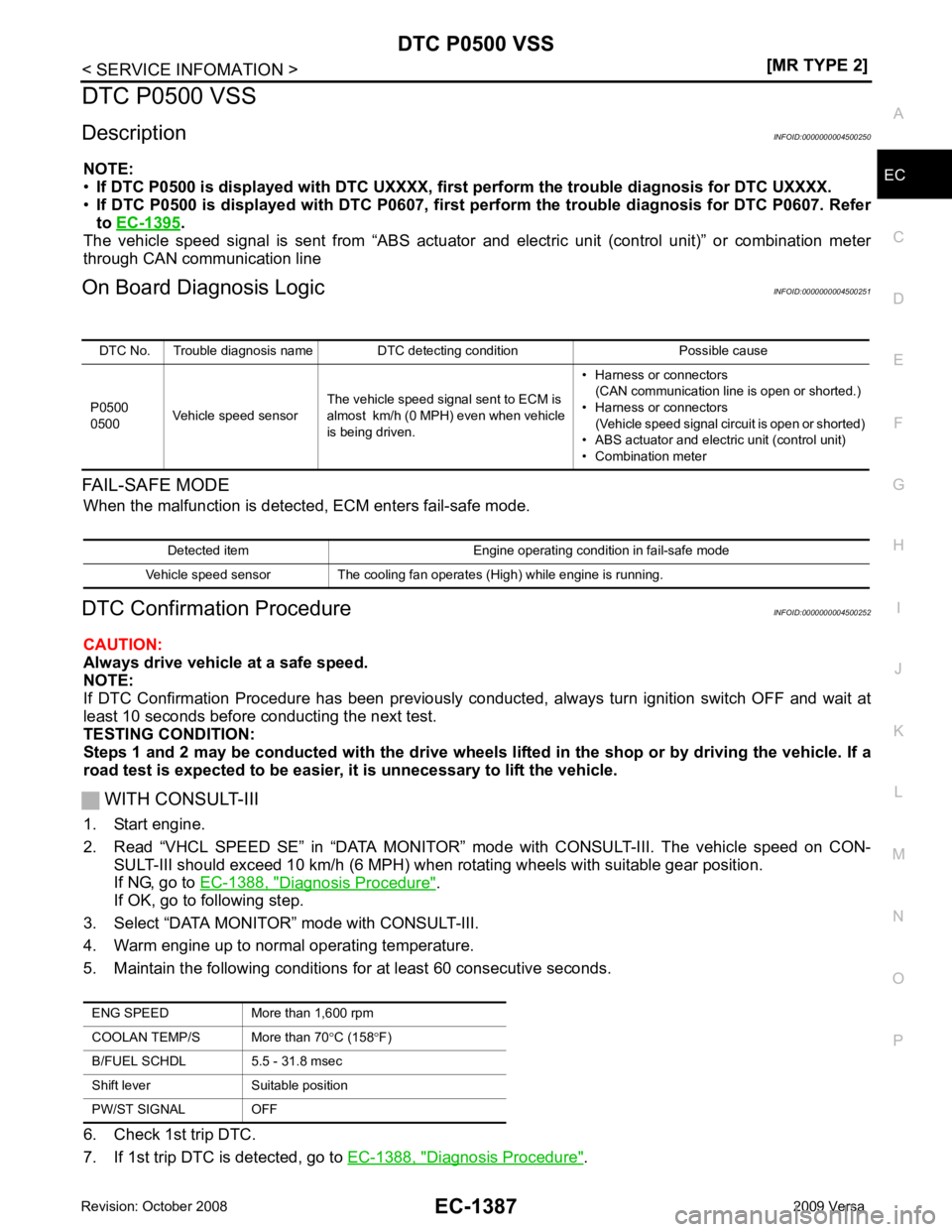
EC
NP
O
DTC P0500 VSS
Description INFOID:0000000004500250
NOTE:
• If DTC P0500 is displayed with DTC UXXXX, first perform the tr ouble diagnosis for DTC UXXXX.
• If DTC P0500 is displayed with DT C P0607, first perform the trouble diagnosis for DTC P0607. Refer
to EC-1395 .
The vehicle speed signal is sent from “ABS actuator and electric unit (control unit)” or combination meter
through CAN communication line
On Board Diagnosis Logic INFOID:0000000004500251
FAIL-SAFE MODE When the malfunction is detect ed, ECM enters fail-safe mode.
DTC Confirmation Procedure INFOID:0000000004500252
CAUTION:
Always drive vehicle at a safe speed.
NOTE:
If DTC Confirmation Procedure has been previously conduc ted, always turn ignition switch OFF and wait at
least 10 seconds before conducting the next test.
TESTING CONDITION:
Steps 1 and 2 may be conducted with the drive wheels li fted in the shop or by driving the vehicle. If a
road test is expected to be easier, it is unnecessary to lift the vehicle.
WITH CONSULT-III
1. Start engine.
2. Read “VHCL SPEED SE” in “DATA MONITOR” m ode with CONSULT-III. The vehicle speed on CON-
SULT-III should exceed 10 km/h (6 MPH) when rotating wheels with suitable gear position.
If NG, go to EC-1388, " Diagnosis Procedure " .
If OK, go to following step.
3. Select “DATA MONITOR” mode with CONSULT-III.
4. Warm engine up to normal operating temperature.
5. Maintain the following conditions for at least 60 consecutive seconds.
6. Check 1st trip DTC.
7. If 1st trip DTC is detected, go to EC-1388, " Diagnosis Procedure " .
DTC No. Trouble diagnosis name DTC detecting condition Possible cause
P0500
0500 Vehicle speed sensor The vehicle speed signal sent to ECM is
almost km/h (0 MPH) even when vehicle
is being driven. • Harness or connectors
(CAN communication line is open or shorted.)
• Harness or connectors (Vehicle speed signal circuit is open or shorted)
• ABS actuator and electric unit (control unit)
• Combination meter Detected item Engine operating condition in fail-safe mode
Vehicle speed sensor The cooling fan operates (High) while engine is running. ENG SPEED More than 1,600 rpm
COOLAN TEMP/S More than 70 °C (158 °F)
B/FUEL SCHDL 5.5 - 31.8 msec
Shift lever Suitable position
PW/ST SIGNAL OFF
Page 2764 of 4331
![NISSAN TIIDA 2009 Service Manual PDF EC-1408< SERVICE INFOMATION >
[MR TYPE 2]
DTC P1217 ENGINE
OVER TEMPERATURE
DTC P1217 ENGINE OVER TEMPERATURE
System Description INFOID:0000000004500279
SYSTEM DESCRIPTION
NOTE:
• If DTC P1217 is d](/img/5/57398/w960_57398-2763.png "NISSAN TIIDA 2009 Service Manual PDF EC-1408< SERVICE INFOMATION >
[MR TYPE 2]
DTC P1217 ENGINE
OVER TEMPERATURE
DTC P1217 ENGINE OVER TEMPERATURE
System Description INFOID:0000000004500279
SYSTEM DESCRIPTION
NOTE:
• If DTC P1217 is d")
EC-1408< SERVICE INFOMATION >
[MR TYPE 2]
DTC P1217 ENGINE
OVER TEMPERATURE
DTC P1217 ENGINE OVER TEMPERATURE
System Description INFOID:0000000004500279
SYSTEM DESCRIPTION
NOTE:
• If DTC P1217 is displayed with DTC UXXXX, first perform the tr ouble diagnosis for DTC UXXXX.
• If DTC P1217 is displayed with DTC P0607, first pe rform the trouble diagnosis for DTC P0607. Refer
to EC-1395 .
Cooling Fan Control
*1: The ECM determines the start signal status by the signals of engine speed and battery voltage.
*2: This signal is sent to ECM through CAN communication line.
The ECM controls the cooling fan corresponding to the vehicle speed, engine coolant temperature, refrigerant
pressure, and air conditioner ON signal. The contro l system has 3-step control [HIGH/LOW/OFF].
Cooling Fan Operation
Models with A/C
Models without A/C Sensor Input Signal to ECM ECM function Actuator
Crankshaft position sensor (POS)
Camshaft position sensor (PHASE) Engine speed*
1
Cooling fan
control IPDM E/R
(Cooling fan relays)
Battery
Battery voltage*1
ABS actuator and electric unit (control unit)
Vehicle speed*2
Combination meter
Engine coolant temperature sensor Engine coolant temperature
Air conditioner switch Air conditioner ON signal*2
Refrigerant pressure sensor Refrigerant pressure PBIB2483E
PBIB3335E
Page 2794 of 4331

for ASCD functions.
On Board Diagn osis Logic INFOID:0000000004500316
NOTE:
• If DTC P1574 is displayed with DTC UXXXX, first perform the tr ouble diagnosis for DTC UXXXX.
• If DTC P1574 is displayed with DTC P0500, first pe rform the trouble diagnosis for DTC P0500. Refer
to EC-1387 .
This self-diagnosis has the one trip detection logic.
The MIL will not light up for this diagnosis.
DTC Confirmation Procedure INFOID:0000000004500317
CAUTION:
Always drive vehicle at a safe speed.
NOTE:
If DTC Confirmation Procedure has been previously conduc ted, always turn ignition switch OFF and wait at
least 10 seconds before conducting the next test.
TESTING CONDITION:
Step 3 may be conducted with the drive wheels lifted in the shop or by driving the vehicle. If a road test
is expected to be easier, it is unnecessary to lift the vehicle.
1. Start engine.
2. Drive the vehicle at more than 40 km/h (25MPH).
3. Check DTC.
4. If DTC is detected, go to EC-1438, " Diagnosis Procedure " .
Diagnosis Procedure INFOID:0000000004500318 (A/T) or
CVT-209 (CVT).
OK or NG OK >> GO TO 2.
NG >> Perform trouble shooting relevant to DTC indicated. .
OK or NG OK >> GO TO 3.DTC No.
Trouble diagnosis
name DTC detecting condition Possible cause
P1574
1574 ASCD vehicle speed
sensor ECM detects a difference between two vehicle
speed signals is out of the specified range. • Harness or connectors
(CAN communication line is open or shorted.)
• Harness or connectors (Combination meter circuit is open or shorted.)
• TCM
• ABS actuator and electric unit (control unit)
• Combination meter
• ECM
Page 2869 of 4331
![NISSAN TIIDA 2009 Service Manual PDF FUEL PUMP
EC-1513
< SERVICE INFOMATION >
[MR TYPE 2] C
D E
F
G H
I
J
K L
M A EC
NP
O
FUEL PUMP
Description INFOID:0000000004500415
SYSTEM DESCRIPTION
*: ECM determines the start signal status by the s](/img/5/57398/w960_57398-2868.png "NISSAN TIIDA 2009 Service Manual PDF FUEL PUMP
EC-1513
< SERVICE INFOMATION >
[MR TYPE 2] C
D E
F
G H
I
J
K L
M A EC
NP
O
FUEL PUMP
Description INFOID:0000000004500415
SYSTEM DESCRIPTION
*: ECM determines the start signal status by the s")
FUEL PUMP
EC-1513
< SERVICE INFOMATION >
[MR TYPE 2] C
D E
F
G H
I
J
K L
M A EC
NP
O
FUEL PUMP
Description INFOID:0000000004500415
SYSTEM DESCRIPTION
*: ECM determines the start signal status by the signals of engine speed and battery voltage.
The ECM activates the fuel pump for several seconds after the ignition switch is turned ON to improve engine
start ability. If the ECM receives a engine speed signal from the crankshaft position sensor (POS) and cam-
shaft position sensor (PHASE), it knows that the engi ne is rotating, and causes the pump to operate. If the
engine speed signal is not received when the ignition s witch is ON, the engine stalls. The ECM stops pump
operation and prevents battery discharging, thereby improving safety. The ECM does not directly drive the fuel
pump. It controls the ON/OFF fuel pump rela y, which in turn controls the fuel pump.
COMPONENT DESCRIPTION A turbine type design fuel pump is used in the fuel tank.
• Fuel level sensor unit and fuel pump (1)
• Fuel pressure regulator (2)
• Fuel level sensor (3)
• Fuel tank temperature sensor (4)
CONSULT-III Reference Val ue in Data Monitor Mode INFOID:0000000004500416
Specification data are reference values. Sensor Input Signal to ECM ECM Function Actuator
Crankshaft position sensor (POS)
Camshaft position sensor (PHASE) Engine speed*
Fuel pump control Fuel pump relay
Battery Battery voltage* Condition Fuel pump operation
Ignition switch is turned to ON Operates for 1 second
Engine running and cranking Operates
Engine: Stopped Stops in 1.5 seconds
Except as shown above Stops BBIA0704E
MONITOR ITEM CONDITION SPECIFICATION
FUEL PUMP RLY • For 1 second after turning ignition switch ON
• Engine running or cranking ON
• Except above conditions OFF