remove engine NISSAN TIIDA 2011 Service Repair Manual
[x] Cancel search | Manufacturer: NISSAN, Model Year: 2011, Model line: TIIDA, Model: NISSAN TIIDA 2011Pages: 3787, PDF Size: 78.35 MB
Page 2139 of 3787
![NISSAN TIIDA 2011 Service Repair Manual DTC P0448 EVAP CANISTER VENT CONTROL VALVE
EC-845
< SERVICE INFORMATION > [MR18DE]
C
D
E
F
G H
I
J
K L
M A
EC
NP
O
Diagnosis ProcedureINFOID:0000000006342013
1.CHECK RUBBER TUBE
1. Turn ignition switc](/img/5/57396/w960_57396-2138.png "NISSAN TIIDA 2011 Service Repair Manual DTC P0448 EVAP CANISTER VENT CONTROL VALVE
EC-845
< SERVICE INFORMATION > [MR18DE]
C
D
E
F
G H
I
J
K L
M A
EC
NP
O
Diagnosis ProcedureINFOID:0000000006342013
1.CHECK RUBBER TUBE
1. Turn ignition switc")
DTC P0448 EVAP CANISTER VENT CONTROL VALVE
EC-845
< SERVICE INFORMATION > [MR18DE]
C
D
E
F
G H
I
J
K L
M A
EC
NP
O
Diagnosis ProcedureINFOID:0000000006342013
1.CHECK RUBBER TUBE
1. Turn ignition switch OFF.
2. Disconnect rubber tube connected to EVAP canister vent control valve (3).
3. Check the rubber tube for clogging.
- EVAP control system pressure sensor (1)
- EVAP canister (2)
OK or NG
OK >> GO TO 2.
NG >> Clean rubber tube using an air blower.
2.CHECK DRAIN FILTER
Refer to EC-814, "
Component Inspection".
OK or NG
OK >> GO TO 3.
NG >> Replace drain filter.
3.CHECK EVAP CANISTER VENT CONTROL VALVE
Refer to EC-840, "
Component Inspection".
OK or NG
OK >> GO TO 4.
NG >> Replace EVAP canister vent control valve.
4.CHECK IF EVAP CANISTER SATURATED WITH WATER
1. Remove EVAP canister with EVAP c anister vent control valve attached.
TER-
MI-
NAL
NO. WIRE
COLOR ITEM
CONDITION DATA (DC Voltage)
28 W EVAP canister vent control
valve [Ignition switch: ON]
BATTERY VOLTAGE
(11 - 14 V)
32 P ECM relay
(Self shut-off) [Engine is running]
[Ignition switch: OFF]
• For a few seconds after turning ignition
switch OFF 0 - 1.0 V
[Ignition switch: OFF]
• More than a few seconds after turning igni- tion switch OFF BATTERY VOLTAGE
(11 - 14 V)
105 G Power supply for ECM [Ignition switch: ON] BATTERY VOLTAGE
(11 - 14 V)
BBIA0693E
Revision: May 2010 2011 Versa
Page 2164 of 3787
![NISSAN TIIDA 2011 Service Repair Manual EC-870
< SERVICE INFORMATION >[MR18DE]
DTC P0455 EVAP CONTROL SYSTEM
2. Apply 12 volts DC to EVAP canister vent control valve (3). The
valve will close. (Continue to appl y 12 volts until the end of t](/img/5/57396/w960_57396-2163.png "NISSAN TIIDA 2011 Service Repair Manual EC-870
< SERVICE INFORMATION >[MR18DE]
DTC P0455 EVAP CONTROL SYSTEM
2. Apply 12 volts DC to EVAP canister vent control valve (3). The
valve will close. (Continue to appl y 12 volts until the end of t")
EC-870
< SERVICE INFORMATION >[MR18DE]
DTC P0455 EVAP CONTROL SYSTEM
2. Apply 12 volts DC to EVAP canister vent control valve (3). The
valve will close. (Continue to appl y 12 volts until the end of test.)
- EVAP control system pressure sensor (1)
- EVAP canister (2)
3. Pressurize the EVAP line using pressure pump with 1.3 to 2.7 kPa (10 to 20 mmHg, 0.39 to 0.79 inHg),
then remove pump and EVAP service port adapter.
CAUTION:
• Never use compressed air or a high pressure pump.
• Do not exceed 4.12 kPa (0.042 kg/cm
2, 0.6 psi) of pressure in the system.
4. Using EVAP leak detector, locate the EVAP leak. For the leak detector, refer to the instruction manual for more details.
Refer to EC-526, "
Description".
OK or NG
OK >> GO TO 13.
NG >> Repair or replace.
12.CHECK EVAP CANISTER PURGE VOLUME CONTROL SOLENOID VALVE OPERATION
With CONSULT-III
1. Disconnect vacuum hose to EVAP canister purge volume control solenoid valve at EVAP service port.
2. Start engine.
3. Perform “PURG VOL CONT/V ” in “ACTIVE TEST” mode.
4. Touch “Qu” on CONSULT-III screen to increase “PURG VOL CONT/V” opening to 100%.
5. Check vacuum hose for vacuum.
OK or NG
OK >> GO TO 15.
NG >> GO TO 14.
13.CHECK EVAP CANISTER PURGE VOLUME CONTROL SOLENOID VALVE OPERATION
Without CONSULT-III
1. Start engine and warm it up to normal operating temperature.
2. Stop engine.
3. Disconnect vacuum hose to EVAP canister purge volume control solenoid valve at EVAP service port.
4. Start engine and let it idle for at least 80 seconds.
5. Check vacuum hose for vacuum when revving engine up to 2,000 rpm.
OK or NG
OK >> GO TO 16.
NG >> GO TO 14.
14.CHECK VACUUM HOSE
BBIA0693E
SEF200U
Vacuum should exist.
Vacuum should exist.
Revision: May 2010 2011 Versa
Page 2168 of 3787
![NISSAN TIIDA 2011 Service Repair Manual EC-874
< SERVICE INFORMATION >[MR18DE]
DTC P0456 EVAP CONTROL SYSTEM
DTC Confirmation Procedure
INFOID:0000000006342040
NOTE:
• If DTC P0456 is displayed with P0442, firs t perform trouble diagnosis](/img/5/57396/w960_57396-2167.png "NISSAN TIIDA 2011 Service Repair Manual EC-874
< SERVICE INFORMATION >[MR18DE]
DTC P0456 EVAP CONTROL SYSTEM
DTC Confirmation Procedure
INFOID:0000000006342040
NOTE:
• If DTC P0456 is displayed with P0442, firs t perform trouble diagnosis")
EC-874
< SERVICE INFORMATION >[MR18DE]
DTC P0456 EVAP CONTROL SYSTEM
DTC Confirmation Procedure
INFOID:0000000006342040
NOTE:
• If DTC P0456 is displayed with P0442, firs t perform trouble diagnosis for DTC P0456.
• After repair, make sure that the hoses and clips are installed properly.
• If DTC Confirmation Procedure has been previously conducted, always turn ignition switch OFF and wait at least 10 seconds before conducting the next test.
TESTING CONDITION:
• Open engine hood before conducting following procedure.
• If any of following conditions are met just before the DTC confirmation procedure, leave the vehicle
for more than 1 hour.
- Fuel filler cap is removed.
- Refilled or drained the fuel.
- EVAP component parts is/are removed.
• Before performing the following procedure, confirm th at battery voltage is more than 11 V at idle.
WITH CONSULT-III
1. Turn ignition switch ON and select “DATA MONITOR” mode with CONSULT-III.
2. Make sure the following conditions are met.
FUEL LEVEL SE: 0.25 - 1.4 V
COOLAN TEMP/S: 0 - 32 °C (32 - 90° F)
FUEL T/TMP SE: 0 - 35° C (32 - 95°F)
INT/A TEMP SE: More than 0 °C (32° F)
If NG, turn ignition switch OFF and leave the vehicle in a cool place (soak the vehicle) or refilling/draining
fuel until the output voltage condition of the “FUEL LEVEL SE” meets within the range above and leave
the vehicle for more than 1 hour. Then start from step 1).
3. Turn ignition switch OFF and wait at least 10 seconds.
4. Turn ignition switch ON.
5. Select “EVAP V/S LEAK P0456” of “EVAPORATI VE SYSTEM” in “DTC WORK SUPPORT” mode with
CONSULT-III.
Follow the instruction displayed.
6. Make sure that “OK” is displayed. If “NG” is displayed, refer to EC-875, "
Diagnosis Procedure".
NOTE:
• If the engine speed cannot be maintained with in the range displayed on CONSULT-III screen, go
to EC-574, "
Basic Inspection".
• Make sure that EVAP hoses are connected to EVAP canister purge volume control solenoid
valve properly.
Overall Function CheckINFOID:0000000006342041
WITH GST
Use this procedure to check the overall function of the EV AP very small leak function. During this check, a 1st
trip DTC might not be confirmed.
CAUTION:
• Never use compressed air, doing so may damage the EVAP system.
• Do not start engine.
• Do not exceeded 4.12 kPa (0.042 kg/cm
2, 0.6 psi).
1. Attach the EVAP service port adapter securely to the EVAP ser- vice port (2).
- EVAP canister purge volume control solenoid valve (1)
- : Vehicle front
BBIA0703E
Revision: May 2010 2011 Versa
Page 2208 of 3787
![NISSAN TIIDA 2011 Service Repair Manual EC-914
< SERVICE INFORMATION >[MR18DE]
DTC P1217 ENGINE OVER TEMPERATURE
Never remove the radiator cap when the engine is
hot. Serious burns could be caused by high pres-
sure fluid escaping from the](/img/5/57396/w960_57396-2207.png "NISSAN TIIDA 2011 Service Repair Manual EC-914
< SERVICE INFORMATION >[MR18DE]
DTC P1217 ENGINE OVER TEMPERATURE
Never remove the radiator cap when the engine is
hot. Serious burns could be caused by high pres-
sure fluid escaping from the")
EC-914
< SERVICE INFORMATION >[MR18DE]
DTC P1217 ENGINE OVER TEMPERATURE
Never remove the radiator cap when the engine is
hot. Serious burns could be caused by high pres-
sure fluid escaping from the reser voir tank or the radiator.
Wrap a thick cloth around cap. Carefully remove the cap by turning it a quarter turn to allow built-up
pressure to escape. Then turn the cap all the way off.
WITH CONSULT-III
1. Check the coolant level in the reservoir tank and radiator. Allow engine to cool before checking coolant level.
If the coolant level in the reservoir tank and/or radiator is below
the proper range, skip the following steps and go to EC-916,
"Diagnosis Procedure" or EC-916, "Diagnosis Procedure".
2. Confirm whether customer filled the coolant or not. If customer
filled the coolant, skip the following steps and go to EC-916,
"Diagnosis Procedure" or EC-916, "Diagnosis Procedure".
3. Turn ignition switch ON.
4. Perform “COOLING FAN” in “ACTIVE TEST” mode with CON- SULT-III.
5. If the results are NG, go to EC-916, "
Diagnosis Procedure" or EC-916, "Diagnosis Procedure".
WITH GST
1. Check the coolant level in the reservoir tank and radiator.
Allow engine to cool before checking coolant level.
If the coolant level in the reservoir tank and/or radiator is below
the proper range, skip the following steps and go to EC-916,
"Diagnosis Procedure".
2. Confirm whether customer filled the coolant or not. If customer
filled the coolant, skip the following steps and go to EC-916,
"Diagnosis Procedure".
3. Perform IPDM/ER auto active te st and check cooling fan motor
operation. Refer to PG-20, "
Auto Active Test".
4. If NG, go to EC-916, "
Diagnosis Procedure".
SEF621W
SEF621W
Revision: May 2010 2011 Versa
Page 2214 of 3787
![NISSAN TIIDA 2011 Service Repair Manual EC-920
< SERVICE INFORMATION >[MR18DE]
DTC P1217 ENGINE OVER TEMPERATURE
*1: Turn the ignition switch ON.
*2: Engine running at 3,000 rpm for 10 minutes.
*3: Drive at 90 km/h (55 MPH) for 30 minutes a](/img/5/57396/w960_57396-2213.png "NISSAN TIIDA 2011 Service Repair Manual EC-920
< SERVICE INFORMATION >[MR18DE]
DTC P1217 ENGINE OVER TEMPERATURE
*1: Turn the ignition switch ON.
*2: Engine running at 3,000 rpm for 10 minutes.
*3: Drive at 90 km/h (55 MPH) for 30 minutes a")
EC-920
< SERVICE INFORMATION >[MR18DE]
DTC P1217 ENGINE OVER TEMPERATURE
*1: Turn the ignition switch ON.
*2: Engine running at 3,000 rpm for 10 minutes.
*3: Drive at 90 km/h (55 MPH) for 30 minutes and then let idle for 10 minutes.
*4: After 60 minutes of cool down time.
For more informat
ion, refer to CO-32
.
Component InspectionINFOID:0000000006342107
COOLING FAN MOTOR
Model with A/C
1. Disconnect cooling fan motor harness connectors.
2. Supply cooling fan motor terminals with battery voltage and
check operation.
Cooling fan motor should operate.
If NG, replace cooling fan motor.
Models without A/C
1. Disconnect cooling fan motor harness connectors.
2. Supply cooling fan motor terminals with battery voltage and check operation.
Cooling fan motor should operate.
If NG, replace cooling fan motor.
OFF*410 •Coolant retu
rn from res-
ervoir tank to radiator •Visual Should be initial level in
reservoir tank See
CO-36.
OFF 11 • Water control valve • Remove and inspect
the valve Within the specified value See
CO-47
OFF12 • Cylinder head
• Straight gauge feeler
gauge 0.1 mm (0.004 in) Maxi-
mum distortion (warping)
See
EM-186
.
13 • Cylinder block and pis-
tons •Visual No scuffing on cylinder
walls or piston See
EM-202
.
Engine Step Inspection item
EquipmentStandardReference
Cooling fan motor Te r m i n a l s
(+) (-) 12
SEF888V
Cooling fan motor Speed
terminals
(+) (− )
Low 14
23
High 1 and 2 3 and 4
SEF734W
Revision: May 2010 2011 Versa
Page 2258 of 3787
![NISSAN TIIDA 2011 Service Repair Manual EC-964
< SERVICE INFORMATION >[MR18DE]
DTC P2119 ELECTRIC THROTTLE CONTROL ACTUATOR
3. Set shift lever to N, P position (A/T, CVT) or Neutral (M/T) position.
4. Start engine and let it idle for 3 seco](/img/5/57396/w960_57396-2257.png "NISSAN TIIDA 2011 Service Repair Manual EC-964
< SERVICE INFORMATION >[MR18DE]
DTC P2119 ELECTRIC THROTTLE CONTROL ACTUATOR
3. Set shift lever to N, P position (A/T, CVT) or Neutral (M/T) position.
4. Start engine and let it idle for 3 seco")
EC-964
< SERVICE INFORMATION >[MR18DE]
DTC P2119 ELECTRIC THROTTLE CONTROL ACTUATOR
3. Set shift lever to N, P position (A/T, CVT) or Neutral (M/T) position.
4. Start engine and let it idle for 3 seconds.
5. Check DTC.
6. If DTC is detected, go to
EC-964, "
Diagnosis Procedure".
Diagnosis ProcedureINFOID:0000000006342179
1.CHECK ELECTRIC THROTTLE CONTROL ACTUATOR VISUALLY
1. Turn ignition switch OFF.
2. Remove the intake air duct.
3. Check if a foreign matter is caught between the throttle valve (1) and the housing.
- : Vehicle front
OK or NG
OK >> GO TO 2.
NG >> Remove the foreign matter and clean the electric throttle control actuator inside.
2.REPLACE ELECTRIC THROTTLE CONTROL ACTUATOR
1. Replace the electric throttle control actuator.
2. Perform EC-580, "
Throttle Valve Closed Position Learning".
3. Perform EC-580, "
Idle Air Volume Learning".
>> INSPECTION END
BBIA0711E
Revision: May 2010 2011 Versa
Page 2310 of 3787
![NISSAN TIIDA 2011 Service Repair Manual EC-1016
< SERVICE INFORMATION >[MR18DE]
FUEL PUMP
Diagnosis Procedure
INFOID:0000000006342239
1.CHECK OVERALL FUNCTION
1. Turn ignition switch ON.
2. Pinch fuel feed hose (1) with two fingers.
- Illus](/img/5/57396/w960_57396-2309.png "NISSAN TIIDA 2011 Service Repair Manual EC-1016
< SERVICE INFORMATION >[MR18DE]
FUEL PUMP
Diagnosis Procedure
INFOID:0000000006342239
1.CHECK OVERALL FUNCTION
1. Turn ignition switch ON.
2. Pinch fuel feed hose (1) with two fingers.
- Illus")
EC-1016
< SERVICE INFORMATION >[MR18DE]
FUEL PUMP
Diagnosis Procedure
INFOID:0000000006342239
1.CHECK OVERALL FUNCTION
1. Turn ignition switch ON.
2. Pinch fuel feed hose (1) with two fingers.
- Illustration shows the view with intake air duct removed.
OK or NG
OK >> INSPECTION END
NG >> GO TO 2.
2.CHECK FUEL PUMP POWER SUPPLY CIRCUIT-I
1. Turn ignition switch OFF.
2. Disconnect ECM harness connector.
3. Turn ignition switch ON.
4. Check voltage between ECM terminal 23 and ground with CON- SULT-III or tester.
OK or NG
OK >> GO TO 5.
NG >> GO TO 3.
3.CHECK FUEL PUMP POWER SUPPLY CIRCUIT-II
1. Turn ignition switch OFF.
2. Disconnect IPDM E/R harness connector E46.
3. Turn ignition switch ON.
4. Check voltage between IPDM E/R terminal 47 and ground with CONSULT-III or tester.
OK or NG
OK >> GO TO 4.
NG >> GO TO 11.
TERMI- NAL NO. WIRE
COLOR ITEM
CONDITION DATA (DC Voltage)
23 GR Fuel pump relay [Ignition switch: ON]
• For 1 second after turning ignition switch ON
[Engine is running]
0 - 1.0 V
[Ignition switch: ON]
• More than 1 second after turning ignition switch ON BATTERY VOLTAGE
(11 - 14 V)
Fuel pressure pulsation should be felt on the fuel feed
hose for 1 second after ignition switch is turned ON.
BBIA0712E
Voltage: Battery voltage
PBIA9573J
Voltage: Battery voltage
PBIB3319E
Revision: May 2010 2011 Versa
Page 2321 of 3787
![NISSAN TIIDA 2011 Service Repair Manual IGNITION SIGNALEC-1027
< SERVICE INFORMATION > [MR18DE]
C
D
E
F
G H
I
J
K L
M A
EC
NP
O
7. Remove fuel pump fuse (1) in IPDM E/R (2) to release fuel pres-
sure.
NOTE:
Do not use CONSULT-III to release](/img/5/57396/w960_57396-2320.png "NISSAN TIIDA 2011 Service Repair Manual IGNITION SIGNALEC-1027
< SERVICE INFORMATION > [MR18DE]
C
D
E
F
G H
I
J
K L
M A
EC
NP
O
7. Remove fuel pump fuse (1) in IPDM E/R (2) to release fuel pres-
sure.
NOTE:
Do not use CONSULT-III to release")
IGNITION SIGNALEC-1027
< SERVICE INFORMATION > [MR18DE]
C
D
E
F
G H
I
J
K L
M A
EC
NP
O
7. Remove fuel pump fuse (1) in IPDM E/R (2) to release fuel pres-
sure.
NOTE:
Do not use CONSULT-III to release fuel pressure, or fuel pres-
sure applies again during the following procedure.
- : Vehicle front
8. Start engine.
9. After engine stalls, crank it two or three times to release all fuel pressure.
10. Turn ignition switch OFF.
11. Remove all ignition coil harness connectors to avoid the electri- cal discharge from the ignition coils.
12. Remove ignition coil and spark plug of the cylinder to be checked.
13. Crank engine for 5 seconds or more to remove combustion gas in the cylinder.
14. Connect spark plug and harness connector to ignition coil.
15. Fix ignition coil using a rope etc. with gap of 13 - 17 mm (0.52 - 0.66 in) between the edge of the spark plug and grounded metal
portion as shown in the figure.
16. Crank engine for about 3 seconds, and check whether spark is generated between the spark plug and the grounded metal por-
tion.
CAUTION:
• Do not approach to the spark plug and the ignition coilwithin 50 cm. Be careful not to get an electrical shock
while checking, because the el ectrical discharge voltage
becomes 20 kV or more.
• It might cause to damage the igni tion coil if the gap of more than 17 mm (0.66 in) is taken.
NOTE:
When the gap is less than 13 mm (0.52 in), the sp ark might be generated even if the coil is mal-
functioning.
17. If NG, replace ignition coil with power transistor.
CONDENSER-2
1. Turn ignition switch OFF.
2. Disconnect condenser-2 harness connector.
3. Check resistance between condenser-2 terminals 1 and 2.
4. If NG, replace condenser-2.
Removal and InstallationINFOID:0000000006342246
IGNITION COIL WITH POWER TRANSISTOR
Refer to MA-34.
Spark should be generated.
PBIB2958E
PBIB2325E
Resistance: Above 1 M
Ω [at 25 °C (77° F)]
PBIB0794E
Revision: May 2010 2011 Versa
Page 2333 of 3787

PRECAUTIONSEI-3
< PRECAUTION >
C
DE
F
G H
J
K L
M A
B
EI
N
O P
PRECAUTION
PRECAUTIONS
Precaution for Supplemental Restraint System (SRS) "AIR BAG" and "SEAT BELT
PRE-TENSIONER"
INFOID:0000000005929545
The Supplemental Restraint System such as “AIR BAG” and “SEAT BELT PRE-TENSIONER”, used along
with a front seat belt, helps to reduce the risk or severi ty of injury to the driver and front passenger for certain
types of collision. This system includes seat belt switch inputs and dual stage front air bag modules. The SRS
system uses the seat belt switches to determine the front air bag deployment, and may only deploy one front
air bag, depending on the severity of a collision and w hether the front occupants are belted or unbelted.
Information necessary to service the system safely is included in the SRS and SB section of this Service Man-
ual.
WARNING:
• To avoid rendering the SRS inoper ative, which could increase the risk of personal injury or death in
the event of a collision which would result in air bag inflation, all maintenance must be performed by
an authorized NISSAN/INFINITI dealer.
• Improper maintenance, including in correct removal and installation of the SRS, can lead to personal
injury caused by unintentional act ivation of the system. For removal of Spiral Cable and Air Bag
Module, see the SRS section.
• Do not use electrical test equipm ent on any circuit related to the SRS unless instructed to in this
Service Manual. SRS wiring harnesses can be identi fied by yellow and/or orange harnesses or har-
ness connectors.
PRECAUTIONS WHEN USING POWER TOOLS (AIR OR ELECTRIC) AND HAMMERS
WARNING:
• When working near the Airbag Diagnosis Sensor Un it or other Airbag System sensors with the Igni-
tion ON or engine running, DO NOT use air or el ectric power tools or strike near the sensor(s) with a
hammer. Heavy vibration could activate the sensor( s) and deploy the air bag(s), possibly causing
serious injury.
• When using air or electric power tools or hammers, always switch the Ignition OFF, disconnect the battery, and wait at least 3 minutes before performing any service.
Precaution Necessary for Steering Wheel Rotation After Battery Disconnect
INFOID:0000000005929546
NOTE:
• This Procedure is applied only to models with Intelligent Key system and NATS (NISSAN ANTI-THEFT SYS-
TEM).
• Remove and install all control units after disconnecti ng both battery cables with the ignition knob in the
″ LOCK ″ position.
• Always use CONSULT-III to perform self-diagnosis as a part of each function inspection after finishing work.
If DTC is detected, perform trouble diagnosis according to self-diagnostic results.
For models equipped with the Intelligent Key system and NATS , an electrically controlled steering lock mech-
anism is adopted on the key cylinder.
For this reason, if the battery is disconnected or if the battery is discharged, the steering wheel will lock and
steering wheel rotation will become impossible.
If steering wheel rotation is required when battery power is interrupted, follow the procedure below before
starting the repair operation.
OPERATION PROCEDURE
1. Connect both battery cables. NOTE:
Supply power using jumper cables if battery is discharged.
2. Use the Intelligent Key or mechanical key to turn the ignition switch to the ″ACC ″ position. At this time, the
steering lock will be released.
3. Disconnect both battery cables. The steering lock will remain released and the steering wheel can be
rotated.
4. Perform the necessary repair operation.
Revision: May 2010 2011 Versa
Page 2346 of 3787
EI-16
< ON-VEHICLE REPAIR >
FRONT BUMPER
CAUTION:
Bumper fascia is made of resin. Do not apply strong force to it, and be careful to prevent contact with
oil.
REMOVAL
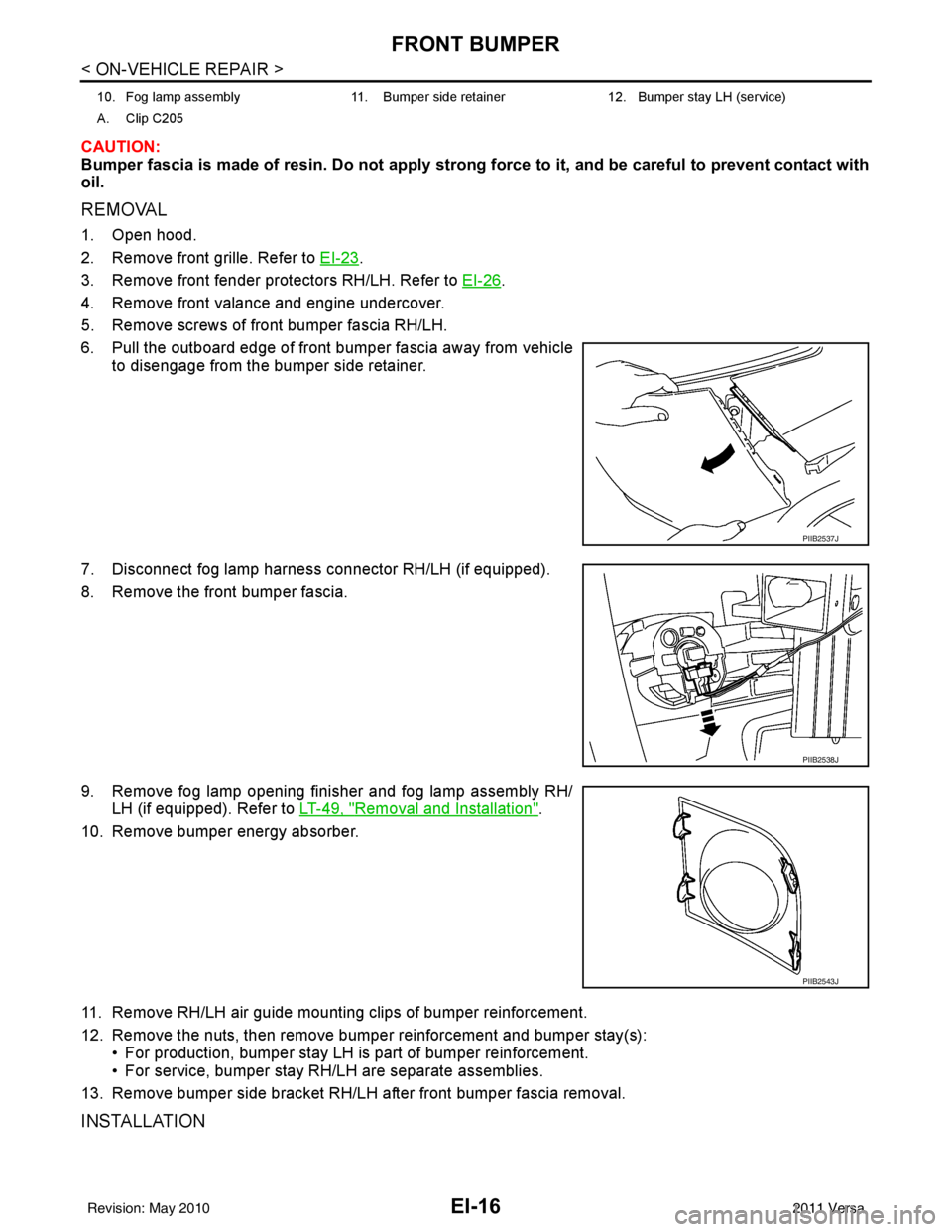
1. Open hood.
2. Remove front grille. Refer to EI-23
.
3. Remove front fender protectors RH/LH. Refer to EI-26
.
4. Remove front valance and engine undercover.
5. Remove screws of front bumper fascia RH/LH.
6. Pull the outboard edge of front bumper fascia away from vehicle to disengage from the bumper side retainer.
7. Disconnect fog lamp harness connector RH/LH (if equipped).
8. Remove the front bumper fascia.
9. Remove fog lamp opening finisher and fog lamp assembly RH/ LH (if equipped). Refer to LT-49, "
Removal and Installation".
10. Remove bumper energy absorber.
11. Remove RH/LH air guide mounting clips of bumper reinforcement.
12. Remove the nuts, then remove bumper reinforcement and bumper stay(s): • For production, bumper stay LH is part of bumper reinforcement.
• For service, bumper stay RH/LH are separate assemblies.
13. Remove bumper side bracket RH/LH after front bumper fascia removal.
INSTALLATION
10. Fog lamp assembly 11. Bumper side retainer 12. Bumper stay LH (service)
A. Clip C205
PIIB2537J
PIIB2538J
PIIB2543J
Revision: May 2010 2011 Versa