Remove NISSAN TIIDA 2011 Service Repair Manual
[x] Cancel search | Manufacturer: NISSAN, Model Year: 2011, Model line: TIIDA, Model: NISSAN TIIDA 2011Pages: 3787, PDF Size: 78.35 MB
Page 757 of 3787
NATS (NISSAN ANTI-THEFT SYSTEM)BL-247
< SERVICE INFORMATION >
C
DE
F
G H
J
K L
M A
B
BL
N
O P
-BCM
- Mechanical key
• NATS trouble diagnoses, system initialization and additional registration of other NATS mechanical key IDs
must be carried out using CONSULT-III hardware and CONSULT-III NATS software. When NATS initializa-
tion has been completed, the ID of the inserted mechanical key can be displayed.
Regarding the procedures of NATS initialization and mechanical key ID registration, refer to CONSULT-III
operation manual NATS.
SECURITY INDICATOR
• Forewarns that the vehicle is equipped with NATS.
• Security indicator will not blink while the ignition knob is in ON or START state. NOTE:
Because security indicator is highly efficient, the battery is barely affected.
Condition of Secu rity Indicator
• When operating the ignition switch with Intelligent Key, security indicator lamp will turn off at once if ignition
switch is pressed and blinks when ignition switch is released.
• When operating the ignition switch with mechanical key security indicator will turn off at once if mechanical key is inserted into key cylinder and blinks when mechanical key is removed.
(Once the mechanical key is inserted into key cylinder, BCM will only perform the key ID verification with
mechanical key)
System CompositionINFOID:0000000005929433
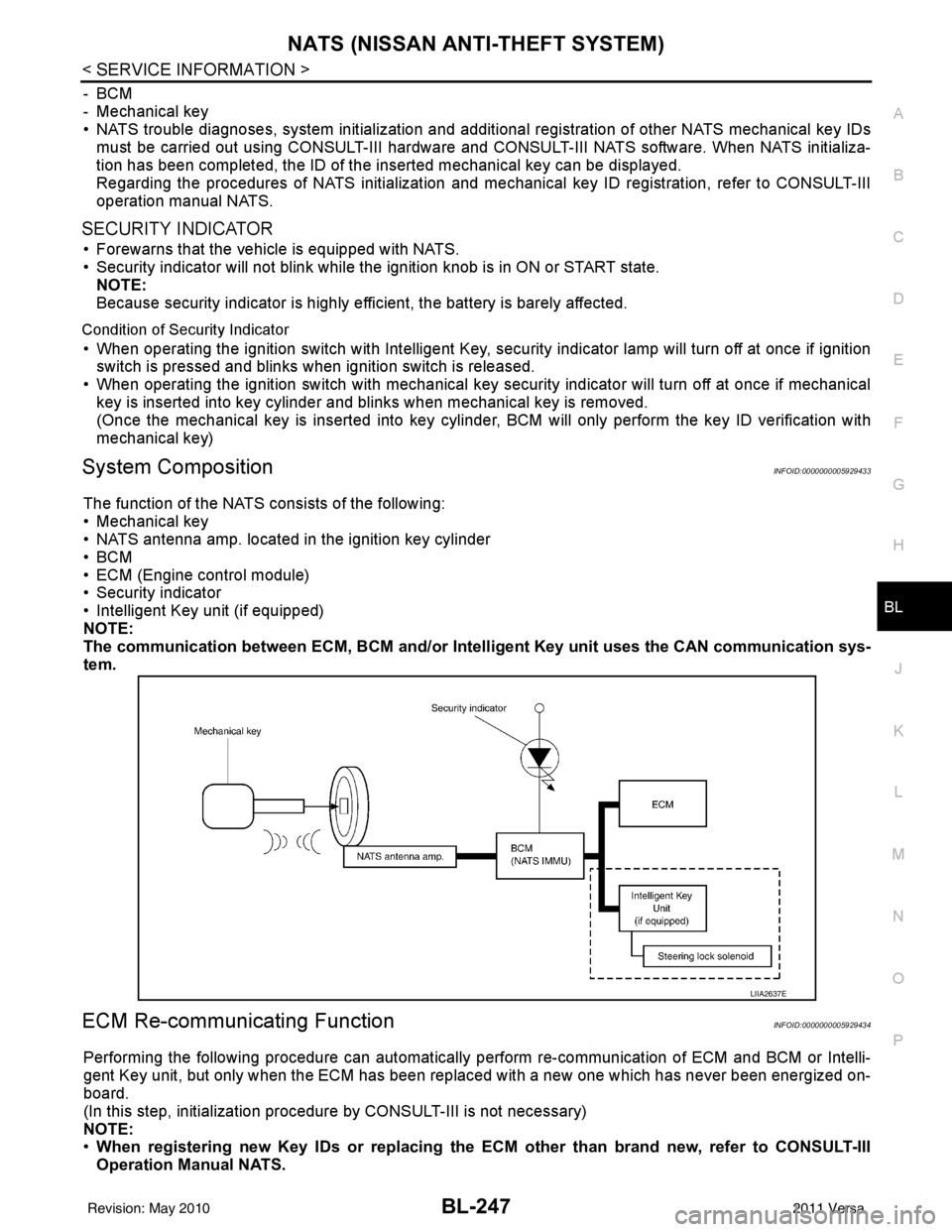
The function of the NATS consists of the following:
• Mechanical key
• NATS antenna amp. located in the ignition key cylinder
•BCM
• ECM (Engine control module)
• Security indicator
• Intelligent Key unit (if equipped)
NOTE:
The communication between ECM, BCM and/or Intelligent K ey unit uses the CAN communication sys-
tem.
ECM Re-communicating FunctionINFOID:0000000005929434
Performing the following procedure can automatically perform re-communication of ECM and BCM or Intelli-
gent Key unit, but only when the ECM has been replaced with a new one which has never been energized on-
board.
(In this step, initialization procedur e by CONSULT-III is not necessary)
NOTE:
• When registering new Key IDs or replacing the ECM other than brand new, refer to CONSULT-III
Operation Manual NATS.
LIIA2637E
Revision: May 2010 2011 Versa
Page 762 of 3787
BL-252
< SERVICE INFORMATION >
NATS (NISSAN ANTI-THEFT SYSTEM)
301LGBack door/trunk lid in-
put Input —Back door/trunk lid opener
switch ON (closed) Battery voltage
↓0
↓
Battery voltage
Back door/trunk lid opener
switch OFF (open) Battery voltage
30
3V Back door opener
switch
Input —All doors locked (SW OFF)
Battery voltage
All doors unlocked (SW ON) 0V
30
4V Trunk lid opener
switch
Input —All doors locked (SW OFF)
Battery voltage
All doors unlocked (SW ON) 0V
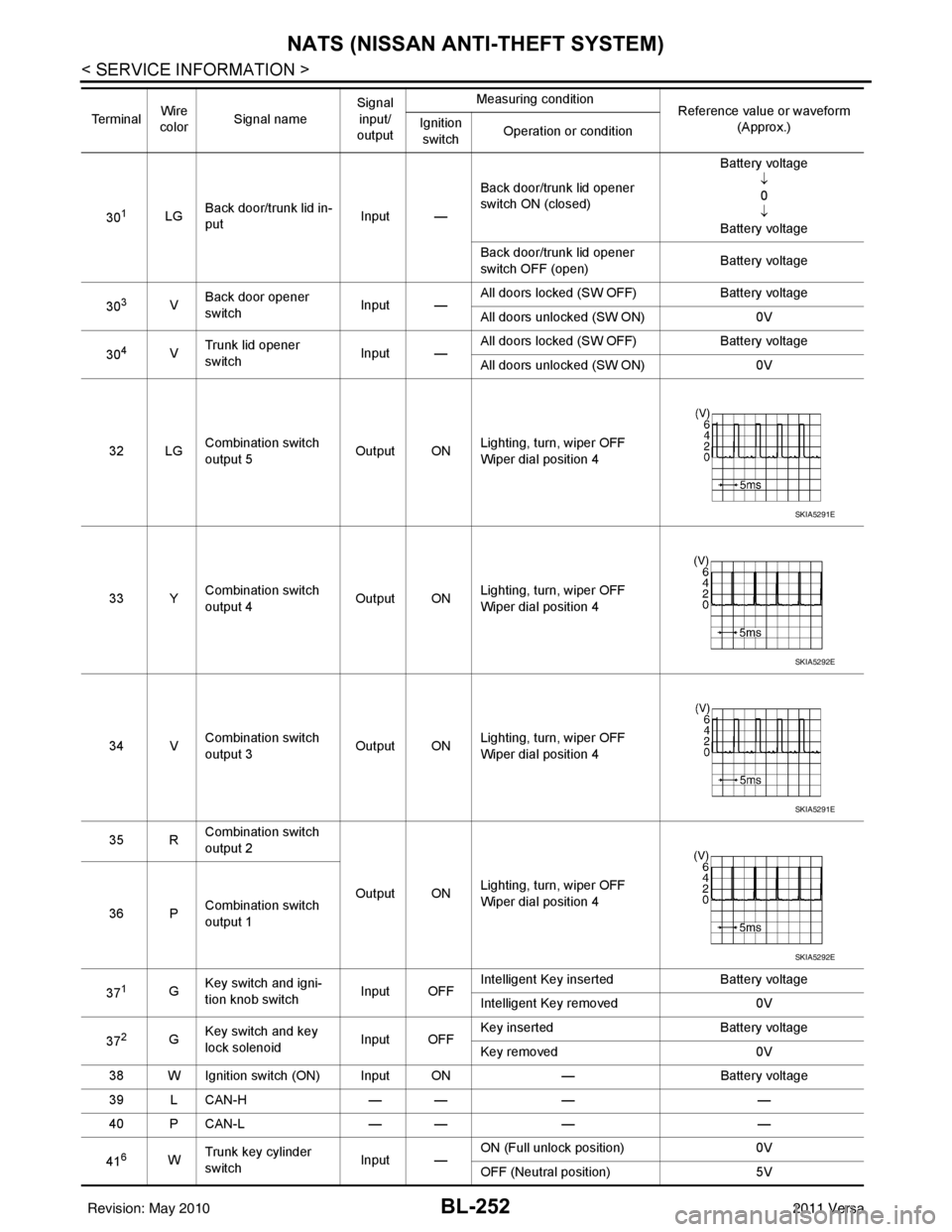
32 LG Combination switch
output 5 Output ONLighting, turn, wiper OFF
Wiper dial position 4
33 Y Combination switch
output 4 Output ON
Lighting, turn, wiper OFF
Wiper dial position 4
34 V Combination switch
output 3
Output ONLighting, turn, wiper OFF
Wiper dial position 4
35 R Combination switch
output 2
Output ONLighting, turn, wiper OFF
Wiper dial position 4
36 P Combination switch
output 1
37
1G Key switch and igni-
tion knob switch Input OFFIntelligent Key inserted
Battery voltage
Intelligent Key removed 0V
37
2G Key switch and key
lock solenoid Input OFFKey inserted
Battery voltage
Key removed 0V
38 W Ignition switch (ON) Input ON —Battery voltage
39 L CAN-H — —— —
40 P CAN-L — —— —
41
6W Trunk key cylinder
switch
Input —ON (Full unlock position)
0V
OFF (Neutral position) 5V
Te r m i n a l
Wire
color Signal name Signal
input/
output Measuring condition
Reference value or waveform
(Approx.)
Ignition
switch Operation or condition
SKIA5291E
SKIA5292E
SKIA5291E
SKIA5292E
Revision: May 2010
2011 Versa
Page 812 of 3787

BL-302
< SERVICE INFORMATION >
BODY REPAIR
1. When repairing and painting a portion of the body adjacent to plastic parts, consider their characteristics
(influence of heat and solvent) and remove them if neces sary or take suitable measures to protect them.
2. Plastic parts should be repaired and painted using methods suiting the materials
, characteristics.
LOCATION OF PLASTIC PARTS
Abbre- viation Material name Heat resisting
temperature °C ( °F) Resistance to gasoline and
solvents Other cautions
PE Polyethylene 60 (140)Gasoline and most solvents are
harmless if applied for a very
short time (wipe up quickly). Flammable
PVC Polyvinyl Chloride 80 (176) Same as above. Poison gas is emitted
when burned.
EPM/
EPDM Ethylene Propylene (Diene) rub-
ber
80 (176) Same as above.
Flammable
TPO/
TPR Thermoplastic Olefine/
Thermoplastic Rubber
80 (176) Same as above.
Flammable
PP Polypropylene 90 (194) Same as above. Flammable, avoid bat-
tery acid.
UP Polyester thermoset 90 (194) Same as above. Flammable
PS Polystyrene 80 (176) Avoid solvents. Flammable
ABS Acrylonitrile Butadiene Styrene
resin
80 (176) Avoid gasoline and solvents.
AES Acrylonitrile Ethylene Styrene 80 (176) Same as above.
PMMA Polymethyl Methacrylate 85 (185) Same as above.
AAS Acrylonitrile Acrylic Styrene 85 (185) Same as above.
AS Acrylonitrile Styrene 85 (185) Same as above.
EVA Polyvinyl Ethyl Acetate 90 (194) Same as above.
ASA Acrylonitrile Styrene Acrylate 100 (222) Same as above. Flammable
PPO/
PPE Polyphenylene Oxide/
Polyphenylene Ether
110 (230) Same as above.
PC Polycarbonate 120 (248) Same as above.
PAR Polyacrylate 180 (356) Same as above.
L-
LDPE Lenear Low Density PE
45 (100)Gasoline and most solvents are
harmless. Flammable
PUR Polyurethane 90 (194) Same as above.
TPU Thermoplastic Urethane 110 (230) Same as above.
PPC Polypropylene Composite 115 (239) Same as above. Flammable
POM Polyacetal 120 (248) Same as above. Avoid battery acid.
PBT+P
C Polybutylene Terephtha-
late+Polycarbonate
120 (248) Same as above.
Flammable
PA Polyamide (Nylon) 140 (284) Same as above. Avoid immersing in wa-
ter.
PBT Polybutylene Terephthalate 140 (284) Same as above.
FRP Fiber Reinforced Plastics 170 (338) Same as above. Avoid battery acid.
PET Polyethylene Terephthalate 180 (356) Same as above.
PEI Polyetherimide 200 (392) Same as above.
Revision: May 2010 2011 Versa
Page 819 of 3787
BODY REPAIRBL-309
< SERVICE INFORMATION >
C
DE
F
G H
J
K L
M A
B
BL
N
O P
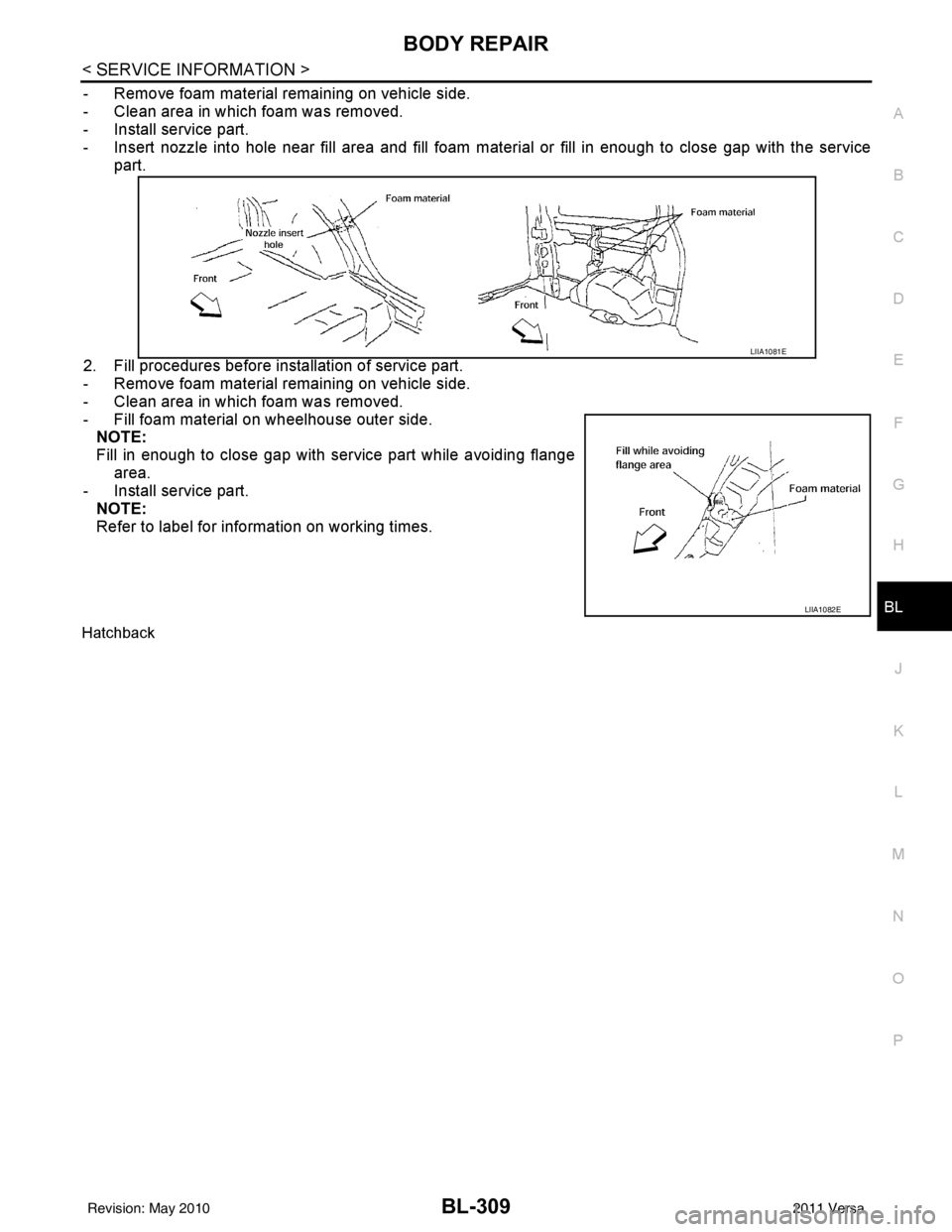
- Remove foam material remaining on vehicle side.
- Clean area in which foam was removed.
- Install service part.
- Insert nozzle into hole near fill area and fill foam material or fill in enough to close gap with the service part.
2. Fill procedures before installation of service part.
- Remove foam material remaining on vehicle side.
- Clean area in which foam was removed.
- Fill foam material on wheelhouse outer side. NOTE:
Fill in enough to close gap with service part while avoiding flange
area.
- Install service part.
NOTE:
Refer to label for information on working times.
Hatchback
LIIA1081E
LIIA1082E
Revision: May 2010 2011 Versa
Page 824 of 3787
BL-314
< SERVICE INFORMATION >
BODY REPAIR
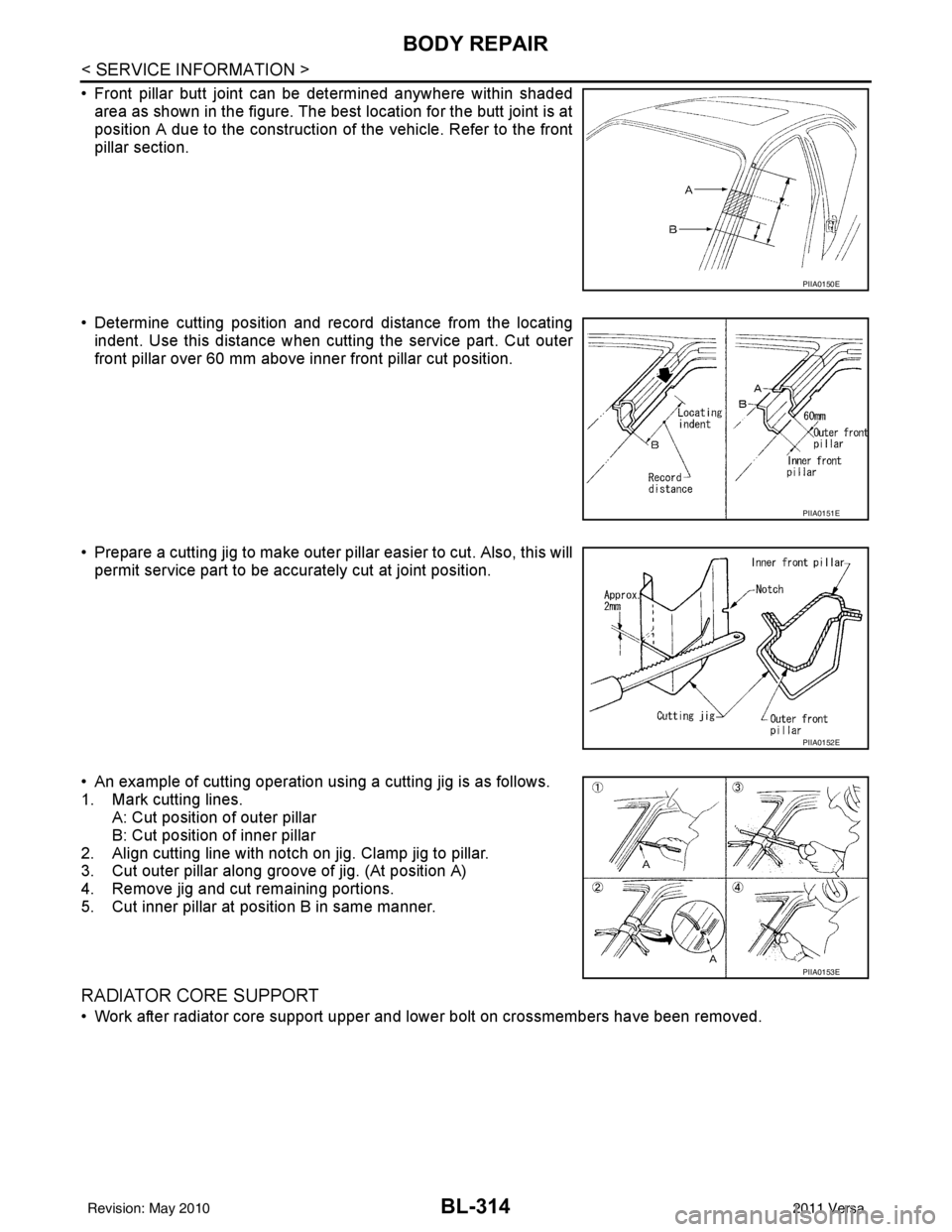
• Front pillar butt joint can be determined anywhere within shadedarea as shown in the figure. The best location for the butt joint is at
position A due to the construction of the vehicle. Refer to the front
pillar section.
• Determine cutting position and record distance from the locating indent. Use this distance when cutt ing the service part. Cut outer
front pillar over 60 mm above inner front pillar cut position.
• Prepare a cutting jig to make outer pillar easier to cut. Also, this will permit service part to be accurately cut at joint position.
• An example of cutting operation using a cutting jig is as follows.
1. Mark cutting lines. A: Cut position of outer pillar
B: Cut position of inner pillar
2. Align cutting line with notch on jig. Clamp jig to pillar.
3. Cut outer pillar along groove of jig. (At position A)
4. Remove jig and cut remaining portions.
5. Cut inner pillar at position B in same manner.
RADIATOR CORE SUPPORT
• Work after radiator core support upper and lower bolt on crossmembers have been removed.
PIIA0150E
PIIA0151E
PIIA0152E
PIIA0153E
Revision: May 2010 2011 Versa
Page 825 of 3787
BODY REPAIRBL-315
< SERVICE INFORMATION >
C
DE
F
G H
J
K L
M A
B
BL
N
O P
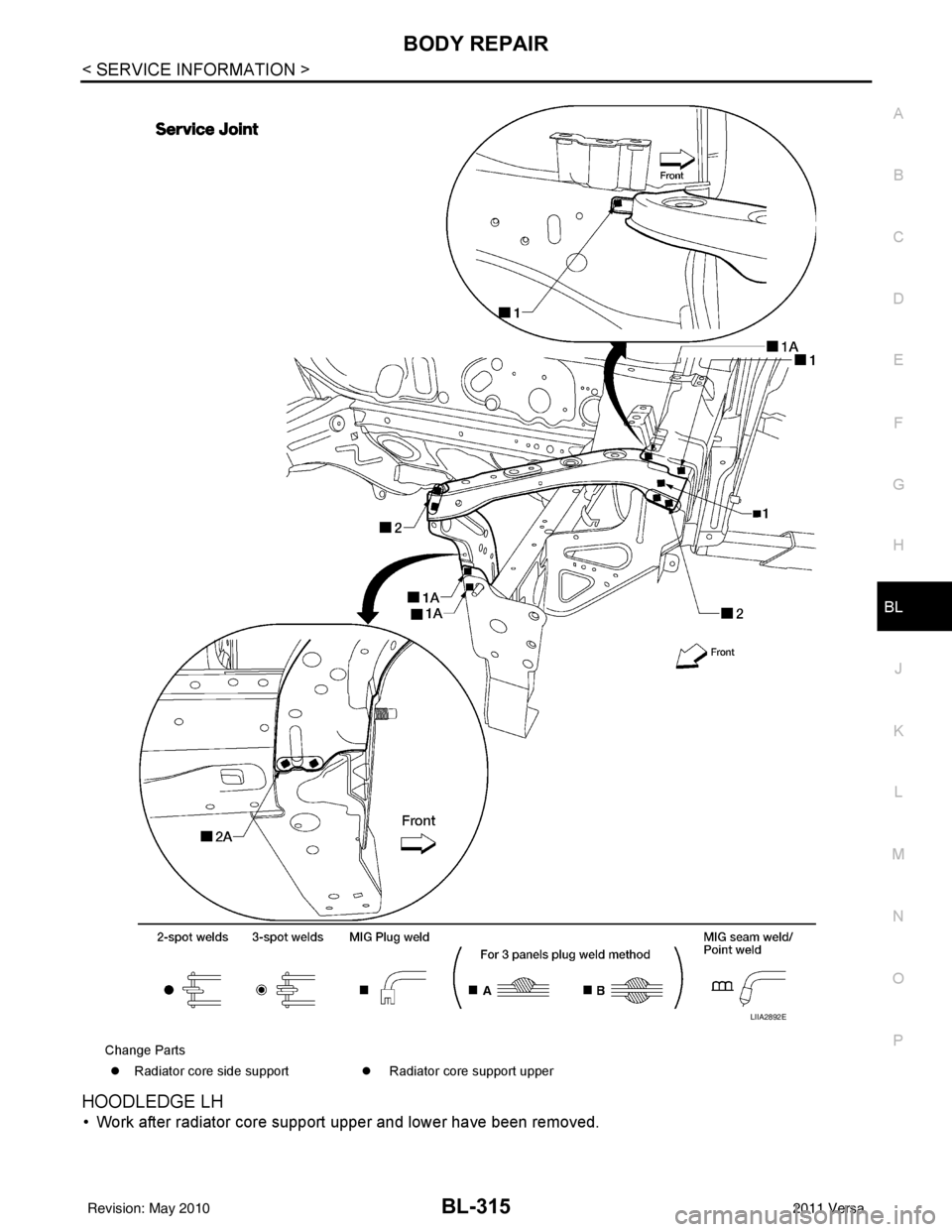
HOODLEDGE LH
• Work after radiator core support upper and lower have been removed.
Change Parts z Radiator core side support z Radiator core support upper
LIIA2892E
Revision: May 2010 2011 Versa
Page 826 of 3787
BL-316
< SERVICE INFORMATION >
BODY REPAIR
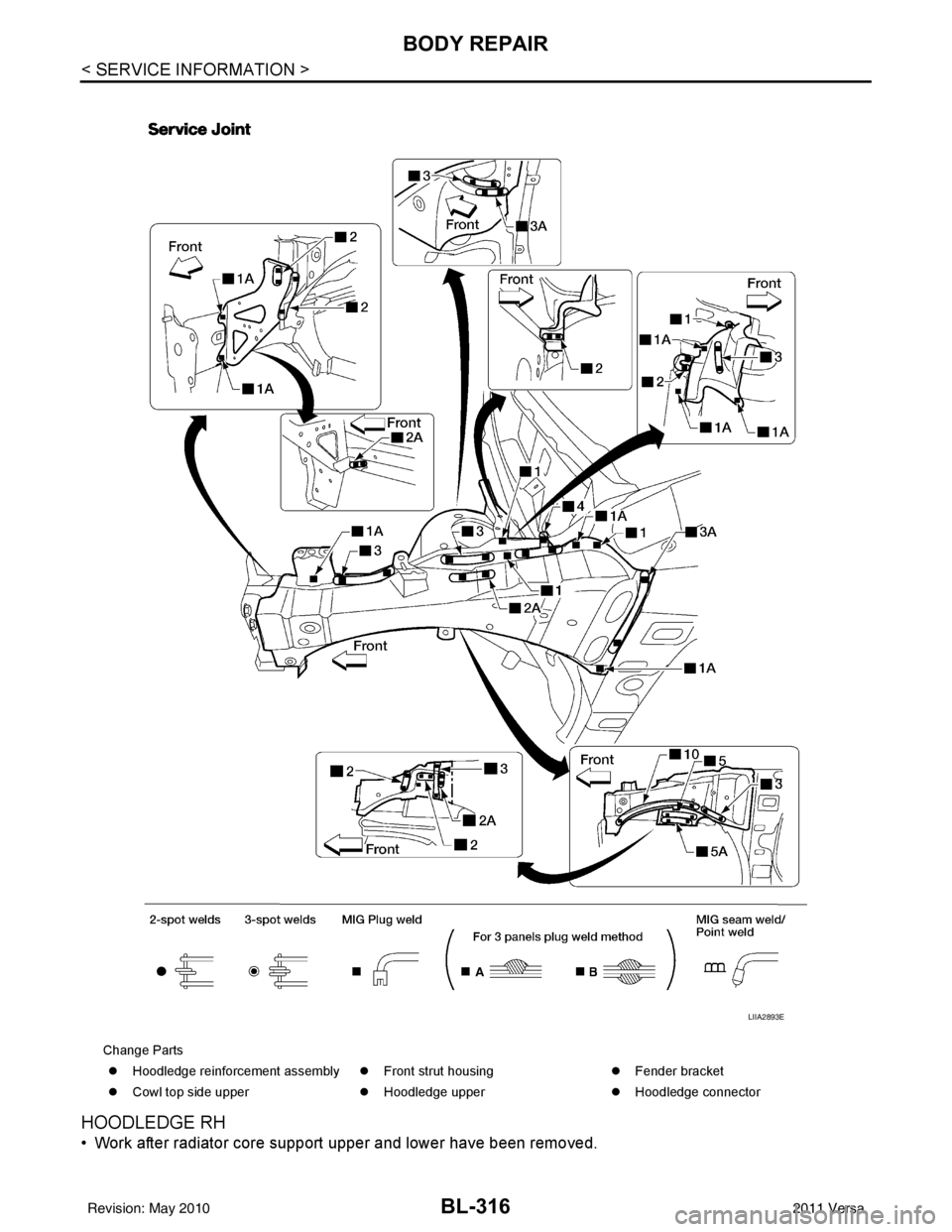
HOODLEDGE RH
• Work after radiator core support upper and lower have been removed.
Change Partsz Hoodledge reinforcement assembly zFront strut housing zFender bracket
z Cowl top side upper zHoodledge upper zHoodledge connector
LIIA2893E
Revision: May 2010 2011 Versa
Page 827 of 3787
BODY REPAIRBL-317
< SERVICE INFORMATION >
C
DE
F
G H
J
K L
M A
B
BL
N
O P
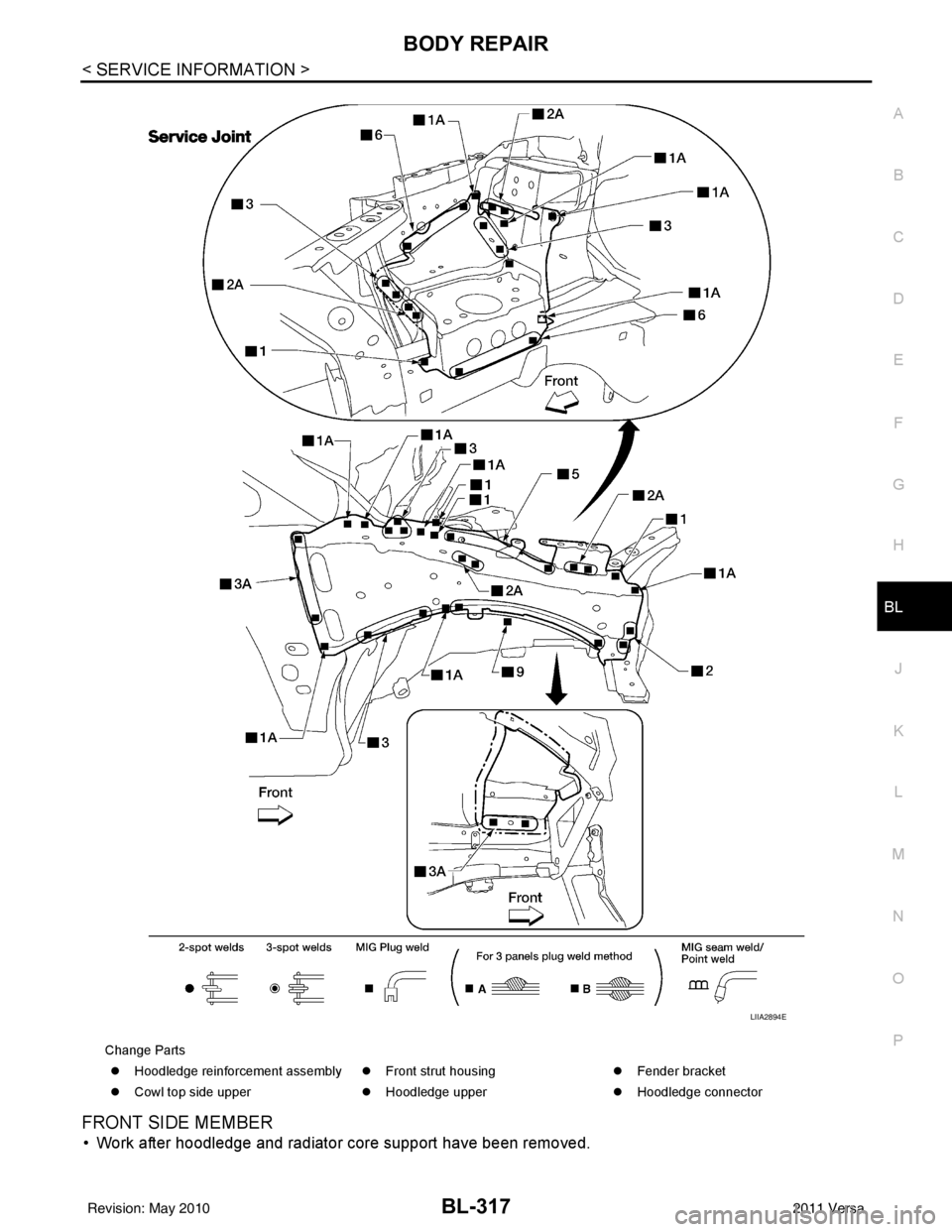
FRONT SIDE MEMBER
• Work after hoodledge and radiator core support have been removed.
Change Parts z Hoodledge reinforcement assembly zFront strut housing zFender bracket
z Cowl top side upper zHoodledge upper zHoodledge connector
LIIA2894E
Revision: May 2010 2011 Versa
Page 828 of 3787
BL-318
< SERVICE INFORMATION >
BODY REPAIR
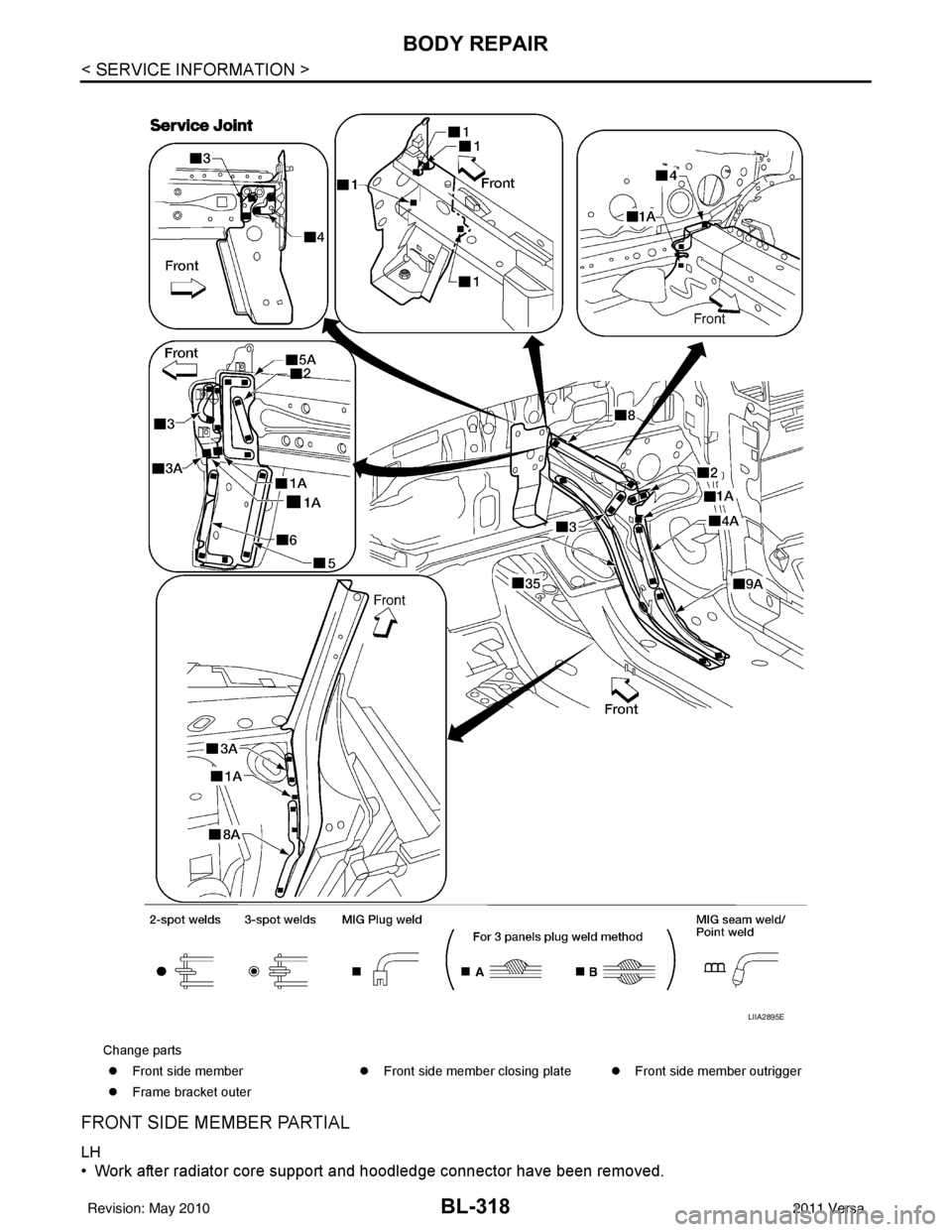
FRONT SIDE MEMBER PARTIAL
LH
• Work after radiator core support and hoodledge connector have been removed.
Change partsz Front side member zFront side member closing plate zFront side member outrigger
z Frame bracket outer
LIIA2895E
Revision: May 2010 2011 Versa
Page 829 of 3787
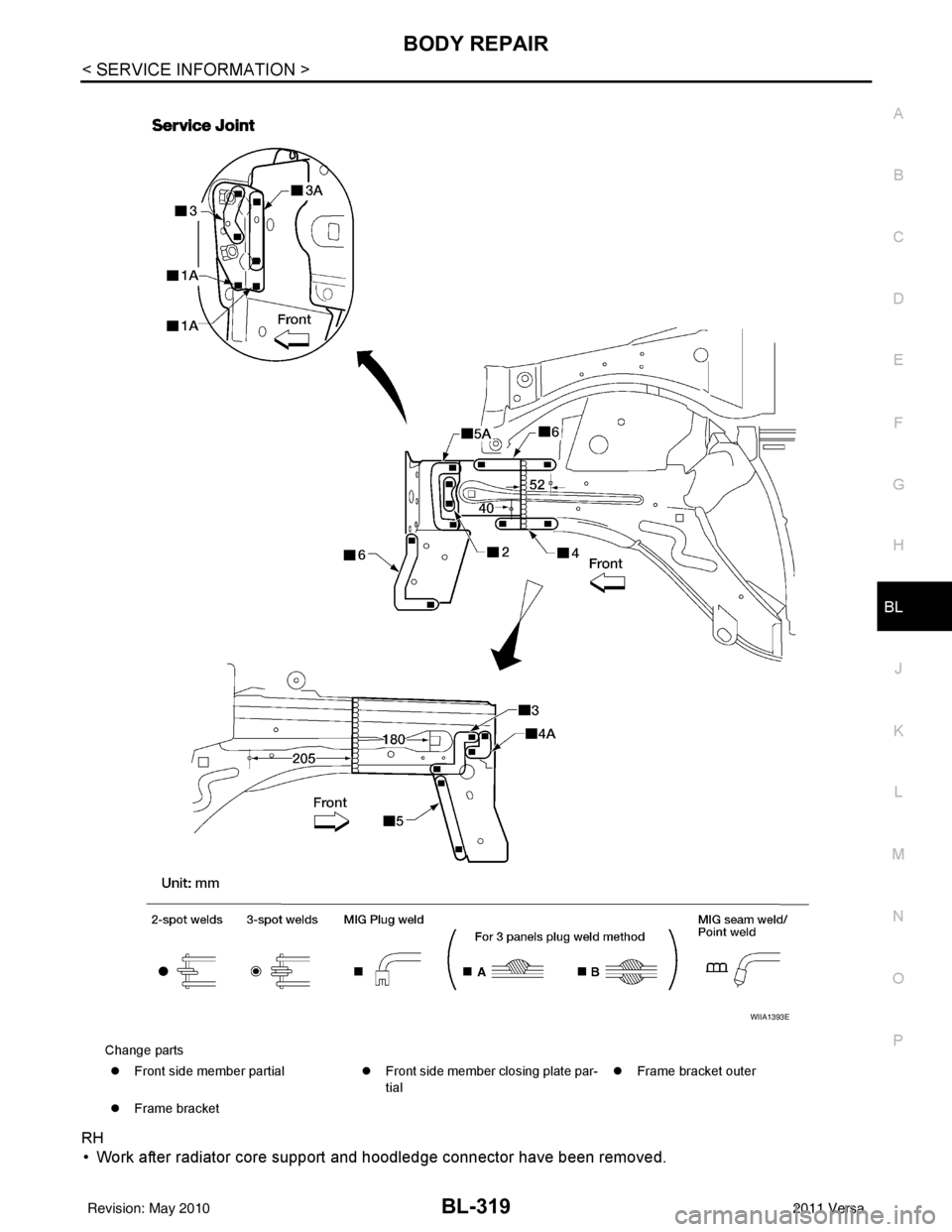
BODY REPAIRBL-319
< SERVICE INFORMATION >
C
DE
F
G H
J
K L
M A
B
BL
N
O P
RH
• Work after radiator core support and hoodledge connector have been removed.
Change parts z Front side member partial zFront side member closing plate par-
tial z
Frame bracket outer
z Frame bracket
WIIA1393E
Revision: May 2010 2011 Versa