weight NISSAN TITAN 2006 1.G User Guide
[x] Cancel search | Manufacturer: NISSAN, Model Year: 2006, Model line: TITAN, Model: NISSAN TITAN 2006 1.GPages: 360, PDF Size: 6.15 MB
Page 314 of 360

WHEELS AND TIRES
Wheels
17 x 7.5J
18 x 8.0J
Tires
P245/75R17
P285/70R17
P265/70R18
Spare tire Full size
DIMENSIONS AND WEIGHTS
Overall length in (mm) 224.2 (5,695)
Overall width in (mm) 78.8 (2,001)
Overall height
2wd KC in (mm) 75.0(1,905.1)
4wd KC in (mm) 76.6(1,945.8)
2wd CC in (mm) 75.1 (1,907)
4wd KC in (mm) 76.7 (1,948)
Front tread
17 inch tire (offroad
package)in (mm) 67.5 (1,715)
17 inch tire (steel) in (mm) 68.3 (1,735)
18 inch tire in (mm) 67.9 (1,725)
Rear tread
17 inch tire (offroad
package)in (mm) 67.5 (1,715)
17 inch tire (steel) in (mm) 68.3 (1,735)
18 inch tire in (mm) 67.9 (1,725)
Wheelbase in (mm) 139.8 (3,550)
Gross vehicle weight
ratinglb (kg) See the “F.M.V.S.S.
certification label” on the
center pillar between the
driver’s side front and
side doors. Gross axle weight rating
Front lb (kg)
Rear lb (kg)
9-10Technical and consumer information
ZREVIEW COPYÐ2006 Titan(tzw)
Owners ManualÐUSA_English(nna)
06/15/05Ðdebbie
X
Page 316 of 360

ENGINE SERIAL NUMBER
The number is stamped on the engine as shown.
F.M.V.S.S./C.M.V.S.S.
CERTIFICATION LABEL
The Federal/Canadian Motor Vehicle Safety
Standard (F.M.V.S.S./C.M.V.S.S.) certification la-
bel is affixed as shown. This label contains valu-
able vehicle information, such as: Gross Vehicle
Weight Ratings (GVWR) , Gross Axle Weight
Rating (GAWR) , month and year of manufacture,
Vehicle Identification Number (VIN) , etc. Review
it carefully.
EMISSION CONTROL
INFORMATION LABEL
The emission control information label is at-
tached as shown.
WTI0095WTI0099LTI0087
9-12Technical and consumer information
ZREVIEW COPYÐ2006 Titan(tzw)
Owners ManualÐUSA_English(nna)
06/15/05Ðdebbie
X
Page 318 of 360
WARNING
cIt is extremely dangerous to ride
in a cargo area inside a vehicle. In
a collision, people riding in these
areas are more likely to be seri-
ously injured or killed.
cDo not allow people to ride in any
area of your vehicle that is not
equipped with seats and seat
belts.
cBe sure everyone in your vehicle
is in a seat and using a seat belt
properly.
TERMS
It is important to familiarize yourself with
the following terms before loading your
vehicle:
cCurb Weight (actual weight of your
vehicle) - vehicle weight including:
standard and optional equipment, flu-
ids, emergency tools, and spare tire
assembly. This weightdoes not
in-
clude passengers and cargo.
cGVW (Gross Vehicle Weight) - curb
weight plus the combined weight ofpassengers and cargo.
cGVWR (Gross Vehicle Weight Rat-
ing) - maximum total combined
weight of the unloaded vehicle, pas-
sengers, luggage, hitch, trailer
tongue load and any other optional
equipment. This information is lo-
cated on the F.M.V.S.S. label.
cGAWR (Gross Axle Weight Rating) -
maximum weight (load) limit specified
for the front or rear axle. This informa-
tion is located on the F.M.V.S.S. label.
cGCWR (Gross Combined Weight
rating) - The maximum total weight
rating of the vehicle, passengers,
cargo, and trailer.
cVehicle Capacity Weight, Load limit,
Total load capacity - maximum total
weight limit specified of the load
(passengers and cargo) for the ve-
hicle. This is the maximum combined
weight of occupants and cargo that
can be loaded into the vehicle. If the
vehicle is used to tow a trailer, the
trailer tongue weight must be in-cluded as part of the cargo load. This
information is located on the Tire and
Loading Information label (if so
equipped) .
cCargo capacity - permissible weight
of cargo, the subtracted weight of
occupants from the load limit.
VEHICLE LOAD CAPACITY
Before driving a loaded vehicle, confirm
that you do not exceed the Gross Vehicle
Weight Rating (GVWR) or the Gross Axle
Weight Rating (GAWR) for your vehicle.
Both the GVWR and GAWR are located
on the FMVSS label. See9Measurement
of Weights9later in this section.
Do not exceed the load limit of your ve-
hicle shown as9The combined weight of
occupants and cargo9on the Tire and
Loading Information label (if so
equipped) . Do not exceed the number of
occupants shown as9Seating Capacity9
on Tire and Loading Information label (if
so equipped) .
VEHICLE LOADING INFORMATION
9-14Technical and consumer information
ZREVIEW COPYÐ2006 Titan(tzw)
Owners ManualÐUSA_English(nna)
06/15/05Ðdebbie
X
Page 319 of 360

To get9the combined weight of occu-
pants and cargo9, add the weight of all
occupants, then add the total luggage
weight. Examples are shown below.
LTI0152
Technical and consumer information9-15
ZREVIEW COPYÐ2006 Titan(tzw)
Owners ManualÐUSA_English(nna)
06/15/05Ðdebbie
X
Page 320 of 360
Steps for determining correct load
limit
1. Locate the statement “The combined
weight of occupants and cargo
should never exceed XXX lbs” on
your vehicle’s placard.
2. Determine the combined weight of
the driver and passengers that will be
riding in your vehicle.
3. Subtract the combined weight of the
driver and passengers from XXX kg
or XXX lbs.
4. The resulting figure equals the avail-
able amount of cargo and luggage
load capacity. For example, if the
XXX amount equals 1400 lbs. and
there will be five 150 lb. passengers
in your vehicle, the amount of avail-
able cargo and luggage load capac-
ity is 650 lbs. (1400-750 (5 * 150) =
650 lbs) or (640-340 (5 * 70) = 300
kg.)5. Determine the combined weight of
luggage and cargo being loaded on
the vehicle. That weight may not
safely exceed the available cargo and
luggage load capacity calculated in
Step 4.
6. If your vehicle will be towing a trailer,
load from your trailer will be trans-
ferred to your vehicle. Consult this
manual to determine how this re-
duces the available cargo and lug-
gage load capacity of your vehicle.
Before driving a loaded vehicle, confirm
the you do not exceed the Gross Vehicle
Weight Rating (GVWR) or the Gross Axle
Weight Rating (GAWR) for your vehicle.
See “Measurement of Weights” later in
this section.
Also check tires for proper inflation pres-
sures. See the Tire and Loading label.
SECURING THE LOAD
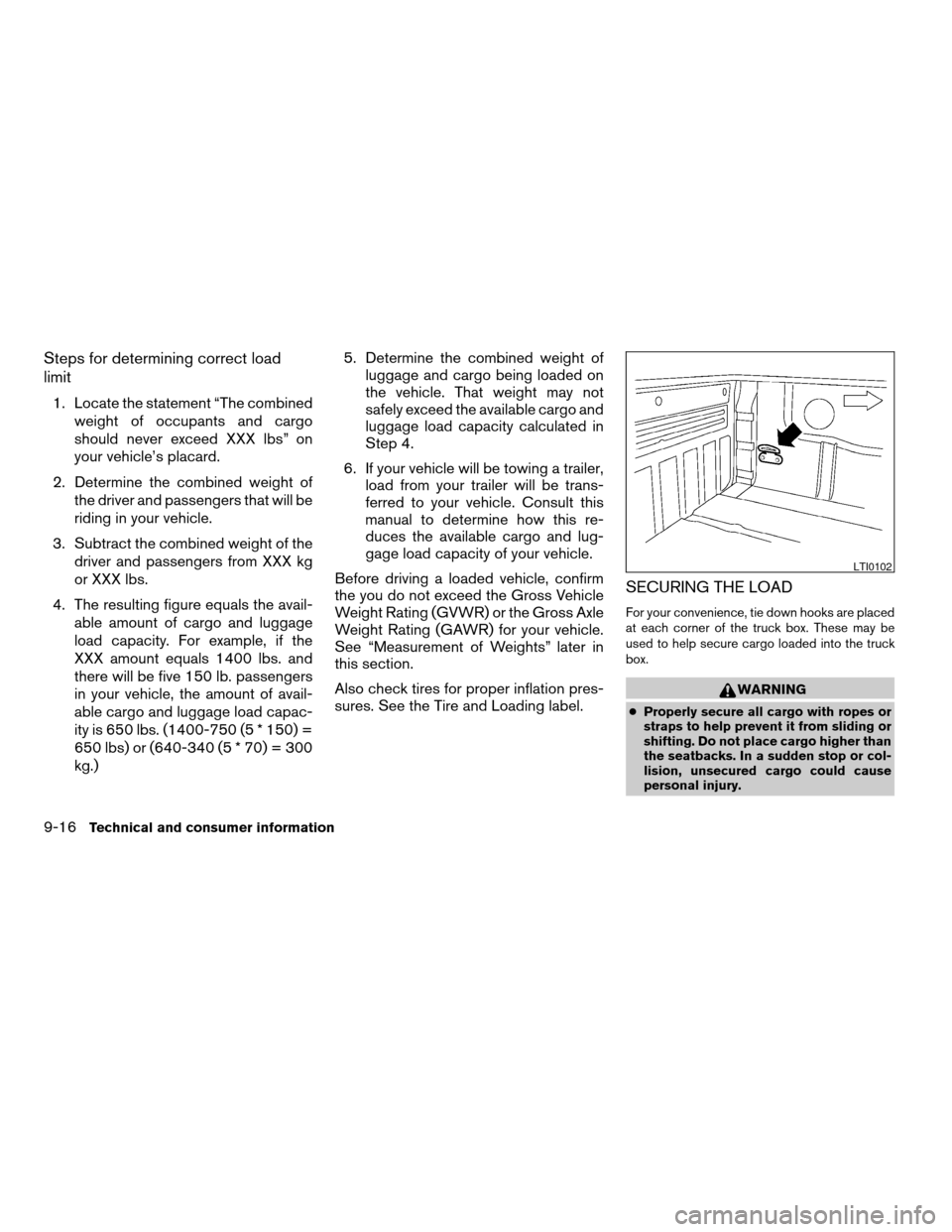
For your convenience, tie down hooks are placed
at each corner of the truck box. These may be
used to help secure cargo loaded into the truck
box.
WARNING
cProperly secure all cargo with ropes or
straps to help prevent it from sliding or
shifting. Do not place cargo higher than
the seatbacks. In a sudden stop or col-
lision, unsecured cargo could cause
personal injury.
LTI0102
9-16Technical and consumer information
ZREVIEW COPYÐ2006 Titan(tzw)
Owners ManualÐUSA_English(nna)
06/15/05Ðdebbie
X
Page 327 of 360
LOCATION FOR CENTER OF
GRAVITY
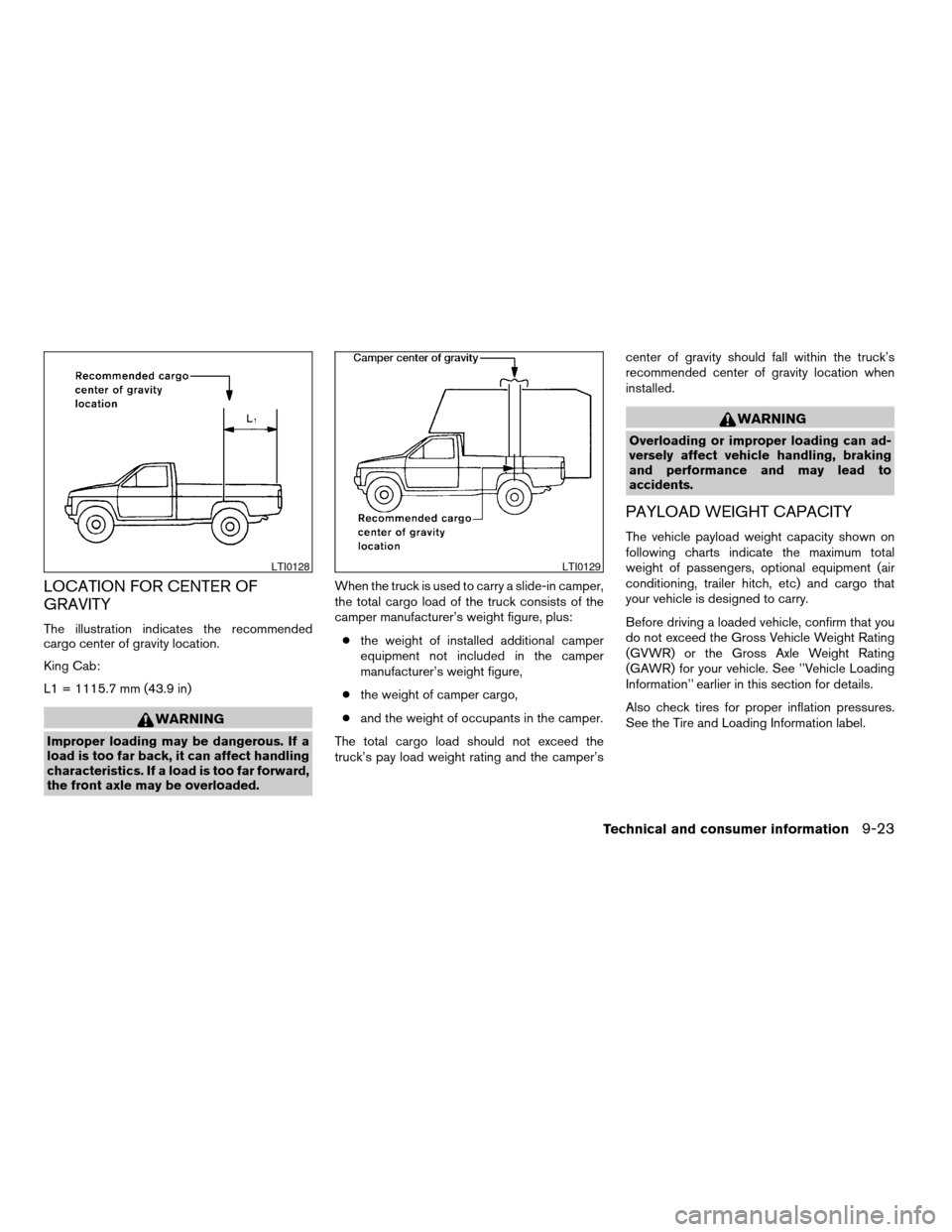
The illustration indicates the recommended
cargo center of gravity location.
King Cab:
L1 = 1115.7 mm (43.9 in)
WARNING
Improper loading may be dangerous. If a
load is too far back, it can affect handling
characteristics. If a load is too far forward,
the front axle may be overloaded.When the truck is used to carry a slide-in camper,
the total cargo load of the truck consists of the
camper manufacturer’s weight figure, plus:
cthe weight of installed additional camper
equipment not included in the camper
manufacturer’s weight figure,
cthe weight of camper cargo,
cand the weight of occupants in the camper.
The total cargo load should not exceed the
truck’s pay load weight rating and the camper’scenter of gravity should fall within the truck’s
recommended center of gravity location when
installed.
WARNING
Overloading or improper loading can ad-
versely affect vehicle handling, braking
and performance and may lead to
accidents.
PAYLOAD WEIGHT CAPACITY
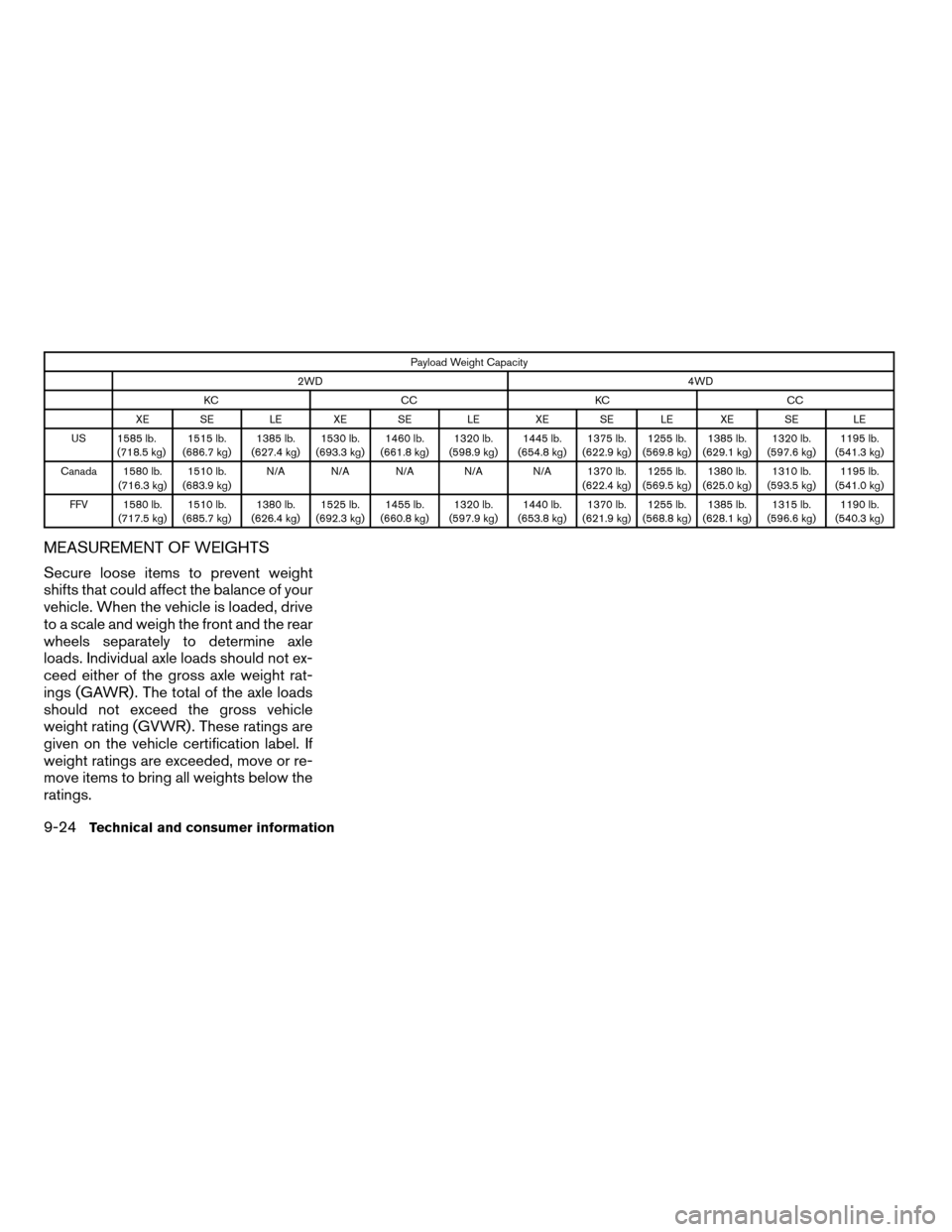
The vehicle payload weight capacity shown on
following charts indicate the maximum total
weight of passengers, optional equipment (air
conditioning, trailer hitch, etc) and cargo that
your vehicle is designed to carry.
Before driving a loaded vehicle, confirm that you
do not exceed the Gross Vehicle Weight Rating
(GVWR) or the Gross Axle Weight Rating
(GAWR) for your vehicle. See ’’Vehicle Loading
Information’’ earlier in this section for details.
Also check tires for proper inflation pressures.
See the Tire and Loading Information label.
LTI0128LTI0129
Technical and consumer information9-23
ZREVIEW COPYÐ2006 Titan(tzw)
Owners ManualÐUSA_English(nna)
06/15/05Ðdebbie
X
Page 328 of 360
Payload Weight Capacity
2WD4WD
KC CC KC CC
XE SE LE XE SE LE XE SE LE XE SE LE
US 1585 lb.
(718.5 kg)1515 lb.
(686.7 kg)1385 lb.
(627.4 kg)1530 lb.
(693.3 kg)1460 lb.
(661.8 kg)1320 lb.
(598.9 kg)1445 lb.
(654.8 kg)1375 lb.
(622.9 kg)1255 lb.
(569.8 kg)1385 lb.
(629.1 kg)1320 lb.
(597.6 kg)1195 lb.
(541.3 kg)
Canada 1580 lb.
(716.3 kg)1510 lb.
(683.9 kg)N/A N/A N/A N/A N/A 1370 lb.
(622.4 kg)1255 lb.
(569.5 kg)1380 lb.
(625.0 kg)1310 lb.
(593.5 kg)1195 lb.
(541.0 kg)
FFV 1580 lb.
(717.5 kg)1510 lb.
(685.7 kg)1380 lb.
(626.4 kg)1525 lb.
(692.3 kg)1455 lb.
(660.8 kg)1320 lb.
(597.9 kg)1440 lb.
(653.8 kg)1370 lb.
(621.9 kg)1255 lb.
(568.8 kg)1385 lb.
(628.1 kg)1315 lb.
(596.6 kg)1190 lb.
(540.3 kg)
MEASUREMENT OF WEIGHTS
Secure loose items to prevent weight
shifts that could affect the balance of your
vehicle. When the vehicle is loaded, drive
to a scale and weigh the front and the rear
wheels separately to determine axle
loads. Individual axle loads should not ex-
ceed either of the gross axle weight rat-
ings (GAWR) . The total of the axle loads
should not exceed the gross vehicle
weight rating (GVWR) . These ratings are
given on the vehicle certification label. If
weight ratings are exceeded, move or re-
move items to bring all weights below the
ratings.
9-24
Technical and consumer information
ZREVIEW COPYÐ2006 Titan(tzw)
Owners ManualÐUSA_English(nna)
06/15/05Ðdebbie
X
Page 329 of 360
WARNING
Overloading or improper loading of a
trailer and its cargo can adversely affect
vehicle handling, braking and perfor-
mance and may lead to accidents.
CAUTION
cDo not tow a trailer or haul a heavy load
for the first 500 miles (800 km) . Your
engine, axle or other parts could be
damaged.
cFor the first 500 miles (800 km) that you
tow a trailer, do not drive over 50 mph
(80 km/h) and do not make starts at full
throttle. This helps the engine and other
parts of your vehicle wear in at the
heavier loads.
Your new vehicle was designed to be used pri-
marily to carry passengers and cargo. Remember
that towing a trailer places additional loads on
your vehicle’s engine, drive train, steering, brak-
ing and other systems.
MAXIMUM LOAD LIMITS
Maximum trailer loads
Never allow the total trailer load to exceed the
value specified in the following Towing
Load/Specification Chart found later in this sec-
tion. The total trailer load equals trailer weight
plus its cargo weight.
cWhen towing a trailer load of 1,000 lbs.
(454 kg) or more, trailers with a brake sys-
tem MUST be used.
The maximum GCWR (Gross Combined Weight
Rating) should not exceed the value specified in
the following Towing Load/ Specification Chart.
The GCWR equals the combined weight of the
towing vehicle (including passengers and cargo)
plus the total trailer load. Towing loads greater
than these or using improper towing equipment
could adversely affect vehicle handling, braking
and performance.
The ability of your vehicle to tow a trailer is not
only related to the maximum trailer loads, but also
the places you plan to tow. Tow weights appro-
priate for level highway driving may have to be
reduced on very steep grades or in low traction
situations (for example, on slippery boat ramps) .Temperature conditions can also affect towing.
For example, towing a heavy trailer in high outside
temperatures on graded roads can affect engine
performance and cause overheating. The engine
protection mode, which helps reduce the chance
of engine damage, could activate and automati-
cally decrease engine power. Vehicle speed may
decrease under high load. Plan your trip carefully
to account for trailer and vehicle load, weather
and road conditions.
WARNING
Overheating can result in reduced engine
power and vehicle speed. The reduced
speed may be lower than other traffic,
which could increase the chance of a col-
lision. Be especially careful when driving.
Pull to the side of the road to a safe area.
Allow the engine to cool and return to
normal operation. See “If your vehicle
overheats” in the “In case of emergency”
section of this manual.
CAUTION
Vehicle damage resulting from improper
towing procedures is not covered by
NISSAN warranties.
TOWING A TRAILER
Technical and consumer information9-25
ZREVIEW COPYÐ2006 Titan(tzw)
Owners ManualÐUSA_English(nna)
06/15/05Ðdebbie
X
Page 330 of 360

Tongue load
When using a weight carrying or a weight distrib-
uting hitch, keep the tongue load between 10 -
15 percent of the total trailer load within the
maximum tongue load limits shown in the follow-
ing Towing Load/Specification Chart. If the
tongue load becomes excessive, rearrange cargo
to allow for proper tongue load.
Maximum gross vehicle weight/
maximum gross axle weight
The gross vehicle weight of the towing vehicle
must not exceed the gross vehicle weight rating
(GVWR) shown on the F. M. V. S. S. certification
label. The gross vehicle weight equals the com-
bined weight of the unloaded vehicle, passen-
gers, luggage, hitch, trailer tongue load and any
other optional equipment. In addition, front or rear
gross axle weight must not exceed the gross axle
weight rating (GAWR) shown on the F. M. V. S. S.
certification label.
CA0009CA0036
9-26Technical and consumer information
ZREVIEW COPYÐ2006 Titan(tzw)
Owners ManualÐUSA_English(nna)
06/15/05Ðdebbie
X
Page 331 of 360
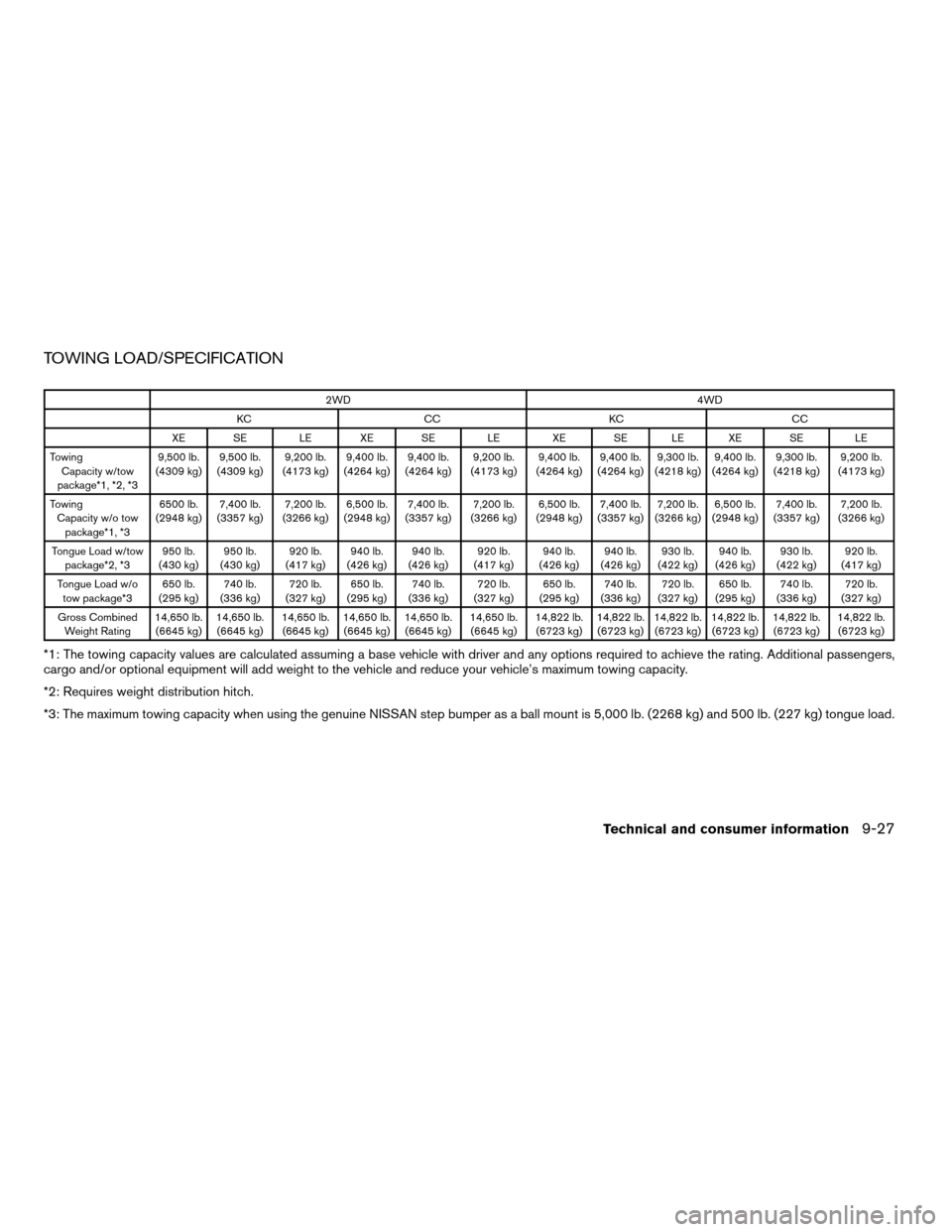
TOWING LOAD/SPECIFICATION
2WD 4WD
KC CC KC CC
XE SE LE XE SE LE XE SE LE XE SE LE
Towing
Capacity w/tow
package*1, *2, *39,500 lb.
(4309 kg)9,500 lb.
(4309 kg)9,200 lb.
(4173 kg)9,400 lb.
(4264 kg)9,400 lb.
(4264 kg)9,200 lb.
(4173 kg)9,400 lb.
(4264 kg)9,400 lb.
(4264 kg)9,300 lb.
(4218 kg)9,400 lb.
(4264 kg)9,300 lb.
(4218 kg)9,200 lb.
(4173 kg)
Towing
Capacity w/o tow
package*1, *36500 lb.
(2948 kg)7,400 lb.
(3357 kg)7,200 lb.
(3266 kg)6,500 lb.
(2948 kg)7,400 lb.
(3357 kg)7,200 lb.
(3266 kg)6,500 lb.
(2948 kg)7,400 lb.
(3357 kg)7,200 lb.
(3266 kg)6,500 lb.
(2948 kg)7,400 lb.
(3357 kg)7,200 lb.
(3266 kg)
Tongue Load w/tow
package*2, *3950 lb.
(430 kg)950 lb.
(430 kg)920 lb.
(417 kg)940 lb.
(426 kg)940 lb.
(426 kg)920 lb.
(417 kg)940 lb.
(426 kg)940 lb.
(426 kg)930 lb.
(422 kg)940 lb.
(426 kg)930 lb.
(422 kg)920 lb.
(417 kg)
Tongue Load w/o
tow package*3650 lb.
(295 kg)740 lb.
(336 kg)720 lb.
(327 kg)650 lb.
(295 kg)740 lb.
(336 kg)720 lb.
(327 kg)650 lb.
(295 kg)740 lb.
(336 kg)720 lb.
(327 kg)650 lb.
(295 kg)740 lb.
(336 kg)720 lb.
(327 kg)
Gross Combined
Weight Rating14,650 lb.
(6645 kg)14,650 lb.
(6645 kg)14,650 lb.
(6645 kg)14,650 lb.
(6645 kg)14,650 lb.
(6645 kg)14,650 lb.
(6645 kg)14,822 lb.
(6723 kg)14,822 lb.
(6723 kg)14,822 lb.
(6723 kg)14,822 lb.
(6723 kg)14,822 lb.
(6723 kg)14,822 lb.
(6723 kg)
*1: The towing capacity values are calculated assuming a base vehicle with driver and any options required to achieve the rating. Additional passengers,
cargo and/or optional equipment will add weight to the vehicle and reduce your vehicle’s maximum towing capacity.
*2: Requires weight distribution hitch.
*3: The maximum towing capacity when using the genuine NISSAN step bumper as a ball mount is 5,000 lb. (2268 kg) and 500 lb. (227 kg) tongue load.
Technical and consumer information9-27
ZREVIEW COPYÐ2006 Titan(tzw)
Owners ManualÐUSA_English(nna)
06/15/05Ðdebbie
X