engine NISSAN TITAN 2016 2.G Owners Manual
[x] Cancel search | Manufacturer: NISSAN, Model Year: 2016, Model line: TITAN, Model: NISSAN TITAN 2016 2.GPages: 636, PDF Size: 7.17 MB
Page 493 of 636
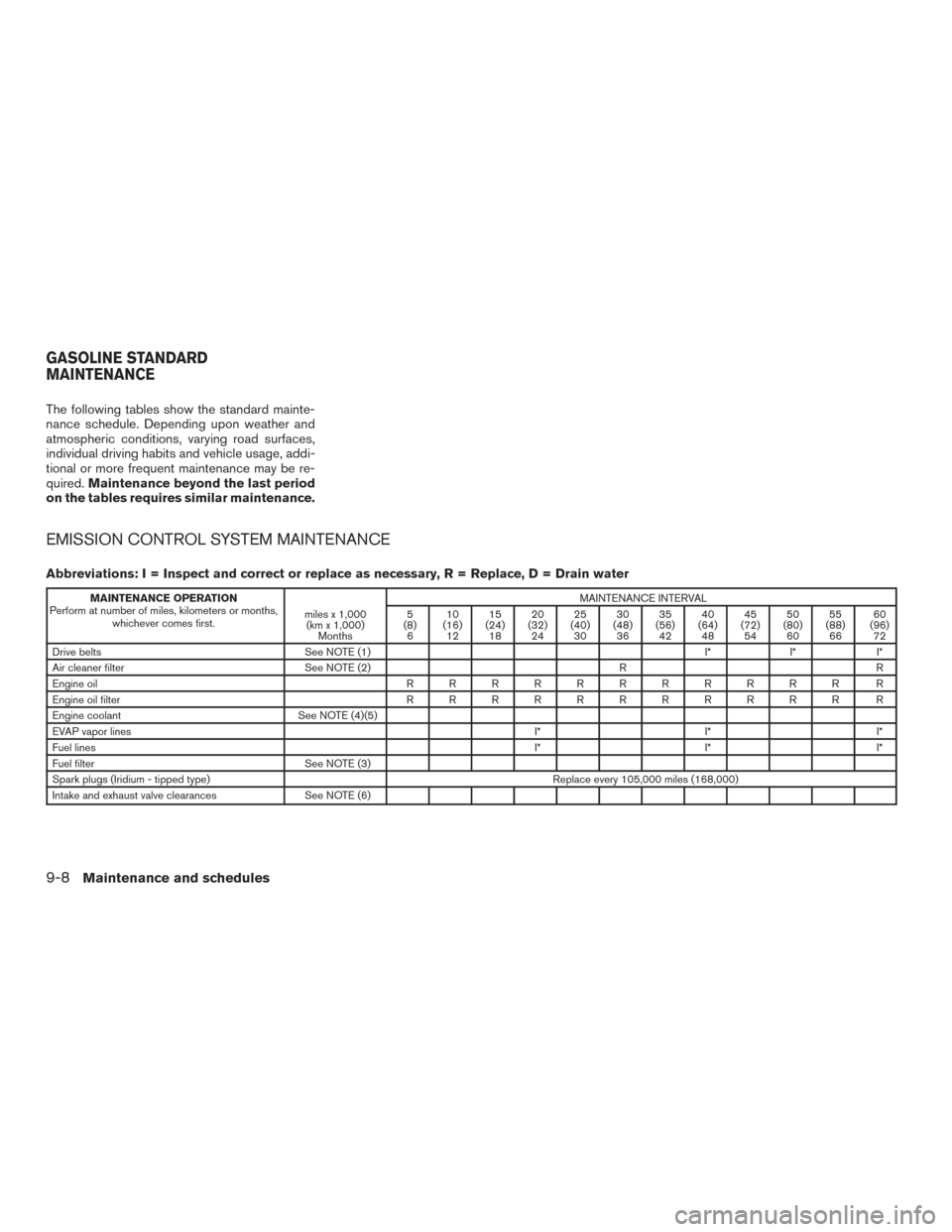
The following tables show the standard mainte-
nance schedule. Depending upon weather and
atmospheric conditions, varying road surfaces,
individual driving habits and vehicle usage, addi-
tional or more frequent maintenance may be re-
quired.Maintenance beyond the last period
on the tables requires similar maintenance.
EMISSION CONTROL SYSTEM MAINTENANCE
Abbreviations: I = Inspect and correct or replace as necessary, R = Replace, D = Drain water
MAINTENANCE OPERATION
Perform at number of miles, kilometers or months, whichever comes first. miles x 1,000
(km x 1,000) Months MAINTENANCE INTERVAL
5
(8) 6 10
(16) 12 15
(24) 18 20
(32) 24 25
(40) 30 30
(48) 36 35
(56) 42 40
(64) 48 45
(72) 54 50
(80) 60 55
(88) 66 60
(96) 72
Drive belts See NOTE (1) I*I* I*
Air cleaner filter See NOTE (2) RR
Engine oil RRRRRRRRRRR R
Engine oil filter RRRRRRRRRRR R
Engine coolant See NOTE (4)(5)
EVAP vapor lines I*I* I*
Fuel lines I*I* I*
Fuel filter See NOTE (3)
Spark plugs (Iridium - tipped type) Replace every 105,000 miles (168,000)
Intake and exhaust valve clearances See NOTE (6)
GASOLINE STANDARD
MAINTENANCE
9-8Maintenance and schedules
Page 494 of 636
MAINTENANCE OPERATION
Perform at number of miles, kilometers or months, whichever comes first. miles x 1,000
(km x 1,000) Months MAINTENANCE INTERVAL
65
(104) 78 70
(112) 84 75
(120) 90 80
(128) 96 85
(136) 102 90
(144) 108 95
(152) 114 100
(160) 120 105
(168) 126 110
(176) 132 115
(184) 138 120
(192) 144
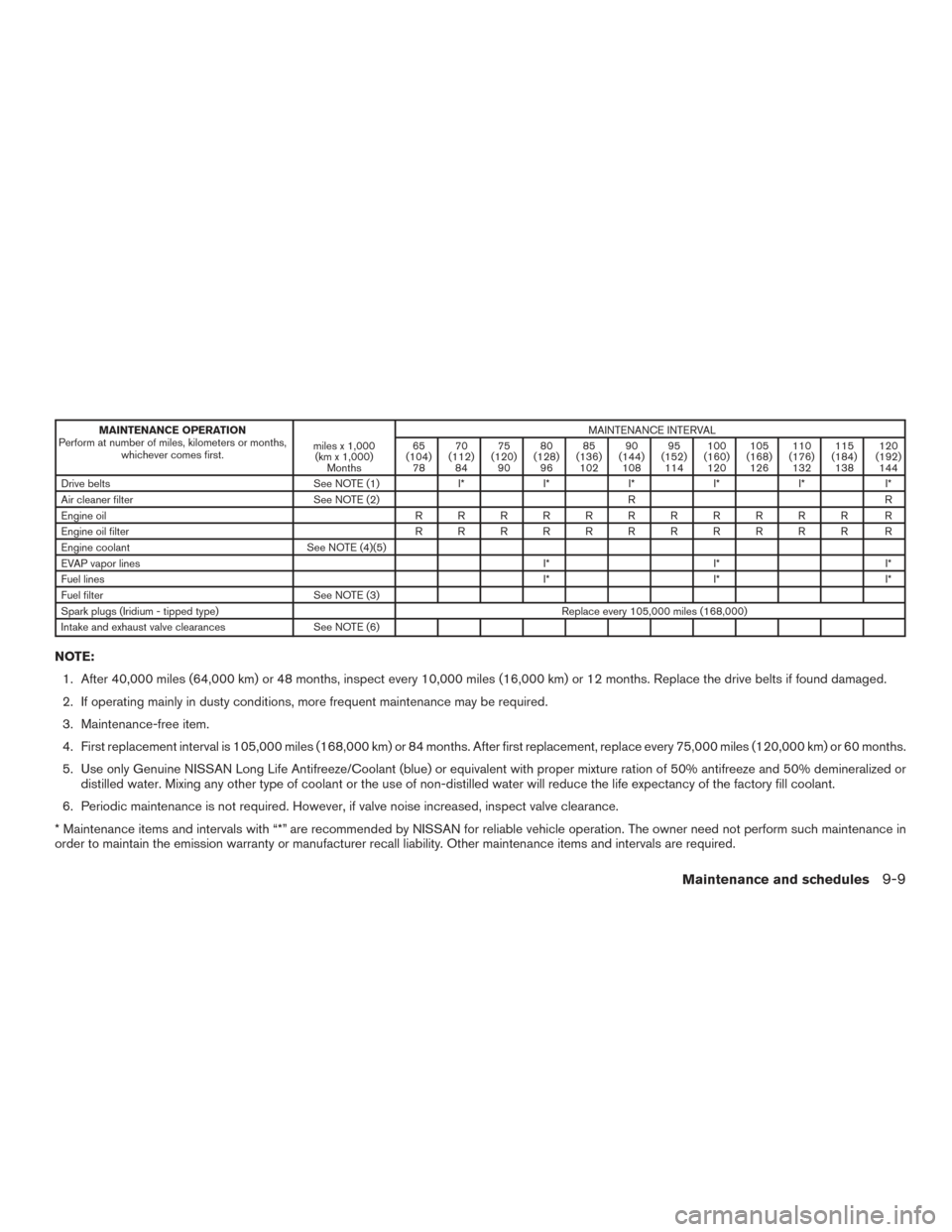
Drive belts See NOTE (1)I*I*I*I*I* I*
Air cleaner filter See NOTE (2) RR
Engine oil RRRRRRRRRRR R
Engine oil filter RRRRRRRRRRR R
Engine coolant See NOTE (4)(5)
EVAP vapor lines I*I* I*
Fuel lines I*I* I*
Fuel filter See NOTE (3)
Spark plugs (Iridium - tipped type) Replace every 105,000 miles (168,000)
Intake and exhaust valve clearances See NOTE (6)
NOTE:
1. After 40,000 miles (64,000 km) or 48 months, inspect every 10,000 miles (16,000 km) or 12 months. Replace the drive belts if found damaged.
2. If operating mainly in dusty conditions, more frequent maintenance may be required.
3. Maintenance-free item.
4. First replacement interval is 105,000 miles (168,000 km) or 84 months. After first replacement, replace every 75,000 miles (120,000 km) or 60 months.
5. Use only Genuine NISSAN Long Life Antifreeze/Coolant (blue) or equivalent with proper mixture ration of 50% antifreeze and 50% demineralized or distilled water. Mixing any other type of coolant or the use of non-distilled water will reduce the life expectancy of the factory fill coolant.
6. Periodic maintenance is not required. However, if valve noise increased, inspect valve clearance.
* Maintenance items and intervals with “*” are recommended by NISSAN for reliable vehicle operation. The owner need not perform such maintenance in
order to maintain the emission warranty or manufacturer recall liability. Other maintenance items and intervals are required.
Maintenance and schedules9-9
Page 498 of 636
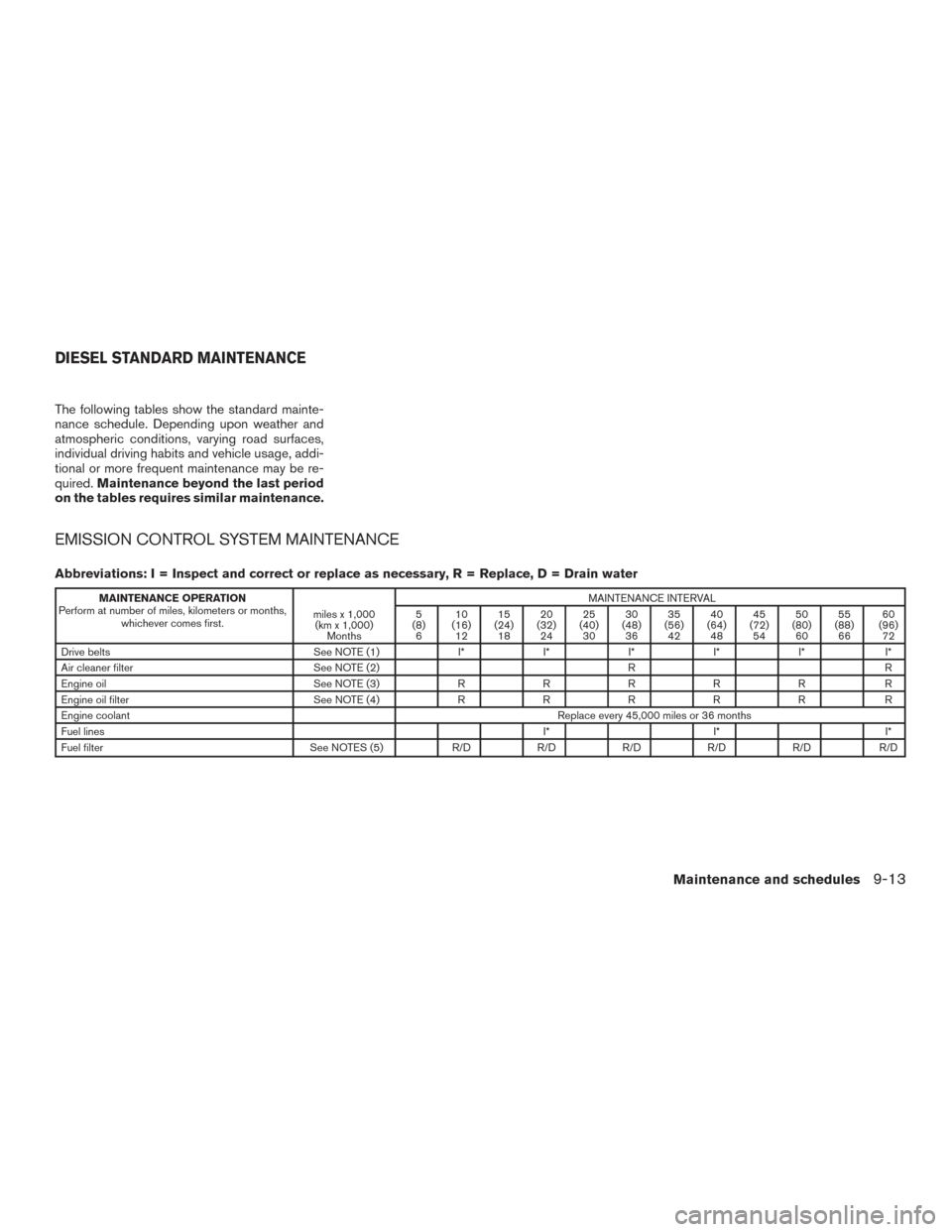
The following tables show the standard mainte-
nance schedule. Depending upon weather and
atmospheric conditions, varying road surfaces,
individual driving habits and vehicle usage, addi-
tional or more frequent maintenance may be re-
quired.Maintenance beyond the last period
on the tables requires similar maintenance.
EMISSION CONTROL SYSTEM MAINTENANCE
Abbreviations: I = Inspect and correct or replace as necessary, R = Replace, D = Drain water
MAINTENANCE OPERATION
Perform at number of miles, kilometers or months, whichever comes first. miles x 1,000
(km x 1,000) Months MAINTENANCE INTERVAL
5
(8) 6 10
(16) 12 15
(24) 18 20
(32) 24 25
(40) 30 30
(48) 36 35
(56) 42 40
(64) 48 45
(72) 54 50
(80) 60 55
(88) 66 60
(96) 72
Drive belts See NOTE (1)I*I*I*I*I* I*
Air cleaner filter See NOTE (2) RR
Engine oil See NOTE (3)RRRRR R
Engine oil filter See NOTE (4)RRRRR R
Engine coolant Replace every 45,000 miles or 36 months
Fuel lines I*I* I*
Fuel filter See NOTES (5)R/DR/DR/DR/DR/D R/D
DIESEL STANDARD MAINTENANCE
Maintenance and schedules9-13
Page 499 of 636
MAINTENANCE OPERATION
Perform at number of miles, kilometers or months, whichever comes first. miles x 1,000
(km x 1,000) Months MAINTENANCE INTERVAL
65
(104) 78 70
(112) 84 75
(120) 90 80
(128) 96 85
(136) 102 90
(144) 108 95
(152) 114 100
(160) 120 105
(168) 126 110
(176) 132 115
(184) 138 120
(192) 144
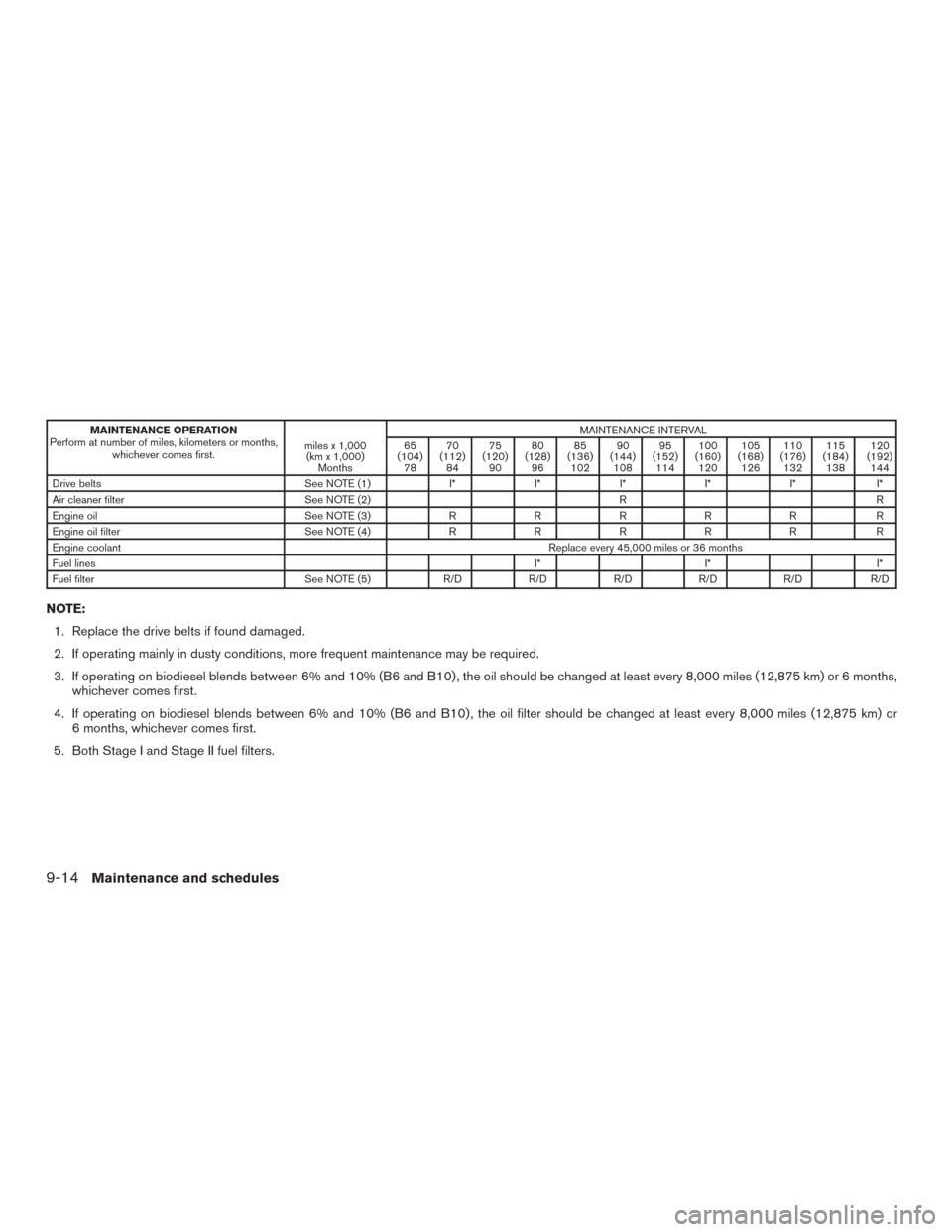
Drive belts See NOTE (1)I*I*I*I*I* I*
Air cleaner filter See NOTE (2) RR
Engine oil See NOTE (3)RRRRR R
Engine oil filter See NOTE (4)RRRRR R
Engine coolant Replace every 45,000 miles or 36 months
Fuel lines I*I* I*
Fuel filter See NOTE (5)R/DR/DR/DR/DR/D R/D
NOTE:
1. Replace the drive belts if found damaged.
2. If operating mainly in dusty conditions, more frequent maintenance may be required.
3. If operating on biodiesel blends between 6% and 10% (B6 and B10) , the oil should be changed at least every 8,000 miles (12,875 km) or 6 months, whichever comes first.
4. If operating on biodiesel blends between 6% and 10% (B6 and B10) , the oil filter should be changed at least every 8,000 miles (12,875 km) or 6 months, whichever comes first.
5. Both Stage I and Stage II fuel filters.
9-14Maintenance and schedules
Page 502 of 636
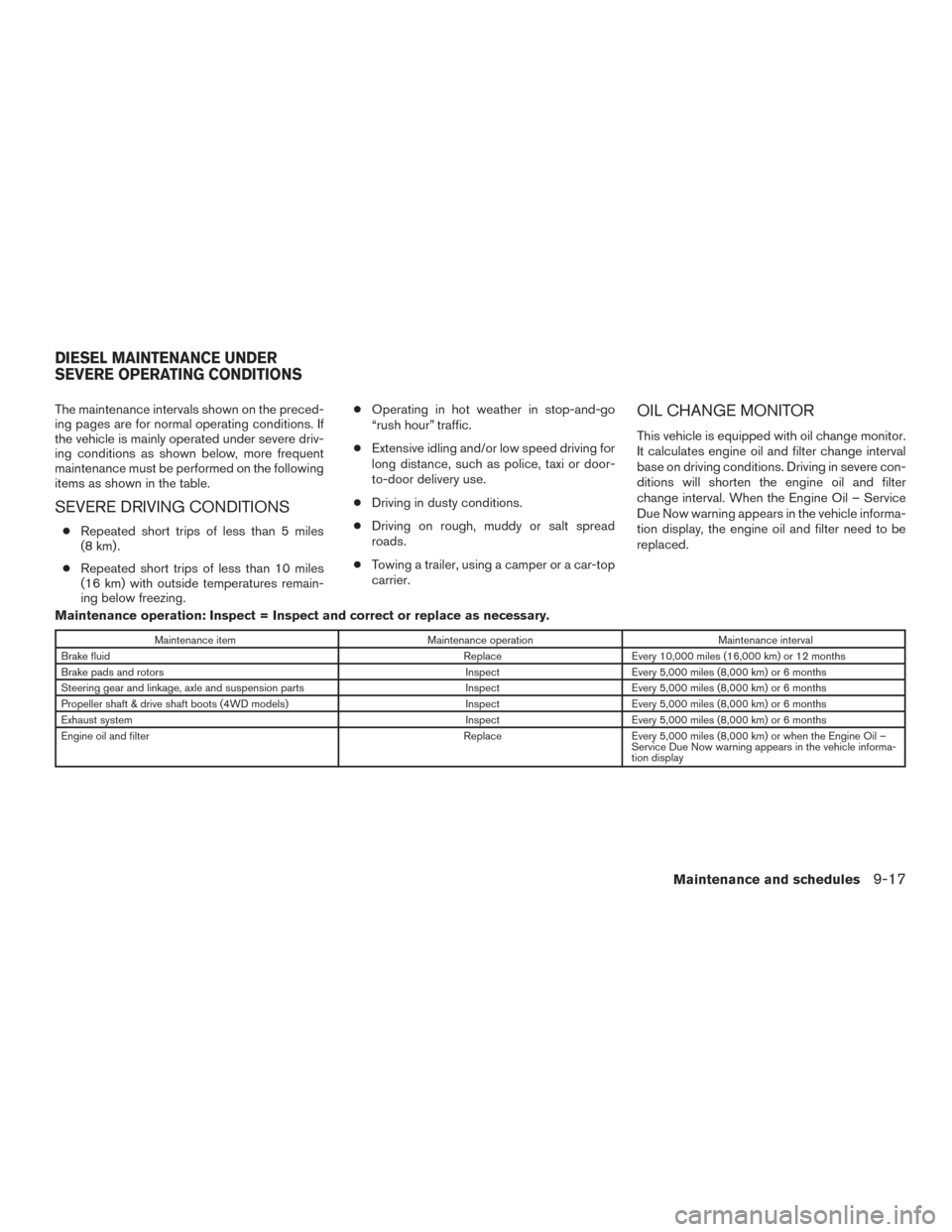
The maintenance intervals shown on the preced-
ing pages are for normal operating conditions. If
the vehicle is mainly operated under severe driv-
ing conditions as shown below, more frequent
maintenance must be performed on the following
items as shown in the table.
SEVERE DRIVING CONDITIONS
●Repeated short trips of less than 5 miles
(8 km) .
● Repeated short trips of less than 10 miles
(16 km) with outside temperatures remain-
ing below freezing. ●
Operating in hot weather in stop-and-go
“rush hour” traffic.
● Extensive idling and/or low speed driving for
long distance, such as police, taxi or door-
to-door delivery use.
● Driving in dusty conditions.
● Driving on rough, muddy or salt spread
roads.
● Towing a trailer, using a camper or a car-top
carrier.
OIL CHANGE MONITOR
This vehicle is equipped with oil change monitor.
It calculates engine oil and filter change interval
base on driving conditions. Driving in severe con-
ditions will shorten the engine oil and filter
change interval. When the Engine Oil – Service
Due Now warning appears in the vehicle informa-
tion display, the engine oil and filter need to be
replaced.
Maintenance operation: Inspect = Inspect and correct or replace as necessary.
Maintenance item Maintenance operation Maintenance interval
Brake fluid ReplaceEvery 10,000 miles (16,000 km) or 12 months
Brake pads and rotors InspectEvery 5,000 miles (8,000 km) or 6 months
Steering gear and linkage, axle and suspension parts InspectEvery 5,000 miles (8,000 km) or 6 months
Propeller shaft & drive shaft boots (4WD models) InspectEvery 5,000 miles (8,000 km) or 6 months
Exhaust system InspectEvery 5,000 miles (8,000 km) or 6 months
Engine oil and filter ReplaceEvery 5,000 miles (8,000 km) or when the Engine Oil –
Service Due Now warning appears in the vehicle informa-
tion display
DIESEL MAINTENANCE UNDER
SEVERE OPERATING CONDITIONS
Maintenance and schedules9-17
Page 506 of 636
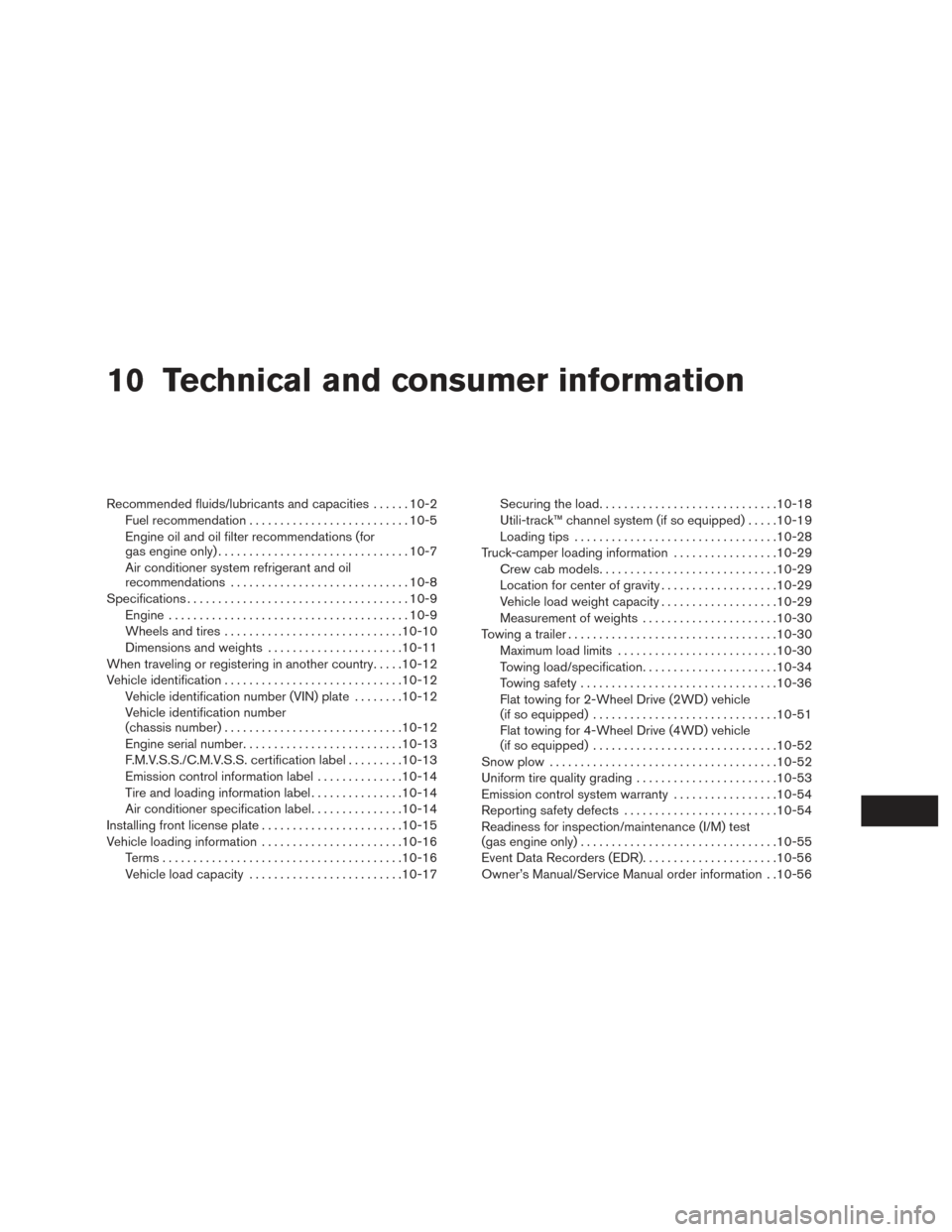
10 Technical and consumer information
Recommended fluids/lubricants and capacities......10-2
Fuel recommendation .......................... 10-5
Engine oil and oil filter recommendations (for
gas engine only) ............................... 10-7
Air conditioner system refrigerant and oil
recommendations ............................. 10-8
Specifications .................................... 10-9
Engine ....................................... 10-9
Wheels and tires ............................. 10-10
Dimensions and weights ......................10-11
When traveling or registering in another country .....10-12
Vehicle identification ............................. 10-12
Vehicle identification number (VIN) plate ........10-12
Vehicle identification number
(chassis number) ............................. 10-12
Engine serial number .......................... 10-13
F.M.V.S.S./C.M.V.S.S. certification label .........10-13
Emission control information label ..............10-14
Tire and loading information label ...............10-14
Air conditioner specification label ...............10-14
Installing front license plate .......................10-15
Vehicle loading information .......................10-16
Terms ....................................... 10-16
Vehicle load capacity ......................... 10-17Securing the load
............................. 10-18
Utili-track™ channel system (if so equipped) .....10-19
Loading tips ................................. 10-28
Truck-camper loading information .................10-29
Crew cab models ............................. 10-29
Location for center of gravity ...................10-29
Vehicle load weight capacity ...................10-29
Measurement of weights ......................10-30
Towing a trailer .................................. 10-30
Maximum load limits .......................... 10-30
Towing load/specification ......................10-34
Towing safety ................................ 10-36
Flat
towing for 2-Wheel Drive (2WD) vehicle
(if so equipped) .............................. 10-51
Flat towing for 4-Wheel Drive (4WD) vehicle
(if so equipped) .............................. 10-52
Snow plow ..................................... 10-52
Uniform tire quality grading .......................10-53
Emission control system warranty .................10-54
Reporting safety defects ......................... 10-54
Readiness for inspection/maintenance (I/M) test
(gas engine only) ................................ 10-55
Event Data Recorders (EDR) ......................10-56
Owner’s Manual/Service Manual order information . .10-56
Page 507 of 636
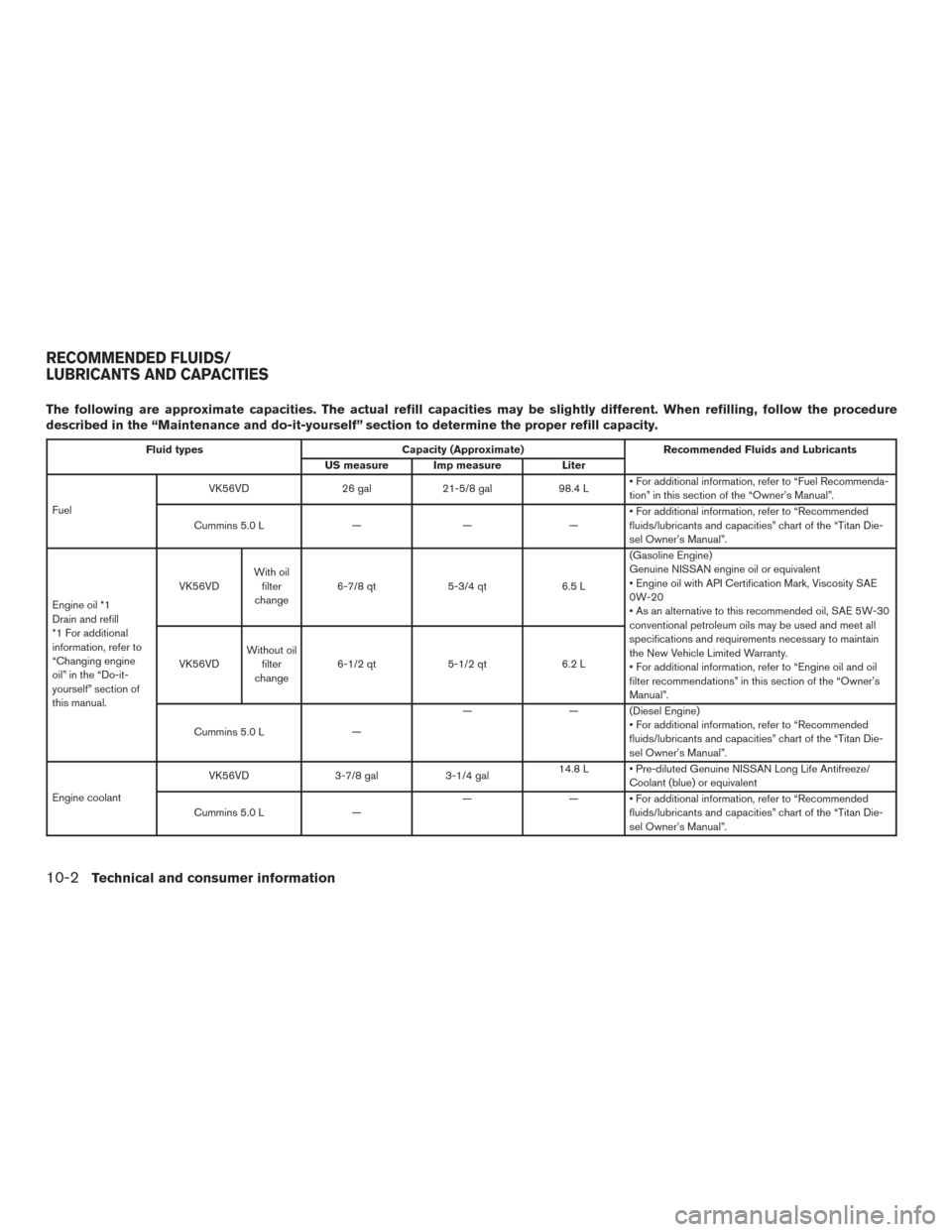
The following are approximate capacities. The actual refill capacities may be slightly different. When refilling, follow the procedure
described in the “Maintenance and do-it-yourself” section to determine the proper refill capacity.
Fluid typesCapacity (Approximate) Recommended Fluids and Lubricants
US measure Imp measure Liter
Fuel VK56VD
26 gal21-5/8 gal 98.4 L• For additional information, refer to “Fuel Recommenda-
tion” in this section of the “Owner’s Manual”.
Cummins 5.0 L ———• For additional information, refer to “Recommended
fluids/lubricants and capacities” chart of the “Titan Die-
sel Owner’s Manual”.
Engine oil *1
Drain and refill
*1 For additional
information, refer to
“Changing engine
oil” in the “Do-it-
yourself” section of
this manual. VK56VD
With oil
filter
change 6-7/8 qt
5-3/4 qt 6.5 L(Gasoline Engine)
Genuine NISSAN engine oil or equivalent
• Engine oil with API Certification Mark, Viscosity SAE
0W-20
• As an alternative to this recommended oil, SAE 5W-30
conventional petroleum oils may be used and meet all
specifications and requirements necessary to maintain
the New Vehicle Limited Warranty.
• For additional information, refer to “Engine oil and oil
filter recommendations” in this section of the “Owner’s
Manual”.
VK56VD
Without oil
filter
change 6-1/2 qt
5-1/2 qt 6.2 L
Cummins 5.0 L ——
— (Diesel Engine)
• For additional information, refer to “Recommended
fluids/lubricants and capacities” chart of the “Titan Die-
sel Owner’s Manual”.
Engine coolant VK56VD
3-7/8 gal3-1/4 gal 14.8 L • Pre-diluted Genuine NISSAN Long Life Antifreeze/
Coolant (blue) or equivalent
Cummins 5.0 L ——
— • For additional information, refer to “Recommended
fluids/lubricants and capacities” chart of the “Titan Die-
sel Owner’s Manual”.
RECOMMENDED FLUIDS/
LUBRICANTS AND CAPACITIES
10-2Technical and consumer information
Page 508 of 636
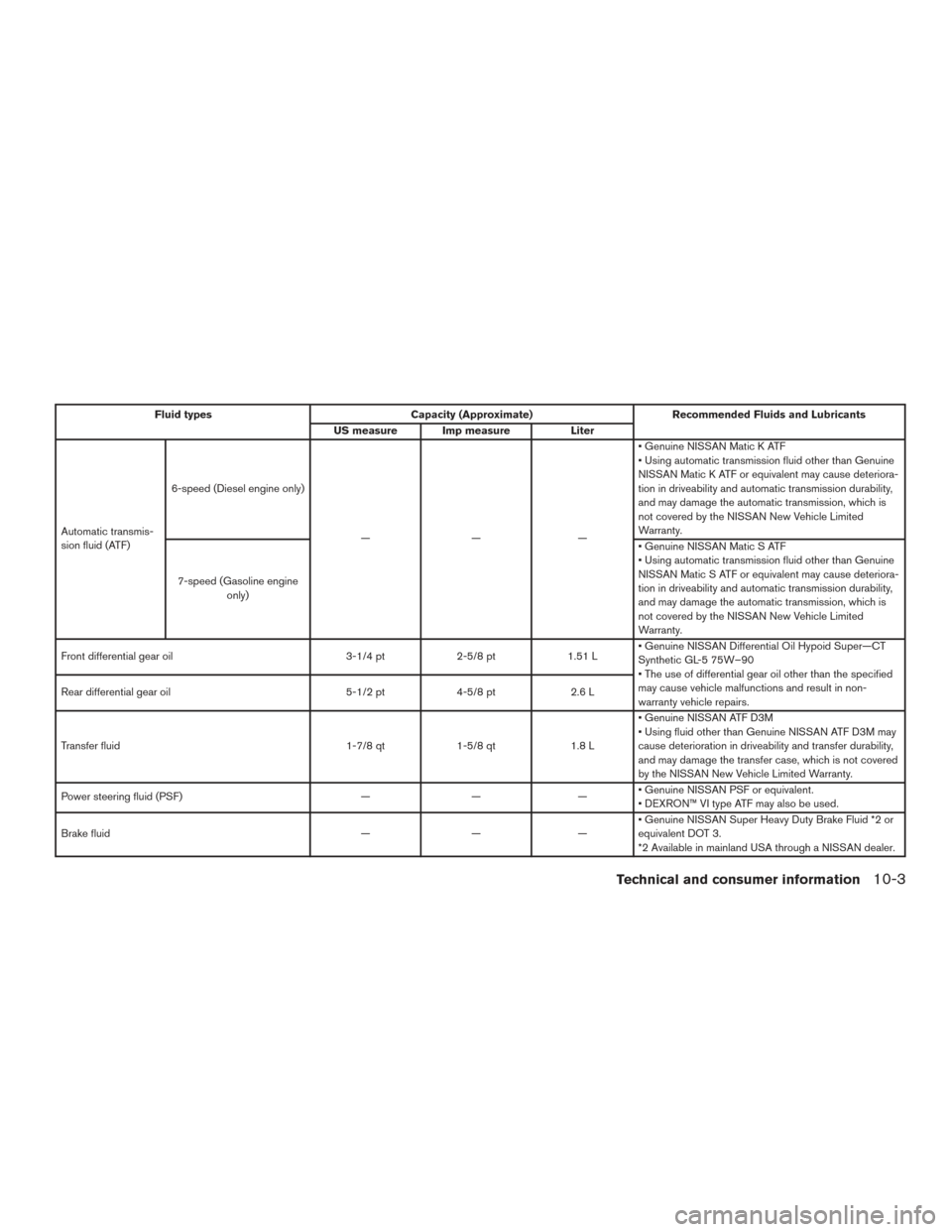
Fluid typesCapacity (Approximate) Recommended Fluids and Lubricants
US measure Imp measure Liter
Automatic transmis-
sion fluid (ATF) 6-speed (Diesel engine only)
——— • Genuine NISSAN Matic K ATF
• Using automatic transmission fluid other than Genuine
NISSAN Matic K ATF or equivalent may cause deteriora-
tion in driveability and automatic transmission durability,
and may damage the automatic transmission, which is
not covered by the NISSAN New Vehicle Limited
Warranty.
7-speed (Gasoline engine only) • Genuine NISSAN Matic S ATF
• Using automatic transmission fluid other than Genuine
NISSAN Matic S ATF or equivalent may cause deteriora-
tion in driveability and automatic transmission durability,
and may damage the automatic transmission, which is
not covered by the NISSAN New Vehicle Limited
Warranty.
Front differential gear oil 3-1/4 pt2-5/8 pt 1.51 L• Genuine NISSAN Differential Oil Hypoid Super—CT
Synthetic GL-5 75W–90
• The use of differential gear oil other than the specified
may cause vehicle malfunctions and result in non-
warranty vehicle repairs.
Rear differential gear oil
5-1/2 pt4-5/8 pt 2.6 L
Transfer fluid 1-7/8 qt1-5/8 qt 1.8 L• Genuine NISSAN ATF D3M
• Using fluid other than Genuine NISSAN ATF D3M may
cause deterioration in driveability and transfer durability,
and may damage the transfer case, which is not covered
by the NISSAN New Vehicle Limited Warranty.
Power steering fluid (PSF) ———• Genuine NISSAN PSF or equivalent.
• DEXRON™ VI type ATF may also be used.
Brake fluid ———• Genuine NISSAN Super Heavy Duty Brake Fluid *2 or
equivalent DOT 3.
*2 Available in mainland USA through a NISSAN dealer.
Technical and consumer information10-3
Page 510 of 636
FUEL RECOMMENDATION
Gas engine only
Use unleaded regular gasoline with an octane
rating of at least 87 AKI (Anti-Knock Index) num-
ber (Research octane number 91) .
CAUTION
●Using a fuel other than that specified
could adversely affect the emission
control system, and may also affect the
warranty coverage.
● Under no circumstances should a
leaded gasoline be used, because this
will damage the three-way catalyst.
● Do not use E-15 or E-85 fuel in your
vehicle. Your vehicle is not designed to
run on E-15 or E-85 fuel. Using E-15 or
E-85 fuel in a vehicle not specifically
designed for E-15 or E-85 fuel can ad-
versely affect the emission control de-
vices and systems of the vehicle. Dam-
age caused by such fuel is not covered
by the NISSAN New Vehicle Limited
Warranty. ●
Do not use fuel that contains the octane
booster methylcyclopentadienyl man-
ganese tricarbonyl (MMT) . Using fuel
containing MMT may adversely affect
vehicle performance and vehicle emis-
sions. Not all fuel dispensers are la-
beled to indicate MMT content, so you
may have to consult your gasoline re-
tailer for more details. Note that Fed-
eral and California laws prohibit the use
of MMT in reformulated gasoline.
● U.S. government regulations require
ethanol dispensing pumps to be identi-
fied by a small, square, orange and
black label with the common abbrevia-
tion or the appropriate percentage for
that region.
Diesel engine only
For additional information, refer to “Fuel recom-
mendation” in the “Titan Diesel Owner’s Manual”.
Gasoline specifications
NISSAN recommends using gasoline that meets
the World-Wide Fuel Charter (WWFC) specifi-
cations where it is available. Many of the automo-
bile manufacturers developed this specification
to improve emission control system and vehicle
performance. Ask your service station manager if
the gasoline meets the WWFC specifications.
Reformulated gasoline
Some fuel suppliers are now producing reformu-
lated gasolines. These gasolines are specially
designed to reduce vehicle emissions. NISSAN
supports efforts towards cleaner air and sug-
gests that you use reformulated gasoline when
available.
Gasoline containing oxygenates
Some fuel suppliers sell gasoline containing oxy-
genates such as ethanol, Methyl Tert-butyl Ether
(MTBE) and methanol with or without advertising
their presence. NISSAN does not recommend
the use of fuels of which the oxygenate content
and the fuel compatibility for your NISSAN can-
not be readily determined. If in doubt, ask your
service station manager.
If you use oxygenate-blend gasoline, please take
the following precautions as the usage of such
fuels may cause vehicle performance problems
and/or fuel system damage. ● The fuel should be unleaded and have
an octane rating no lower than that
recommended for unleaded gasoline.
●
If an oxygenate-blend other than metha-
nol blend is used, it should contain no
more than 10% oxygenate. (MTBE may,
however, be added up to 15%.)
Technical and consumer information10-5
Page 511 of 636
●E-15 fuel contains more than 10% oxy-
genate. E-15 fuel will adversely affect
the emission control devices and sys-
tems of the vehicle and should not be
used. Damage caused by such fuel is
not covered by the NISSAN New Ve-
hicle Limited Warranty.
● If a methanol blend is used, it should
contain no more than 5% methanol
(methyl alcohol, wood alcohol) . It
should also contain a suitable amount
of appropriate cosolvents and corro-
sion inhibitors. If not properly formu-
lated with appropriate cosolvents and
corrosion inhibitors, such methanol
blends may cause fuel system damage
and/or vehicle performance problems.
At this time, sufficient data is not avail-
able to ensure that all methanol blends
are suitable for use in NISSAN ve-
hicles.
If any driveability problems such as engine stall-
ing and difficult hot-starting are experienced after
using oxygenate-blend fuels, immediately
change to a non-oxygenate fuel or a fuel with a
low blend of MTBE.
Take care not to spill gasoline during refu-
eling. Gasoline containing oxygenates can
cause paint damage.E–15 fuel
E-15 fuel is a mixture of approximately 15% fuel
ethanol and 85% unleaded gasoline. E-15 can
only be used in vehicles designed to run on E-15
fuel. Do not use E-15 in your vehicle. U.S. gov-
ernment regulations require fuel ethanol dispens-
ing pumps to be identified with small, square,
orange and black label with the common abbre-
viation or the appropriate percentage for that
region.
E–85 fuel
E-85 fuel is a mixture of approximately 85% fuel
ethanol and 15% unleaded gasoline. E-85 can
only be used in a Flexible Fuel Vehicle (FFV) . Do
not use E-85 in your vehicle. U.S. government
regulations require fuel ethanol dispensing
pumps to be identified by a small, square, orange
and black label with the common abbreviation or
the appropriate percentage for that region.
Fuel containing MMT
MMT, or methylcyclopentadienyl manganese tri-
carbonyl, is an octane boosting additive. NISSAN
does not recommend the use of fuel containing
MMT. Such fuel may adversely affect vehicle per-
formance, including the emissions control sys-
tem. Note that while some fuel pumps label MMT
content, not all do, so you may have to consult
your gasoline retailer for more details.
Aftermarket fuel additives
NISSAN does not recommend the use of any
aftermarket fuel additives (for example, fuel injec-
tor cleaner, octane booster, intake valve deposit
removers, etc.) which are sold commercially.
Many of these additives intended for gum, varnish
or deposit removal may contain active solvents or
similar ingredients that can be harmful to the fuel
system and engine.
Octane rating tips
Using unleaded gasoline with an octane
rating lower than recommended can cause
persistent, heavy “spark knock.” (“Spark
knock” is a metallic rapping noise.) If se-
vere, this can lead to engine damage. If you
detect a persistent heavy spark knock even
when using gasoline of the stated octane
rating, or if you hear steady spark knock
while holding a steady speed on level
roads, it is recommended that you have a
NISSAN dealer correct the condition. Fail-
ure to correct the condition is misuse of the
vehicle, for which NISSAN is not respon-
sible.
Incorrect ignition timing may result in spark
knock, after-run and/or overheating, which may
cause excessive fuel consumption or engine
damage. If any of the above symptoms are en-
10-6Technical and consumer information