fuel filter NISSAN TITAN 2018 Owner´s Manual
[x] Cancel search | Manufacturer: NISSAN, Model Year: 2018, Model line: TITAN, Model: NISSAN TITAN 2018Pages: 650, PDF Size: 7.54 MB
Page 550 of 650
Radiator and hosesCheck the front of the
radiator and clean off any dirt, insects,
leaves, etc., that may have accumulated.
Make sure the hoses have no cracks, defor-
mation, rot or loose connections.
Underbody: The underbody is frequently
exposed to corrosive substances such as
those used on icy roads or to control dust. It
is very important to remove these sub-
stances from the underbody, otherwise
rust may form on the floor pan, frame, fuel
lines and exhaust system. At the end of
winter, the underbody should be thor-
oughly flushed with plain water, in those
areas where mud and dirt may have accu-
mulated. For additional information, refer
to the “Appearance and care” section of this
manual.
Windshield-washer fluid*: Check that
there is adequate fluid in the reservoir.The following descriptions are provided to
give you a better understanding of the sched-
uled maintenance items that should be regu-
larly checked or replaced. The maintenance
schedule indicates at which mileage/time in-
tervals each item requires service.
Items marked with “*”are recommended
by NISSAN for reliable vehicle operation.
You are not required to perform mainte-
nance on these items in order to maintain
the warranties which come with your
NISSAN. Other maintenance items and in-
tervals are required.
When applicable, additional information
can be found in the “Do-it-yourself ” section
of this manual.
NOTE: NISSAN does not advocate the use
of non-OEM approved af termarket flush-ing systems and strongly advises againstperforming these services on a NISSANproduct. Many of the af termarket flushingsystems use non-OEM approved chemi-cals or solvents, the use of which has notbeen validated by NISSAN.
For recommended fuel, lubricants, fluids,
grease, and refrigerant, refer to “Recom-
mended fluids/lubricants and capacities”
in the “Technical and consumer informa-
tion” section of this manual.
EMISSION CONTROL SYSTEM
MAINTENANCE:
Drive Belts*: Check engine drive belts for
wear, fraying or cracking and for proper
tension. Replace any damaged drive belts.
Engine Air Filter: Replace at specified in-
tervals. When driving for prolonged periods
in dusty conditions, check/replace the filter
more frequently.
Engine Coolant*:
Replace coolant at the
specified interval. When adding or replacing
coolant, be sure to use only Genuine NISSAN
Long Life Antifreeze/Coolant (blue) or
equivalent with the proper mixture. (For ad-
ditional information on the proper mixture
for your area, refer to Engine cooling system”
in the “Do-it-yourself ” section of this manual
or the “Titan Diesel Owner’s Manual”.)
NOTE: Mixing any other type of coolant or
the use of non-distilled water may reduce
the recommended service interval of the
coolant.
Engine Oil and Oil Filter: Replace engine
oil and oil filter at the specified intervals. For
recommended oil grade and viscosity refer
to “Recommended fluids/lubricants and
capacities” in the “Technical and consumer
information” section of this manual.
EXPLANATION OF SCHEDULED
MAINTENANCE ITEMS
Maintenance and schedules9-5
Page 551 of 650
Engine Valve Clearance* (gasoline en-
gine only):Inspect only if valve noise in-
creases. Adjust valve clearance if neces-
sary.
Evaporative Emissions Control Vapor
Lines* (gasoline engine only): Check va-
por lines for leaks or looseness. Tighten
connections or replace parts as necessary.
Fuel Filter (diesel engine only): Replace
the fuel filter and drain the water at the
specified intervals.
Fuel Lines*: Check the fuel hoses, piping
and connections for leaks, looseness, or
deterioration. Tighten connections or re-
place parts as necessary.
CHASSIS AND BODY
MAINTENANCE:
Brake Lines and Cables: Visually inspect
for proper installation. Check for chafing,
cracks, deterioration, and signs of leaking.
Replace any deteriorated or damaged
parts immediately.
Brake Pads and Rotors: Check for wear,
deterioration and fluid leaks. Replace any
deteriorated or damaged parts immedi-
ately. Exhaust System:
Visually inspect the ex-
haust pipes, muffler and hangers for leaks,
cracks, deterioration, and damage. Tighten
connections or replace parts as necessary.
In-Cabin Microfilter: Replace at specified
intervals. When driving for prolonged peri-
ods in dusty conditions, replace the filter
more frequently.
Propeller Shaf t(s): Check for damage,
looseness, and grease leakage.
(4WD/AWD/RWD).
Steering Gear and Linkage, Axle and Sus-
pension Parts, Drive Shaf t Boots: Check
for damage, looseness, and leakage of oil
or grease. Under severe driving conditions,
inspect more frequently.
Tire Rotation: Tires should be rotated ev-
ery 5,000 miles (8,000 km) according to the
instructions under “General maintenance”
in this section. When rotating tires, check
for damage and uneven wear. Replace if
necessary.
Transmission Fluid/Oil, Differential Oil,
Transfer Case Oil: Visually inspect for signs
of leakage at specified intervals.
Replace automatic transmission fluid at
specified intervals. (For diesel engine models)
If towing a trailer, using a camper or car-top
carrier, or driving on rough or muddy roads:
∙ Replace the differential oil every 20,000 miles (32,000 km) or 24 months.
∙ Replace the automatic transmission fluid ever 30,000 miles (48,000 km) or
24 months. (For gasoline engine mod-
els)
Off-Road Maintenance: Check the follow-
ing items frequently whenever you drive
off-road through deep sand, mud or water:
∙ Brake pads and rotors
∙ Brake lines and hoses
∙ Differential, transmission and transfer case oil
∙ Steering linkage
∙ Propeller shaf t(s) and front drive shaf ts
∙ Engine air filter
∙ Clutch housing drain (4WD only)
9-6Maintenance and schedules
Page 553 of 650
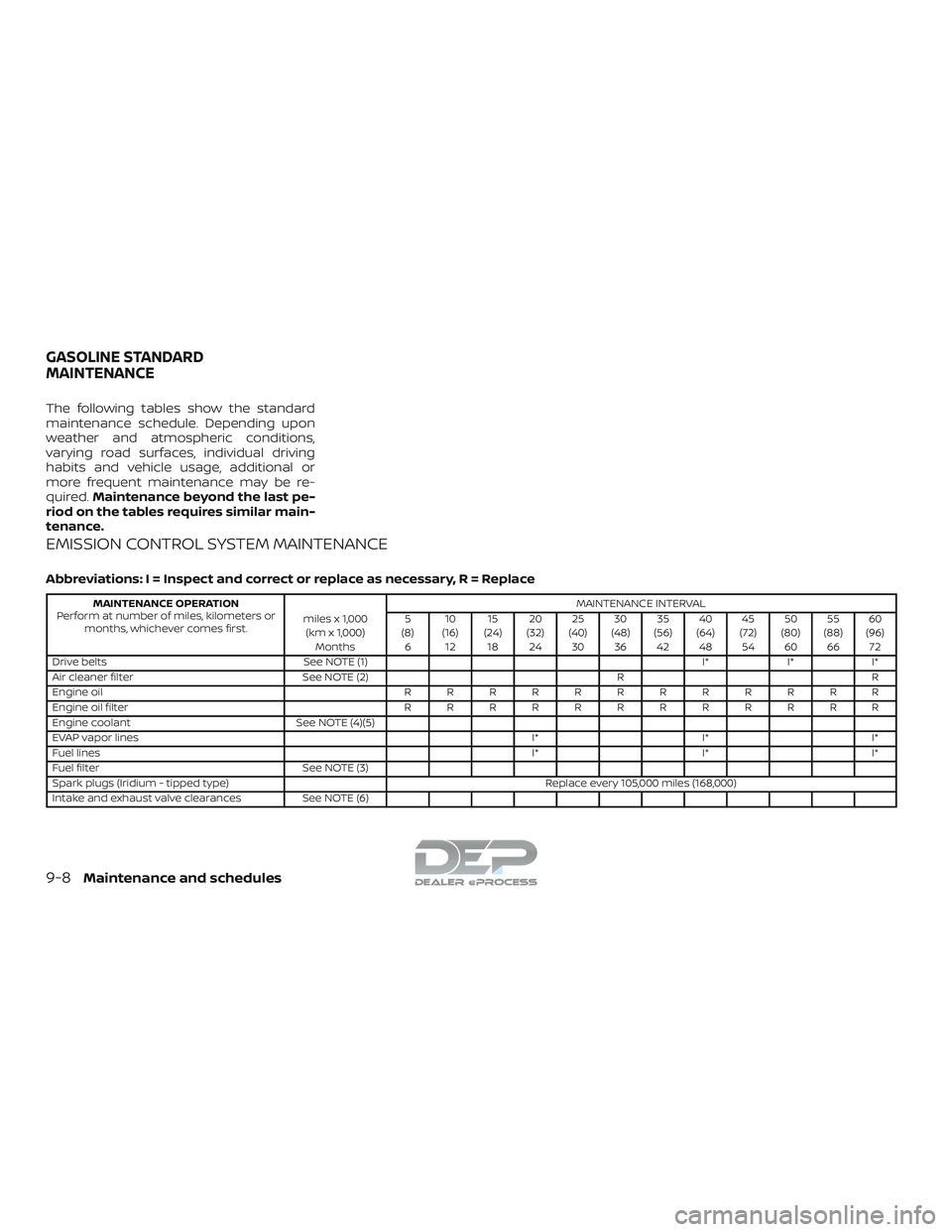
The following tables show the standard
maintenance schedule. Depending upon
weather and atmospheric conditions,
varying road surfaces, individual driving
habits and vehicle usage, additional or
more frequent maintenance may be re-
quired.Maintenance beyond the last pe-
riod on the tables requires similar main-
tenance.
EMISSION CONTROL SYSTEM MAINTENANCE
Abbreviations: I = Inspect and correct or replace as necessary, R = Replace
MAINTENANCE OPERATION
Perform at number of miles, kilometers or months, whichever comes first. miles x 1,000
(km x 1,000) Months MAINTENANCE INTERVAL
5
(8) 6 10
(16) 12 15
(24) 18 20
(32) 24 25
(40) 30 30
(48) 36 35
(56) 42 40
(64) 48 45
(72) 54 50
(80) 60 55
(88) 66 60
(96) 72
Drive belts See NOTE (1) I*I*I*
Air cleaner filter See NOTE (2) RR
Engine oil RRRRRRRRRRRR
Engine oil filter RRRRRRRRRRRR
Engine coolant See NOTE (4)(5)
EVAP vapor lines I*I*I*
Fuel lines I*I*I*
Fuel filter See NOTE (3)
Spark plugs (Iridium - tipped type) Replace every 105,000 miles (168,000)
Intake and exhaust valve clearances See NOTE (6)
GASOLINE STANDARD
MAINTENANCE
9-8Maintenance and schedules
Page 554 of 650
MAINTENANCE OPERATION
Perform at number of miles, kilometers or months, whichever comes first. miles x 1,000
(km x 1,000) Months MAINTENANCE INTERVAL
65
(104) 78 70
(112) 84 75
(120) 90 80
(128) 96 85
(136) 102 90
(144) 108 95
(152) 114 100
(160) 120 105
(168) 126 110
(176) 132 115
(184) 138 120
(192) 144
Drive belts See NOTE (1)I*I*I*I*I*I*
Air cleaner filter See NOTE (2) RR
Engine oil RRRRRRRRRRRR
Engine oil filter RRRRRRRRRRRR
Engine coolant See NOTE (4)(5)
EVAP vapor lines I*I*I*
Fuel lines I*I*I*
Fuel filter See NOTE (3)
Spark plugs (Iridium - tipped type) Replace every 105,000 miles (168,000)
Intake and exhaust valve clearances See NOTE (6)
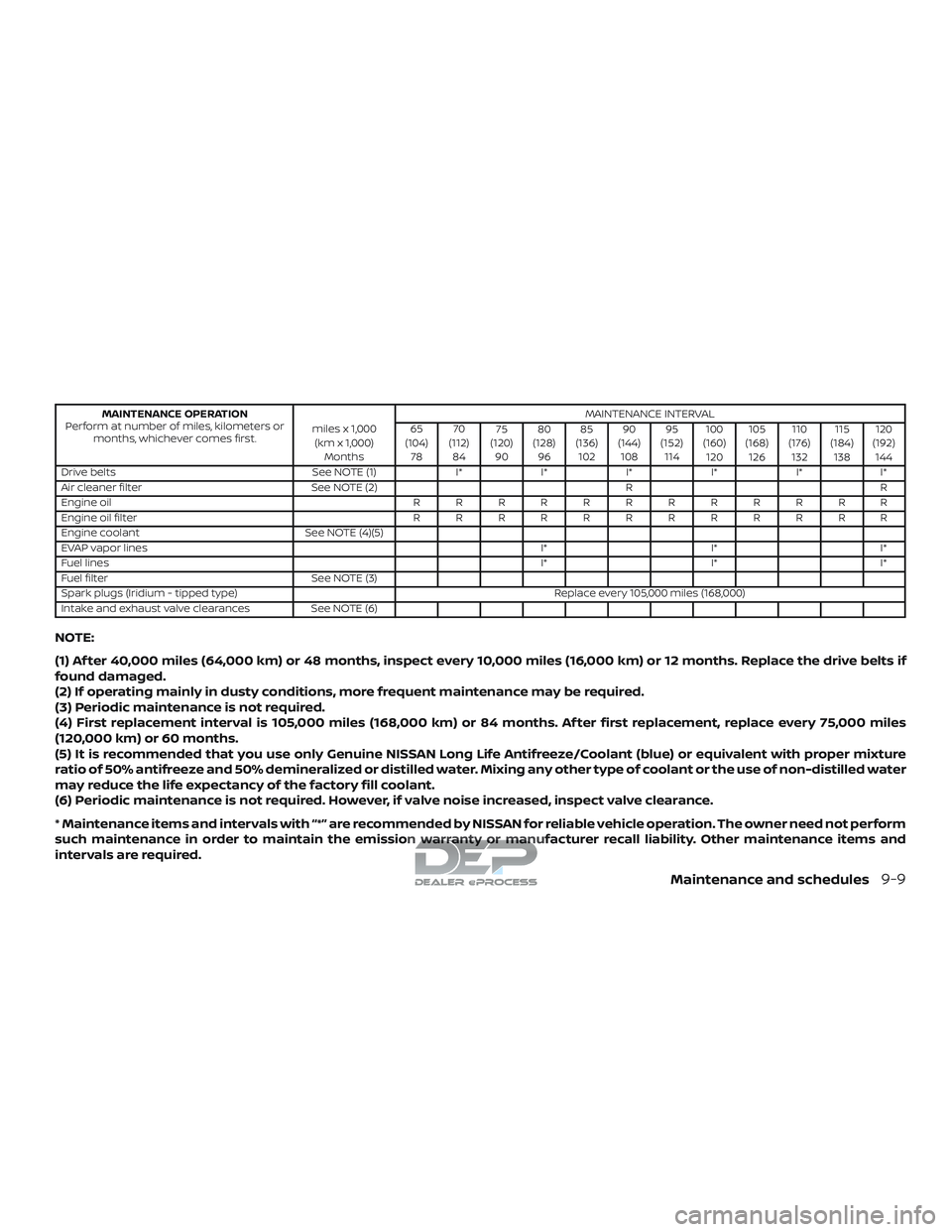
NOTE:
(1) Af ter 40,000 miles (64,000 km) or 48 months, inspect every 10,000 miles (16,000 km) or 12 months. Replace the drive belts if
found damaged.
(2) If operating mainly in dusty conditions, more frequent maintenance may be required.
(3) Periodic maintenance is not required.
(4) First replacement interval is 105,000 miles (168,000 km) or 84 months. Af ter first replacement, replace every 75,000 miles
(120,000 km) or 60 months.
(5) It is recommended that you use only Genuine NISSAN Long Life Antifreeze/Coolant (blue) or equivalent with proper mixture
ratio of 50% antifreeze and 50% demineralized or distilled water. Mixing any other type of coolant or the use of non-distilled water
may reduce the life expectancy of the factory fill coolant.
(6) Periodic maintenance is not required. However, if valve noise increased, inspect valve clearance.
* Maintenance items and intervals with “*” are recommended by NISSAN for reliable vehicle operation. The owner need not perform
such maintenance in order to maintain the emission warranty or manufacturer recall liability. Other maintenance items and
intervals are required.
Maintenance and schedules9-9
Page 558 of 650
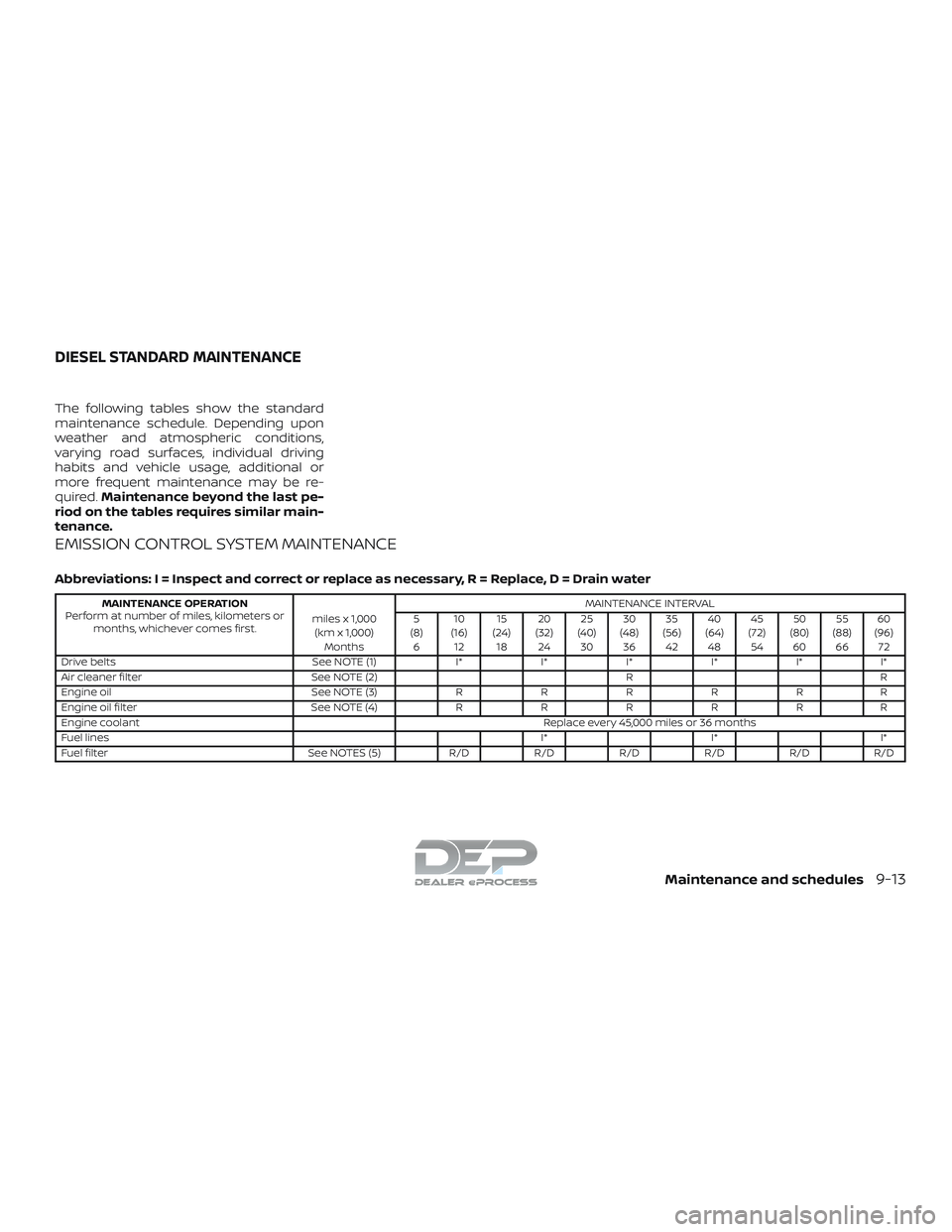
The following tables show the standard
maintenance schedule. Depending upon
weather and atmospheric conditions,
varying road surfaces, individual driving
habits and vehicle usage, additional or
more frequent maintenance may be re-
quired.Maintenance beyond the last pe-
riod on the tables requires similar main-
tenance.
EMISSION CONTROL SYSTEM MAINTENANCE
Abbreviations: I = Inspect and correct or replace as necessary, R = Replace, D = Drain water
MAINTENANCE OPERATION
Perform at number of miles, kilometers or months, whichever comes first. miles x 1,000
(km x 1,000) Months MAINTENANCE INTERVAL
5
(8) 6 10
(16) 12 15
(24) 18 20
(32) 24 25
(40) 30 30
(48) 36 35
(56) 42 40
(64) 48 45
(72) 54 50
(80) 60 55
(88) 66 60
(96) 72
Drive belts See NOTE (1)I*I*I*I*I*I*
Air cleaner filter See NOTE (2) RR
Engine oil See NOTE (3)RRRRRR
Engine oil filter See NOTE (4)RRRRRR
Engine coolant Replace every 45,000 miles or 36 months
Fuel lines I*I*I*
Fuel filter See NOTES (5)R/DR/DR/DR/DR/DR/D
DIESEL STANDARD MAINTENANCE
Maintenance and schedules9-13
Page 559 of 650
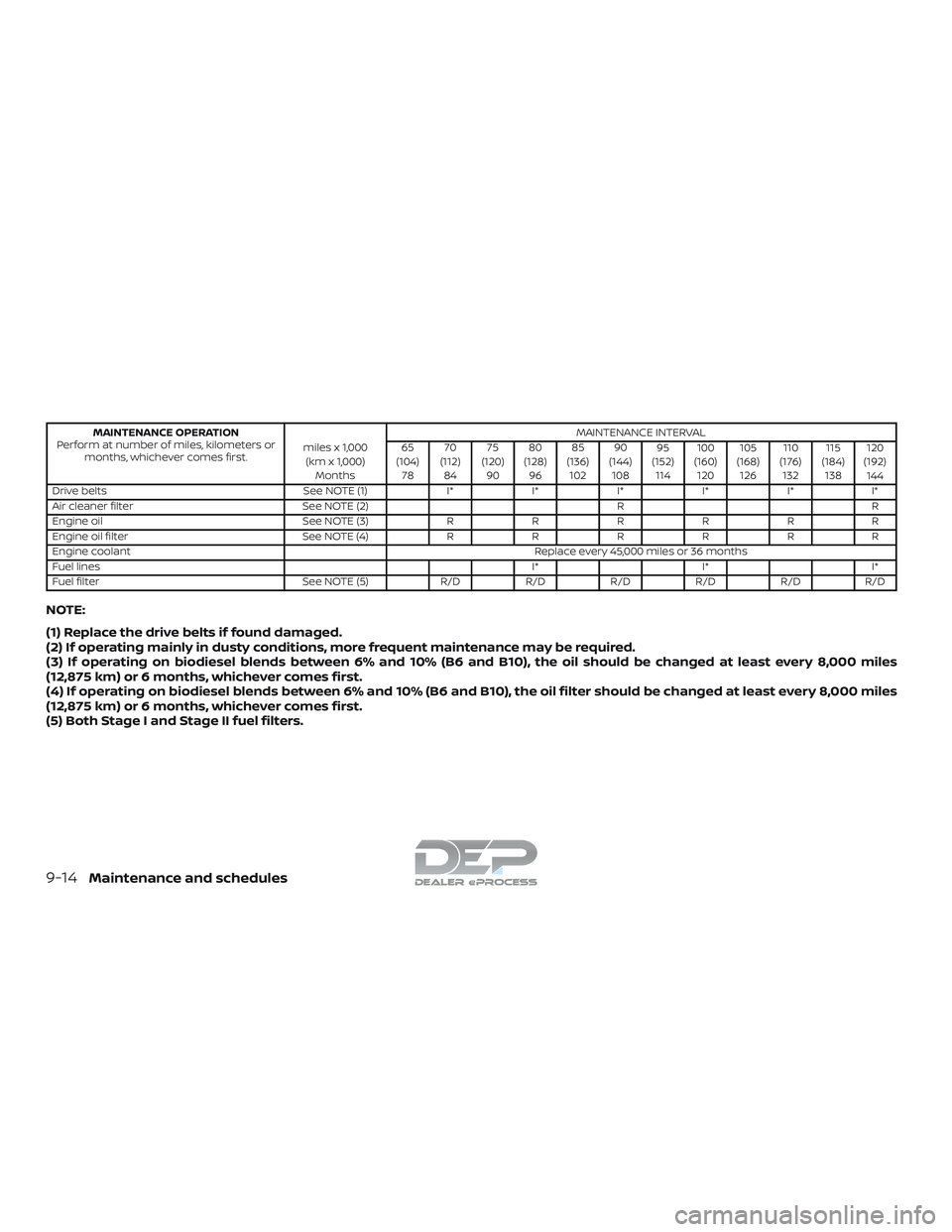
MAINTENANCE OPERATION
Perform at number of miles, kilometers or months, whichever comes first. miles x 1,000
(km x 1,000) Months MAINTENANCE INTERVAL
65
(104) 78 70
(112) 84 75
(120) 90 80
(128) 96 85
(136) 102 90
(144) 108 95
(152) 114 100
(160) 120 105
(168) 126 110
(176) 132 115
(184) 138 120
(192) 144
Drive belts See NOTE (1)I*I*I*I*I*I*
Air cleaner filter See NOTE (2) RR
Engine oil See NOTE (3)RRRRRR
Engine oil filter See NOTE (4)RRRRRR
Engine coolant Replace every 45,000 miles or 36 months
Fuel lines I*I*I*
Fuel filter See NOTE (5)R/DR/DR/DR/DR/DR/D
NOTE:
(1) Replace the drive belts if found damaged.
(2) If operating mainly in dusty conditions, more frequent maintenance may be required.
(3) If operating on biodiesel blends between 6% and 10% (B6 and B10), the oil should be changed at least every 8,000 miles
(12,875 km) or 6 months, whichever comes first.
(4) If operating on biodiesel blends between 6% and 10% (B6 and B10), the oil filter should be changed at least every 8,000 miles
(12,875 km) or 6 months, whichever comes first.
(5) Both Stage I and Stage II fuel filters.
9-14Maintenance and schedules
Page 567 of 650
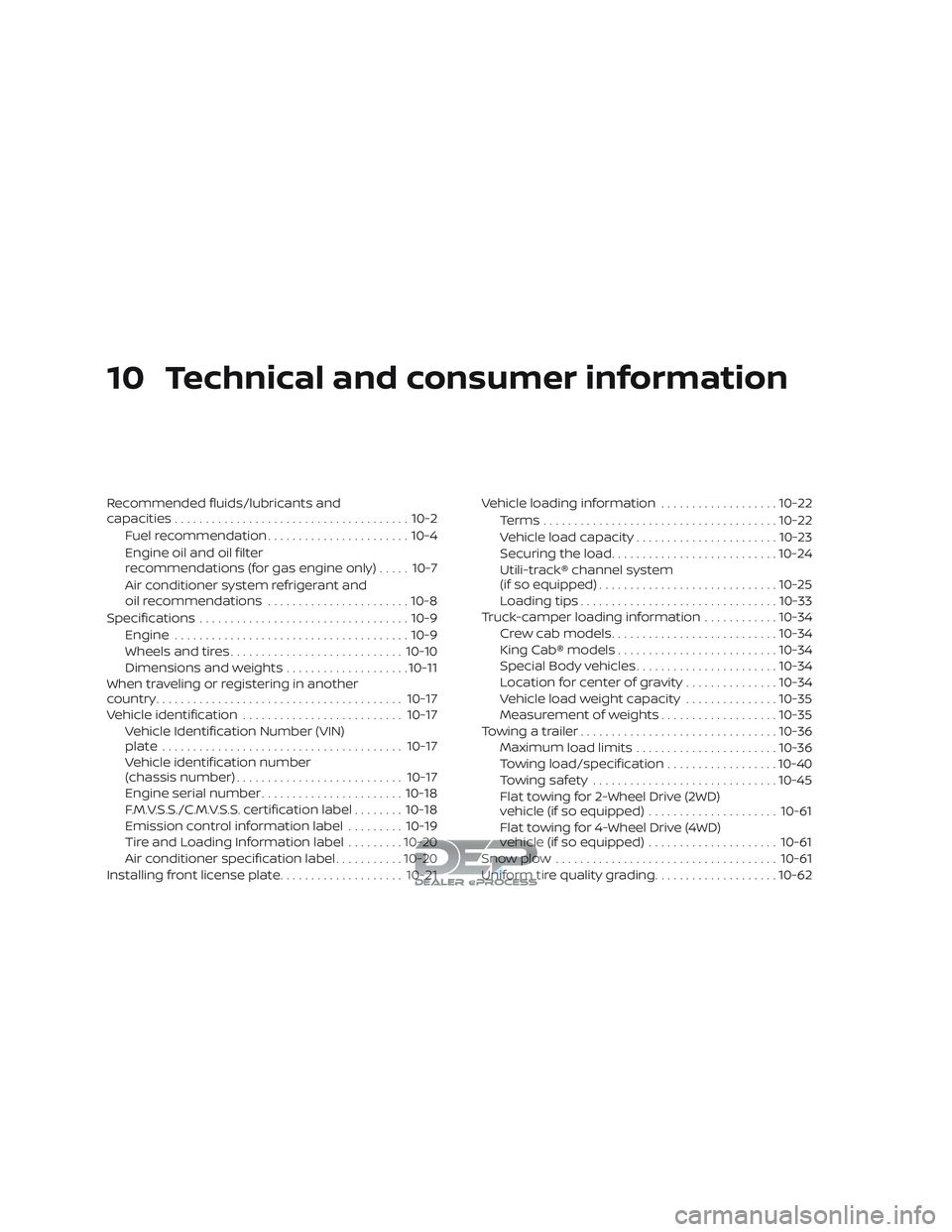
10 Technical and consumer information
Recommended fluids/lubricants and
capacities...................................... 10-2
Fuel recommendation ....................... 10-4
Engine oil and oil filter
recommendations (for gas engine only) .....10-7
Air conditioner system refrigerant and
oil recommendations .......................10-8
Specifications .................................. 10-9
Engine ...................................... 10-9
Wheels and tires ............................ 10-10
Dimensions and weights ....................10-11
When traveling or registering in another
country ........................................ 10-17
Vehicle identification .......................... 10-17
Vehicle Identification Number (VIN)
plate ....................................... 10-17
Vehicle identification number
(chassis number) ........................... 10-17
Engine serial number ....................... 10-18
F.M.V.S.S./C.M.V.S.S. certification label ........10-18
Emission control information label .........10-19
Tire and Loading Information label .........10-20
Air conditioner specification label ...........10-20
Installing front license plate ....................10-21Vehicle loading information
...................10-22
Terms ...................................... 10-22
Vehicle load capacity ....................... 10-23
Securing the load ........................... 10-24
Utili-track® channel system
(if so equipped) ............................. 10-25
Loading tips ................................ 10-33
Truck-camper loading information ............10-34
Crew cab models ........................... 10-34
King Cab® models .......................... 10-34
Special Body vehicles ....................... 10-34
Location for center of gravity ...............10-34
Vehicle load weight capacity ...............10-35
Measurement of weights ...................10-35
Towing a trailer ................................ 10-36
Maximum load
limits ....................... 10-36
Towing load/specification ..................10-40
Towing safety .............................. 10-45
Flat towing for 2-Wheel Drive (2WD)
vehicle (if so equipped) .....................10-61
Flat towing for 4-Wheel Drive (4WD)
vehicle (if so equipped) .....................10-61
Snowplow .................................... 10-61
Uniform tire quality grading ....................10-62
Page 569 of 650
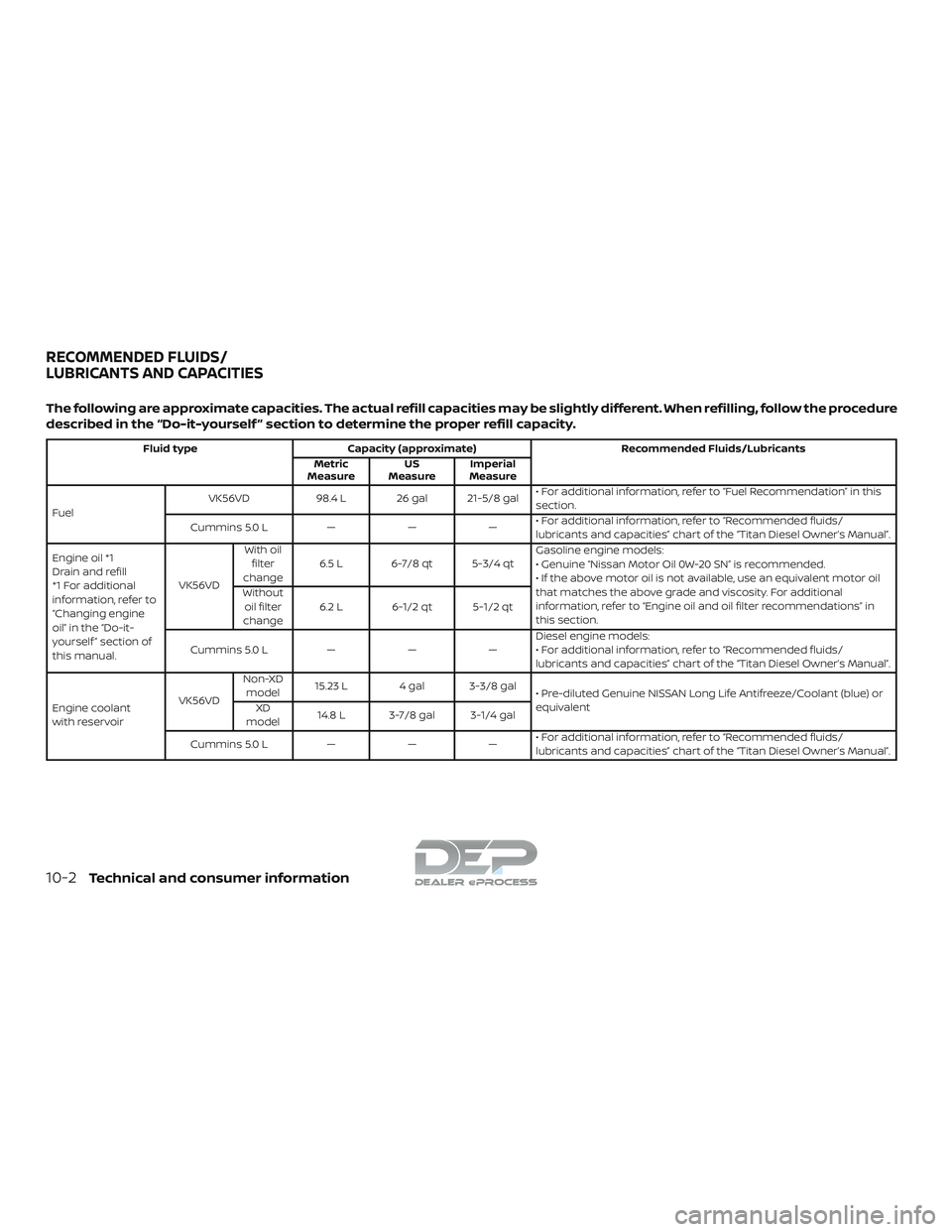
The following are approximate capacities. The actual refill capacities may be slightly different. When refilling, follow the procedure
described in the “Do-it-yourself ” section to determine the proper refill capacity.
Fluid typeCapacity (approximate) Recommended Fluids/Lubricants
Metric
Measure US
Measure Imperial
Measure
Fuel VK56VD
98.4 L 26 gal 21-5/8 gal • For additional information, refer to “Fuel Recommendation” in this
section.
Cummins 5.0 L ———• For additional information, refer to “Recommended fluids/
lubricants and capacities” chart of the “Titan Diesel Owner’s Manual”.
Engine oil *1
Drain and refill
*1 For additional
information, refer to
“Changing engine
oil” in the “Do-it-
yourself ” section of
this manual. VK56VD
With oil
filter
change 6.5 L 6-7/8 qt 5-3/4 qt
Gasoline engine models:
• Genuine “Nissan Motor Oil 0W-20 SN” is recommended.
• If the above motor oil is not available, use an equivalent motor oil
that matches the above grade and viscosity. For additional
information, refer to “Engine oil and oil filter recommendations” in
this section.
Without
oil filter
change 6.2 L 6-1/2 qt 5-1/2 qt
Cummins 5.0 L ———Diesel engine models:
• For additional information, refer to “Recommended fluids/
lubricants and capacities” chart of the “Titan Diesel Owner’s Manual”.
Engine coolant
with reservoir VK56VDNon-XD
model 15.23 L 4 gal 3-3/8 gal
• Pre-diluted Genuine NISSAN Long Life Antifreeze/Coolant (blue) or
equivalent
XD
model 14.8 L 3-7/8 gal 3-1/4 gal
Cummins 5.0 L ———• For additional information, refer to “Recommended fluids/
lubricants and capacities” chart of the “Titan Diesel Owner’s Manual”.
RECOMMENDED FLUIDS/
LUBRICANTS AND CAPACITIES
10-2Technical and consumer information
Page 574 of 650
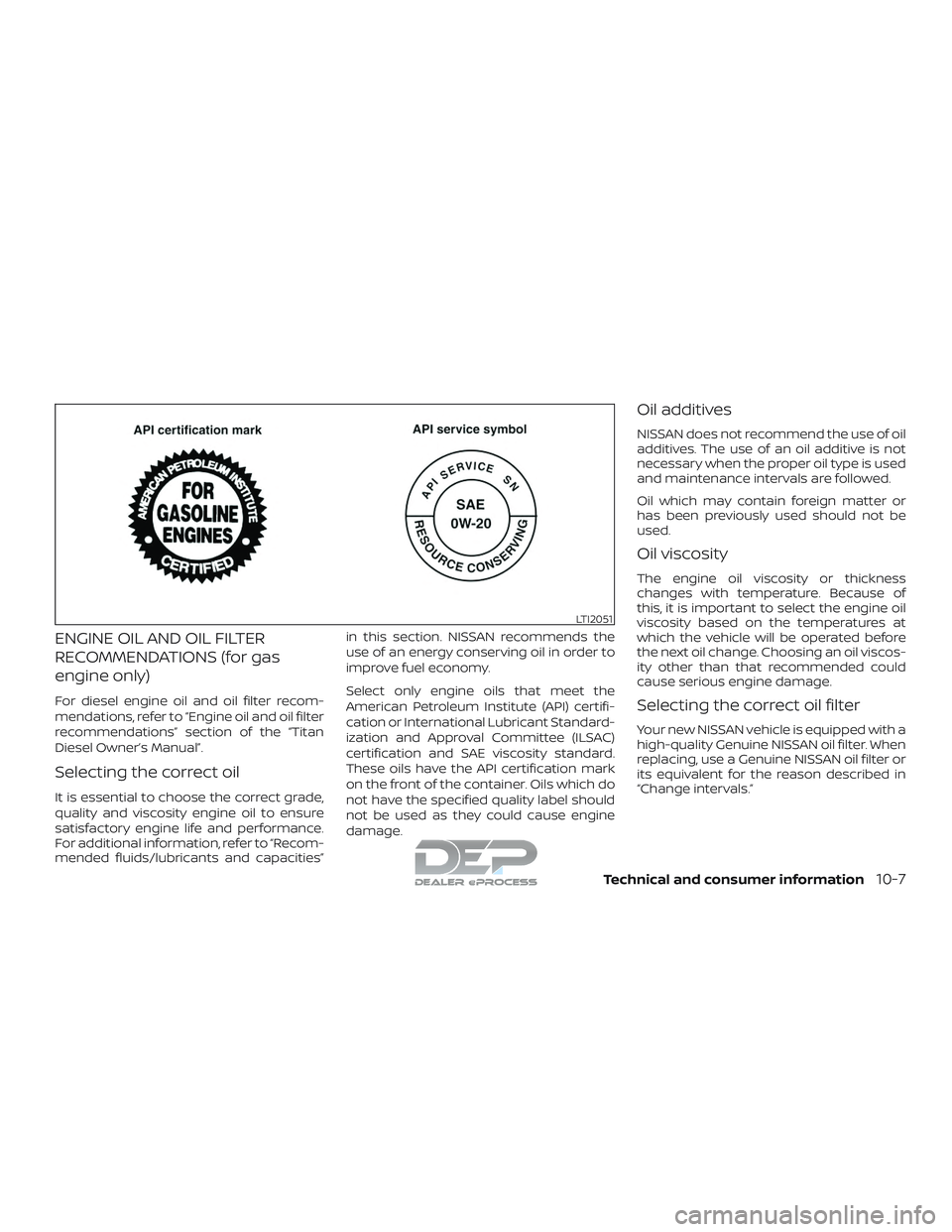
ENGINE OIL AND OIL FILTER
RECOMMENDATIONS (for gas
engine only)
For diesel engine oil and oil filter recom-
mendations, refer to “Engine oil and oil filter
recommendations” section of the “Titan
Diesel Owner’s Manual”.
Selecting the correct oil
It is essential to choose the correct grade,
quality and viscosity engine oil to ensure
satisfactory engine life and performance.
For additional information, refer to “Recom-
mended fluids/lubricants and capacities”in this section. NISSAN recommends the
use of an energy conserving oil in order to
improve fuel economy.
Select only engine oils that meet the
American Petroleum Institute (API) certifi-
cation or International Lubricant Standard-
ization and Approval Committee (ILSAC)
certification and SAE viscosity standard.
These oils have the API certification mark
on the front of the container. Oils which do
not have the specified quality label should
not be used as they could cause engine
damage.
Oil additives
NISSAN does not recommend the use of oil
additives. The use of an oil additive is not
necessary when the proper oil type is used
and maintenance intervals are followed.
Oil which may contain foreign matter or
has been previously used should not be
used.
Oil viscosity
The engine oil viscosity or thickness
changes with temperature. Because of
this, it is important to select the engine oil
viscosity based on the temperatures at
which the vehicle will be operated before
the next oil change. Choosing an oil viscos-
ity other than that recommended could
cause serious engine damage.
Selecting the correct oil filter
Your new NISSAN vehicle is equipped with a
high-quality Genuine NISSAN oil filter. When
replacing, use a Genuine NISSAN oil filter or
its equivalent for the reason described in
“Change intervals.”
LTI2051
Technical and consumer information10-7
Page 635 of 650
Brakewearindicators.......2-32,8-21
Parking brake operation.........5-22
Self-adjustingbrakes...........8-21
Brake assist ..................5-58
Brakefluid....................8-13
Brakes......................8-21
Brake system ..................5-56
Break-in schedule ...............5-43
Brightness/contrast button .........4-9
Brightness control Instrument panel .............2-58
Bulb check/instrument panel ........2-22
Bulb replacement ...............8-31
C
Capacities and recommended fuel/
lubricants....................10-2
Cargolightswitch...............2-60
Cargo
(See vehicle loading information) .....10-22
Car phone or CB radio ...........4-120
CDcareandcleaning.............4-86
CD player
(See audio system) .......4-59,4-65,4-72
Check tire pressure ..............2-42
Childrestraints........1-24, 1-25, 1-26, 1-29 LATCH (Lower Anchors and Tethers for
CHildren)System............. .1-29
Precautions on child
restraints......1-26, 1-34, 1-40, 1-44, 1-50
Top tether strap anchor point
locations.................. .1-31Child safety rear door lock
..........3-9
Chimes, audible reminders .........2-32
Cleaningexteriorandinterior......7-2,7-4
Climatecontrolseatswitch.........2-60
Clock setting (models with Navigation
System)......................4-7
Clock setting (models without Navigation
System)..................4-58,4-63
C.M.V.S.S. certification label .........10-18
Cold weather driving .............5-69
Compact disc (CD) player . . .4-59, 4-65, 4-72
Compass ....................2-18
Console light ..................2-92
Control panel buttons .............4-4
Back button .................4-7
Brightness/contrast button .......4-9
Enterbutton.................4-4
Withnavigationsystem..........4-4
Controls Audio controls (steering wheel) .....4-87
Heater and air conditioner controls . .4-44
Heater and air conditioner controls
(manual) ...................4-34
Coolant Capacities and recommended
fuel/lubricants...............10-2
Changing engine coolant .........8-6
Checking engine coolant level ......8-6
Engine coolant temperature gauge . .2-9
Corrosionprotection..............7-7
Cruisecontrol...........5-41,5-41,5-42
Cupholders ..................2-82
Curtain side-impact and rollover air
bag........................1-78 D
Daytime Running Light System . . .2-57, 8-29
Diesel Particulate Filter (DPF) .........8-11
DigitalvideodiscDVD ............4-93
Dimensions and weights ..........10-11
Dimmer switch for instrument panel . . .2-58
Display......................2-32
Display controls
(see control panel buttons) ..........4-4
Door locks ..................3-5,3-6
Door open warning light ...........2-25
Drivebelt.....................8-17
Drive positioner, Automatic ......3-42,3-44
Driving Coldweatherdriving...........5-69
Driving with automatic
transmission ................5-17
Precautions when starting and
driving ..................5-2,5-9
Driving the vehicle ...............5-16
E
Eco Drive Report ................5-54
Economy - fuel .................5-45
Electronic locking rear differential (E-Lock)
system......................5-52
Electronic locking rear differential (E-Lock)
systemswitch.................2-67
Emergency engine shutoff .......5-13, 6-2
Emission control information label . . . .10-19
Emission c
ontrol system warranty . . . .10-63
11-2