steering wheel NISSAN TITAN 2018 Owner´s Manual
[x] Cancel search | Manufacturer: NISSAN, Model Year: 2018, Model line: TITAN, Model: NISSAN TITAN 2018Pages: 650, PDF Size: 7.54 MB
Page 100 of 650
∙ Immediately af ter inflation, severalfront air bag system components will
be hot. Do not touch them; you may
severely burn yourself.
∙ No unauthorized changes should be made to any components or wiring of
the supplemental air bag system. This
is to prevent accidental inflation of
the supplemental air bag or damage
to the supplemental air bag system.
∙ Do not make unauthorized changes to your vehicle’s electrical system,
suspension system or front end struc-
ture. This could affect proper opera-
tion of the front air bag system.
∙ If your vehicle has front recovery hooks as original factory equipment
do not remove or modif y them. If it
was not equipped with front recovery
hooks do not install them. Either ac-
tion could affect proper operation of
the front air bag system resulting in
injury or death. ∙ Tampering with the front air bag sys-
tem may result in serious personal in-
jury. Tampering includes changes to
the steering wheel and the instru-
ment panel assembly by placing ma-
terial over the steering wheel pad and
above the instrument panel or by in-
stalling additional trim material
around the air bag system.
∙ No unauthorized changes should be made to any components or wiring of
the seat belt system. This may affect
the front air bag system. Tampering
with the seat belt system may result
in serious personal injury.
∙ It is recommended that you visit a NISSAN dealer for work on and around
the front air bag. It is also recom-
mended that you visit a NISSAN dealer
for installation of electrical equip-
ment. The Supplemental Restraint
System (SRS) wiring harness* should
not be modified or disconnected. Un-
authorized electrical test equipment
and probing devices should not be
used on the air bag system. ∙ A cracked windshield should be re-
placed immediately by a qualified re-
pair facility. A cracked windshield
could affect the function of the
supplemental air bag system.
*The SRS wiring harness connectors are
yellow and orange for easy identifica-
tion.
When selling your vehicle, we request that
you inform the buyer about the front air
bag system and guide the buyer to the
appropriate sections in this Owner’s
Manual.
Safety—Seats, seat belts and supplemental restraint system1-77
Page 107 of 650
Cargo lamp switch............................. 2-60
Climate controlled seat switches
(if so equipped) ................................. 2-60
Heated seat switches (if so equipped) ..........2-61
Heated rear seat switches (if so equipped) ......2-62
Heated steering wheel switch (if so equipped) . . 2-64
Warning systems switch (if so equipped) .......2-64
Vehicle Dynamic Control (VDC) OFF switch ......2-65
Hill descent control switch (if so equipped) ......2-66
Electronic locking rear differential (E-Lock)
system switch (if so equipped) ..................2-67
Power inverter switch (if so equipped) ..........2-68
Front and rear sonar system OFF switch
(if so equipped) ................................. 2-69
Tow mode switch .............................. 2-70
E-call (SOS) switch (if so equipped) ..............2-70
Trailer Brake Controller Unit (TBCU)
(if so equipped) ................................. 2-71
Power outlets .................................. 2-71
12v Outlets .................................. 2-71
120v outlets (if so equipped) .................2-73
Extended storage switch .......................2-74
Storage ........................................ 2-75
Front-door pockets .......................... 2-75Rear-door pockets (if so equipped)
..........2-76
Console side pockets (if so equipped) ........2-76
Seatback pockets (if so equipped) ...........2-76
Under-seat storage (if so equipped) .........2-77
Console box storage trays
(if so equipped) .............................. 2-78
Glovebox.................................... 2-78
Console box (if so equipped) .................2-79
Center armrest storage (if so equipped) .....2-80
Under front seat storage bin
(if so equipped) .............................. 2-81
Overhead sunglasses storage
(if so equipped) .............................. 2-81
Cup holders ................................. 2-82
Grocery hooks (if so equipped) ...............2-85
Bed liner storage bins (if so equipped) .......2-85
Cargo hooks (if so equipped) ................2-86
C -Channel
cargo hooks (if so equipped) .....2-86
Windows ....................................... 2-87
Power windows ............................. 2-87
Rear power window switch
(if so equipped) .............................. 2-89
Rear sliding window (if so equipped) .........2-90
Interior lights ................................... 2-91
Page 109 of 650
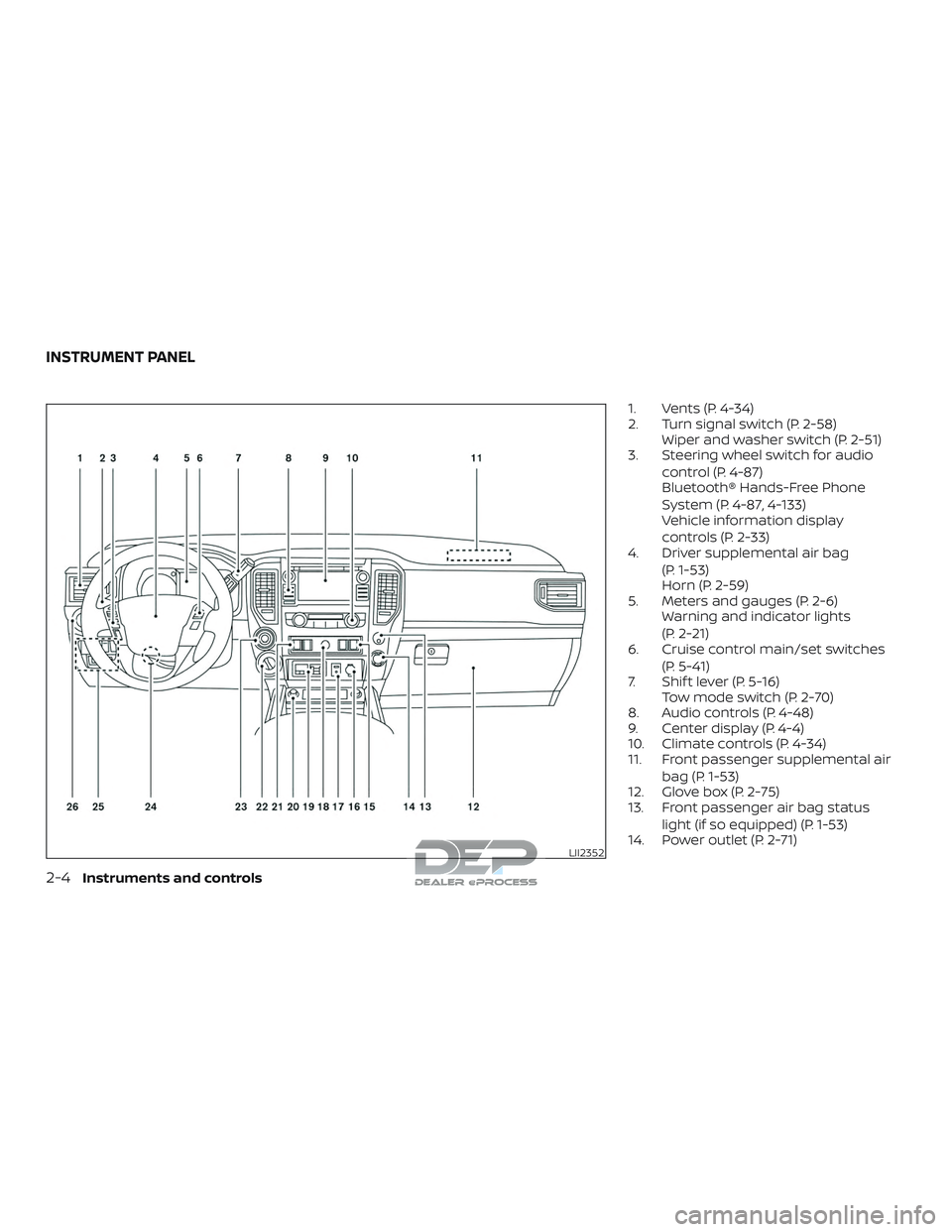
1. Vents (P. 4-34)
2. Turn signal switch (P. 2-58)Wiper and washer switch (P. 2-51)
3. Steering wheel switch for audio
control (P. 4-87)
Bluetooth® Hands-Free Phone
System (P. 4-87, 4-133)
Vehicle information display
controls (P. 2-33)
4. Driver supplemental air bag
(P. 1-53)
Horn (P. 2-59)
5. Meters and gauges (P. 2-6) Warning and indicator lights
(P. 2-21)
6. Cruise control main/set switches
(P. 5-41)
7. Shif t lever (P. 5-16) Tow mode switch (P. 2-70)
8. Audio controls (P. 4-48)
9. Center display (P. 4-4)
10. Climate controls (P. 4-34)
11. Front passenger supplemental air
bag (P. 1-53)
12. Glove box (P. 2-75)
13. Front passenger air bag status
light (if so equipped) (P. 1-53)
14. Power outlet (P. 2-71)
LII2352
INSTRUMENT PANEL
2-4Instruments and controls
Page 110 of 650
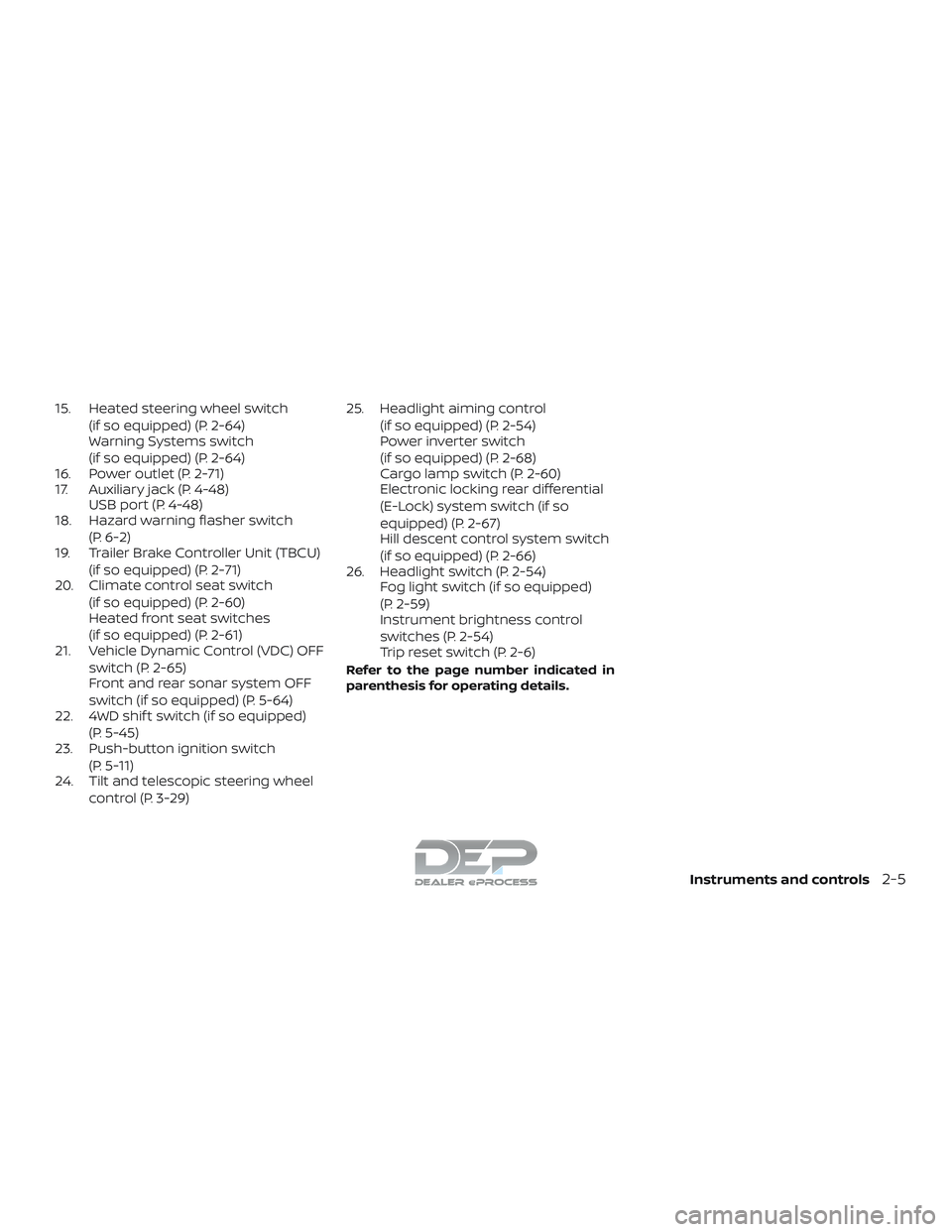
15. Heated steering wheel switch(if so equipped) (P. 2-64)
Warning Systems switch
(if so equipped) (P. 2-64)
16. Power outlet (P. 2-71)
17. Auxiliary jack (P. 4-48) USB port (P. 4-48)
18. Hazard warning flasher switch
(P. 6-2)
19. Trailer Brake Controller Unit (TBCU)
(if so equipped) (P. 2-71)
20. Climate control seat switch
(if so equipped) (P. 2-60)
Heated front seat switches
(if so equipped) (P. 2-61)
21. Vehicle Dynamic Control (VDC) OFF
switch (P. 2-65)
Front and rear sonar system OFF
switch (if so equipped) (P. 5-64)
22. 4WD shif t switch (if so equipped)
(P. 5-45)
23. Push-button ignition switch
(P. 5-11)
24. Tilt and telescopic steering wheel
control (P. 3-29) 25. Headlight aiming control
(if so equipped) (P. 2-54)
Power inverter switch
(if so equipped) (P. 2-68)
Cargo lamp switch (P. 2-60)
Electronic locking rear differential
(E-Lock) system switch (if so
equipped) (P. 2-67)
Hill descent control system switch
(if so equipped) (P. 2-66)
26. Headlight switch (P. 2-54) Fog light switch (if so equipped)
(P. 2-59)
Instrument brightness control
switches (P. 2-54)
Trip reset switch (P. 2-6)
Refer to the page number indicated in
parenthesis for operating details.
Instruments and controls2-5
Page 118 of 650
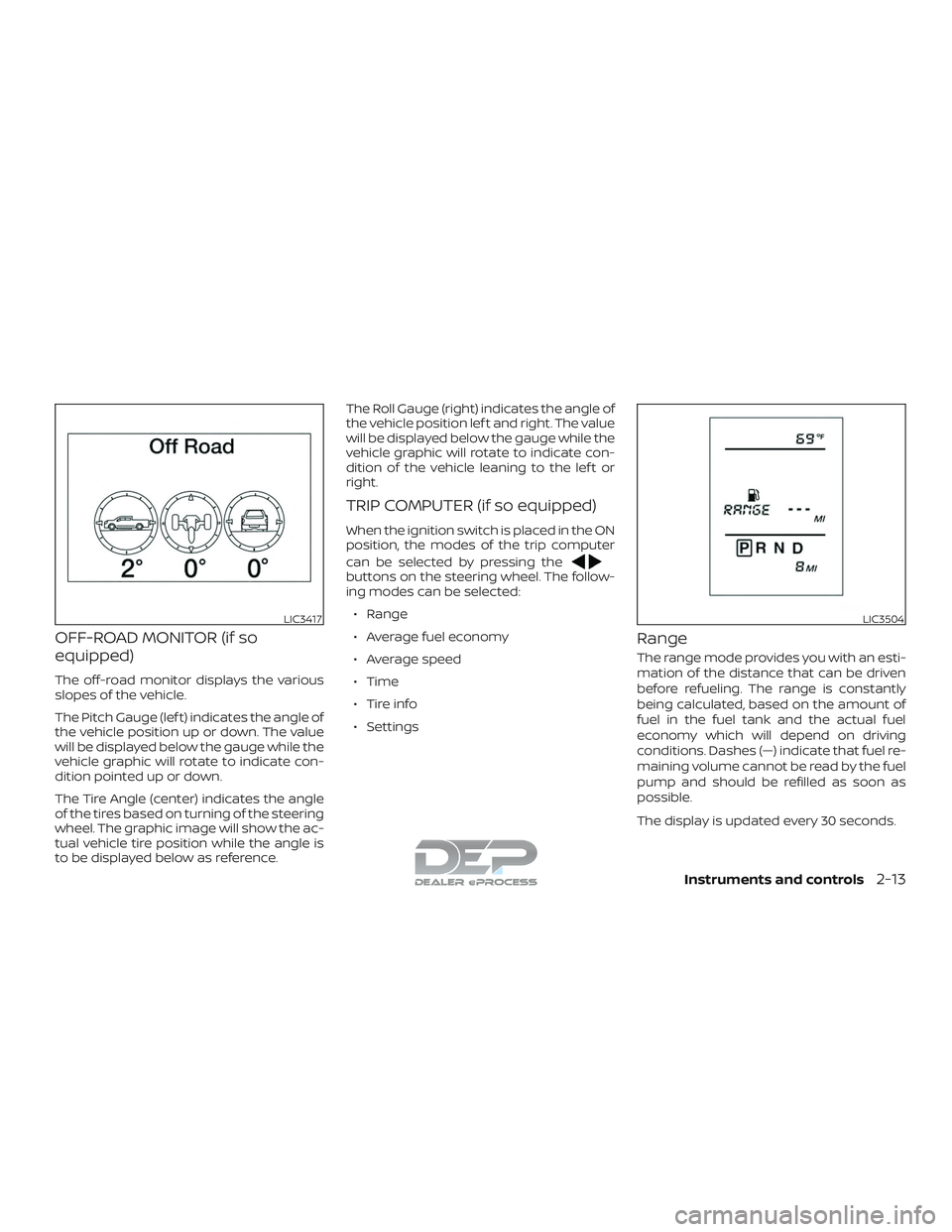
OFF-ROAD MONITOR (if so
equipped)
The off-road monitor displays the various
slopes of the vehicle.
The Pitch Gauge (lef t) indicates the angle of
the vehicle position up or down. The value
will be displayed below the gauge while the
vehicle graphic will rotate to indicate con-
dition pointed up or down.
The Tire Angle (center) indicates the angle
of the tires based on turning of the steering
wheel. The graphic image will show the ac-
tual vehicle tire position while the angle is
to be displayed below as reference.The Roll Gauge (right) indicates the angle of
the vehicle position lef t and right. The value
will be displayed below the gauge while the
vehicle graphic will rotate to indicate con-
dition of the vehicle leaning to the lef t or
right.
TRIP COMPUTER (if so equipped)
When the ignition switch is placed in the ON
position, the modes of the trip computer
can be selected by pressing the
buttons on the steering wheel. The follow-
ing modes can be selected:
∙ Range
∙ Average fuel economy
∙ Average speed
∙ Time
∙ Tire info
∙ Settings
Range
The range mode provides you with an esti-
mation of the distance that can be driven
before refueling. The range is constantly
being calculated, based on the amount of
fuel in the fuel tank and the actual fuel
economy which will depend on driving
conditions. Dashes (—) indicate that fuel re-
maining volume cannot be read by the fuel
pump and should be refilled as soon as
possible.
The display is updated every 30 seconds.
LIC3417LIC3504
Instruments and controls2-13
Page 119 of 650
NOTE:
When driving uphill or rounding curves,
the fuel in the tank shif ts, which may
momentarily change the display.
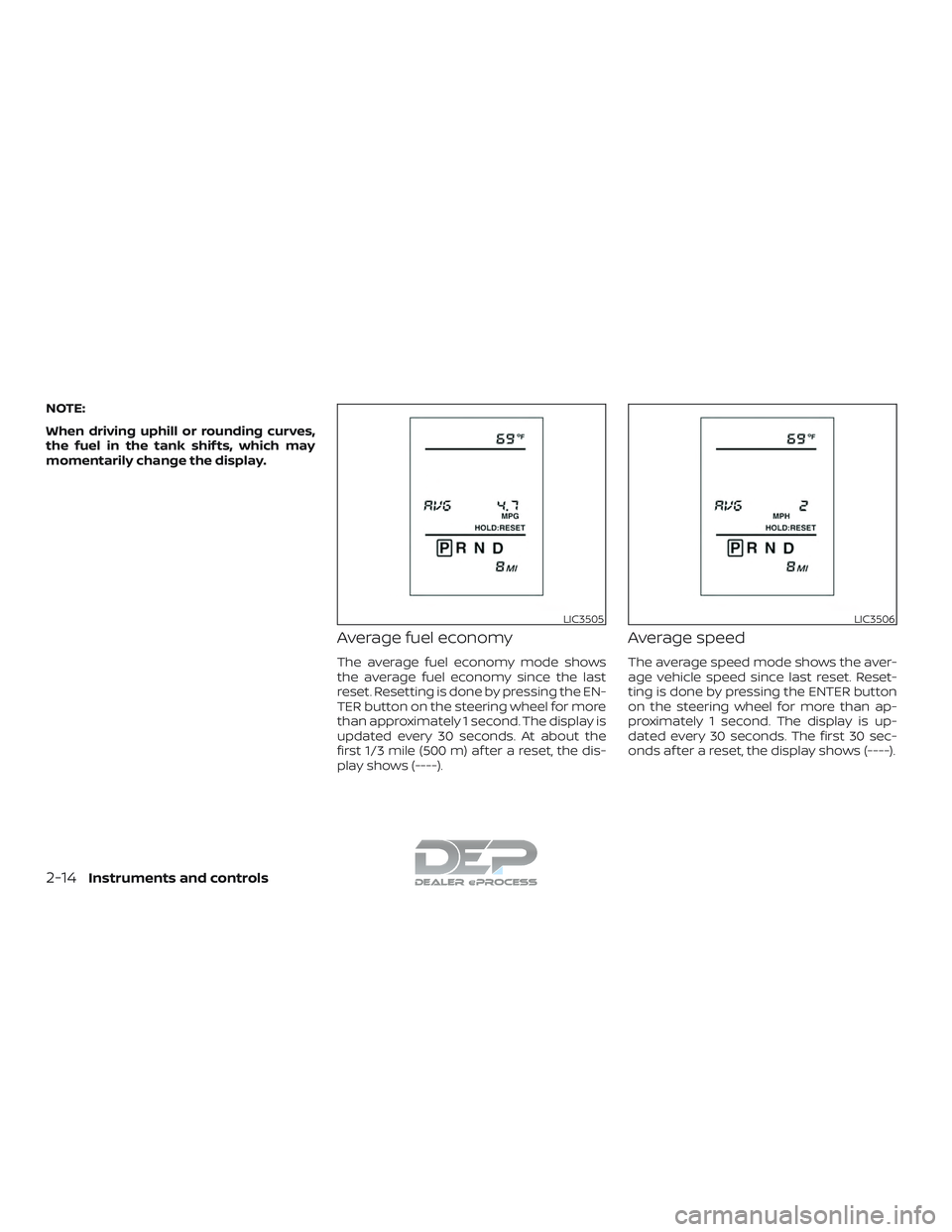
Average fuel economy
The average fuel economy mode shows
the average fuel economy since the last
reset. Resetting is done by pressing the EN-
TER button on the steering wheel for more
than approximately 1 second. The display is
updated every 30 seconds. At about the
first 1/3 mile (500 m) af ter a reset, the dis-
play shows (----).
Average speed
The average speed mode shows the aver-
age vehicle speed since last reset. Reset-
ting is done by pressing the ENTER button
on the steering wheel for more than ap-
proximately 1 second. The display is up-
dated every 30 seconds. The first 30 sec-
onds af ter a reset, the display shows (----).
LIC3505LIC3506
2-14Instruments and controls
Page 120 of 650
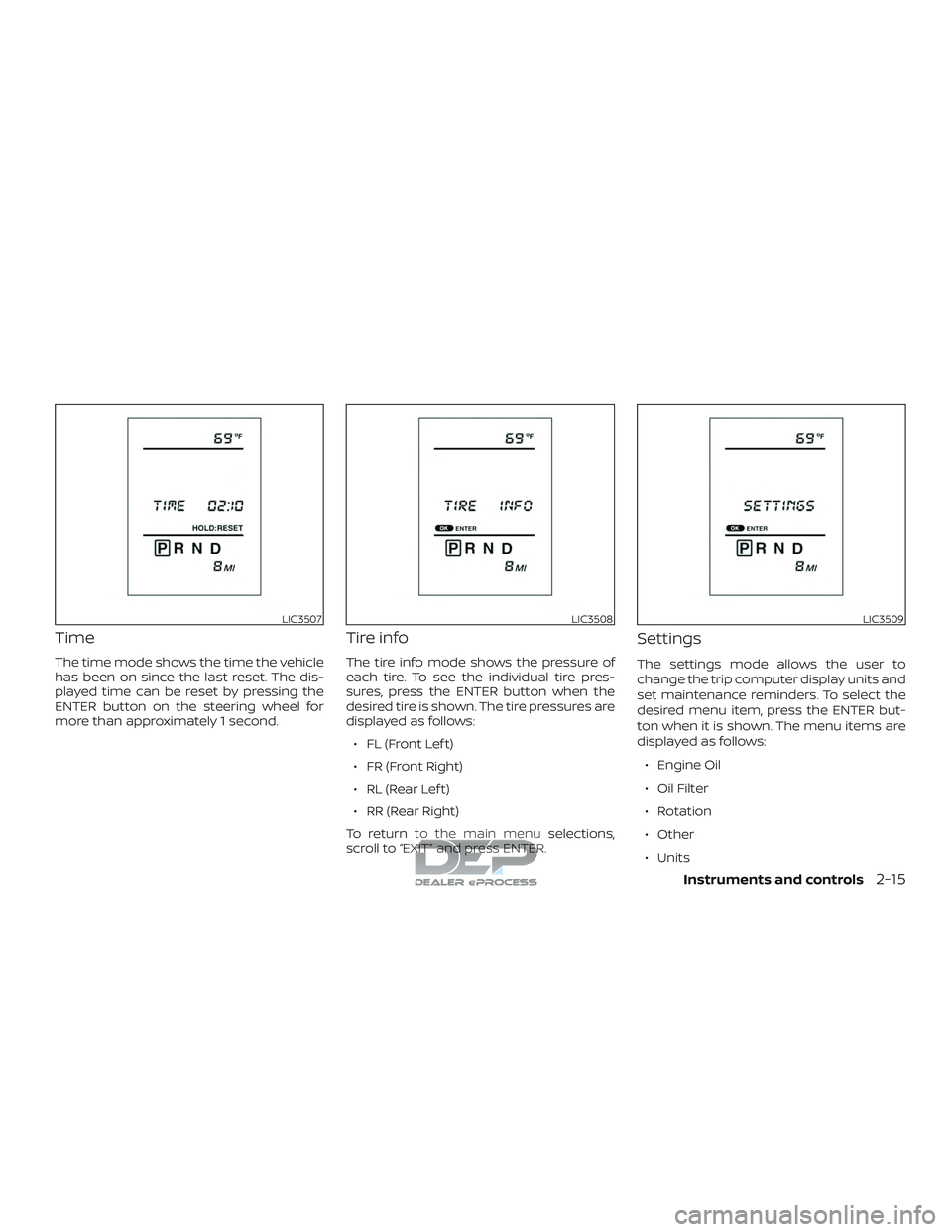
Time
The time mode shows the time the vehicle
has been on since the last reset. The dis-
played time can be reset by pressing the
ENTER button on the steering wheel for
more than approximately 1 second.
Tire info
The tire info mode shows the pressure of
each tire. To see the individual tire pres-
sures, press the ENTER button when the
desired tire is shown. The tire pressures are
displayed as follows:∙ FL (Front Lef t)
∙ FR (Front Right)
∙ RL (Rear Lef t)
∙ RR (Rear Right)
To return to the main menu selections,
scroll to “EXIT” and press ENTER.
Settings
The settings mode allows the user to
change the trip computer display units and
set maintenance reminders. To select the
desired menu item, press the ENTER but-
ton when it is shown. The menu items are
displayed as follows:
∙ Engine Oil
∙ Oil Filter
∙ Rotation
∙ Other
∙ Units
LIC3507LIC3508LIC3509
Instruments and controls2-15
Page 132 of 650
∙ If the light illuminates while driving,avoid sudden steering maneuvers or
abrupt braking, reduce vehicle speed,
pull off the road to a safe location and
stop the vehicle as soon as possible.
Driving with under-inflated tires may
permanently damage the tires and in-
crease the likelihood of tire failure. Se-
rious vehicle damage could occur and
may lead to an accident and could re-
sult in serious personal injury or
death. Check the tire pressure for all
four tires. Adjust the tire pressure to
the recommended COLD tire pressure
show on the Tire and Loading Infor-
mation label located in the driver’s
door opening to turn the low tire pres-
sure warning light off. If the light still
illuminates while driving af ter adjust-
ing the tire pressure, a tire may be flat
or the TPMS may be malfunctioning. If
you have a flat tire, replace it with a
spare tire as soon as possible. If no tire
is flat and all tires are properly in-
flated, have the vehicle checked. It is
recommended that you visit a NISSAN
dealer for this service. ∙ When replacing a wheel without the
TPMS such as the spare tire, the TPMS
will not function and the low tire pres-
sure warning light will flash for ap-
proximately 1 minute. The light will re-
main on af ter 1 minute. Have your
tires replaced and/or TPMS system
reset as soon as possible. It is recom-
mended that you visit a NISSAN dealer
for these services.
∙ Replacing tires with those not origi- nally specified by NISSAN could affect
the proper operation of the TPMS.
CAUTION
∙ The TPMS is not a substitute for theregular tire pressure check. Be sure to
check the tire pressure regularly.
∙ If the vehicle is being driven at speeds of less than 16 mph (25 km/h), the
TPMS may not operate correctly.
∙ Be sure to install the specified size of tires to the four wheels correctly.
Low windshield-washer
fluid warning light (if so
equipped)
This light comes on when the windshield-
washer fluid is at a low level. Add
windshield-washer fluid as necessary. For
additional information, refer to “Windshield-
washer fluid” in the “Do-it-yourself ” section
of this manual.
Malfunction warning light(red) (if so equipped)
If this warning light illuminates this indi-
cates either the coolant temperature is
above a critical threshold or the exhaust
temperatures are above a critical thresh-
old. When illuminated this lamp indicates
the need to stop the engine as soon as it
can be safely done. The engine must re-
main shut down until the engine can be
repaired. For additional information, refer
to the “Titan Diesel Owner’s Manual”.
Instruments and controls2-27
Page 138 of 650
∙ NISSAN Intelligent Key® operation infor-mation
∙ Indicators and warnings
∙ Tire Pressure information
HOW TO USE THE VEHICLE
INFORMATION DISPLAY
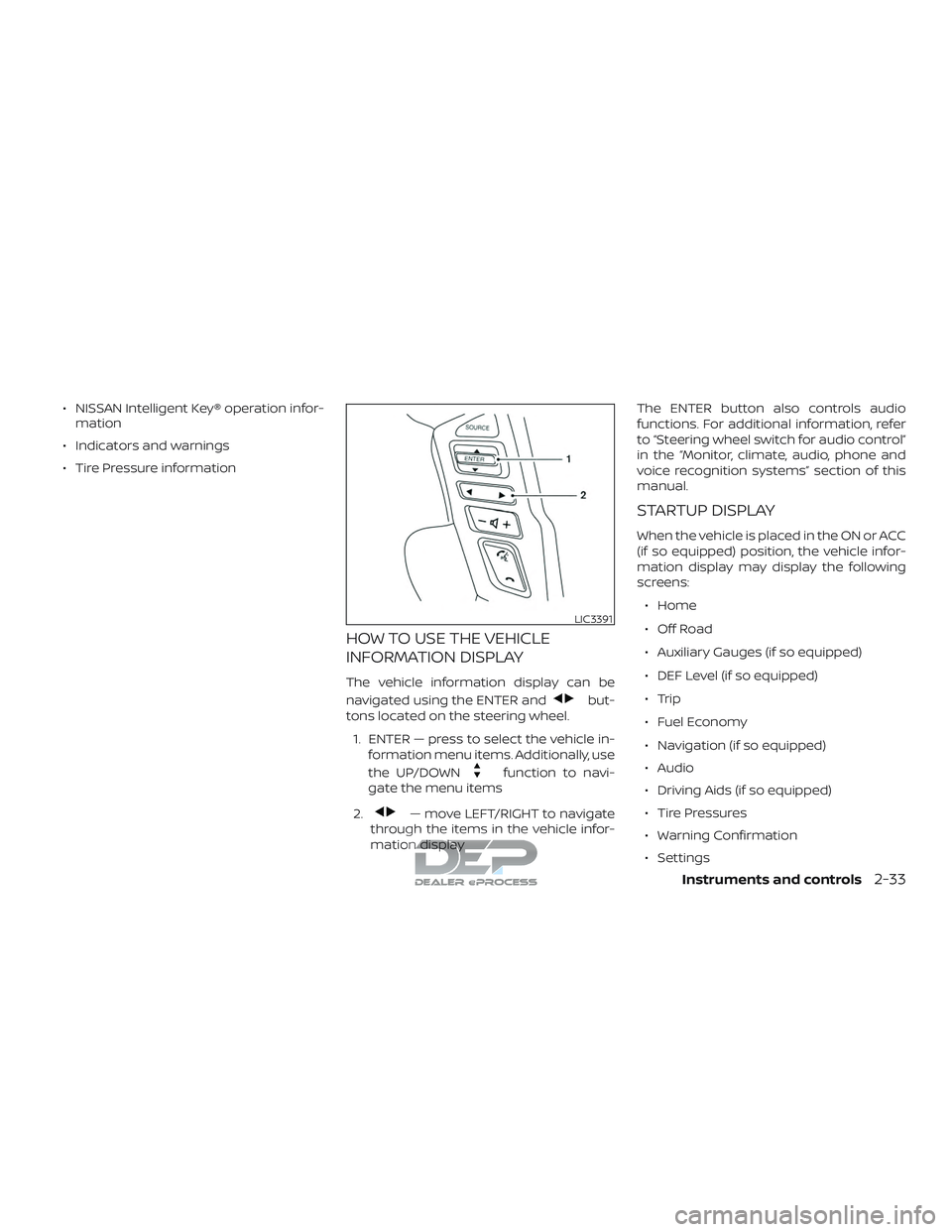
The vehicle information display can be
navigated using the ENTER and
but-
tons located on the steering wheel.
1. ENTER — press to select the vehicle in- formation menu items. Additionally, use
the UP/DOWN
function to navi-
gate the menu items
2.
— move LEFT/RIGHT to navigate
through the items in the vehicle infor-
mation display The ENTER button also controls audio
functions. For additional information, refer
to “Steering wheel switch for audio control”
in the “Monitor, climate, audio, phone and
voice recognition systems” section of this
manual.
STARTUP DISPLAY
When the vehicle is placed in the ON or ACC
(if so equipped) position, the vehicle infor-
mation display may display the following
screens:
∙ Home
∙ Off Road
∙ Auxiliary Gauges (if so equipped)
∙ DEF Level (if so equipped)
∙ Trip
∙ Fuel Economy
∙ Navigation (if so equipped)
∙ Audio
∙ Driving Aids (if so equipped)
∙ Tire Pressures
∙ Warning Confirmation
∙ Settings
LIC3391
Instruments and controls2-33
Page 142 of 650
Menu itemResult
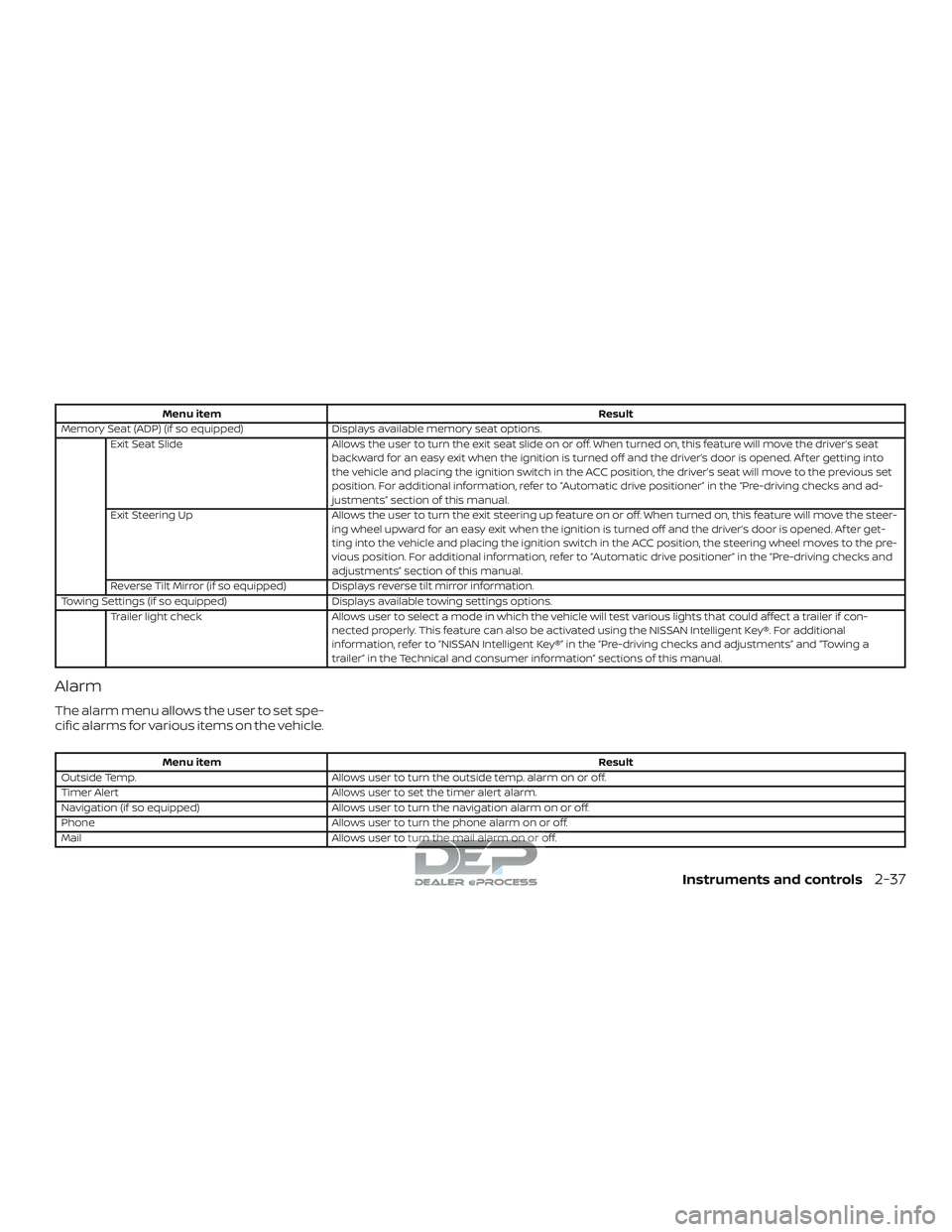
Memory Seat (ADP) (if so equipped) Displays available memory seat options.
Exit Seat Slide Allows the user to turn the exit seat slide on or off. When turned on, this feature will move the driver’s seat
backward for an easy exit when the ignition is turned off and the driver’s door is opened. Af ter getting into
the vehicle and placing the ignition switch in the ACC position, the driver’s seat will move to the previous set
position. For additional information, refer to “Automatic drive positioner” in the “Pre-driving checks and ad-
justments” section of this manual.
Exit Steering Up Allows the user to turn the exit steering up feature on or off. When turned on, this feature will move the steer-
ing wheel upward for an easy exit when the ignition is turned off and the driver’s door is opened. Af ter get-
ting into the vehicle and placing the ignition switch in the ACC position, the steering wheel moves to the pre-
vious position. For additional information, refer to “Automatic drive positioner” in the “Pre-driving checks and
adjustments” section of this manual.
Reverse Tilt Mirror (if so equipped) Displays reverse tilt mirror information.
Towing Settings (if so equipped) Displays available towing settings options.
Trailer light check Allows user to select a mode in which the vehicle will test various lights that could affect a trailer if con-
nected properly. This feature can also be activated using the NISSAN Intelligent Key®. For additional
information, refer to “NISSAN Intelligent Key®” in the “Pre-driving checks and adjustments” and “Towing a
trailer” in the Technical and consumer information” sections of this manual.
Alarm
The alarm menu allows the user to set spe-
cific alarms for various items on the vehicle.
Menu item Result
Outside Temp. Allows user to turn the outside temp. alarm on or off.
Timer Alert Allows user to set the timer alert alarm.
Navigation (if so equipped) Allows user to turn the navigation alarm on or off.
Phone Allows user to turn the phone alarm on or off.
Mail Allows user to turn the mail alarm on or off.
Instruments and controls2-37