towing capacity NISSAN TITAN 2018 Owner´s Manual
[x] Cancel search | Manufacturer: NISSAN, Model Year: 2018, Model line: TITAN, Model: NISSAN TITAN 2018Pages: 650, PDF Size: 7.54 MB
Page 614 of 650
WARNING
Properly adjust the weight distributing
hitch so the rear of the bumper is no
higher than the measured reference
height when the trailer is attached. If
the rear bumper is higher than the mea-
sured reference height when loaded,
the vehicle may handle unpredictably
which could cause a loss of vehicle con-
trol and cause serious personal injury or
property damage.
Sway control device
Sudden maneuvers, wind gusts, and buf-
feting caused by other vehicles can affect
trailer handling. Sway control devices may
be used to help control these affects. If you
choose to use one, contact a reputable
trailer hitch supplier to make sure the sway
control device will work with the vehicle,
hitch, trailer and the trailer’s brake system.
Follow the instructions provided by the
manufacturer for installing and using the
sway control device.
Class I hitch
Class I trailer hitch equipment (receiver, ball
mount and hitch ball) can be used to tow
trailers of a maximum weight of 2,000 lbs.
(907 kg).
Class II hitch
Class II trailer hitch equipment (receiver,
ball mount and hitch ball) can be used to
tow trailers of a maximum weight of
3,500 lbs. (1,587 kg).
Class III hitch
Class III trailer hitch equipment (receiver,
ball mount and hitch ball) can be used to
tow trailers of a maximum weight of
5,000 lbs. (2,268 kg).
Class IV hitch
Class IV hitches are weight carrying (WC)
and weight distributing (WD) hitches de-
pending on the vehicle and hitch specifica-
tions. Not all Class IV hitches are rated to be
both. See the specific hitch for that infor-
mation. Class IV trailer hitch equipment (re-
ceiver, ball mount and hitch ball) used as
weight carrying are rated up to 10,000 lbs.
(4,535 kg) gross trailer weight (GTW) with a
maximum trailer tongue weight (TW) of
1,000 lbs. (453 kg). Class IV hitches used for
weight distributing are rated up to
14,000 lbs. (6,350 kg) gross trailer weight
(GTW) with a maximum trailer tongue
weight (TW) of 1,400 lbs. (635 kg). A Class IV
hitch usually has a 2" square receiver open-
ing. A higher class drawbar does not in-crease the towing capacity of the hitch. To
use this class of hitch for weight distribu-
tion requires a weight distribution system.
Class IV hitches attach to the vehicle frame
only. A weight distributing hitch should be
used to tow trailers that weigh over
5,000 lbs. (2,268 kg).
Your vehicle may be equipped with Class IV
weigh distributing trailer hitch that has a
14,000 lbs. (6,350 kg) maximum weight rat-
ing, but your vehicle is only capable of tow-
ing the maximum trailer weights shown in
the “Towing Load/Specification” chart in
this section.5th wheel/gooseneck
A 5th wheel or gooseneck trailer can be
towed by installing a 5th wheel or goose-
neck trailer hitch. These types of hitches
are mounted in the bed of the pick-up. A
professional trailer equipment supplier
should install these hitches as it is very im-
portant to mount the hitch correctly to dis-
tribute the king pin weight for the proper
load carrying and sway control perfor-
mance.
The king pin weight should be 15% of the
fully loaded trailer. Make sure the king pin
weight does not cause the gross vehicle
weight to exceed the Gross Maximum
Technical and consumer information10-47
Page 615 of 650
Weight Rating or the rear axle weight to
exceed the Rear Gross Axle Weight rating.
For additional information, refer to “Maxi-
mum load limits” in this section.
The weight of the trailer should not exceed
the maximum towing capacity for the ve-
hicle. For additional information, refer to
“Towing Load/Specification” chart in this
section.
Make sure the trailer design allows for the
correct vehicle to trailer clearances before
purchasing a 5th wheel trailer.
WARNING
∙ The hitch should not be attached to oraffect the operation of the impact-
absorbing bumper.
∙ Do not use axle-mounted hitches.
∙ Do not modif y the vehicle exhaust system, brake system, etc. to install a
trailer hitch.
∙ To reduce the possibility of additional damage if your vehicle is struck from
the rear, where practical, remove the
receiver when not in use. ∙ Regularly check that all trailer hitch
mounting bolts are securely
mounted.
∙ When towing with the hitch ball mounted to the rear bumper, do not
make sharp turns. The trailer may
contact the bumper and cause dam-
age to the bumper or trailer.
∙ When towing a 5th wheel trailer, do not make sharp turns while driving or
backing. The trailer may contact the
vehicle and cause damage to both the
trailer and vehicle.CAUTION
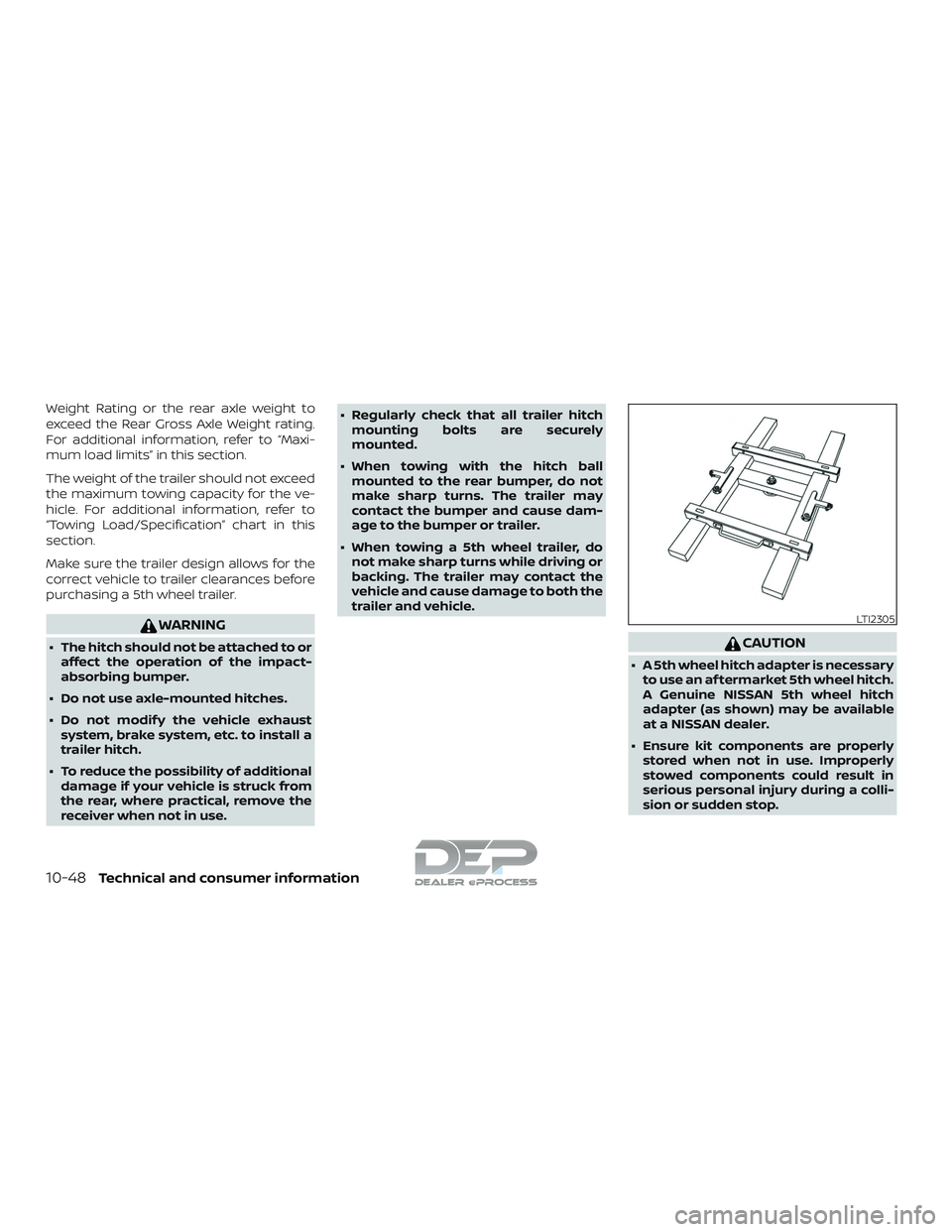
∙ A 5th wheel hitch adapter is necessaryto use an af termarket 5th wheel hitch.
A Genuine NISSAN 5th wheel hitch
adapter (as shown) may be available
at a NISSAN dealer.
∙ Ensure kit components are properly stored when not in use. Improperly
stowed components could result in
serious personal injury during a colli-
sion or sudden stop.
LTI2305
10-48Technical and consumer information