engine coolant NISSAN TITAN 2018 Owner´s Manual
[x] Cancel search | Manufacturer: NISSAN, Model Year: 2018, Model line: TITAN, Model: NISSAN TITAN 2018Pages: 650, PDF Size: 7.54 MB
Page 554 of 650
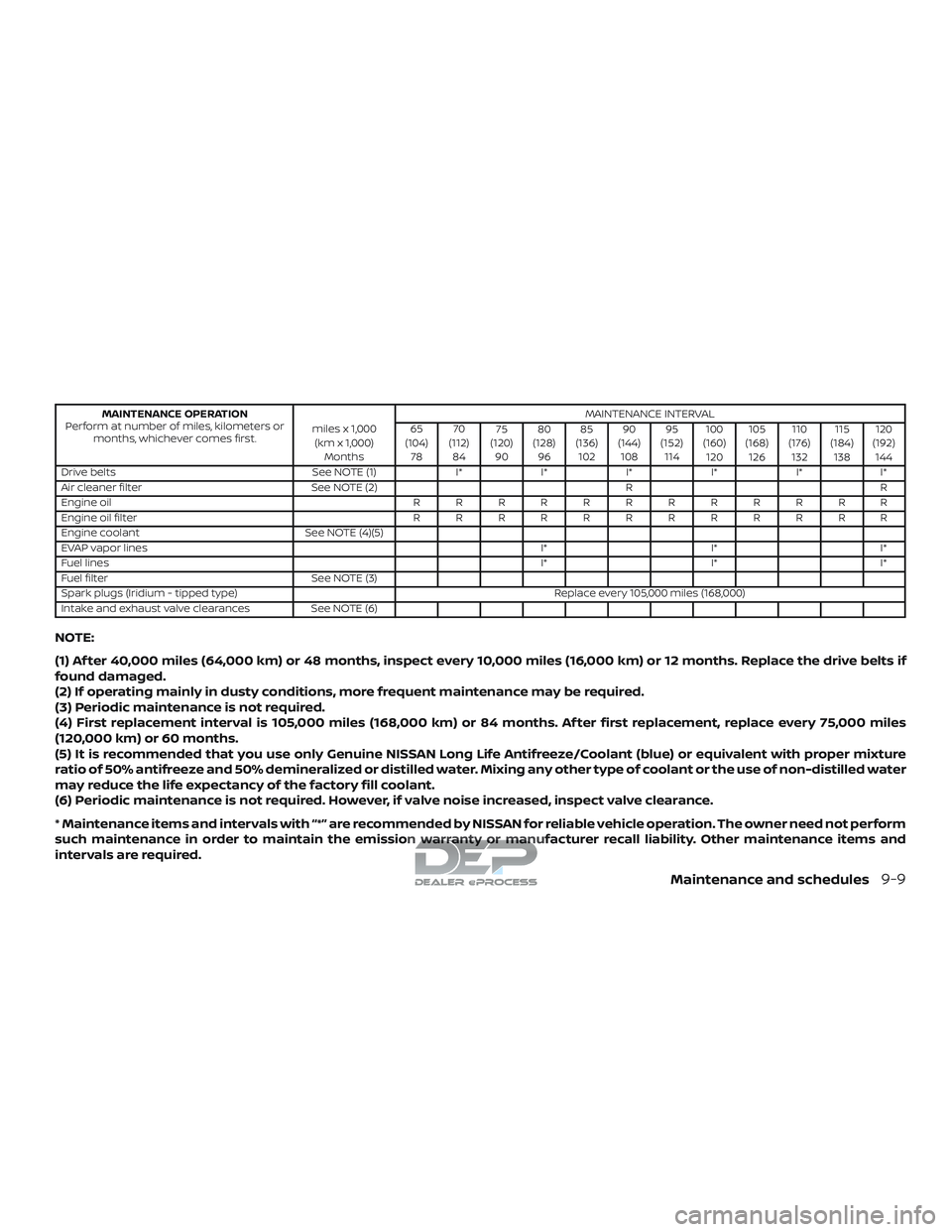
MAINTENANCE OPERATION
Perform at number of miles, kilometers or months, whichever comes first. miles x 1,000
(km x 1,000) Months MAINTENANCE INTERVAL
65
(104) 78 70
(112) 84 75
(120) 90 80
(128) 96 85
(136) 102 90
(144) 108 95
(152) 114 100
(160) 120 105
(168) 126 110
(176) 132 115
(184) 138 120
(192) 144
Drive belts See NOTE (1)I*I*I*I*I*I*
Air cleaner filter See NOTE (2) RR
Engine oil RRRRRRRRRRRR
Engine oil filter RRRRRRRRRRRR
Engine coolant See NOTE (4)(5)
EVAP vapor lines I*I*I*
Fuel lines I*I*I*
Fuel filter See NOTE (3)
Spark plugs (Iridium - tipped type) Replace every 105,000 miles (168,000)
Intake and exhaust valve clearances See NOTE (6)
NOTE:
(1) Af ter 40,000 miles (64,000 km) or 48 months, inspect every 10,000 miles (16,000 km) or 12 months. Replace the drive belts if
found damaged.
(2) If operating mainly in dusty conditions, more frequent maintenance may be required.
(3) Periodic maintenance is not required.
(4) First replacement interval is 105,000 miles (168,000 km) or 84 months. Af ter first replacement, replace every 75,000 miles
(120,000 km) or 60 months.
(5) It is recommended that you use only Genuine NISSAN Long Life Antifreeze/Coolant (blue) or equivalent with proper mixture
ratio of 50% antifreeze and 50% demineralized or distilled water. Mixing any other type of coolant or the use of non-distilled water
may reduce the life expectancy of the factory fill coolant.
(6) Periodic maintenance is not required. However, if valve noise increased, inspect valve clearance.
* Maintenance items and intervals with “*” are recommended by NISSAN for reliable vehicle operation. The owner need not perform
such maintenance in order to maintain the emission warranty or manufacturer recall liability. Other maintenance items and
intervals are required.
Maintenance and schedules9-9
Page 558 of 650
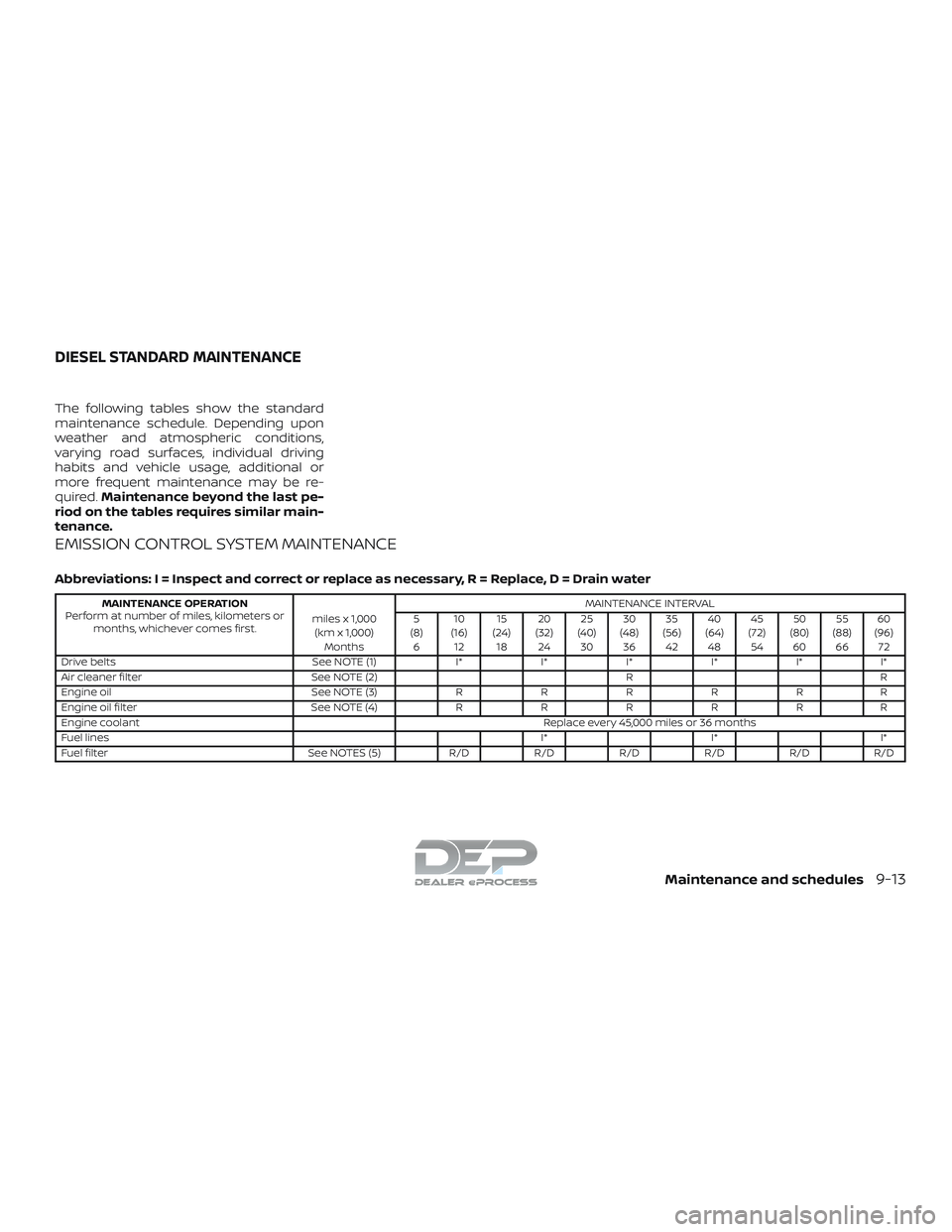
The following tables show the standard
maintenance schedule. Depending upon
weather and atmospheric conditions,
varying road surfaces, individual driving
habits and vehicle usage, additional or
more frequent maintenance may be re-
quired.Maintenance beyond the last pe-
riod on the tables requires similar main-
tenance.
EMISSION CONTROL SYSTEM MAINTENANCE
Abbreviations: I = Inspect and correct or replace as necessary, R = Replace, D = Drain water
MAINTENANCE OPERATION
Perform at number of miles, kilometers or months, whichever comes first. miles x 1,000
(km x 1,000) Months MAINTENANCE INTERVAL
5
(8) 6 10
(16) 12 15
(24) 18 20
(32) 24 25
(40) 30 30
(48) 36 35
(56) 42 40
(64) 48 45
(72) 54 50
(80) 60 55
(88) 66 60
(96) 72
Drive belts See NOTE (1)I*I*I*I*I*I*
Air cleaner filter See NOTE (2) RR
Engine oil See NOTE (3)RRRRRR
Engine oil filter See NOTE (4)RRRRRR
Engine coolant Replace every 45,000 miles or 36 months
Fuel lines I*I*I*
Fuel filter See NOTES (5)R/DR/DR/DR/DR/DR/D
DIESEL STANDARD MAINTENANCE
Maintenance and schedules9-13
Page 559 of 650
MAINTENANCE OPERATION
Perform at number of miles, kilometers or months, whichever comes first. miles x 1,000
(km x 1,000) Months MAINTENANCE INTERVAL
65
(104) 78 70
(112) 84 75
(120) 90 80
(128) 96 85
(136) 102 90
(144) 108 95
(152) 114 100
(160) 120 105
(168) 126 110
(176) 132 115
(184) 138 120
(192) 144
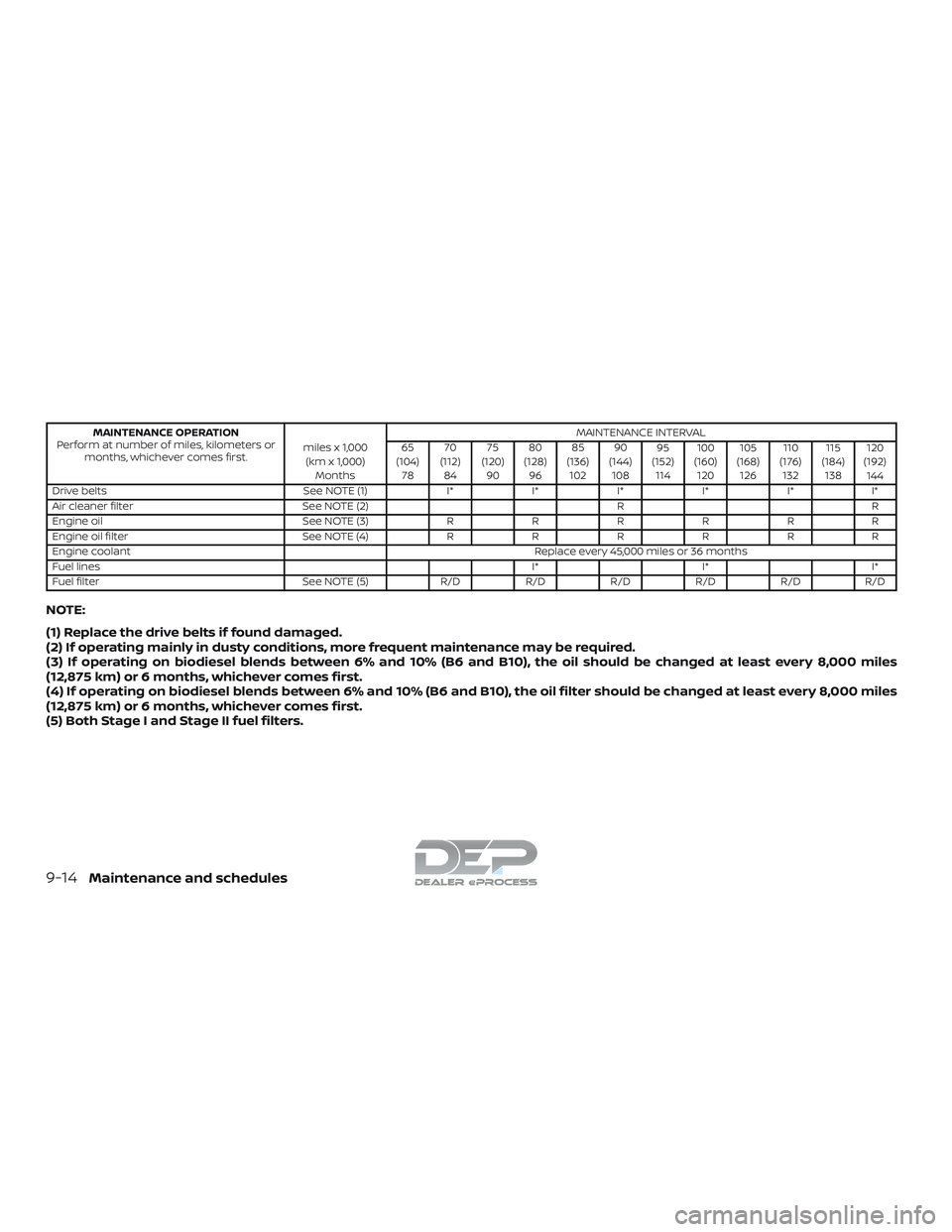
Drive belts See NOTE (1)I*I*I*I*I*I*
Air cleaner filter See NOTE (2) RR
Engine oil See NOTE (3)RRRRRR
Engine oil filter See NOTE (4)RRRRRR
Engine coolant Replace every 45,000 miles or 36 months
Fuel lines I*I*I*
Fuel filter See NOTE (5)R/DR/DR/DR/DR/DR/D
NOTE:
(1) Replace the drive belts if found damaged.
(2) If operating mainly in dusty conditions, more frequent maintenance may be required.
(3) If operating on biodiesel blends between 6% and 10% (B6 and B10), the oil should be changed at least every 8,000 miles
(12,875 km) or 6 months, whichever comes first.
(4) If operating on biodiesel blends between 6% and 10% (B6 and B10), the oil filter should be changed at least every 8,000 miles
(12,875 km) or 6 months, whichever comes first.
(5) Both Stage I and Stage II fuel filters.
9-14Maintenance and schedules
Page 569 of 650
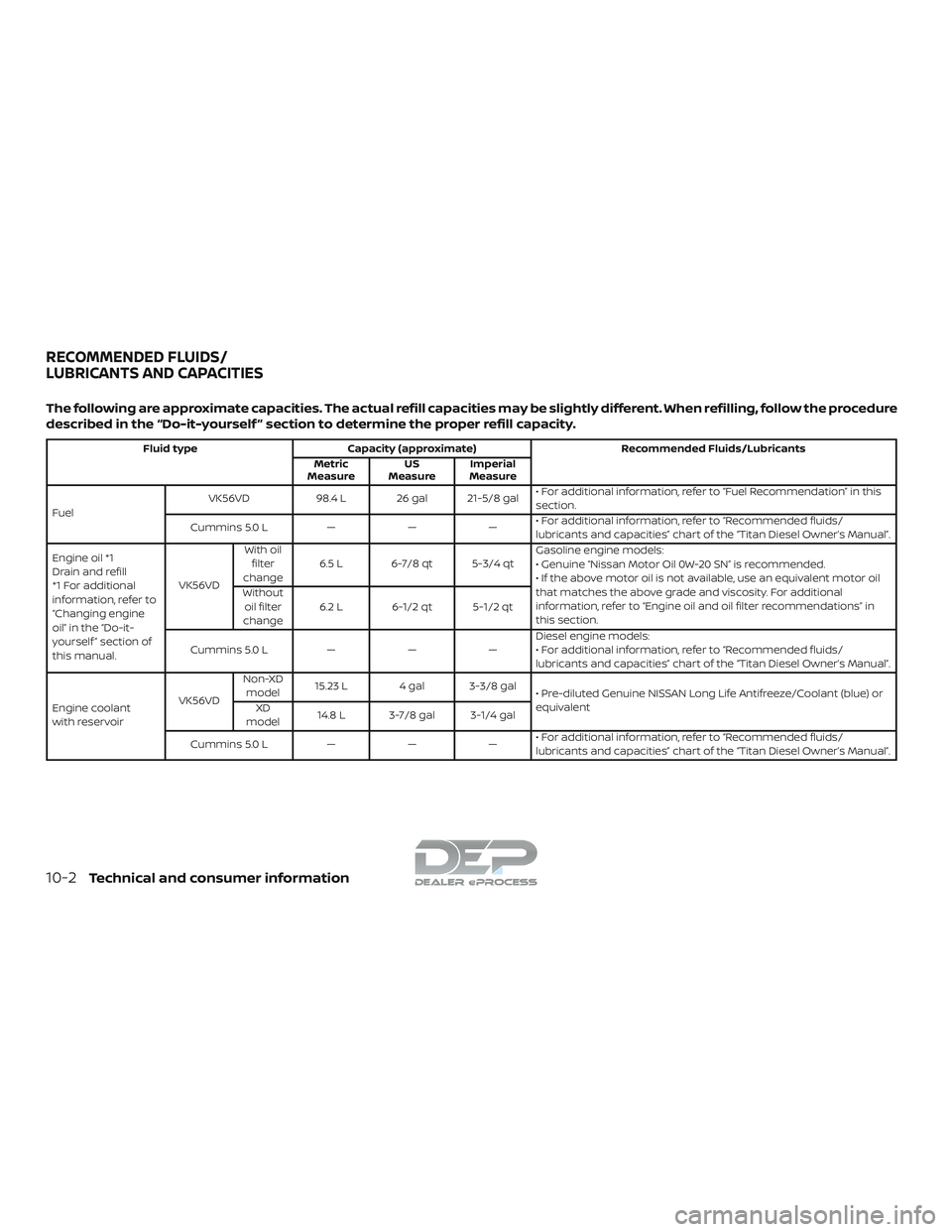
The following are approximate capacities. The actual refill capacities may be slightly different. When refilling, follow the procedure
described in the “Do-it-yourself ” section to determine the proper refill capacity.
Fluid typeCapacity (approximate) Recommended Fluids/Lubricants
Metric
Measure US
Measure Imperial
Measure
Fuel VK56VD
98.4 L 26 gal 21-5/8 gal • For additional information, refer to “Fuel Recommendation” in this
section.
Cummins 5.0 L ———• For additional information, refer to “Recommended fluids/
lubricants and capacities” chart of the “Titan Diesel Owner’s Manual”.
Engine oil *1
Drain and refill
*1 For additional
information, refer to
“Changing engine
oil” in the “Do-it-
yourself ” section of
this manual. VK56VD
With oil
filter
change 6.5 L 6-7/8 qt 5-3/4 qt
Gasoline engine models:
• Genuine “Nissan Motor Oil 0W-20 SN” is recommended.
• If the above motor oil is not available, use an equivalent motor oil
that matches the above grade and viscosity. For additional
information, refer to “Engine oil and oil filter recommendations” in
this section.
Without
oil filter
change 6.2 L 6-1/2 qt 5-1/2 qt
Cummins 5.0 L ———Diesel engine models:
• For additional information, refer to “Recommended fluids/
lubricants and capacities” chart of the “Titan Diesel Owner’s Manual”.
Engine coolant
with reservoir VK56VDNon-XD
model 15.23 L 4 gal 3-3/8 gal
• Pre-diluted Genuine NISSAN Long Life Antifreeze/Coolant (blue) or
equivalent
XD
model 14.8 L 3-7/8 gal 3-1/4 gal
Cummins 5.0 L ———• For additional information, refer to “Recommended fluids/
lubricants and capacities” chart of the “Titan Diesel Owner’s Manual”.
RECOMMENDED FLUIDS/
LUBRICANTS AND CAPACITIES
10-2Technical and consumer information
Page 626 of 650
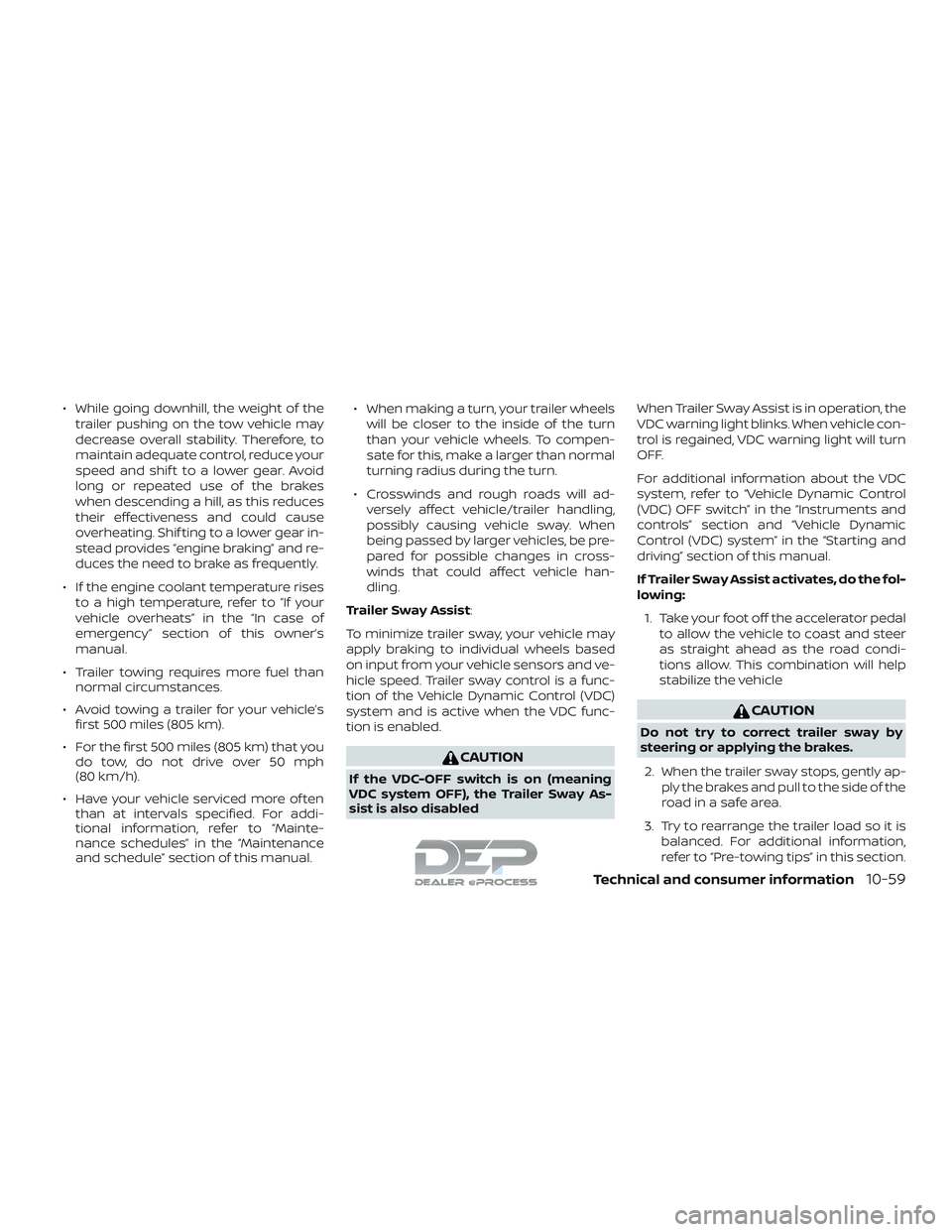
∙ While going downhill, the weight of thetrailer pushing on the tow vehicle may
decrease overall stability. Therefore, to
maintain adequate control, reduce your
speed and shif t to a lower gear. Avoid
long or repeated use of the brakes
when descending a hill, as this reduces
their effectiveness and could cause
overheating. Shif ting to a lower gear in-
stead provides “engine braking” and re-
duces the need to brake as frequently.
∙ If the engine coolant temperature rises to a high temperature, refer to “If your
vehicle overheats” in the “In case of
emergency” section of this owner’s
manual.
∙ Trailer towing requires more fuel than normal circumstances.
∙ Avoid towing a trailer for your vehicle’s first 500 miles (805 km).
∙ For the first 500 miles (805 km) that you do tow, do not drive over 50 mph
(80 km/h).
∙ Have your vehicle serviced more of ten than at intervals specified. For addi-
tional information, refer to “Mainte-
nance schedules” in the “Maintenance
and schedule” section of this manual. ∙ When making a turn, your trailer wheels
will be closer to the inside of the turn
than your vehicle wheels. To compen-
sate for this, make a larger than normal
turning radius during the turn.
∙ Crosswinds and rough roads will ad- versely affect vehicle/trailer handling,
possibly causing vehicle sway. When
being passed by larger vehicles, be pre-
pared for possible changes in cross-
winds that could affect vehicle han-
dling.
Trailer Sway Assist :
To minimize trailer sway, your vehicle may
apply braking to individual wheels based
on input from your vehicle sensors and ve-
hicle speed. Trailer sway control is a func-
tion of the Vehicle Dynamic Control (VDC)
system and is active when the VDC func-
tion is enabled.
CAUTION
If the VDC-OFF switch is on (meaning
VDC system OFF), the Trailer Sway As-
sist is also disabled When Trailer Sway Assist is in operation, the
VDC warning light blinks. When vehicle con-
trol is regained, VDC warning light will turn
OFF.
For additional information about the VDC
system, refer to “Vehicle Dynamic Control
(VDC) OFF switch” in the “Instruments and
controls” section and “Vehicle Dynamic
Control (VDC) system” in the “Starting and
driving” section of this manual.
If Trailer Sway Assist activates, do the fol-
lowing:
1. Take your foot off the accelerator pedal to allow the vehicle to coast and steer
as straight ahead as the road condi-
tions allow. This combination will help
stabilize the vehicle
CAUTION
Do not try to correct trailer sway by
steering or applying the brakes.
2. When the trailer sway stops, gently ap- ply the brakes and pull to the side of the
road in a safe area.
3. Try to rearrange the trailer load so it is balanced. For additional information,
refer to “Pre-towing tips” in this section.
Technical and consumer information10-59
Page 635 of 650
Brakewearindicators.......2-32,8-21
Parking brake operation.........5-22
Self-adjustingbrakes...........8-21
Brake assist ..................5-58
Brakefluid....................8-13
Brakes......................8-21
Brake system ..................5-56
Break-in schedule ...............5-43
Brightness/contrast button .........4-9
Brightness control Instrument panel .............2-58
Bulb check/instrument panel ........2-22
Bulb replacement ...............8-31
C
Capacities and recommended fuel/
lubricants....................10-2
Cargolightswitch...............2-60
Cargo
(See vehicle loading information) .....10-22
Car phone or CB radio ...........4-120
CDcareandcleaning.............4-86
CD player
(See audio system) .......4-59,4-65,4-72
Check tire pressure ..............2-42
Childrestraints........1-24, 1-25, 1-26, 1-29 LATCH (Lower Anchors and Tethers for
CHildren)System............. .1-29
Precautions on child
restraints......1-26, 1-34, 1-40, 1-44, 1-50
Top tether strap anchor point
locations.................. .1-31Child safety rear door lock
..........3-9
Chimes, audible reminders .........2-32
Cleaningexteriorandinterior......7-2,7-4
Climatecontrolseatswitch.........2-60
Clock setting (models with Navigation
System)......................4-7
Clock setting (models without Navigation
System)..................4-58,4-63
C.M.V.S.S. certification label .........10-18
Cold weather driving .............5-69
Compact disc (CD) player . . .4-59, 4-65, 4-72
Compass ....................2-18
Console light ..................2-92
Control panel buttons .............4-4
Back button .................4-7
Brightness/contrast button .......4-9
Enterbutton.................4-4
Withnavigationsystem..........4-4
Controls Audio controls (steering wheel) .....4-87
Heater and air conditioner controls . .4-44
Heater and air conditioner controls
(manual) ...................4-34
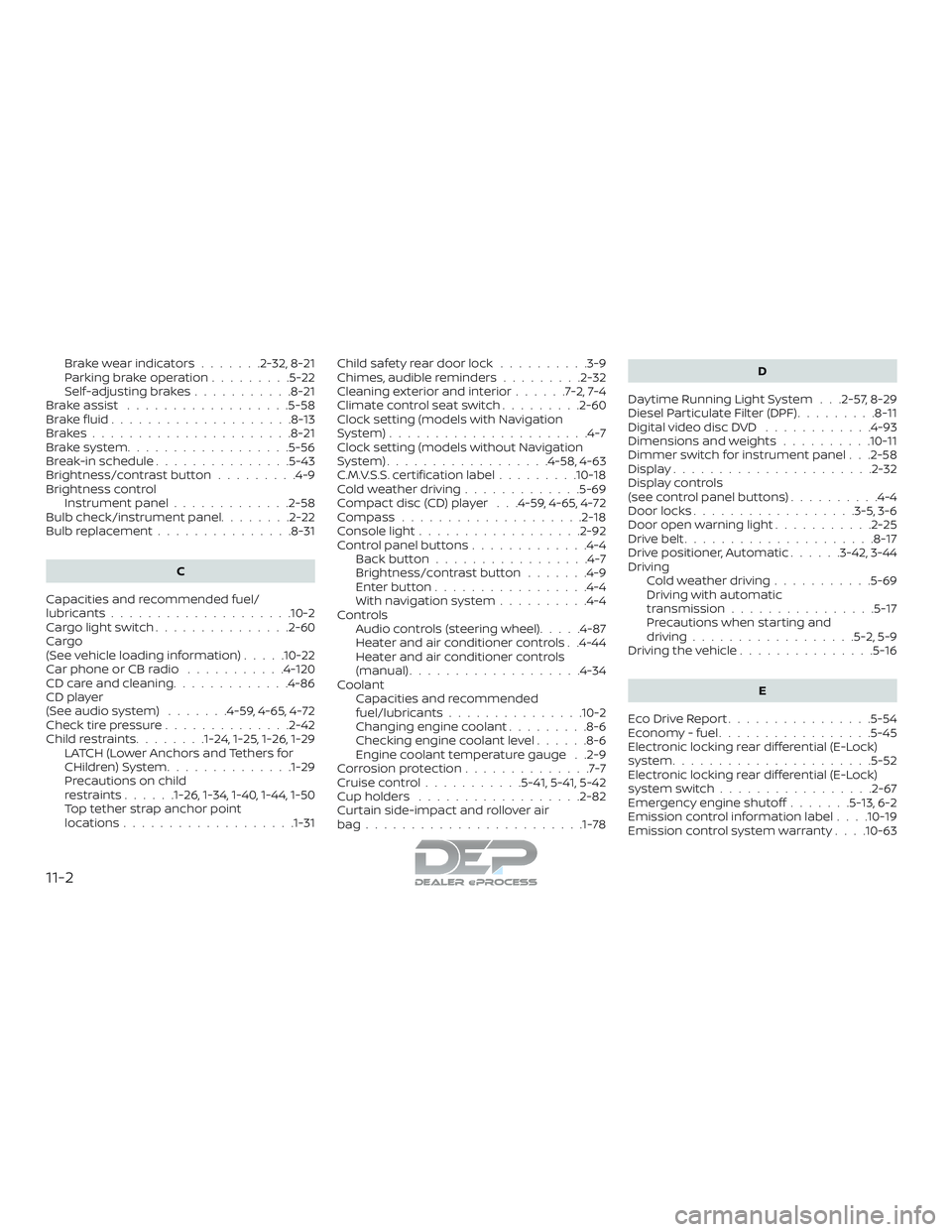
Coolant Capacities and recommended
fuel/lubricants...............10-2
Changing engine coolant .........8-6
Checking engine coolant level ......8-6
Engine coolant temperature gauge . .2-9
Corrosionprotection..............7-7
Cruisecontrol...........5-41,5-41,5-42
Cupholders ..................2-82
Curtain side-impact and rollover air
bag........................1-78 D
Daytime Running Light System . . .2-57, 8-29
Diesel Particulate Filter (DPF) .........8-11
DigitalvideodiscDVD ............4-93
Dimensions and weights ..........10-11
Dimmer switch for instrument panel . . .2-58
Display......................2-32
Display controls
(see control panel buttons) ..........4-4
Door locks ..................3-5,3-6
Door open warning light ...........2-25
Drivebelt.....................8-17
Drive positioner, Automatic ......3-42,3-44
Driving Coldweatherdriving...........5-69
Driving with automatic
transmission ................5-17
Precautions when starting and
driving ..................5-2,5-9
Driving the vehicle ...............5-16
E
Eco Drive Report ................5-54
Economy - fuel .................5-45
Electronic locking rear differential (E-Lock)
system......................5-52
Electronic locking rear differential (E-Lock)
systemswitch.................2-67
Emergency engine shutoff .......5-13, 6-2
Emission control information label . . . .10-19
Emission c
ontrol system warranty . . . .10-63
11-2
Page 636 of 650
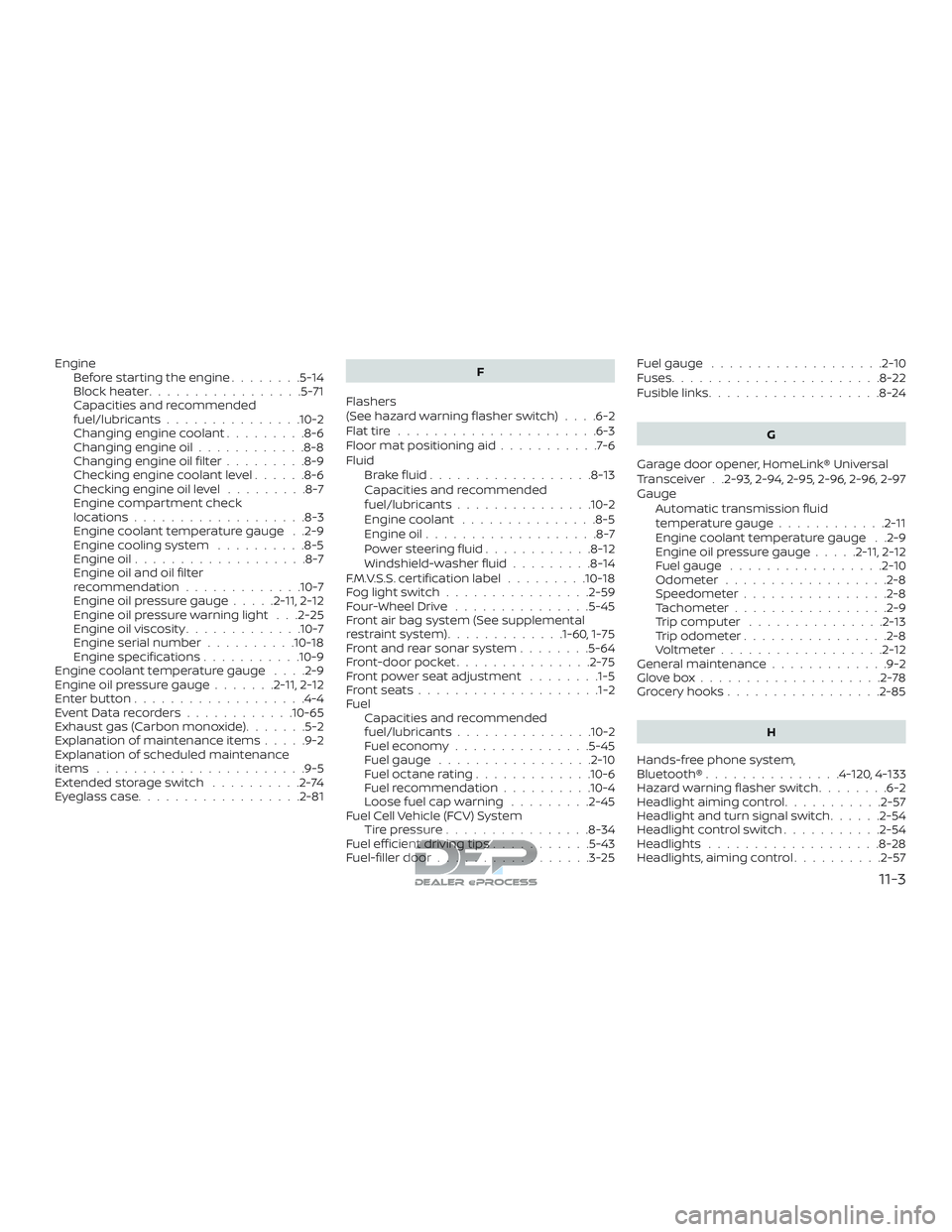
EngineBefore starting the engine ........5-14
Blockheater.................5-71
Capacities and recommended
fuel/lubricants...............10-2
Changing engine coolant .........8-6
Changing engine oil ............8-8
Changing engine oil filter .........8-9
Checking engine coolant level ......8-6
Checking engine oil level .........8-7
Engine compartment check
locations...................8-3
Engine coolant temperature gauge . .2-9
Engine cooling system ..........8-5
Engine oil ...................8-7
Engine oil and oil filter
recommendation .............10-7
Engine oil pressure gauge .....2-11, 2-12
Engine oil pressure warning light . . .2-25
Engine oil viscosity .............10-7
Engine serial number ..........10-18
Engine specifications ...........10-9
Engine coolant temperature gauge ....2-9
Engine oil pressure gauge .......2-11, 2-12
Enterbutton...................4-4
EventDatarecorders............10-65
Exhaust gas (Carbon monoxide) .......5-2
Explanation of maintenance items .....9-2
Explanation of scheduled maintenance
items .......................9-5
Extended storage switch ..........2-74
Eyeglasscase..................2-81 F
Flashers
(See hazard warning flasher switch) ....6-2
Flattire......................6-3
Floormatpositioningaid...........7-6
Fluid Brakefluid..................8-13
Capacities and recommended
fuel/lubricants...............10-2
Engine coolant ...............8-5
Engine oil ...................8-7
Powersteeringfluid............8-12
Windshield-washer fluid .........8-14
F.M.V.S.S. certification label .........10-18
Foglightswitch................2-59
Four-Wheel Drive ...............5-45
Front air bag system (See supplemental
restraint system) .............1-60, 1-75
Front and rear sonar system ........5-64
Front-door pocket ...............2-75
Front power seat adjustment ........1-5
Frontseats....................1-2
Fuel Capacities and recommended
fuel/lubricants...............10-2
Fuel economy ...............5-45
Fuel gauge .................2-10
Fueloctanerating.............10-6
Fuel recommendation ..........10-4
Loose fuel cap warning .........2-45
Fuel Cell Vehicle (FCV) System Tire pressure ................8-34
Fuel efficient driving tips ...........5-43
Fuel-filler door .................3-25 Fuel gauge
...................2-10
Fuses.......................8-22
Fusiblelinks...................8-24
G
Garage door opener, HomeLink® Universal
Transceiver . .2-93, 2-94, 2-95, 2-96, 2-96, 2-97
Gauge Automatic transmission fluid
temperature gauge ............2-11
Engine coolant temperature gauge . .2-9
Engine oil pressure gauge .....2-11, 2-12
Fuel gauge .................2-10
Odometer ..................2-8
Speedometer ................
2
-8
Tachometer .................2-9
Trip computer ...............2-13
Trip odometer ................2-8
Voltmeter..................2-12
General maintenance .............9-2
Glovebox....................2-78
Grocery hooks .................2-85
H
Hands-free phone system,
Bluetooth®...............4-120,4-133
Hazardwarningflasherswitch........6-2
Headlightaimingcontrol...........2-57
Headlight and turn signal switch ......2-54
Headlightcontrolswitch...........2-54
Headlights...................8-28
Headlights,aimingcontrol..........2-57
11-3
Page 640 of 650
Precautions when starting and
driving..................5-2,5-9
Push starting................6-15
Starting the engine (diesel only) ......5-16
Starting the engine
(gasoline engine only) .............5-15
Steering Powersteeringfluid............8-12
Power steering system .........5-56
Steering wheel .................3-29
Steering wheel audio control switch . . .4-87
Stoplight ....................8-31
Storage .....................2-75
Storagetray...................2-79
Sunglasses case ................2-81
Sunglasses holder ...............2-81
Sunvisors....................3-30
Supplemental air bag warning labels . . .1-80
Supplemental air bag warning
light.....................1-81, 2-29
Supplemental front impact air bag
system ...................1-60, 1-75
Supplemental restraint system Information and warning labels . . . .1-80
Precautions on supplemental
restraint system ...........1-53, 1-68
Supplemental restraint system
(Supplemental air bag system) .......1-53
Switch Autolightswitch..............2-55
Automatic power window switch . . .2-89
Electronic locking rear differential (E-Lock)
system switch ...............2-67
Foglightswitch..............2-59
Hazard warning flasher switch ......6-2
Headlightaimingcontrol.........2-57 Headlight and turn signal switch
....2-54
Headlightcontrolswitch.........2-54
Hill descent control switch .......2-66
Instrument brightness control .....2-58
Power door lock switch ..........3-6
Powerinverterswitch ..........2-68
Rear sonar system off switch ......2-69
Tow mode switch .............2-70
Turn signal switch .............2-58
Vehicle dynamic control (VDC) off
switch....................2-65
T
Tachometer ...................2-9
Tailgate ................. .3-37, 3-37
Temperature gauge Engine coolant temperature gauge . .2-9
Thef t (NISSAN Vehicle Immobilizer System),
engine start ...............2-49,5-14
Three-waycatalyst...............5-2
Tie down hooks ................3-41
Tire Flattire....................6-3
Spare tire ..........6-4,6-6,6-7,8-46
Tire and Loading Information label . .10-20
Tire chains .................8-42
Tire pressure ................8-34
Tirerotation ................8-42
Tires of 4-wheel drive ...........8-45
Types of tires ................8-41
Uniform tire quality grading ......10-62
Wheels and tires ..........8-34,10-10
Wheel/tire size ...............10-10 Tire pressure
..................8-34
Lowtirepressurewarninglight.....2-26
Tire Pressure Monitoring System
(TPMS)....................5-3,6-3
Towing 2-wheel drive models ...........6-17
Flattowing.................10-61
Towing load/specification .......10-40
Trailertowing...............10-36
Towingatrailer................10-36
Towingyourvehicle..............6-16
Tow mode switch ...............2-70
Trailer Brake Controller Unit (TBCU) .....2-71
Transceiver HomeLink® Universal
Transceiver ..........2-93,2-94,2-95,
2-96, 2-96, 2-97
Transfer case ..................
5
-46
Transmission Driving with automatic
transmission................5-17
Travel (See registering a vehicle in another
country) .....................10-17
Trip computer .................2-13
Trip odometer ..................2-8
Troubleshooting guide
(NISSAN voice recognition system) ....4-147
Truckbox.................3-37, 3-37
Truck - camper loading ...........10-34
Turn signal switch ...............2-58
U
Under seat storage bin .........2-77,2-81
Uniform tire quality grading ........10-62
11-7