fuel cap NISSAN TITAN 2019 Owner´s Manual
[x] Cancel search | Manufacturer: NISSAN, Model Year: 2019, Model line: TITAN, Model: NISSAN TITAN 2019Pages: 682, PDF Size: 7.99 MB
Page 655 of 682
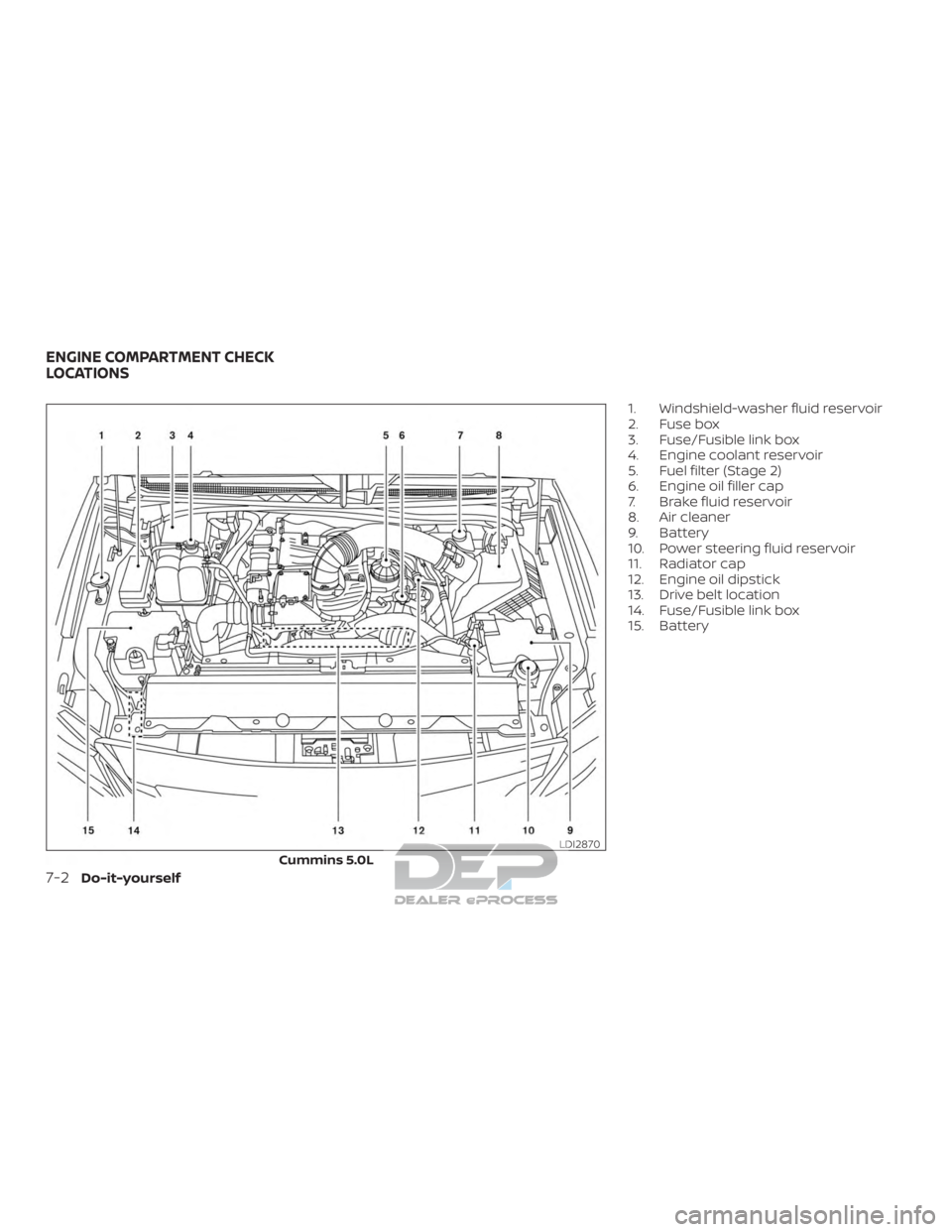
1. Windshield-washer fluid reservoir
2. Fuse box
3. Fuse/Fusible link box
4. Engine coolant reservoir
5. Fuel filter (Stage 2)
6. Engine oil filler cap
7. Brake fluid reservoir
8. Air cleaner
9. Battery
10. Power steering fluid reservoir
11. Radiator cap
12. Engine oil dipstick
13. Drive belt location
14. Fuse/Fusible link box
15. Battery
Cummins 5.0L
LDI2870
ENGINE COMPARTMENT CHECK
LOCATIONS
7-2Do-it-yourself
Page 663 of 682
WARNING
∙ Stay clear from the exhaust outlet andexhaust gases. These can cause burns
or personal injury.
∙ To avoid the risk of personal injury or fire, do not park the vehicle over flam-
mable materials such as dry grass,
waste paper or rags, as hot vehicle
components may ignite them.
CAUTION
To maintain maximum Diesel Particu-
late Filter (DPF) performance, follow
these precautions:
∙ Use ultra low-sulfur fuel.
∙ Use an engine oil specified by NISSAN.For additional information, refer to
“Recommended fluids/lubricants and
capacities” in the “Capacities and
specifications” section of this manual.
If an engine oil not specified by
NISSAN is used, it could cause DPF
malfunction or reduced fuel
efficiency. ∙ Do not modif y the DPF, muffler or ex-
haust pipe. Otherwise it could affect
the DPF performance and cause a
malfunction.
∙ Do not kick or hit the DPF. The DPF has a built-in catalyst system in the muf-
fler. Such an impact could cause DPF
damage.
The DPF reduces the amount of materials
that affect the environment by collecting
particulate matter included in exhaust
gases. Normally, particulate matter accu-
mulated in the DPF is automatically burned
and converted to harmless substances
during driving. However, particulate matter
collected in the DPF cannot be burned un-
der the following conditions: ∙ When vehicle speed remains below 5 mph (8 km/h) for a long period of time.
∙ When the engine is frequently stopped and restarted within 10 minutes.
∙ When the vehicle is frequently used for short journeys of 10 minutes or less.
∙ When the engine is frequently stopped before it has warmed up. In these cases, it becomes difficult to burn
particulate matter that has accumulated
in the DPF. As a result, the DPF warning light
will illuminate/blink and one of the follow-
ing messages will display on the vehicle
information display (in order of severity):
∙ Exhaust Filter Overloaded See Owner’s Manual for Drive Pattern
∙ Exhaust Filter Overloaded Engine Power Reduced See Owner’s Manual
∙ Exhaust Filter Overloaded Immediate Service Required
For additional information, refer to “Meters
and gauges" in the “Instrument panel” sec-
tion of this manual.
CAUTION
∙ If the vehicle continues to be driven with the DPF warning light illumi-
nated and without doing the regen-
eration process, the fail-safe will limit
the engine revolutions and/or torque.
In this case, it is recommended to con-
tact a NISSAN dealer to have the Ser-
vice Regeneration procedure
performed.
DIESEL PARTICULATE FILTER (DPF)
7-10Do-it-yourself
Page 666 of 682

8 Capacities and Specifications
Recommended fluids/lubricants and
capacities.......................................8-2
Fuel recommendation ........................8-3
Engine oil and oil filter
recommendations ...........................8-5 Specifications
...................................8-7
Engine .......................................8-7
Readiness for Inspection/Maintenance (I/M)
test (diesel engine only) ..........................8-8
Page 667 of 682
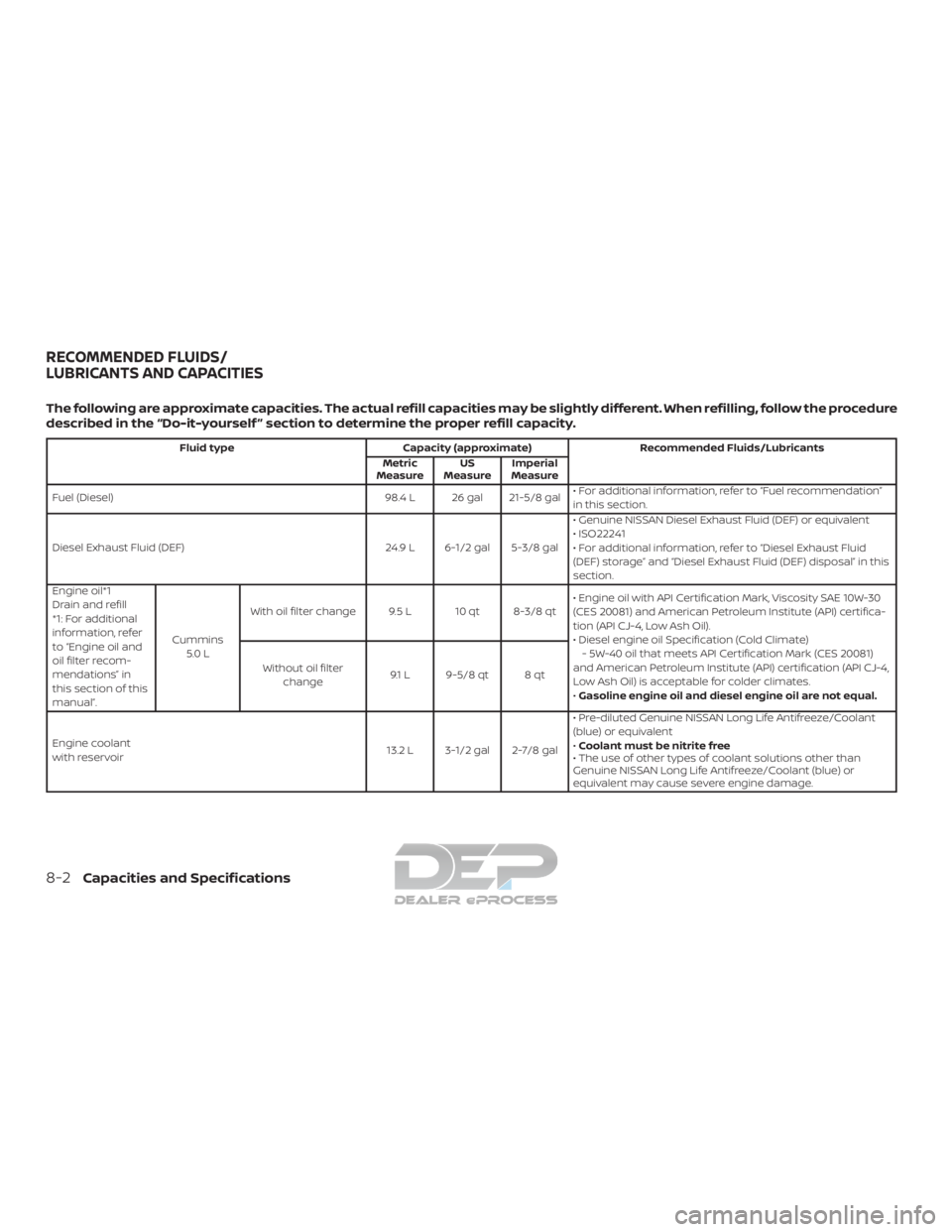
The following are approximate capacities. The actual refill capacities may be slightly different. When refilling, follow the procedure
described in the “Do-it-yourself ” section to determine the proper refill capacity.
Fluid typeCapacity (approximate) Recommended Fluids/Lubricants
Metric
Measure US
Measure Imperial
Measure
Fuel (Diesel) 98.4 L 26 gal 21-5/8 gal• For additional information, refer to “Fuel recommendation”
in this section.
Diesel Exhaust Fluid (DEF) 24.9 L 6-1/2 gal 5-3/8 gal• Genuine NISSAN Diesel Exhaust Fluid (DEF) or equivalent
• ISO22241
• For additional information, refer to “Diesel Exhaust Fluid
(DEF) storage” and “Diesel Exhaust Fluid (DEF) disposal” in this
section.
Engine oil*1
Drain and refill
*1: For additional
information, refer
to “Engine oil and
oil filter recom-
mendations” in
this section of this
manual”. Cummins
5.0 L With oil filter change 9.5 L 10 qt 8-3/8 qt
• Engine oil with API Certification Mark, Viscosity SAE 10W-30
(CES 20081) and American Petroleum Institute (API) certifica-
tion (API CJ-4, Low Ash Oil).
• Diesel engine oil Specification (Cold Climate)
- 5W-40 oil that meets API Certification Mark (CES 20081)
and American Petroleum Institute (API) certification (API CJ-4,
Low Ash Oil) is acceptable for colder climates.
• Gasoline engine oil and diesel engine oil are not equal.
Without oil filter
change 9.1 L 9-5/8 qt 8 qt
Engine coolant
with reservoir 13.2 L 3-1/2 gal 2-7/8 gal• Pre-diluted Genuine NISSAN Long Life Antifreeze/Coolant
(blue) or equivalent
•
Coolant must be nitrite free
• The use of other types of coolant solutions other than
Genuine NISSAN Long Life Antifreeze/Coolant (blue) or
equivalent may cause severe engine damage.
RECOMMENDED FLUIDS/
LUBRICANTS AND CAPACITIES
8-2Capacities and Specifications
Page 668 of 682
FUEL RECOMMENDATION
Diesel engine
Commercially available diesel fuel is ad-
justed seasonally for cold temperatures.
NISSAN recommends the use of diesel fuel
that has been seasonally adjusted for tem-
peratures below 32°F (0°C)
Diesel fuel of above 42 cetane minimum
above 32°F (0°C); 45 cetane minimum be-
low 32°F (0°C) and with less than 15 ppm of
sulfur must be used.
A cetane number below 42 can cause poor
starting, excessive white smoke, and poor
idling. A cetane number above 55 can in-
crease smoke at peak torque conditions.
If two types of diesel fuel are available, use
summer or winter fuel properly according
to the following temperature conditions.∙ Above 32°F (0°C) . . . Summer type diesel
fuel.
∙ Below 32°F (0°C) . . . Winter type diesel fuel.
If you are in any doubt, it is recommended
that you consult a NISSAN dealer.
CAUTION
∙ Do not use home heating oil, petro- leum, biodiesel (more than 10%) or
other alternate fuels in your diesel en-
gine. The use of those can cause en-
gine damage.
∙ Do not use summer fuel at tempera- tures below 20°F (- 7°C). The cold tem-
peratures will cause wax to form in
the fuel. As a result, it may prevent the
engine from running smoothly.
B10 fuel
B10 fuel is a mixture of approximately 10%
biodiesel and 90% petroleum diesel. Your
vehicle was designed to run on blends of
biodiesel up to B10 (B1-B10). Operating your
vehicle on higher blends is not recom-
mended. Your vehicle’s engine, exhaust
catalyst filter and particulate filter, and fuel
system components may be damaged if
any of these blends are used.
U.S. government regulations require that
biodiesel blends between B6 and B10 are
identified at fuel dispensing pumps by a
label with the common abbreviation or the
appropriate percentage for that region. B6
--B10 blends must meet prescribed quality
standards specified by ASTM D7467.
B10 fuel storage
Biodiesel degrades more quickly than pure
petroleum-based diesel. When storing a
vehicle that runs on a biodiesel blend, it is
important to keep the following in mind:
∙ If storing a vehicle for longer than one month, empty the fuel tank of biodiesel.
∙ To prepare a vehicle to run af ter pro- longed storage, fill the fuel tank with a
pure petroleum-based diesel fuel and
run your vehicle for at least half an hour.
∙ Fuel system seals, plastics and steel parts can be damaged by degraded or
oxidized biodiesel.
During cold weather, biodiesel fuel may
need to be stored in a heated storage tank
in order to prevent it from gelling or solidi-
f ying.
Diesel Exhaust Fluid (DEF)
DEF is a solution composed of urea and
de-ionized water. In diesel vehicles, it is
used as part of the exhaust system to
break down harmful NOx emissions into
nitrogen and water. It is important to keep
your vehicle’s DEF tank filled properly.
Capacities and Specifications8-3
Page 670 of 682

ENGINE OIL AND OIL FILTER
RECOMMENDATIONS
Selecting the correct oil
NOTE:
The factory fill oil may include a red dye
that that is added for manufacturing
quality processes. The dye makes the oil
appear to be red. This is normal. The red
dye will be flushed from the engine af ter
approximately 4-5 oil changes.It is essential to choose the correct grade,
quality and viscosity engine oil to ensure
satisfactory engine life and performance.
For additional information, refer to “Recom-
mended fluids/lubricants and capacities”
in this section. NISSAN recommends the
use of an energy conserving oil in order to
improve fuel economy.Select only engine oils that meet the Cum-
mins® Engineering Standard (CES) classifi-
cation (CES 20081) and American Petro-
leum Institute (API) certification (API CJ-4,
Low Ash Oil) and SAE viscosity standard
(10W-30 or 5W-40). These oils have the API
certification mark and CES 20081 on the
container. Oils which do not have the
specified information on the label should
not be used as they could cause engine
damage.
Oil additives
NISSAN does not recommend the use of oil
additives. The use of an oil additive is not
necessary when the proper oil type is used
and maintenance intervals are followed.
Oil which may contain foreign matter or
has been previously used should not be
used.LTI2207
Capacities and Specifications8-5
Page 674 of 682
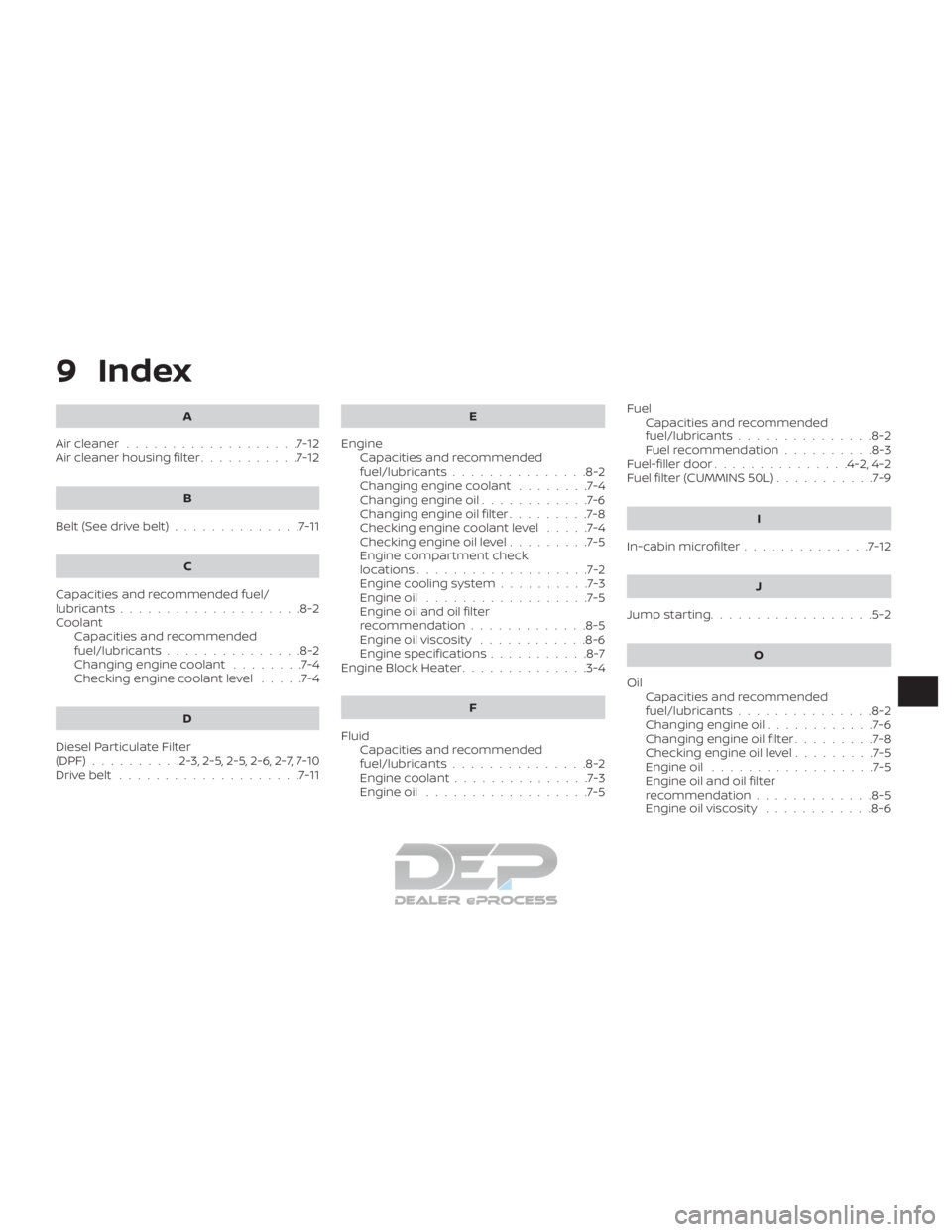
9 Index
A
Air cleaner ...................7-12
Air cleaner housing filter ...........7-12
B
Belt(Seedrivebelt)..............7-11
C
Capacities and recommended fuel/
lubricants....................8-2
Coolant Capacities and recommended
fuel/lubricants...............8-2
Changing engine coolant ........7-4
Checking engine coolant level .....7-4
D
Diesel Particulate Filter
(DPF) ..........2-3,2-5,2-5,2-6,2-7,7-10
Drivebelt ....................7-11 E
Engine Capacities and recommended
fuel/lubricants...............8-2
Changing engine coolant ........7-4
Changing engine oil ............7-6
Changing engine oil filter .........7-8
Checking engine coolant level .....7-4
Checking engine oil level .........7-5
Engine compartment check
locations...................7-2
Engine cooling system ..........7-3
Engine oil ..................7-5
Engine oil and oil filter
recommendation .............8-5
Engine oil viscosity ............8-6
Engine specifications ...........8-7
Engine Block Heater ..............3-4
F
Fluid Capacities and recommended
fuel/lubricants...............8-2
Engine coolant ...............7-3
Engine oil ..................7-5 Fuel
Capacities and recommended
fuel/lubricants...............8-2
Fuel recommendation ..........8-3
Fuel-filler door ...............4-2,4-2
Fuel filter (CUMMINS 50L) ...........7-9
I
In-cabinmicrofilter..............7-12
J
Jumpstarting..................5-2
O
Oil Capacities and recommended
fuel/lubricants...............8-2
Changing engine oil ............7-6
Changing engine oil filter .........7-8
Checking engine oil level .........7-5
Engine oil ..................7-5
Engine oil and oil filter
recommendation .............8-5
Engine oil viscosity ............8-6
Page 681 of 682
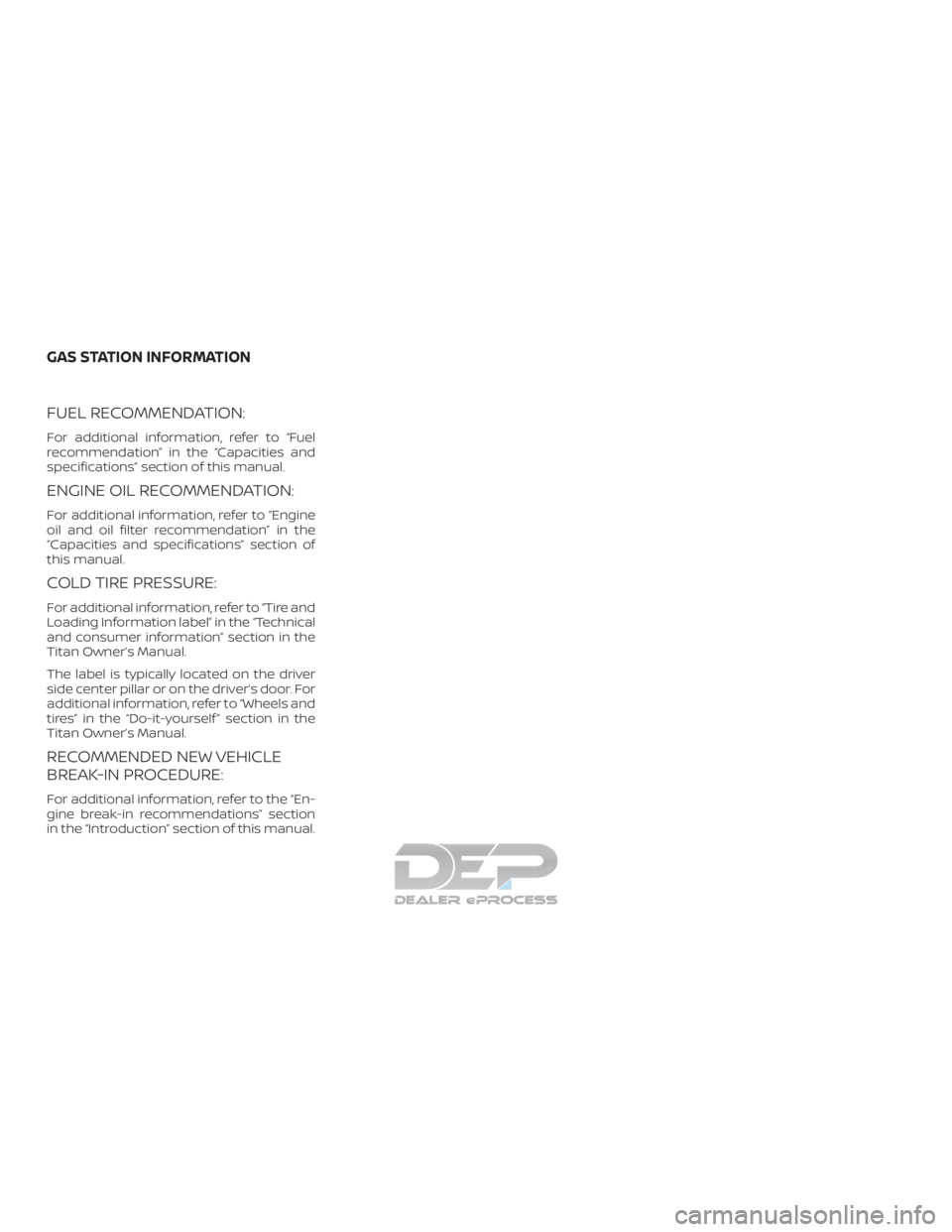
FUEL RECOMMENDATION:
For additional information, refer to “Fuel
recommendation” in the “Capacities and
specifications” section of this manual.
ENGINE OIL RECOMMENDATION:
For additional information, refer to “Engine
oil and oil filter recommendation” in the
“Capacities and specifications” section of
this manual.
COLD TIRE PRESSURE:
For additional information, refer to “Tire and
Loading Information label” in the “Technical
and consumer information” section in the
Titan Owner’s Manual.
The label is typically located on the driver
side center pillar or on the driver’s door. For
additional information, refer to “Wheels and
tires” in the “Do-it-yourself ” section in the
Titan Owner’s Manual.
RECOMMENDED NEW VEHICLE
BREAK-IN PROCEDURE:
For additional information, refer to the “En-
gine break-in recommendations” section
in the “Introduction” section of this manual.
GAS STATION INFORMATION