towing capacity NISSAN TITAN 2019 Owner´s Manual
[x] Cancel search | Manufacturer: NISSAN, Model Year: 2019, Model line: TITAN, Model: NISSAN TITAN 2019Pages: 682, PDF Size: 7.99 MB
Page 523 of 682
10 Technical and consumer information
Recommended fluids/lubricants and
capacities...................................... 10-2
Fuel recommendation ....................... 10-5
Engine oil and oil filter
recommendations (for gas engine only) .....10-7
Air conditioner system refrigerant and
oil recommendations .......................10-8
Specifications ................................. 10-10
Engine ..................................... 10-10
Wheels and tires ............................. 10-11
Dimensions and weights ...................10-12
When traveling or registering in another
country ........................................ 10-18
Vehicle identification .......................... 10-18
Vehicle Identification Number (VIN)
plate ....................................... 10-18
Vehicle identification number
(chassis number) ........................... 10-18
Engine serial number ....................... 10-19
F.M.V.S.S./C.M.V.S.S. certification label ........10-20
Emission control information label .........10-20
Tire and Loading Information label .........10-21
Air conditioner specification label ...........10-21
Installing front license plate ....................10-22Vehicle loading information
...................10-23
Terms ...................................... 10-23
Vehicle load capacity ....................... 10-24
Securing the load ........................... 10-26
Utili-track® channel system
(if so equipped) ............................. 10-27
Loading tips ................................ 10-35
Truck-camper loading information ............10-36
Crew cab models ........................... 10-36
King Cab® models .......................... 10-36
Special Body vehicles ....................... 10-36
Location for center of gravity ...............10-36
Vehicle load weight capacity ...............10-37
Measurement of weights ...................10-37
Towing a trailer ................................ 10-38
Maximum load limits ....................... 10-38
T
owing load/specification ..................10-42
Towing safety .............................. 10-47
Flat towing for 2-Wheel Drive (2WD)
vehicle (if so equipped) .....................10-63
Flat towing for 4-Wheel Drive (4WD)
vehicle (if so equipped) .....................10-63
Snowplow .................................... 10-63
Uniform tire quality grading ....................10-64
Page 549 of 682
5. Determine the combined weightof luggage and cargo being
loaded on the vehicle. That
weight may not safely exceed
the available cargo and luggage
load capacity calculated in
step 4.
6. If your vehicle will be towing a trailer, load from your trailer will
be transferred to your vehicle.
Consult this manual to deter-
mine how this reduces the avail-
able cargo and luggage load ca-
pacity of your vehicle.
Before driving a loaded vehicle, con-
firm that you do not exceed the
GVWR or the GAWR for your vehicle.
For additional information, refer to
“Measurement of weights” in this
section.
Also check tires for proper inflation
pressures. For additional informa-
tion, refer to “Tire and Loading Infor-
mation label” in the “Do-it-yourself ”
section of this manual.
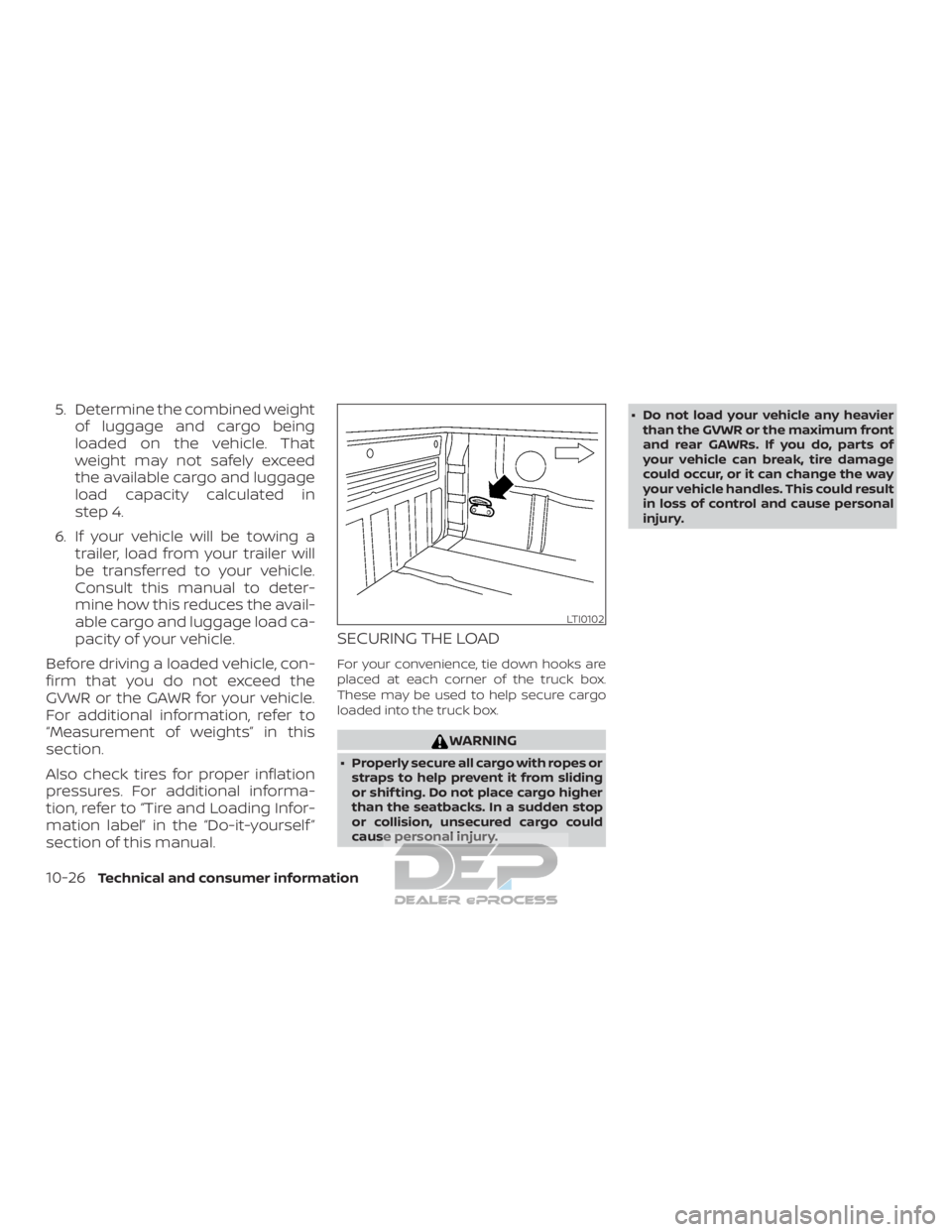
SECURING THE LOAD
For your convenience, tie down hooks are
placed at each corner of the truck box.
These may be used to help secure cargo
loaded into the truck box.
WARNING
∙ Properly secure all cargo with ropes or straps to help prevent it from sliding
or shif ting. Do not place cargo higher
than the seatbacks. In a sudden stop
or collision, unsecured cargo could
cause personal injury. ∙ Do not load your vehicle any heavier
than the GVWR or the maximum front
and rear GAWRs. If you do, parts of
your vehicle can break, tire damage
could occur, or it can change the way
your vehicle handles. This could result
in loss of control and cause personal
injury.
LTI0102
10-26Technical and consumer information
Page 563 of 682
King pin load
When using a 5th wheel hitch, keep the
tongue load between 15 - 25% of the total
trailer load within the maximum king pin
load limits shown in the following “Towing
load/specification” chart. If the king pin
load becomes excessive, rearrange cargo
to allow for proper king pin load.
Maximum Gross Vehicle Weight
(GVW)/maximum Gross Axle
Weight (GAW)
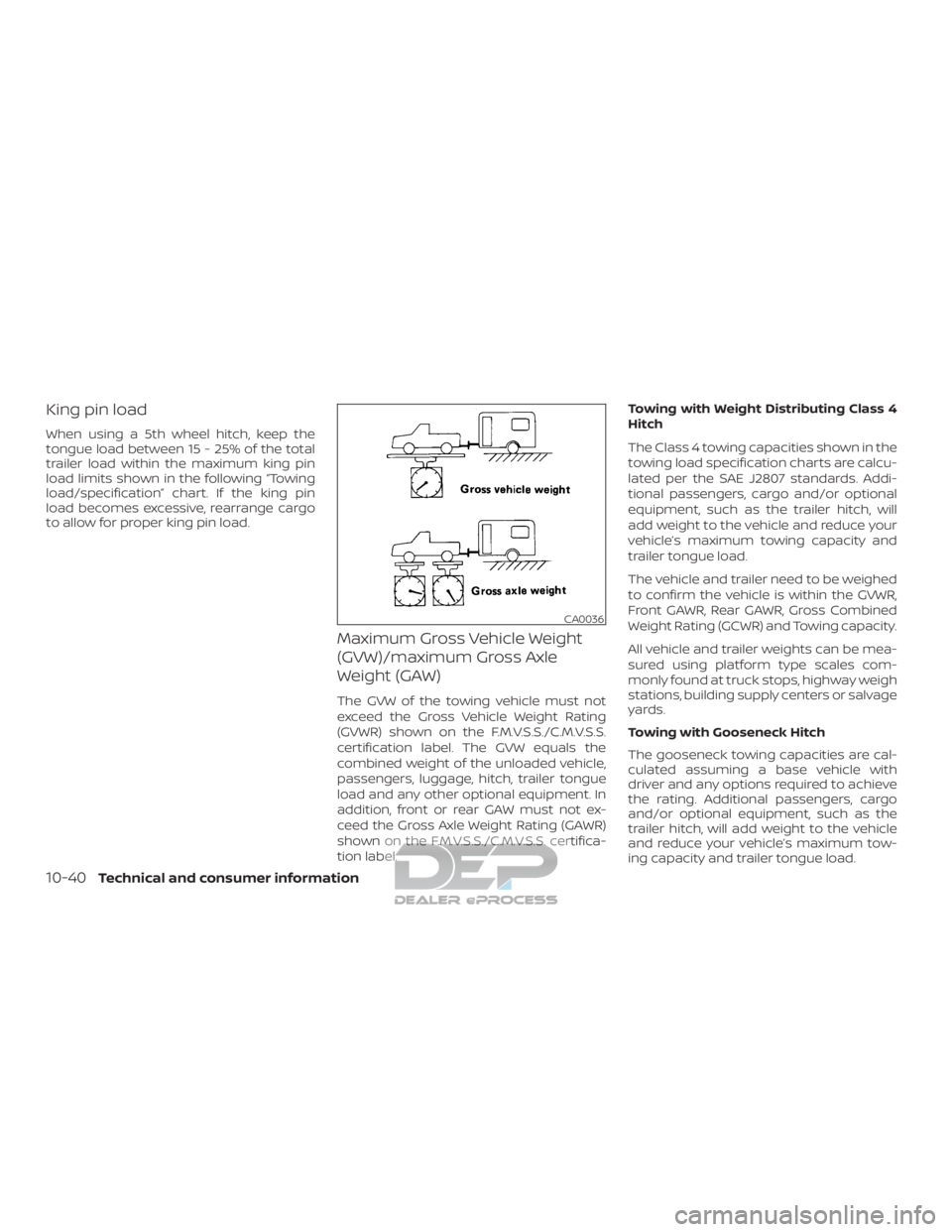
The GVW of the towing vehicle must not
exceed the Gross Vehicle Weight Rating
(GVWR) shown on the F.M.V.S.S./C.M.V.S.S.
certification label. The GVW equals the
combined weight of the unloaded vehicle,
passengers, luggage, hitch, trailer tongue
load and any other optional equipment. In
addition, front or rear GAW must not ex-
ceed the Gross Axle Weight Rating (GAWR)
shown on the F.M.V.S.S./C.M.V.S.S. certifica-
tion label.Towing with Weight Distributing Class 4
Hitch
The Class 4 towing capacities shown in the
towing load specification charts are calcu-
lated per the SAE J2807 standards. Addi-
tional passengers, cargo and/or optional
equipment, such as the trailer hitch, will
add weight to the vehicle and reduce your
vehicle’s maximum towing capacity and
trailer tongue load.
The vehicle and trailer need to be weighed
to confirm the vehicle is within the GVWR,
Front GAWR, Rear GAWR, Gross Combined
Weight Rating (GCWR) and Towing capacity.
All vehicle and trailer weights can be mea-
sured using platform type scales com-
monly found at truck stops, highway weigh
stations, building supply centers or salvage
yards.
Towing with Gooseneck Hitch
The gooseneck towing capacities are cal-
culated assuming a base vehicle with
driver and any options required to achieve
the rating. Additional passengers, cargo
and/or optional equipment, such as the
trailer hitch, will add weight to the vehicle
and reduce your vehicle’s maximum tow-
ing capacity and trailer tongue load.
CA0036
10-40Technical and consumer information
Page 564 of 682
The vehicle and trailer need to be weighed
to confirm the vehicle is within the GVWR,
Front GAWR, Rear GAWR, Gross Combined
Weight Rating (GCWR) and Towing capacity.
All vehicle and trailer weights can be mea-
sured using platform type scales com-
monly found at truck stops, highway weigh
stations, building supply centers or salvage
yards.
To determine the available payload capac-
ity for tongue/king pin load, use the follow-
ing procedure.1. Locate the GVWR on the F.M.V.S.S./C.M.V.S.S. certification label.
2. Weigh your vehicle on the scale with all of the passengers and cargo that are
normally in the vehicle when towing a
trailer.
3. Subtract the actual vehicle weight from the GVWR. The remaining amount is
the available maximum tongue/king
pin load.
To determine the available towing capacity,
use the following procedure. 1. Find the GCWR for your vehicle on the "Towing load/specification" chart
found in this section. 2. Subtract the actual vehicle weight
from the GCWR. The remaining amount
is the available maximum towing ca-
pacity.
To determine the Gross Trailer Weight,
weigh your trailer on a scale with all equip-
ment and cargo, that are normally in the
trailer when it is towed. Make sure the
Gross trailer weight is not more than the
Gross Trailer Weight Rating shown on the
trailer and is not more than the calculated
available maximum towing capacity.
Also weigh the front and rear axles on the
scale to make sure the Front Gross Axle
Weight and Rear Gross Axle Weight are not
more than Front Gross Axle Weight and
Rear Gross Axle Weight on the
F.M.V.S.S./C.M.V.S.S. certification label. The
cargo in the trailer and vehicle may need to
be moved or removed to meet the speci-
fied ratings.
Example: ∙ Gross Vehicle Weight (GVW) as weighed on a scale - including passengers, cargo
and hitch - 7,804 lbs. (3,540 kg).
∙ Gross Vehicle Weight Rating (GVWR) from F.M.V.S.S./C.M.V.S.S. certification la-
bel - 8,990 lbs. (4,078 kg). ∙ Gross Combined Weight Rating (GCWR)
from “Towing load/specification" chart -
19,450 lbs. (8,822 kg).
∙ Maximum Trailer towing capacity from “Towing load/specification" chart -
9,200 lbs. (4,173 kg).
8,990 lbs. (4,078 kg) GVWR
– 7,804 lbs. (3,540 kg) GVW
= 1,186 lbs. (538 kg) Available for tongue/ king pin weight
19,450 lbs. (8,822 kg) GCWR
– 7,804 lbs. (3,540 kg) GVW
= 11,644 lbs. (5,282 kg) Capacity available for towing
1,186 lbs. (538 kg) Available tongue weight
/ 11,644 lbs. (5,282 kg) Available capacity
= 10 % tongue weight
The available towing capacity may be less
than the maximum towing capacity due to
the passenger and cargo load in the ve-
hicle.
Technical and consumer information10-41
Page 565 of 682
Remember to keep trailer tongue weight
between 10 - 15% of the trailer weight or
within the trailer tongue weight specifica-
tion recommended by the trailer manufac-
turer. If the tongue weight becomes exces-
sive, rearrange the cargo to obtain the
proper tongue weight. Do not exceed the
maximum tongue weight specification
shown in the “Towing load/specification”
chart even if the calculated available
tongue weight is greater than 15%. If the
calculated tongue weight is less than 10%,
shif t the trailer load forward until the trailer
tongue weight reaches 10% of the trailer
weight.
Always verif y that available capacities are
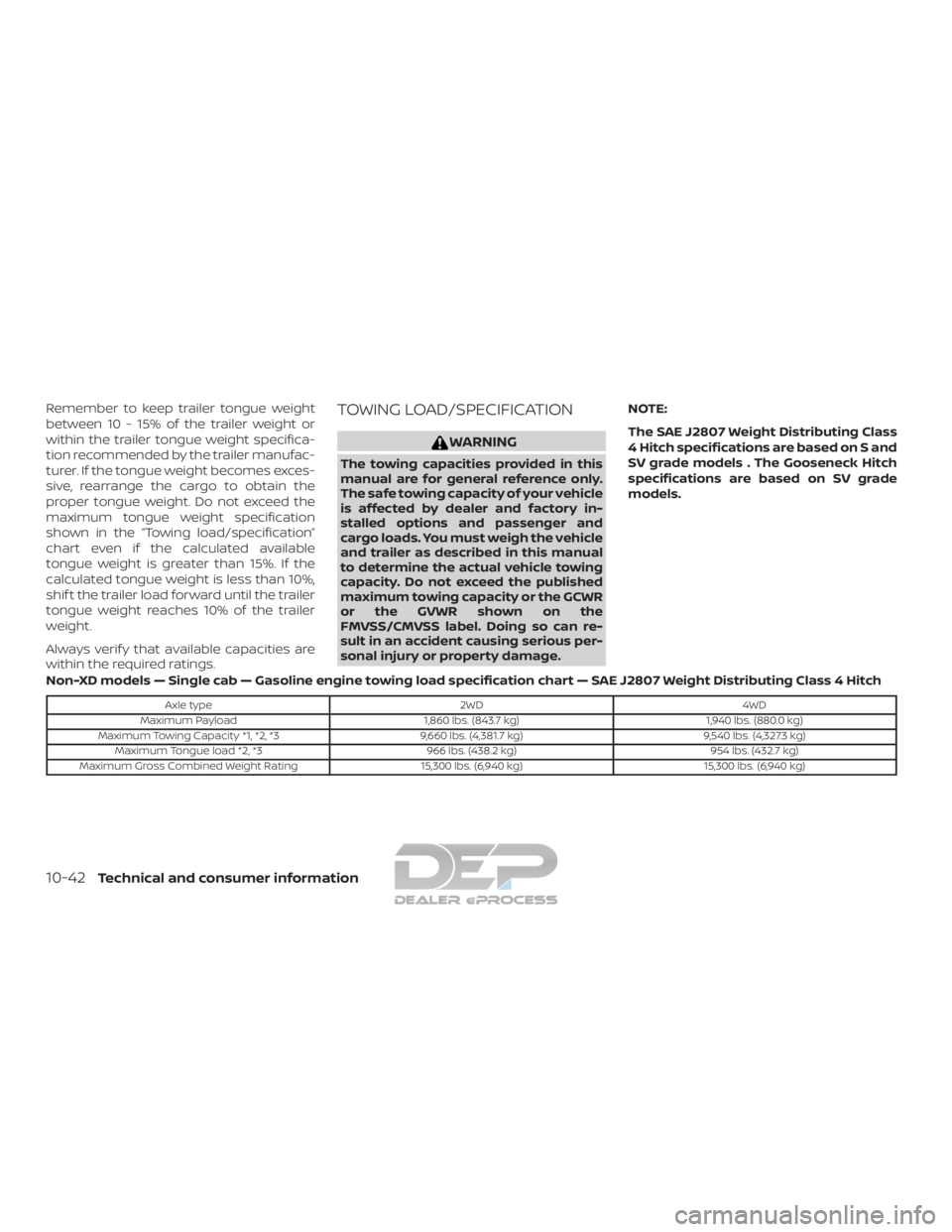
within the required ratings.TOWING LOAD/SPECIFICATION
WARNING
The towing capacities provided in this
manual are for general reference only.
The safe towing capacity of your vehicle
is affected by dealer and factory in-
stalled options and passenger and
cargo loads. You must weigh the vehicle
and trailer as described in this manual
to determine the actual vehicle towing
capacity. Do not exceed the published
maximum towing capacity or the GCWR
or the GVWR shown on the
FMVSS/CMVSS label. Doing so can re-
sult in an accident causing serious per-
sonal injury or property damage.NOTE:
The SAE J2807 Weight Distributing Class
4 Hitch specifications are based on S and
SV grade models . The Gooseneck Hitch
specifications are based on SV grade
models.
Non-XD models — Single cab — Gasoline engine towing load specification chart — SAE J2807 Weight Distributing Class 4 Hitch
Axle type 2WD4WD
Maximum Payload 1,860 lbs. (843.7 kg)1,940 lbs. (880.0 kg)
Maximum Towing Capacity *1, *2, *3 9,660 lbs. (4,381.7 kg)9,540 lbs. (4,327.3 kg)
Maximum Tongue load *2, *3 966 lbs. (438.2 kg)954 lbs. (432.7 kg)
Maximum Gross Combined Weight Rating 15,300 lbs. (6,940 kg)15,300 lbs. (6,940 kg)
10-42Technical and consumer information
Page 566 of 682
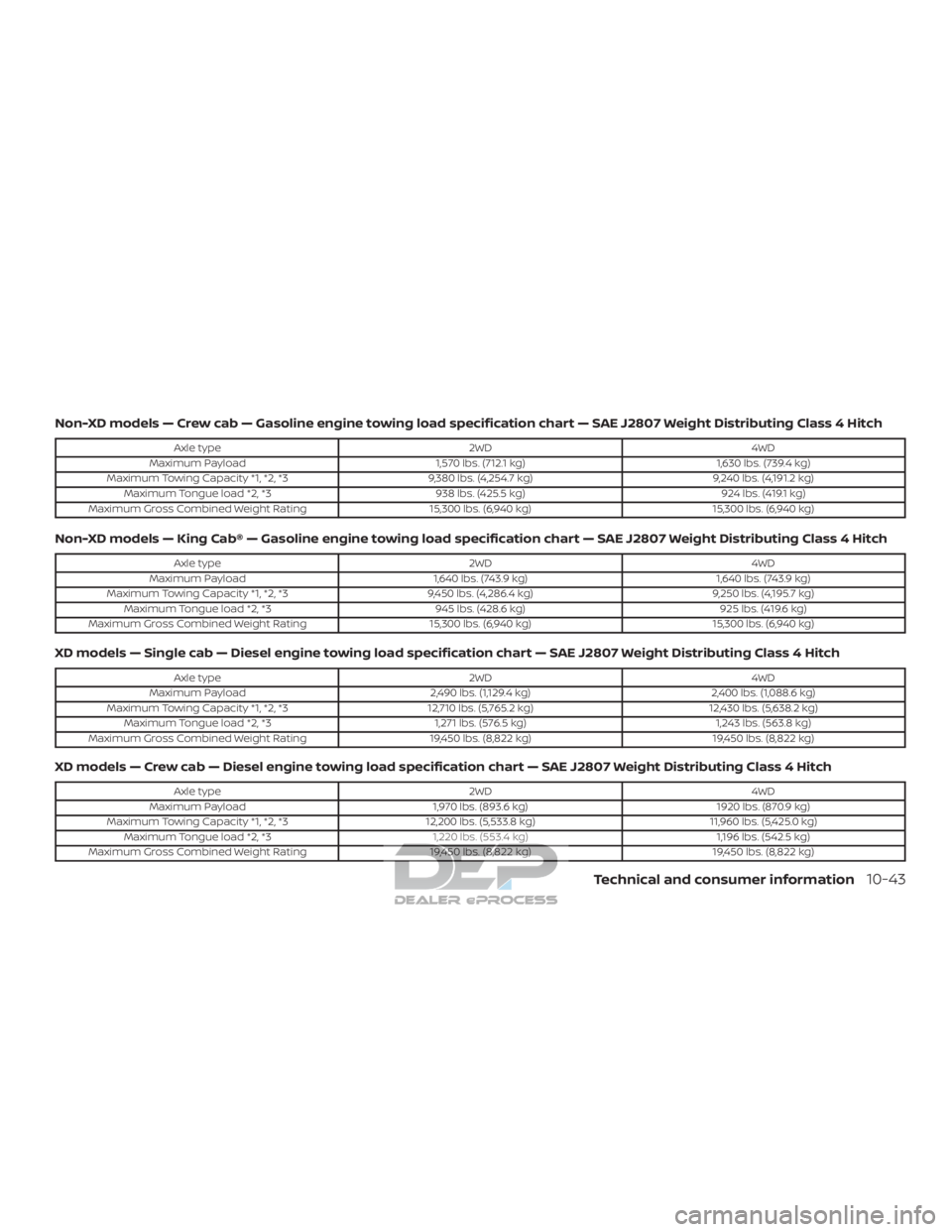
Non-XD models — Crew cab — Gasoline engine towing load specification chart — SAE J2807 Weight Distributing Class 4 Hitch
Axle type2WD4WD
Maximum Payload 1,570 lbs. (712.1 kg)1,630 lbs. (739.4 kg)
Maximum Towing Capacity *1, *2, *3 9,380 lbs. (4,254.7 kg)9,240 lbs. (4,191.2 kg)
Maximum Tongue load *2, *3 938 lbs. (425.5 kg)924 lbs. (419.1 kg)
Maximum Gross Combined Weight Rating 15,300 lbs. (6,940 kg)15,300 lbs. (6,940 kg)
Non-XD models — King Cab® — Gasoline engine towing load specification chart — SAE J2807 Weight Distributing Class 4 Hitch
Axle type 2WD4WD
Maximum Payload 1,640 lbs. (743.9 kg)1,640 lbs. (743.9 kg)
Maximum Towing Capacity *1, *2, *3 9,450 lbs. (4,286.4 kg)9,250 lbs. (4,195.7 kg)
Maximum Tongue load *2, *3 945 lbs. (428.6 kg)925 lbs. (419.6 kg)
Maximum Gross Combined Weight Rating 15,300 lbs. (6,940 kg)15,300 lbs. (6,940 kg)
XD models — Single cab — Diesel engine towing load specification chart — SAE J2807 Weight Distributing Class 4 Hitch
Axle type 2WD4WD
Maximum Payload 2,490 lbs. (1,129.4 kg)2,400 lbs. (1,088.6 kg)
Maximum Towing Capacity *1, *2, *3 12,710 lbs. (5,765.2 kg)12,430 lbs. (5,638.2 kg)
Maximum Tongue load *2, *3 1,271 lbs. (576.5 kg)1,243 lbs. (563.8 kg)
Maximum Gross Combined Weight Rating 19,450 lbs. (8,822 kg)19,450 lbs. (8,822 kg)
XD models — Crew cab — Diesel engine towing load specification chart — SAE J2807 Weight Distributing Class 4 Hitch
Axle type 2WD4WD
Maximum Payload 1,970 lbs. (893.6 kg)1920 lbs. (870.9 kg)
Maximum Towing Capacity *1, *2, *3 12,200 lbs. (5,533.8 kg)11,960 lbs. (5,425.0 kg)
Maximum Tongue load *2, *3 1,220 lbs. (553.4 kg)1,196 lbs. (542.5 kg)
Maximum Gross Combined Weight Rating 19,450 lbs. (8,822 kg)19,450 lbs. (8,822 kg)
Technical and consumer information10-43
Page 567 of 682
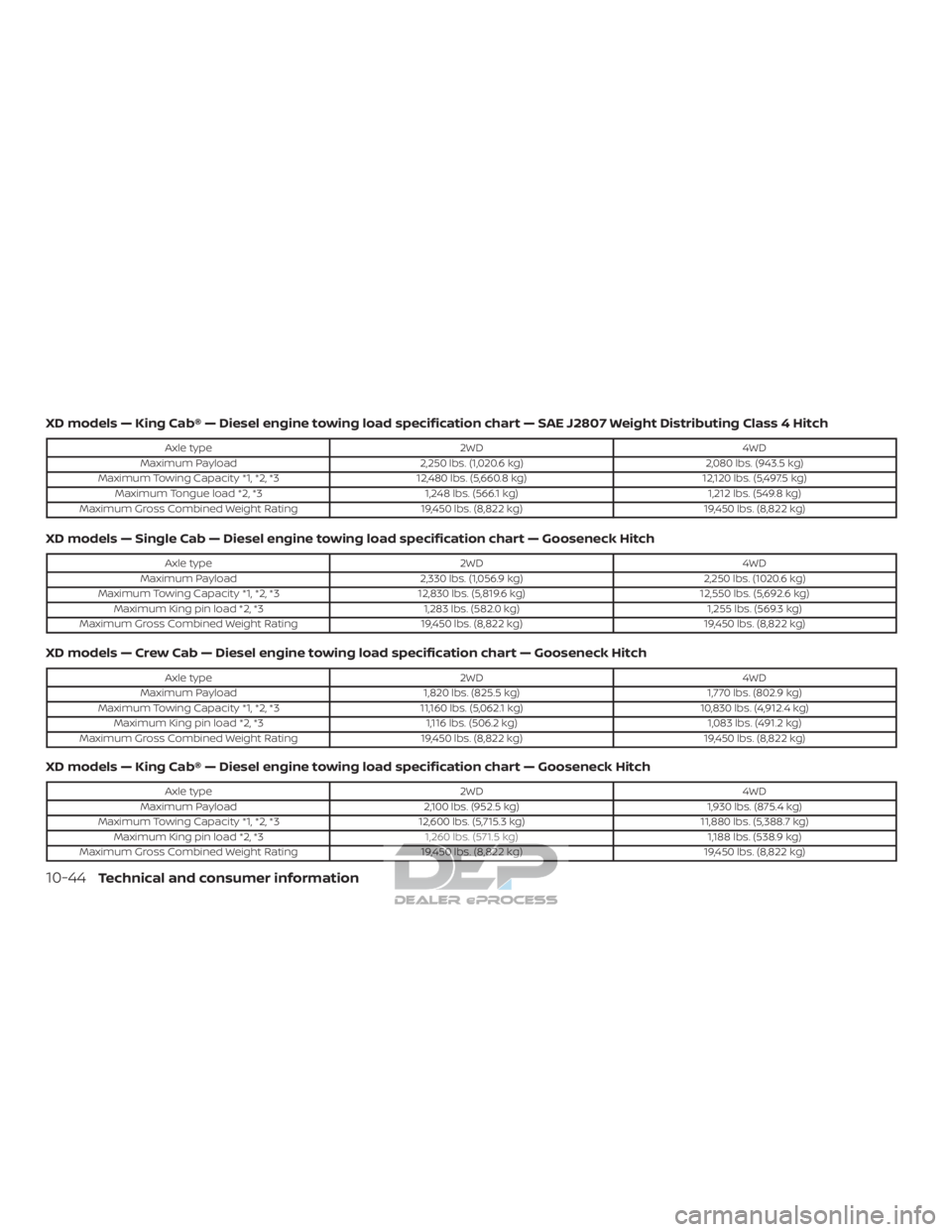
XD models — King Cab® — Diesel engine towing load specification chart — SAE J2807 Weight Distributing Class 4 Hitch
Axle type2WD4WD
Maximum Payload 2,250 lbs. (1,020.6 kg) 2,080 lbs. (943.5 kg)
Maximum Towing Capacity *1, *2, *3 12,480 lbs. (5,660.8 kg)12,120 lbs. (5,497.5 kg)
Maximum Tongue load *2, *3 1,248 lbs. (566.1 kg)1,212 lbs. (549.8 kg)
Maximum Gross Combined Weight Rating 19,450 lbs. (8,822 kg)19,450 lbs. (8,822 kg)
XD models — Single Cab — Diesel engine towing load specification chart — Gooseneck Hitch
Axle type 2WD4WD
Maximum Payload 2,330 lbs. (1,056.9 kg) 2,250 lbs. (1020.6 kg)
Maximum Towing Capacity *1, *2, *3 12,830 lbs. (5,819.6 kg)12,550 lbs. (5,692.6 kg)
Maximum King pin load *2, *3 1,283 lbs. (582.0 kg)1,255 lbs. (569.3 kg)
Maximum Gross Combined Weight Rating 19,450 lbs. (8,822 kg)19,450 lbs. (8,822 kg)
XD models — Crew Cab — Diesel engine towing load specification chart — Gooseneck Hitch
Axle type 2WD4WD
Maximum Payload 1,820 lbs. (825.5 kg) 1,770 lbs. (802.9 kg)
Maximum Towing Capacity *1, *2, *3 11,160 lbs. (5,062.1 kg)10,830 lbs. (4,912.4 kg)
Maximum King pin load *2, *3 1,116 lbs. (506.2 kg)1,083 lbs. (491.2 kg)
Maximum Gross Combined Weight Rating 19,450 lbs. (8,822 kg)19,450 lbs. (8,822 kg)
XD models — King Cab® — Diesel engine towing load specification chart — Gooseneck Hitch
Axle type 2WD4WD
Maximum Payload 2,100 lbs. (952.5 kg)1,930 lbs. (875.4 kg)
Maximum Towing Capacity *1, *2, *3 12,600 lbs. (5,715.3 kg)11,880 lbs. (5,388.7 kg)
Maximum King pin load *2, *3 1,260 lbs. (571.5 kg)1,188 lbs. (538.9 kg)
Maximum Gross Combined Weight Rating 19,450 lbs. (8,822 kg)19,450 lbs. (8,822 kg)
10-44Technical and consumer information
Page 568 of 682
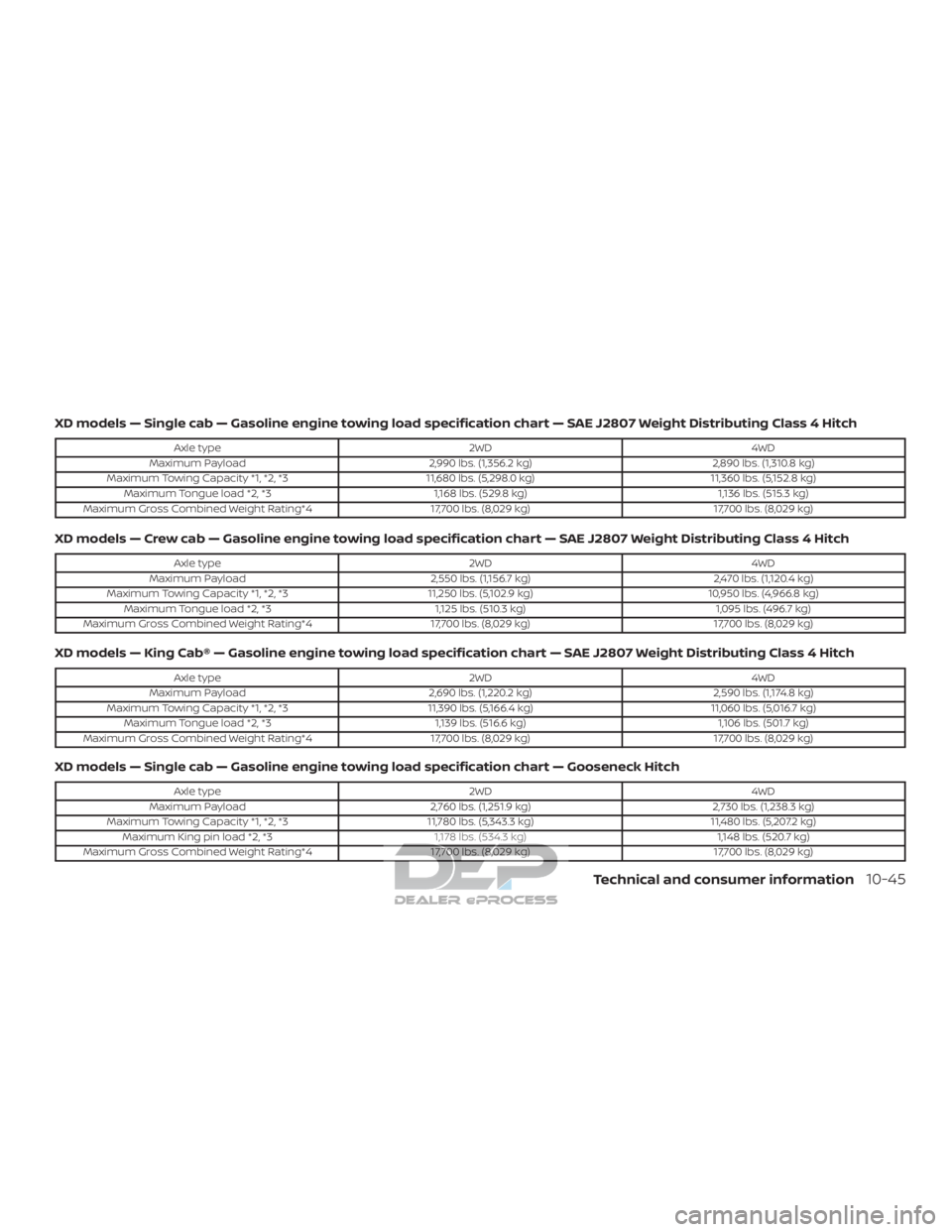
XD models — Single cab — Gasoline engine towing load specification chart — SAE J2807 Weight Distributing Class 4 Hitch
Axle type2WD4WD
Maximum Payload 2,990 lbs. (1,356.2 kg) 2,890 lbs. (1,310.8 kg)
Maximum Towing Capacity *1, *2, *3 11,680 lbs. (5,298.0 kg)11,360 lbs. (5,152.8 kg)
Maximum Tongue load *2, *3 1,168 lbs. (529.8 kg)1,136 lbs. (515.3 kg)
Maximum Gross Combined Weight Rating*4 17,700 lbs. (8,029 kg)17,700 lbs. (8,029 kg)
XD models — Crew cab — Gasoline engine towing load specification chart — SAE J2807 Weight Distributing Class 4 Hitch
Axle type 2WD4WD
Maximum Payload 2,550 lbs. (1,156.7 kg) 2,470 lbs. (1,120.4 kg)
Maximum Towing Capacity *1, *2, *3 11,250 lbs. (5,102.9 kg)10,950 lbs. (4,966.8 kg)
Maximum Tongue load *2, *3 1,125 lbs. (510.3 kg)1,095 lbs. (496.7 kg)
Maximum Gross Combined Weight Rating*4 17,700 lbs. (8,029 kg)17,700 lbs. (8,029 kg)
XD models — King Cab® — Gasoline engine towing load specification chart — SAE J2807 Weight Distributing Class 4 Hitch
Axle type 2WD4WD
Maximum Payload 2,690 lbs. (1,220.2 kg) 2,590 lbs. (1,174.8 kg)
Maximum Towing Capacity *1, *2, *3 11,390 lbs. (5,166.4 kg)11,060 lbs. (5,016.7 kg)
Maximum Tongue load *2, *3 1,139 lbs. (516.6 kg)1,106 lbs. (501.7 kg)
Maximum Gross Combined Weight Rating*4 17,700 lbs. (8,029 kg)17,700 lbs. (8,029 kg)
XD models — Single cab — Gasoline engine towing load specification chart — Gooseneck Hitch
Axle type 2WD4WD
Maximum Payload 2,760 lbs. (1,251.9 kg) 2,730 lbs. (1,238.3 kg)
Maximum Towing Capacity *1, *2, *3 11,780 lbs. (5,343.3 kg)11,480 lbs. (5,207.2 kg)
Maximum King pin load *2, *3 1,178 lbs. (534.3 kg)1,148 lbs. (520.7 kg)
Maximum Gross Combined Weight Rating*4 17,700 lbs. (8,029 kg)17,700 lbs. (8,029 kg)
Technical and consumer information10-45
Page 569 of 682
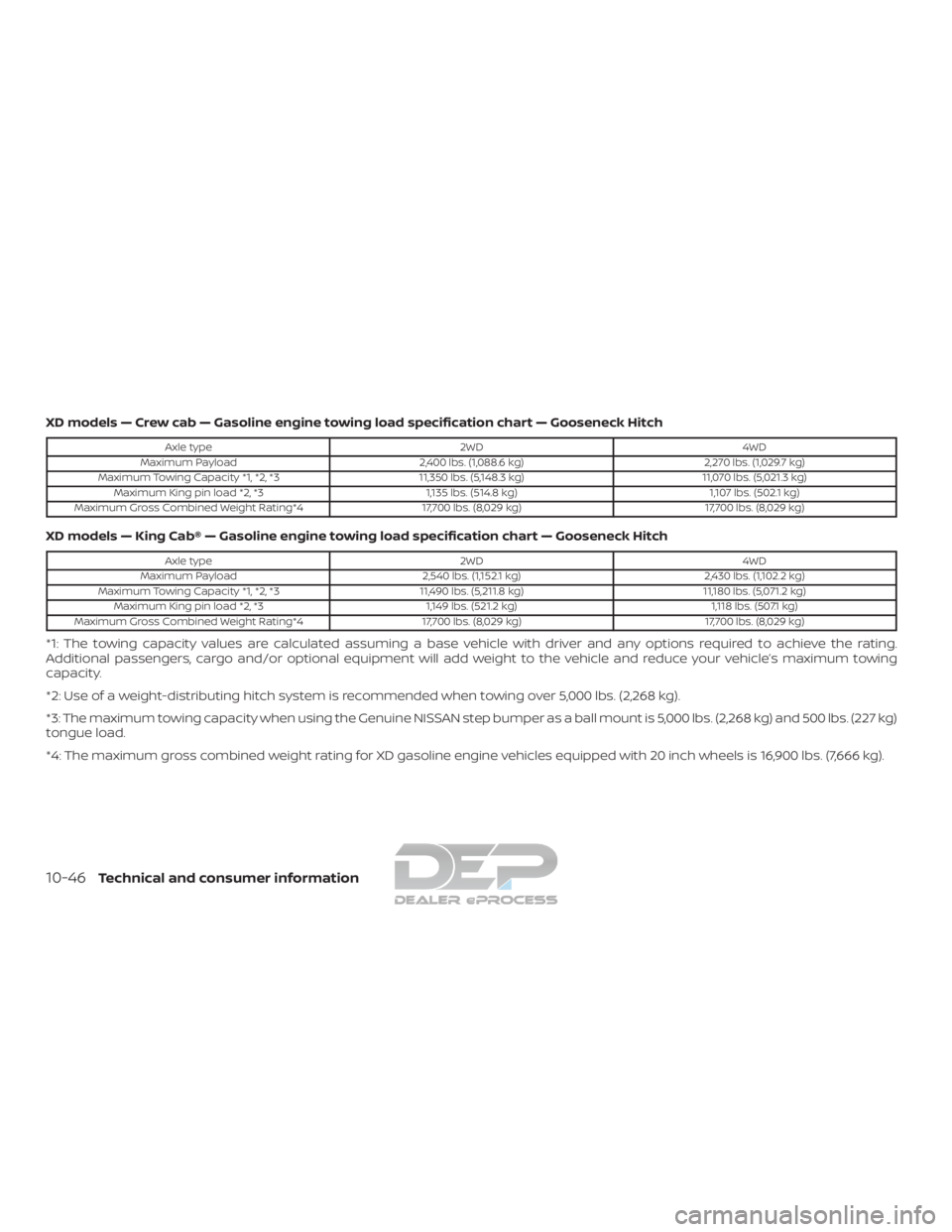
XD models — Crew cab — Gasoline engine towing load specification chart — Gooseneck Hitch
Axle type2WD4WD
Maximum Payload 2,400 lbs. (1,088.6 kg) 2,270 lbs. (1,029.7 kg)
Maximum Towing Capacity *1, *2, *3 11,350 lbs. (5,148.3 kg)11,070 lbs. (5,021.3 kg)
Maximum King pin load *2, *3 1,135 lbs. (514.8 kg)1,107 lbs. (502.1 kg)
Maximum Gross Combined Weight Rating*4 17,700 lbs. (8,029 kg)17,700 lbs. (8,029 kg)
XD models — King Cab® — Gasoline engine towing load specification chart — Gooseneck Hitch
Axle type 2WD4WD
Maximum Payload 2,540 lbs. (1,152.1 kg)2,430 lbs. (1,102.2 kg)
Maximum Towing Capacity *1, *2, *3 11,490 lbs. (5,211.8 kg)11,180 lbs. (5,071.2 kg)
Maximum King pin load *2, *3 1,149 lbs. (521.2 kg)1,118 lbs. (507.1 kg)
Maximum Gross Combined Weight Rating*4 17,700 lbs. (8,029 kg)17,700 lbs. (8,029 kg)
*1: The towing capacity values are calculated assuming a base vehicle with driver and any options required to achieve the rating.
Additional passengers, cargo and/or optional equipment will add weight to the vehicle and reduce your vehicle’s maximum towing
capacity.
*2: Use of a weight-distributing hitch system is recommended when towing over 5,000 lbs. (2,268 kg).
*3: The maximum towing capacity when using the Genuine NISSAN step bumper as a ball mount is 5,000 lbs. (2,268 kg) and 500 lbs. (227 kg)
tongue load.
*4: The maximum gross combined weight rating for XD gasoline engine vehicles equipped with 20 inch wheels is 16,900 lbs. (7,666 kg).
10-46Technical and consumer information
Page 570 of 682
TOWING SAFETY
Trailer hitch
Your vehicle may be equipped with an op-
tional trailer tow package. The trailer tow
package includes a receiver-type frame
mounted hitch. This hitch is rated for the
maximum towing capacity of this vehicle
when the proper towing equipment is
used. Choose a proper ball mount and
hitch ball that is rated for the trailer to be
towed. Genuine NISSAN ball mounts and
hitch balls are available at a NISSAN dealer.
If your vehicle is not equipped with the op-
tional trailer tow package, check the tow-
ing capacity of your bumper hitch or
receiver-type frame mounted hitch.
Choose a proper hitch for your vehicle and
trailer. A Genuine NISSAN trailer hitch is
available at a NISSAN dealer. Make sure the
trailer hitch is securely attached to the ve-
hicle to help avoid personal injury or prop-
erty damage due to sway caused by cross-
winds, rough road surfaces or passing
trucks.A hitch used for towing 5th wheel and
gooseneck trailers can also be installed on
your vehicle. Contact a professional sup-
plier of towing equipment to purchase and
have a 5th wheel or gooseneck hitch in-
stalled.
WARNING
Trailer hitch components have specific
weight ratings. Your vehicle may be ca-
pable of towing a trailer heavier than
the weight rating of the hitch compo-
nents. Never exceed the weight rating
of the hitch components. Doing so can
cause serious personal injury or prop-
erty damage.
Hitch ball
Choose a hitch ball of the proper size and
weight rating for your trailer:
∙ The required hitch ball size is stamped on most trailer couplers. Most hitch
balls also have the size printed on the
top of the ball.
∙ Choose the proper class hitch ball based on the trailer weight. ∙ The diameter of the threaded shank of
the hitch ball must be matched to the
ball mount hole diameter. The hitch ball
shank should be no more than 1/16”
smaller than the hole in the ball mount.
∙ The threaded shank of the hitch ball must be long enough to be properly
secured to the ball mount. There should
be at least 2 threads showing beyond
the lock washer and nut.
Ball mount
The hitch ball is attached to the ball mount
and the ball mount is inserted into the
hitch receiver. Choose a proper class ball
mount based on the trailer weight. Addi-
tionally, the ball mount should be chosen to
keep the trailer tongue level with the
ground.
Technical and consumer information10-47