lock NISSAN TITAN 2019 Owner´s Manual
[x] Cancel search | Manufacturer: NISSAN, Model Year: 2019, Model line: TITAN, Model: NISSAN TITAN 2019Pages: 682, PDF Size: 7.99 MB
Page 29 of 682
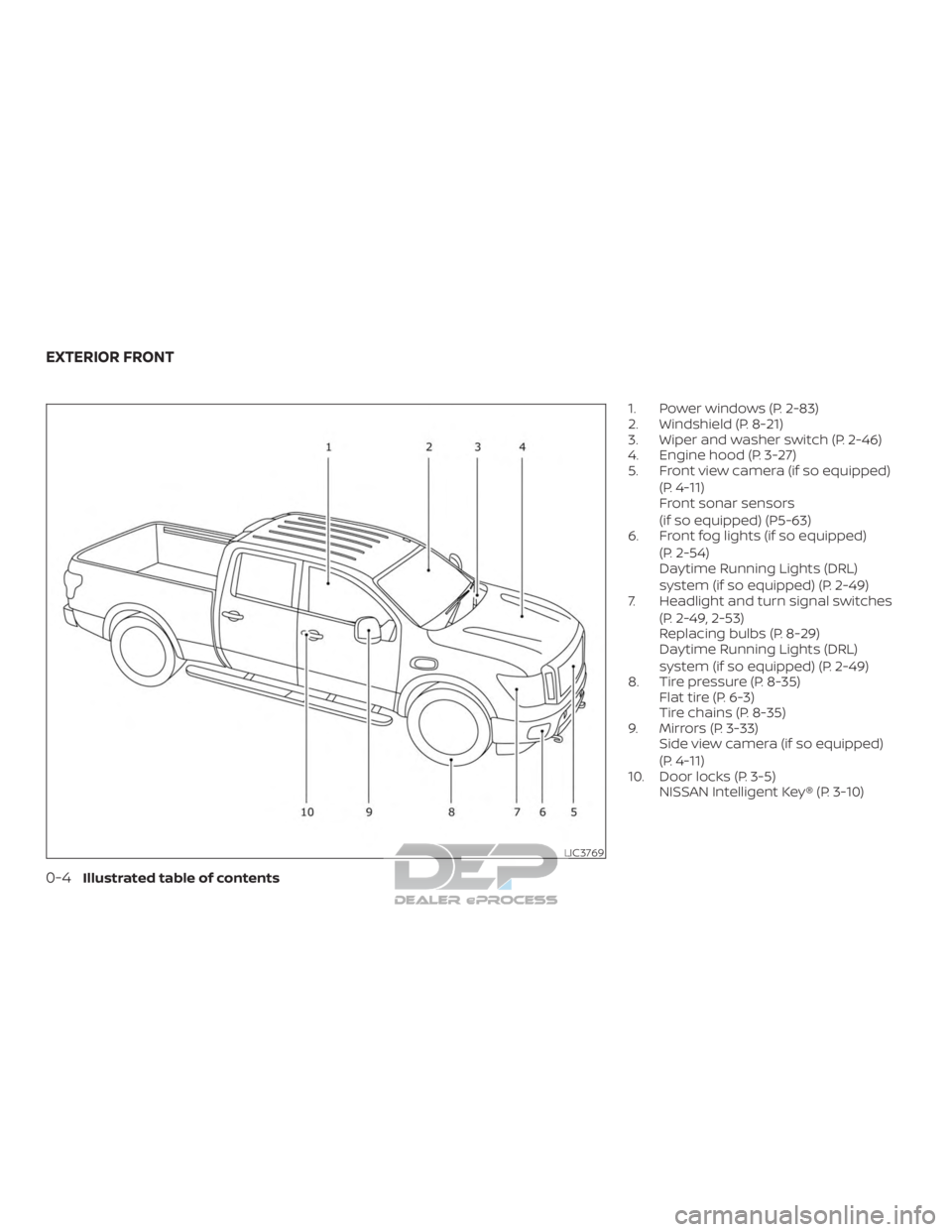
1. Power windows (P. 2-83)
2. Windshield (P. 8-21)
3. Wiper and washer switch (P. 2-46)
4. Engine hood (P. 3-27)
5. Front view camera (if so equipped)(P. 4-11)
Front sonar sensors
(if so equipped) (P5-63)
6. Front fog lights (if so equipped)
(P. 2-54)
Daytime Running Lights (DRL)
system (if so equipped) (P. 2-49)
7. Headlight and turn signal switches
(P. 2-49, 2-53)
Replacing bulbs (P. 8-29)
Daytime Running Lights (DRL)
system (if so equipped) (P. 2-49)
8. Tire pressure (P. 8-35) Flat tire (P. 6-3)
Tire chains (P. 8-35)
9. Mirrors (P. 3-33) Side view camera (if so equipped)
(P. 4-11)
10. Door locks (P. 3-5) NISSAN Intelligent Key® (P. 3-10)
LIC3769
EXTERIOR FRONT
0-4Illustrated table of contents
Page 31 of 682
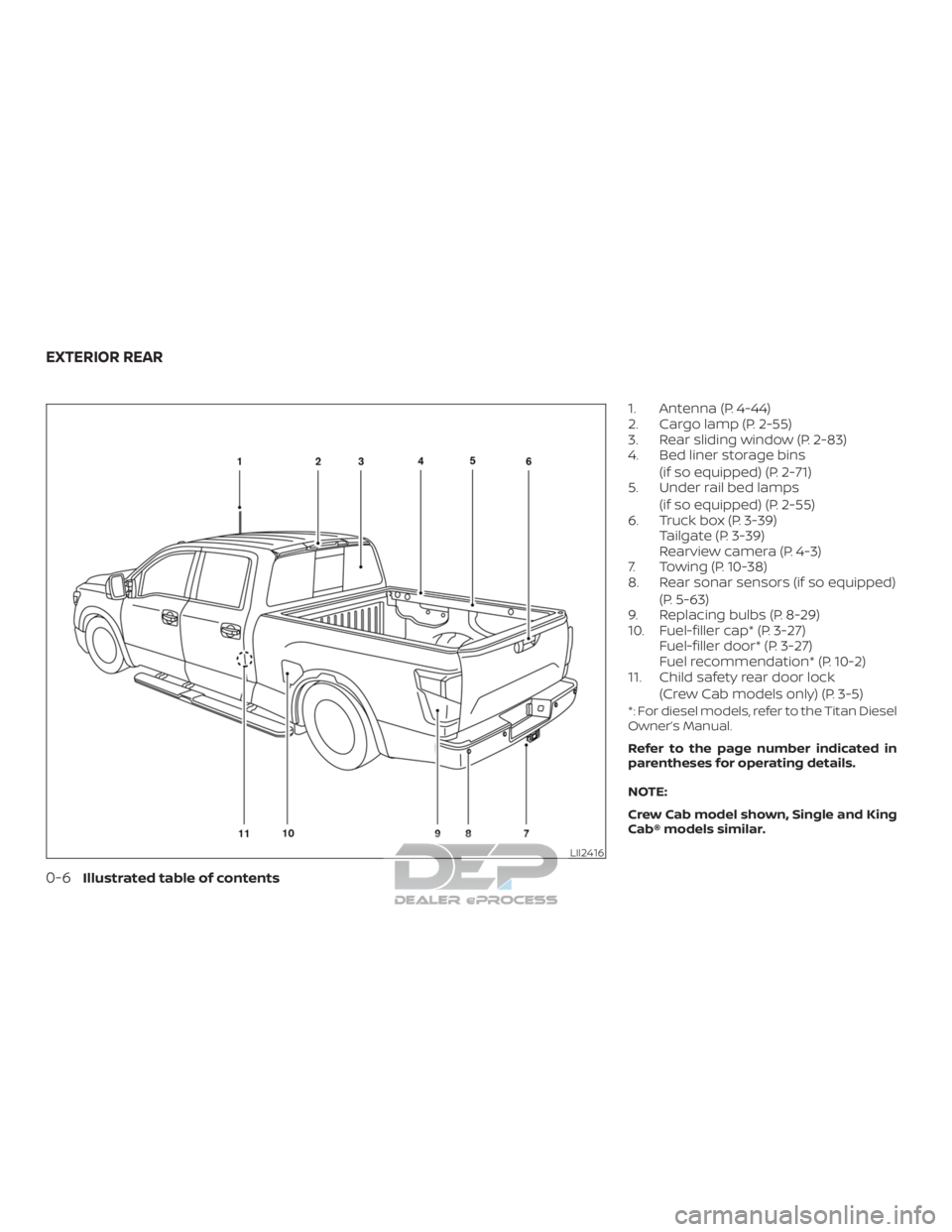
1. Antenna (P. 4-44)
2. Cargo lamp (P. 2-55)
3. Rear sliding window (P. 2-83)
4. Bed liner storage bins(if so equipped) (P. 2-71)
5. Under rail bed lamps
(if so equipped) (P. 2-55)
6. Truck box (P. 3-39) Tailgate (P. 3-39)
Rearview camera (P. 4-3)
7. Towing (P. 10-38)
8. Rear sonar sensors (if so equipped)
(P. 5-63)
9. Replacing bulbs (P. 8-29)
10. Fuel-filler cap* (P. 3-27) Fuel-filler door* (P. 3-27)
Fuel recommendation* (P. 10-2)
11. Child safety rear door lock
(Crew Cab models only) (P. 3-5)
*: For diesel models, refer to the Titan Diesel
Owner’s Manual.
Refer to the page number indicated in
parentheses for operating details.
NOTE:
Crew Cab model shown, Single and King
Cab® models similar.
LII2416
EXTERIOR REAR
0-6Illustrated table of contents
Page 34 of 682
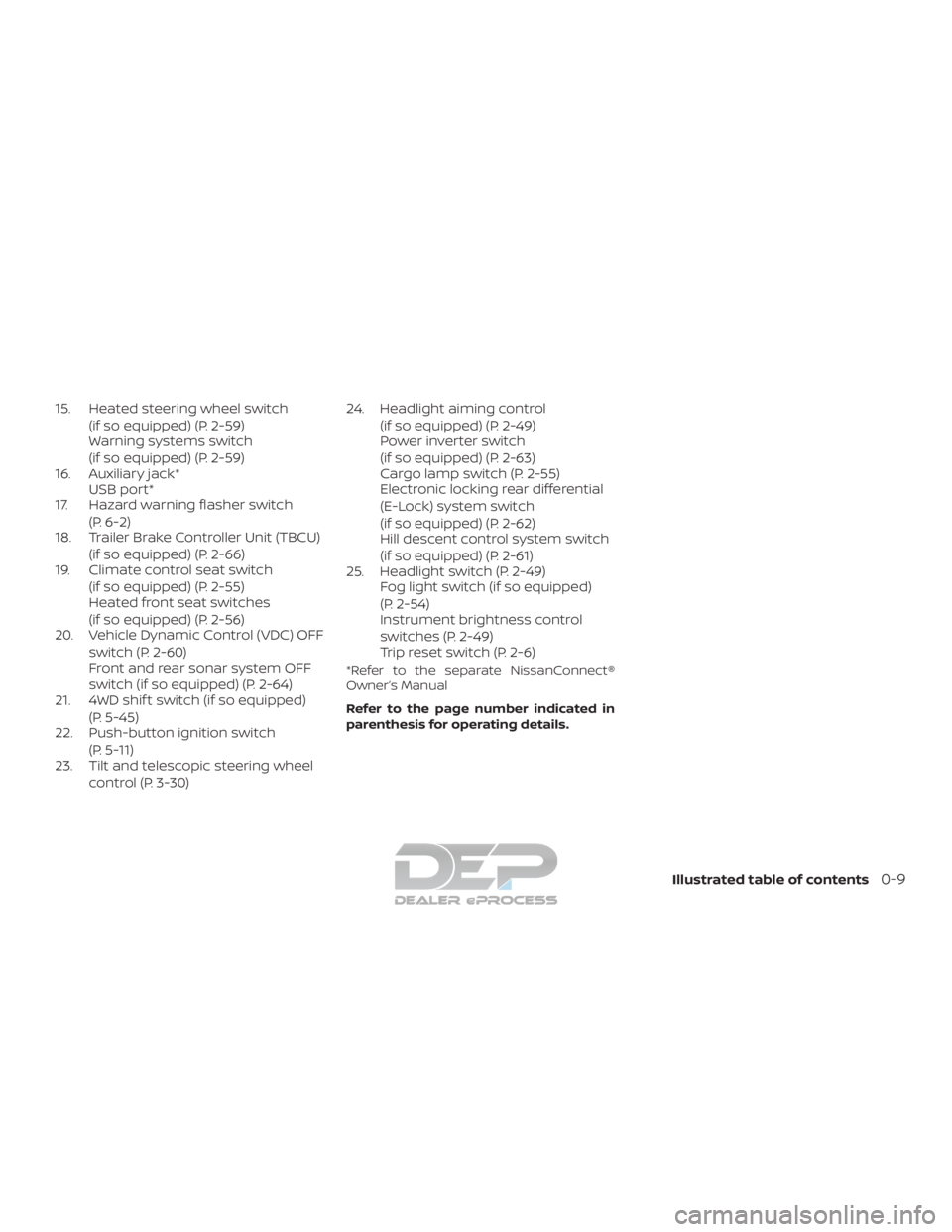
15. Heated steering wheel switch(if so equipped) (P. 2-59)
Warning systems switch
(if so equipped) (P. 2-59)
16. Auxiliary jack* USB port*
17. Hazard warning flasher switch
(P. 6-2)
18. Trailer Brake Controller Unit (TBCU)
(if so equipped) (P. 2-66)
19. Climate control seat switch
(if so equipped) (P. 2-55)
Heated front seat switches
(if so equipped) (P. 2-56)
20. Vehicle Dynamic Control (VDC) OFF
switch (P. 2-60)
Front and rear sonar system OFF
switch (if so equipped) (P. 2-64)
21. 4WD shif t switch (if so equipped)
(P. 5-45)
22. Push-button ignition switch
(P. 5-11)
23. Tilt and telescopic steering wheel
control (P. 3-30) 24. Headlight aiming control
(if so equipped) (P. 2-49)
Power inverter switch
(if so equipped) (P. 2-63)
Cargo lamp switch (P. 2-55)
Electronic locking rear differential
(E-Lock) system switch
(if so equipped) (P. 2-62)
Hill descent control system switch
(if so equipped) (P. 2-61)
25. Headlight switch (P. 2-49) Fog light switch (if so equipped)
(P. 2-54)
Instrument brightness control
switches (P. 2-49)
Trip reset switch (P. 2-6)
*Refer to the separate NissanConnect®
Owner’s Manual
Refer to the page number indicated in
parenthesis for operating details.
Illustrated table of contents0-9
Page 38 of 682
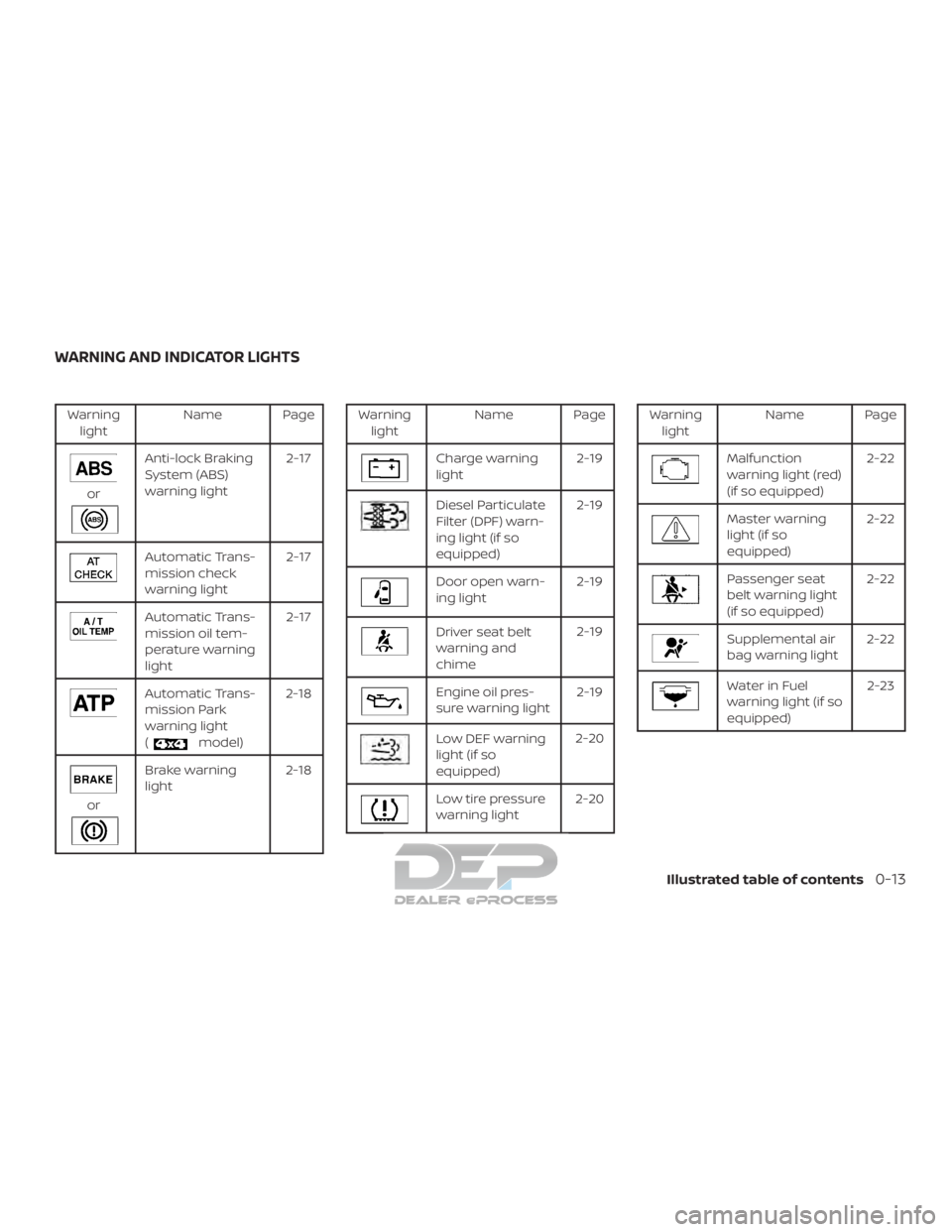
Warninglight Name Page
or
Anti-lock Braking
System (ABS)
warning light 2-17
Automatic Trans-
mission check
warning light2-17
Automatic Trans-
mission oil tem-
perature warning
light2-17
Automatic Trans-
mission Park
warning light
(
model)2-18
or
Brake warning
light
2-18
Warning
light Name Page
Charge warning
light 2-19
Diesel Particulate
Filter (DPF) warn-
ing light (if so
equipped)2-19
Door open warn-
ing light
2-19
Driver seat belt
warning and
chime2-19
Engine oil pres-
sure warning light
2-19
Low DEF warning
light (if so
equipped)2-20
Low tire pressure
warning light
2-20
Warning
light Name Page
Malfunction
warning light (red)
(if so equipped) 2-22
Master warning
light (if so
equipped)2-22
Passenger seat
belt warning light
(if so equipped)2-22
Supplemental air
bag warning light
2-22
Water in Fuel
warning light (if so
equipped) 2-23
WARNING AND INDICATOR LIGHTS
Illustrated table of contents0-13
Page 39 of 682
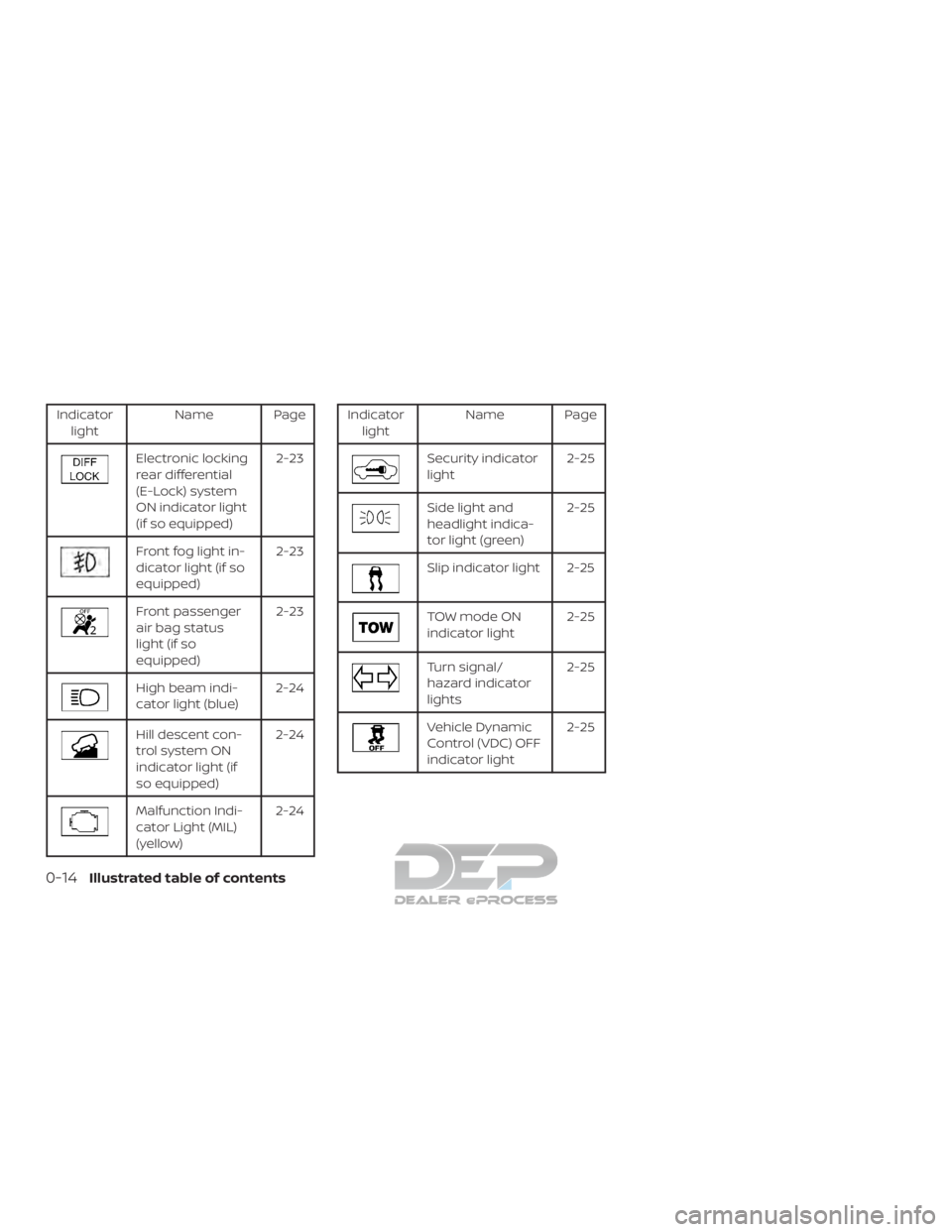
Indicatorlight Name Page
Electronic locking
rear differential
(E-Lock) system
ON indicator light
(if so equipped) 2-23
Front fog light in-
dicator light (if so
equipped)
2-23
Front passenger
air bag status
light (if so
equipped)2-23
High beam indi-
cator light (blue)
2-24
Hill descent con-
trol system ON
indicator light (if
so equipped)2-24
Malfunction Indi-
cator Light (MIL)
(yellow)
2-24
Indicator
light Name Page
Security indicator
light 2-25
Side light and
headlight indica-
tor light (green)2-25
Slip indicator light 2-25
TOW mode ON
indicator light
2-25
Turn signal/
hazard indicator
lights2-25
Vehicle Dynamic
Control (VDC) OFF
indicator light2-25
0-14Illustrated table of contents
Page 43 of 682
WARNING
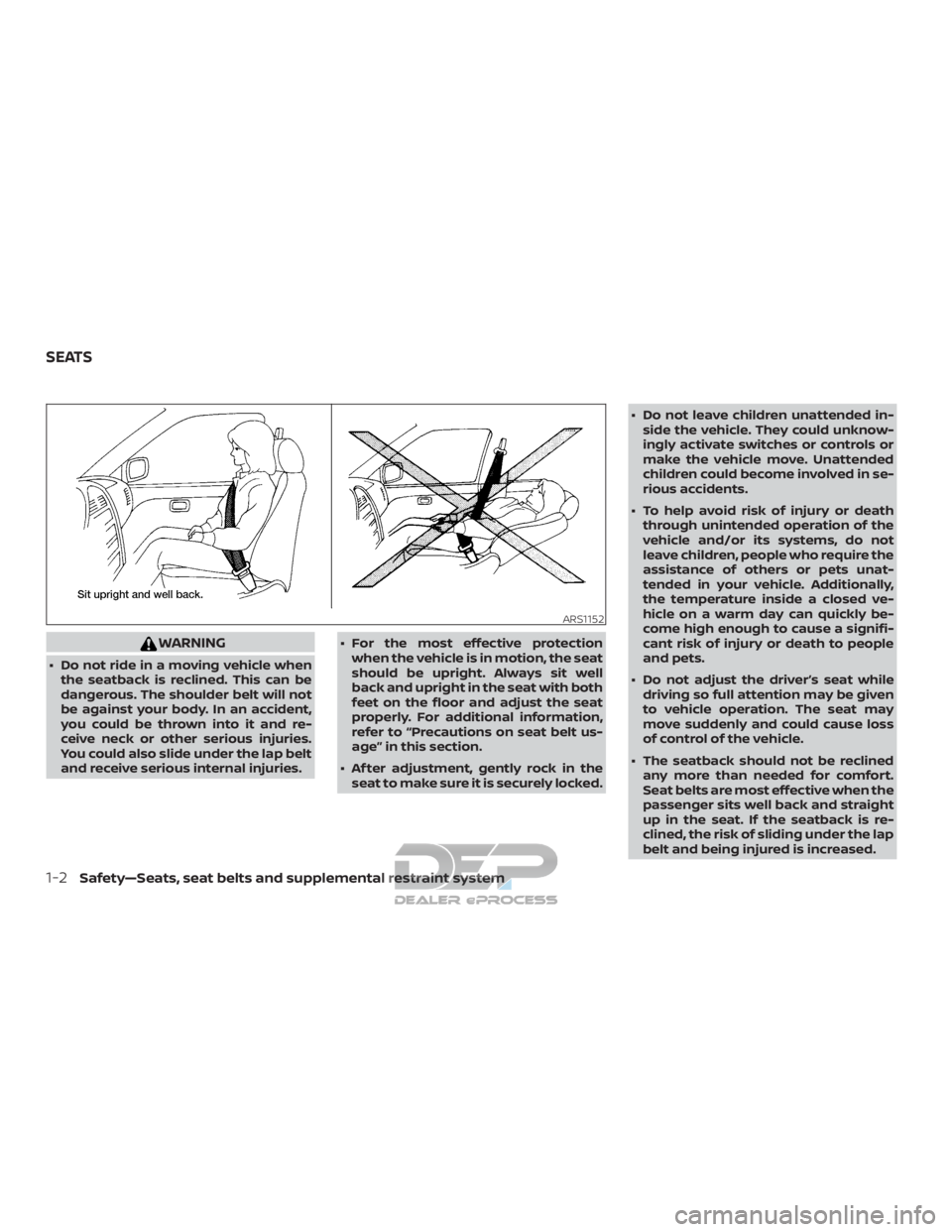
∙ Do not ride in a moving vehicle whenthe seatback is reclined. This can be
dangerous. The shoulder belt will not
be against your body. In an accident,
you could be thrown into it and re-
ceive neck or other serious injuries.
You could also slide under the lap belt
and receive serious internal injuries. ∙ For the most effective protection
when the vehicle is in motion, the seat
should be upright. Always sit well
back and upright in the seat with both
feet on the floor and adjust the seat
properly. For additional information,
refer to “Precautions on seat belt us-
age” in this section.
∙ Af ter adjustment, gently rock in the seat to make sure it is securely locked. ∙ Do not leave children unattended in-
side the vehicle. They could unknow-
ingly activate switches or controls or
make the vehicle move. Unattended
children could become involved in se-
rious accidents.
∙ To help avoid risk of injury or death through unintended operation of the
vehicle and/or its systems, do not
leave children, people who require the
assistance of others or pets unat-
tended in your vehicle. Additionally,
the temperature inside a closed ve-
hicle on a warm day can quickly be-
come high enough to cause a signifi-
cant risk of injury or death to people
and pets.
∙ Do not adjust the driver’s seat while driving so full attention may be given
to vehicle operation. The seat may
move suddenly and could cause loss
of control of the vehicle.
∙ The seatback should not be reclined any more than needed for comfort.
Seat belts are most effective when the
passenger sits well back and straight
up in the seat. If the seatback is re-
clined, the risk of sliding under the lap
belt and being injured is increased.
ARS1152
SEATS
1-2Safety—Seats, seat belts and supplemental restraint system
Page 44 of 682
CAUTION
When adjusting the seat positions, be
sure not to contact any moving parts to
avoid possible injuries and/or damage.
FRONT MANUAL BENCH SEAT
ADJUSTMENT (Single Cab models
and if so equipped for King Cab®
and Crew Cab models)
Your vehicle seats can be adjusted manu-
ally. For additional information about ad-
justing the seats, refer to the steps outlined
in this section.
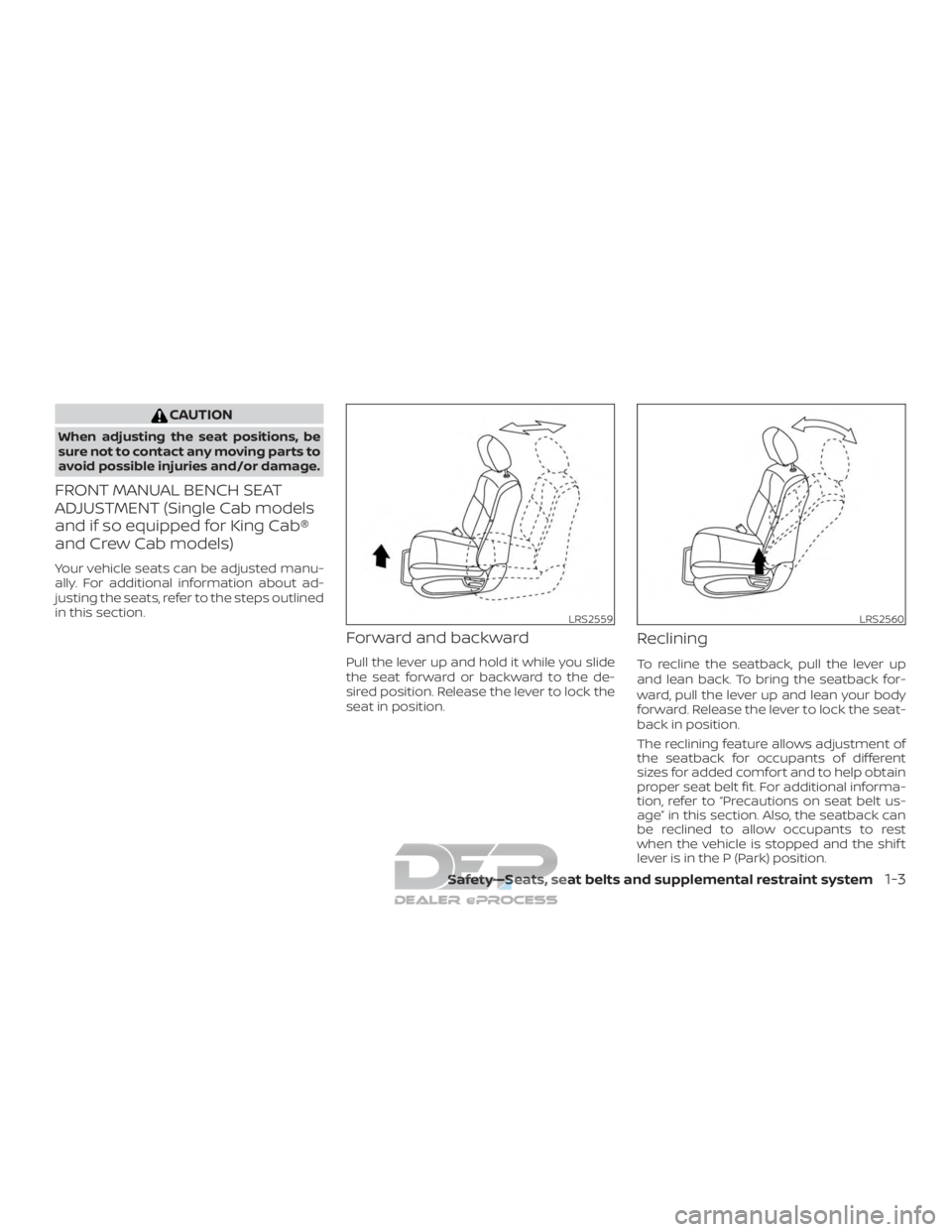
Forward and backward
Pull the lever up and hold it while you slide
the seat forward or backward to the de-
sired position. Release the lever to lock the
seat in position.
Reclining
To recline the seatback, pull the lever up
and lean back. To bring the seatback for-
ward, pull the lever up and lean your body
forward. Release the lever to lock the seat-
back in position.
The reclining feature allows adjustment of
the seatback for occupants of different
sizes for added comfort and to help obtain
proper seat belt fit. For additional informa-
tion, refer to “Precautions on seat belt us-
age” in this section. Also, the seatback can
be reclined to allow occupants to rest
when the vehicle is stopped and the shif t
lever is in the P (Park) position.
LRS2559LRS2560
Safety—Seats, seat belts and supplemental restraint system1-3
Page 45 of 682
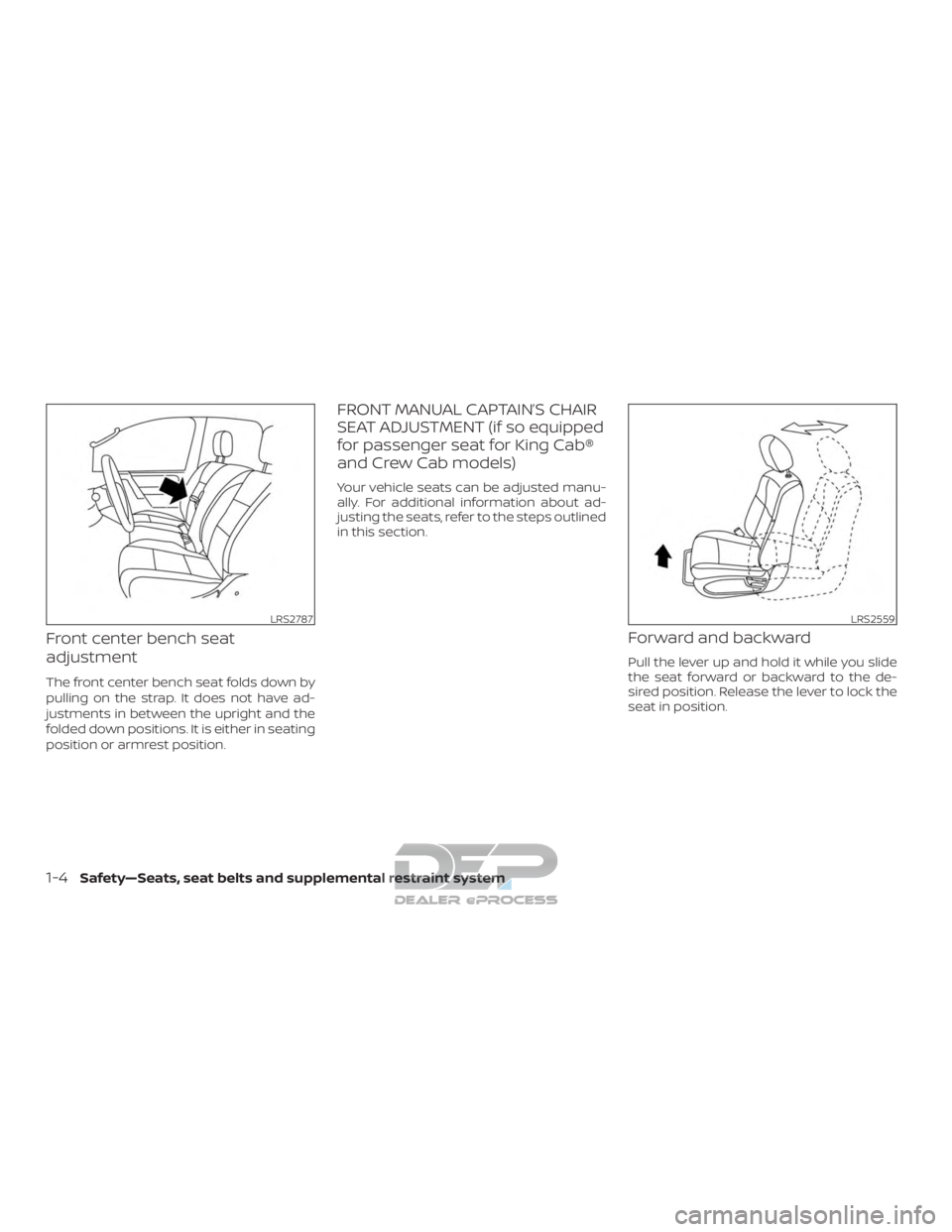
Front center bench seat
adjustment
The front center bench seat folds down by
pulling on the strap. It does not have ad-
justments in between the upright and the
folded down positions. It is either in seating
position or armrest position.
FRONT MANUAL CAPTAIN’S CHAIR
SEAT ADJUSTMENT (if so equipped
for passenger seat for King Cab®
and Crew Cab models)
Your vehicle seats can be adjusted manu-
ally. For additional information about ad-
justing the seats, refer to the steps outlined
in this section.
Forward and backward
Pull the lever up and hold it while you slide
the seat forward or backward to the de-
sired position. Release the lever to lock the
seat in position.
LRS2787LRS2559
1-4Safety—Seats, seat belts and supplemental restraint system
Page 46 of 682
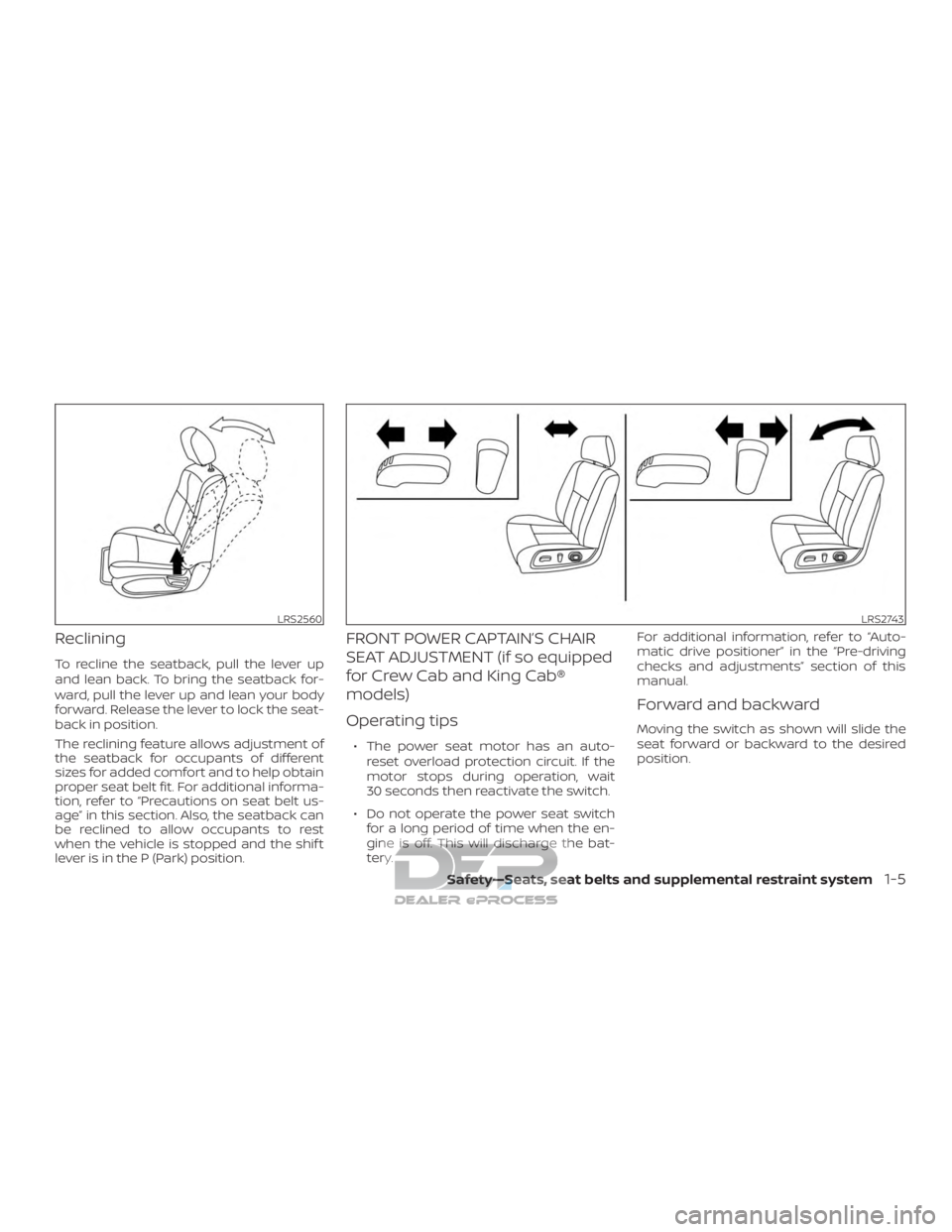
Reclining
To recline the seatback, pull the lever up
and lean back. To bring the seatback for-
ward, pull the lever up and lean your body
forward. Release the lever to lock the seat-
back in position.
The reclining feature allows adjustment of
the seatback for occupants of different
sizes for added comfort and to help obtain
proper seat belt fit. For additional informa-
tion, refer to “Precautions on seat belt us-
age” in this section. Also, the seatback can
be reclined to allow occupants to rest
when the vehicle is stopped and the shif t
lever is in the P (Park) position.
FRONT POWER CAPTAIN’S CHAIR
SEAT ADJUSTMENT (if so equipped
for Crew Cab and King Cab®
models)
Operating tips
∙ The power seat motor has an auto-reset overload protection circuit. If the
motor stops during operation, wait
30 seconds then reactivate the switch.
∙ Do not operate the power seat switch for a long period of time when the en-
gine is off. This will discharge the bat-
tery. For additional information, refer to “Auto-
matic drive positioner” in the “Pre-driving
checks and adjustments” section of this
manual.
Forward and backward
Moving the switch as shown will slide the
seat forward or backward to the desired
position.
LRS2560LRS2743
Safety—Seats, seat belts and supplemental restraint system1-5
Page 49 of 682
∙ Head restraints/headrests should beadjusted properly as they may pro-
vide significant protection against in-
jury in an accident. Always replace
and adjust them properly if they have
been removed for any reason.
∙ If the head restraints/headrests are removed for any reason, they should
be securely stored to prevent them
from causing injury to passengers or
damage to the vehicle in case of sud-
den braking or an accident.
∙ When returning the seatbacks to the upright position, be certain they are
completely secured in the latched po-
sition. If they are not completely se-
cured, passengers may be injured in
an accident or sudden stop.
∙ Properly secure all cargo to help pre- vent it from sliding or shif ting. Do not
place cargo higher than the seat-
backs. In a sudden stop or collision,
unsecured cargo could cause per-
sonal injury.
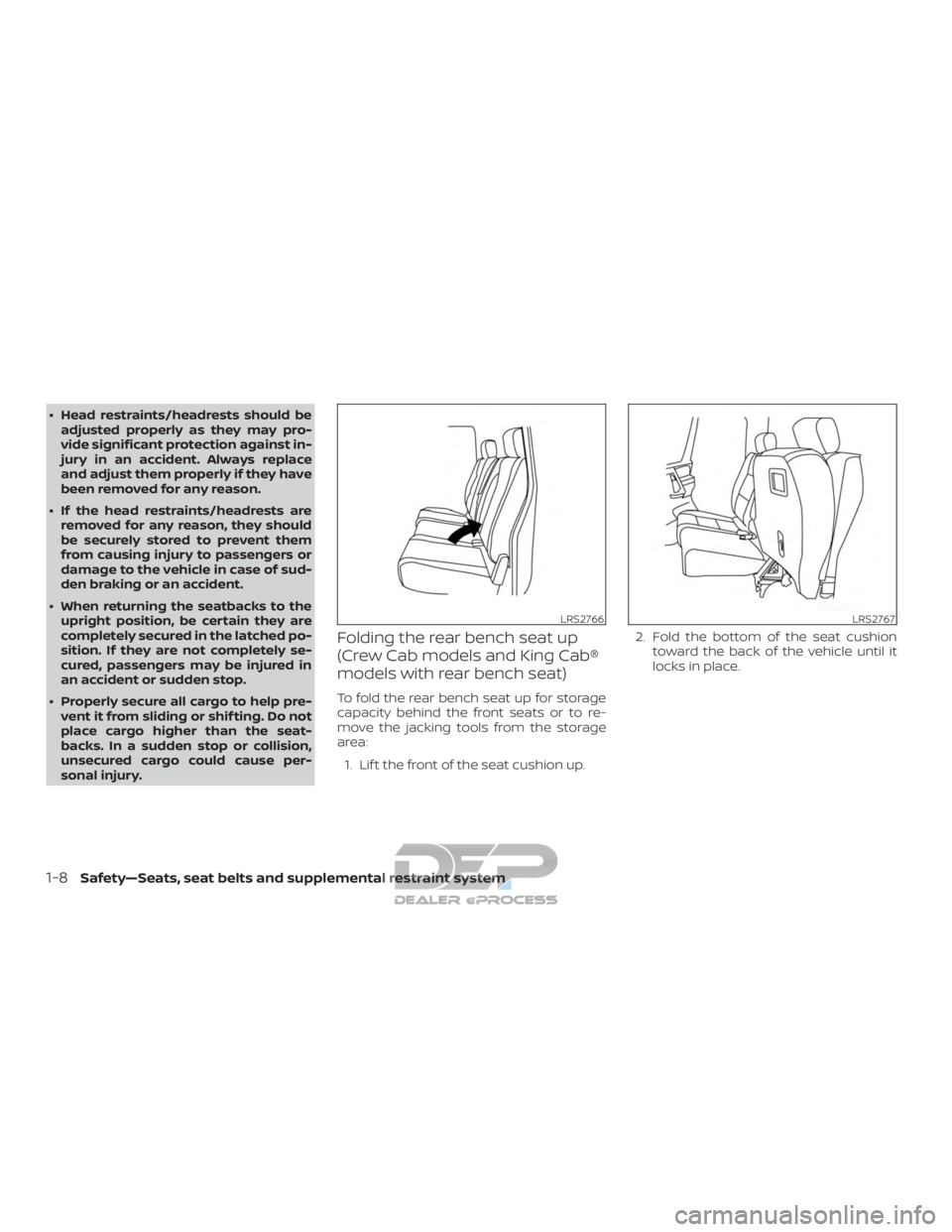
Folding the rear bench seat up
(Crew Cab models and King Cab®
models with rear bench seat)
To fold the rear bench seat up for storage
capacity behind the front seats or to re-
move the jacking tools from the storage
area:
1. Lif t the front of the seat cushion up. 2. Fold the bottom of the seat cushion
toward the back of the vehicle until it
locks in place.
LRS2766LRS2767
1-8Safety—Seats, seat belts and supplemental restraint system