air condition NISSAN TITAN 2020 Owner´s Manual
[x] Cancel search | Manufacturer: NISSAN, Model Year: 2020, Model line: TITAN, Model: NISSAN TITAN 2020Pages: 657, PDF Size: 5.1 MB
Page 609 of 657
These data can help provide a better un-
derstanding of the circumstances in which
crashes and injuries occur. NOTE: EDR data
are recorded by your vehicle only if a non-
trivial crash situation occurs; no data are
recorded by the EDR under normal driving
conditions and no personal data (e.g.
name, gender, age and crash location) are
recorded. However, other parties, such as
law enforcement, could combine the EDR
data with the type of personally identif ying
data routinely acquired during a crash in-
vestigation.
To read data recorded by an EDR, special
equipment is required and access to the
vehicle or the EDR is needed. In addition to
the vehicle manufacturer and NISSAN
dealer, other parties, such as law enforce-
ment, that have the special equipment, can
read the information if they have access to
the vehicle or the EDR. EDR data will only be
accessed with the consent of the vehicle
owner or lessee or as otherwise required or
permitted by law.Genuine NISSAN Service Manuals for this
model year and prior can be purchased. A
Genuine NISSAN Service Manual is the best
source of service and repair information for
your vehicle. This manual is the same one
used by the factory-trained technicians
working at NISSAN dealerships. Genuine
NISSAN Owner’s Manuals can also be pur-
chased.
For USA
For current pricing and availability of Genu-
ine
NISSAN Service Manuals, contact:
www.nissan-techinfo.com
For current pricing and availability of Genu-
ine NISSAN Owner's Manuals, contact:
1-800-247-5321
For Canada
To purchase a copy of a Genuine NISSAN
Service Manual or Owner’s Manual, for this
model year and prior, please contact your
nearest NISSAN dealer. For the phone num-
ber and location of a NISSAN dealer in your
area, call the NISSAN Information Center at
1-800-387-0122 and a bilingual NISSAN rep-
resentative will assist you.
OWNER'S MANUAL/SERVICE
MANUAL ORDER INFORMATION
10-60Technical and consumer information
Page 610 of 657
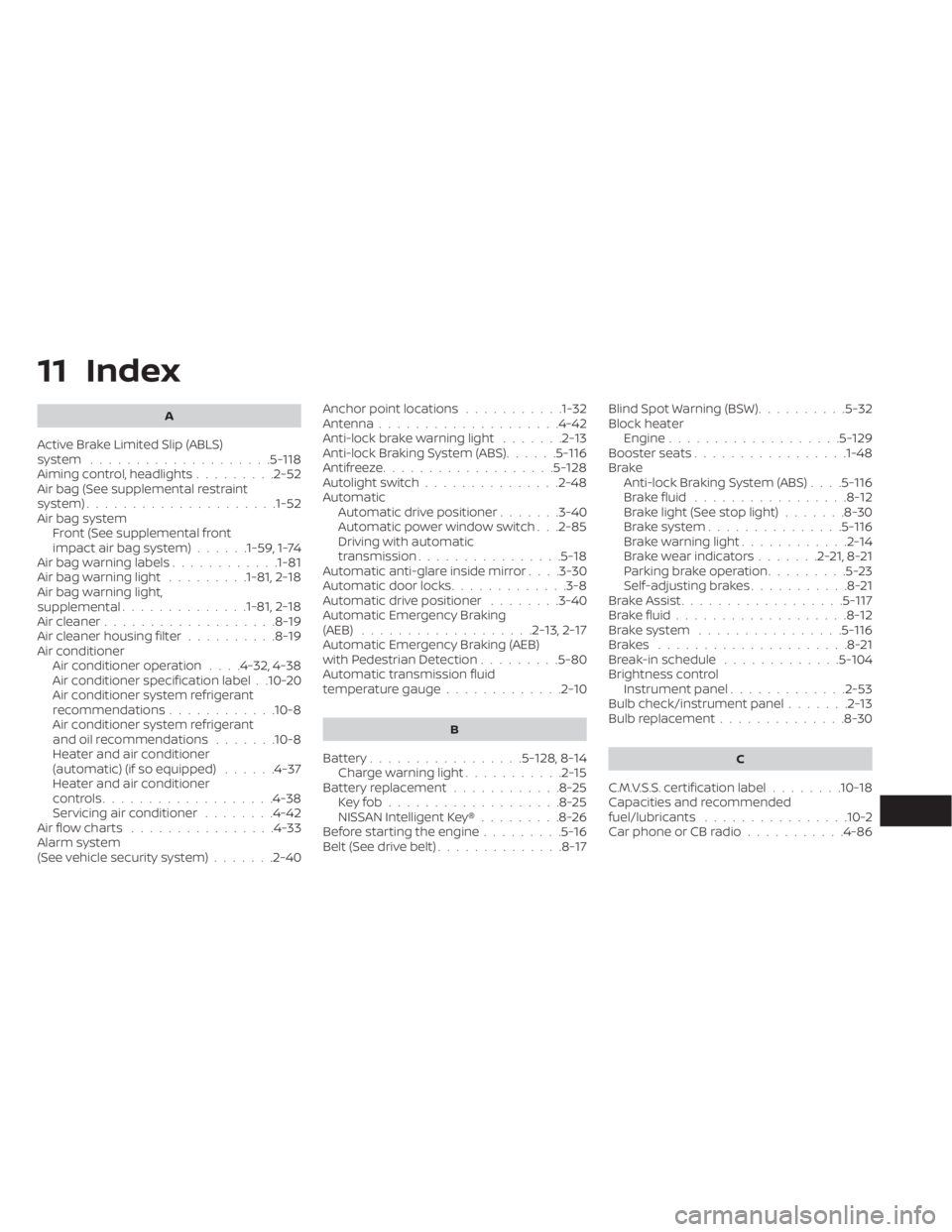
11 Index
A
Active Brake Limited Slip (ABLS)
system....................5-118Aiming control, headlights.........2-52Air bag (See supplemental restraint
system).....................1-52Air bag system
Front (See supplemental front
impact air bag system)
......1-59, 1-74Air bag warning labels............1-81Air bag warning light.........1-81, 2-18Air bag warning light,
supplemental..............1-81, 2-18Air cleaner...................8-19Air cleaner housing filter..........8-19Air conditionerAir conditioner operation. . . .4-32, 4-38Air conditioner specification label. .10-20Air conditioner system refrigerant
recommendations............10-8Air conditioner system refrigerant
and oil recommendations.......10-8Heater and air conditioner
(automatic) (if so equipped)......4-37Heater and air conditioner
controls.................. .4-38Servicing air conditioner........4-42Air flow charts................4-33Alarm system
(See vehicle security system).......2-40
Anchor point locations...........1-32Antenna................... .4-42Anti-lock brake warning light.......2-13Anti-lock Braking System (ABS)......5-116Antifreeze...................5-128Autolight switch...............2-48Automatic
Automatic drive positioner.......3-40Automatic power window switch. . .2-85Driving with automatic
transmission................5-18Automatic anti-glare inside mirror. . . .3-30Automatic door locks.............3-8Automatic drive positioner........3-40Automatic Emergency Braking
(AEB)...................2-13,2-17Automatic Emergency Braking (AEB)
with Pedestrian Detection.........5-80Automatic transmission fluid
temperature gauge.............2-10
B
Battery.................5- 128, 8-14Charge warning light...........2-15Battery replacement............8-25Key fob...................8-25NISSAN Intelligent Key®.........8-26Before starting the engine.........5-16Belt (See drive belt)..............8-17
Blind Spot Warning (BSW)..........5-32Block heater
Engine...................5-129Booster seats................ .1-48Brake
Anti-lock Braking System (ABS). . . .5-116Brake fluid.................8-12Brake light (See stop light).......8-30Brake system...............5-116Brake warning light............2-14Brake wear indicators.......2-21,8-21Parking brake operation.........5-23Self-adjusting brakes...........8-21Brake Assist..................5-117Brake fluid...................8-12Brake system................5-116Brakes.....................8-21Break-in schedule.............5-104Brightness controlInstrument panel.............2-53Bulb check/instrument panel.......2-13Bulb replacement..............8-30
C
C.M.V.S.S. certification label........10-18Capacities and recommended
fuel/lubricants................10-2Car phone or CB radio...........4-86
Page 611 of 657
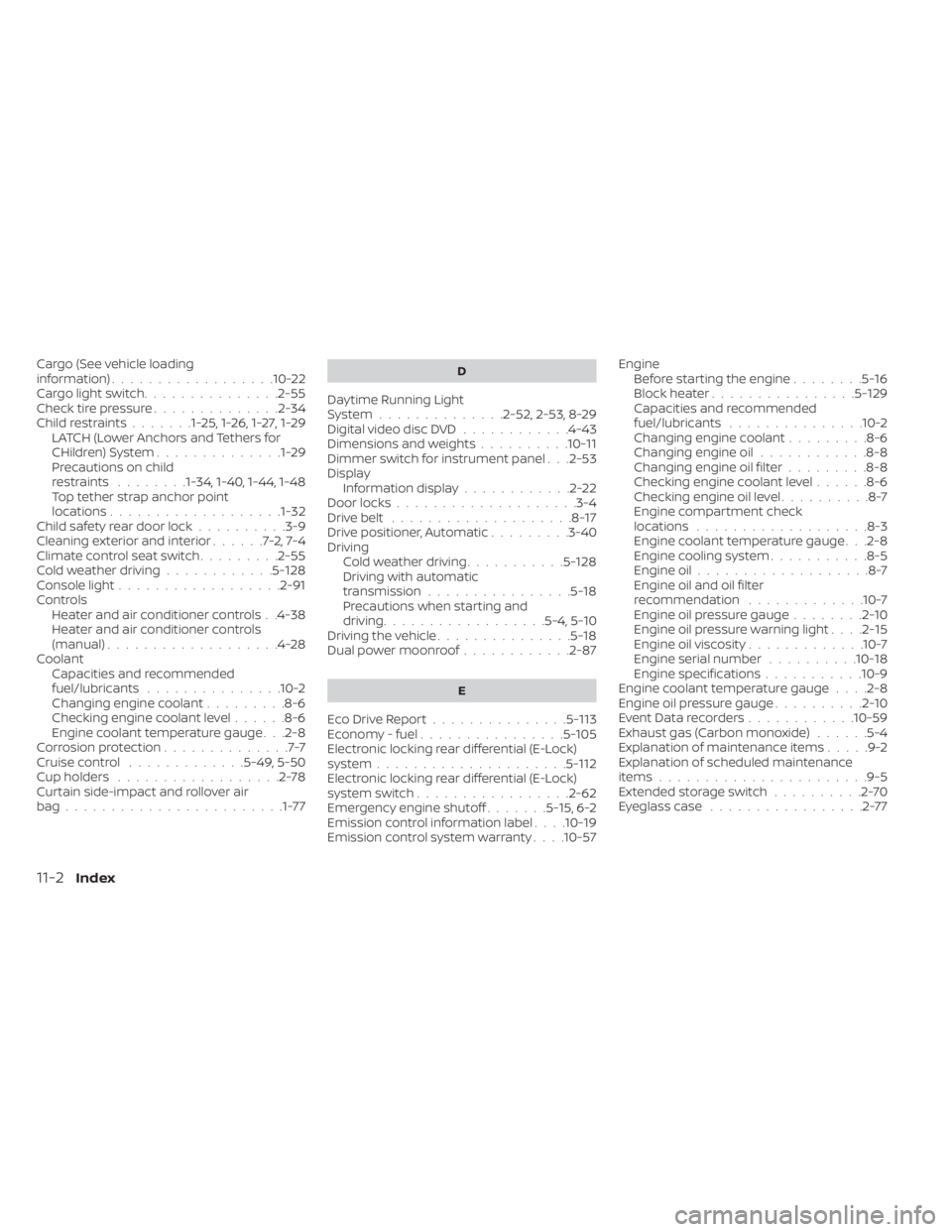
Cargo (See vehicle loading
information)..................10-22Cargo light switch...............2-55Check tire pressure..............2-34Child restraints.......1-25,1-26,1-27,1-29LATCH (Lower Anchors and Tethers for
CHildren) System..............1-29Precautions on child
restraints........1-34, 1-40, 1-44, 1-48Top tether strap anchor point
locations.................. .1-32Child safety rear door lock..........3-9Cleaning exterior and interior......7-2,7-4Climate control seat switch.........2-55Cold weather driving............5-128Console light..................2-91Controls
Heater and air conditioner controls. .4-38Heater and air conditioner controls
(manual)...................4-28CoolantCapacities and recommended
fuel/lubricants
...............10-2Changing engine coolant.........8-6Checking engine coolant level......8-6Engine coolant temperature gauge. . .2-8Corrosion protection..............7-7Cruise control.............5-49, 5-50Cup holders..................2-78Curtain side-impact and rollover air
bag........................1-77
D
Daytime Running Light
System..............2-52, 2-53, 8-29Digital video disc DVD............4-43Dimensions and weights..........10-11Dimmer switch for instrument panel. . .2-53DisplayInformation display............2-22Door locks................... .3-4Drive belt....................8-17Drive positioner, Automatic.........3-40Driving
Cold weather driving...........5-128Driving with automatic
transmission................5-18Precautions when starting and
driving................. .5-4, 5-10Driving the vehicle...............5-18Dual power moonroof............2-87
E
Eco Drive Report...............5-113Economy - fuel................5-105Electronic locking rear differential (E-Lock)
system.....................5-112Electronic locking rear differential (E-Lock)
system switch.................2-62Emergency engine shutoff.......5-15,6-2Emission control information label. . . .10-19Emission control system warranty. . . .10-57
Engine
Before starting the engine........5-16Block heater................5-129Capacities and recommended
fuel/lubricants...............10-2Changing engine coolant.........8-6Changing engine oil............8-8Changing engine oil filter.........8-8Checking engine coolant level......8-6Checking engine oil level..........8-7Engine compartment check
locations.................. .8-3Engine coolant temperature gauge. . .2-8Engine cooling system...........8-5Engine oil...................8-7Engine oil and oil filter
recommendation.............10-7Engine oil pressure gauge........2-10Engine oil pressure warning light. . . .2-15Engine oil viscosity.............10-7Engine serial number..........10-18Engine specifications...........10-9Engine coolant temperature gauge. . . .2-8Engine oil pressure gauge..........2-10Event Data recorders............10-59Exhaust gas (Carbon monoxide)......5-4Explanation of maintenance items.....9-2Explanation of scheduled maintenance
items...................... .9-5Extended storage switch..........2-70Eyeglass case.................2-77
11-2Index
Page 612 of 657
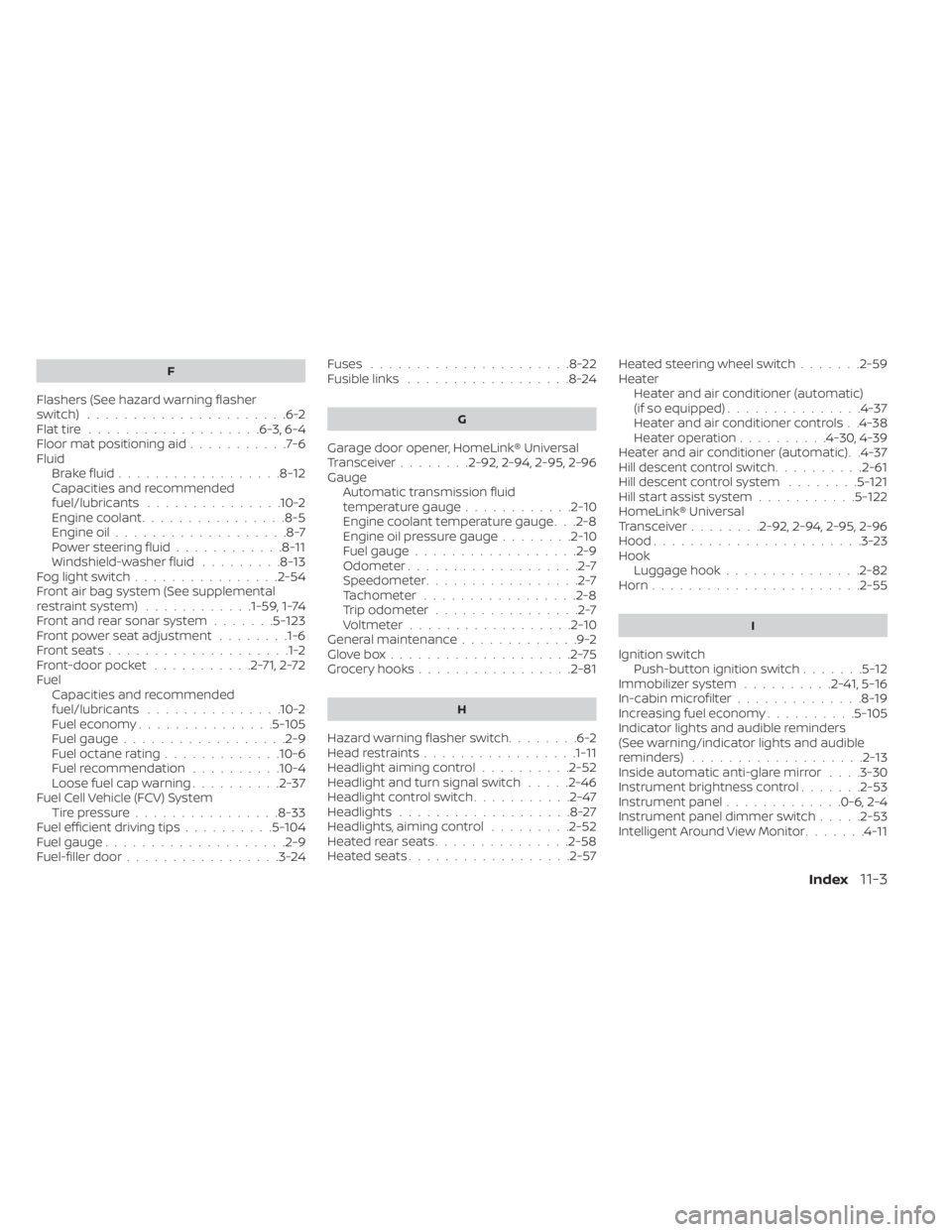
F
Flashers (See hazard warning flasher
switch)......................6-2Flat tire...................6-3, 6-4Floor mat positioning aid...........7-6Fluid
Brake fluid..................8-12Capacities and recommended
fuel/lubricants...............10-2Engine coolant................8-5Engine oil...................8-7Power steering fluid............8-11Windshield-washer fluid.........8-13Fog light switch................2-54Front air bag system (See supplemental
restraint system)............1-59, 1-74Front and rear sonar system.......5-123Front power seat adjustment........1-6Front seats....................1-2Front-door pocket...........2-71,2-72FuelCapacities and recommended
fuel/lubricants
...............10-2Fuel economy...............5-105Fuel gauge................. .2-9Fuel octane rating.............10-6Fuel recommendation..........10-4Loose fuel cap warning..........2-37Fuel Cell Vehicle (FCV) System
Tire pressure................8-33Fuel efficient driving tips..........5-104Fuel gauge................... .2-9Fuel-filler door.................3-24
Fuses......................8-22Fusible links..................8-24
G
Garage door opener, HomeLink® Universal
Transceiver........2-92, 2-94, 2-95, 2-96Gauge
Automatic transmission fluid
temperature gauge
............2-10Engine coolant temperature gauge. . .2-8Engine oil pressure gauge........2-10Fuel gauge................. .2-9Odometer...................2-7Speedometer.................2-7Tachometer.................2-8Trip odometer................2-7Voltmeter..................2-10General maintenance.............9-2Glove box....................2-75Grocery hooks.................2-81
H
Hazard warning flasher switch........6-2Head restraints.................1-11Headlight aiming control..........2-52Headlight and turn signal switch.....2-46Headlight control switch...........2-47Headlights...................8-27Headlights, aiming control.........2-52Heated rear seats...............2-58Heated seats................. .2-57
Heated steering wheel switch.......2-59Heater
Heater and air conditioner (automatic)
(if so equipped)
...............4-37Heater and air conditioner controls. .4-38Heater operation..........4-30, 4-39Heater and air conditioner (automatic). .4-37Hill descent control switch..........2-61Hill descent control system........5-121Hill start assist system...........5-122HomeLink® Universal
Transceiver........2-92, 2-94, 2-95, 2-96Hood.......................3-23HookLuggage hook...............2-82Horn...................... .2-55
I
Ignition switch
Push-button ignition switch.......5-12Immobilizer system..........2-41, 5-16In-cabin microfilter..............8-19Increasing fuel economy..........5-105Indicator lights and audible reminders
(See warning/indicator lights and audible
reminders)
...................2-13Inside automatic anti-glare mirror. . . .3-30Instrument brightness control.......2-53Instrument panel.............0-6, 2-4Instrument panel dimmer switch.....2-53Intelligent Around View Monitor.......4-11
Index11-3
Page 613 of 657
Intelligent Cruise Control (ICC)
(for vehicles without ProPILOT Assist). . .5-51Intelligent Driver Alertness (I-DA).....5-101Intelligent Forward Collision Warning
(I-FCW)......................5-90Intelligent Key system
Key operating range............3-11Key operation................3-12Mechanical key................3-3Remote keyless entry operation. . . .3-15Troubleshooting guide..........3-19Warning signals...............3-19Interior light................. .2-90ISOFIX child restraints.............1-29
J
Jump starting..............6-10,8-16
K
Key.........................3-2Key fob battery replacement........8-25Keyless entry
With Intelligent Key system
(See Intelligent Key system)
.......3-15KeysNISSAN Intelligent Key®........3-2,3-9NISSAN Vehicle Immobilizer System
keys..................... .3-4
L
Labels
Air conditioner specification label. . .10-20C.M.V.S.S. certification label.......10-18Emission control information label. .10-19Engine serial number..........10-18Tire and Loading Information label. .10-19Vehicle identification number (VIN). .10-17Vehicle identification number (VIN)
plate.................... .10-17Warning labels (for SRS)..........1-81Lane Departure Warning (LDW).......5-27LATCH (Lower Anchors and Tethers for
CHildren) System...............1-29License plate
Installing the license plate........10-21LightAir bag warning light........1-81, 2-18Brake light (See stop light)........8-30Bulb check/instrument panel......2-13Bulb replacement.............8-30Charge warning light...........2-15Console light................2-91Exterior and Interior lights........8-30Fog light switch..............2-54Fog lights..................8-28Headlight and turn signal switch. . . .2-46Headlight control switch.........2-47Headlights..................8-27Interior light................ .2-90Light bulbs.................8-27Low tire pressure warning light.....2-15
Low windshield-washer fluid warning
light..................... .2-35Passenger air bag and status light. . .1-62Personal lights...............2-91Security indicator light..........2-20Warning/indicator lights and audible
reminders..................2-13Lights......................8-27Map lights..................2-91Lock
Child safety rear door lock.........3-9Door locks................. .3-4Power door locks..............3-6Loose fuel cap warning...........2-37Low fuel warning light.........2-17,2-34Low tire pressure warning light.......2-15Low windshield-washer fluid warning
light...................... .2-35Luggage (See vehicle loading
information)..................10-22Luggage hook.................2-82
M
Maintenance
General maintenance...........9-2Inside the vehicle..............9-3Maintenance precautions.........8-2Outside the vehicle.............9-2Seat belt maintenance..........1-24Under the hood and vehicle.......9-4Maintenance log................9-11Maintenance requirements..........9-2
11-4Index
Page 615 of 657
Rear window and/or outside mirror
defroster switch................2-45Rearview mirror................3-29RearView Monitor................4-3Recommended Fluids............10-2RecordersEvent Data................ .10-59Refrigerant recommendation.......10-8Registering a vehicle in another
country.................... .10-17Remote Engine Start..........3-21,5-17Reporting safety defects (US only). . . .10-58
S
Safety
Child safety rear door lock.........3-9Child seat belts. .1-27, 1-34, 1-40, 1-44, 1-48Reporting safety defects (US only). .10-58Seat adjustmentFront manual seat adjustment......1-4Front power seat adjustment.......1-6Seat beltChild safety.................1-25Infants and small children.....1-25,1-26Injured person................1-19Larger children...............1-26Precautions on seat belt usage.....1-16Pregnant women..............1-19Seat belt extenders............1-24Seat belt maintenance..........1-24Seat belts................1-16,7-7Shoulder belt height adjustment. . . .1-23
Three-point type with retractor.....1-19Seat belt extenders..............1-24Seat belt warning light.........1-19,2-18Seatback pockets...............2-72SeatsAdjustment..................1-2Automatic drive positioner.......3-40Front seats..................1-2Heated seats................2-57Manual front seat adjustment......1-4Rear seat.................. .1-4Security indicator light............2-20Security system (NISSAN Vehicle Immobilizer
System), engine start.........2-41, 5-16Security systems
Vehicle security system.........2-40Self-adjusting brakes.............8-21Service manual order form........10-60Servicing air conditioner...........4-42Shif tingAutomatic transmission.........5-20Shoulder belt height adjustment......1-23Side air bag system (See supplemental side
air bag, curtain and rollover air bag
systems)
.....................1-77Snow plow................. .10-56Spark plug replacement...........8-18Spark plugs...................8-18Specifications.................10-9Speedometer..................2-7Speedometer and odometer........2-6SRS warning label...............1-81Stability control................5-119Standard maintenance.........9-7,9-8
Starting
Before starting the engine........5-16Jump starting............6-10,8-16Precautions when starting and
driving................. .5-4, 5-10Push starting................6-12Starting the engine
(gasoline engine only)............5-16Steering
Power steering fluid............8-11Power steering system.........5-115Steering wheel.................3-26Stop light................... .8-30Storage.....................2-71Storage tray..................2-75Sun visors....................3-28Sunglasses case................2-77Sunglasses holder...............2-77Sunroof..................2-87, 7-5Supplemental air bag warning labels. . .1-81Supplemental air bag warning
light................... .1-81, 2-18Supplemental front impact air bag
system..................1-59, 1-74Supplemental restraint system
Information and warning labels.....1-81Precautions on supplemental restraint
system................ .1-52, 1-67Supplemental restraint system
(Supplemental air bag system).......1-52Switch
Autolight switch..............2-48Automatic power window switch. . .2-85
11-6Index
Page 628 of 657
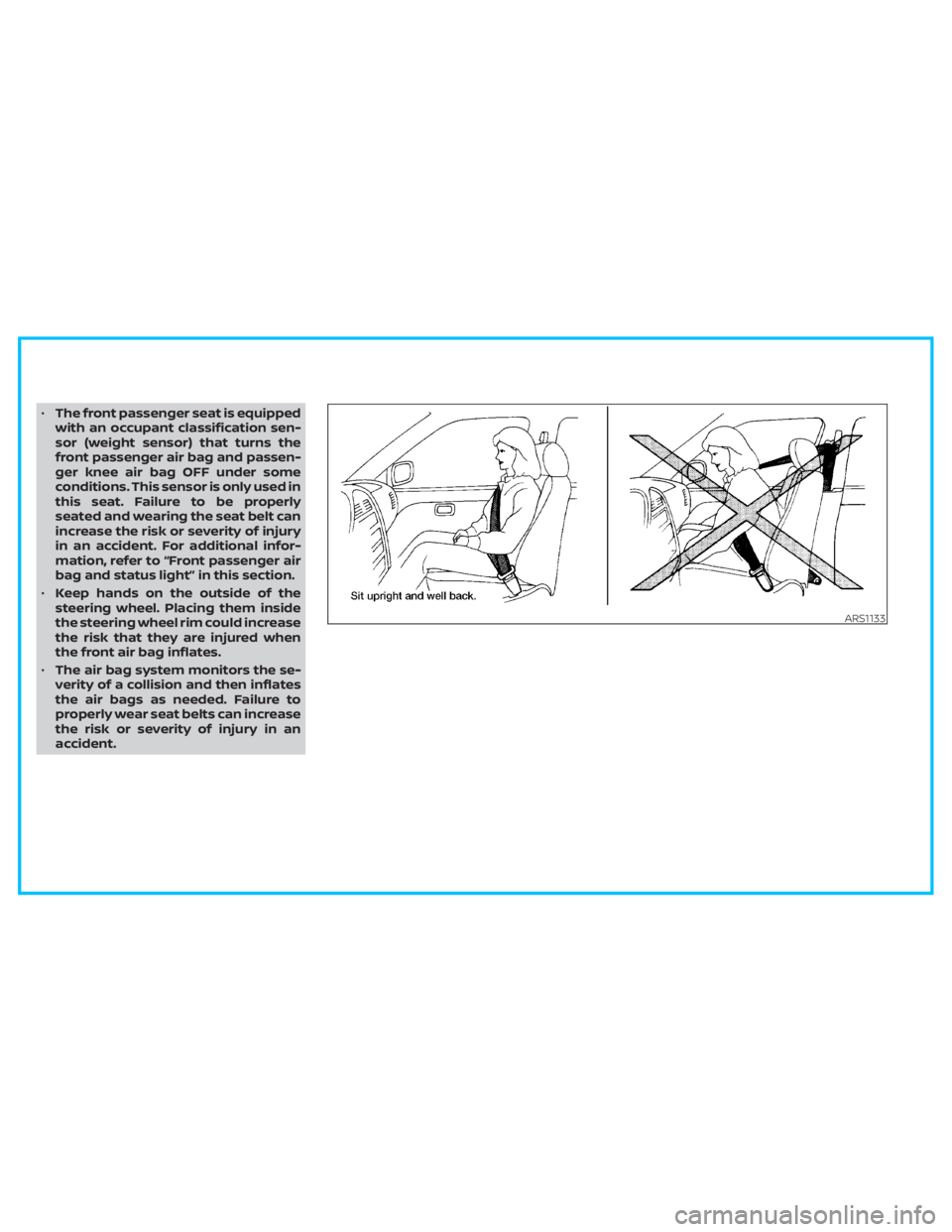
•The front passenger seat is equipped
with an occupant classification sen-
sor (weight sensor) that turns the
front passenger air bag and passen-
ger knee air bag OFF under some
conditions. This sensor is only used in
this seat. Failure to be properly
seated and wearing the seat belt can
increase the risk or severity of injury
in an accident. For additional infor-
mation, refer to “Front passenger air
bag and status light” in this section.
•Keep hands on the outside of the
steering wheel. Placing them inside
the steering wheel rim could increase
the risk that they are injured when
the front air bag inflates.
•The air bag system monitors the se-
verity of a collision and then inflates
the air bags as needed. Failure to
properly wear seat belts can increase
the risk or severity of injury in an
accident.
ARS1133
Page 634 of 657
12. Satellite sensor (passenger’s side
shown; driver’s side similar)
13. Seat belt with pretensioner(s) (rear out-
board seats) (passenger's side shown;
driver's side similar)
WARNING
To ensure proper operation of the pas-
senger’s NISSAN Advanced Air Bag Sys-
tem, please observe the following
items.
•Do not allow a passenger in the rear
bench seats to push or pull on the
seatback pocket.
•Do not place heavy loads heavier
than 2.2 lbs. (1 kg) on the seatback,
head restraint or in the seatback
pocket.
•Do not store luggage behind the seat
that can press into the seatback.
•Do not position the front passenger
seat so it contacts the rear bench
seats. If the front seat does contact
the rear bench seats, the air bag sys-
tem may determine a sensor mal-
function has occurred and the front
passenger air bag status light may
illuminate and the supplemental air
bag warning light may flash.•If a forward-facing child restraint is
installed in the front passenger seat,
do not position the front passenger
seat so the child restraint contacts
the instrument panel. If the child re-
straint does contact the instrument
panel, the system may determine the
seat as occupied and the passenger
air bag and passenger knee air bag
may deploy in a collision. Also the
front passenger air bag status light
may not illuminate. For additional in-
formation, refer to “Child restraints”
in this section.
•Confirm the operating condition with
the front passenger air bag status
light.
•If you notice that the front passenger
air bag status light is not operating
as described in this section, get the
occupant classification system
checked. It is recommended that you
take your vehicle to a NISSAN dealer
for this service.
•Until you have confirmed with a
dealer that your passenger seat oc-
cupant classification system is work-
ing properly, position the occupants
in the rear seating positions.This vehicle is equipped with the NISSAN
Advanced Air Bag System for the driver and
front passenger seats.All of the informa-
tion, cautions and warnings in this
manual still apply and must be followed.
The driver supplemental front-impact air
bag is located in the center of the steering
wheel. The front passenger supplemental
front-impact air bag is mounted in the
dashboard above the glove box. The front
air bags are designed to inflate in higher
severity frontal collisions, although they
may inflate if the forces in another type of
collision are similar to those of a higher
severity frontal impact. They may not in-
flate in certain frontal collisions. Vehicle
damage (or lack of it) is not always an indi-
cation of proper front air bag system op-
eration.
The NISSAN Advanced Air Bag System
monitors information from the crash zone
sensor and the Air bag Control Unit (ACU).
Inflator operation is based on the severity
of a collision and seat belt usage for the
driver. For the front passenger, the occu-
pant classification sensor is also moni-
tored. Based upon the information from
the sensor, only one front air bag may in-
flate in a crash, depending on the crash
severity. Additionally, the front passenger
Page 635 of 657
air bag and passenger knee air bag may be
automatically turned off under some con-
ditions, depending on the weight detected
on the front passenger seat and how the
seat belt is used. If the front passenger air
bag and passenger knee air bag are OFF,
the front passenger air bag status light will
be illuminated (if the seat is unoccupied,
the light will not be illuminated, but the air
bag will be off ). For additional information,
refer to “Front passenger air bag and sta-
tus light” in this section. One front air bag
inflating does not indicate improper per-
formance of the system.
If you have any questions about your air
bag system, it is recommended that you
contact NISSAN or a NISSAN dealer. If you
are considering modification of your ve-
hicle due to a disability, you may also con-
tact NISSAN. Contact information is con-
tained in the front of this Owner's Manual.
When a front air bag inflates, a fairly loud
noise may be heard, followed by the re-
lease of smoke. This smoke is not harmful
and does not indicate a fire. Care should be
taken to not inhale it, as it may cause irrita-
tion and choking. Those with a history of a
breathing condition should get fresh air
promptly.Front air bags, along with the use of seat
belts, help to cushion the impact force on
the face and chest of the front occupants.
They can help save lives and reduce seri-
ous injuries. However, an inflating front air
bag may cause facial abrasions or other
injuries. Front air bags, other than the driv-
er’s knee air bag, do not provide restraint to
the lower body.
Even with NISSAN Advanced Air Bags, seat
belts should be correctly worn and the
driver and front passenger seated upright
as far as practical away from the steering
wheel or instrument panel. The front air
bags inflate quickly in order to help protect
the front occupants. Because of this, the
force of the front air bag inflating can in-
crease the risk of injury if the occupant is
too close to, or is against, the front air bag
module during inflation.
The front air bags deflate quickly af ter a
collision.The front air bags operate only when the
ignition switch is in the ON position.
Af ter placing the ignition switch in the
ON position, the supplemental air bag
warning light illuminates. The supple-
mental air bag warning light will turn off
af ter about 7 seconds if the system is
operational.
Page 636 of 657
Front passenger air bag and status
light
WARNING
The front passenger air bag and pas-
senger knee air bag is designed to au-
tomatically turn OFF under some con-
ditions. Read this section carefully to
learn how it operates. Proper use of the
seat, seat belt and child restraints is
necessary for most effective protec-
tion. Failure to follow all instructions in
this manual concerning the use of
seats, seat belts and child restraintscan increase the risk or severity of in-
jury in an accident.
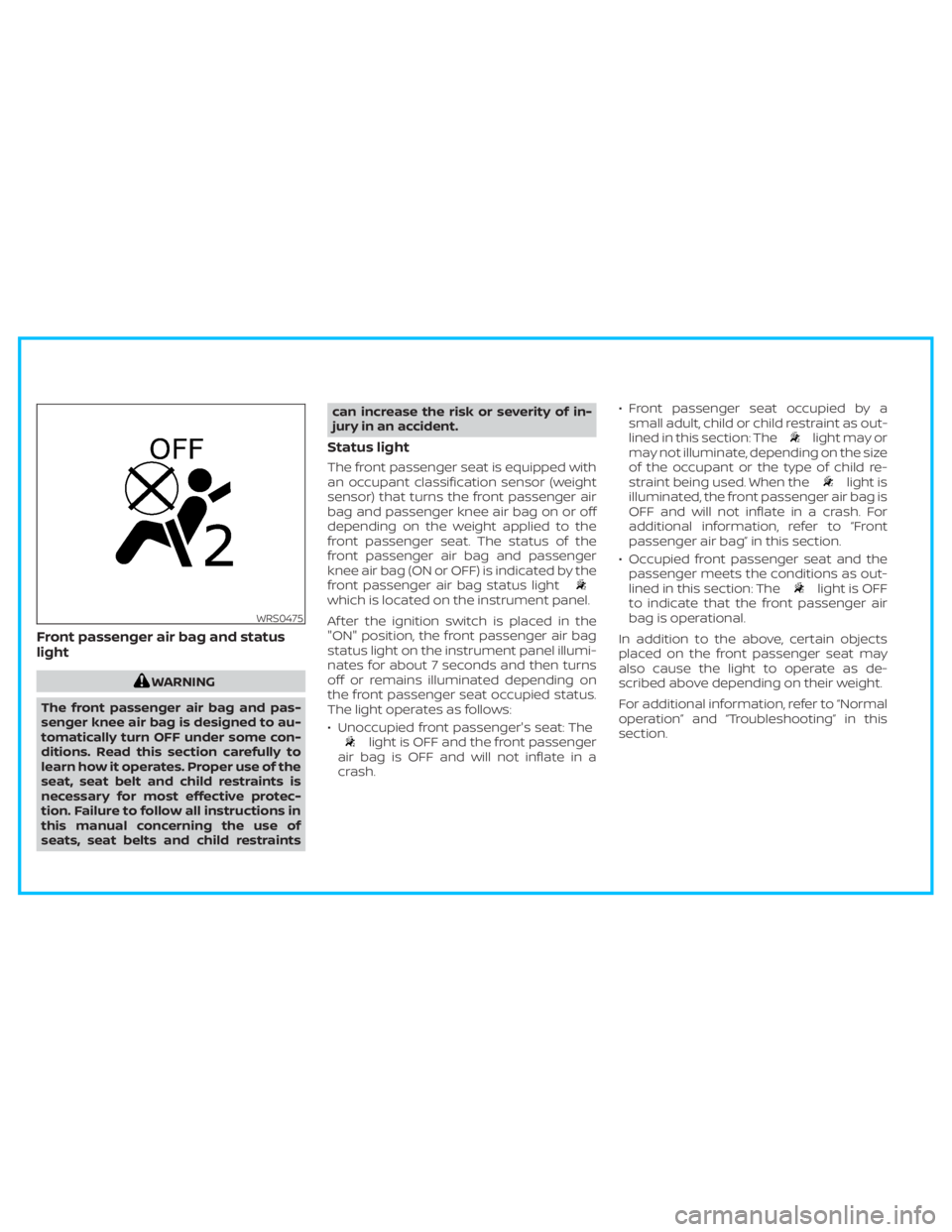
Status light
The front passenger seat is equipped with
an occupant classification sensor (weight
sensor) that turns the front passenger air
bag and passenger knee air bag on or off
depending on the weight applied to the
front passenger seat. The status of the
front passenger air bag and passenger
knee air bag (ON or OFF) is indicated by the
front passenger air bag status light
which is located on the instrument panel.
Af ter the ignition switch is placed in the
"ON" position, the front passenger air bag
status light on the instrument panel illumi-
nates for about 7 seconds and then turns
off or remains illuminated depending on
the front passenger seat occupied status.
The light operates as follows:
• Unoccupied front passenger's seat: The
light is OFF and the front passenger
air bag is OFF and will not inflate in a
crash.• Front passenger seat occupied by a
small adult, child or child restraint as out-
lined in this section: The
light may or
may not illuminate, depending on the size
of the occupant or the type of child re-
straint being used. When the
light is
illuminated, the front passenger air bag is
OFF and will not inflate in a crash. For
additional information, refer to “Front
passenger air bag” in this section.
• Occupied front passenger seat and the
passenger meets the conditions as out-
lined in this section: The
light is OFF
to indicate that the front passenger air
bag is operational.
In addition to the above, certain objects
placed on the front passenger seat may
also cause the light to operate as de-
scribed above depending on their weight.
For additional information, refer to “Normal
operation” and “Troubleshooting” in this
section.
WRS0475