towing NISSAN TITAN 2021 Owner´s Manual
[x] Cancel search | Manufacturer: NISSAN, Model Year: 2021, Model line: TITAN, Model: NISSAN TITAN 2021Pages: 638, PDF Size: 4.31 MB
Page 533 of 638
Your vehicle may be equipped with a full
size spare that is a different size or brand
than the tires originally installed on the ve-
hicle. This full size spare tire is intended for
temporary use only and should be re-
placed at the first opportunity.
Observe the following precautions if the
FULL SIZE TEMPORARY USE ONLY spare tire
must be used. Otherwise, your vehicle
could be damaged or involved in an acci-
dent:
WARNING
To help reduce the risk of a crash which
may result in personal injury or death:
• The TEMPORARY FULL SIZE spare tire
should be used for emergency use
only. It should be replaced with the
standard tire at the first opportunity
to avoid possible tire or differential
damage.
• Drive carefully while the TEMPORARY
FULL SIZE spare tire is installed. Avoid
sharp turns and abrupt braking while
driving. The vehicle driving perfor-
mance may be affected when driving
on wet or snow covered roads. •
When the TEMPORARY FULL SIZE
spare is installed, the following sys-
tems may not work correctly:
– Tire Pressure Monitoring System
(TPMS)
– Vehicle Dynamic Control (VDC)
System
• Periodically check the TEMPORARY
FULL SIZE spare tire inflation pres-
sure. Always keep the TEMPORARY
FULL SIZE inflated to the pressure
specification shown on the Tire and
Loading Information label.
• With the TEMPORARY FULL SIZE spare
tire installed do not drive the vehicle
at speeds faster than 50 mph (80
km/h).
• When driving on roads covered with
snow or ice, the TEMPORARY FULL
SIZE spare tire should be used on the
front wheels and the original tire
used on the rear wheels. Use tire
chains only on the drive wheels.
• Do not use the TEMPORARY FULL SIZE
spare tire on other vehicles.
• Do not use more than one TEMPO-
RARY FULL SIZE spare tire at the same
time. •
TEMPORARY FULL SIZE spare tire
Limitations (except for Pro 4X)
– 50mph MAX
– Towing allowed
• Customer can identif y TEMPORARY
FULL SIZE spare tire condition by
checking the Tire and loading infor-
mation label located on the B-pillar.
CAUTION
• Do not use tire chains on a TEMPO-
RARY FULL SIZE spare tire. Tire chains
will not fit properly and may cause
damage to the vehicle.
• Use of the TEMPORARY FULL SIZE
spare tire on a vehicle that has tires
larger than were originally equipped
can affect the 4WD system. This may
result in a circumference difference
between tires on front and rear axles
which can cause the 4WD system to
automatically place the vehicle in
2WD and flash the 4WD light. When
the TEMPORARY FULL SIZE spare tire
is replaces with a tire that matches all
other tires on the vehicle, and all tires
are properly inflated the 4WD system
will operate normally
Do-it-yourself8-47
Page 540 of 638
EMISSION CONTROL SYSTEM
MAINTENANCE:
Drive Belts*:Check engine drive belts for
wear, fraying or cracking and for proper
tension. Replace any damaged drive belts.
Engine Air Filter: Replace at specified in-
tervals. When driving for prolonged periods
in dusty conditions, check/replace the filter
more frequently.
Engine Coolant*: Replace coolant at the
specified interval. When adding or replac-
ing coolant, be sure to use only Genuine
NISSAN Long Life Antifreeze/Coolant (blue)
or equivalent with the proper mixture. (For
additional information on the proper mix-
ture for your area, see “Engine cooling sys-
tem” (P. 8-6)).
NOTE: Mixing any other type of coolant or
the use of non-distilled water may reduce
the recommended service interval of the
coolant.
Engine Oil and Oil Filter: Replace engine
oil and oil filter at the specified intervals. For
recommended oil grade and viscosity see
“Recommended fluids/lubricants and ca-
pacities” (P. 10-2). Engine Valve Clearance*:
Inspect only if
valve noise increases. Adjust valve clear-
ance if necessary.
Evaporative Emissions Control Vapor
Lines*: Check vapor lines for leaks or loose-
ness. Tighten connections or replace parts
as necessary.
Fuel Lines*: Check the fuel hoses, piping
and connections for leaks, looseness, or
deterioration. Tighten connections or re-
place parts as necessary.
CHASSIS AND BODY
MAINTENANCE:
Brake Lines and Cables: Visually inspect
for proper installation. Check for chafing,
cracks, deterioration, and signs of leaking.
Replace any deteriorated or damaged
parts immediately.
Brake Pads and Rotors: Check for wear,
deterioration and fluid leaks. Replace any
deteriorated or damaged parts immedi-
ately.
Exhaust System: Visually inspect the ex-
haust pipes, muffler and hangers for leaks,
cracks, deterioration, and damage. Tighten
connections or replace parts as necessary. In-Cabin Microfilter:
Replace at specified
intervals. When driving for prolonged peri-
ods in dusty conditions, replace the filter
more frequently.
Propeller Shaf t(s): Check for damage,
looseness, and grease leakage. (4WD/
AWD/RWD).
Steering Gear and Linkage, Axle and Sus-
pension Parts, Drive Shaf t Boots: Check
for damage, looseness, and leakage of oil
or grease. Under severe driving conditions,
inspect more frequently.
Tire Rotation: Rotate tires at the specified
interval shown in the maintenance sched-
ule. When rotating tires, check for damage
and uneven wear. Replace if necessary.
Transmission Fluid/Oil, Differential Oil,
Transfer Case Oil: Visually inspect for signs
of leakage at specified intervals.
Replace automatic transmission fluid at
specified intervals.
If towing a trailer, using a camper or car-top
carrier, or driving on rough or muddy roads:
• Replace the differential oil every 20,000 miles (32,000 km) or 24 months.
•
Replace the automatic transmission fluid
ever 30,000 miles (48,000 km) or 24 months.
9-6Maintenance and schedules
Page 541 of 638
Off-Road Maintenance:Check the follow-
ing items frequently whenever you drive
off-road through deep sand, mud or water:
• Brake pads and rotors
• Brake lines and hoses
• Differential, transmission and transfer case oil
• Steering linkage
• Propeller shaf t(s) and front drive shaf ts
• Engine air filter
• Clutch housing drain (4WD only) To help ensure smooth, safe and economi-
cal driving, NISSAN provides two mainte-
nance schedules that may be used, de-
pending upon the conditions in which you
usually drive. These schedules contain
both distance and time intervals, up to
120,000 miles (192,000 km)/96 months. For
most people, the odometer reading will in-
dicate when service is needed. However, if
you drive very little, your vehicle should be
serviced at the regular time intervals
shown in the schedule.
Af ter 120,000 miles (192,000 km)/96
months, continue maintenance at the
same mileage/time intervals.
ADDITIONAL MAINTENANCE ITEMS
FOR SEVERE OPERATING
CONDITIONS
Additional maintenance items for severe
operating conditions
should be per-
formed on vehicles that are driven under
especially demanding conditions. Addi-
tional maintenance items should be per-
formed if you primarily operate your vehicle
under the following conditions:
• Repeated short trips of less than 5 miles in normal temperatures or less than 10
miles in freezing temperatures. • Stop-and-go traffic in hot weather or low
speed driving for long distances.
• Driving in dusty conditions or on rough, muddy or salt-spread roads.
• Towing a trailer, or using a camper or car- top carrier.
If your vehicle is mainly operated under the
severe conditions, follow the severe main-
tenance intervals shown in the mainte-
nance schedule.
MAINTENANCE SCHEDULES
Maintenance and schedules9-7
Page 566 of 638
10 Technical and consumer information
Recommended fluids/lubricants and
capacities...................................... 10-2
Fuel recommendation ......................10-4
Engine oil and oil filter
recommendations .......................... 10-7
Air conditioner system refrigerant and
oil recommendations .......................10-8
Specifications .................................. 10-9
Engine ...................................... 10-9
Wheels and tires ............................ 10-9
Dimensions and weights ....................10-11
When traveling or registering in another
country ....................................... 10-17
Vehicle identification .......................... 10-17
Vehicle Identification Number (VIN)
plate ....................................... 10-17
Vehicle identification number
(chassis number) ........................... 10-17
Engine serial number ......................10-18
F.M.V.S.S./C.M.V.S.S. certification label ........10-18
Emission control information label .........10-19
Tire and Loading Information label .........10-19
Air conditioner specification label ..........10-20
Installing front license plate ...................10-21
Vehicle loading information ...................10-22Terms
...................................... 10-23
Vehicle load capacity ....................... 10-23
Securing the load .......................... 10-25
Utili-track® channel system
(if so equipped) ............................. 10-26
Rear assist step (if so equipped) ............10-30
Loading tips ................................ 10-31
Truck-camper loading information ............10-31
Crew cab models .......................... 10-31
King Cab® models .......................... 10-31
Special Body vehicles ......................10-31
Location for center of gravity ...............10-32
Vehicle load weight capacity ...............10-33
Measurement of weights ...................10-33
Towing a trailer ................................ 10-33
Maximum load limits ....................... 10-34
T
owing load/specification ..................10-37
Towing safety .............................. 10-39
Flat towing for 2-Wheel Drive (2WD)
vehicle (if so equipped) .....................10-55
Flat towing for 4-Wheel Drive (4WD)
vehicle (if so equipped) .....................10-55
Snowplow .................................... 10-56
Uniform tire quality grading ...................10-56
Emission control system warranty ............10-57
Page 574 of 638
Change intervals
The oil and oil filter change intervals for
your engine are based on the use of the
specified quality oils and filters. Using en-
gine oil and filters that are not of the speci-
fied quality, or exceeding recommended oil
and filter change intervals could reduce
engine life. Damage to the engine caused
by improper maintenance or use of incor-
rect oil and filter quality and/or viscosity is
not covered by the NISSAN New Vehicle
Limited Warranty.
Your engine was filled with a high-quality
engine oil when it was built. You do not have
to change the oil before the first recom-
mended change interval. Oil and filter
change intervals depend upon how you
use your vehicle.
Operation under the following conditions
may require more frequent oil and filter
changes:
• repeated short distance driving at coldoutside temperatures
• driving in dusty conditions
• extensive idling
• towing a trailer
• stop and go commuting For additional information, see the “Mainte-
nance and schedules” section of this
manual.
AIR CONDITIONER SYSTEM
REFRIGERANT AND OIL
RECOMMENDATIONS
The air conditioner system in your
NISSAN vehicle must be charged with the
refrigerant HFO-1234yf (R-1234yf ) and
NISSAN A/C system oil Type PAG
(VC100yf oil) or the exact equivalents.
CAUTION
The use of any other refrigerant or oil
may cause severe damage to the air
conditioning system and may require
the replacement of all air conditioner
system components. The refrigerant HFO-1234yf (R-1234yf ) in
your NISSAN vehicle does not harm the
earth's ozone layer. Although this refriger-
ant does not affect the earth's atmo-
sphere, certain government regulations re-
quire the recovery and recycling of any
refrigerant during automotive air condi-
tioner system service. Air conditioner sys-
tem should only be service by trained and
certified technicians to ensure proper and
safe operation (SAE J2845). A NISSAN dealer
has the trained technicians and equip-
ment needed to recover and recycle your
air conditioner system refrigerant. Only
new and SAE J2842 certified evaporator(s)
shall be used as replacement parts.
A damaged or leaking air conditioning
evaporator shall never be repaired or re-
placed with one removed from a used or
salvaged vehicle. To replace a damaged or
leaking evaporator, use only new and SAE
J2842 certified evaporator(s). It is recom-
mended that you visit a NISSAN dealer when
servicing your air conditioner system.
10-8Technical and consumer information
Page 591 of 638
5. Determine the combined weightof luggage and cargo being
loaded on the vehicle. That weight
may not safely exceed the avail-
able cargo and luggage load ca-
pacity calculated in step 4.
6. If your vehicle will be towing a trailer, load from your trailer will be
transferred to your vehicle. Con-
sult this manual to determine
how this reduces the available
cargo and luggage load capacity
of your vehicle.
Before driving a loaded vehicle, con-
firm that you do not exceed the
GVWR or the GAWR for your vehicle.
For additional information, see “Mea-
surement of weights” (P. 10-33).
Also check tires for proper inflation
pressures. For additional informa-
tion, see “Tire and Loading Informa-
tion label” (P. 8-37).
SECURING THE LOAD
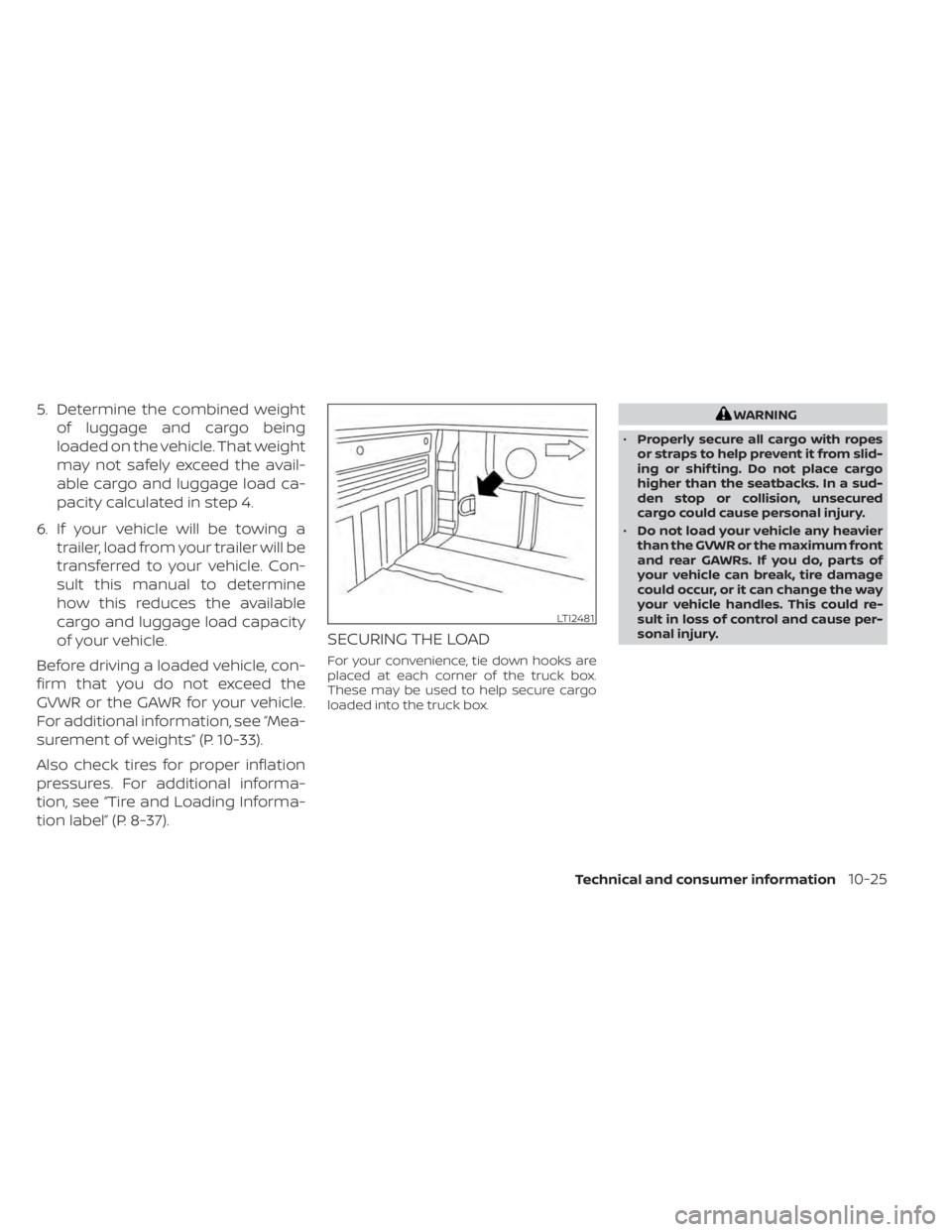
For your convenience, tie down hooks are
placed at each corner of the truck box.
These may be used to help secure cargo
loaded into the truck box.
WARNING
• Properly secure all cargo with ropes
or straps to help prevent it from slid-
ing or shif ting. Do not place cargo
higher than the seatbacks. In a sud-
den stop or collision, unsecured
cargo could cause personal injury.
• Do not load your vehicle any heavier
than the GVWR or the maximum front
and rear GAWRs. If you do, parts of
your vehicle can break, tire damage
could occur, or it can change the way
your vehicle handles. This could re-
sult in loss of control and cause per-
sonal injury.
LTI2481
Technical and consumer information10-25
Page 599 of 638
The total cargo load should not exceed the
truck's cargo weight rating and the camp-
er's center of gravity should fall within the
truck's recommended center of gravity
zone when installed.
WARNING
Overloading or improper loading can
adversely affect vehicle handling, brak-
ing and performance and may lead to
accidents.
VEHICLE LOAD WEIGHT CAPACITY
The vehicle payload weight capacity
shown on the Tire and Loading Information
label indicates the maximum total weight
of passengers, optional equipment (air
conditioning, trailer hitch, etc.) and cargo
that your vehicle is designed to carry.
For additional information, see “Tire and
Loading Information label” (P. 8-37).
Before driving a loaded vehicle, confirm
that you do not exceed the GVWR or the
GAWR for your vehicle. For additional infor-
mation, see “Vehicle loading information”
(P. 10-22).
Also check tires for proper inflation pres-
sures. For additional information, see “Tire
and Loading Information label” (P. 8-37).
MEASUREMENT OF WEIGHTS
Secure loose items to prevent
weight shif ts that could affect the
balance of your vehicle. When the
truck camper is loaded, drive to a
scale and weigh on the front and on
the rear wheels separately to deter-
mine axle loads. Individual axle loads
should not exceed either of the
gross axle weight ratings (GAWR).
The total of the axle loads should not
exceed the gross vehicle weight rat-
ing (GVWR). These ratings are given
on the vehicle certification label that
is located on the lef t side of the ve-
hicle, normally the dash, hinge pillar,
door latch post, or door edge next to
the driver. If weight ratings are ex-
ceeded, move or remove items to
bring all weights below the ratings.
WARNING
Overloading or improper loading of a
trailer and its cargo can adversely af-
fect vehicle handling, braking and per-
formance and may lead to accidents.
CAUTION
• Do not tow a trailer or haul a heavy
load for the first 500 miles (805 km).
Your engine, axle or other parts could
be damaged.
• For the first 500 miles (805 km) that
you tow a trailer, do not drive over 50
mph (80 km/h) and do not make
starts at full throttle. This helps the
engine and other parts of your ve-
hicle wear in at the heavier load.
Your new vehicle was designed to be used
primarily to carry passengers and cargo.
Remember that towing a trailer places ad-
ditional loads on your vehicle's engine,
drive train, steering, braking and other sys-
tems.
TOWING A TRAILER
Technical and consumer information10-33
Page 600 of 638
A NISSAN Towing Guide (U.S. only) is available
on the website at www.nissanusa.com. This
guide includes information on trailer towing
capability and the special equipment re-
quired for proper towing.
MAXIMUM LOAD LIMITS
Maximum trailer loads
Never allow the total trailer load to exceed
the value specified in the “Towing load/
specification” chart (P. 10-37). The total
trailer load equals trailer weight plus its
cargo weight.
•When towing a trailer load of 3,500 lbs.
(1,587 kg) or more, trailers with a brake
system MUST be used.
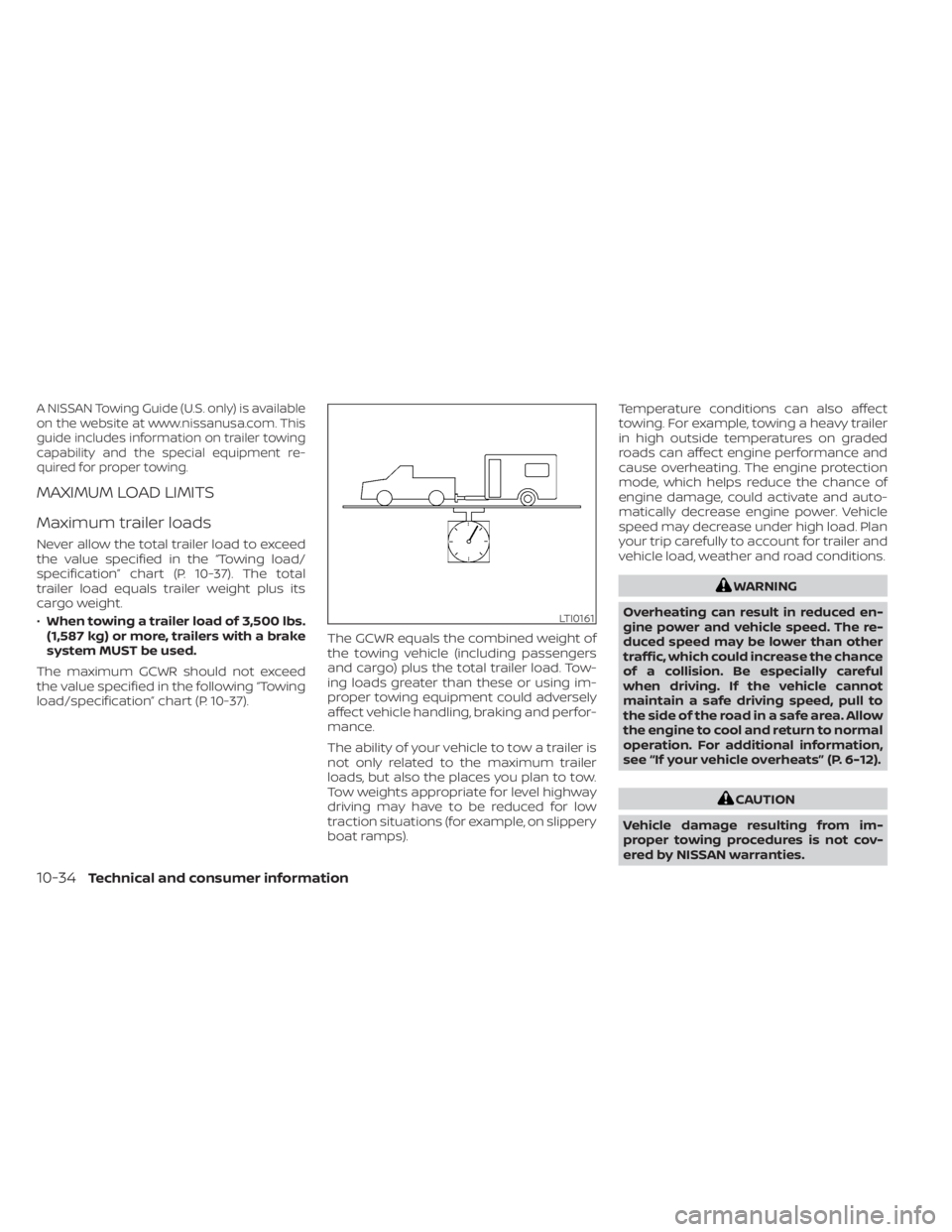
The maximum GCWR should not exceed
the value specified in the following “Towing
load/specification” chart (P. 10-37). The GCWR equals the combined weight of
the towing vehicle (including passengers
and cargo) plus the total trailer load. Tow-
ing loads greater than these or using im-
proper towing equipment could adversely
affect vehicle handling, braking and perfor-
mance.
The ability of your vehicle to tow a trailer is
not only related to the maximum trailer
loads, but also the places you plan to tow.
Tow weights appropriate for level highway
driving may have to be reduced for low
traction situations (for example, on slippery
boat ramps).Temperature conditions can also affect
towing. For example, towing a heavy trailer
in high outside temperatures on graded
roads can affect engine performance and
cause overheating. The engine protection
mode, which helps reduce the chance of
engine damage, could activate and auto-
matically decrease engine power. Vehicle
speed may decrease under high load. Plan
your trip carefully to account for trailer and
vehicle load, weather and road conditions.
WARNING
Overheating can result in reduced en-
gine power and vehicle speed. The re-
duced speed may be lower than other
traffic, which could increase the chance
of a collision. Be especially careful
when driving. If the vehicle cannot
maintain a safe driving speed, pull to
the side of the road in a safe area. Allow
the engine to cool and return to normal
operation. For additional information,
see “If your vehicle overheats” (P. 6-12).
CAUTION
Vehicle damage resulting from im-
proper towing procedures is not cov-
ered by NISSAN warranties.
LTI0161
10-34Technical and consumer information
Page 601 of 638
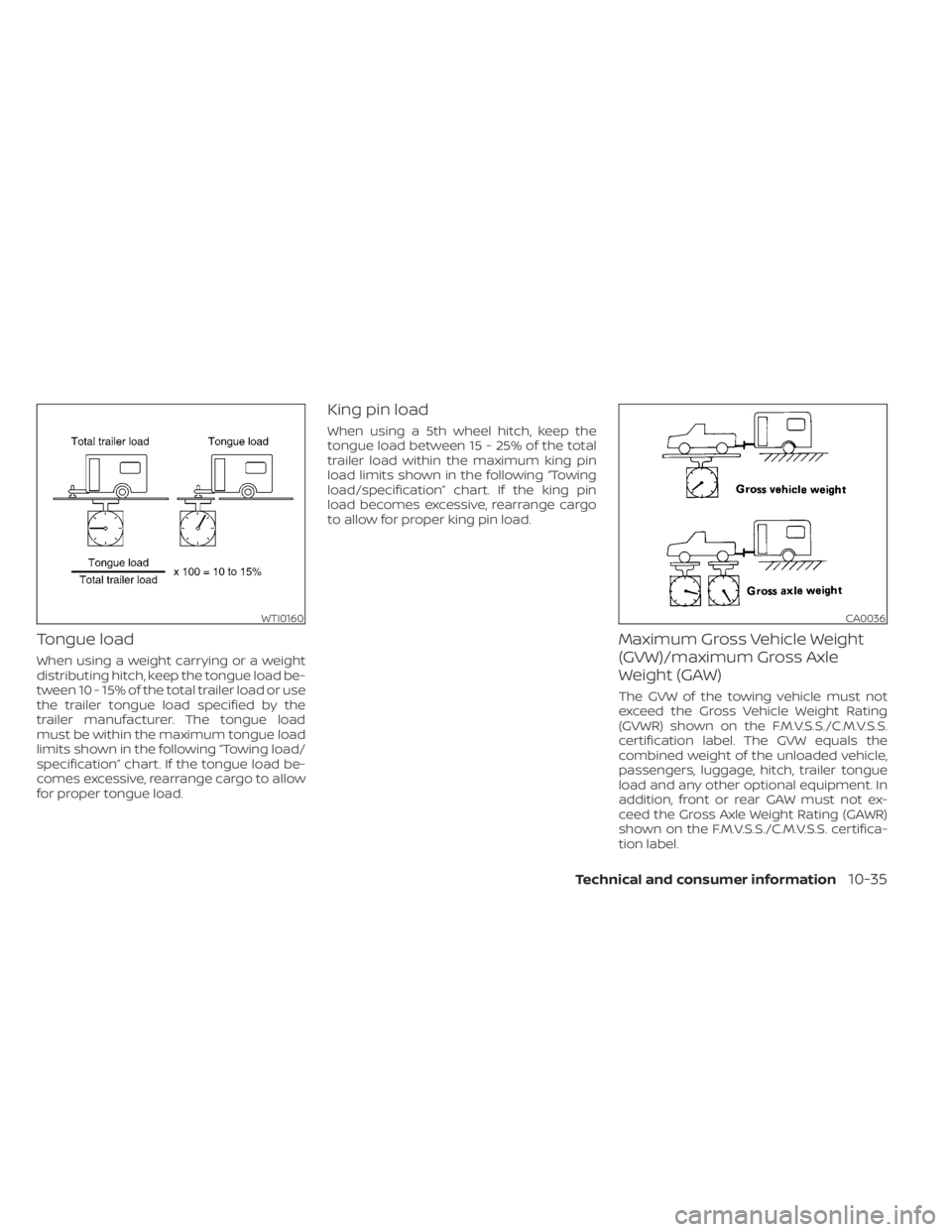
Tongue load
When using a weight carrying or a weight
distributing hitch, keep the tongue load be-
tween 10 - 15% of the total trailer load or use
the trailer tongue load specified by the
trailer manufacturer. The tongue load
must be within the maximum tongue load
limits shown in the following “Towing load/
specification” chart. If the tongue load be-
comes excessive, rearrange cargo to allow
for proper tongue load.
King pin load
When using a 5th wheel hitch, keep the
tongue load between 15 - 25% of the total
trailer load within the maximum king pin
load limits shown in the following “Towing
load/specification” chart. If the king pin
load becomes excessive, rearrange cargo
to allow for proper king pin load.
Maximum Gross Vehicle Weight
(GVW)/maximum Gross Axle
Weight (GAW)
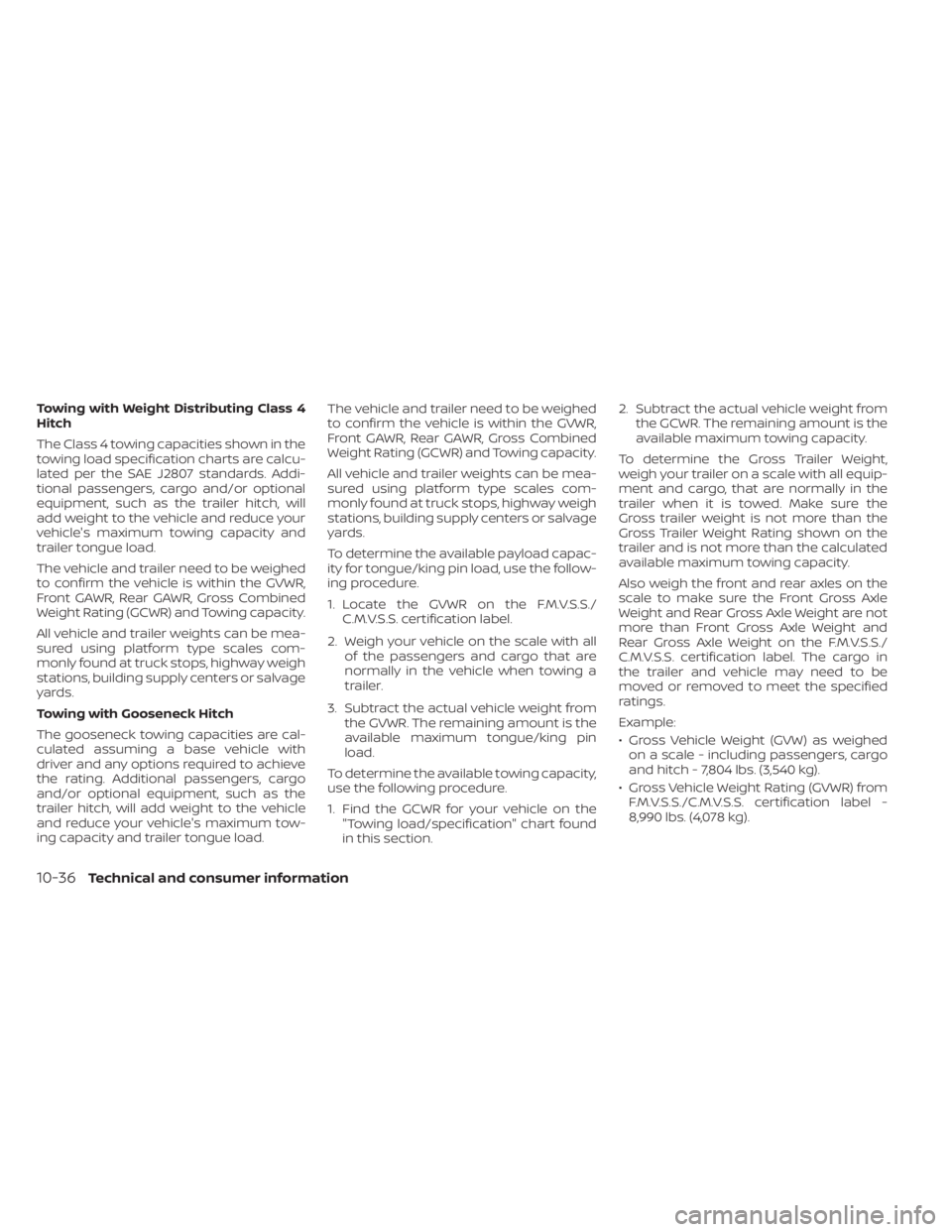
The GVW of the towing vehicle must not
exceed the Gross Vehicle Weight Rating
(GVWR) shown on the F.M.V.S.S./C.M.V.S.S.
certification label. The GVW equals the
combined weight of the unloaded vehicle,
passengers, luggage, hitch, trailer tongue
load and any other optional equipment. In
addition, front or rear GAW must not ex-
ceed the Gross Axle Weight Rating (GAWR)
shown on the F.M.V.S.S./C.M.V.S.S. certifica-
tion label.
WTI0160CA0036
Technical and consumer information10-35
Page 602 of 638
Towing with Weight Distributing Class 4
Hitch
The Class 4 towing capacities shown in the
towing load specification charts are calcu-
lated per the SAE J2807 standards. Addi-
tional passengers, cargo and/or optional
equipment, such as the trailer hitch, will
add weight to the vehicle and reduce your
vehicle's maximum towing capacity and
trailer tongue load.
The vehicle and trailer need to be weighed
to confirm the vehicle is within the GVWR,
Front GAWR, Rear GAWR, Gross Combined
Weight Rating (GCWR) and Towing capacity.
All vehicle and trailer weights can be mea-
sured using platform type scales com-
monly found at truck stops, highway weigh
stations, building supply centers or salvage
yards.
Towing with Gooseneck Hitch
The gooseneck towing capacities are cal-
culated assuming a base vehicle with
driver and any options required to achieve
the rating. Additional passengers, cargo
and/or optional equipment, such as the
trailer hitch, will add weight to the vehicle
and reduce your vehicle's maximum tow-
ing capacity and trailer tongue load.The vehicle and trailer need to be weighed
to confirm the vehicle is within the GVWR,
Front GAWR, Rear GAWR, Gross Combined
Weight Rating (GCWR) and Towing capacity.
All vehicle and trailer weights can be mea-
sured using platform type scales com-
monly found at truck stops, highway weigh
stations, building supply centers or salvage
yards.
To determine the available payload capac-
ity for tongue/king pin load, use the follow-
ing procedure.
1. Locate the GVWR on the F.M.V.S.S./
C.M.V.S.S. certification label.
2. Weigh your vehicle on the scale with all of the passengers and cargo that are
normally in the vehicle when towing a
trailer.
3. Subtract the actual vehicle weight from the GVWR. The remaining amount is the
available maximum tongue/king pin
load.
To determine the available towing capacity,
use the following procedure.
1. Find the GCWR for your vehicle on the "Towing load/specification" chart found
in this section. 2. Subtract the actual vehicle weight from
the GCWR. The remaining amount is the
available maximum towing capacity.
To determine the Gross Trailer Weight,
weigh your trailer on a scale with all equip-
ment and cargo, that are normally in the
trailer when it is towed. Make sure the
Gross trailer weight is not more than the
Gross Trailer Weight Rating shown on the
trailer and is not more than the calculated
available maximum towing capacity.
Also weigh the front and rear axles on the
scale to make sure the Front Gross Axle
Weight and Rear Gross Axle Weight are not
more than Front Gross Axle Weight and
Rear Gross Axle Weight on the F.M.V.S.S./
C.M.V.S.S. certification label. The cargo in
the trailer and vehicle may need to be
moved or removed to meet the specified
ratings.
Example:
• Gross Vehicle Weight (GVW) as weighed on a scale - including passengers, cargo
and hitch - 7,804 lbs. (3,540 kg).
• Gross Vehicle Weight Rating (GVWR) from F.M.V.S.S./C.M.V.S.S. certification label -
8,990 lbs. (4,078 kg).
10-36Technical and consumer information