weight NISSAN TITAN 2021 Owner´s Manual
[x] Cancel search | Manufacturer: NISSAN, Model Year: 2021, Model line: TITAN, Model: NISSAN TITAN 2021Pages: 638, PDF Size: 4.31 MB
Page 240 of 638
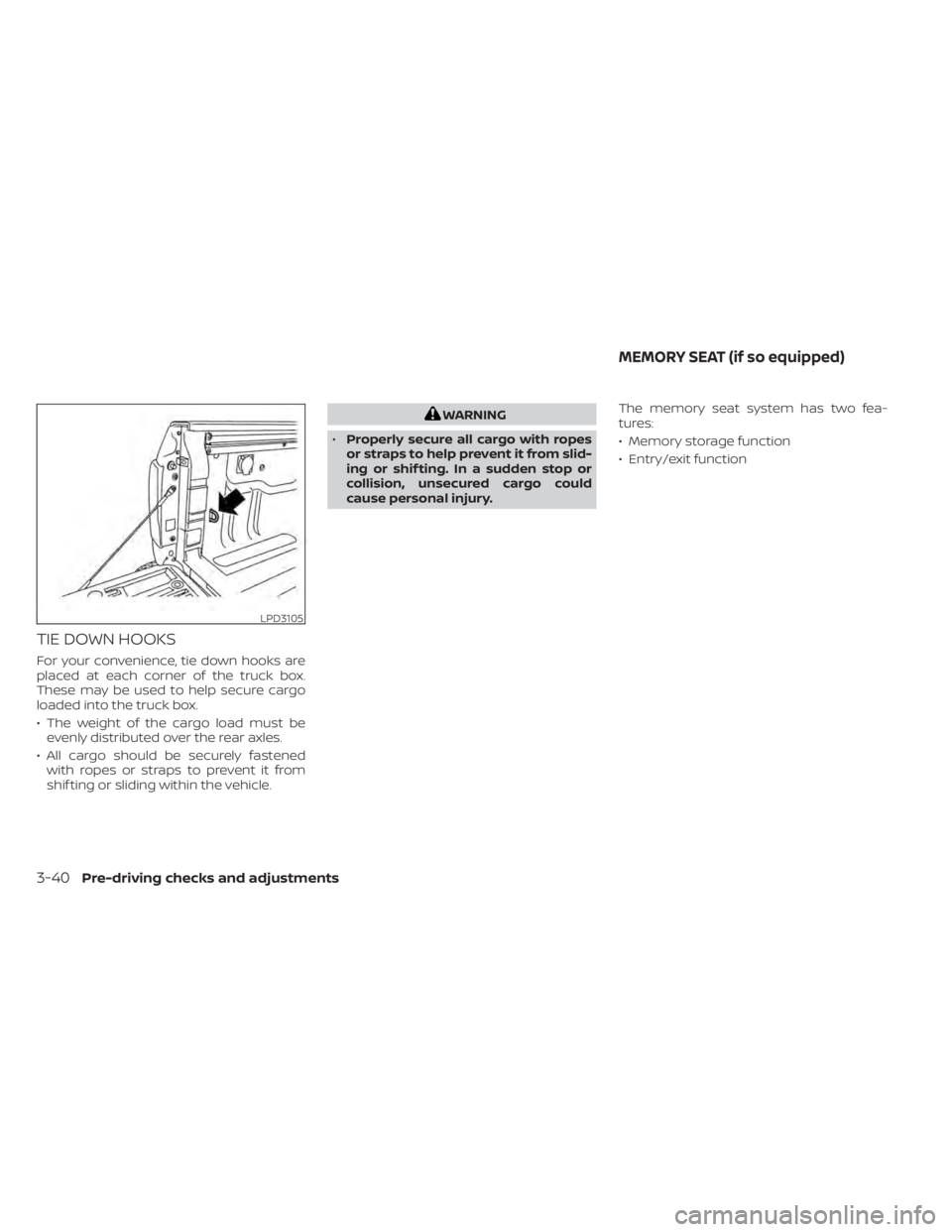
TIE DOWN HOOKS
For your convenience, tie down hooks are
placed at each corner of the truck box.
These may be used to help secure cargo
loaded into the truck box.
• The weight of the cargo load must beevenly distributed over the rear axles.
• All cargo should be securely fastened with ropes or straps to prevent it from
shif ting or sliding within the vehicle.
WARNING
• Properly secure all cargo with ropes
or straps to help prevent it from slid-
ing or shif ting. In a sudden stop or
collision, unsecured cargo could
cause personal injury. The memory seat system has two fea-
tures:
• Memory storage function
• Entry/exit function
LPD3105
MEMORY SEAT (if so equipped)
3-40Pre-driving checks and adjustments
Page 522 of 638
Incorrect tire pressure, including under
inflation, may adversely affect tire life
and vehicle handling.
WARNING
•
Improperly inflated tires can
fail suddenly and cause an
accident.
•The Gross Vehicle Weight Rat-
ing (GVWR) is located on the
F.M.V.S.S./C.M.V.S.S. certifica-
tion label. The vehicle weight
capacity is indicated on the Tire
and Loading Information label.
Do not load your vehicle be-
yond this capacity. Overloading
your vehicle may result in re-
duced tire life, unsafe operating
conditions due to premature
tire failure, or unfavorable han-
dling characteristics and could
also lead to a serious accident.
Loading beyond the specified
capacity may also result in fail-
ure of other vehicle
components.•Before taking a long trip, or
whenever you heavily load your
vehicle, use a tire pressure
gauge to ensure that the tire
pressures are at the specified
level.
•For additional information re-
garding tires, refer to “Impor-
tant Tire Safety Information”
(US) or “Tire Safety Information”
(Canada) in the Warranty Infor-
mation Booklet.
8-36
Do-it-yourself
Page 526 of 638
6. Two- or three-digit number (95):This number is the tire's load in-
dex. It is a measurement of how
much weight each tire can sup-
port. You may not find this infor-
mation on all tires because it is
not required by law.
7. H: Tire speed rating. You should not drive the vehicle faster than
the tire speed rating.
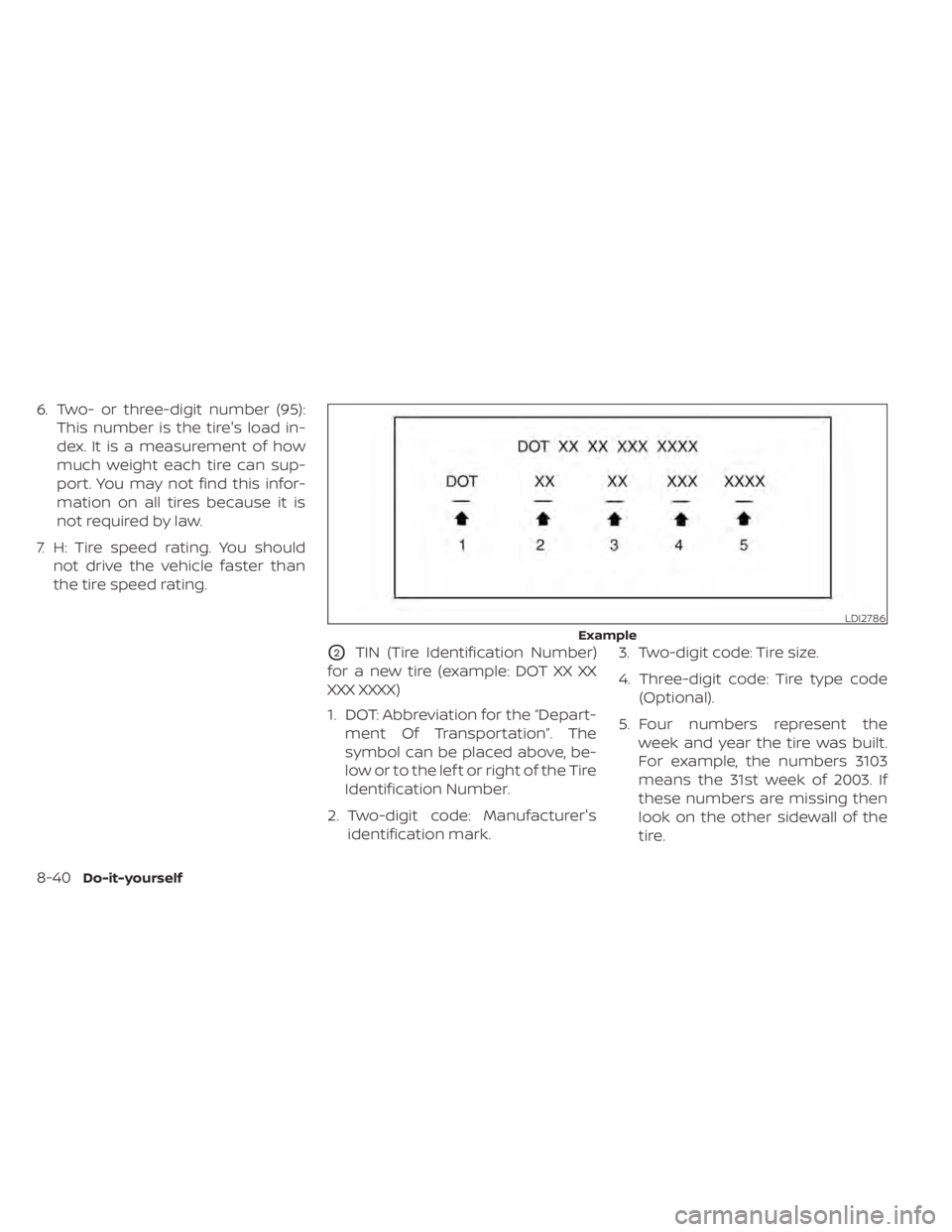
O2TIN (Tire Identification Number)
for a new tire (example: DOT XX XX
XXX XXXX)
1. DOT: Abbreviation for the “Depart- ment Of Transportation”. The
symbol can be placed above, be-
low or to the lef t or right of the Tire
Identification Number.
2. Two-digit code: Manufacturer's identification mark. 3. Two-digit code: Tire size.
4. Three-digit code: Tire type code
(Optional).
5. Four numbers represent the week and year the tire was built.
For example, the numbers 3103
means the 31st week of 2003. If
these numbers are missing then
look on the other sidewall of the
tire.
LDI2786
Example
8-40Do-it-yourself
Page 566 of 638
10 Technical and consumer information
Recommended fluids/lubricants and
capacities...................................... 10-2
Fuel recommendation ......................10-4
Engine oil and oil filter
recommendations .......................... 10-7
Air conditioner system refrigerant and
oil recommendations .......................10-8
Specifications .................................. 10-9
Engine ...................................... 10-9
Wheels and tires ............................ 10-9
Dimensions and weights ....................10-11
When traveling or registering in another
country ....................................... 10-17
Vehicle identification .......................... 10-17
Vehicle Identification Number (VIN)
plate ....................................... 10-17
Vehicle identification number
(chassis number) ........................... 10-17
Engine serial number ......................10-18
F.M.V.S.S./C.M.V.S.S. certification label ........10-18
Emission control information label .........10-19
Tire and Loading Information label .........10-19
Air conditioner specification label ..........10-20
Installing front license plate ...................10-21
Vehicle loading information ...................10-22Terms
...................................... 10-23
Vehicle load capacity ....................... 10-23
Securing the load .......................... 10-25
Utili-track® channel system
(if so equipped) ............................. 10-26
Rear assist step (if so equipped) ............10-30
Loading tips ................................ 10-31
Truck-camper loading information ............10-31
Crew cab models .......................... 10-31
King Cab® models .......................... 10-31
Special Body vehicles ......................10-31
Location for center of gravity ...............10-32
Vehicle load weight capacity ...............10-33
Measurement of weights ...................10-33
Towing a trailer ................................ 10-33
Maximum load limits ....................... 10-34
T
owing load/specification ..................10-37
Towing safety .............................. 10-39
Flat towing for 2-Wheel Drive (2WD)
vehicle (if so equipped) .....................10-55
Flat towing for 4-Wheel Drive (4WD)
vehicle (if so equipped) .....................10-55
Snowplow .................................... 10-56
Uniform tire quality grading ...................10-56
Emission control system warranty ............10-57
Page 577 of 638
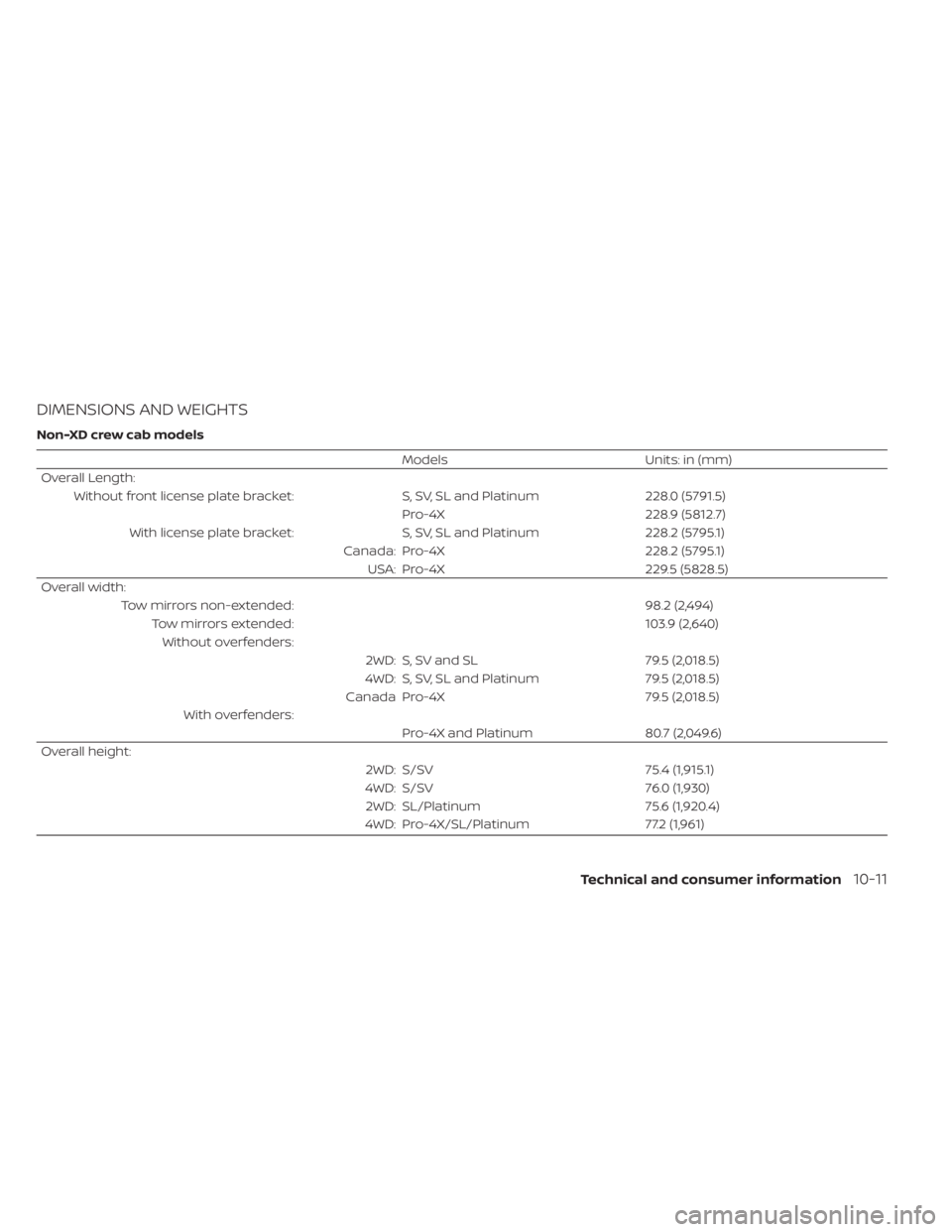
DIMENSIONS AND WEIGHTS
Non-XD crew cab models
ModelsUnits: in (mm)
Overall Length: Without front license plate bracket: S, SV, SL and Platinum228.0 (5791.5)
Pro-4X 228.9 (5812.7)
With license plate bracket: S, SV, SL and Platinum228.2 (5795.1)
Canada: Pro-4X 228.2 (5795.1)
USA: Pro-4X 229.5 (5828.5)
Overall width: Tow mirrors non-extended: 98.2 (2,494)
Tow mirrors extended: 103.9 (2,640)
Without overfenders: 2WD: S, SV and SL 79.5 (2,018.5)
4WD: S, SV, SL and Platinum 79.5 (2,018.5)
Canada Pro-4X 79.5 (2,018.5)
With overfenders: Pro-4X and Platinum 80.7 (2,049.6)
Overall height: 2WD: S/SV75.4 (1,915.1)
4WD: S/SV 76.0 (1,930)
2WD: SL/Platinum 75.6 (1,920.4)
4WD: Pro-4X/SL/Platinum 77.2 (1,961)
Technical and consumer information10-11
Page 578 of 638
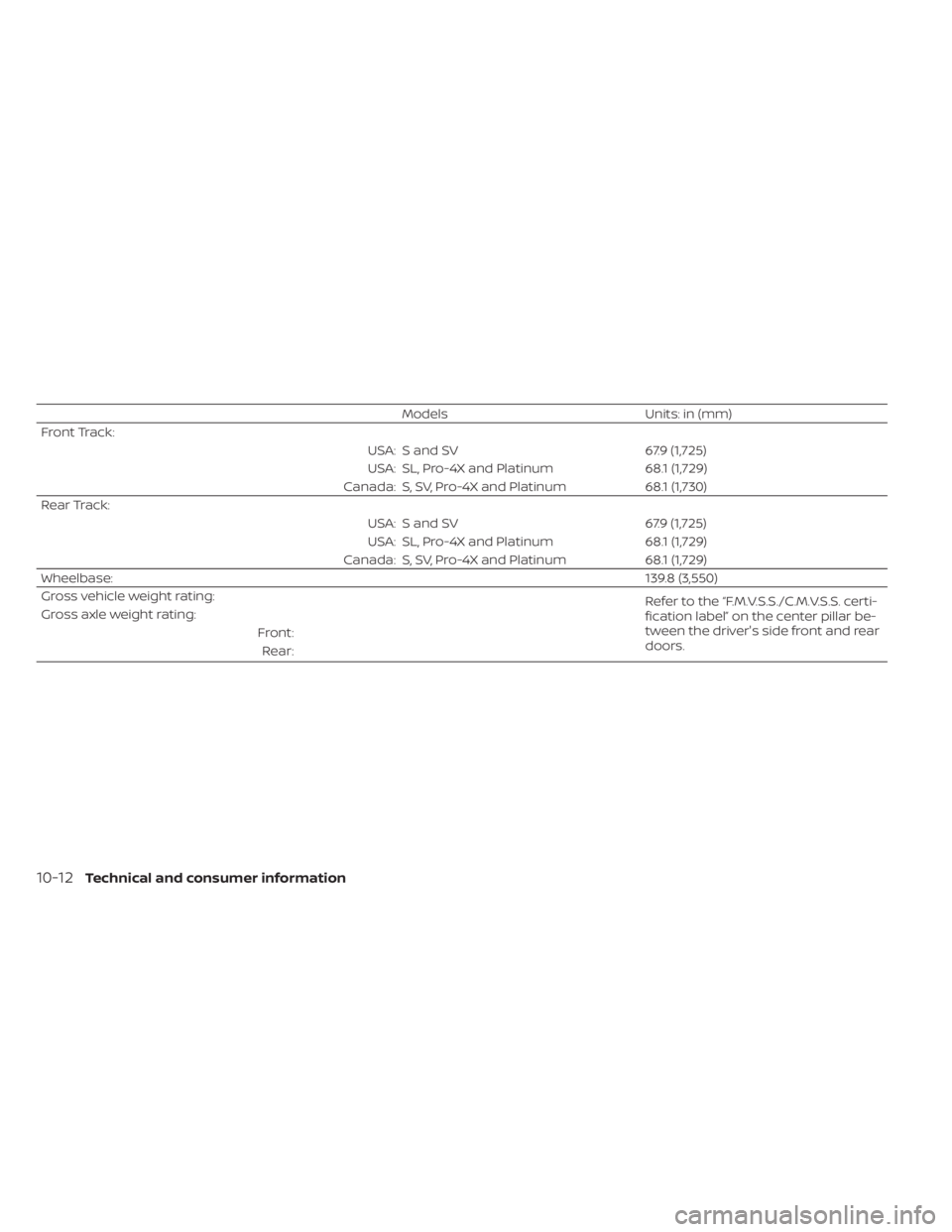
ModelsUnits: in (mm)
Front Track: USA: S and SV67.9 (1,725)
USA: SL, Pro-4X and Platinum 68.1 (1,729)
Canada: S, SV, Pro-4X and Platinum 68.1 (1,730)
Rear Track: USA: S and SV67.9 (1,725)
USA: SL, Pro-4X and Platinum 68.1 (1,729)
Canada: S, SV, Pro-4X and Platinum 68.1 (1,729)
Wheelbase: 139.8 (3,550)
Gross vehicle weight rating: Refer to the “F.M.V.S.S./C.M.V.S.S. certi-
fication label” on the center pillar be-
tween the driver's side front and rear
doors.
Gross axle weight rating:
Front:Rear:
10-12Technical and consumer information
Page 580 of 638
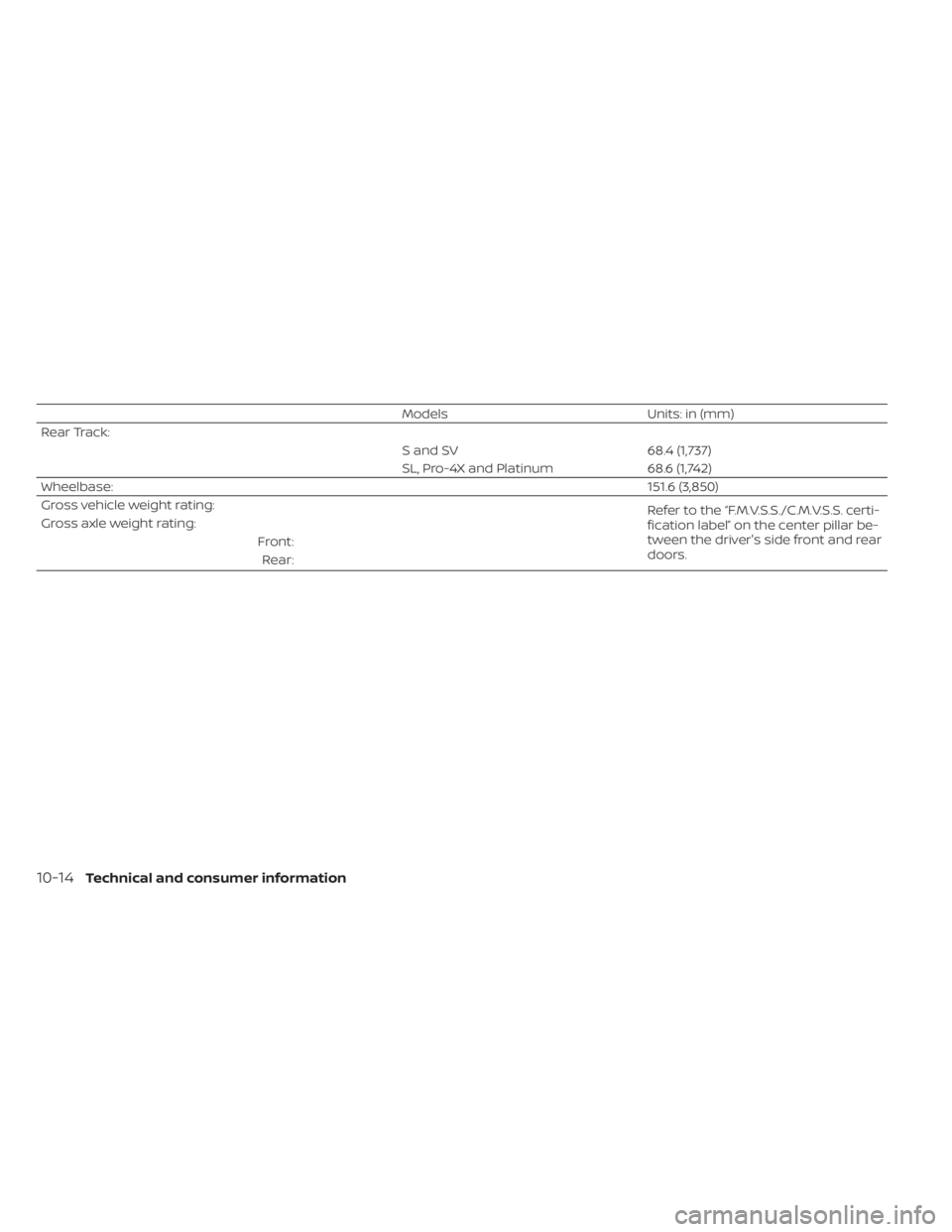
ModelsUnits: in (mm)
Rear Track: S and SV68.4 (1,737)
SL, Pro-4X and Platinum 68.6 (1,742)
Wheelbase: 151.6 (3,850)
Gross vehicle weight rating: Refer to the “F.M.V.S.S./C.M.V.S.S. certi-
fication label” on the center pillar be-
tween the driver's side front and rear
doors.
Gross axle weight rating:
Front:Rear:
10-14Technical and consumer information
Page 582 of 638
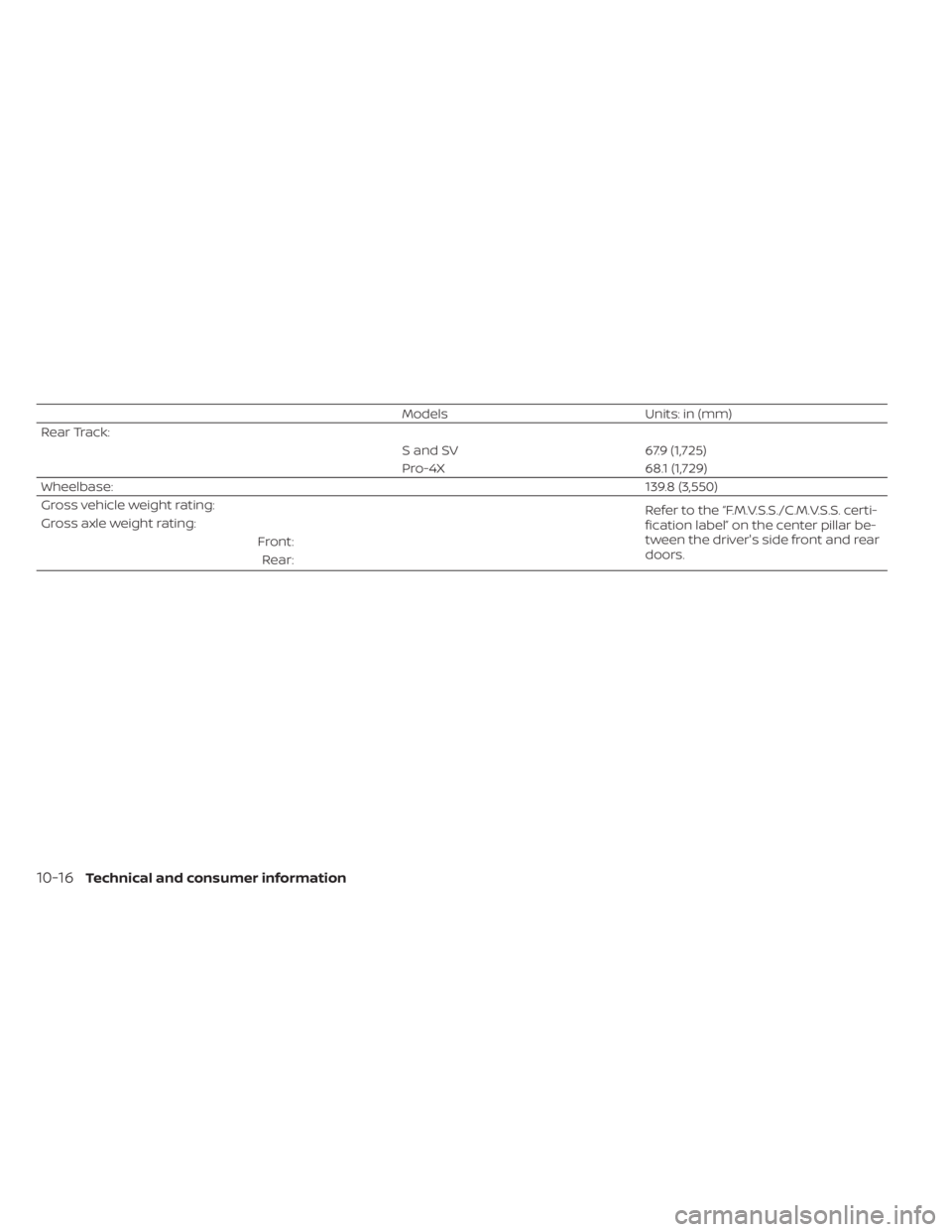
ModelsUnits: in (mm)
Rear Track: S and SV67.9 (1,725)
Pro-4X 68.1 (1,729)
Wheelbase: 139.8 (3,550)
Gross vehicle weight rating: Refer to the “F.M.V.S.S./C.M.V.S.S. certi-
fication label” on the center pillar be-
tween the driver's side front and rear
doors.
Gross axle weight rating:
Front:Rear:
10-16Technical and consumer information
Page 589 of 638
TERMS
It is important to familiarize yourself
with the following terms before
loading your vehicle:
• Curb Weight (actual weight of yourvehicle) - vehicle weight including:
standard and optional equipment,
fluids, emergency tools, and spare
tire assembly. This weight does
not include passengers and cargo.
• GVW (Gross Vehicle Weight) - curb weight plus the combined weight
of passengers and cargo.
• GVWR (Gross Vehicle Weight Rat- ing) - maximum total combined
weight of the unloaded vehicle,
passengers, luggage, hitch, trailer
tongue load and any other op-
tional equipment. This information
is located on the F.M.V.S.S./
C.M.V.S.S. certification label. •
GAWR (Gross Axle Weight Rating) -
maximum weight (load) limit speci-
fied for the front or rear axle. This
information is located on the
F.M.V.S.S./C.M.V.S.S. certification label.
• GCWR (Gross Combined Weight Rating) - The maximum total
weight rating of the vehicle, pas-
sengers, cargo, and trailer.
•
Vehicle Capacity Weight, Load limit,
Total load capacity - maximum total
weight limit specified of the load
(passengers and cargo) for the ve-
hicle. This is the maximum com-
bined weight of occupants and
cargo that can be loaded into the
vehicle. If the vehicle is used to tow a
trailer, the trailer tongue weight must
be included as part of the cargo load.
This information is located on the
Tire and Loading Information label.
•Cargo capacity - permissible weight
of cargo, the subtracted weight of
occupants from the load limit.
VEHICLE LOAD CAPACITY
Before driving a loaded vehicle, con-
firm that you do not exceed the
Gross Vehicle Weight Rating (GVWR)
or the Gross Axle Weight Rating
(GAWR) for your vehicle. Both the
GVWR and GAWR are located on the
F.M.V.S.S./C.M.V.S.S. certification label.
For additional information, see “Mea-
surement of weights” (P. 10-33).
Do not exceed the load limit of your
vehicle shown as “The combined
weight of occupants and cargo” on
the Tire and Loading Information la-
bel. Do not exceed the number of
occupants shown as “Seating Ca-
pacity” on the Tire and Loading Infor-
mation label.
To get “the combined weight of oc-
cupants and cargo”, add the weight
of all occupants, then add the total
luggage weight. Examples are
shown in the following illustration.
Technical and consumer information10-23
Page 590 of 638
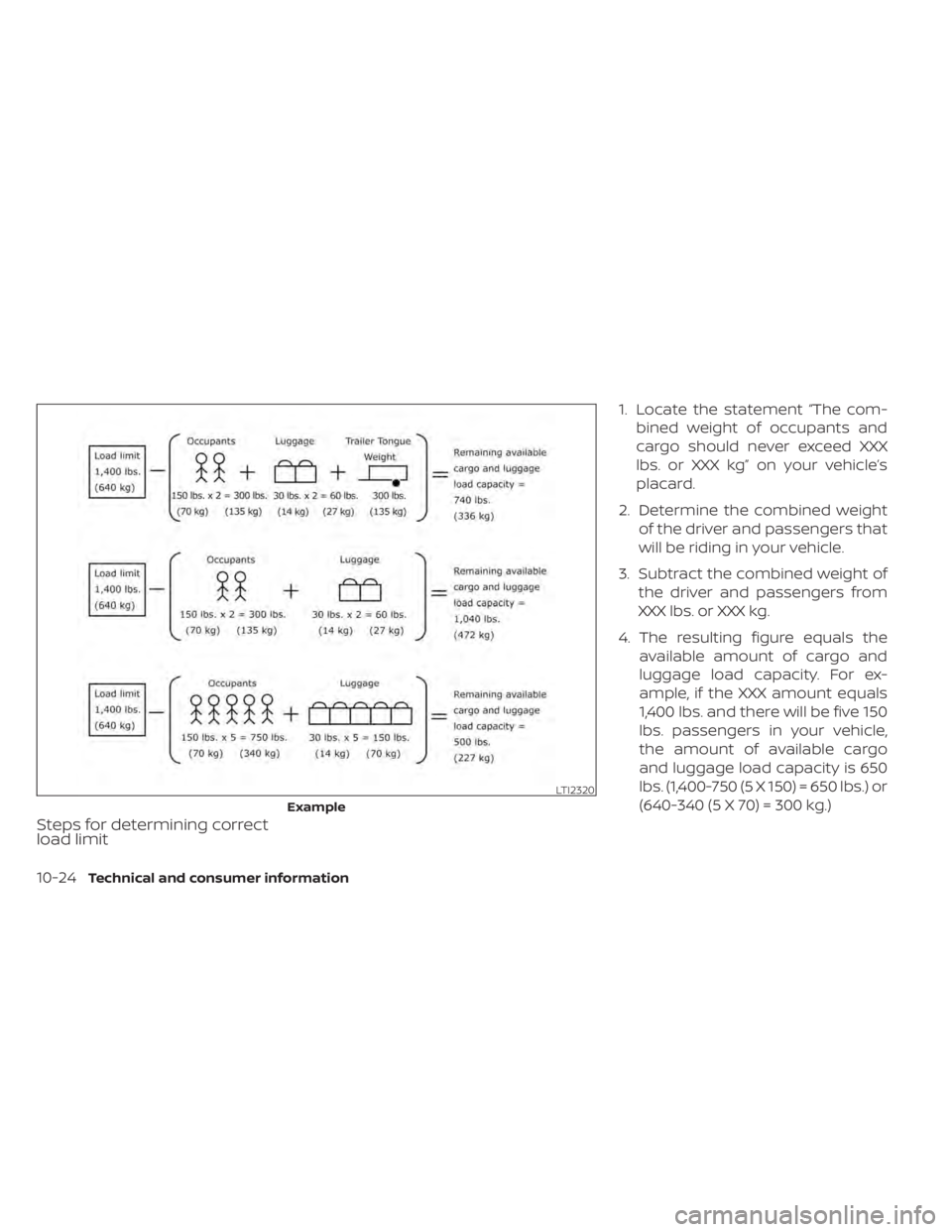
Steps for determining correct
load limit
1. Locate the statement “The com-bined weight of occupants and
cargo should never exceed XXX
lbs. or XXX kg” on your vehicle’s
placard.
2. Determine the combined weight of the driver and passengers that
will be riding in your vehicle.
3. Subtract the combined weight of the driver and passengers from
XXX lbs. or XXX kg.
4. The resulting figure equals the available amount of cargo and
luggage load capacity. For ex-
ample, if the XXX amount equals
1,400 lbs. and there will be five 150
lbs. passengers in your vehicle,
the amount of available cargo
and luggage load capacity is 650
lbs. (1,400-750 (5 X 150) = 650 lbs.) or
(640-340 (5 X 70) = 300 kg.)
LTI2320
Example
10-24Technical and consumer information