automatic transmission NISSAN TITAN 2021 Owner´s Manual
[x] Cancel search | Manufacturer: NISSAN, Model Year: 2021, Model line: TITAN, Model: NISSAN TITAN 2021Pages: 638, PDF Size: 4.31 MB
Page 553 of 638
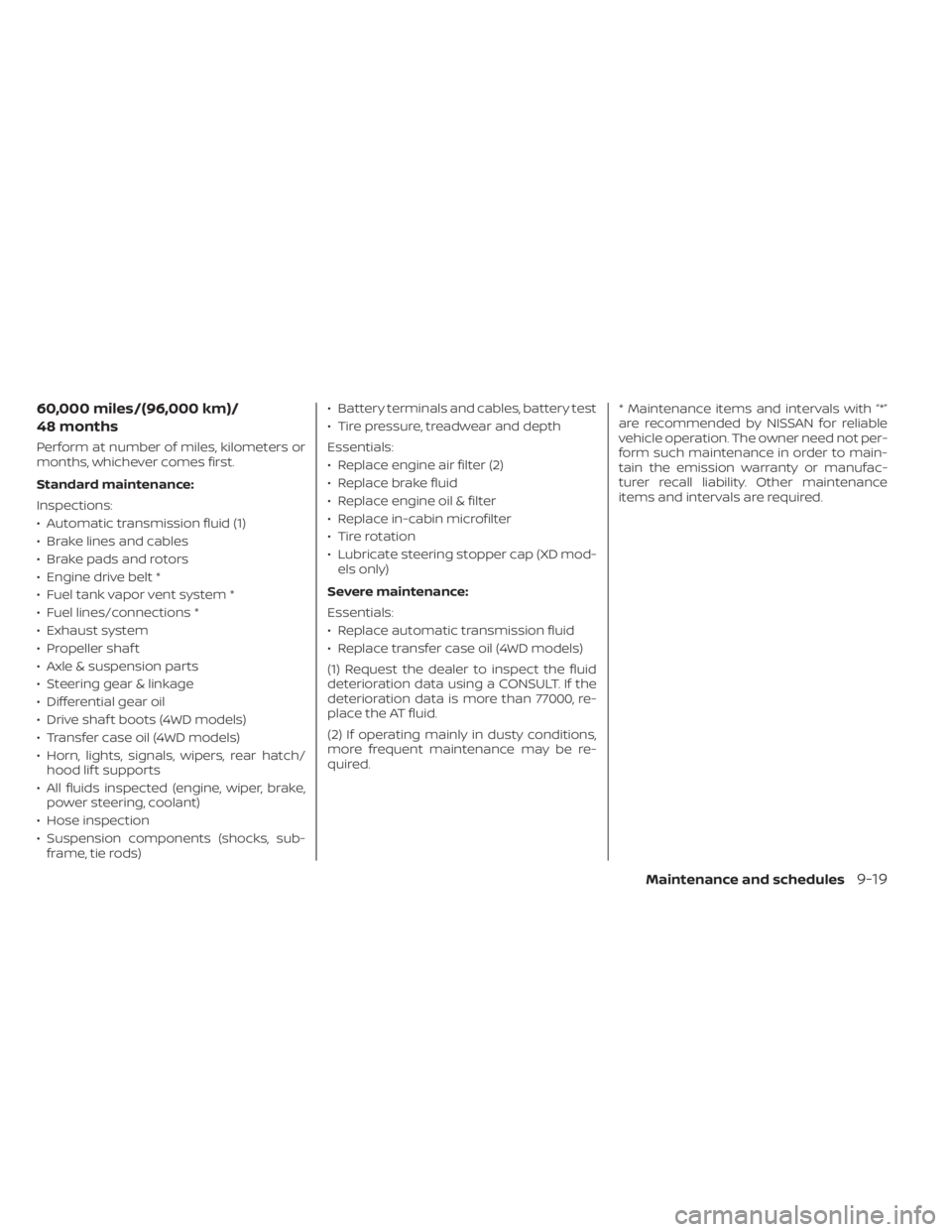
60,000 miles/(96,000 km)/
48 months
Perform at number of miles, kilometers or
months, whichever comes first.
Standard maintenance:
Inspections:
• Automatic transmission fluid (1)
• Brake lines and cables
• Brake pads and rotors
• Engine drive belt *
• Fuel tank vapor vent system *
• Fuel lines/connections *
• Exhaust system
• Propeller shaf t
• Axle & suspension parts
• Steering gear & linkage
• Differential gear oil
• Drive shaf t boots (4WD models)
• Transfer case oil (4WD models)
• Horn, lights, signals, wipers, rear hatch/hood lif t supports
• All fluids inspected (engine, wiper, brake, power steering, coolant)
• Hose inspection
• Suspension components (shocks, sub- frame, tie rods) • Battery terminals and cables, battery test
• Tire pressure, treadwear and depth
Essentials:
• Replace engine air filter (2)
• Replace brake fluid
• Replace engine oil & filter
• Replace in-cabin microfilter
• Tire rotation
• Lubricate steering stopper cap (XD mod-
els only)
Severe maintenance:
Essentials:
• Replace automatic transmission fluid
• Replace transfer case oil (4WD models)
(1) Request the dealer to inspect the fluid
deterioration data using a CONSULT. If the
deterioration data is more than 77000, re-
place the AT fluid.
(2) If operating mainly in dusty conditions,
more frequent maintenance may be re-
quired. * Maintenance items and intervals with “*”
are recommended by NISSAN for reliable
vehicle operation. The owner need not per-
form such maintenance in order to main-
tain the emission warranty or manufac-
turer recall liability. Other maintenance
items and intervals are required.
Maintenance and schedules9-19
Page 556 of 638
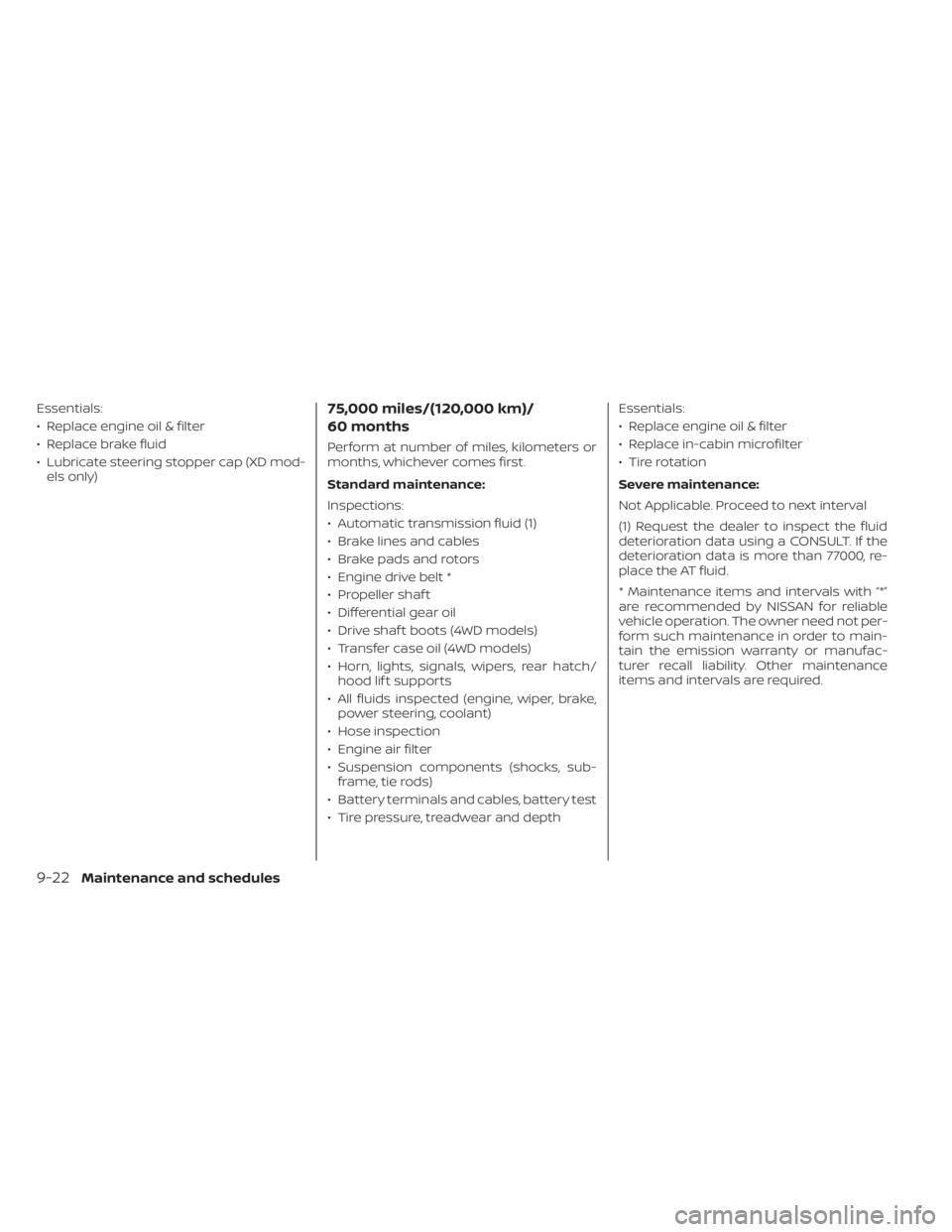
Essentials:
• Replace engine oil & filter
• Replace brake fluid
• Lubricate steering stopper cap (XD mod-els only)75,000 miles/(120,000 km)/
60 months
Perform at number of miles, kilometers or
months, whichever comes first.
Standard maintenance:
Inspections:
• Automatic transmission fluid (1)
• Brake lines and cables
• Brake pads and rotors
• Engine drive belt *
• Propeller shaf t
• Differential gear oil
• Drive shaf t boots (4WD models)
• Transfer case oil (4WD models)
• Horn, lights, signals, wipers, rear hatch/hood lif t supports
• All fluids inspected (engine, wiper, brake, power steering, coolant)
• Hose inspection
• Engine air filter
• Suspension components (shocks, sub- frame, tie rods)
• Battery terminals and cables, battery test
• Tire pressure, treadwear and depth Essentials:
• Replace engine oil & filter
• Replace in-cabin microfilter
• Tire rotation
Severe maintenance:
Not Applicable. Proceed to next interval
(1) Request the dealer to inspect the fluid
deterioration data using a CONSULT. If the
deterioration data is more than 77000, re-
place the AT fluid.
* Maintenance items and intervals with “*”
are recommended by NISSAN for reliable
vehicle operation. The owner need not per-
form such maintenance in order to main-
tain the emission warranty or manufac-
turer recall liability. Other maintenance
items and intervals are required.
9-22Maintenance and schedules
Page 559 of 638
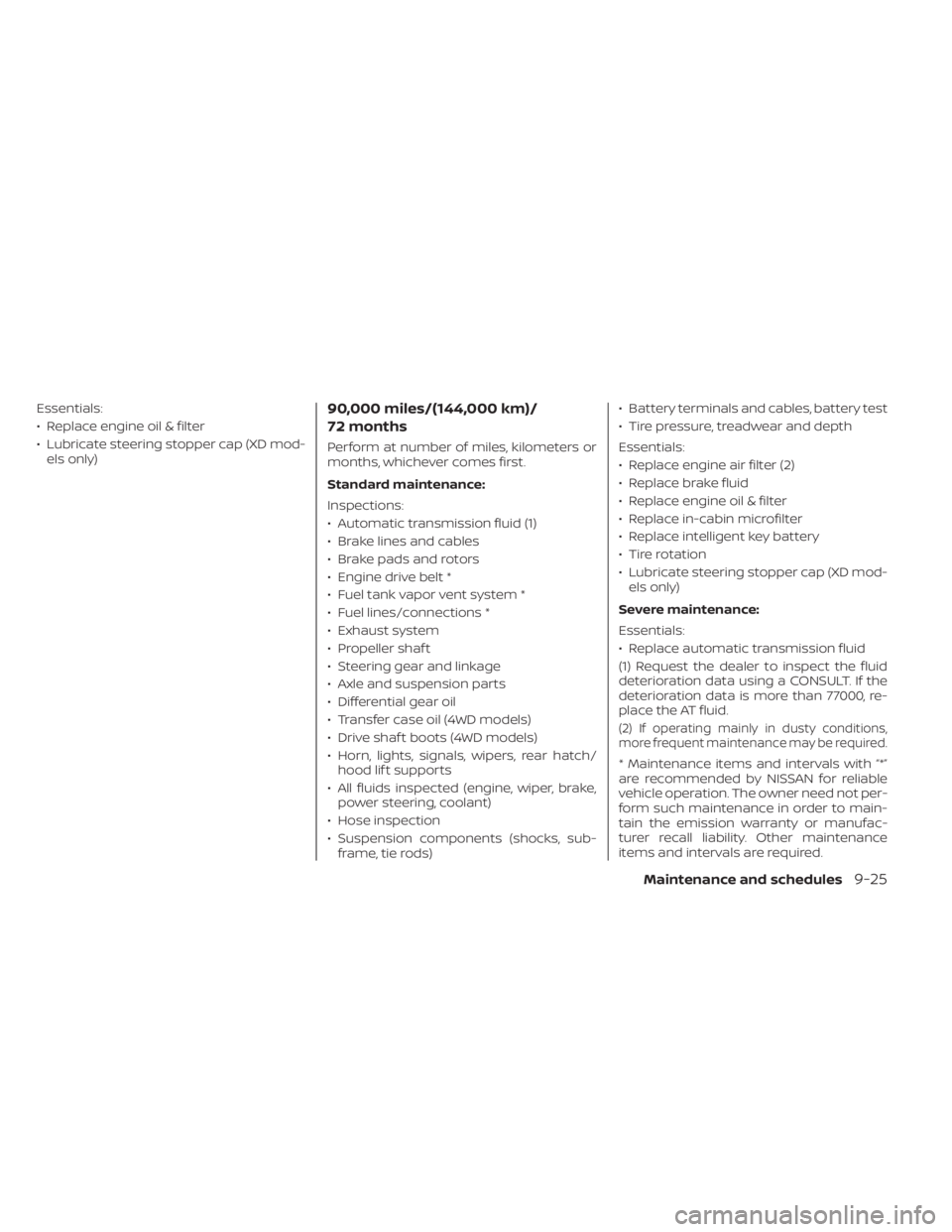
Essentials:
• Replace engine oil & filter
• Lubricate steering stopper cap (XD mod-els only)90,000 miles/(144,000 km)/
72 months
Perform at number of miles, kilometers or
months, whichever comes first.
Standard maintenance:
Inspections:
• Automatic transmission fluid (1)
• Brake lines and cables
• Brake pads and rotors
• Engine drive belt *
• Fuel tank vapor vent system *
• Fuel lines/connections *
• Exhaust system
• Propeller shaf t
• Steering gear and linkage
• Axle and suspension parts
• Differential gear oil
• Transfer case oil (4WD models)
• Drive shaf t boots (4WD models)
• Horn, lights, signals, wipers, rear hatch/hood lif t supports
• All fluids inspected (engine, wiper, brake, power steering, coolant)
• Hose inspection
• Suspension components (shocks, sub- frame, tie rods) • Battery terminals and cables, battery test
• Tire pressure, treadwear and depth
Essentials:
• Replace engine air filter (2)
• Replace brake fluid
• Replace engine oil & filter
• Replace in-cabin microfilter
• Replace intelligent key battery
• Tire rotation
• Lubricate steering stopper cap (XD mod-
els only)
Severe maintenance:
Essentials:
• Replace automatic transmission fluid
(1) Request the dealer to inspect the fluid
deterioration data using a CONSULT. If the
deterioration data is more than 77000, re-
place the AT fluid.
(2) If operating mainly in dusty conditions,
more frequent maintenance may be required.
* Maintenance items and intervals with “*”
are recommended by NISSAN for reliable
vehicle operation. The owner need not per-
form such maintenance in order to main-
tain the emission warranty or manufac-
turer recall liability. Other maintenance
items and intervals are required.
Maintenance and schedules9-25
Page 562 of 638
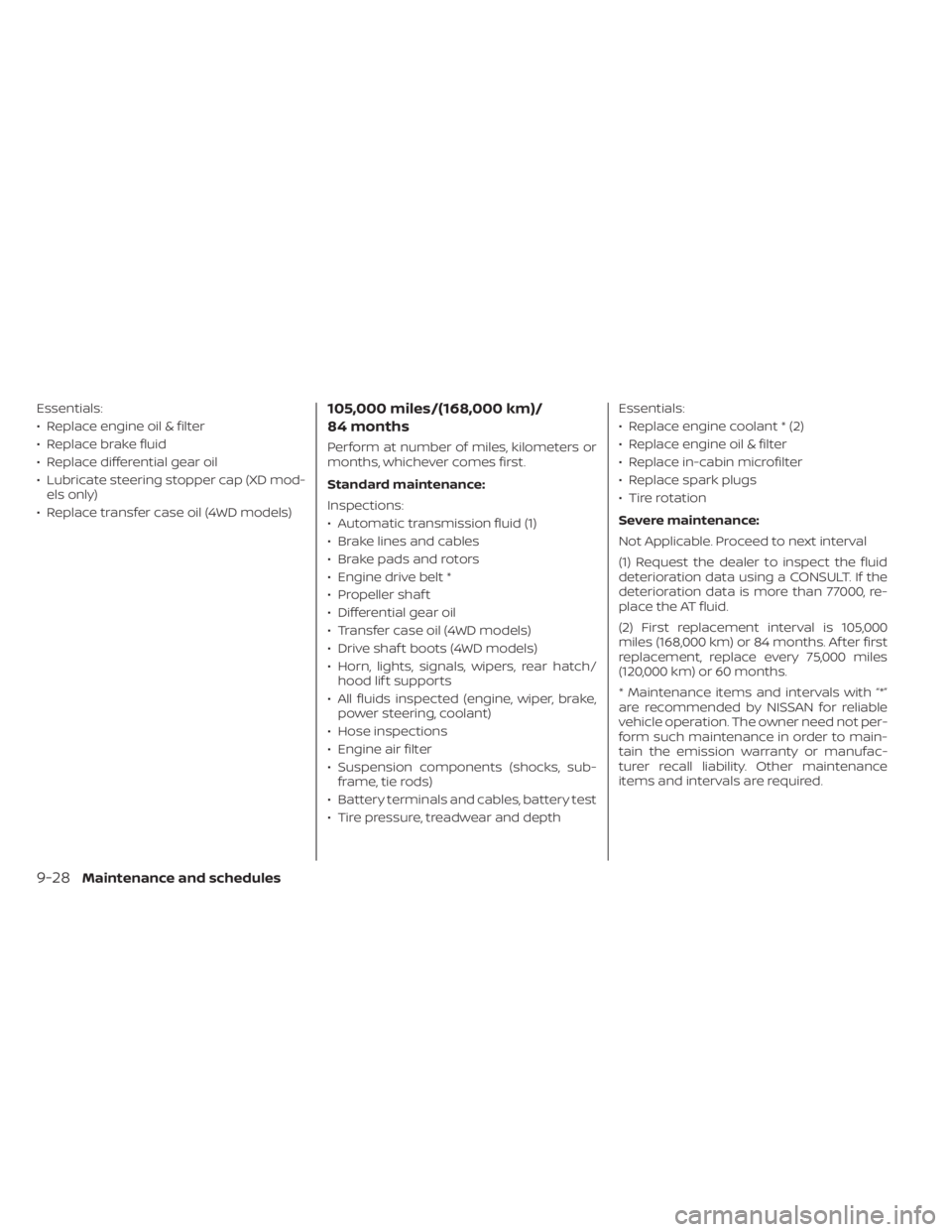
Essentials:
• Replace engine oil & filter
• Replace brake fluid
• Replace differential gear oil
• Lubricate steering stopper cap (XD mod-els only)
• Replace transfer case oil (4WD models)105,000 miles/(168,000 km)/
84 months
Perform at number of miles, kilometers or
months, whichever comes first.
Standard maintenance:
Inspections:
• Automatic transmission fluid (1)
• Brake lines and cables
• Brake pads and rotors
• Engine drive belt *
• Propeller shaf t
• Differential gear oil
• Transfer case oil (4WD models)
• Drive shaf t boots (4WD models)
• Horn, lights, signals, wipers, rear hatch/ hood lif t supports
• All fluids inspected (engine, wiper, brake, power steering, coolant)
• Hose inspections
• Engine air filter
• Suspension components (shocks, sub- frame, tie rods)
• Battery terminals and cables, battery test
• Tire pressure, treadwear and depth Essentials:
• Replace engine coolant * (2)
• Replace engine oil & filter
• Replace in-cabin microfilter
• Replace spark plugs
• Tire rotation
Severe maintenance:
Not Applicable. Proceed to next interval
(1) Request the dealer to inspect the fluid
deterioration data using a CONSULT. If the
deterioration data is more than 77000, re-
place the AT fluid.
(2) First replacement interval is 105,000
miles (168,000 km) or 84 months. Af ter first
replacement, replace every 75,000 miles
(120,000 km) or 60 months.
* Maintenance items and intervals with “*”
are recommended by NISSAN for reliable
vehicle operation. The owner need not per-
form such maintenance in order to main-
tain the emission warranty or manufac-
turer recall liability. Other maintenance
items and intervals are required.
9-28Maintenance and schedules
Page 565 of 638
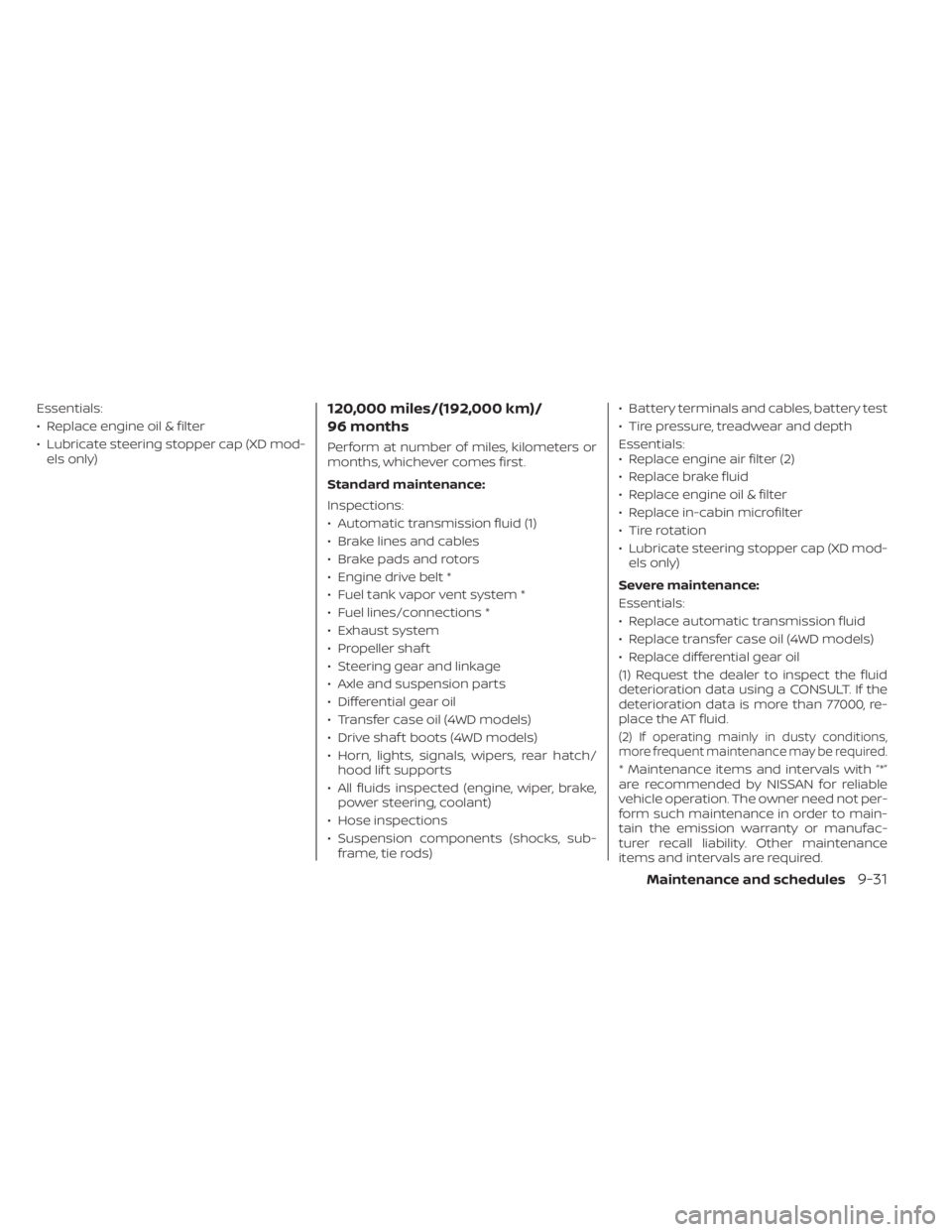
Essentials:
• Replace engine oil & filter
• Lubricate steering stopper cap (XD mod-els only)120,000 miles/(192,000 km)/
96 months
Perform at number of miles, kilometers or
months, whichever comes first.
Standard maintenance:
Inspections:
• Automatic transmission fluid (1)
• Brake lines and cables
• Brake pads and rotors
• Engine drive belt *
• Fuel tank vapor vent system *
• Fuel lines/connections *
• Exhaust system
• Propeller shaf t
• Steering gear and linkage
• Axle and suspension parts
• Differential gear oil
• Transfer case oil (4WD models)
• Drive shaf t boots (4WD models)
• Horn, lights, signals, wipers, rear hatch/hood lif t supports
• All fluids inspected (engine, wiper, brake, power steering, coolant)
• Hose inspections
• Suspension components (shocks, sub- frame, tie rods) • Battery terminals and cables, battery test
• Tire pressure, treadwear and depth
Essentials:
• Replace engine air filter (2)
• Replace brake fluid
• Replace engine oil & filter
• Replace in-cabin microfilter
• Tire rotation
• Lubricate steering stopper cap (XD mod-
els only)
Severe maintenance:
Essentials:
• Replace automatic transmission fluid
• Replace transfer case oil (4WD models)
• Replace differential gear oil
(1) Request the dealer to inspect the fluid
deterioration data using a CONSULT. If the
deterioration data is more than 77000, re-
place the AT fluid.
(2) If operating mainly in dusty conditions,
more frequent maintenance may be required.
* Maintenance items and intervals with “*”
are recommended by NISSAN for reliable
vehicle operation. The owner need not per-
form such maintenance in order to main-
tain the emission warranty or manufac-
turer recall liability. Other maintenance
items and intervals are required.
Maintenance and schedules9-31
Page 568 of 638
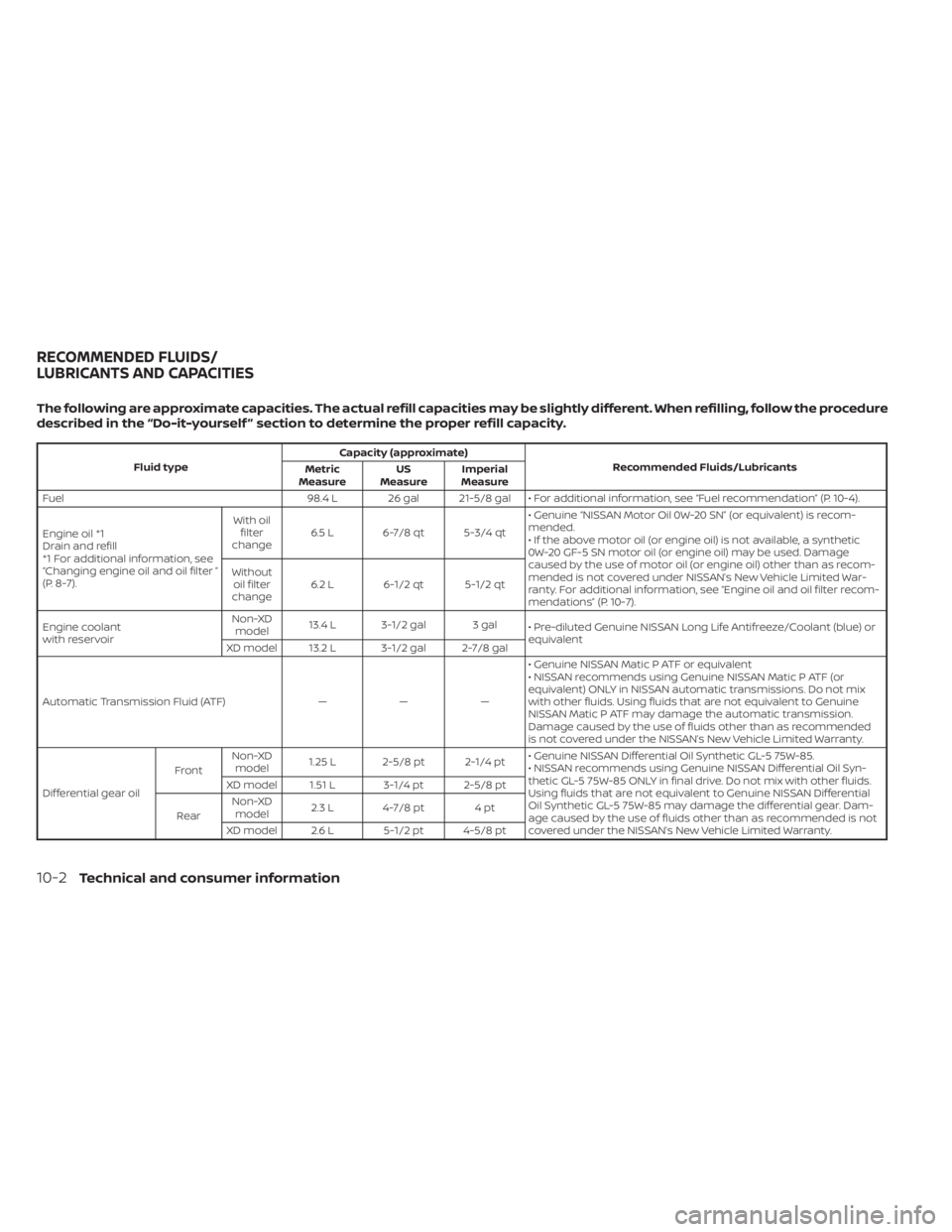
The following are approximate capacities. The actual refill capacities may be slightly different. When refilling, follow the procedure
described in the “Do-it-yourself ” section to determine the proper refill capacity.
Fluid typeCapacity (approximate)
Recommended Fluids/Lubricants
Metric
Measure US
Measure Imperial
Measure
Fuel 98.4 L 26 gal 21-5/8 gal • For additional information, see “Fuel recommendation” (P. 10-4).
Engine oil *1
Drain and refill
*1 For additional information, see
“Changing engine oil and oil filter ”
(P. 8-7). With oil
filter
change 6.5 L 6-7/8 qt 5-3/4 qt • Genuine “NISSAN Motor Oil 0W-20 SN” (or equivalent) is recom-
mended.
• If the above motor oil (or engine oil) is not available, a synthetic
0W-20 GF-5 SN motor oil (or engine oil) may be used. Damage
caused by the use of motor oil (or engine oil) other than as recom-
mended is not covered under NISSAN’s New Vehicle Limited War-
ranty. For additional information, see “Engine oil and oil filter recom-
mendations” (P. 10-7).
Without
oil filter
change 6.2 L 6-1/2 qt 5-1/2 qt
Engine coolant
with reservoir Non-XD
model 13.4 L 3-1/2 gal 3 gal
• Pre-diluted Genuine NISSAN Long Life Antifreeze/Coolant (blue) or
equivalent
XD model 13.2 L 3-1/2 gal 2-7/8 gal
Automatic Transmission Fluid (ATF) — — — • Genuine NISSAN Matic P ATF or equivalent
• NISSAN recommends using Genuine NISSAN Matic P ATF (or
equivalent) ONLY in NISSAN automatic transmissions. Do not mix
with other fluids. Using fluids that are not equivalent to Genuine
NISSAN Matic P ATF may damage the automatic transmission.
Damage caused by the use of fluids other than as recommended
is not covered under the NISSAN’s New Vehicle Limited Warranty.
Differential gear oil Front
Non-XD
model 1.25 L 2-5/8 pt 2-1/4 pt
• Genuine NISSAN Differential Oil Synthetic GL-5 75W-85.
• NISSAN recommends using Genuine NISSAN Differential Oil Syn-
thetic GL-5 75W-85 ONLY in final drive. Do not mix with other fluids.
Using fluids that are not equivalent to Genuine NISSAN Differential
Oil Synthetic GL-5 75W-85 may damage the differential gear. Dam-
age caused by the use of fluids other than as recommended is not
covered under the NISSAN’s New Vehicle Limited Warranty.
XD model 1.51 L 3-1/4 pt 2-5/8 pt
Rear Non-XD
model 2.3 L 4-7/8 pt 4 pt
XD model 2.6 L 5-1/2 pt 4-5/8 pt
RECOMMENDED FLUIDS/
LUBRICANTS AND CAPACITIES
10-2Technical and consumer information
Page 618 of 638
• Be certain your rearview mirrors conformto all federal, state or local regulations. If
not, install any mirrors required for towing
before driving the vehicle.
• Determine the overall height of the ve- hicle and trailer so the required clearance
is known.
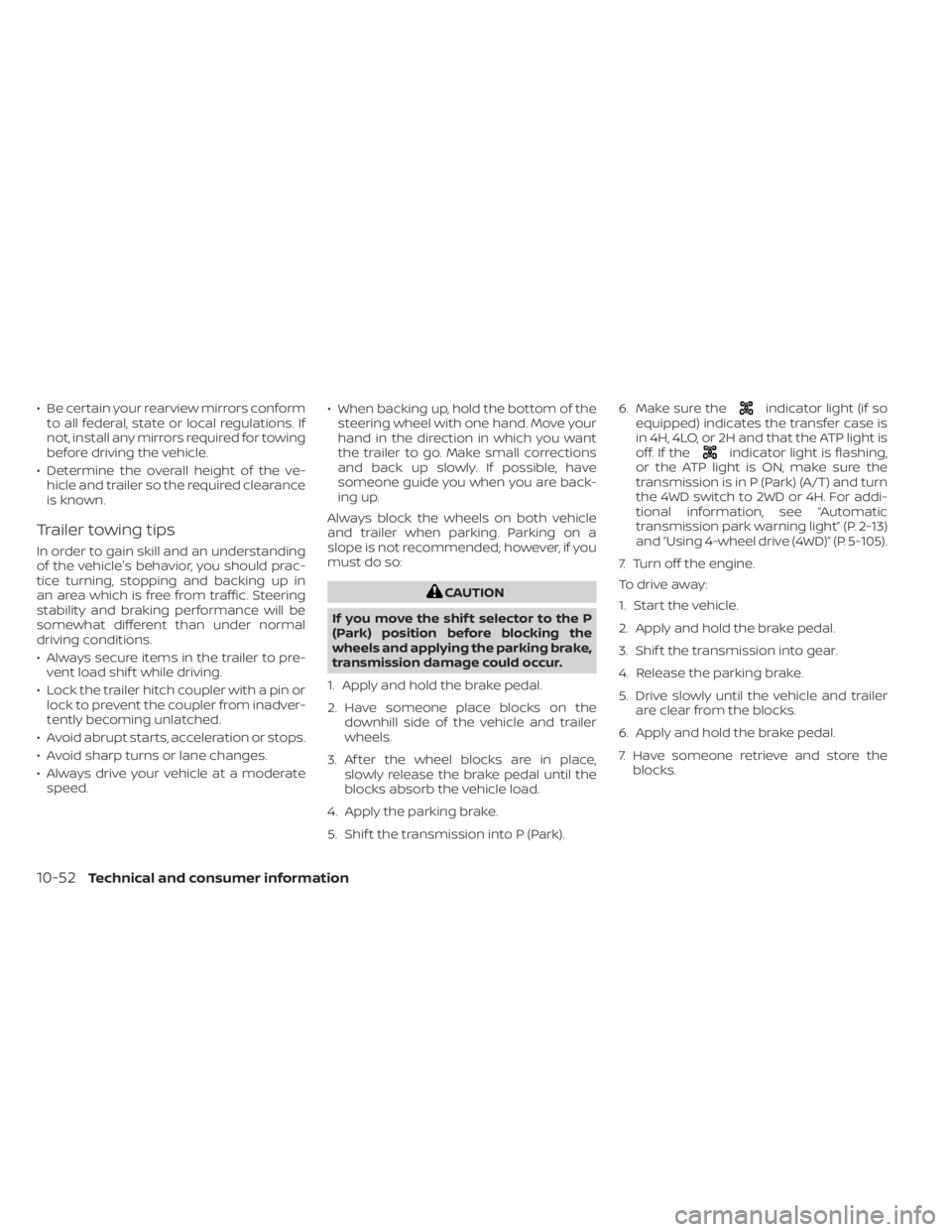
Trailer towing tips
In order to gain skill and an understanding
of the vehicle's behavior, you should prac-
tice turning, stopping and backing up in
an area which is free from traffic. Steering
stability and braking performance will be
somewhat different than under normal
driving conditions.
• Always secure items in the trailer to pre-vent load shif t while driving.
• Lock the trailer hitch coupler with a pin or lock to prevent the coupler from inadver-
tently becoming unlatched.
• Avoid abrupt starts, acceleration or stops.
• Avoid sharp turns or lane changes.
• Always drive your vehicle at a moderate speed. • When backing up, hold the bottom of the
steering wheel with one hand. Move your
hand in the direction in which you want
the trailer to go. Make small corrections
and back up slowly. If possible, have
someone guide you when you are back-
ing up.
Always block the wheels on both vehicle
and trailer when parking. Parking on a
slope is not recommended; however, if you
must do so:
CAUTION
If you move the shif t selector to the P
(Park) position before blocking the
wheels and applying the parking brake,
transmission damage could occur.
1. Apply and hold the brake pedal.
2. Have someone place blocks on the downhill side of the vehicle and trailer
wheels.
3. Af ter the wheel blocks are in place, slowly release the brake pedal until the
blocks absorb the vehicle load.
4. Apply the parking brake.
5. Shif t the transmission into P (Park). 6. Make sure the
indicator light (if so
equipped) indicates the transfer case is
in 4H, 4LO, or 2H and that the ATP light is
off. If the
indicator light is flashing,
or the ATP light is ON, make sure the
transmission is in P (Park) (A/T) and turn
the 4WD switch to 2WD or 4H. For addi-
tional information, see “Automatic
transmission park warning light” (P. 2-13)
and “Using 4-wheel drive (4WD)” (P. 5-105).
7. Turn off the engine.
To drive away:
1. Start the vehicle.
2. Apply and hold the brake pedal.
3. Shif t the transmission into gear.
4. Release the parking brake.
5. Drive slowly until the vehicle and trailer are clear from the blocks.
6. Apply and hold the brake pedal.
7. Have someone retrieve and store the blocks.
10-52Technical and consumer information
Page 620 of 638
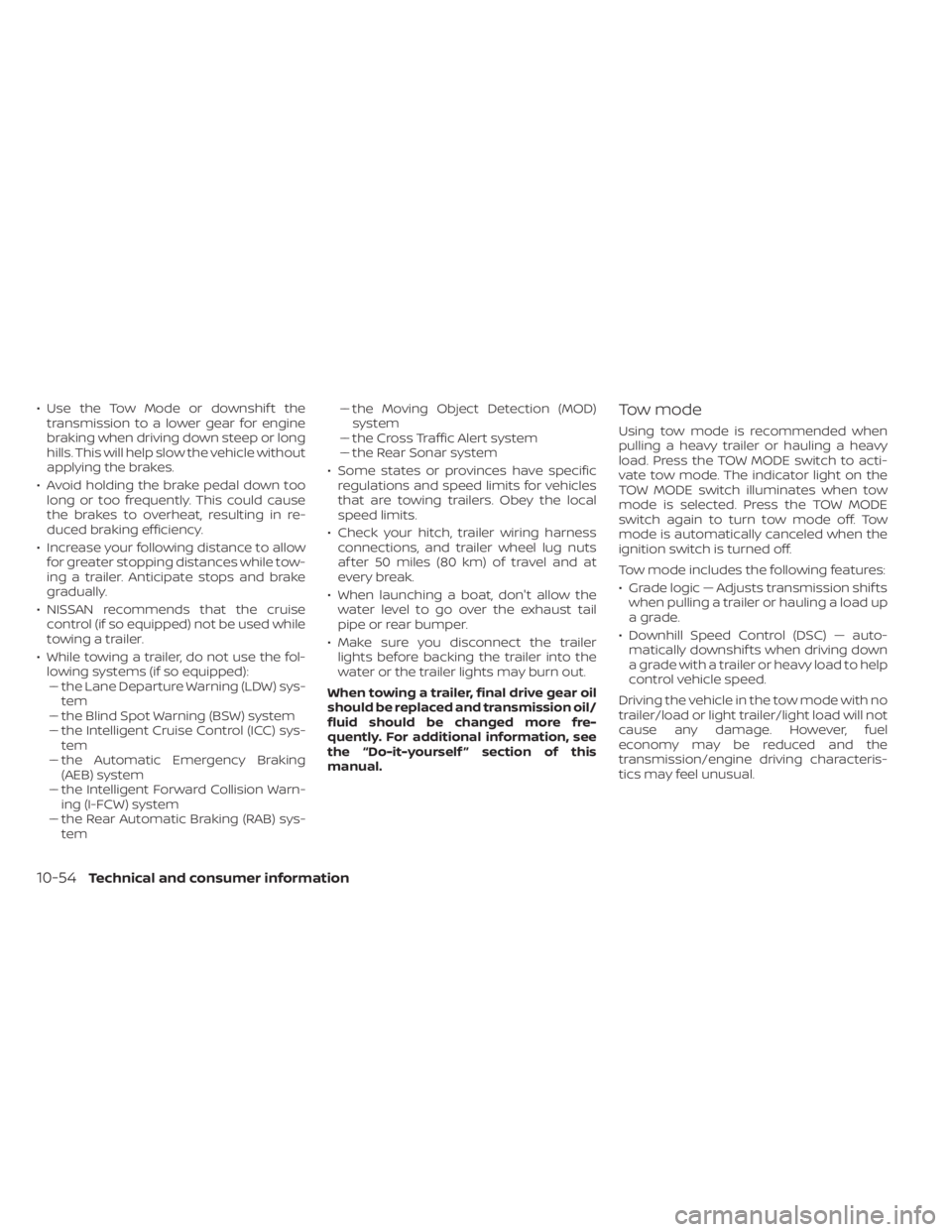
• Use the Tow Mode or downshif t thetransmission to a lower gear for engine
braking when driving down steep or long
hills. This will help slow the vehicle without
applying the brakes.
• Avoid holding the brake pedal down too long or too frequently. This could cause
the brakes to overheat, resulting in re-
duced braking efficiency.
• Increase your following distance to allow for greater stopping distances while tow-
ing a trailer. Anticipate stops and brake
gradually.
• NISSAN recommends that the cruise control (if so equipped) not be used while
towing a trailer.
• While towing a trailer, do not use the fol- lowing systems (if so equipped):–– the Lane Departure Warning (LDW) sys- tem
–– the Blind Spot Warning (BSW) system
– – the Intelligent Cruise Control (ICC) sys-
tem
– – the Automatic Emergency Braking
(AEB) system
– – the Intelligent Forward Collision Warn-
ing (I-FCW) system
– – the Rear Automatic Braking (RAB) sys-
tem –
– the Moving Object Detection (MOD)
system
– – the Cross Traffic Alert system
–– the Rear Sonar system
• Some states or provinces have specific regulations and speed limits for vehicles
that are towing trailers. Obey the local
speed limits.
• Check your hitch, trailer wiring harness connections, and trailer wheel lug nuts
af ter 50 miles (80 km) of travel and at
every break.
• When launching a boat, don't allow the water level to go over the exhaust tail
pipe or rear bumper.
• Make sure you disconnect the trailer lights before backing the trailer into the
water or the trailer lights may burn out.
When towing a trailer, final drive gear oil
should be replaced and transmission oil/
fluid should be changed more fre-
quently. For additional information, see
the “Do-it-yourself ” section of this
manual.Tow mode
Using tow mode is recommended when
pulling a heavy trailer or hauling a heavy
load. Press the TOW MODE switch to acti-
vate tow mode. The indicator light on the
TOW MODE switch illuminates when tow
mode is selected. Press the TOW MODE
switch again to turn tow mode off. Tow
mode is automatically canceled when the
ignition switch is turned off.
Tow mode includes the following features:
• Grade logic — Adjusts transmission shif ts when pulling a trailer or hauling a load up
a grade.
• Downhill Speed Control (DSC) — auto- matically downshif ts when driving down
a grade with a trailer or heavy load to help
control vehicle speed.
Driving the vehicle in the tow mode with no
trailer/load or light trailer/light load will not
cause any damage. However, fuel
economy may be reduced and the
transmission/engine driving characteris-
tics may feel unusual.
10-54Technical and consumer information
Page 621 of 638
When towing a trailer, final drive gear oil
should be replaced and transmission oil/
fluid should be changed more fre-
quently. For additional information, see
the “Do-it-yourself ” section of this
manual.
FLAT TOWING FOR 2-WHEEL DRIVE
(2WD) VEHICLE (if so equipped)
Towing your vehicle with all four wheels on
the ground is sometimes called flat towing.
This method is sometimes used when
towing a vehicle behind a recreational ve-
hicle, such as a motor home.
CAUTION
•
Failure to follow these guidelines can
result in severe transmission damage.
• Never flat tow your 2WD vehicle.
• Never tow your 2WD vehicle with the
rear wheels on the ground. Doing so
may cause serious and expensive
damage to the powertrain.
• DO NOT tow your 2WD vehicle with all
four wheels on the ground (flat tow-
ing). Doing so WILL DAMAGE internal
transmission parts due to lack of
transmission lubrication. •
For emergency towing procedures
see “Towing recommended by
NISSAN” (P. 6-13).
FLAT TOWING FOR 4-WHEEL DRIVE
(4WD) VEHICLE (if so equipped)
Towing your vehicle with all four wheels on
the ground is sometimes called flat towing.
This method is sometimes used when
towing a vehicle behind a recreational ve-
hicle, such as a motor home.
CAUTION
•
Failure to follow these guidelines can
result in severe transmission damage.
• Never flat tow your 4WD vehicle.
• DO NOT tow your 4WD vehicle with
any wheels on the ground. Doing so
may cause serious and expensive
damage to the powertrain.
• For emergency towing procedures
see “Towing recommended by
NISSAN” (P. 6-13).
Automatic Transmission
To tow a vehicle equipped with an auto-
matic transmission, an appropriate vehicle
dolly MUST be placed under the towed ve-
hicle's drive wheels. Alwaysfollow the dolly
manufacturer's recommendations when
using their product.
NOTE:
If the battery is completely drained the
transmission will not manually shif t to
other positions.
Technical and consumer information10-55
Page 627 of 638
11 Index
A
Active Brake Limited Slip (ABLS)
system.....................5-117Aiming control, headlights.........2-49Air bag (See supplemental restraint
system).....................1-53Air bag system
Front (See supplemental front impact
air bag system)
...........1-60, 1-75Air bag warning labels............1-82Air bag warning light.........1-82, 2-16Air bag warning light,
supplemental..............1-82, 2-16Air cleaner...................8-21Air cleaner housing filter..........8-21Air conditionerAir conditioner operation. . . .4-32, 4-38Air conditioner specification label. .10-20Air conditioner system refrigerant
recommendations............10-8Air conditioner system refrigerant and
oil recommendations..........10-8Heater and air conditioner (automatic)
(if so equipped)..............4-37Heater and air conditioner
controls.................. .4-38Servicing air conditioner........4-42Air flow charts................4-33Alarm system (See vehicle security
system).................... .2-37
Anchor point locations...........1-32Antenna....................4-43Anti-lock brake warning light.......2-13Anti-lock Braking System (ABS)......5-116Antifreeze...................5-127Autolight switch...............2-44Automatic
Automatic power window switch. . .2-83Driving with automatic
transmission................5-18Automatic anti-glare inside mirror. . . .3-31Automatic door locks.............3-8Automatic Emergency Braking
(AEB)...................2-17,2-21Automatic Emergency Braking (AEB) with
Pedestrian Detection............5-80Automatic transmission fluid temperature
gauge......................2-10
B
Battery.................5- 127, 8-16Charge warning light...........2-14Battery replacement............8-27Key fob...................8-27NISSAN Intelligent Key®.........8-27Before starting the engine.........5-16Belt (See drive belt)..............8-19Blind Spot Warning (BSW)..........5-32
Block heater
Engine...................5-128Booster seats................ .1-49Brake
Anti-lock Braking System (ABS). . . .5-116Brake fluid.................8-14Brake light (See stop light).......8-32Brake system...............5-115Brake warning light............2-14Brake wear indicators.......2-22,8-23Parking brake operation.........5-23Self-adjusting brakes..........8-23Brake Assist..................5-117Brake fluid...................8-14Brake system................5-115Brakes.....................8-23Break-in schedule.............5-103Brightness controlInstrument panel.............2-50Bulb check/instrument panel.......2-13Bulb replacement..............8-32
C
C.M.V.S.S. certification label........10-18Capacities and recommended
fuel/lubricants................10-2Car phone or CB radio...........4-88Cargo (See vehicle loading
information)................ .10-22