warning NISSAN TITAN 2022 Owner's Manual
[x] Cancel search | Manufacturer: NISSAN, Model Year: 2022, Model line: TITAN, Model: NISSAN TITAN 2022Pages: 635, PDF Size: 7.78 MB
Page 47 of 635
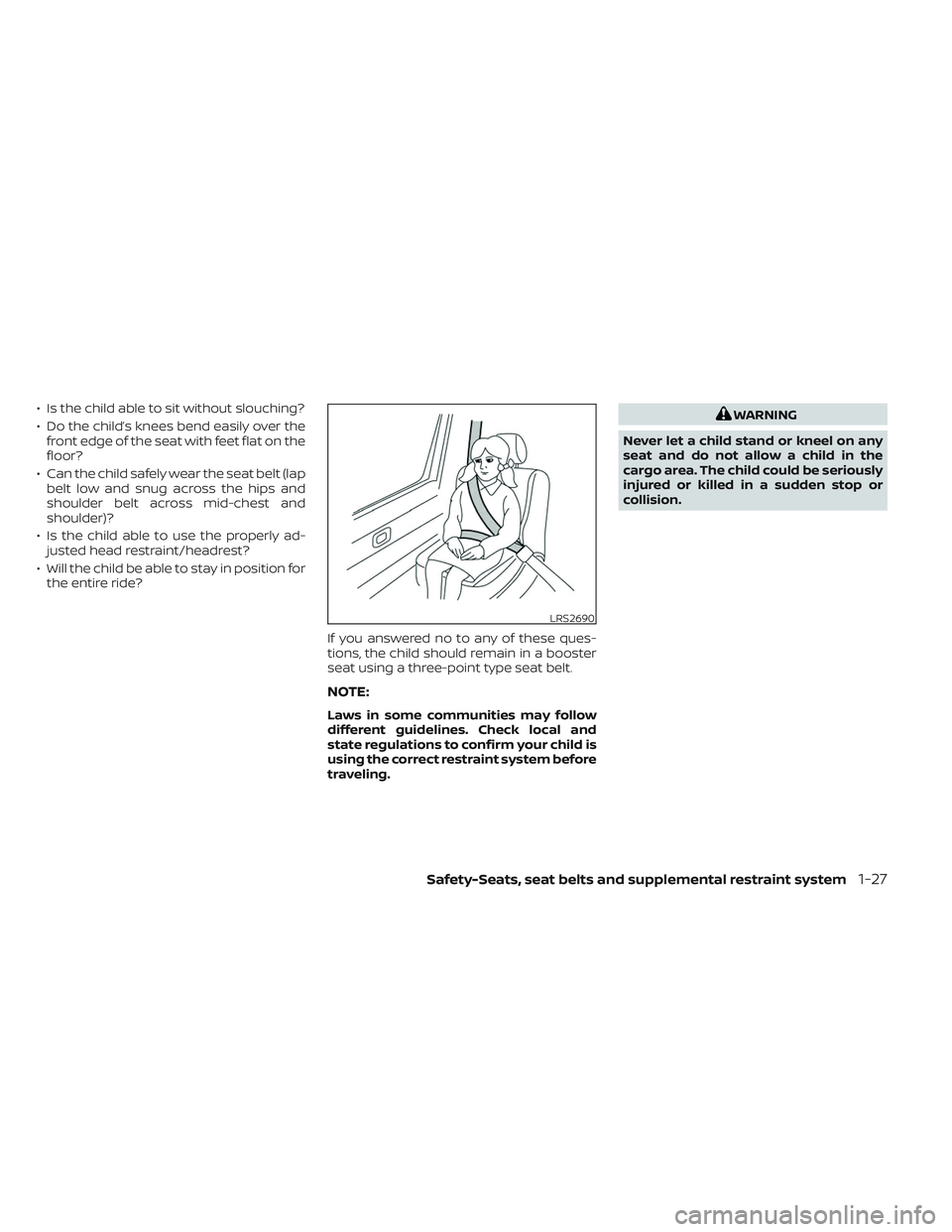
• Is the child able to sit without slouching?
• Do the child’s knees bend easily over thefront edge of the seat with feet flat on the
floor?
• Can the child safely wear the seat belt (lap belt low and snug across the hips and
shoulder belt across mid-chest and
shoulder)?
• Is the child able to use the properly ad- justed head restraint/headrest?
• Will the child be able to stay in position for the entire ride?
If you answered no to any of these ques-
tions, the child should remain in a booster
seat using a three-point type seat belt.
NOTE:
Laws in some communities may follow
different guidelines. Check local and
state regulations to confirm your child is
using the correct restraint system before
traveling.
WARNING
Never let a child stand or kneel on any
seat and do not allow a child in the
cargo area. The child could be seriously
injured or killed in a sudden stop or
collision.
LRS2690
Safety-Seats, seat belts and supplemental restraint system1-27
Page 48 of 635
PRECAUTIONS ON CHILD
RESTRAINTS
WARNING
• Failure to follow the warnings and in-
structions for proper use and instal-
lation of child restraints could result
in serious injury or death of a child or
other passengers in a sudden stop or
collision:
– The child restraint must be used
and installed properly. Always fol-
low all of the child restraint manu-
facturer's instructions for instal-
lation and use. –
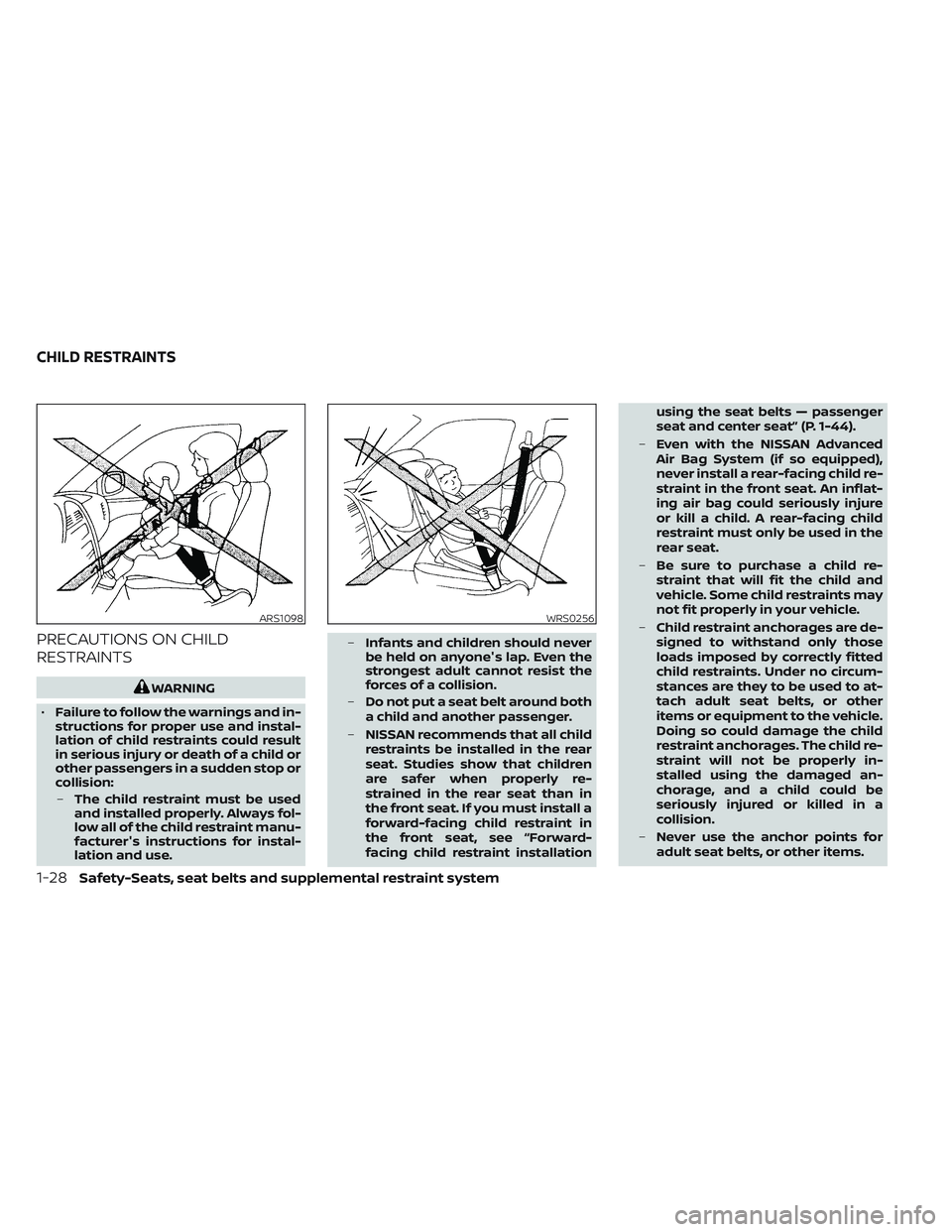
Infants and children should never
be held on anyone's lap. Even the
strongest adult cannot resist the
forces of a collision.
– Do not put a seat belt around both
a child and another passenger.
– NISSAN recommends that all child
restraints be installed in the rear
seat. Studies show that children
are safer when properly re-
strained in the rear seat than in
the front seat. If you must install a
forward-facing child restraint in
the front seat, see “Forward-
facing child restraint installation using the seat belts — passenger
seat and center seat” (P. 1-44).
– Even with the NISSAN Advanced
Air Bag System (if so equipped),
never install a rear-facing child re-
straint in the front seat. An inflat-
ing air bag could seriously injure
or kill a child. A rear-facing child
restraint must only be used in the
rear seat.
– Be sure to purchase a child re-
straint that will fit the child and
vehicle. Some child restraints may
not fit properly in your vehicle.
– Child restraint anchorages are de-
signed to withstand only those
loads imposed by correctly fitted
child restraints. Under no circum-
stances are they to be used to at-
tach adult seat belts, or other
items or equipment to the vehicle.
Doing so could damage the child
restraint anchorages. The child re-
straint will not be properly in-
stalled using the damaged an-
chorage, and a child could be
seriously injured or killed in a
collision.
– Never use the anchor points for
adult seat belts, or other items.
ARS1098WRS0256
CHILD RESTRAINTS
1-28Safety-Seats, seat belts and supplemental restraint system
Page 50 of 635
LATCH (Lower Anchors and
Tethers for CHildren) SYSTEM
Your vehicle is equipped with special an-
chor points that are used with LATCH sys-
tem compatible child restraints. This sys-
tem may also be referred to as the ISOFIX
or ISOFIX compatible system. With this sys-
tem, you do not have to use a vehicle seat
belt to secure the child restraint unless the
combined weight of the child and child re-
straint exceeds 65 lbs. (29.5 kg). If the com-
bined weight of the child and child restraint
is greater than 65 lbs. (29.5 kg) use the vehi-
cle’s seat belt (not the lower anchors) toinstall the child restraint. Be sure to follow
the child restraint manufacturer’s instruc-
tions for installation.
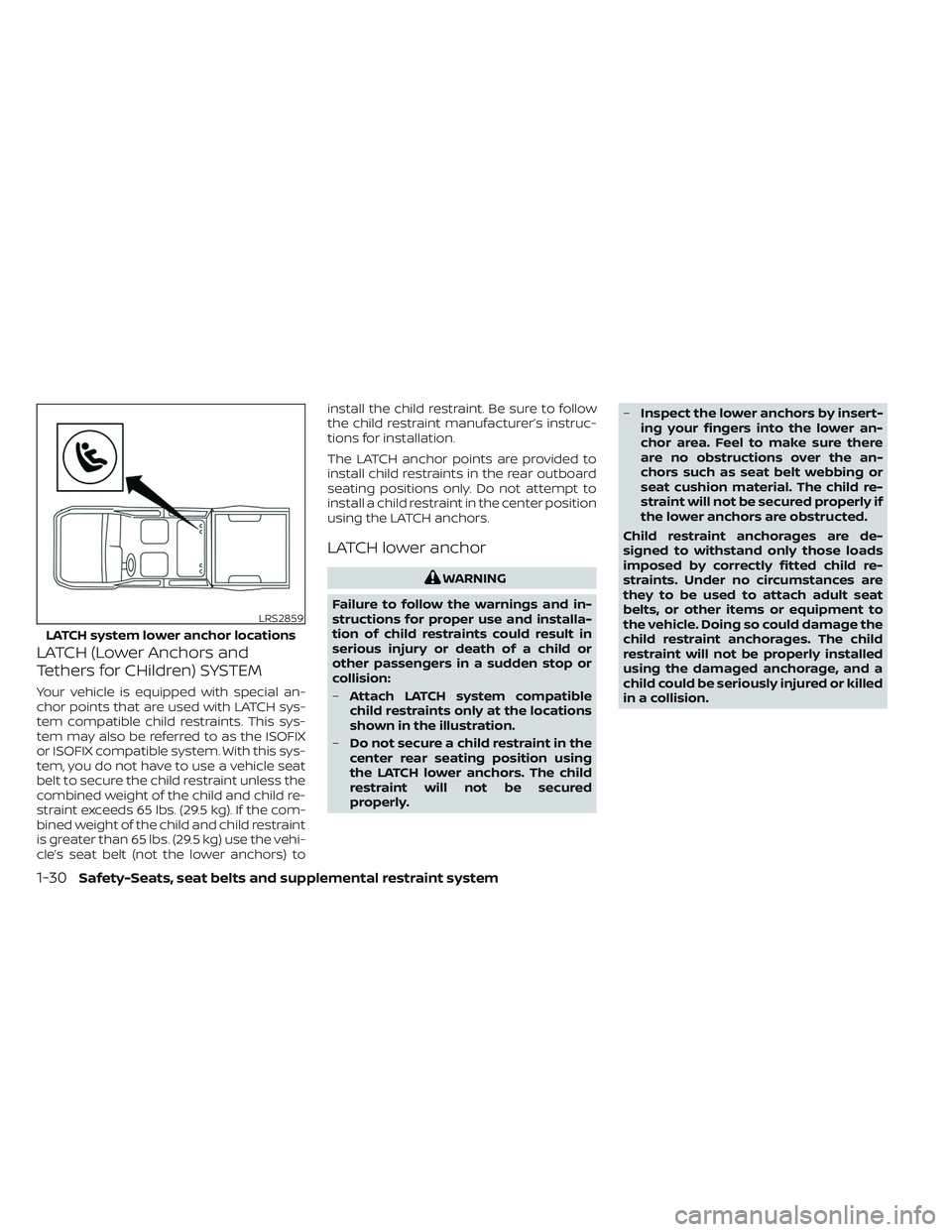
The LATCH anchor points are provided to
install child restraints in the rear outboard
seating positions only. Do not attempt to
install a child restraint in the center position
using the LATCH anchors.
LATCH lower anchor
WARNING
Failure to follow the warnings and in-
structions for proper use and installa-
tion of child restraints could result in
serious injury or death of a child or
other passengers in a sudden stop or
collision:
– Attach LATCH system compatible
child restraints only at the locations
shown in the illustration.
– Do not secure a child restraint in the
center rear seating position using
the LATCH lower anchors. The child
restraint will not be secured
properly. –
Inspect the lower anchors by insert-
ing your fingers into the lower an-
chor area. Feel to make sure there
are no obstructions over the an-
chors such as seat belt webbing or
seat cushion material. The child re-
straint will not be secured properly if
the lower anchors are obstructed.
Child restraint anchorages are de-
signed to withstand only those loads
imposed by correctly fitted child re-
straints. Under no circumstances are
they to be used to attach adult seat
belts, or other items or equipment to
the vehicle. Doing so could damage the
child restraint anchorages. The child
restraint will not be properly installed
using the damaged anchorage, and a
child could be seriously injured or killed
in a collision.
LRS2859
LATCH system lower anchor locations
1-30Safety-Seats, seat belts and supplemental restraint system
Page 52 of 635
When installing a child restraint, carefully
read and follow the instructions in this
manual and those supplied with the child
restraint.TOP TETHER ANCHOR POINT
LOCATIONS
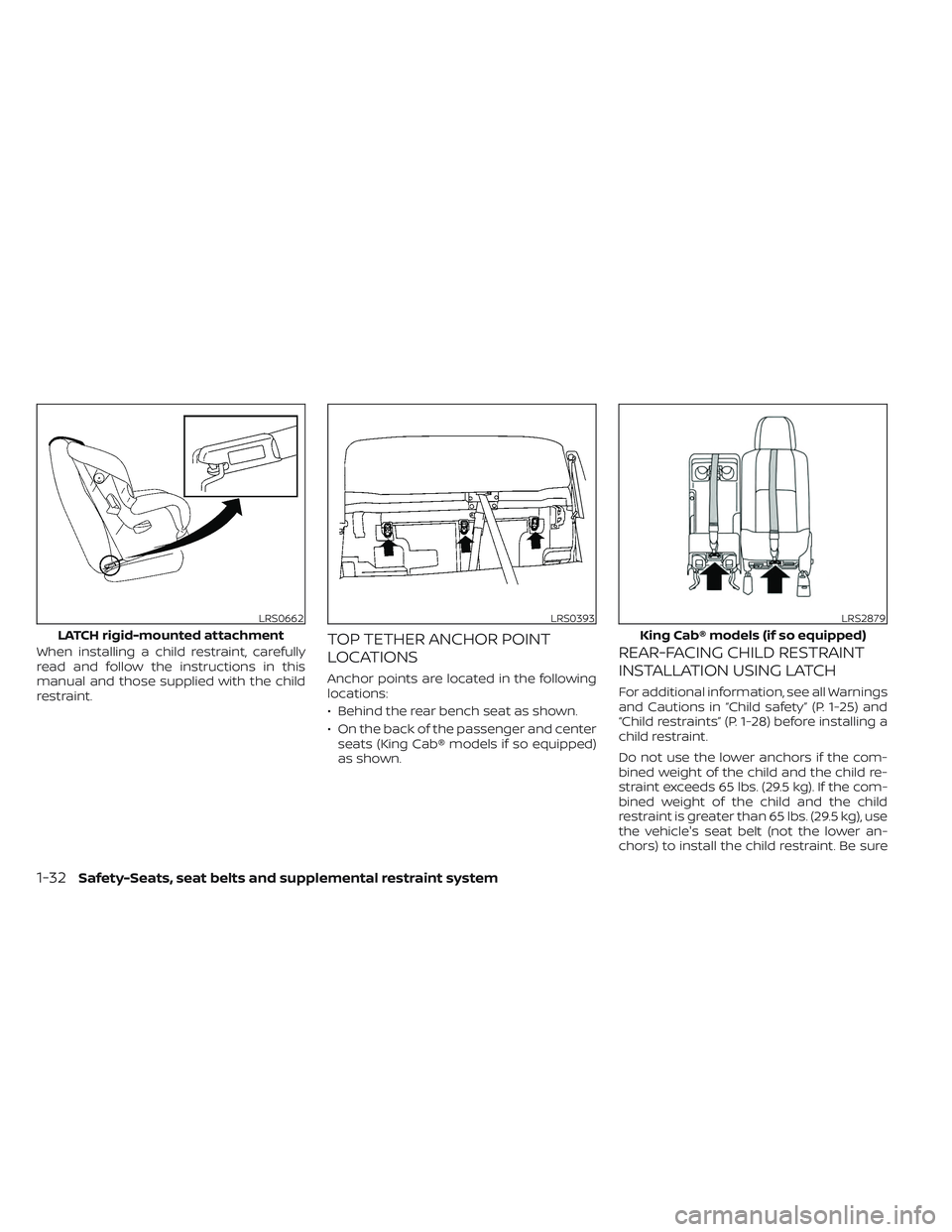
Anchor points are located in the following
locations:
• Behind the rear bench seat as shown.
• On the back of the passenger and centerseats (King Cab® models if so equipped)
as shown.
REAR-FACING CHILD RESTRAINT
INSTALLATION USING LATCH
For additional information, see all Warnings
and Cautions in “Child safety” (P. 1-25) and
“Child restraints” (P. 1-28) before installing a
child restraint.
Do not use the lower anchors if the com-
bined weight of the child and the child re-
straint exceeds 65 lbs. (29.5 kg). If the com-
bined weight of the child and the child
restraint is greater than 65 lbs. (29.5 kg), use
the vehicle's seat belt (not the lower an-
chors) to install the child restraint. Be sure
LRS0662
LATCH rigid-mounted attachment
LRS0393LRS2879
King Cab® models (if so equipped)
1-32Safety-Seats, seat belts and supplemental restraint system
Page 54 of 635
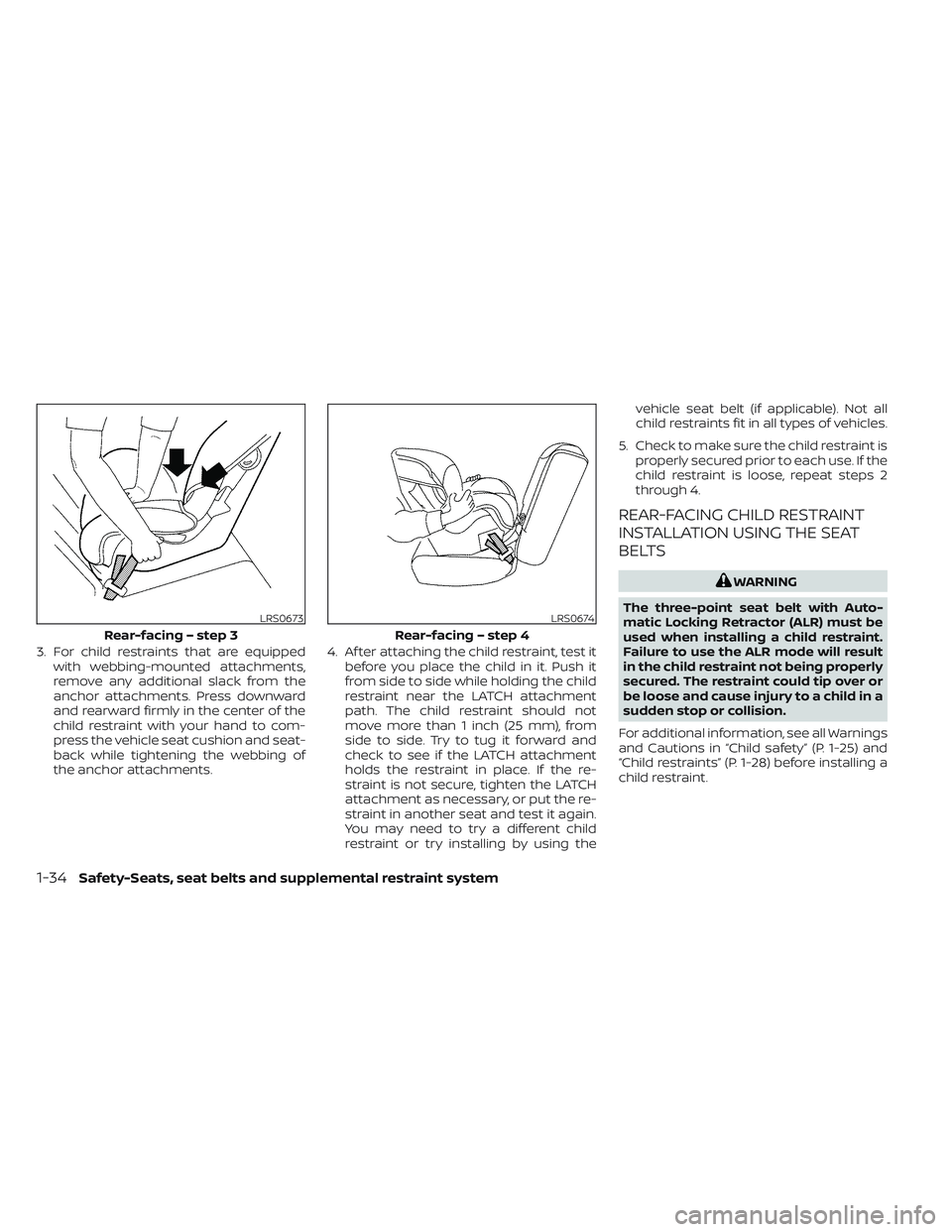
3. For child restraints that are equippedwith webbing-mounted attachments,
remove any additional slack from the
anchor attachments. Press downward
and rearward firmly in the center of the
child restraint with your hand to com-
press the vehicle seat cushion and seat-
back while tightening the webbing of
the anchor attachments. 4. Af ter attaching the child restraint, test it
before you place the child in it. Push it
from side to side while holding the child
restraint near the LATCH attachment
path. The child restraint should not
move more than 1 inch (25 mm), from
side to side. Try to tug it forward and
check to see if the LATCH attachment
holds the restraint in place. If the re-
straint is not secure, tighten the LATCH
attachment as necessary, or put the re-
straint in another seat and test it again.
You may need to try a different child
restraint or try installing by using the vehicle seat belt (if applicable). Not all
child restraints fit in all types of vehicles.
5. Check to make sure the child restraint is properly secured prior to each use. If the
child restraint is loose, repeat steps 2
through 4.
REAR-FACING CHILD RESTRAINT
INSTALLATION USING THE SEAT
BELTS
WARNING
The three-point seat belt with Auto-
matic Locking Retractor (ALR) must be
used when installing a child restraint.
Failure to use the ALR mode will result
in the child restraint not being properly
secured. The restraint could tip over or
be loose and cause injury to a child in a
sudden stop or collision.
For additional information, see all Warnings
and Cautions in “Child safety” (P. 1-25) and
“Child restraints” (P. 1-28) before installing a
child restraint.
LRS0673
Rear-facing – step 3
LRS0674
Rear-facing – step 4
1-34Safety-Seats, seat belts and supplemental restraint system
Page 57 of 635
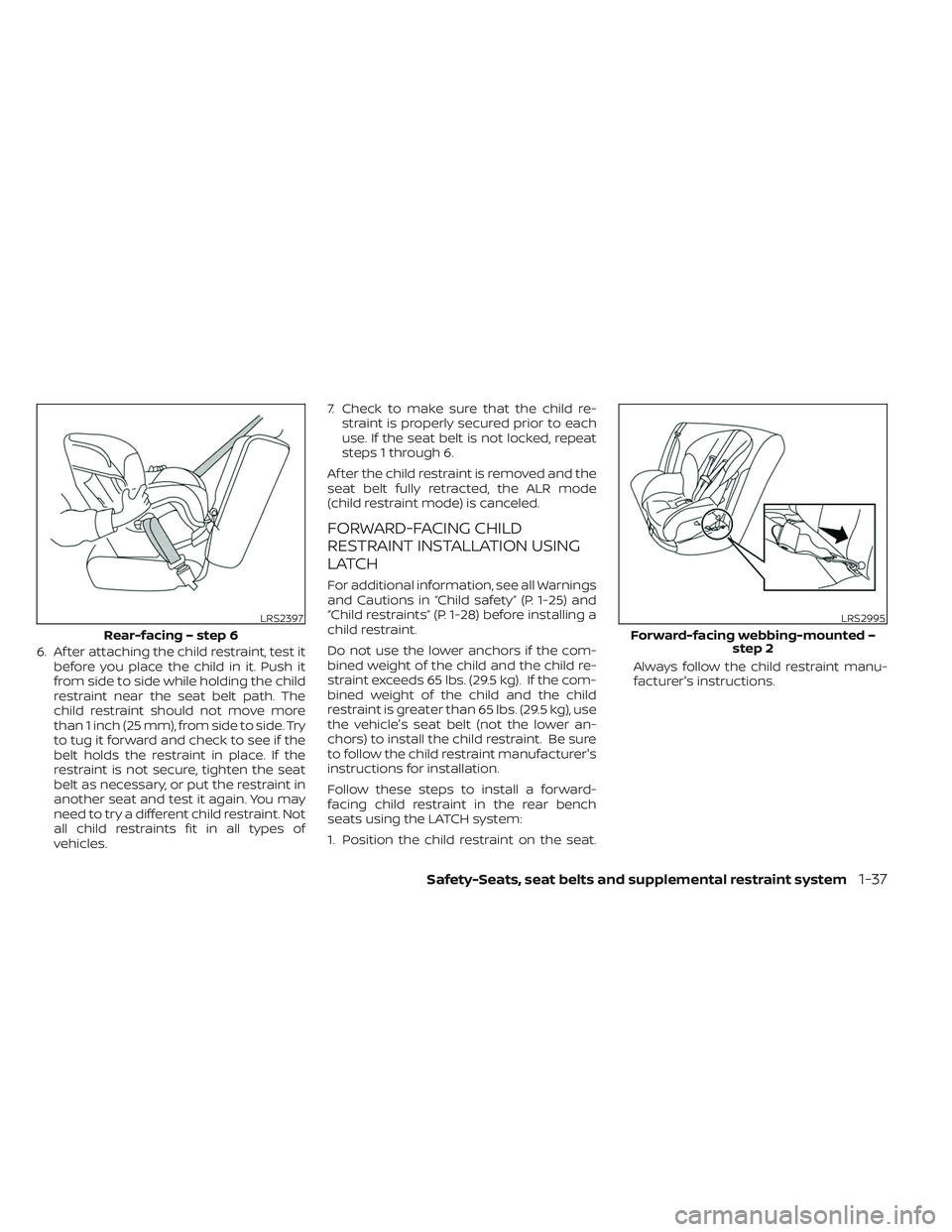
6. Af ter attaching the child restraint, test itbefore you place the child in it. Push it
from side to side while holding the child
restraint near the seat belt path. The
child restraint should not move more
than 1 inch (25 mm), from side to side. Try
to tug it forward and check to see if the
belt holds the restraint in place. If the
restraint is not secure, tighten the seat
belt as necessary, or put the restraint in
another seat and test it again. You may
need to try a different child restraint. Not
all child restraints fit in all types of
vehicles. 7. Check to make sure that the child re-
straint is properly secured prior to each
use. If the seat belt is not locked, repeat
steps 1 through 6.
Af ter the child restraint is removed and the
seat belt fully retracted, the ALR mode
(child restraint mode) is canceled.
FORWARD-FACING CHILD
RESTRAINT INSTALLATION USING
LATCH
For additional information, see all Warnings
and Cautions in “Child safety” (P. 1-25) and
“Child restraints” (P. 1-28) before installing a
child restraint.
Do not use the lower anchors if the com-
bined weight of the child and the child re-
straint exceeds 65 lbs. (29.5 kg). If the com-
bined weight of the child and the child
restraint is greater than 65 lbs. (29.5 kg), use
the vehicle's seat belt (not the lower an-
chors) to install the child restraint. Be sure
to follow the child restraint manufacturer's
instructions for installation.
Follow these steps to install a forward-
facing child restraint in the rear bench
seats using the LATCH system:
1. Position the child restraint on the seat. Always follow the child restraint manu-
facturer's instructions.
LRS2397
Rear-facing – step 6
LRS2995
Forward-facing webbing-mounted –
step 2
Safety-Seats, seat belts and supplemental restraint system1-37
Page 60 of 635
Rear bench seat
OUTBOARD SEATING POSITIONS
1. Remove the head restraint/headrestand store it in a secure place. Be sure to
reinstall the head restraint/headrest
when the child restraint is removed. For
additional information, see “Head
restraints/headrests” (P. 1-11) for head
restraint/headrest adjustment, removal
and installation information.
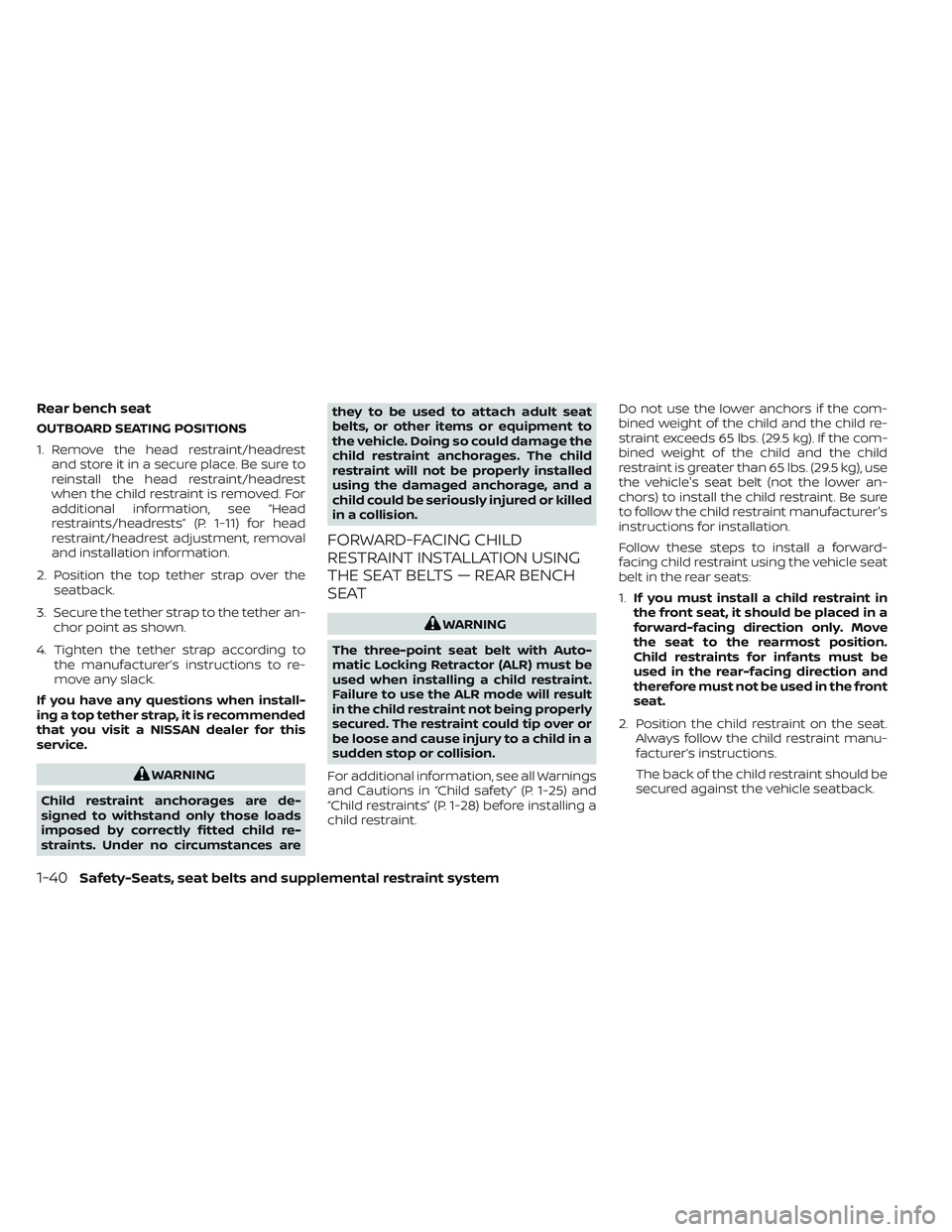
2. Position the top tether strap over the seatback.
3. Secure the tether strap to the tether an- chor point as shown.
4. Tighten the tether strap according to the manufacturer’s instructions to re-
move any slack.
If you have any questions when install-
ing a top tether strap, it is recommended
that you visit a NISSAN dealer for this
service.
WARNING
Child restraint anchorages are de-
signed to withstand only those loads
imposed by correctly fitted child re-
straints. Under no circumstances are they to be used to attach adult seat
belts, or other items or equipment to
the vehicle. Doing so could damage the
child restraint anchorages. The child
restraint will not be properly installed
using the damaged anchorage, and a
child could be seriously injured or killed
in a collision.
FORWARD-FACING CHILD
RESTRAINT INSTALLATION USING
THE SEAT BELTS — REAR BENCH
SEAT
WARNING
The three-point seat belt with Auto-
matic Locking Retractor (ALR) must be
used when installing a child restraint.
Failure to use the ALR mode will result
in the child restraint not being properly
secured. The restraint could tip over or
be loose and cause injury to a child in a
sudden stop or collision.
For additional information, see all Warnings
and Cautions in “Child safety” (P. 1-25) and
“Child restraints” (P. 1-28) before installing a
child restraint. Do not use the lower anchors if the com-
bined weight of the child and the child re-
straint exceeds 65 lbs. (29.5 kg). If the com-
bined weight of the child and the child
restraint is greater than 65 lbs. (29.5 kg), use
the vehicle's seat belt (not the lower an-
chors) to install the child restraint. Be sure
to follow the child restraint manufacturer's
instructions for installation.
Follow these steps to install a forward-
facing child restraint using the vehicle seat
belt in the rear seats:
1.
If you must install a child restraint in
the front seat, it should be placed in a
forward-facing direction only. Move
the seat to the rearmost position.
Child restraints for infants must be
used in the rear-facing direction and
therefore must not be used in the front
seat.
2. Position the child restraint on the seat. Always follow the child restraint manu-
facturer’s instructions.
The back of the child restraint should be
secured against the vehicle seatback.
1-40Safety-Seats, seat belts and supplemental restraint system
Page 64 of 635
Rear bench seat
OUTBOARD SEATING POSITIONS
1. Remove the head restraint/headrestand store it in a secure place. Be sure to
reinstall the head restraint/headrest
when the child restraint is removed. For
additional information, see “Head
restraints/headrests” (P. 1-11).
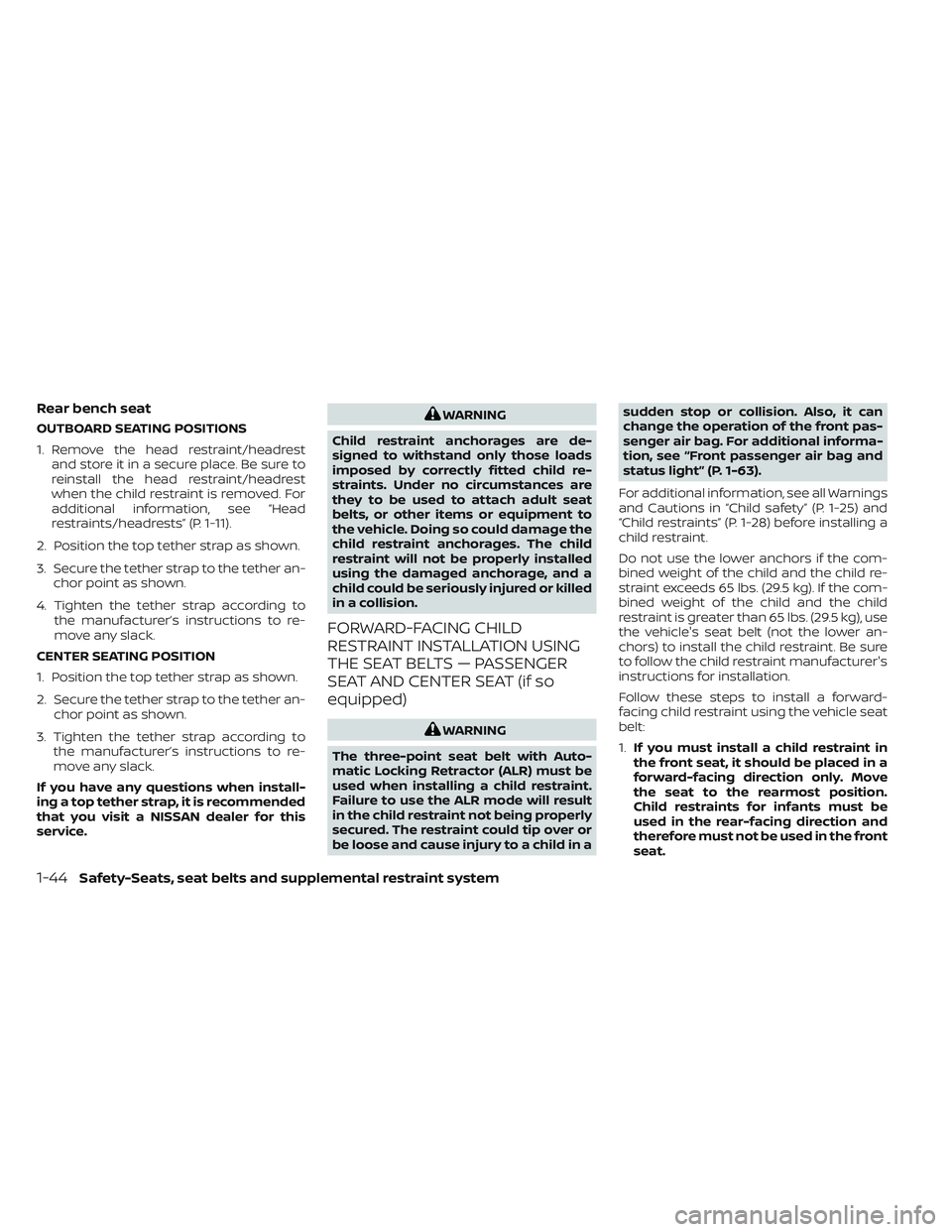
2. Position the top tether strap as shown.
3. Secure the tether strap to the tether an- chor point as shown.
4. Tighten the tether strap according to the manufacturer’s instructions to re-
move any slack.
CENTER SEATING POSITION
1. Position the top tether strap as shown.
2. Secure the tether strap to the tether an- chor point as shown.
3. Tighten the tether strap according to the manufacturer’s instructions to re-
move any slack.
If you have any questions when install-
ing a top tether strap, it is recommended
that you visit a NISSAN dealer for this
service.WARNING
Child restraint anchorages are de-
signed to withstand only those loads
imposed by correctly fitted child re-
straints. Under no circumstances are
they to be used to attach adult seat
belts, or other items or equipment to
the vehicle. Doing so could damage the
child restraint anchorages. The child
restraint will not be properly installed
using the damaged anchorage, and a
child could be seriously injured or killed
in a collision.
FORWARD-FACING CHILD
RESTRAINT INSTALLATION USING
THE SEAT BELTS — PASSENGER
SEAT AND CENTER SEAT (if so
equipped)
WARNING
The three-point seat belt with Auto-
matic Locking Retractor (ALR) must be
used when installing a child restraint.
Failure to use the ALR mode will result
in the child restraint not being properly
secured. The restraint could tip over or
be loose and cause injury to a child in a sudden stop or collision. Also, it can
change the operation of the front pas-
senger air bag. For additional informa-
tion, see “Front passenger air bag and
status light” (P. 1-63).
For additional information, see all Warnings
and Cautions in “Child safety” (P. 1-25) and
“Child restraints” (P. 1-28) before installing a
child restraint.
Do not use the lower anchors if the com-
bined weight of the child and the child re-
straint exceeds 65 lbs. (29.5 kg). If the com-
bined weight of the child and the child
restraint is greater than 65 lbs. (29.5 kg), use
the vehicle's seat belt (not the lower an-
chors) to install the child restraint. Be sure
to follow the child restraint manufacturer's
instructions for installation.
Follow these steps to install a forward-
facing child restraint using the vehicle seat
belt:
1. If you must install a child restraint in
the front seat, it should be placed in a
forward-facing direction only. Move
the seat to the rearmost position.
Child restraints for infants must be
used in the rear-facing direction and
therefore must not be used in the front
seat.
1-44Safety-Seats, seat belts and supplemental restraint system
Page 69 of 635
WARNING
Child restraint anchorages are de-
signed to withstand only those loads
imposed by correctly fitted child re-
straints. Under no circumstances are
they to be used to attach adult seat
belts, or other items or equipment to
the vehicle. Doing so could damage the
child restraint anchorages. The child
restraint will not be properly installed
using the damaged anchorage, and a
child could be seriously injured or killed
in a collision.
BOOSTER SEATS
For additional information on installing a
booster seat in your vehicle, follow the in-
structions outlined in this section.
Precautions on booster seats
WARNING
If a booster seat and seat belt are not
used properly, the risk of a child being
injured or killed in a sudden stop or col-
lision greatly increases:
– Make sure the shoulder portion of
the belt is away from the child's face
and neck and the lap portion of the
belt does not cross the stomach.
– Make sure the shoulder belt is not
behind the child or under the child's
arm.
– A booster seat must only be installed
in a seating position that has a lap/
shoulder belt.
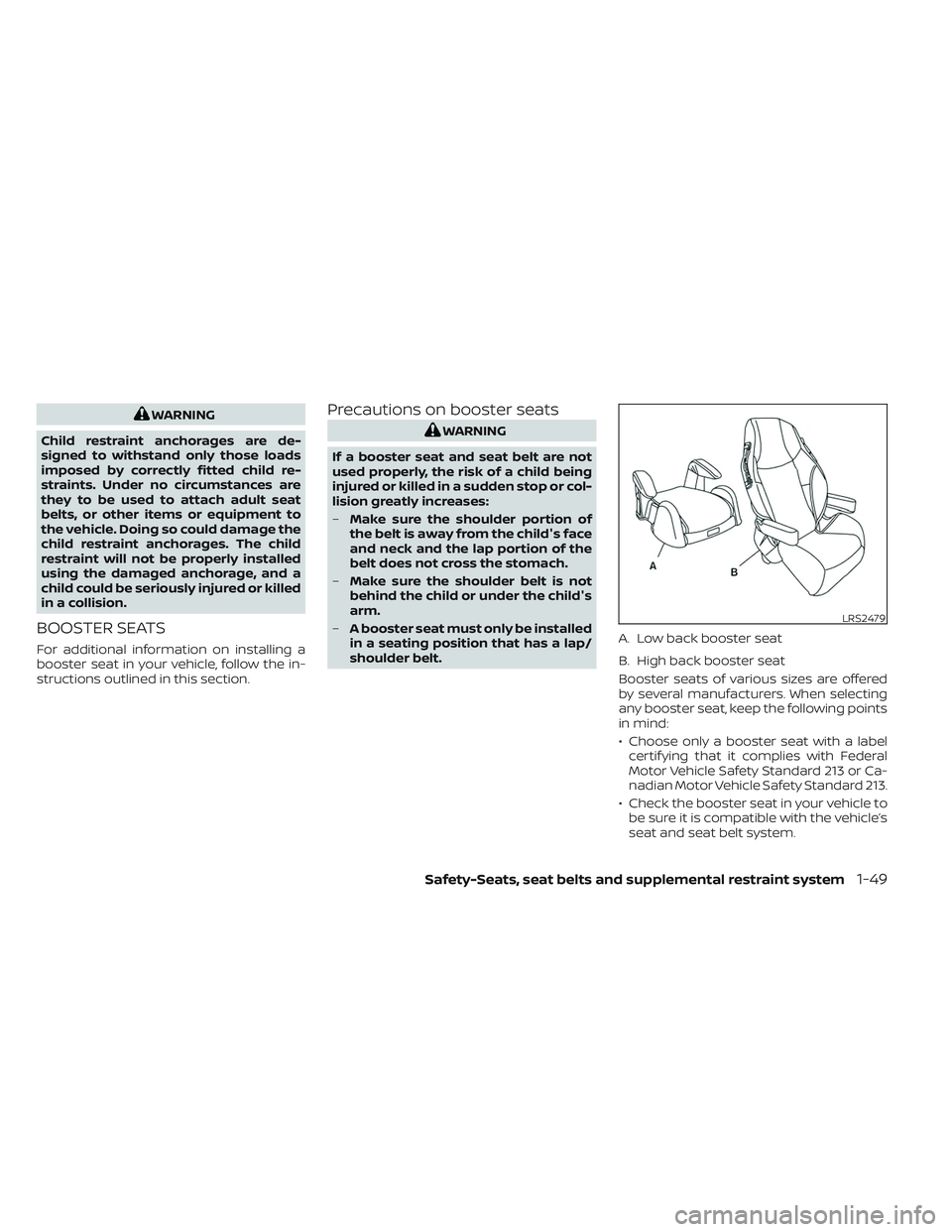
Booster seats of various sizes are offered
by several manufacturers. When selecting
any booster seat, keep the following points
in mind:
• Choose only a booster seat with a labelcertif ying that it complies with Federal
Motor Vehicle Safety Standard 213 or Ca-
nadian Motor Vehicle Safety Standard 213.
• Check the booster seat in your vehicle to be sure it is compatible with the vehicle’s
seat and seat belt system.
LRS2479
A. Low back booster seat
B. High back booster seat
Safety-Seats, seat belts and supplemental restraint system1-49
Page 70 of 635
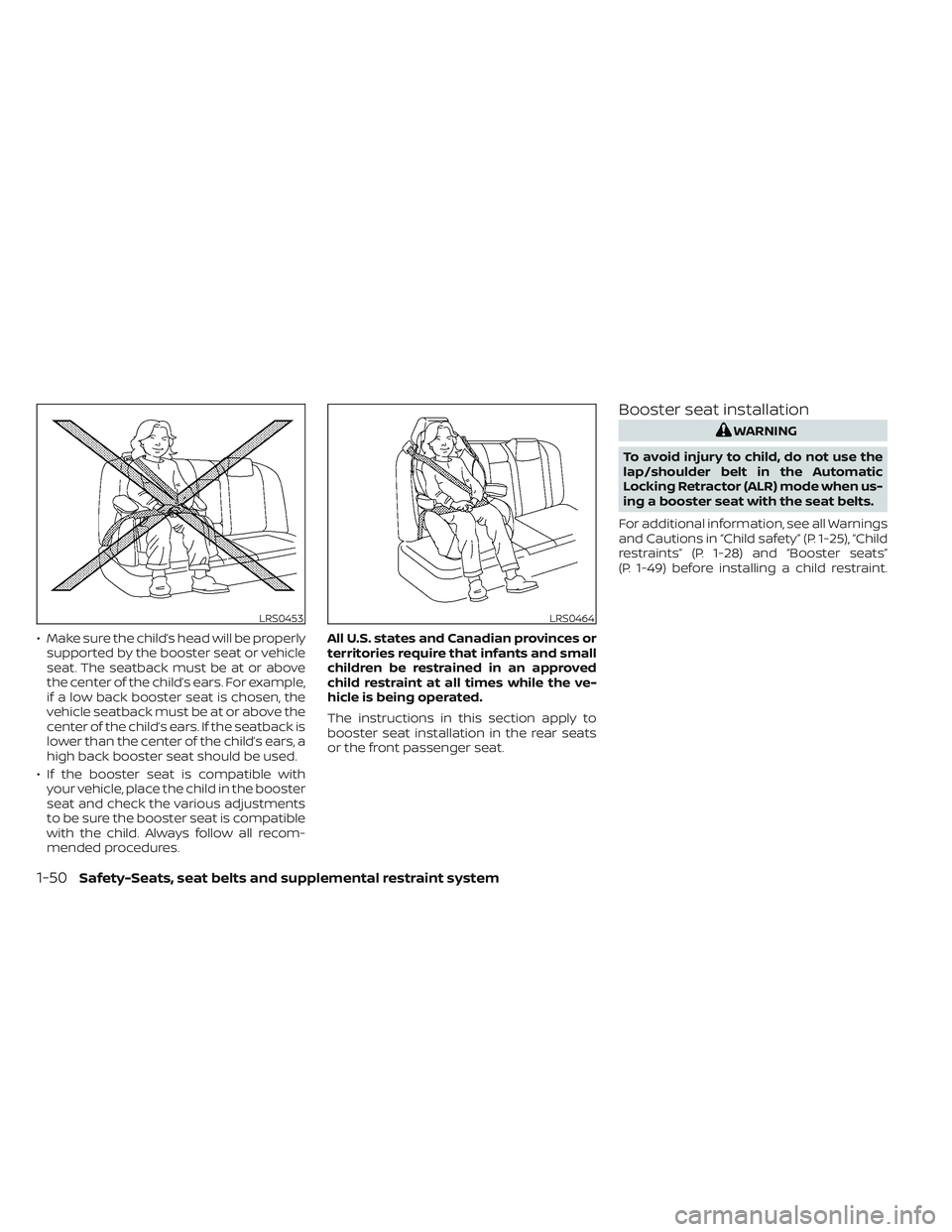
• Make sure the child’s head will be properlysupported by the booster seat or vehicle
seat. The seatback must be at or above
the center of the child’s ears. For example,
if a low back booster seat is chosen, the
vehicle seatback must be at or above the
center of the child’s ears. If the seatback is
lower than the center of the child’s ears, a
high back booster seat should be used.
• If the booster seat is compatible with your vehicle, place the child in the booster
seat and check the various adjustments
to be sure the booster seat is compatible
with the child. Always follow all recom-
mended procedures. All U.S. states and Canadian provinces or
territories require that infants and small
children be restrained in an approved
child restraint at all times while the ve-
hicle is being operated.
The instructions in this section apply to
booster seat installation in the rear seats
or the front passenger seat.
Booster seat installation
WARNING
To avoid injury to child, do not use the
lap/shoulder belt in the Automatic
Locking Retractor (ALR) mode when us-
ing a booster seat with the seat belts.
For additional information, see all Warnings
and Cautions in “Child safety” (P. 1-25), “Child
restraints” (P. 1-28) and “Booster seats”
(P. 1-49) before installing a child restraint.
LRS0453LRS0464
1-50Safety-Seats, seat belts and supplemental restraint system