can NISSAN TITAN 2023 Owners Manual
[x] Cancel search | Manufacturer: NISSAN, Model Year: 2023, Model line: TITAN, Model: NISSAN TITAN 2023Pages: 644, PDF Size: 7.8 MB
Page 570 of 644
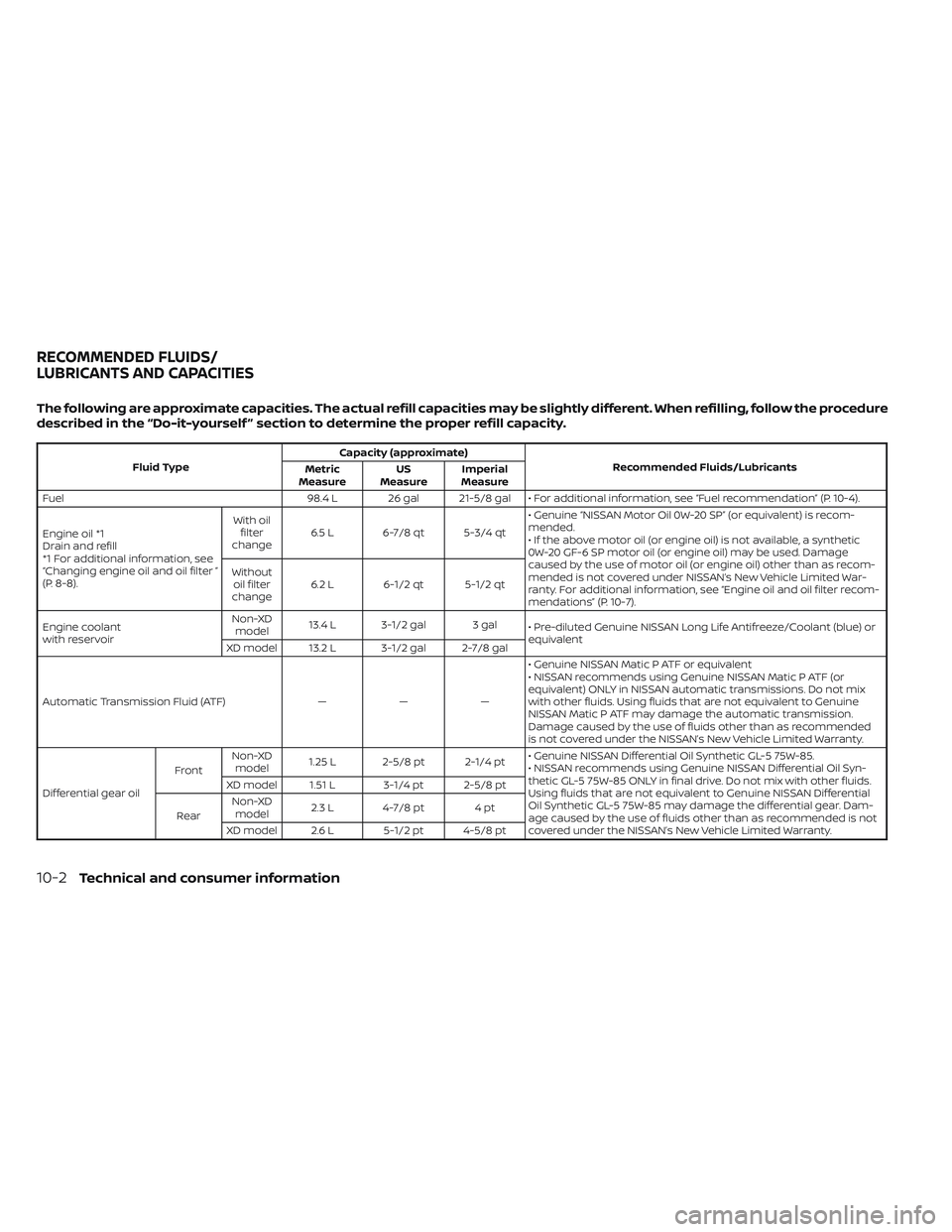
The following are approximate capacities. The actual refill capacities may be slightly different. When refilling, follow the procedure
described in the “Do-it-yourself ” section to determine the proper refill capacity.
Fluid TypeCapacity (approximate)
Recommended Fluids/Lubricants
Metric
Measure US
Measure Imperial
Measure
Fuel 98.4 L 26 gal 21-5/8 gal • For additional information, see “Fuel recommendation” (P. 10-4).
Engine oil *1
Drain and refill
*1 For additional information, see
“Changing engine oil and oil filter ”
(P. 8-8). With oil
filter
change 6.5 L 6-7/8 qt 5-3/4 qt • Genuine “NISSAN Motor Oil 0W-20 SP” (or equivalent) is recom-
mended.
• If the above motor oil (or engine oil) is not available, a synthetic
0W-20 GF-6 SP motor oil (or engine oil) may be used. Damage
caused by the use of motor oil (or engine oil) other than as recom-
mended is not covered under NISSAN’s New Vehicle Limited War-
ranty. For additional information, see “Engine oil and oil filter recom-
mendations” (P. 10-7).
Without
oil filter
change 6.2 L 6-1/2 qt 5-1/2 qt
Engine coolant
with reservoir Non-XD
model 13.4 L 3-1/2 gal 3 gal
• Pre-diluted Genuine NISSAN Long Life Antifreeze/Coolant (blue) or
equivalent
XD model 13.2 L 3-1/2 gal 2-7/8 gal
Automatic Transmission Fluid (ATF) ———• Genuine NISSAN Matic P ATF or equivalent
• NISSAN recommends using Genuine NISSAN Matic P ATF (or
equivalent) ONLY in NISSAN automatic transmissions. Do not mix
with other fluids. Using fluids that are not equivalent to Genuine
NISSAN Matic P ATF may damage the automatic transmission.
Damage caused by the use of fluids other than as recommended
is not covered under the NISSAN’s New Vehicle Limited Warranty.
Differential gear oil Front
Non-XD
model 1.25 L 2-5/8 pt 2-1/4 pt
• Genuine NISSAN Differential Oil Synthetic GL-5 75W-85.
• NISSAN recommends using Genuine NISSAN Differential Oil Syn-
thetic GL-5 75W-85 ONLY in final drive. Do not mix with other fluids.
Using fluids that are not equivalent to Genuine NISSAN Differential
Oil Synthetic GL-5 75W-85 may damage the differential gear. Dam-
age caused by the use of fluids other than as recommended is not
covered under the NISSAN’s New Vehicle Limited Warranty.
XD model 1.51 L 3-1/4 pt 2-5/8 pt
Rear Non-XD
model 2.3 L 4-7/8 pt 4 pt
XD model 2.6 L 5-1/2 pt 4-5/8 pt
RECOMMENDED FLUIDS/
LUBRICANTS AND CAPACITIES
10-2Technical and consumer information
Page 571 of 644
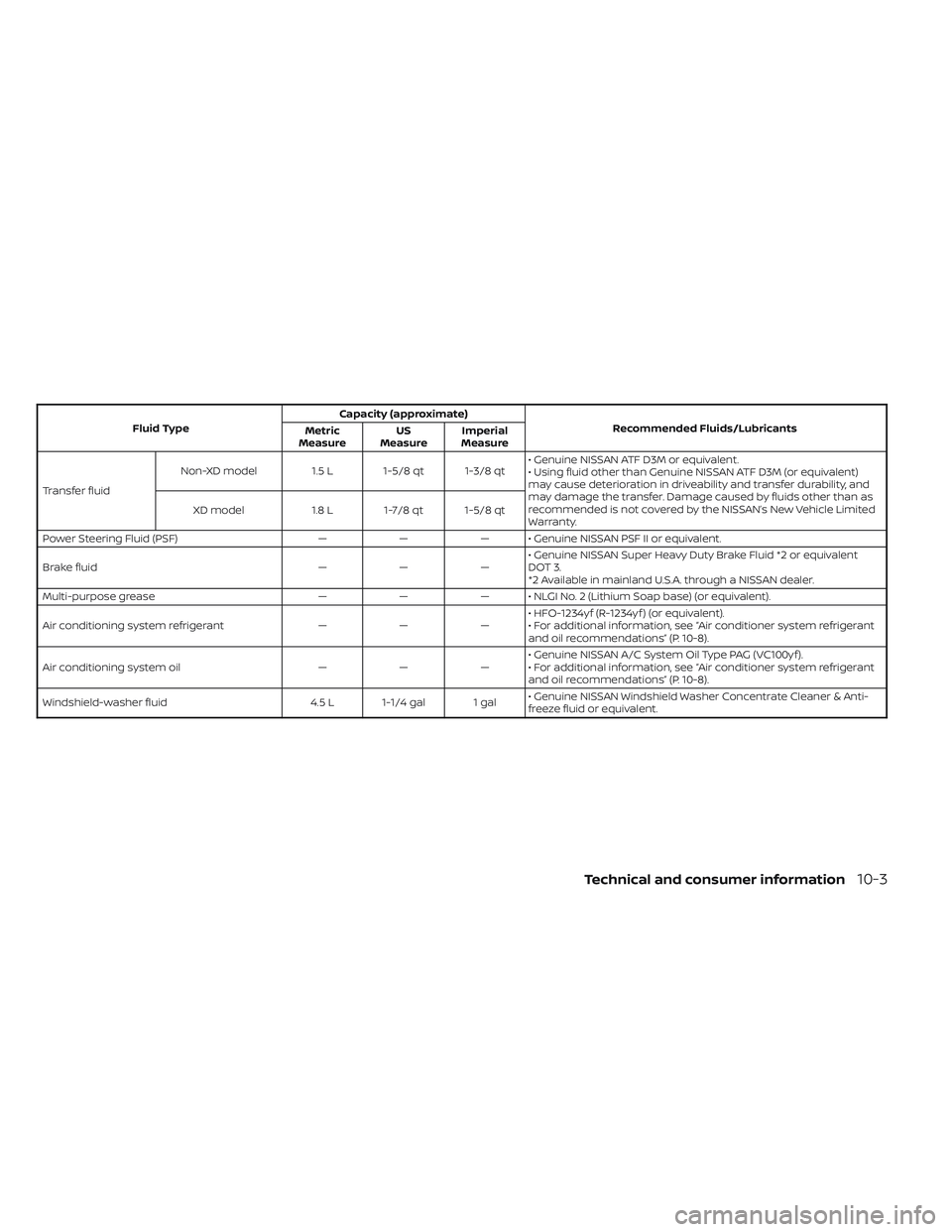
Fluid TypeCapacity (approximate)
Recommended Fluids/Lubricants
Metric
Measure US
Measure Imperial
Measure
Transfer fluid Non-XD model
1.5 L 1-5/8 qt 1-3/8 qt • Genuine NISSAN ATF D3M or equivalent.
• Using fluid other than Genuine NISSAN ATF D3M (or equivalent)
may cause deterioration in driveability and transfer durability, and
may damage the transfer. Damage caused by fluids other than as
recommended is not covered by the NISSAN’s New Vehicle Limited
Warranty.
XD model
1.8 L 1-7/8 qt 1-5/8 qt
Power Steering Fluid (PSF) ——— • Genuine NISSAN PSF II or equivalent.
Brake fluid ———• Genuine NISSAN Super Heavy Duty Brake Fluid *2 or equivalent
DOT 3.
*2 Available in mainland U.S.A. through a NISSAN dealer.
Multi-purpose grease ——— • NLGI No. 2 (Lithium Soap base) (or equivalent).
Air conditioning system refrigerant ———• HFO-1234yf (R-1234yf ) (or equivalent).
• For additional information, see “Air conditioner system refrigerant
and oil recommendations” (P. 10-8).
Air conditioning system oil ———• Genuine NISSAN A/C System Oil Type PAG (VC100yf ).
• For additional information, see “Air conditioner system refrigerant
and oil recommendations” (P. 10-8).
Windshield-washer fluid 4.5 L 1-1/4 gal 1 gal• Genuine NISSAN Windshield Washer Concentrate Cleaner & Anti-
freeze fluid or equivalent.
Technical and consumer information10-3
Page 572 of 644
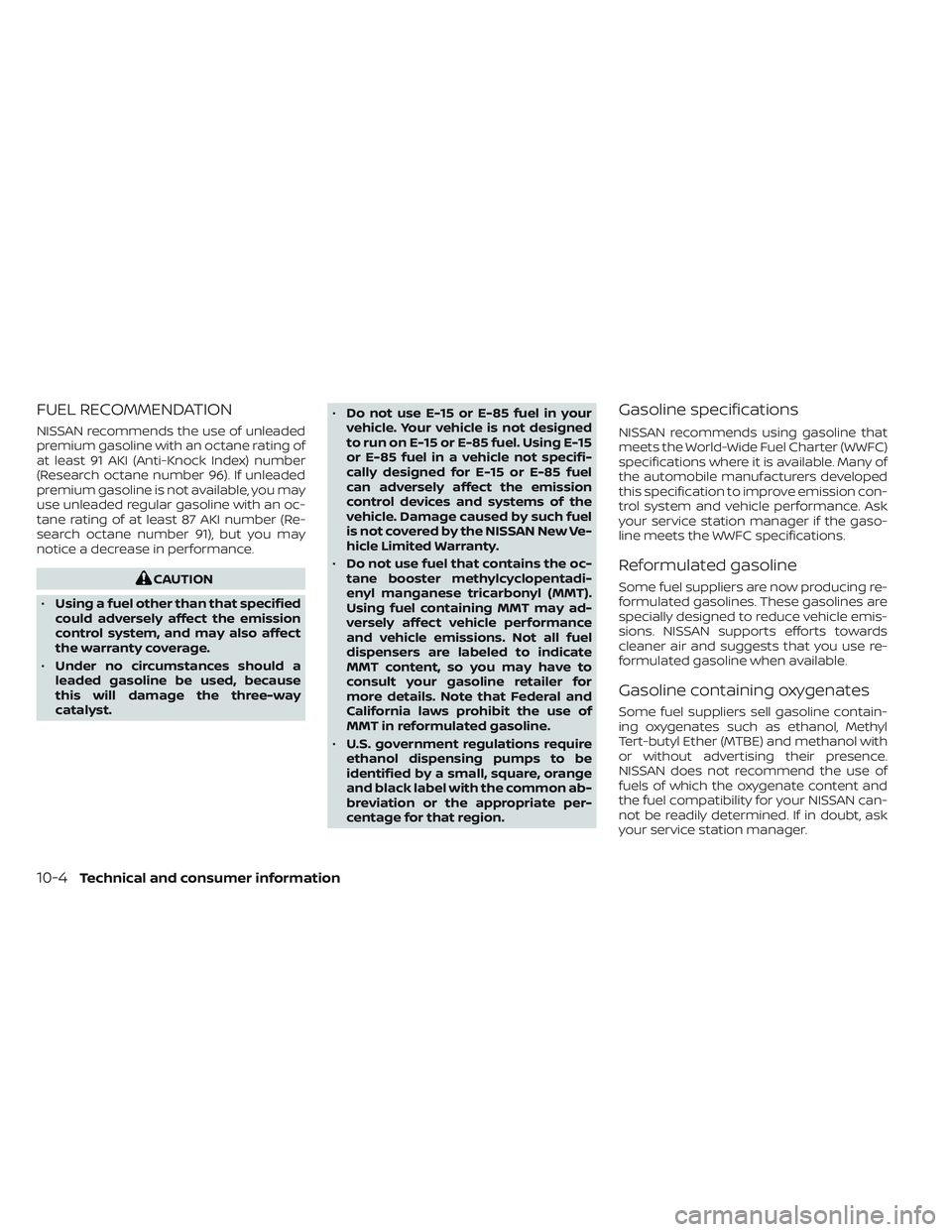
FUEL RECOMMENDATION
NISSAN recommends the use of unleaded
premium gasoline with an octane rating of
at least 91 AKI (Anti-Knock Index) number
(Research octane number 96). If unleaded
premium gasoline is not available, you may
use unleaded regular gasoline with an oc-
tane rating of at least 87 AKI number (Re-
search octane number 91), but you may
notice a decrease in performance.
CAUTION
• Using a fuel other than that specified
could adversely affect the emission
control system, and may also affect
the warranty coverage.
• Under no circumstances should a
leaded gasoline be used, because
this will damage the three-way
catalyst. •
Do not use E-15 or E-85 fuel in your
vehicle. Your vehicle is not designed
to run on E-15 or E-85 fuel. Using E-15
or E-85 fuel in a vehicle not specifi-
cally designed for E-15 or E-85 fuel
can adversely affect the emission
control devices and systems of the
vehicle. Damage caused by such fuel
is not covered by the NISSAN New Ve-
hicle Limited Warranty.
• Do not use fuel that contains the oc-
tane booster methylcyclopentadi-
enyl manganese tricarbonyl (MMT).
Using fuel containing MMT may ad-
versely affect vehicle performance
and vehicle emissions. Not all fuel
dispensers are labeled to indicate
MMT content, so you may have to
consult your gasoline retailer for
more details. Note that Federal and
California laws prohibit the use of
MMT in reformulated gasoline.
• U.S. government regulations require
ethanol dispensing pumps to be
identified by a small, square, orange
and black label with the common ab-
breviation or the appropriate per-
centage for that region.
Gasoline specifications
NISSAN recommends using gasoline that
meets the World-Wide Fuel Charter (WWFC)
specifications where it is available. Many of
the automobile manufacturers developed
this specification to improve emission con-
trol system and vehicle performance. Ask
your service station manager if the gaso-
line meets the WWFC specifications.
Reformulated gasoline
Some fuel suppliers are now producing re-
formulated gasolines. These gasolines are
specially designed to reduce vehicle emis-
sions. NISSAN supports efforts towards
cleaner air and suggests that you use re-
formulated gasoline when available.
Gasoline containing oxygenates
Some fuel suppliers sell gasoline contain-
ing oxygenates such as ethanol, Methyl
Tert-butyl Ether (MTBE) and methanol with
or without advertising their presence.
NISSAN does not recommend the use of
fuels of which the oxygenate content and
the fuel compatibility for your NISSAN can-
not be readily determined. If in doubt, ask
your service station manager.
10-4Technical and consumer information
Page 573 of 644
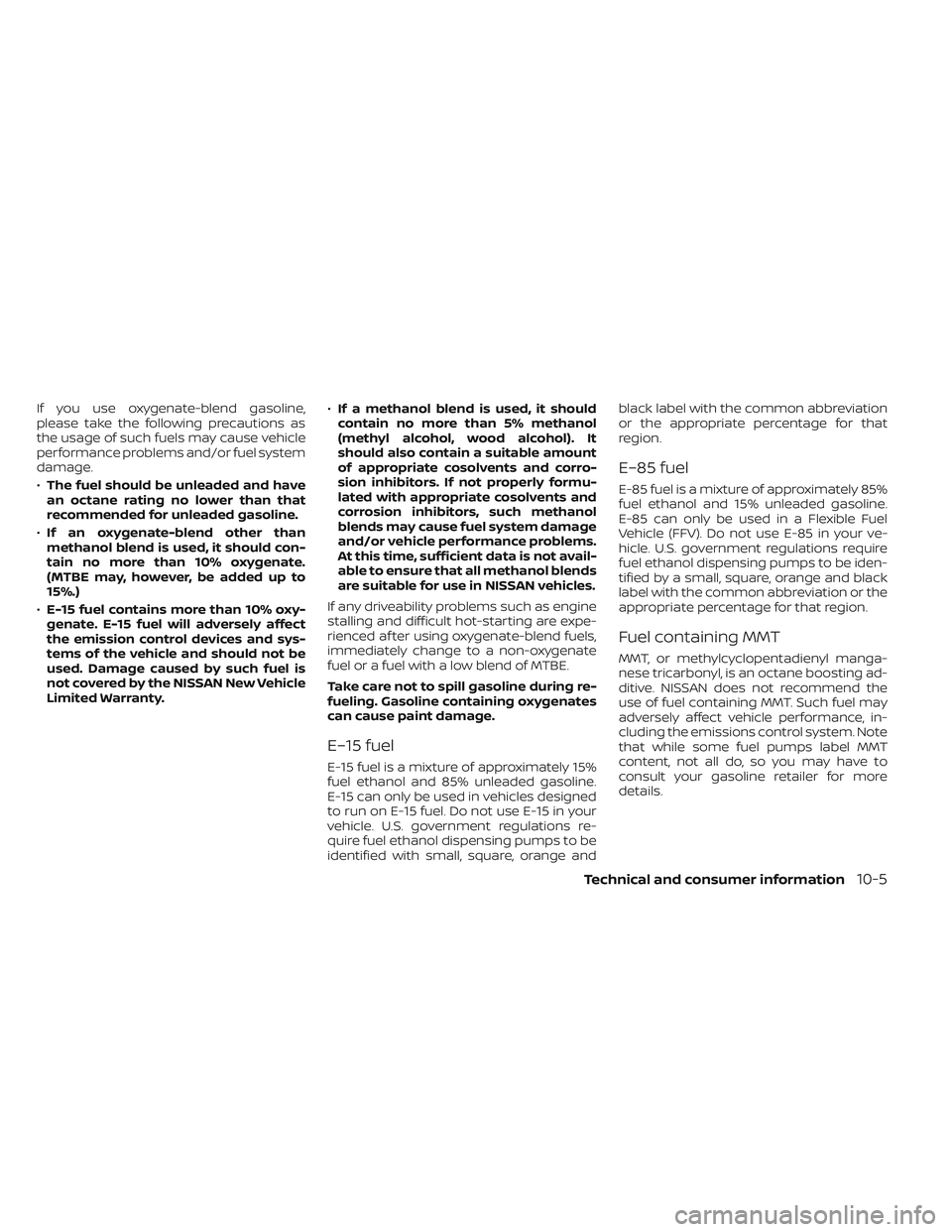
If you use oxygenate-blend gasoline,
please take the following precautions as
the usage of such fuels may cause vehicle
performance problems and/or fuel system
damage.
•The fuel should be unleaded and have
an octane rating no lower than that
recommended for unleaded gasoline.
• If an oxygenate-blend other than
methanol blend is used, it should con-
tain no more than 10% oxygenate.
(MTBE may, however, be added up to
15%.)
• E-15 fuel contains more than 10% oxy-
genate. E-15 fuel will adversely affect
the emission control devices and sys-
tems of the vehicle and should not be
used. Damage caused by such fuel is
not covered by the NISSAN New Vehicle
Limited Warranty. •
If a methanol blend is used, it should
contain no more than 5% methanol
(methyl alcohol, wood alcohol). It
should also contain a suitable amount
of appropriate cosolvents and corro-
sion inhibitors. If not properly formu-
lated with appropriate cosolvents and
corrosion inhibitors, such methanol
blends may cause fuel system damage
and/or vehicle performance problems.
At this time, sufficient data is not avail-
able to ensure that all methanol blends
are suitable for use in NISSAN vehicles.
If any driveability problems such as engine
stalling and difficult hot-starting are expe-
rienced af ter using oxygenate-blend fuels,
immediately change to a non-oxygenate
fuel or a fuel with a low blend of MTBE.
Take care not to spill gasoline during re-
fueling. Gasoline containing oxygenates
can cause paint damage.
E–15 fuel
E-15 fuel is a mixture of approximately 15%
fuel ethanol and 85% unleaded gasoline.
E-15 can only be used in vehicles designed
to run on E-15 fuel. Do not use E-15 in your
vehicle. U.S. government regulations re-
quire fuel ethanol dispensing pumps to be
identified with small, square, orange and black label with the common abbreviation
or the appropriate percentage for that
region.
E–85 fuel
E-85 fuel is a mixture of approximately 85%
fuel ethanol and 15% unleaded gasoline.
E-85 can only be used in a Flexible Fuel
Vehicle (FFV). Do not use E-85 in your ve-
hicle. U.S. government regulations require
fuel ethanol dispensing pumps to be iden-
tified by a small, square, orange and black
label with the common abbreviation or the
appropriate percentage for that region.
Fuel containing MMT
MMT, or methylcyclopentadienyl manga-
nese tricarbonyl, is an octane boosting ad-
ditive. NISSAN does not recommend the
use of fuel containing MMT. Such fuel may
adversely affect vehicle performance, in-
cluding the emissions control system. Note
that while some fuel pumps label MMT
content, not all do, so you may have to
consult your gasoline retailer for more
details.
Technical and consumer information10-5
Page 574 of 644
Af termarket fuel additives
NISSAN does not recommend the use of
any af termarket fuel additives (for ex-
ample, fuel injector cleaner, octane
booster, intake valve deposit removers,
etc.) which are sold commercially. Many of
these additives intended for gum, varnish
or deposit removal may contain active sol-
vents or similar ingredients that can be
harmful to the fuel system and engine.
Octane rating tips
Using unleaded gasoline with an octane
rating lower than recommended can
cause persistent, heavy “spark knock.”
(“Spark knock” is a metallic rapping
noise.) If severe, this can lead to engine
damage. If you detect a persistent heavy
spark knock even when using gasoline
of the stated octane rating, or if you hear
steady spark knock while holding a
steady speed on level roads, it is recom-
mended that you have a NISSAN dealer
correct the condition. Failure to correct
the condition is misuse of the vehicle, for
which NISSAN is not responsible.Incorrect ignition timing may result in
spark knock, af ter-run and/or overheating,
which may cause excessive fuel consump-
tion or engine damage. If any of the above
symptoms are encountered, have your ve-
hicle checked. It is recommended that you
visit a NISSAN dealer for servicing.
However, now and then you may notice
light spark knock for a short time while
accelerating or driving up hills. This is not
a cause for concern, because you get the
greatest fuel benefit when there is light
spark knock for a short time under heavy
engine load.
10-6Technical and consumer information
Page 575 of 644
ENGINE OIL AND OIL FILTER
RECOMMENDATIONS
Selecting the correct oil
It is essential to choose the correct grade,
quality and viscosity engine oil to ensure
satisfactory engine life and performance.
For additional information, see “Recom-
mended fluids/lubricants and capacities”
(P. 10-2). NISSAN recommends the use of an
energy conserving oil in order to improve
fuel economy.Select only engine oils that meet the
American Petroleum Institute (API) certifi-
cation or International Lubricant Standard-
ization and Approval Committee (ILSAC)
certification and SAE viscosity standard.
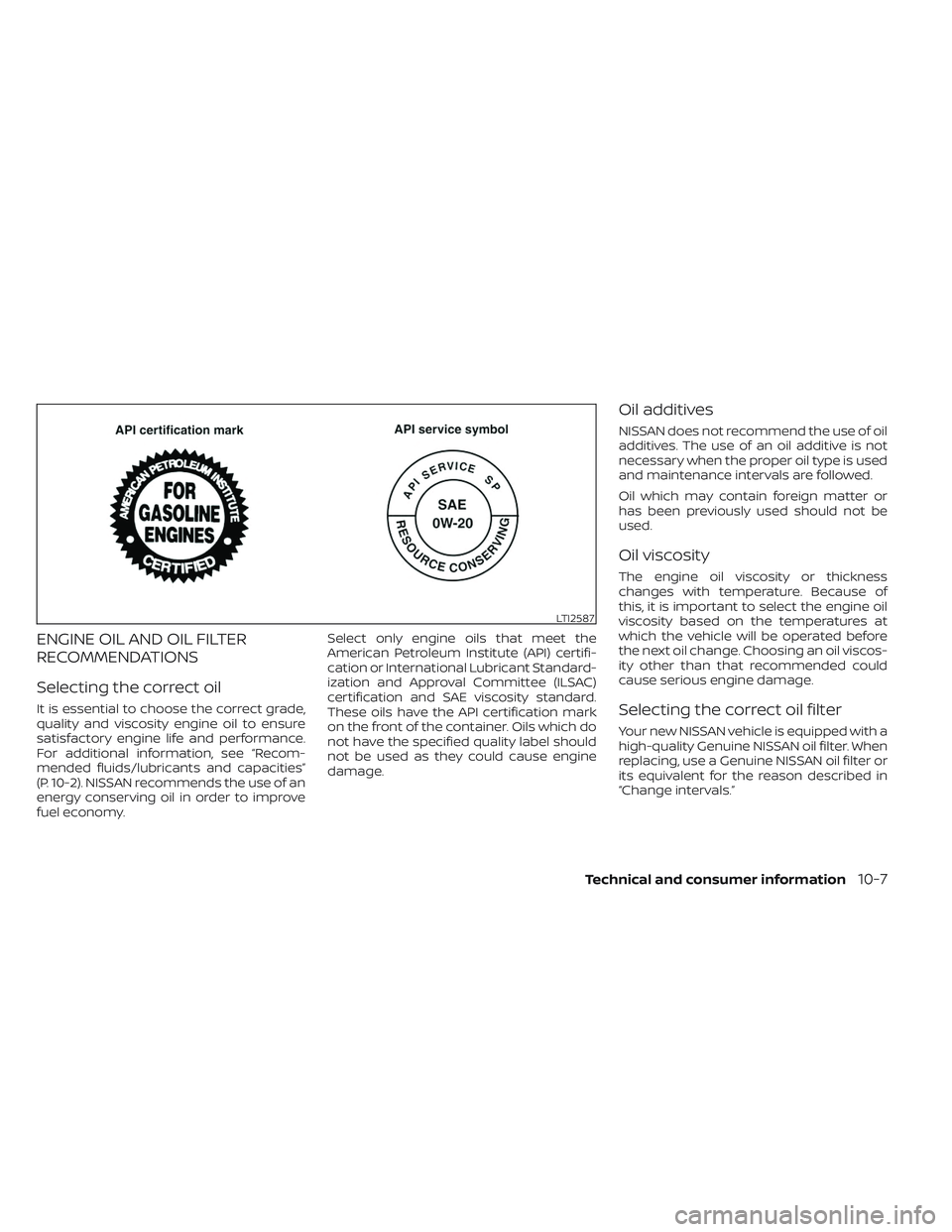
These oils have the API certification mark
on the front of the container. Oils which do
not have the specified quality label should
not be used as they could cause engine
damage.
Oil additives
NISSAN does not recommend the use of oil
additives. The use of an oil additive is not
necessary when the proper oil type is used
and maintenance intervals are followed.
Oil which may contain foreign matter or
has been previously used should not be
used.
Oil viscosity
The engine oil viscosity or thickness
changes with temperature. Because of
this, it is important to select the engine oil
viscosity based on the temperatures at
which the vehicle will be operated before
the next oil change. Choosing an oil viscos-
ity other than that recommended could
cause serious engine damage.
Selecting the correct oil filter
Your new NISSAN vehicle is equipped with a
high-quality Genuine NISSAN oil filter. When
replacing, use a Genuine NISSAN oil filter or
its equivalent for the reason described in
“Change intervals.”
LTI2587
Technical and consumer information10-7
Page 584 of 644
ENGINE SERIAL NUMBER
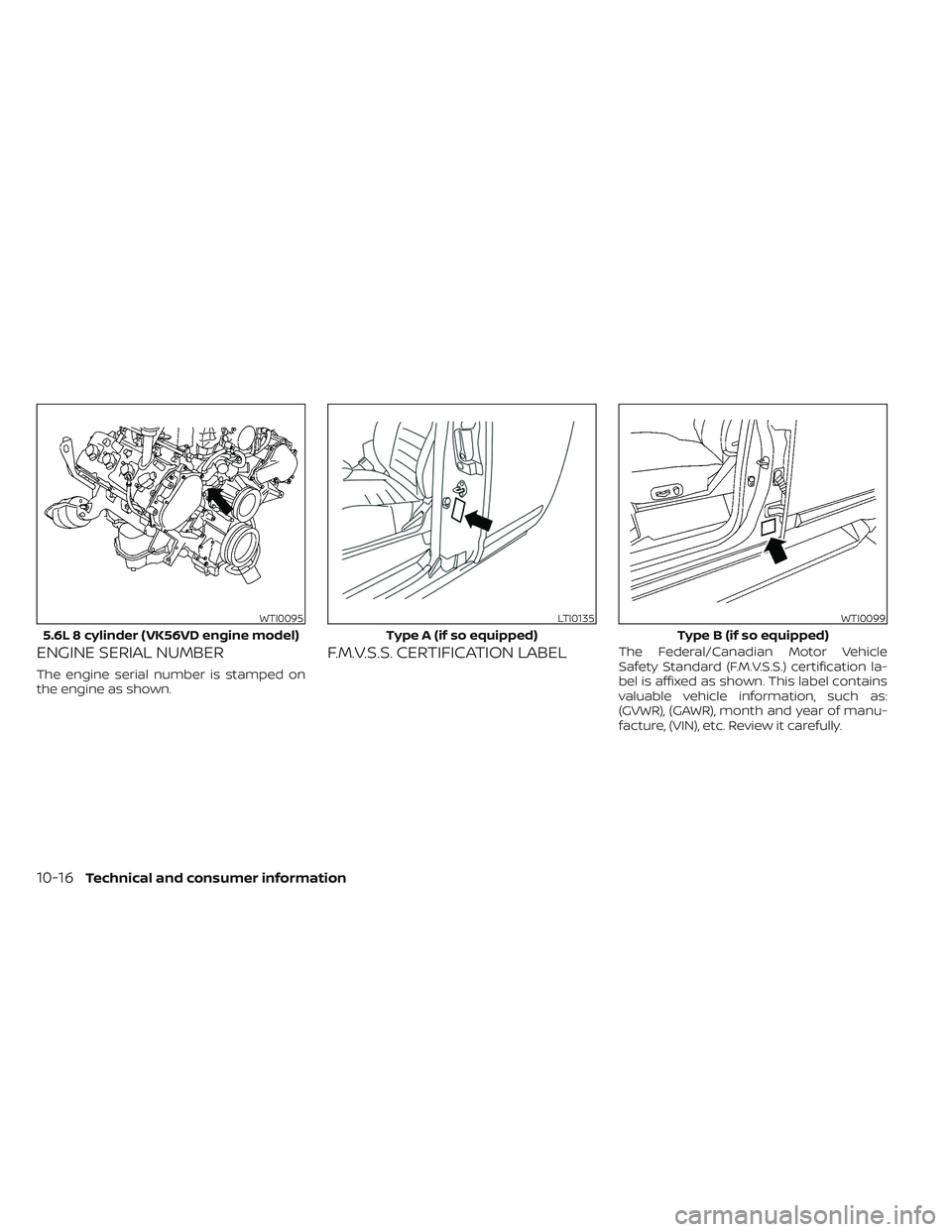
The engine serial number is stamped on
the engine as shown.
F.M.V.S.S. CERTIFICATION LABELThe Federal/Canadian Motor Vehicle
Safety Standard (F.M.V.S.S.) certification la-
bel is affixed as shown. This label contains
valuable vehicle information, such as:
(GVWR), (GAWR), month and year of manu-
facture, (VIN), etc. Review it carefully.
WTI0095
5.6L 8 cylinder (VK56VD engine model)
LTI0135
Type A (if so equipped)
WTI0099
Type B (if so equipped)
10-16Technical and consumer information
Page 587 of 644
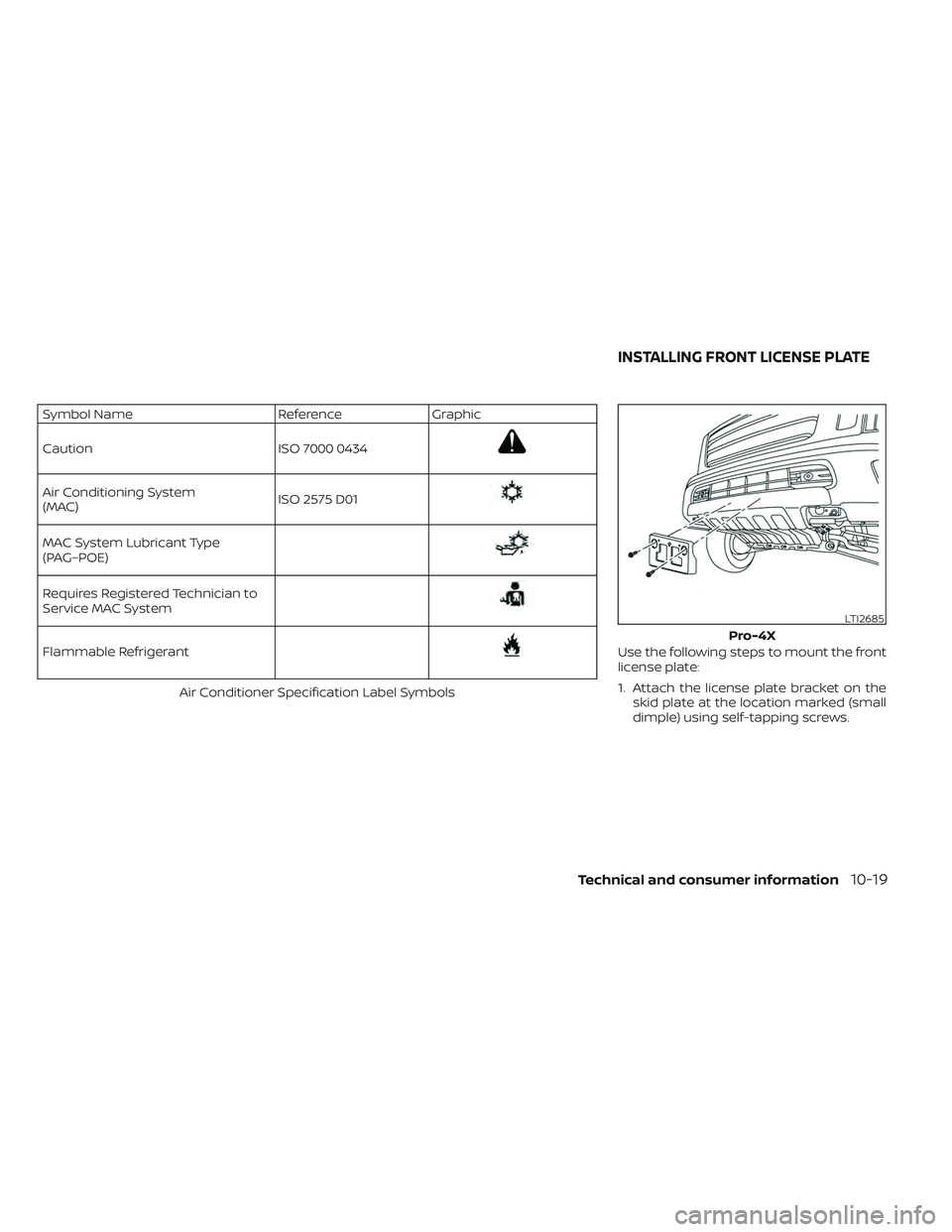
Symbol NameReferenceGraphic
Caution ISO 7000 0434
Air Conditioning System
(MAC)ISO 2575 D01
MAC System Lubricant Type
(PAG–POE)
Requires Registered Technician to
Service MAC System
Flammable Refrigerant
Air Conditioner Specification Label Symbols Use the following steps to mount the front
license plate:
1. Attach the license plate bracket on the
skid plate at the location marked (small
dimple) using self-tapping screws.
LTI2685
Pro-4X
INSTALLING FRONT LICENSE PLATE
Technical and consumer information10-19
Page 589 of 644
TERMS
It is important to familiarize yourself
with the following terms before
loading your vehicle:
• Curb Weight (actual weight of yourvehicle) - vehicle weight including:
standard and optional equipment,
fluids, emergency tools, and spare
tire assembly. This weight does
not include passengers and cargo.
• GVW (Gross Vehicle Weight) - curb weight plus the combined weight
of passengers and cargo.
• GVWR (Gross Vehicle Weight Rat- ing) - maximum total combined
weight of the unloaded vehicle,
passengers, cargo, hitch, trailer
tongue load and any other op-
tional equipment. This information
is located on the F.M.V.S.S. certifica-
tion label. • GAWR (Gross Axle Weight Rating) -
maximum weight (load) limit
specified for the front or rear axle.
This information is located on the
F.M.V.S.S. certification label.
• GCWR (Gross Combined Weight Rating) - The maximum total
weight rating of the vehicle, pas-
sengers, cargo, and trailer.
• Vehicle Capacity Weight, Load limit, Total load capacity - maximum to-
tal weight limit specified of the load
(passengers and cargo) for the ve-
hicle. This is the maximum com-
bined weight of occupants and
cargo that can be loaded into the
vehicle. If the vehicle is used to tow
a trailer, the trailer tongue weight
must be included as part of the
cargo load. This information is lo-
cated on the Tire and Loading In-
formation label. • Cargo capacity - permissible
weight of cargo, the subtracted
weight of occupants from the load
limit.
VEHICLE LOAD CAPACITY
Before driving a loaded vehicle, con-
firm that you do not exceed the
Gross Vehicle Weight Rating (GVWR)
or the Gross Axle Weight Rating
(GAWR) for your vehicle. Both the
GVWR and GAWR are located on the
F.M.V.S.S. certification label. For addi-
tional information, see “Measure-
ment of weights” (P. 10-29).
Do not exceed the load limit of your
vehicle shown as “The combined
weight of occupants and cargo” on
the Tire and Loading Information la-
bel. Do not exceed the number of
occupants shown as “Seating Ca-
pacity” on the Tire and Loading Infor-
mation label.
Technical and consumer information10-21
Page 592 of 644
WARNING
• Properly secure all cargo with ropes
or straps to help prevent it from slid-
ing or shif ting. Do not place cargo
higher than the seatbacks. In a sud-
den stop or collision, unsecured
cargo could cause personal injury.
• Do not load your vehicle any heavier
than the GVWR or the maximum front
and rear GAWRs. If you do, parts of
your vehicle can break, tire damage
could occur, or it can change the way
your vehicle handles. This could re-
sult in loss of control and cause per-
sonal injury.
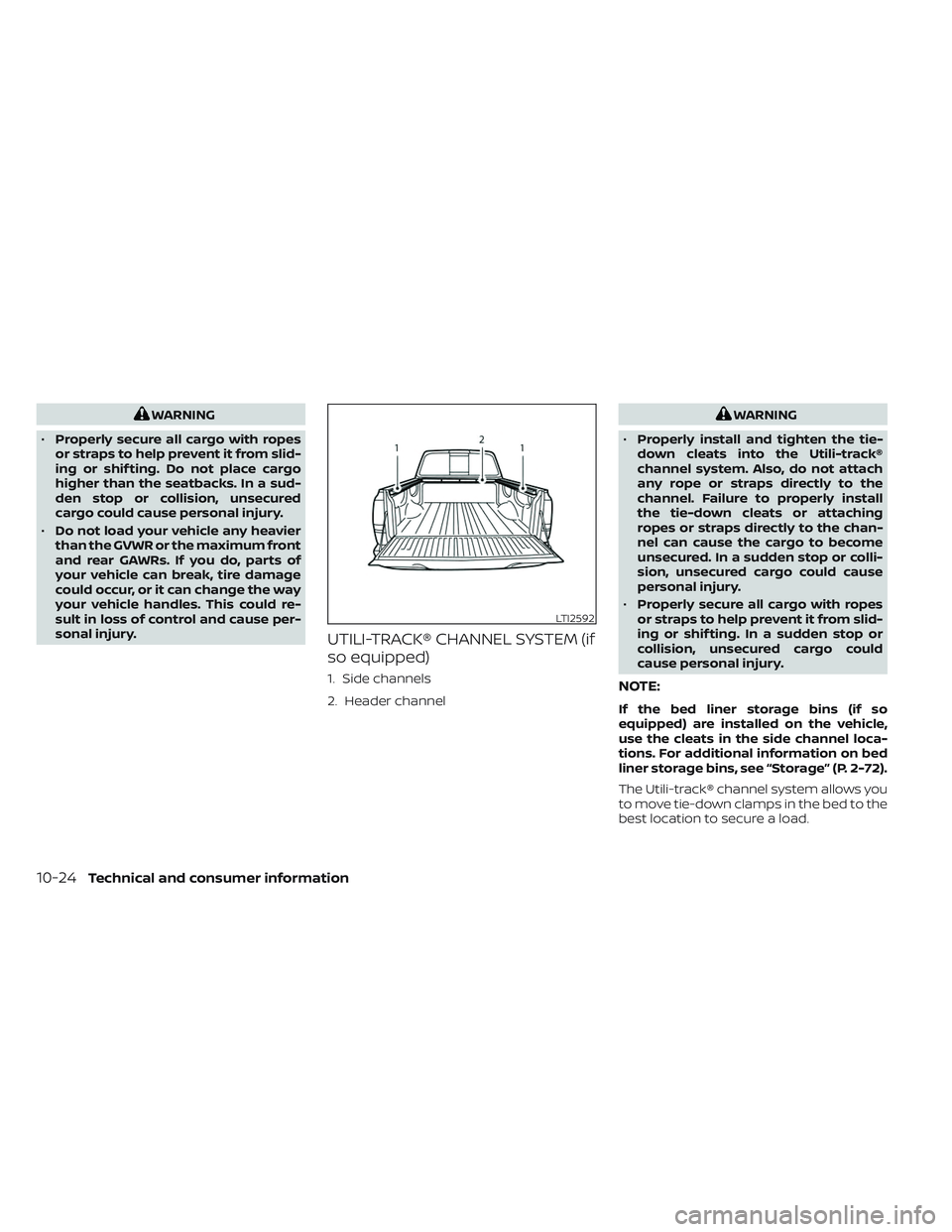
UTILI-TRACK® CHANNEL SYSTEM (if
so equipped)
1. Side channels
2. Header channel
WARNING
• Properly install and tighten the tie-
down cleats into the Utili-track®
channel system. Also, do not attach
any rope or straps directly to the
channel. Failure to properly install
the tie-down cleats or attaching
ropes or straps directly to the chan-
nel can cause the cargo to become
unsecured. In a sudden stop or colli-
sion, unsecured cargo could cause
personal injury.
• Properly secure all cargo with ropes
or straps to help prevent it from slid-
ing or shif ting. In a sudden stop or
collision, unsecured cargo could
cause personal injury.
NOTE:
If the bed liner storage bins (if so
equipped) are installed on the vehicle,
use the cleats in the side channel loca-
tions. For additional information on bed
liner storage bins, see “Storage” (P. 2-72).
The Utili-track® channel system allows you
to move tie-down clamps in the bed to the
best location to secure a load.
LTI2592
10-24Technical and consumer information