can NISSAN TITAN 2023 Owners Manual
[x] Cancel search | Manufacturer: NISSAN, Model Year: 2023, Model line: TITAN, Model: NISSAN TITAN 2023Pages: 644, PDF Size: 7.8 MB
Page 593 of 644
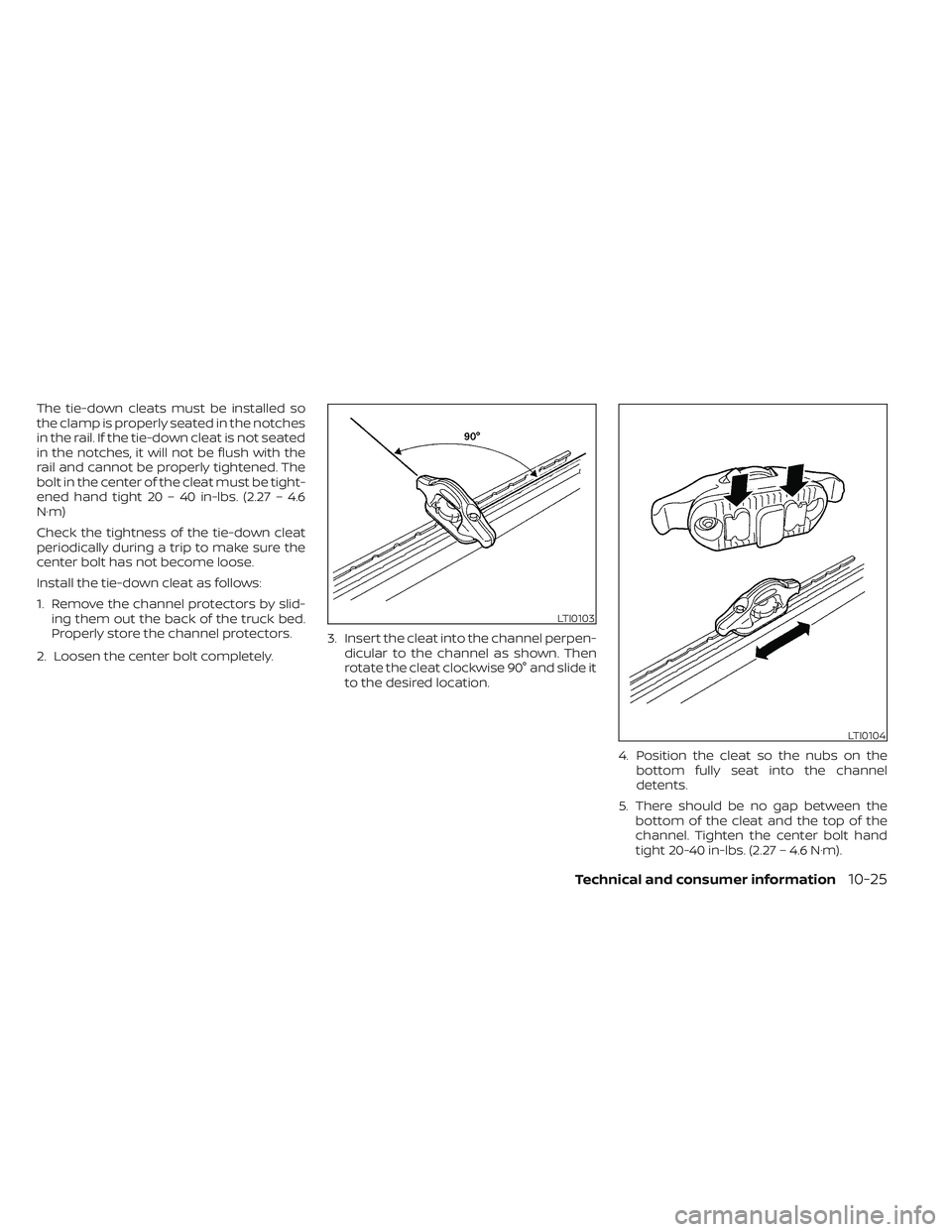
The tie-down cleats must be installed so
the clamp is properly seated in the notches
in the rail. If the tie-down cleat is not seated
in the notches, it will not be flush with the
rail and cannot be properly tightened. The
bolt in the center of the cleat must be tight-
ened hand tight 20 – 40 in-lbs. (2.27 – 4.6
N·m)
Check the tightness of the tie-down cleat
periodically during a trip to make sure the
center bolt has not become loose.
Install the tie-down cleat as follows:
1. Remove the channel protectors by slid-ing them out the back of the truck bed.
Properly store the channel protectors.
2. Loosen the center bolt completely. 3. Insert the cleat into the channel perpen-
dicular to the channel as shown. Then
rotate the cleat clockwise 90° and slide it
to the desired location.
4. Position the cleat so the nubs on thebottom fully seat into the channel
detents.
5. There should be no gap between the bottom of the cleat and the top of the
channel. Tighten the center bolt hand
tight 20-40 in-lbs. (2.27 – 4.6 N·m).
LTI0103
LTI0104
Technical and consumer information10-25
Page 597 of 644
LOADING TIPS
• The GVW must not exceed GVWR orGAWR as specified on the F.M.V.S.S.
certification label.
• Do not load the front and rear axle to the GAWR. Doing so will exceed
the GVWR.
WARNING
• Properly secure all cargo with
ropes or straps to help prevent
it from sliding or shif ting. Do
not place cargo higher than the
seatbacks. In a sudden stop or
collision, unsecured cargo
could cause personal injury. •
Do not load your vehicle any
heavier than the GVWR or the
maximum front and rear
GAWRs. If you do, parts of your
vehicle can break, tire damage
could occur, or it can change
the way your vehicle handles.
This could result in loss of con-
trol and cause personal injury.
• Overloading not only can
shorten the life of your vehicle
and the tire, but can also cause
unsafe vehicle handling and
longer braking distances. This
may cause a premature tire
failure which could result in a
serious accident and personal
injury. Failures caused by over-
loading are not covered by the
vehicle’s warranty.
MEASUREMENT OF WEIGHTS
Secure loose items to prevent
weight shif ts that could affect the
balance of your vehicle. When the ve-
hicle is loaded, drive to a scale and
weigh the front and the rear wheels
separately to determine axle loads.
Individual axle loads should not ex-
ceed either of the Gross Axle Weight
Ratings (GAWR). The total of the axle
loads should not exceed the Gross
Vehicle Weight Rating (GVWR). These
ratings are given on the vehicle cer-
tification label. If weight ratings are
exceeded, move or remove items to
bring all weights below the ratings.
Technical and consumer information10-29
Page 598 of 644
CREW CAB MODELS
Crew Cab short wheel base models
should not be used to carry a slide-in
camper.
KING CAB® MODELS
This information is provided for you to
properly install a slide-in camper and is
based on the National Highway Traffic
Safety Administration regulations. It is rec-
ommended that, before installing the
camper, you carefully read the following in-
formation and ensure that the camper
meets the specifications.
This information may not apply to some
Canada model vehicles.
SPECIAL BODY VEHICLES
Some vehicles are equipped with commer-
cial or camper bodies. However, this Own-
er's Manual does not cover these options.
For additional information, refer to the
body manufacturer's instruction manual.
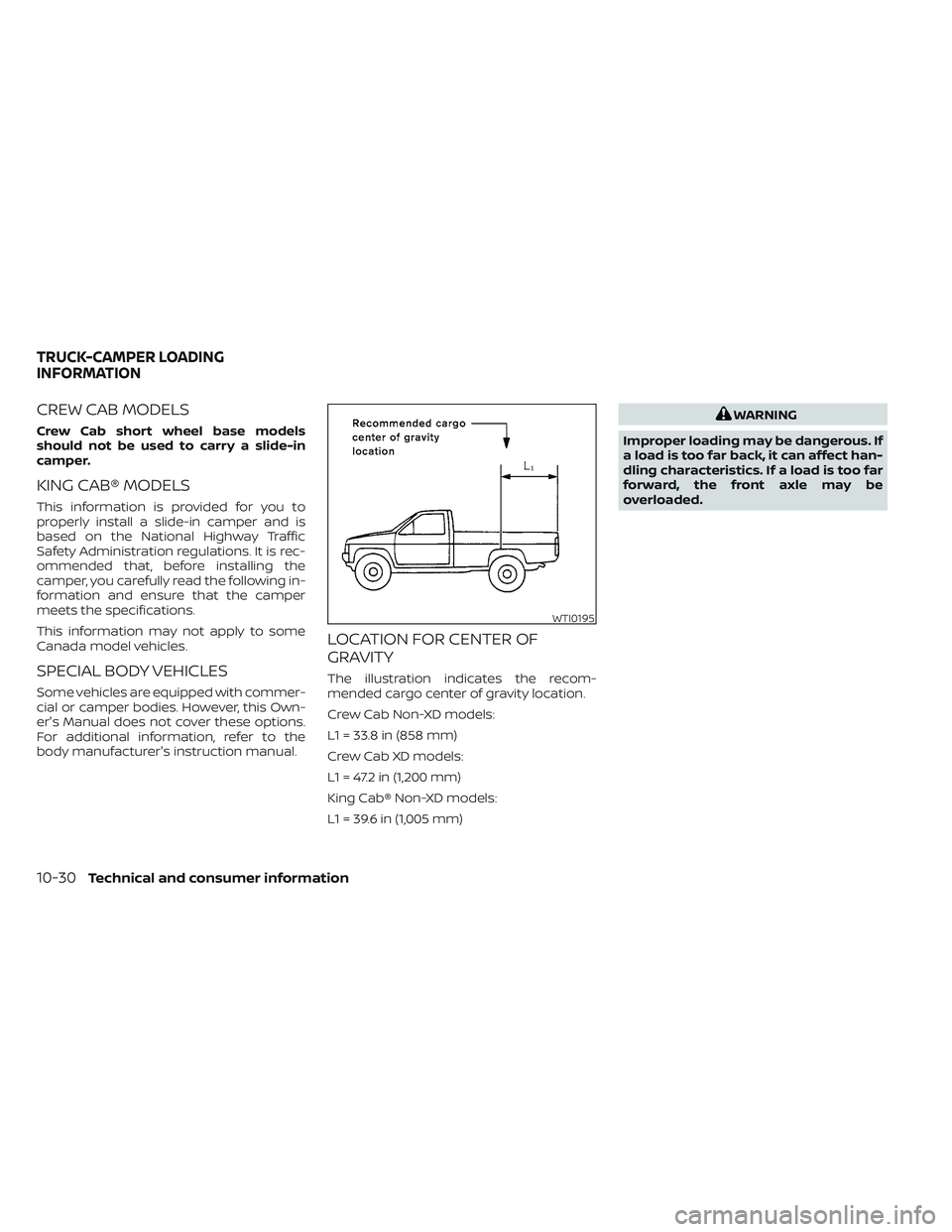
LOCATION FOR CENTER OF
GRAVITY
The illustration indicates the recom-
mended cargo center of gravity location.
Crew Cab Non-XD models:
L1 = 33.8 in (858 mm)
Crew Cab XD models:
L1 = 47.2 in (1,200 mm)
King Cab® Non-XD models:
L1 = 39.6 in (1,005 mm)
WARNING
Improper loading may be dangerous. If
a load is too far back, it can affect han-
dling characteristics. If a load is too far
forward, the front axle may be
overloaded.
WTI0195
TRUCK-CAMPER LOADING
INFORMATION
10-30Technical and consumer information
Page 599 of 644
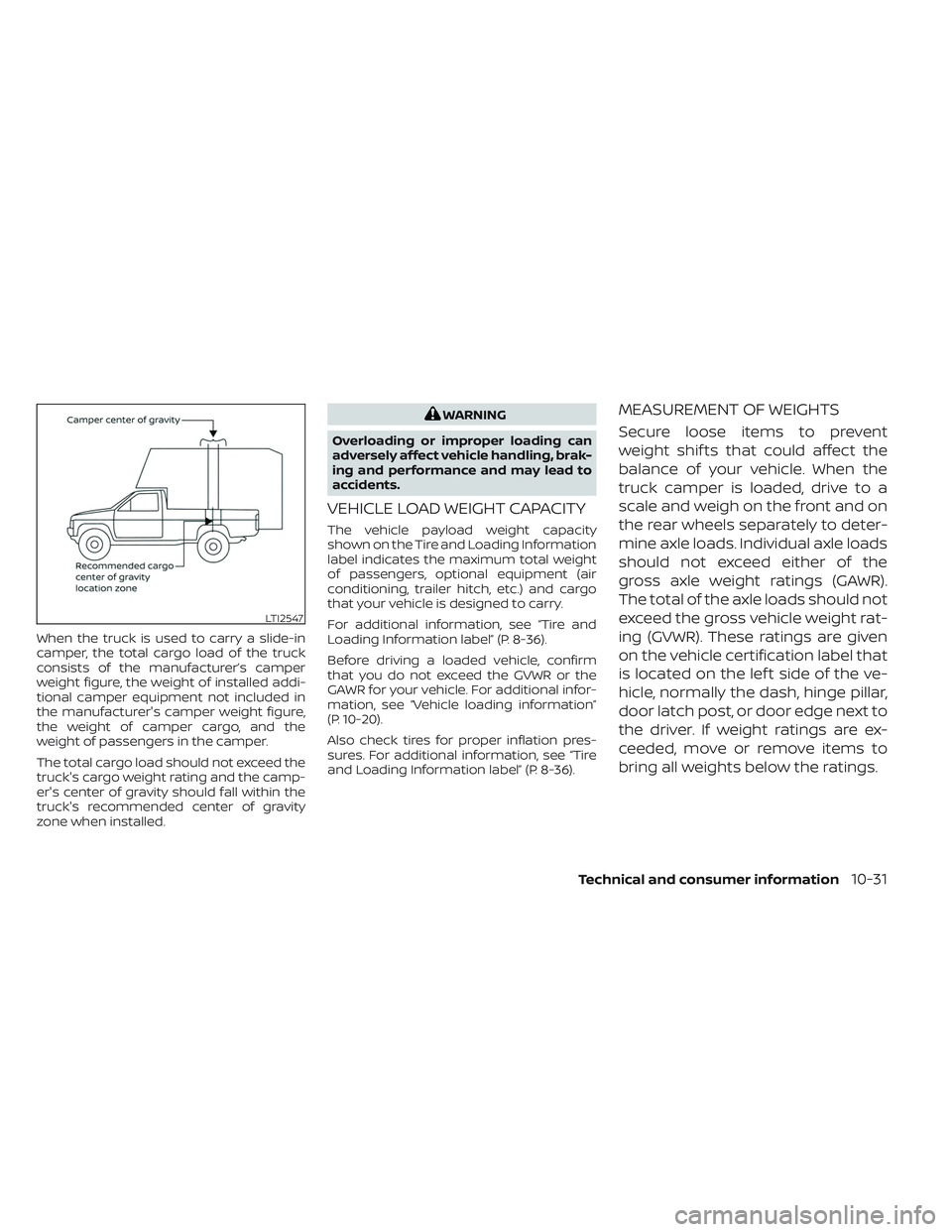
When the truck is used to carry a slide-in
camper, the total cargo load of the truck
consists of the manufacturer’s camper
weight figure, the weight of installed addi-
tional camper equipment not included in
the manufacturer's camper weight figure,
the weight of camper cargo, and the
weight of passengers in the camper.
The total cargo load should not exceed the
truck's cargo weight rating and the camp-
er's center of gravity should fall within the
truck's recommended center of gravity
zone when installed.
WARNING
Overloading or improper loading can
adversely affect vehicle handling, brak-
ing and performance and may lead to
accidents.
VEHICLE LOAD WEIGHT CAPACITY
The vehicle payload weight capacity
shown on the Tire and Loading Information
label indicates the maximum total weight
of passengers, optional equipment (air
conditioning, trailer hitch, etc.) and cargo
that your vehicle is designed to carry.
For additional information, see “Tire and
Loading Information label” (P. 8-36).
Before driving a loaded vehicle, confirm
that you do not exceed the GVWR or the
GAWR for your vehicle. For additional infor-
mation, see “Vehicle loading information”
(P. 10-20).
Also check tires for proper inflation pres-
sures. For additional information, see “Tire
and Loading Information label” (P. 8-36).
MEASUREMENT OF WEIGHTS
Secure loose items to prevent
weight shif ts that could affect the
balance of your vehicle. When the
truck camper is loaded, drive to a
scale and weigh on the front and on
the rear wheels separately to deter-
mine axle loads. Individual axle loads
should not exceed either of the
gross axle weight ratings (GAWR).
The total of the axle loads should not
exceed the gross vehicle weight rat-
ing (GVWR). These ratings are given
on the vehicle certification label that
is located on the lef t side of the ve-
hicle, normally the dash, hinge pillar,
door latch post, or door edge next to
the driver. If weight ratings are ex-
ceeded, move or remove items to
bring all weights below the ratings.
LTI2547
Technical and consumer information10-31
Page 600 of 644
WARNING
Overloading or improper loading of a
trailer and its cargo can adversely af-
fect vehicle handling, braking and per-
formance and may lead to accidents.
CAUTION
• Do not tow a trailer or haul a heavy
load for the first 500 miles (805 km).
Your engine, axle or other parts could
be damaged.
• For the first 500 miles (805 km) that
you tow a trailer, do not drive over 50
mph (80 km/h) and do not make
starts at full throttle. This helps the
engine and other parts of your ve-
hicle wear in at the heavier load.
Your new vehicle was designed to be used
primarily to carry passengers and cargo.
Remember that towing a trailer places ad-
ditional loads on your vehicle's engine,
drive train, steering, braking and other
systems. A NISSAN Towing Guide (U.S. only) is
available on the website at
www.nissanusa.com. This guide includes
information on trailer towing capability and
the special equipment required for proper
towing.
MAXIMUM LOAD LIMITS
Maximum trailer loads
Never allow the total trailer load to exceed
the value specified in the “Towing load/
specification” chart (P. 10-36). The total
trailer load equals trailer weight plus its
cargo weight.
•
When towing a trailer load of 3,500 lbs.
(1,587 kg) or more, trailers with a brake
system MUST be used.
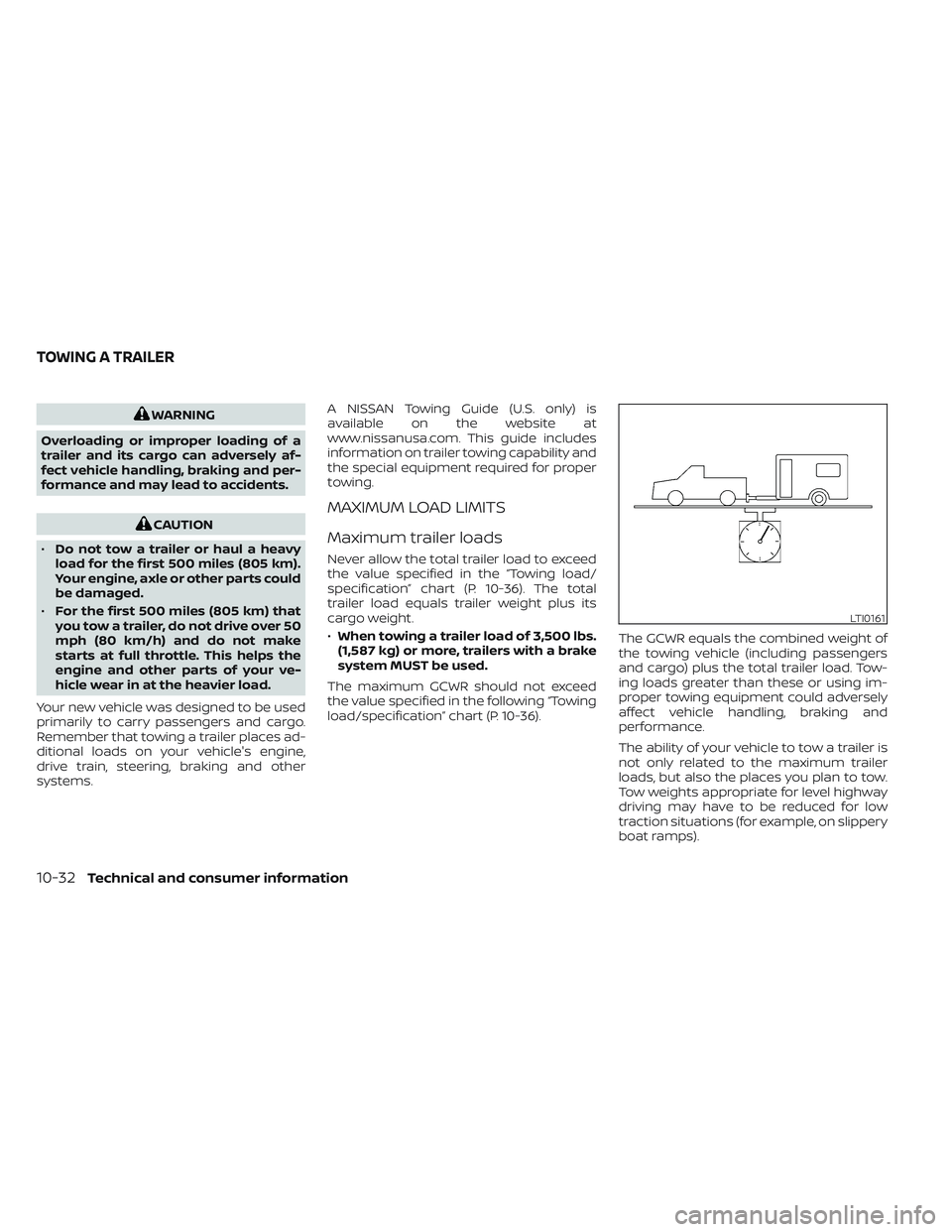
The maximum GCWR should not exceed
the value specified in the following “Towing
load/specification” chart (P. 10-36). The GCWR equals the combined weight of
the towing vehicle (including passengers
and cargo) plus the total trailer load. Tow-
ing loads greater than these or using im-
proper towing equipment could adversely
affect vehicle handling, braking and
performance.
The ability of your vehicle to tow a trailer is
not only related to the maximum trailer
loads, but also the places you plan to tow.
Tow weights appropriate for level highway
driving may have to be reduced for low
traction situations (for example, on slippery
boat ramps).
LTI0161
TOWING A TRAILER
10-32Technical and consumer information
Page 601 of 644
Temperature conditions can also affect
towing. For example, towing a heavy trailer
in high outside temperatures on graded
roads can affect engine performance and
cause overheating. The engine protection
mode, which helps reduce the chance of
engine damage, could activate and auto-
matically decrease engine power. Vehicle
speed may decrease under high load. Plan
your trip carefully to account for trailer and
vehicle load, weather and road conditions.
WARNING
Overheating can result in reduced en-
gine power and vehicle speed. The re-
duced speed may be lower than other
traffic, which could increase the chance
of a collision. Be especially careful
when driving. If the vehicle cannot
maintain a safe driving speed, pull to
the side of the road in a safe area. Allow
the engine to cool and return to normal
operation. For additional information,
see “If your vehicle overheats” (P. 6-12).
CAUTION
Vehicle damage resulting from im-
proper towing procedures is not cov-
ered by NISSAN warranties.
Tongue load
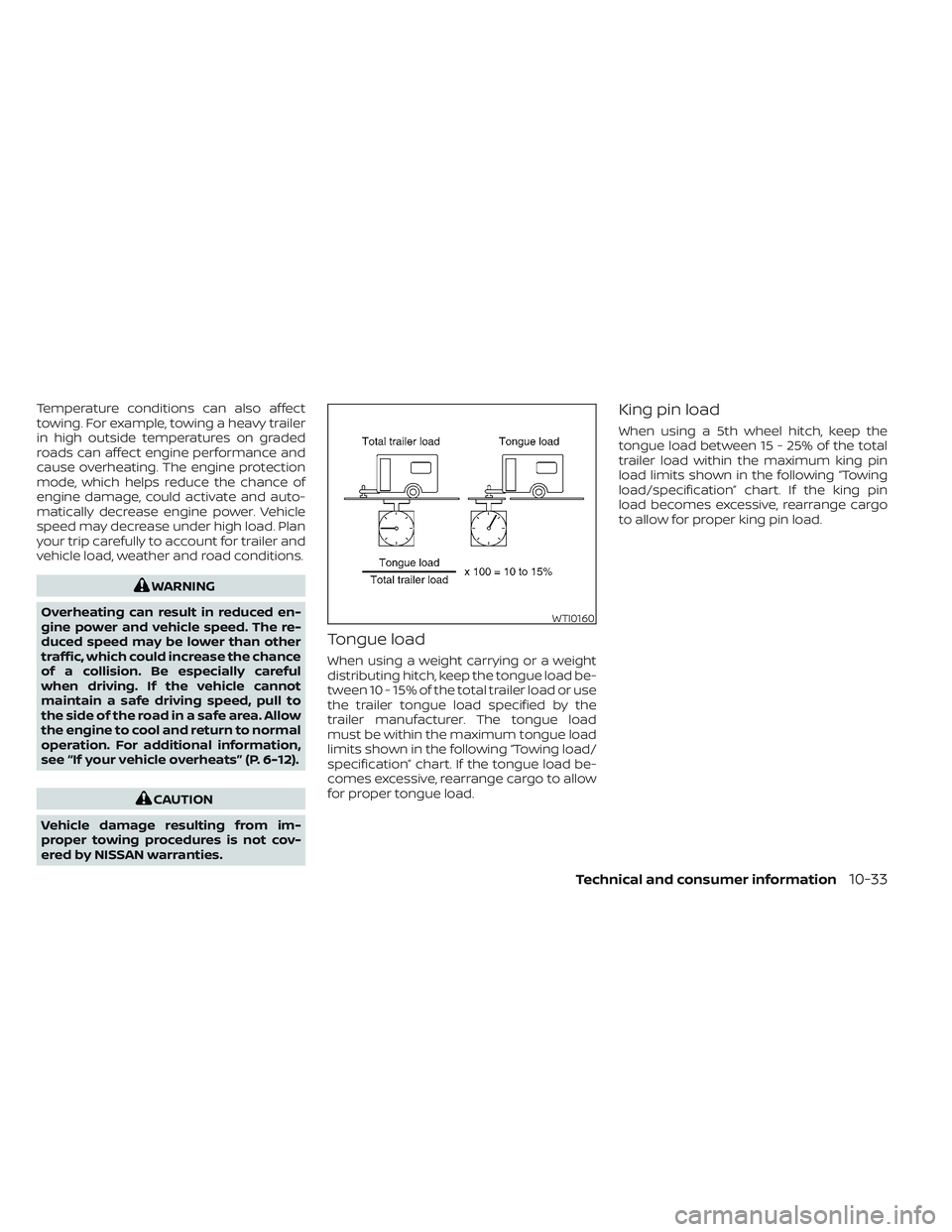
When using a weight carrying or a weight
distributing hitch, keep the tongue load be-
tween 10 - 15% of the total trailer load or use
the trailer tongue load specified by the
trailer manufacturer. The tongue load
must be within the maximum tongue load
limits shown in the following “Towing load/
specification” chart. If the tongue load be-
comes excessive, rearrange cargo to allow
for proper tongue load.
King pin load
When using a 5th wheel hitch, keep the
tongue load between 15 - 25% of the total
trailer load within the maximum king pin
load limits shown in the following “Towing
load/specification” chart. If the king pin
load becomes excessive, rearrange cargo
to allow for proper king pin load.
WTI0160
Technical and consumer information10-33
Page 602 of 644
Maximum Gross Vehicle Weight
(GVW)/maximum Gross Axle
Weight (GAW)
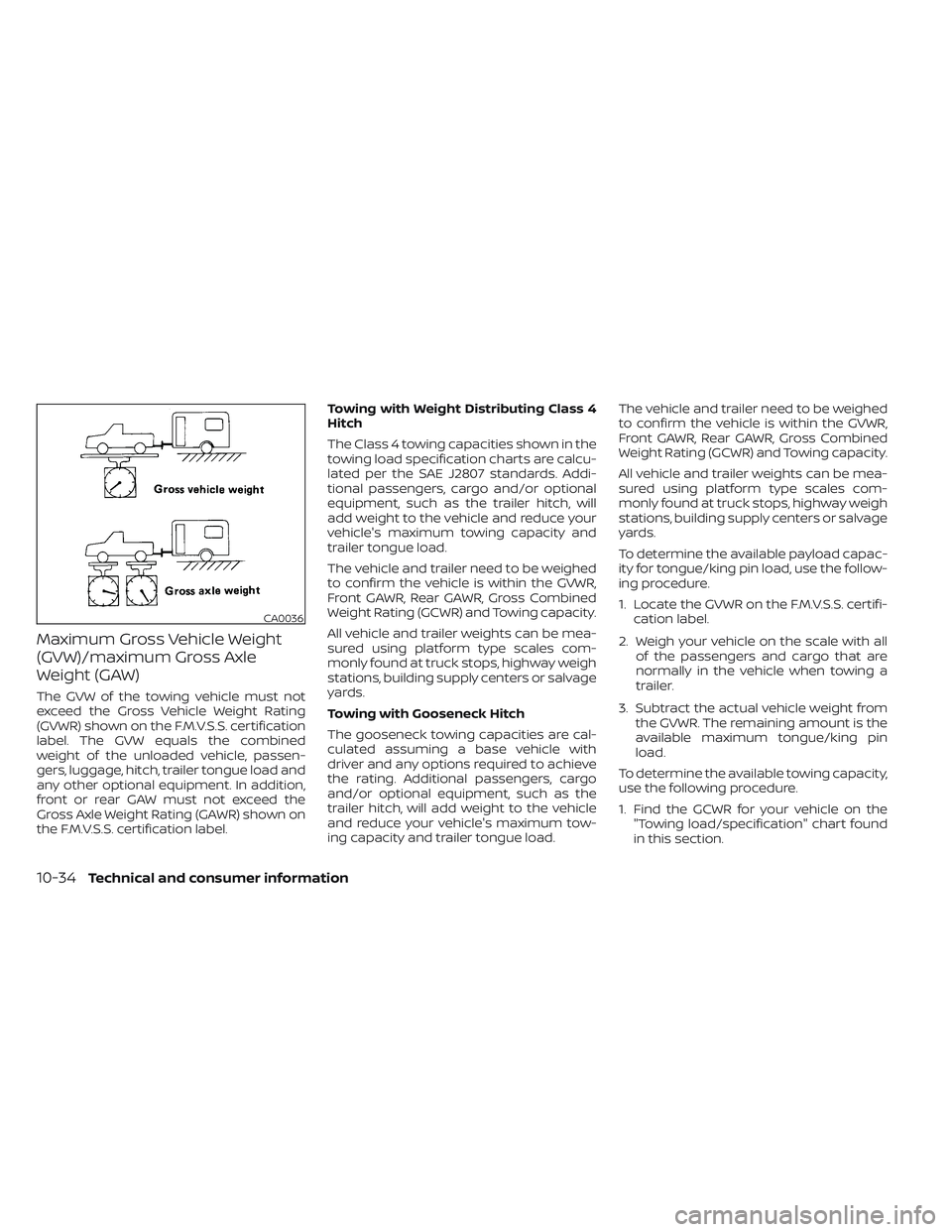
The GVW of the towing vehicle must not
exceed the Gross Vehicle Weight Rating
(GVWR) shown on the F.M.V.S.S. certification
label. The GVW equals the combined
weight of the unloaded vehicle, passen-
gers, luggage, hitch, trailer tongue load and
any other optional equipment. In addition,
front or rear GAW must not exceed the
Gross Axle Weight Rating (GAWR) shown on
the F.M.V.S.S. certification label.Towing with Weight Distributing Class 4
Hitch
The Class 4 towing capacities shown in the
towing load specification charts are calcu-
lated per the SAE J2807 standards. Addi-
tional passengers, cargo and/or optional
equipment, such as the trailer hitch, will
add weight to the vehicle and reduce your
vehicle's maximum towing capacity and
trailer tongue load.
The vehicle and trailer need to be weighed
to confirm the vehicle is within the GVWR,
Front GAWR, Rear GAWR, Gross Combined
Weight Rating (GCWR) and Towing capacity.
All vehicle and trailer weights can be mea-
sured using platform type scales com-
monly found at truck stops, highway weigh
stations, building supply centers or salvage
yards.
Towing with Gooseneck Hitch
The gooseneck towing capacities are cal-
culated assuming a base vehicle with
driver and any options required to achieve
the rating. Additional passengers, cargo
and/or optional equipment, such as the
trailer hitch, will add weight to the vehicle
and reduce your vehicle's maximum tow-
ing capacity and trailer tongue load.The vehicle and trailer need to be weighed
to confirm the vehicle is within the GVWR,
Front GAWR, Rear GAWR, Gross Combined
Weight Rating (GCWR) and Towing capacity.
All vehicle and trailer weights can be mea-
sured using platform type scales com-
monly found at truck stops, highway weigh
stations, building supply centers or salvage
yards.
To determine the available payload capac-
ity for tongue/king pin load, use the follow-
ing procedure.
1. Locate the GVWR on the F.M.V.S.S. certifi-
cation label.
2. Weigh your vehicle on the scale with all of the passengers and cargo that are
normally in the vehicle when towing a
trailer.
3. Subtract the actual vehicle weight from the GVWR. The remaining amount is the
available maximum tongue/king pin
load.
To determine the available towing capacity,
use the following procedure.
1. Find the GCWR for your vehicle on the "Towing load/specification" chart found
in this section.
CA0036
10-34Technical and consumer information
Page 604 of 644
TOWING LOAD/SPECIFICATION
WARNING
The towing capacities provided in this
manual are for general reference only.
The safe towing capacity of your ve-
hicle is affected by dealer and factory
installed options and passenger and cargo loads. You must weigh the ve-
hicle and trailer as described in this
manual to determine the actual vehicle
towing capacity. Do not exceed the
published maximum towing capacity
or the GCWR or the GVWR shown on the
FMVSS label. Doing so can result in an
accident causing serious personal in-
jury or property damage.
NOTE:
The SAE J2807 Weight Distributing Class
4 Hitch specifications are based on S and
SV grade models . The Gooseneck Hitch
specifications are based on SV grade
models.
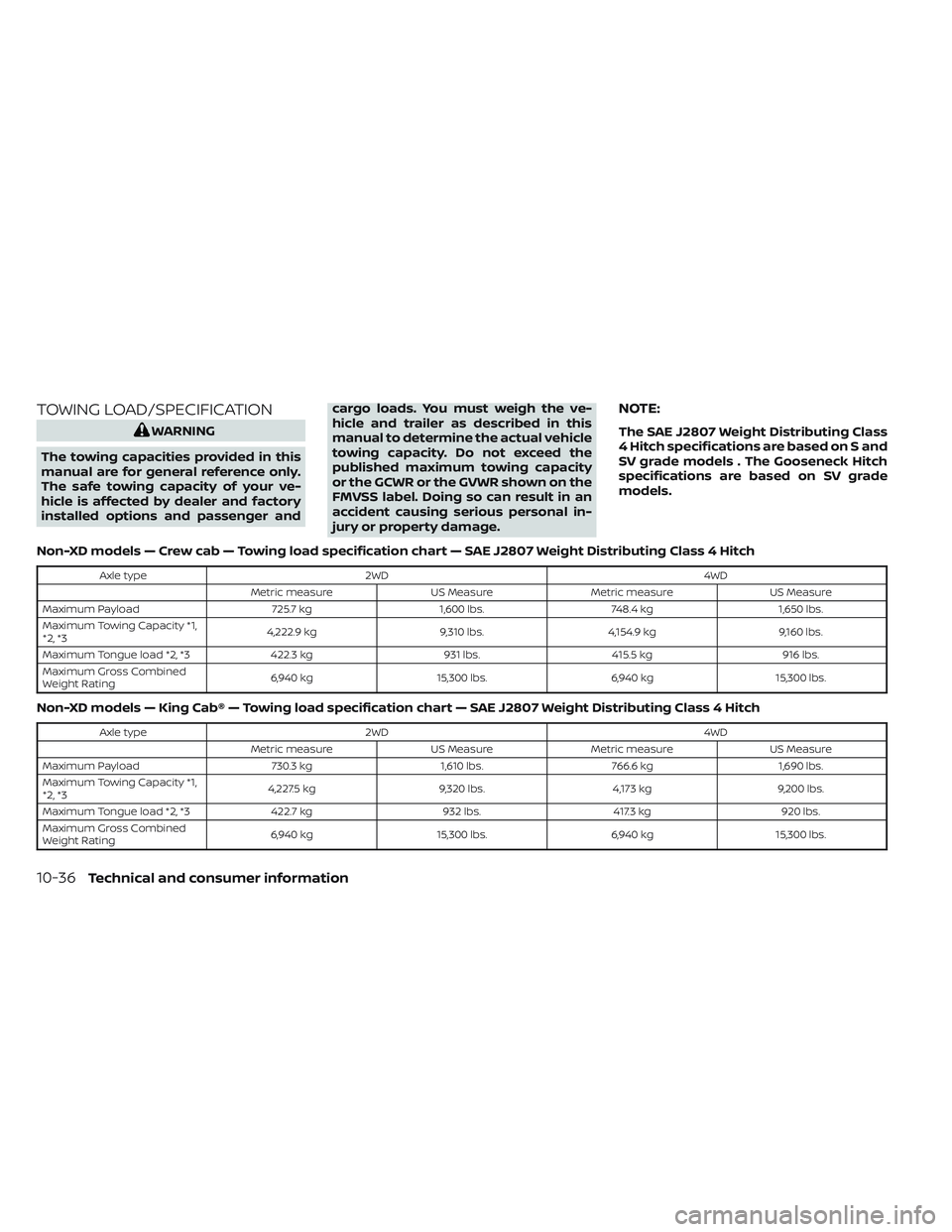
Non-XD models — Crew cab — Towing load specification chart — SAE J2807 Weight Distributing Class 4 Hitch
Axle type 2WD 4WD
Metric measure US MeasureMetric measure US Measure
Maximum Payload 725.7 kg1,600 lbs. 748.4 kg1,650 lbs.
Maximum Towing Capacity *1,
*2, *3 4,222.9 kg
9,310 lbs.4,154.9 kg 9,160 lbs.
Maximum Tongue load *2, *3 422.3 kg931 lbs.415.5 kg 916 lbs.
Maximum Gross Combined
Weight Rating 6,940 kg
15,300 lbs. 6,940 kg15,300 lbs.
Non-XD models — King Cab® — Towing load specification chart — SAE J2807 Weight Distributing Class 4 Hitch
Axle type 2WD 4WD
Metric measure US MeasureMetric measure US Measure
Maximum Payload 730.3 kg1,610 lbs. 766.6 kg1,690 lbs.
Maximum Towing Capacity *1,
*2, *3 4,227.5 kg
9,320 lbs. 4,173 kg9,200 lbs.
Maximum Tongue load *2, *3 422.7 kg932 lbs.417.3 kg920 lbs.
Maximum Gross Combined
Weight Rating 6,940 kg
15,300 lbs. 6,940 kg15,300 lbs.
10-36Technical and consumer information
Page 606 of 644
A hitch used for towing 5th wheel and
gooseneck trailers can also be installed on
your vehicle. Contact a professional sup-
plier of towing equipment to purchase and
have a 5th wheel or gooseneck hitch
installed.
WARNING
Trailer hitch components have specific
weight ratings. Your vehicle may be ca-
pable of towing a trailer heavier than
the weight rating of the hitch compo-
nents. Never exceed the weight rating
of the hitch components. Doing so can
cause serious personal injury or prop-
erty damage.
Hitch ball
Choose a hitch ball of the proper size and
weight rating for your trailer:
• The required hitch ball size is stamped on most trailer couplers. Most hitch balls
also have the size printed on the top of
the ball.
• Choose the proper class hitch ball based on the trailer weight. • The diameter of the threaded shank of
the hitch ball must be matched to the ball
mount hole diameter. The hitch ball
shank should be no more than 1/16”
smaller than the hole in the ball mount.
• The threaded shank of the hitch ball must be long enough to be properly secured to
the ball mount. There should be at least 2
threads showing beyond the lock washer
and nut.
Ball mount
The hitch ball is attached to the ball mount
and the ball mount is inserted into the
hitch receiver. Choose a proper class ball
mount based on the trailer weight. Addi-
tionally, the ball mount should be chosen to
keep the trailer tongue level with the
ground.
Bumper towing
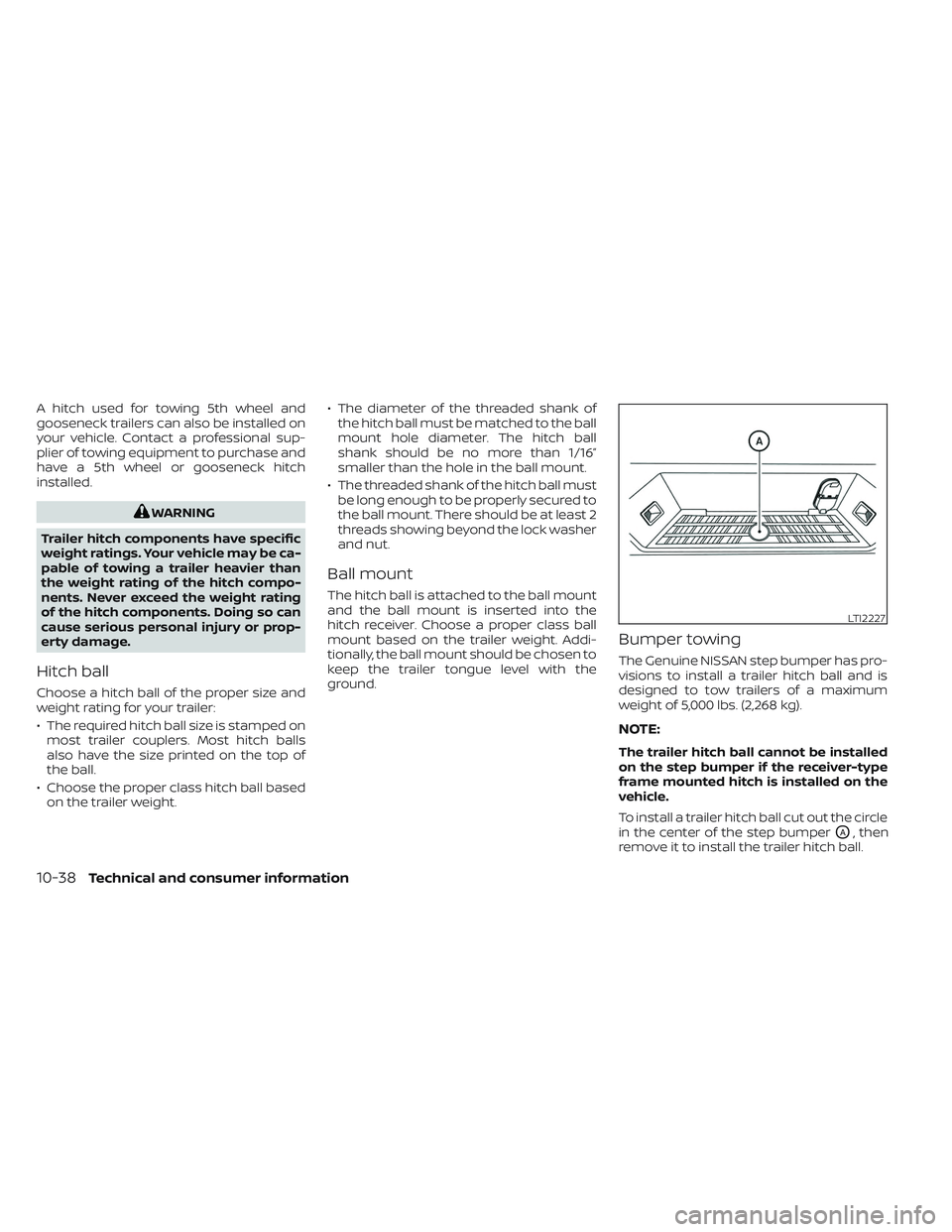
The Genuine NISSAN step bumper has pro-
visions to install a trailer hitch ball and is
designed to tow trailers of a maximum
weight of 5,000 lbs. (2,268 kg).
NOTE:
The trailer hitch ball cannot be installed
on the step bumper if the receiver-type
frame mounted hitch is installed on the
vehicle.
To install a trailer hitch ball cut out the circle
in the center of the step bumper
OA, then
remove it to install the trailer hitch ball.
LTI2227
10-38Technical and consumer information
Page 607 of 644
Weight carrying hitches
A weight carrying or “dead weight” ball
mount is one that is designed to carry the
whole amount of tongue weight and gross
weight directly on the ball mount and on
the receiver.
Weight distribution hitch
This type of hitch is also called a “load-
leveling” or “equalizing” hitch. A set of bars
attach to the ball mount and to the trailer
to distribute the tongue weight (hitch
weight) of your trailer. Many vehicles can't
carry the full tongue weight of a given
trailer, and need some of the tongue
weight transferred through the frame and
pushing down on the front wheels. This
gives stability to the tow vehicle.
A weight-distributing hitch system (Class
IV) is recommended if you plan to tow trail-
ers with a maximum weight over 5,000 lbs.
(2,268 kg). Check with the trailer and towing
equipment manufacturers to determine if
they recommend the use of a weight-
distributing hitch system.
NOTE:
A weight-distributing hitch system may
affect the operation of trailer surge
brakes. If you are considering use of a
weight-distributing hitch system with a
surge brake-equipped trailer, check with
the surge brake, hitch or trailer manufac-
turer to determine if and how this can be
done.
Follow the instructions provided by the
manufacturer for installing and using the
weight-distributing hitch system.
General set-up instructions are as follows:
1. Park unloaded vehicle on a level surface.With the ignition switch in the ON posi-
tion and the doors closed, allow the ve-
hicle to stand for several minutes so that
it can level.
2. Measure the height of a reference point on the front and rear bumpers at the
center of the vehicle.
3. Attach the trailer to the vehicle and ad- just the hitch equalizers so that the front
bumper height is within0-.5inches (0 –
13 mm) of the reference height mea-
sured in step 2. The rear bumper should
be no higher than the reference height
measured in step 2.
WARNING
Properly adjust the weight distributing
hitch so the rear of the bumper is no
higher than the measured reference
height when the trailer is attached. If
the rear bumper is higher than the
measured reference height when
loaded, the vehicle may handle unpre-
dictably which could cause a loss of ve-
hicle control and cause serious per-
sonal injury or property damage.
Sway control device
Sudden maneuvers, wind gusts, and buf-
feting caused by other vehicles can affect
trailer handling. Sway control devices may
be used to help control these affects. If you
choose to use one, contact a reputable
trailer hitch supplier to make sure the sway
control device will work with the vehicle,
hitch, trailer and the trailer's brake system.
Follow the instructions provided by the
manufacturer for installing and using the
sway control device.
Technical and consumer information10-39