seat NISSAN VERSA 2007 1.G Warranty Booklet
[x] Cancel search | Manufacturer: NISSAN, Model Year: 2007, Model line: VERSA, Model: NISSAN VERSA 2007 1.GPages: 55, PDF Size: 5.93 MB
Page 2 of 55
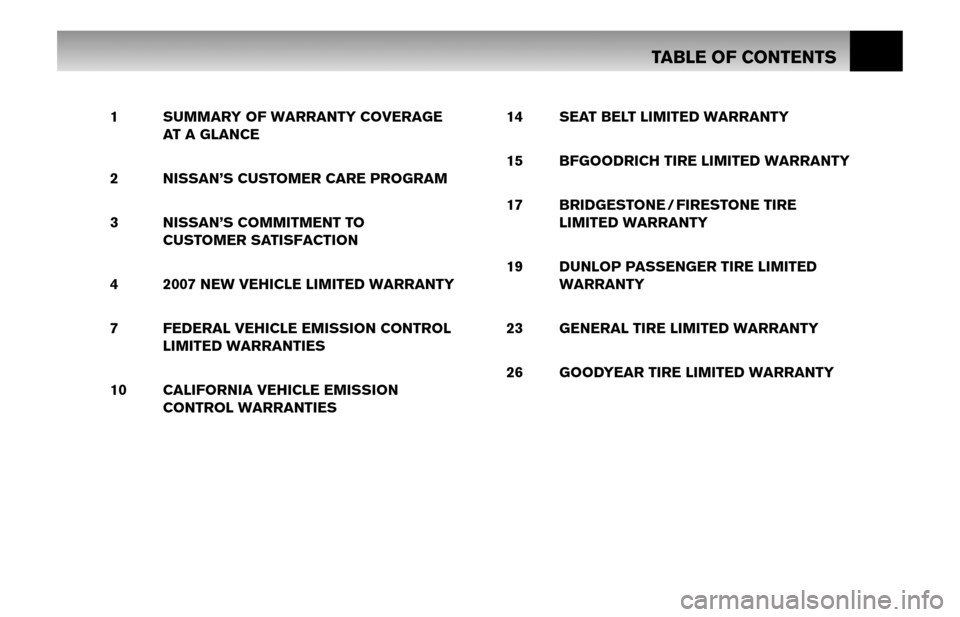
TABLE OF CONTENTS
1 SUMMARY OF WARRANTY COVERAGE
AT A GLANCE
2 NISSAN’S CUSTOMER CARE PROGRAM
3 NISSAN’S COMMITMENT TO
CUSTOMER SATISFACTION
4 2007 NEW VEHICLE LIMITED WARRANTY
7 FEDERAL VEHICLE EMISSION CONTROL
LIMITED WARRANTIES
10 CALIFORNIA VEHICLE EMISSION
CONTROL WARRANTIES 14
SEAT BELT LIMITED WARRANTY
15 BFGOODRICH TIRE LIMITED WARRANTY
17 BRIDGESTONE / FIRESTONE TIRE
LIMITED WARRANTY
19 DUNLOP PASSENGER TIRE LIMITED
WARRANTY
23 GENERAL TIRE LIMITED WARRANTY
26 GOODYEAR TIRE LIMITED WARRANTY
Page 4 of 55
1
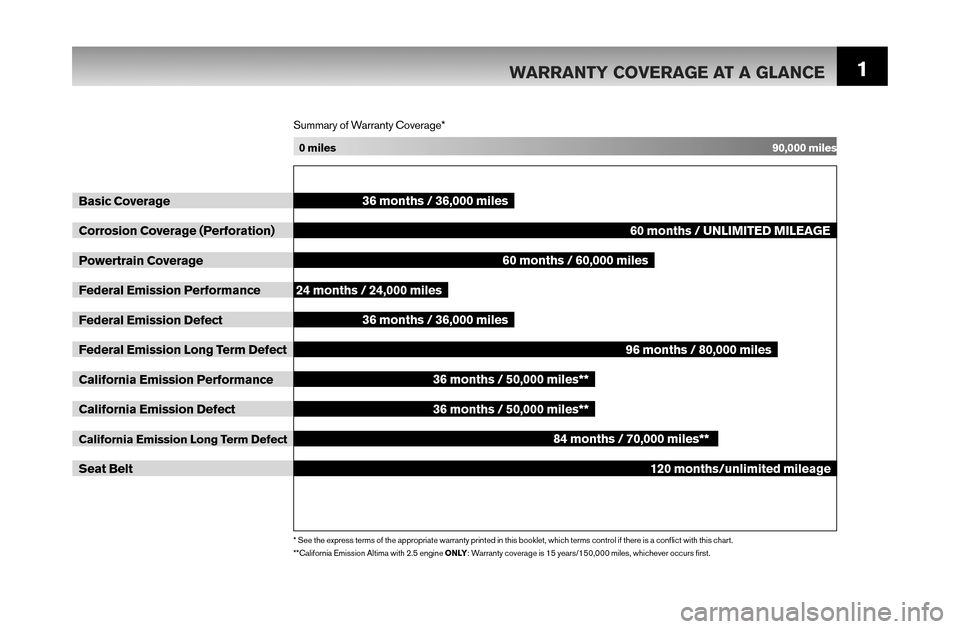
Basic Coverage
Corrosion Coverage (Perforation)
Powertrain Coverage
Federal Emission Performance
Federal Emission Defect
Federal Emission Long Term Defect
California Emission Performance
California Emission Defect
California Emission Long Term Defect
Seat Belt
36 months / 36,000 miles..
60 months / UNLIMITED MILEAGE
..
60 months / 60,000 miles
..
24 months / 24,000 miles
..
36 months / 36,000 miles
..
96 months / 80,000 miles
..
36 months / 50,000 miles**
..
36 months / 50,000 miles**
..
84 months / 70,000 miles**
..
120 months/unlimited mileage
..
Summary of Warranty Coverage*
0 miles
90,000 miles
* See the express terms of the appropriate warranty printed in this booklet, which terms control if there is a confl ict with this chart.
**California Emission Altima with 2.5 engine ONLY: Warranty coverage is 15 years/150,000 miles, whichever occurs fi rst.
WARRANTY COVERAGE AT A GLANCE
57052 Booklet text pages.indd 157052 Booklet text pages.indd 18/30/06 3:34:04 PM8/30/06 3:34:04 PM
Page 9 of 55
6
E
a
T
d
c
C
W
HT
o
d
d
a
w
E
T
2007 NEW VEHICLE LIMITED WARRANTY
WHAT IS NOT COVEREDDAMAGE, FAILURES OR CORROSION DUE TO
ACCIDENTS, MISUSE OR ALTERATIONS
This warranty does not cover damage, failures or corrosion
resulting from:
■ Accident, theft, fi re, driving through water (including engine
water ingestion) or misuse, which includes racing of any
sort whatsoever (Proper use is outlined in your OWNER’S
MANUAL) .
■ Alteration, tampering or improper repair.
■ Installation of non-Nissan approved accessories or
components.
■ Improper installation of any Nissan approved or aftermarket
accessory or component.
■ Glass breakage, unless resulting from defects in material
or workmanship.
■ Normal wear and tear, including dings, dents, chips or
scratches.
ALTERED OR UNCERTAIN ODOMETER MILEAGE
This warranty does not cover repair of any vehicle or any part
of a vehicle of which the odometer mileage has been altered,
or the odometer repaired or replaced and the actual vehicle
mileage cannot be correctly and readily determined.
SALVAGE TITLE
This limited warranty does not apply to any vehicle, and is
rendered void if the vehicle is (or ever has been) issued a
“salvage” or similar title under any state’s law; or has ever been
determined to be a “total loss” or equivalent by any insurance
company, such as by payment of a cash payment of claim in lieu
of repairs because of a determination that the cost of repairs
exceeded the actual cash value of the vehicle.
DAMAGE, FAILURES OR CORROSION FROM
ENVIRONMENTAL CONDITIONS
This warranty does not cover damage, failures or corrosion
resulting from:
■ Stone chipping, chemical fallout (acid rain) , tree sap, salt,
hail, wind-storm, lightning, fl ood or other environmental
conditions.■ The items listed below are not covered under corrosion
coverage (perforation from corrosion) .
• Exhaust system components.
• Corrosion of outer trim parts, such as moldings.
However, corrosion of outer trim parts is warranted for
12 months or 12,500 miles, whichever comes fi rst.
• Corrosion other than perforation, such as cosmetic
or surface corrosion due to defects in materials
or workmanship. This is covered under the Basic
Coverage of the New Vehicle Limited Warranty.
• Special bodies or equipment not manufactured or
supplied by Nissan.
DAMAGE, FAILURES OR CORROSION DUE TO LACK
OF OR IMPROPER MAINTENANCE
This warranty does not cover damage, failures or corrosion
resulting from:
■ Lack of performance of proper maintenance services as
outlined in your NISSAN SERVICE & MAINTENANCE
GUIDE.
■ Use of improper or dirty fuel, fl uids or lubricants.
■ Use of parts not equivalent in quality or design to parts
supplied by Nissan.
MAINTENANCE SERVICE EXPENSE
This warranty does not cover normal maintenance services
as specifi ed in your NISSAN SERVICE & MAINTENANCE
GUIDE such as engine tune-up; cleaning and polishing; wheel
alignment; headlight aiming; replacement of fi lters, replacement
of windshield wiper inserts, replacement of key fob batteries,
lubricants, coolant; worn brake shoes, pads, drums and rotors
and worn clutch discs.
SEAT BELTS, TIRES, DROP-IN BEDLINERS AND
EMISSION CONTROL SYSTEM
Seat belts, tires, drop-in bedliners and the emission control
system are not covered by this warranty, but are covered by
separate warranties.
NISSAN SPRAY-IN BEDLINERS
Nissan Spray-in Bedliners will be repaired to commercially
acceptable standards which may include minor appearance
differences from the original bedliner.(See following pages for separate warranties which may apply
to your Nissan, such as those covering vehicle emissions,
seat belts, and tires.)
57052 Booklet text pages.indd 657052 Booklet text pages.indd 68/30/06 3:34:11 PM8/30/06 3:34:11 PM
Page 17 of 55
14SEAT BELT LIMITED WARRANTY
WHO IS THE WARRANTOR
Nissan* warrants all parts of your 2007 Nissan vehicle seat
belt system supplied by Nissan.
*Nissan indicates Nissan North America, Inc., P.O. Box 685003,
Franklin, TN 37068-5003, which distributes Nissan vehicles
in the United States.
WHAT IS COVERED AND FOR HOW
LONG
This warranty covers any Nissan supplied seat belt
or related component, that fails to function properly
during normal use within ten (10) years of the date
the vehicle is delivered to the fi rst retail buyer or put
into service, whichever is earlier. Warranty repairs are
free of charge for parts and labor.
OBTAINING WARRANTY SERVICE
You must take the vehicle to an authorized Nissan dealer in
the United States or Canada during regular business hours
at your expense in order to obtain warranty service. The
names and addresses of authorized Nissan dealers are
listed in telephone directories.
WHAT IS NOT COVERED
■ Damage or failure due to misuse, alteration, accident
or collision damage. (Proper use is outlined in your
OWNER’S MANUAL) .
■ Color fading, spotting or other cosmetic items when
the belt is otherwise functioning properly.
■ Air bags and related electronic control systems
which are covered by the Powertrain warranty.
LIMITATION OF WARRANTIES AND
OTHER WARRANTY TERMS AND
STATE LAW RIGHTS
EXTRA EXPENSES - LIMITATIONS OF
DAMAGES
This warranty does not cover incidental or
consequential damages such as loss of the
use of the vehicle, inconvenience or com-
mercial loss.
ANY IMPLIED WARRANTY OF MERCHANTABILITY
AND FITNESS FOR A PARTICULAR PURPOSE
SHALL BE LIMITED TO THE DURATION OF THIS
WRITTEN WARRANTY.
Some states do not allow the exclusion or limitation
of incidental or consequential damages or limita-
tions on how long an implied warranty lasts, so the
above limitations or exclusions may not apply to
you. This warranty gives you specifi c legal rights,
and you may also have other rights which vary from
state to state.
Nissan does not authorize any person to create for it
any other warranty, obligation or liability in connection
with this vehicle.
57052 Booklet text pages.indd 1457052 Booklet text pages.indd 148/30/06 3:34:16 PM8/30/06 3:34:16 PM
Page 23 of 55
20DUNLOP PASSENGER TIRE LIMITED WARRANTY
WHAT ARE YOUR LEGAL RIGHTS?Some states and provinces do not allow the exclusion
or limitation of incidental or consequential damages,
so the above limitations or exclusions may not apply to
you. No representative or dealer has authority to make
any representation, promise, or agreement on behalf of
Goodyear Dunlop Tires North America, Ltd. (GDTNA) ,
except as stated herein.
Any tire, no matter how well constructed, may fail in
service or otherwise become unserviceable due to
conditions beyond the control of the manufacturer. Under
no circumstances is this warranty a representation that a
tire failure cannot occur.
This warranty gives you specifi c legal rights, and you may
also have other rights that vary from state to state and in
Canada province to province.
HOW DO YOU OBTAIN AN
ADJUSTMENT?
A. You must present the tire to be adjusted to an authorized
Dunlop service facility. Tires replaced on an adjustment
basis become the property of Goodyear Dunlop Tires
North America, Ltd. or Goodyear Canada Inc.
B. You must pay for taxes and any additional services you
order at the time of adjustment.
C. You must submit your claim on a GDTNA claim form
supplied by an authorized Dunlop service facility. The
form must be fi lled out completely and signed by you,
the owner of the tire presented for adjustment, or your
authorized agent.
TIRE CARE AND MAINTENANCE GUIDEThe easiest way to help ensure satisfactory mileage and
performance from your Dunlop tires is to give them a simple
but frequent inspection for proper infl ation, even treadwear,
and the presence of any damage.
DO MAINTAIN PROPER INFLATION
PRESSURE IN YOUR TIRES
Proper infl ation pressure is necessary for optimum tire
per-formance, safety and fuel economy. To maintain proper
infl ation pressure, frequently check tires (when they are
cool) with an accurate tire pressure gauge.*
For example, it is diffi cult to tell just by looking at radial
tires whether they are underinfl ated.
Furthermore, when operating a vehicle equipped with
radial tires, it is diffi cult to notice when a tire has gone
fl at or nearly fl at since the “feel” of the vehicle does not
change signifi cantly.
*Evidence of air loss or repeated underinfl ation
always requires expert inspection to determine the
source of leakage and tire removal to determine
repairability. To avoid injury, NEVER attempt to reinfl ate
a tire that has been run severely underinfl ated.
Progressive air loss may result from punctures, cuts, curbing,
impacts or partial bead unseating. Some fi tment causes for
air loss are (1) incomplete bead seating, (2) bead tearing
caused by a machine tool due to insuffi cient lubrication or
improper adjustment, (3) leaking valve core or rubber valve
components. These should be replaced when problems
are detected and whenever tires are replaced.
Always maintain infl ation pressure at the level
recommended by the vehicle manufacturer as shown
on the vehicle placard or in the owner’s manual:Underinfl ation is the leading cause of tire failure and
may result in severe cracking, component separation or
“blowout.” It reduces tire load capacity, allows excessive
sidewall fl exing and increases rolling resistance, resulting in
heat and mechanical damage. Maintaining proper infl ation
pressure is the single most important thing you can do to
ensure tire durability and maximum treadlife.
Overinfl ation increases stiffness, which may deteriorate
ride and generate unwanted vibration. Overinfl ation also
increases the chances of impact damage.
DON’T OVERLOAD YOUR VEHICLECheck your vehicle owner’s manual to determine the load
limits. Overloading your vehicle places stress on your tires
and other critical vehicle components. Overloading a vehicle
can cause poor handling, increased fuel consumption and
may cause tire failure.
Never fi t your vehicle with new tires that have less load
capacity than shown on the vehicle tire placard and
remember that optimum rim width is important for proper
tire load distribution and function.
The maximum load capacity stamped on the sidewalls of
P-Metric tires is reduced by 10 percent when used on a
light truck, utility vehicle or trailer. Never fi t P-Metric tires to
light trucks that specify LT-type replacement tires.
DON'T SPIN YOUR TIRES EXCESSIVELYAvoid excessive tire spinning when your vehicle is stuck in
snow, ice, mud or sand. The centrifugal forces generated
by a free-spinning tire/wheel assembly may cause sudden
tire explosion resulting in vehicle damage and/or serious
(Continued on page 21)
57052 Booklet text pages.indd 2057052 Booklet text pages.indd 208/30/06 3:34:19 PM8/30/06 3:34:19 PM
Page 24 of 55
21
personal injury to you or a bystander. Never exceed 35
mph/60 km/h as indicated on your speedometer. Use a
gentle backward and forward rocking motion to free your
vehicle for continued driving. Never stand near or behind a
tire spinning at high speed as, for example, while attempting
to push a vehicle that is stuck or when an on-the-car spin
balance machine is in use.
DO CHECK YOUR TIRES FOR WEARAlways remove tires from service when they reach two
thirty-seconds of an inch (2/32") remaining tread depth.
All new tires have treadwear indicators which appear as
smooth banks in the tread grooves when they wear to
the two thirty-seconds of an inch (2/32") level. Many wet
weather accidents result from skidding on bald or nearly
bald tires. Excessively worn tires are also more susceptible
to penetrations.
SIDEWALL TREATMENTSDunlop sidewalls are specially compounded to resist ozone
cracking or weather-cracking.
Use a mild soap solution to clean sidewalls, white striping
or lettering, and rinse off with plain water. Instruct service
per-sonnel and customers never to apply any other material
to enhance sidewall appearance. These may degrade rubber
and remove inherent ozone resistance.
DO CHECK YOUR TIRES FOR DAMAGEFrequent inspection of your tires for signs of damage and
their general condition is important for safety. If you have
any questions, have your tire dealer inspect them. Impacts,
penetrations, cracks, knots, bulges, or air loss always
require tire removal and expert inspection. Never perform
a temporary repair or use an innertube as a substitute for a
proper repair. Only qualifi ed persons should repair tires.
PROPER TIRE REPAIRNOTE: Dunlop does not warrant any inspection or repair
process. The repair is entirely the responsibility of the
repairer and should be made in accordance with established
Rubber Manufacturers Association (RMA) procedures.
DON’T ATTEMPT TO MOUNT
YOUR OWN TIRES
Serious injury may result from explosion of tire/rim
assembly due to improper mounting procedures. Follow
tire manufacturer’s instructions and match tire diameter
to rim surfaces. Lock assembly on mounting machine or
place in safety cage. STAND BACK and never exceed
40 psi to seat beads. Never use a volatile substance or
a rubber “donut” (also known as a bead expander or “O-
Ring”) to aid bead seating. Only specially trained persons
should mount tires.
DON’T MIX TIRES OF DIFFERENT SIZES
AND TYPES ON THE SAME AXLE
For optimum handling and control, Dunlop recommends
fi tment of four (4) tires of the same type and size unless
otherwise specifi ed by the vehicle manufacturer.
FOLLOW THESE ADDITIONAL
GUIDELINES:
Fit newest tires on rear axle. If radials and non-radials must
be fi tted to the same vehicle, fi t radials on rear axle. Never
mix radials and non-radials on the same axle. When fi tting
snow tires or all-season tires to performance vehicles,
always fi t in sets for four. Do not fi t tires with different
speed ratings.
Use of lift kits with some vehicle/tire combinations can
cause instability. When changing tire sizes, always consult
dealer for optimum rim width and carefully check vehicle/tire
clearances.
RETREADED TIRESRetreaded passenger and light truck tires are not warranted
by Dunlop for any reason. Dunlop speed ratings and U.S.
Department of Transportation test compliance certifi cations
are voided for retreaded tires.
DO MAINTAIN VEHICLE SUSPENSION,
WHEEL ALIGNMENT AND BALANCE
AND ROTATE YOUR TIRES
Lack of rotation, worn suspension parts, underinfl ation/over-
infl ation, wheel imbalance, and misalignment can cause
vibration or irregular tire wear. Rotate your tires according
to your vehicle manufacturer’s recommendations or at
maximum intervals of 6,000 miles/10,000 km.
LIGHTWEIGHT TEMPORARY
SPARE TIRES IMPORTANT SAFETY
INSTRUCTIONS
• Limit vehicle speed when using the lightweight
temporary spare tire to 50 mph/80 km/h or less.
• Check the infl ation pressure before using and at least
weekly. Maintain cold tire pressure in accordance with
that molded on the tire sidewall or found in your vehicle
owner’s manual. When infl ating or adding air to light-
weight temporary spare tire, be very careful, since the
smaller tire volume can gain pressure quickly. Leave
valve core in place and add infl ation air in short bursts.
Check the pressure often with an in-line or hand gauge
until the specifi ed pressure is reached.
• The lightweight temporary spare tire may lower ground
clear-ance when used. Reduce speed and avoid driving
over large obstacles or through chuckholes and other
road hazards.
• Check your car owner’s manual for other special
clearance precautions when using the lightweight
DUNLOP PASSENGER TIRE LIMITED WARRANTY
(Continued on page 22)
57052 Booklet text pages.indd 2157052 Booklet text pages.indd 218/30/06 3:34:19 PM8/30/06 3:34:19 PM
Page 25 of 55
22
temporary spare tire provided in your vehicle.
• Because your lightweight temporary spare tire was
specifi cally designed for your car, it should not be used
on any other vehicle.
• Do not use snow chains on your lightweight temporary
spare tire. This could cause damage to your vehicle.
• Your lightweight temporary spare has very limited wear
potential (up to 300 miles/500 km) .
• In order to conserve tire treadlife, the lightweight
temporary spare tire should be returned to your trunk
as soon as the standard tire has been repaired or
replaced. Never use the spare if treadwear indicator
(TWI) bars are exposed or it is worn to the last 2/32"
tread depth.
• Do not use your original equipment lightweight
temporary spare tire on any other than its original
equipment rim. The replacement lightweight temporary
spare tire must match the original equipment tire
removed from your lightweight temporary spare rim.
Check the tire for the lightweight temporary spare tire
size marking designation and compare size markings
with those found on both your original lightweight
temporary spare and rim.
NOTE: Your original equipment lightweight temporary
spare tire and rim combination is not the same size as the
other tires and rims with which your vehicle is equipped.
Standard tires, snow tires, conventional wheel covers or
rim rings should not be fi tted to your lightweight temporary
spare tire rim or assembly.
• Improper mounting can cause tire/rim assembly
explosion and serious injury. Tire Fitters: Follow tire
manufacturer’s instructions and match tire diameter to
rim diameter. Mount the lightweight temporary spare
tire only on a rim originally fi tted with a temporary spare
of the same size. Lubricate beads and rim contact
surfaces. Lock assembly on mounting machine or
place in a safety cage. STAND BACK; infl ate in short
DUNLOP PASSENGER TIRE LIMITED WARRANTY
bursts with extension hose, clip-on chuck on in-line
gauge. Never exceed 40 psi to seat beads or use
a volatile substance or a rubber “donut” to aid bead
seating. Only specially trained persons should mount
lightweight temporary spare tires.
Dunlop brand tires are serviced by The Goodyear Tire &
Rubber Company and Goodyear Canada Inc. through
authorized Dunlop outlets.
You must go to an authorized Dunlop outlet for replacement
tires and all warranty service.
THE WARRANTOR The warrantor of Dunlop tires is Goodyear/Dunlop N.A.
Limited at 1144 East Market Street, Akron, Ohio 44136-
0001
FOR SERVICE ASSISTANCE OR
INFORMATION:
• FIRST CONTACT THE NEAREST
DUNLOP RETAILER.
• IF ADDITIONAL ASSISTANCE IS REQUIRED:
IN THE UNITED STATES:
Call (800) 321-2136, or write:
Goodyear/Dunlop Consumer Relations
Dept. 728
1144 East Market Street, Akron, OH 44316-0001
IN CANADA:
Call (800) 387-3288, or write:
Goodyear/Dunlop Consumer Relations Department
450 Kipling Avenue
Toronto, Ontario M8Z 5E1
SAFETY WARNINGSSerious injury or property damage may result from:
• TIRE FAILURE DUE TO UNDERINFLATION/
OVERLOADING:
Follow the owner’s manual, tire placard in vehicle,
or Important Tire Safety Information located in this
booklet.
• EXPLOSION OF TIRE/RIM ASSEMBLY DUE TO
IMPROPER MOUNTING:
Only specially trained persons should mount tires.
• FAILURE TO MOUNT RADIAL TIRES ON APPROVED
RIMS.
• FAILURE TO DEFLATE SINGLE OR DUAL ASSEMBLIES
COMPLETELY BEFORE DEMOUNTING.
• TIRE SPINNING ON SLIPPERY SURFACES SUCH
AS SNOW, MUD, ICE, ETC. DO NOT SPIN TIRES
IN EXCESS OF 35 MPH (55 KPH) , AS INDICATED
ON THE SPEEDOMETER. PERSONAL INJURY
AND SEVERE DAMAGE MAY RESULT FROM
EXCESSIVE WHEEL SPINNING, INCLUDING TIRE
DISINTEGRATION OR AXLE FAILURE.
57052 Booklet text pages.indd 2257052 Booklet text pages.indd 228/30/06 3:34:21 PM8/30/06 3:34:21 PM