trailer NISSAN VERSA 2008 1.G Towing Guide
[x] Cancel search | Manufacturer: NISSAN, Model Year: 2008, Model line: VERSA, Model: NISSAN VERSA 2008 1.GPages: 32, PDF Size: 1.16 MB
Page 13 of 32

2008 Nissan Towing Guide 12 On all Nissan vehicles, the GVWR is shown on the
Federal Motor Vehicle Safety Standard (F.M.V.S.S.)
certification label located in the driver’s-side door area.
To avoid overloading the vehicle, be sure
to include the trailer tongue/king pin load as a
part of the cargo when determining how much weight
can be safely carried inside the vehicle. The weight of
the roof rack cargo should also be included.
GROSS AXLE WEIGHT (GAW)
The Gross Axle Weight (GAW) is the maximum weight each axle (front and rear) is designed
to safely carry.
To determine the GAW, load the vehicle as you would for towing and attach the loaded
trailer. At a public scale, with the loaded trailer attached, place only the tow vehicle front
wheels on the scale to determine the actual front axle GAW. To obtain the rear axle GAW,
place all four tow vehicle wheels on the scale. From that figure, subtract the front GAW and
you’ve got the rear GAW amount.
The GAW you come up with must not exceed the Gross Axle Weight Rating (GAWR)
for your vehicle. On Nissan vehicles, the GAWR for both axles is listed on the F.M.V.S.S.
certification label.
MFD BY NISSAN MOTOR CO., LTD
DATE
GVWR
GAWR FR.
WITH
GAWR RR.
WITH
THIS VEHICLE CONFORMS TO
ALL APPLICABLE FEDERAL
MOTOR VEHICLE SAFETY
STANDARDS IN EFFECT ON
THE DATE OF MANUFACTURE
SHOWN ABOVE.
SEE OWNERS MANUAL FOR
ADDITIONAL INFORMATION.
TIRES
TIRES
TYPE: TRUCK
MODEL: 3B000
COLOR TRIM TRANS
AXLE ENGINE
RIMS AT PSI
COLD SINGLERIMS AT PSI
COLD SINGLE
F.M.V.S.S.
Certification Label
Page 14 of 32
2008 Nissan Towing Guide 13
GROSS COMBINED WEIGHT (GCW)
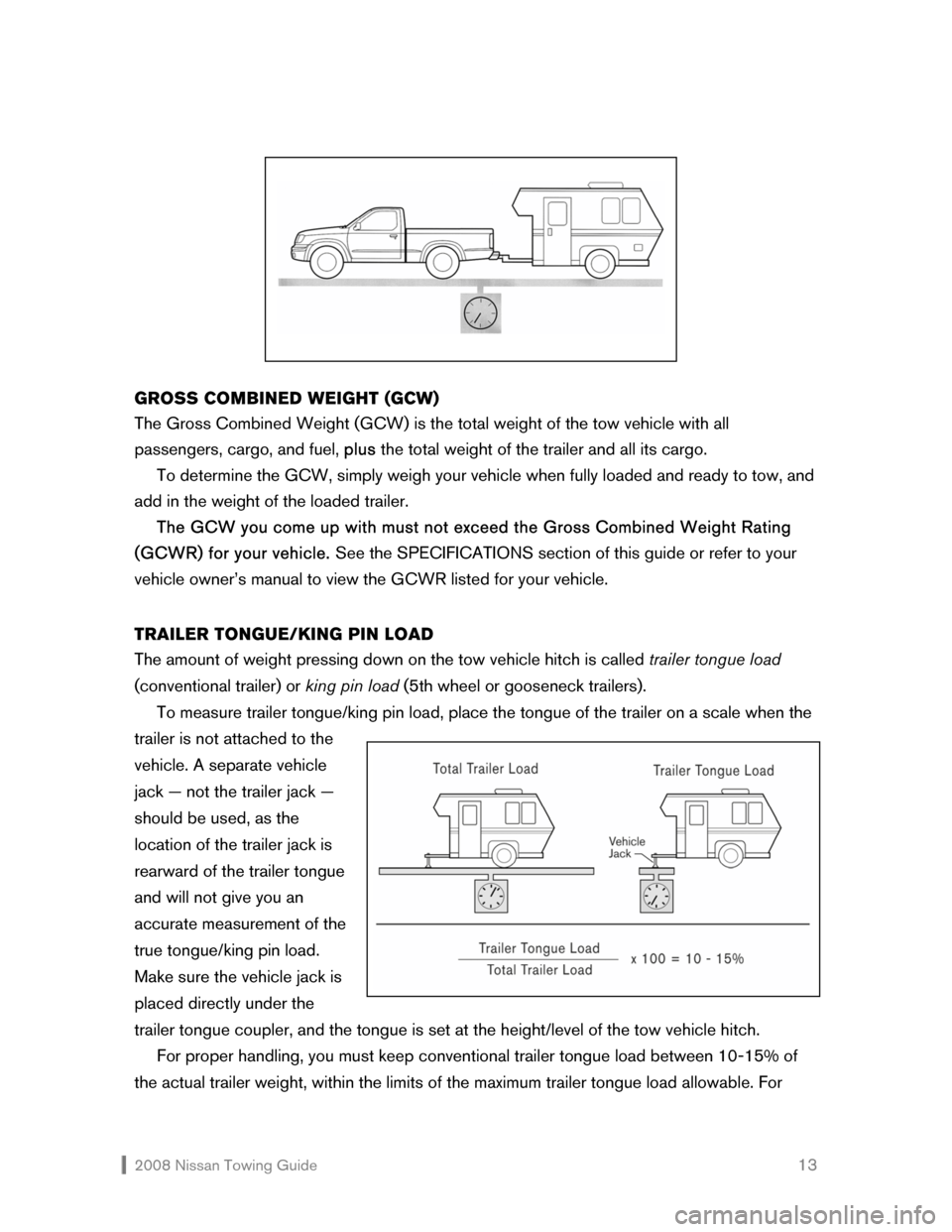
The Gross Combined Weight (GCW) is the total weight of the tow vehicle with all
passengers, cargo, and fuel, plus the total weight of the trailer and all its cargo.
To determine the GCW, simply weigh your vehicle when fully loaded and ready to tow, and
add in the weight of the loaded trailer.
The GCW you come up with must not exceed the Gross Combined Weight Rating
(GCWR) for your vehicle. See the SPECIFICATIONS section of this guide or refer to your
vehicle owner’s manual to view the GCWR listed for your vehicle.
TRAILER TONGUE/KING PIN LOAD
The amount of weight pressing down on the tow vehicle hitch is called trailer tongue load
(conventional trailer) or king pin load (5th wheel or gooseneck trailers).
To measure trailer tongue/king pin load, place the tongue of the trailer on a scale when the
trailer is not attached to the
vehicle. A separate vehicle
jack — not the trailer jack —
should be used, as the
location of the trailer jack is
rearward of the trailer tongue
and will not give you an
accurate measurement of the
true tongue/king pin load.
Make sure the vehicle jack is
placed directly under the
trailer tongue coupler, and the tongue is set at the height/level of the tow vehicle hitch.
For proper handling, you must keep conventional trailer tongue load between 10-15% of
the actual trailer weight, within the limits of the maximum trailer tongue load allowable. For
Page 15 of 32
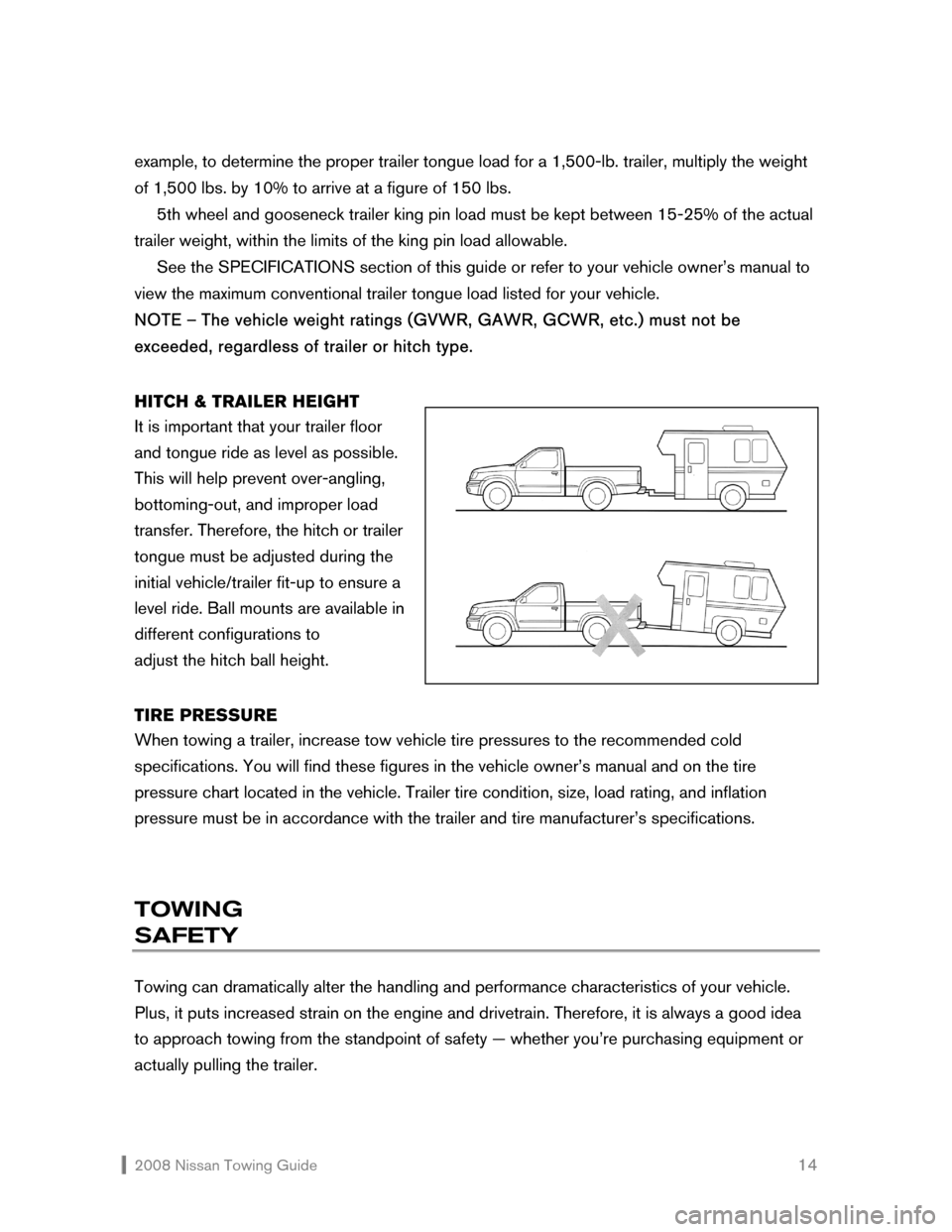
2008 Nissan Towing Guide 14 example, to determine the proper trailer tongue load for a 1,500-lb. trailer, multiply the weight
of 1,500 lbs. by 10% to arrive at a figure of 150 lbs.
5th wheel and gooseneck trailer king pin load must be kept between 15-25% of the actual
trailer weight, within the limits of the king pin load allowable.
See the SPECIFICATIONS section of this guide or refer to your vehicle owner’s manual to
view the maximum conventional trailer tongue load listed for your vehicle.
NOTE – The vehicle weight ratings (GVWR, GAWR, GCWR, etc.) must not be
exceeded, regardless of trailer or hitch type.
HITCH & TRAILER HEIGHT
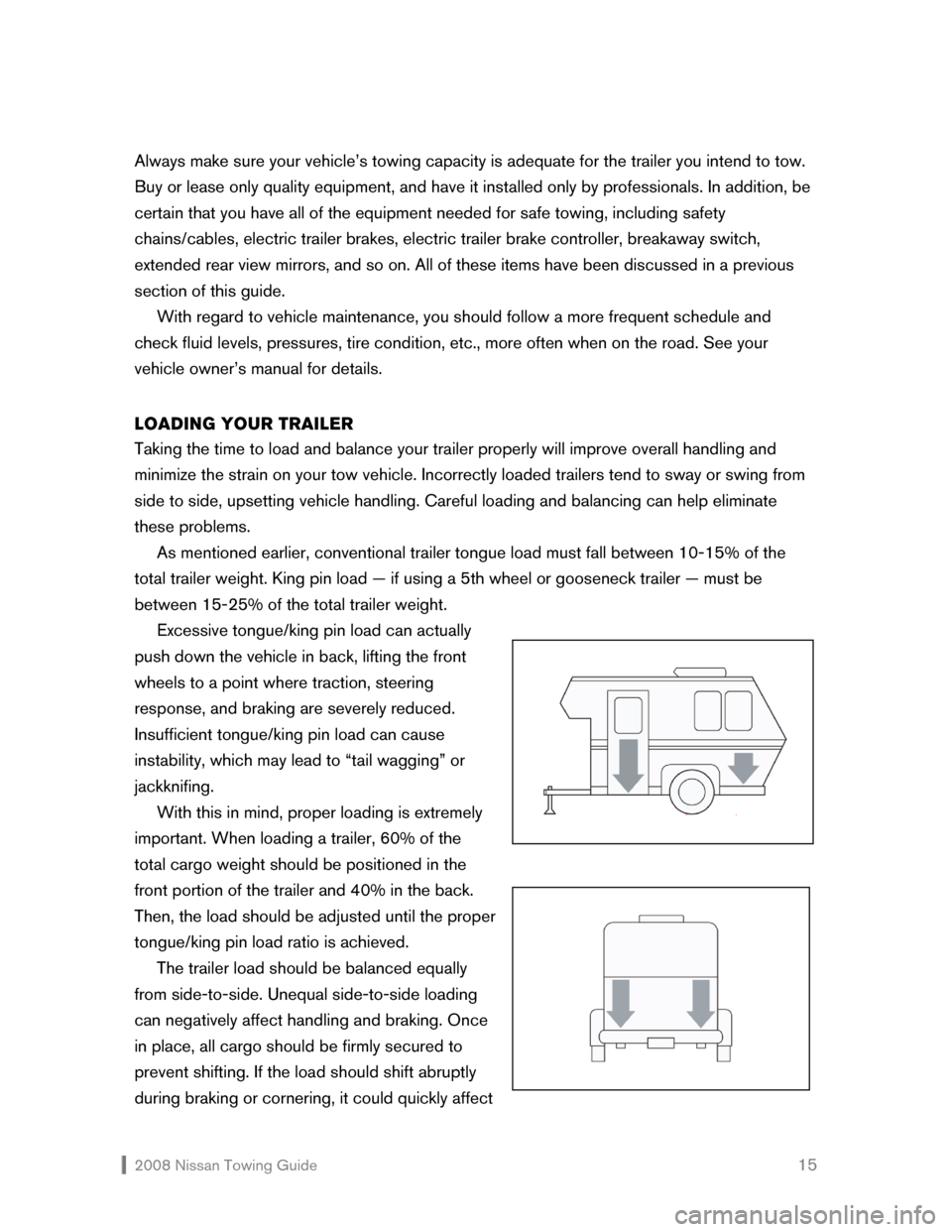
It is important that your trailer floor
and tongue ride as level as possible.
This will help prevent over-angling,
bottoming-out, and improper load
transfer. Therefore, the hitch or trailer
tongue must be adjusted during the
initial vehicle/trailer fit-up to ensure a
level ride. Ball mounts are available in
different configurations to
adjust the hitch ball height.
TIRE PRESSURE
When towing a trailer, increase tow vehicle tire pressures to the recommended cold
specifications. You will find these figures in the vehicle owner’s manual and on the tire
pressure chart located in the vehicle. Trailer tire condition, size, load rating, and inflation
pressure must be in accordance with the trailer and tire manufacturer’s specifications.
TOWING
SAFETY
Towing can dramatically alter the handling and performance characteristics of your vehicle.
Plus, it puts increased strain on the engine and drivetrain. Therefore, it is always a good idea
to approach towing from the standpoint of safety — whether you’re purchasing equipment or
actually pulling the trailer.
Page 16 of 32
2008 Nissan Towing Guide 15 Always make sure your vehicle’s towing capacity is adequate for the trailer you intend to tow.
Buy or lease only quality equipment, and have it installed only by professionals. In addition, be
certain that you have all of the equipment needed for safe towing, including safety
chains/cables, electric trailer brakes, electric trailer brake controller, breakaway switch,
extended rear view mirrors, and so on. All of these items have been discussed in a previous
section of this guide.
With regard to vehicle maintenance, you should follow a more frequent schedule and
check fluid levels, pressures, tire condition, etc., more often when on the road. See your
vehicle owner’s manual for details.
LOADING YOUR TRAILER
Taking the time to load and balance your trailer properly will improve overall handling and
minimize the strain on your tow vehicle. Incorrectly loaded trailers tend to sway or swing from
side to side, upsetting vehicle handling. Careful loading and balancing can help eliminate
these problems.
As mentioned earlier, conventional trailer tongue load must fall between 10-15% of the
total trailer weight. King pin load — if using a 5th wheel or gooseneck trailer — must be
between 15-25% of the total trailer weight.
Excessive tongue/king pin load can actually
push down the vehicle in back, lifting the front
wheels to a point where traction, steering
response, and braking are severely reduced.
Insufficient tongue/king pin load can cause
instability, which may lead to “tail wagging” or
jackknifing.
With this in mind, proper loading is extremely
important. When loading a trailer, 60% of the
total cargo weight should be positioned in the
front portion of the trailer and 40% in the back.
Then, the load should be adjusted until the proper
tongue/king pin load ratio is achieved.
The trailer load should be balanced equally
from side-to-side. Unequal side-to-side loading
can negatively affect handling and braking. Once
in place, all cargo should be firmly secured to
prevent shifting. If the load should shift abruptly
during braking or cornering, it could quickly affect
Page 17 of 32

2008 Nissan Towing Guide 16 the handling of your vehicle and cause a very unsafe situation.
Finally, do not carry flammable materials, such as gasoline, in your trailer. In the event of an
accident, an explosion or fire could occur.
ENSURING VEHICLE/TRAILER STABILITY
Improper loading, excessive or insufficient trailer tongue/king pin load, overloading, excessive
trailer weight, poorly designed trailer suspensions, crosswinds, and poor maintenance are all
things that can affect the stability of your vehicle and trailer combination.
If swaying does occur, check the cargo load for proper balance and distribution to ensure
proper trailer tongue/king pin load. In addition, check the condition of the suspension and
shocks, as well as the tires, tire pressures, and wheel bearings on both the tow vehicle and
the trailer. If swaying occurs because of high winds or poor weather conditions, wait until
these conditions improve before resuming your trip.
If the swaying continues and you feel your trailer is suitably balanced and within the towing
capacity limits of your vehicle, discontinue towing and consult your Nissan dealer or trailer
manufacturer to determine the problem. Most important, do not tow until the problem is
corrected.
VEHICLE SPEED
Some states have specific regulations and speed limits for vehicles that are towing trailers.
Always obey these ordinances.
Remember to reduce your speed in unsafe or less-than-ideal road conditions or weather.
When towing a trailer, braking distances increase while handling agility decreases. Always
leave yourself an extra margin of distance to respond to emergency situations.
PASSENGERS
Never allow passengers to ride inside a trailer while it is being towed. Not only is this
unlawful in most areas, passengers could be seriously injured during sudden trailer movement
or in an accident. In addition, trailers may allow fumes from the tow vehicle to leak inside. This
could result in carbon monoxide poisoning from the engine exhaust.
VEHICLE MODIFICATIONS
Vehicle modifications — beyond those required for proper hitch installation, wiring hook-up,
and necessary cooling system upgrading — are not recommended for any Nissan vehicle
being used for towing purposes. Changes to the drivetrain, suspension, exhaust systems,
frame structure/unibody, or other vehicle components are not necessary for towing within the
Page 18 of 32

2008 Nissan Towing Guide 17 limits described in this guide. These changes may diminish the reliability and longevity of your
vehicle and possibly void warranty coverage.
TOOL KIT
It is always a good idea to travel with a special tool kit when towing. In addition to tools, it
should contain flares, a flashlight, emergency reflectors, jumper cables, extra fuses, extra
radiator coolant, oil, and easily replaced spare parts such as taillight bulbs. You should also
carry spare tires for your tow vehicle and trailer, as well as a jack suitable for use on the trailer.
Be aware that not all automotive jacks can be used safely on a trailer.
BEFORE STARTING OUT
Before starting out on a trip, make one last inspection of the tow vehicle and the trailer. Are
the tire pressures correct? Are the safety chains/cables securely in place? Is the cargo tied
down securely? Do all the lights work? Is the coupler properly attached over the hitch ball and
secured using a locking pin? Is the breakaway switch hooked up and functioning properly?
Are vehicle and electric trailer brakes working properly?
Make a checklist of key items to be inspected, and don’t forget the basics. When towing,
vehicle engine oil, transmission oil, and coolant should always be checked before starting out.
Finding a potential problem while in your driveway is better than discovering it miles from
home.
TOWING
TIPS
If you’ve never towed a trailer before, be aware that it does take getting used to. To begin with,
towing noticeably affects your vehicle’s performance:
Š It will not accelerate as quickly — an important point to keep in mind when merging onto a
highway.
Š It will not stop as quickly. Leave more room than usual between you and the traffic ahead,
and brake sooner when coming to a stop.
Š Abrupt maneuvering can unbalance the load and reduce the handling stability of your tow
vehicle. Plan ahead and make lane changes and turns smoothly.
If possible, before you actually hit the open road, practice towing in a large uncrowded area
such as a stadium or shopping center parking lot. Become especially familiar with backing up
a trailer — the maneuver many people find most difficult.
Page 19 of 32

2008 Nissan Towing Guide 18 REDUCE SPEED
Drive your vehicle at a moderate speed, and remember to reduce your speed in unsafe or
less-than-ideal road conditions or weather. The tendency for a trailer to sway increases with
speed, and such swaying can result in a loss of control.
BRAKE SOONER
The combination of your tow vehicle and trailer obviously requires a greater distance to stop.
A good rule of thumb to remember is that for each 10 mph of speed, allow yourself one tow
vehicle and trailer length of distance between the front of your vehicle and the vehicle ahead.
When braking, use firm but gradual pressure on the pedal rather than panic braking.
Applying the brakes abruptly or with too much force can cause the trailer to skid or jackknife
at its point of attachment with the vehicle. This, in turn, can throw the tow vehicle out of
control. If equipped with an electric trailer brake controller, follow the recommended
operational instructions.
PASS CAREFULLY
As mentioned in the introduction to this section, because of the added weight of the trailer,
acceleration capability is reduced and you’ll require a longer distance to pass another vehicle.
Be certain you have sufficient time and space to pass safely. Obviously, never attempt passing
on hills or when going around curves.
CORNER MORE SLOWLY
Know your vehicle and trailer capabilities. Entering a sharp corner too quickly or abruptly can
“crack the whip,” whereby the trailer can actually pull the tow vehicle off the road. Therefore,
when approaching a relatively sharp corner, begin braking sooner than you would when not
towing. Do your braking in a straight line prior to the corner, and turn smoothly into it. In
addition, remember to make a wider turn than normal to ensure that the trailer safely clears the
inside of the turn.
When towing a 5th wheel or gooseneck trailer, do not make sharp turns while driving or
backing as the trailer may contact the vehicle and cause damage to both the trailer and
vehicle. A special extended 5th wheel pin box or sliding hitch may be required to provide
additional trailer-to-truck clearance for tight maneuvering.
BACK UP WITH CAUTION
Backing up with a trailer is a difficult maneuver; however, there is a “trick” that can simplify the
procedure considerably. Simply steer with one hand at the bottom of the steering wheel. To
turn the trailer to the left, first move the steering wheel to the left. To turn the trailer to the right,
Page 20 of 32

2008 Nissan Towing Guide 19 move the wheel to the right. All movements of the wheel should be done in small increments.
Of course, backing up should be done only at very slow speeds. For large trailers that
obstruct your rearward vision, have someone outside the vehicle act as a “spotter” to guide
you along.
PARK SMART
A tow vehicle and trailer can be an unwieldy combination in a small area, so always try to park
where you will have a relatively easy time maneuvering. Once parked, always block the wheels
on both the tow vehicle and the trailer.
Parking on a slope is not recommended. If, however, you must park on a slope and your
vehicle is equipped with an automatic transmission, there are some precautions you should
take:
Š Have someone block the wheels once the tow vehicle and trailer are in position and being
held by the vehicle’s brake.
Š Next, apply the parking brake and only then move the gear lever into PARK. If you move the
lever into PARK before blocking the wheels and applying the parking brake, transmission
damage may occur.
HIGH-ALTITUDE PERFORMANCE
An engine will lose about 4% of its performance for every 1,000 feet above sea level that you
travel. If you will be towing in high altitudes, it is a good idea to allow more time than usual due
to the engine’s reduced performance.
TOW MODE (IF EQUIPPED)
Tow Mode should be used when the vehicle and trailer weight is at least 75% of the vehicle
GCWR. This mode is most useful when towing a heavy trailer or hauling a heavy load,
particularly when stop-and-go traffic, rolling terrain, or a busy parking lot is involved.
Driving the vehicle in Tow Mode with minimal trailer load will not cause any damage;
however, fuel economy may be reduced and transmission/engine driving characteristics may
feel different.
HILLS – UPGRADES
As the incline increases, shift down to a lower gear to maintain speed and prevent the engine
from lugging. However, for long and steep grades, do not stay in first gear when driving above
35 mph or in second gear above 58 mph. The added weight of a trailer places an increased
load on the engine and cooling system, so monitor your coolant temperature gauge and
Page 21 of 32

2008 Nissan Towing Guide 20 automatic transmission fluid temperature gauge (if equipped) very carefully. At the first sign of
overheating, pull to the side of the road. See IF YOUR ENGINE OVERHEATS later in this
section for more information.
HILLS – DOWNGRADES
While going downhill, the weight of the trailer pushing on the tow vehicle may decrease
overall stability. Therefore, to maintain adequate control, reduce your speed and shift to a
lower gear.
Avoid long or repeated use of the brakes when descending a hill, as this reduces their
effectiveness and could cause overheating. Shifting to a lower gear instead provides “engine
braking” and reduces the need to brake as frequently.
AUTOMATIC CRUISE CONTROL
Do not use cruise control while towing a trailer.
IF YOUR ENGINE OVERHEATS
A moderate increase in engine operating temperature is normal when towing a trailer. If,
however, the coolant temperature gauge reading is abnormally high, or if you are experiencing
a significant loss of power, or if you hear unusual engine noises,* the engine may be
overheating and you should immediately take the following steps:
1. Pull your vehicle safely over to the side of the road, out of traffic. Apply the parking brake
and move the gearshift lever to NEUTRAL (manual) or PARK (automatic). DO NOT STOP
THE ENGINE.
2. Turn off the air conditioning and, after opening all the windows, turn the heater on to
maximum hot and the fan to its highest speed. The heater core in your vehicle is just like a
miniature engine radiator and will provide an extra cooling surface to help reduce engine
temperature.
3. Run the engine at a fast idle (approximately 1,500 rpm) until the temperature gauge returns
to a normal reading. If the temperature does not drop or continues to increase, stop this
step immediately.
4. Being cautious of traffic, step out of the vehicle and, from a safe distance, look for steam
underneath the engine. If you see steam or leaking coolant, stand clear to avoid being
burned and shut off your engine immediately and allow it to cool. If there is no steam, open
the hood. Never remove the radiator cap when the radiator is hot. If the cap is removed
under these conditions, hot water under high pressure may spurt out, possibly causing
*See your vehicle owner’s manual for additional indications that your vehicle may be overheating.
Page 22 of 32

2008 Nissan Towing Guide 21 serious injury.
5. As soon as the engine has cooled to its normal operating temperature, visually inspect
the drive belts for damage or looseness. A loose belt reduces water pump efficiency. Be
careful to keep your hands, hair, jewelry, and clothing clear of the running drive belt and
other moving parts when inspecting the engine and radiator. Also check to see if the
cooling fan is running, and inspect the water pump, radiator, and radiator hoses for leaks.
Keep in mind, too, that if your vehicle is equipped with an electric fan motor, it may start
without warning any time the coolant temperature is high. If you find leaking coolant, a
loose or missing drive belt, or an inoperable fan, turn off the engine immediately.
6. If no leaks are apparent and all other components appear to be operating properly with
the engine cooled to its normal operating temperature, check the coolant level in the
reservoir tank with the engine running. Add coolant to the reservoir tank if needed. At this
point, if repairs are required, go to the nearest Nissan dealer. See the IN CASE OF
EMERGENCY section of your vehicle owner’s manual for additional information on
overheating.
NOTE – Armada, Frontier, Pathfinder, and Titan vehicles have an engine protection mode,
which helps reduce the chance of engine damage if the engine coolant reaches a specified
temperature. See your vehicle owner’s manual for details.
TOWING
GLOSSARY
5TH WHEEL
HITCH Located just forward of the rear axle centerline, this hitch uses a
king pin to serve as the pivot point for the trailer.
BALL MOUNT A bar that holds the hitch ball and is inserted into the hitch receiver.
Also commonly called a drawbar or “stinger.”
BREAKAWAY SWITCH A safety device using a trailer battery that automatically applies the
trailer’s brakes if it should accidentally become separated from the
tow vehicle. A breakaway switch may be used with both electric or
surge trailer brake systems.
BUMPER HITCH A reinforced bumper designed to accommodate a hitch ball.
ELECTRIC TRAILER
BRAKES When the brakes on a tow vehicle are applied, an electric current is
sent to an actuator which applies the trailer’s brakes.
ELECTRIC TRAILER
BRAKE CONTROLLER A device that controls the electric trailer brakes.