fuel NISSAN VERSA NOTE 2015 2.G Owner's Guide
[x] Cancel search | Manufacturer: NISSAN, Model Year: 2015, Model line: VERSA NOTE, Model: NISSAN VERSA NOTE 2015 2.GPages: 384, PDF Size: 3.82 MB
Page 316 of 384
UnderbodyThe underbody is frequently ex-
posed to corrosive substances such as those
used on icy roads or to control dust. It is very
important to remove these substances from the
underbody, otherwise rust may form on the floor
pan, frame, fuel lines and exhaust system. At the
end of winter, the underbody should be thor-
oughly flushed with plain water, in those areas
where mud and dirt may have accumulated. For
additional information, refer to the “Appearance
and care” section of this manual.
Windshield–washer fluid* Check that there is
adequate fluid in the reservoir. When performing any inspection or maintenance
work on your vehicle, always take care to prevent
serious accidental injury to yourself or damage to
the vehicle. The following are general precau-
tions which should be closely observed.
WARNING
●
Park the vehicle on a level surface, ap-
ply the parking brake securely and
block the wheels to prevent the vehicle
from moving. For manual transmission
models, move the shift lever to N (Neu-
tral) . For CVT models, move the shift
lever to P (Park) .
● Be sure the ignition switch is placed in
the OFF or LOCK position when per-
forming any parts replacement or
repairs.
● Your vehicle is equipped with an auto-
matic engine cooling fan. It may come
on at any time without warning, even if
the ignition switch is placed in the OFF
position and the engine is not running.
To avoid injury, always disconnect the
negative battery cable before working
near the fan. ●
If you must work with the engine run-
ning, keep your hands, clothing, hair
and tools away from moving fans, belts
and any other moving parts.
● It is advisable to secure or remove any
loose clothing and remove any jewelry,
such as rings, watches, etc. before
working on your vehicle.
● Always wear eye protection whenever
you work on your vehicle.
● If you must run the engine in an en-
closed space such as a garage, be sure
there is proper ventilation for exhaust
gases to escape.
● Never get under the vehicle while it is
supported only by a jack. If it is neces-
sary to work under the vehicle, support
it with safety stands.
● Keep smoking materials, flame and
sparks away from the fuel tank and
battery.
● The fuel filter or fuel lines should be
serviced by a NISSAN dealer because
the fuel lines are under high pressure
even when the engine is off.
MAINTENANCE PRECAUTIONS
Maintenance and do-it-yourself8-5
Page 354 of 384
9 Technical and consumer information
Recommended fluids/lubricants and capacities.......9-2
Recommended fuel .............................9-4
Engine oil and oil filter recommendations ..........9-6
Air conditioner system refrigerant and oil
recommendations ..............................9-7
Specifications .....................................9-8
Engine ........................................9-8
Wheels and tires ...............................9-9
Dimensions and weights ........................9-9
When traveling or registering your vehicle in
another country .................................. 9-10
Vehicle identification .............................. 9-10
Vehicle identification number (VIN) plate .........9-10
Vehicle identification number
(chassis number) .............................. 9-10
Engine serial number ........................... 9-11
F.M.V.S.S./C.M.V.S.S. certification label ..........9-11 Emission control information label
...............9-11
Tire and loading information label ................9-12
Air conditioner specification label ................9-12
Installing front license plate ........................9-13
Vehicle loading information ........................9-13
Terms ........................................ 9-13
Determining vehicle load capacity . . .............9-14
Loading tips .................................. 9-16
Measurement of weights .......................9-16
Towing a trailer ................................... 9-17
Flat towing for front wheel drive vehicle ..........9-17
Uniform tire quality grading ........................9-17
Emission control system warranty ..................9-18
Reporting safety defects .......................... 9-19
Readiness for inspection/maintenance (I/M) test .....9-20
Event Data Recorders (EDR) .......................9-20
Owner’s Manual/Service Manual order information . . . 9-21
Page 355 of 384
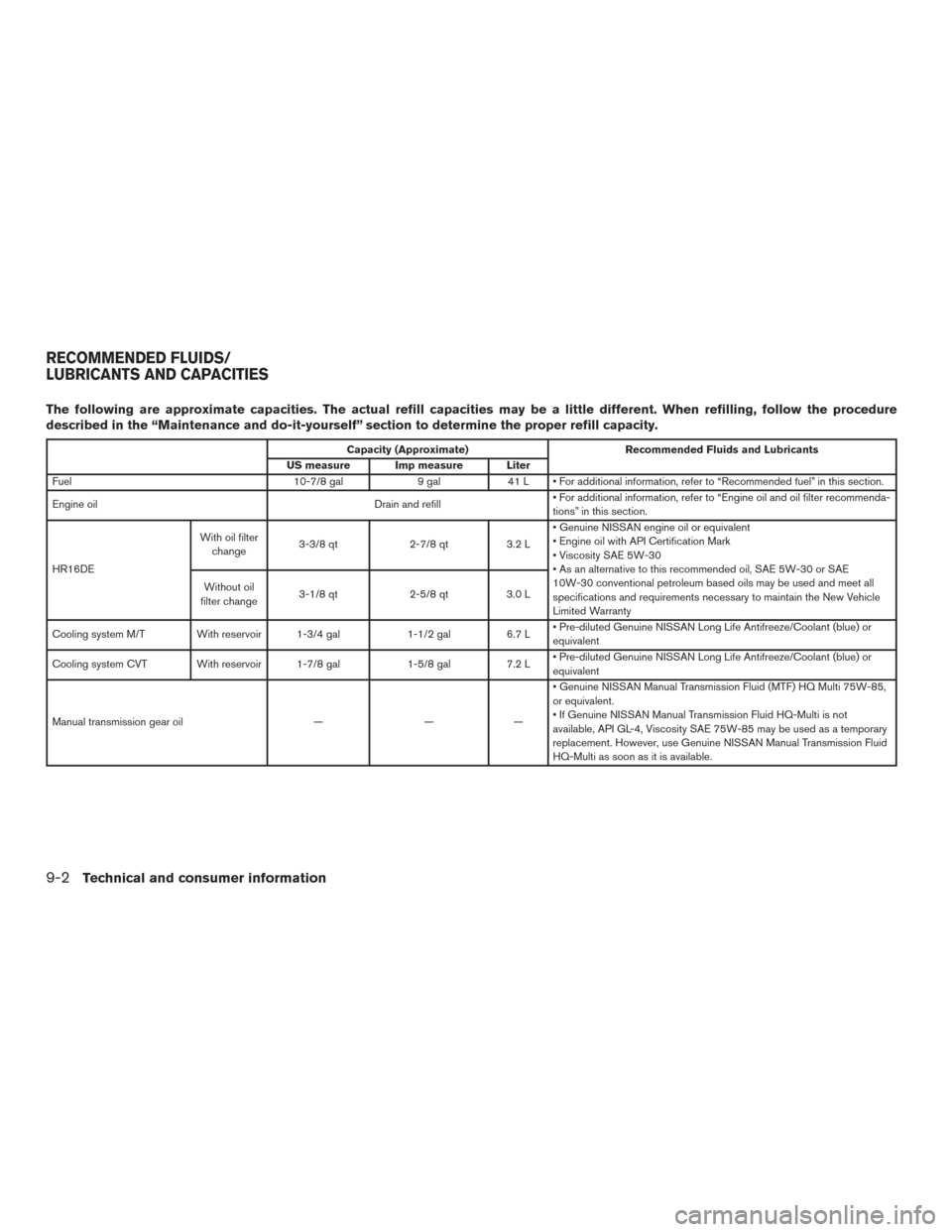
The following are approximate capacities. The actual refill capacities may be a little different. When refilling, follow the procedure
described in the “Maintenance and do-it-yourself” section to determine the proper refill capacity.
Capacity (Approximate)Recommended Fluids and Lubricants
US measure Imp measure Liter
Fuel 10-7/8 gal9 gal41 L • For additional information, refer to “Recommended fuel” in this section.
Engine oil Drain and refill• For additional information, refer to “Engine oil and oil filter recommenda-
tions” in this section.
HR16DE With oil filter
change 3-3/8 qt
2-7/8 qt3.2 L• Genuine NISSAN engine oil or equivalent
• Engine oil with API Certification Mark
• Viscosity SAE 5W-30
• As an alternative to this recommended oil, SAE 5W-30 or SAE
10W-30 conventional petroleum based oils may be used and meet all
specifications and requirements necessary to maintain the New Vehicle
Limited Warranty
Without oil
filter change 3-1/8 qt
2-5/8 qt3.0 L
Cooling system M/T With reservoir 1-3/4 gal 1-1/2 gal6.7 L• Pre-diluted Genuine NISSAN Long Life Antifreeze/Coolant (blue) or
equivalent
Cooling system CVT With reservoir 1-7/8 gal 1-5/8 gal7.2 L• Pre-diluted Genuine NISSAN Long Life Antifreeze/Coolant (blue) or
equivalent
Manual transmission gear oil ———• Genuine NISSAN Manual Transmission Fluid (MTF) HQ Multi 75W-85,
or equivalent.
• If Genuine NISSAN Manual Transmission Fluid HQ-Multi is not
available, API GL-4, Viscosity SAE 75W-85 may be used as a temporary
replacement. However, use Genuine NISSAN Manual Transmission Fluid
HQ-Multi as soon as it is available.
RECOMMENDED FLUIDS/
LUBRICANTS AND CAPACITIES
9-2Technical and consumer information
Page 357 of 384
RECOMMENDED FUEL
Use unleaded regular gasoline with an octane
rating of at least 87 AKI (Anti-Knock Index) num-
ber (Research octane number 91) .
CAUTION
●Only vehicles with the E-85 filler door
label can operate on E-85. Fuel system
or other damage can occur if E-85 is
used in vehicles that are not designed
to run on E-85.
● Using a fuel other than that specified
could adversely affect the emission
control system, and may also affect the
warranty coverage.
● Under no circumstances should a
leaded gasoline be used, because this
will damage the three-way catalyst.
● Do not use E-15 or E-85 fuel in your
vehicle. Your vehicle is not designed to
run on E-15 or E-85 fuel. Using E-15 or
E-85 fuel in a vehicle not specifically
designed for E-15 or E-85 fuel can ad-
versely affect the emission control de-
vices and systems of the vehicle. Dam-
age caused by such fuel is not covered
by the NISSAN new vehicle limited
warranty. ●
U.S. government regulations require
ethanol dispensing pumps to be identi-
fied by a small, square, orange and
black label with the common abbrevia-
tion or the appropriate percentage for
that region.Gasoline specifications
NISSAN recommends using gasoline that meets
the World-Wide Fuel Charter (WWFC) specifi-
cations where it is available. Many of the automo-
bile manufacturers developed this specification
to improve emission control system and vehicle
performance. Ask your service station manager if
the gasoline meets the WWFC specifications.
Reformulated gasoline
Some fuel suppliers are now producing reformu-
lated gasolines. These gasolines are specially
designed to reduce vehicle emissions. NISSAN
supports efforts towards cleaner air and sug-
gests that you use reformulated gasoline when
available.
Gasoline containing oxygenates
Some fuel suppliers sell gasoline containing oxy-
genates such as ethanol, MTBE and methanol
with or without advertising their presence.
NISSAN does not recommend the use of fuels of
which the oxygenate content and the fuel com- patibility for your NISSAN cannot be readily de-
termined. If in doubt, ask your service station
manager.
If you use oxygenate-blend gasoline, please take
the following precautions as the usage of such
fuels may cause vehicle performance problems
and/or fuel system damage.
● The fuel should be unleaded and have
an octane rating no lower than that
recommended for unleaded gasoline.
● If an oxygenate-blend other than
methanol blend is used, it should con-
tain no more than 10% oxygenate.
(MTBE may, however, be added up to
15%.)
● E-15 fuel contains more than 10% oxy-
genate. E-15 fuel will adversely affect
the emission control devices and sys-
tems of the vehicle and should not be
used. Damage caused by such fuel is
not covered by the NISSAN new vehicle
limited warranty.
9-4Technical and consumer information
Page 358 of 384
●If a methanol blend is used, it should
contain no more than 5% methanol
(methyl alcohol, wood alcohol) . It
should also contain a suitable amount
of appropriate cosolvents and corro-
sion inhibitors. If not properly formu-
lated with appropriate cosolvents and
corrosion inhibitors, such methanol
blends may cause fuel system damage
and/or vehicle performance problems.
At this time, sufficient data is not avail-
able to ensure that all methanol blends
are suitable for use in NISSAN ve-
hicles.
If any driveability problems such as engine stall-
ing and difficult hot-starting are experienced after
using oxygenate-blend fuels, immediately
change to a non-oxygenate fuel or a fuel with a
low blend of MTBE.
Take care not to spill gasoline during refu-
eling. Gasoline containing oxygenates can
cause paint damage.
E–15 fuel
E-15 fuel is a mixture of approximately 15% fuel
ethanol and 85% unleaded gasoline. E-15 can
only be used in vehicles designed to run on E-15
fuel. Do not use E-15 in your vehicle. U.S. gov-
ernment regulations require fuel ethanol dispens-
ing pumps to be identified with small, square, orange and black label with the common abbre-
viation or the appropriate percentage for that
region.
E–85 fuel
E-85 fuel is a mixture of approximately 85% fuel
ethanol and 15% unleaded gasoline. E-85 can
only be used in a Flexible Fuel Vehicle (FFV) . Do
not use E-85 in your vehicle. U.S. government
regulations require fuel ethanol dispensing
pumps to be identified by a small, square, orange
and black label with the common abbreviation or
the appropriate percentage for that region.
Aftermarket fuel additives
NISSAN does not recommend the use of any
aftermarket fuel additives (for example, fuel injec-
tor cleaner, octane booster, intake valve deposit
removers, etc.) which are sold commercially.
Many of these additives intended for gum, varnish
or deposit removal may contain active solvents or
similar ingredients that can be harmful to the fuel
system and engine.
Octane rating tips
Using unleaded gasoline with an octane
rating lower than recommended can cause
persistent, heavy “spark knock.” (“Spark
knock” is a metallic rapping noise.) If se-
vere, this can lead to engine damage. If youdetect a persistent heavy spark knock even
when using gasoline of the stated octane
rating, or if you hear steady spark knock
while holding a steady speed on level
roads, have a NISSAN dealer correct the
condition. Failure to correct the condition
is misuse of the vehicle, for which NISSAN
is not responsible.
Incorrect ignition timing may result in spark
knock, after-run and/or overheating, which may
cause excessive fuel consumption or engine
damage. If any of the above symptoms are en-
countered, have your vehicle checked at a
NISSAN dealer.
However, now and then you may notice
light spark knock for a short time while
accelerating or driving up hills. This is not a
cause for concern, because you get the
greatest fuel benefit when there is light
spark knock for a short time under heavy
engine load.
Technical and consumer information9-5
Page 359 of 384
ENGINE OIL AND OIL FILTER
RECOMMENDATIONS
Selecting the correct oil
It is essential to choose the correct grade, quality
and viscosity engine oil to ensure satisfactory
engine life and performance. For additional infor-
mation, refer to “Recommended fluids/lubricants
and capacities” in this section. NISSAN recom-
mends the use of an energy conserving oil in
order to improve fuel economy.
Select only engine oils that meet the American
Petroleum Institute (API) certification or Interna-
tional Lubricant Standardization and ApprovalCommittee (ILSAC) certification and SAE vis-
cosity standard. These oils have the API certifica-
tion mark on the front of the container. Oils which
do not have the specified quality label should not
be used as they could cause engine damage.Oil additives
NISSAN does not recommend the use of oil
additives. The use of an oil additive is not neces-
sary when the proper oil type is used and main-
tenance intervals are followed.
Oil which may contain foreign matter or has been
previously used should not be used.
Oil viscosity
The engine oil viscosity or thickness changes
with temperature. Because of this, it is important
to select the engine oil viscosity based on the
temperatures at which the vehicle will be oper-
ated before the next oil change. Choosing an oil
viscosity other than that recommended could
cause serious engine damage.
Selecting the correct oil filter
Your new NISSAN vehicle is equipped with a
high-quality Genuine NISSAN oil filter. When
replacing, use a Genuine NISSAN oil filter or its
equivalent for the reason described in “Change
intervals.”
Change intervals
The oil and oil filter change intervals for your
engine are based on the use of the specified
quality oils and filters. Using engine oil and filters
that are not of the specified quality, or exceeding
recommended oil and filter change intervals
could reduce engine life. Damage to the engine
caused by improper maintenance or use of incor-
rect oil and filter quality and/or viscosity is not
covered by the NISSAN new vehicle limited war-
ranty.
LTI2061
9-6Technical and consumer information
Page 363 of 384
When planning to drive your NISSAN ve-
hicle in another country,you should first find
out if the fuel available is suitable for your vehi-
cle’s engine.
Using fuel with an octane rating that is too low
may cause engine damage. All gasoline vehicles
must be operated with unleaded gasoline. There-
fore, avoid taking your vehicle to areas where
appropriate fuel is not available.
When transferring the registration of your
vehicle to another country, state, province
or district, it may be necessary to modify the
vehicle to meet local laws and regulations.
The laws and regulations for motor vehicle emis-
sion control and safety standards vary according
to the country, state, province or district; there-
fore, vehicle specifications may differ.
When any vehicle is to be taken into an-
other country, state, province or district and
registered, its modifications, transporta-
tion and registration are the responsibility
of the user. NISSAN is not responsible for
any inconvenience that may result.
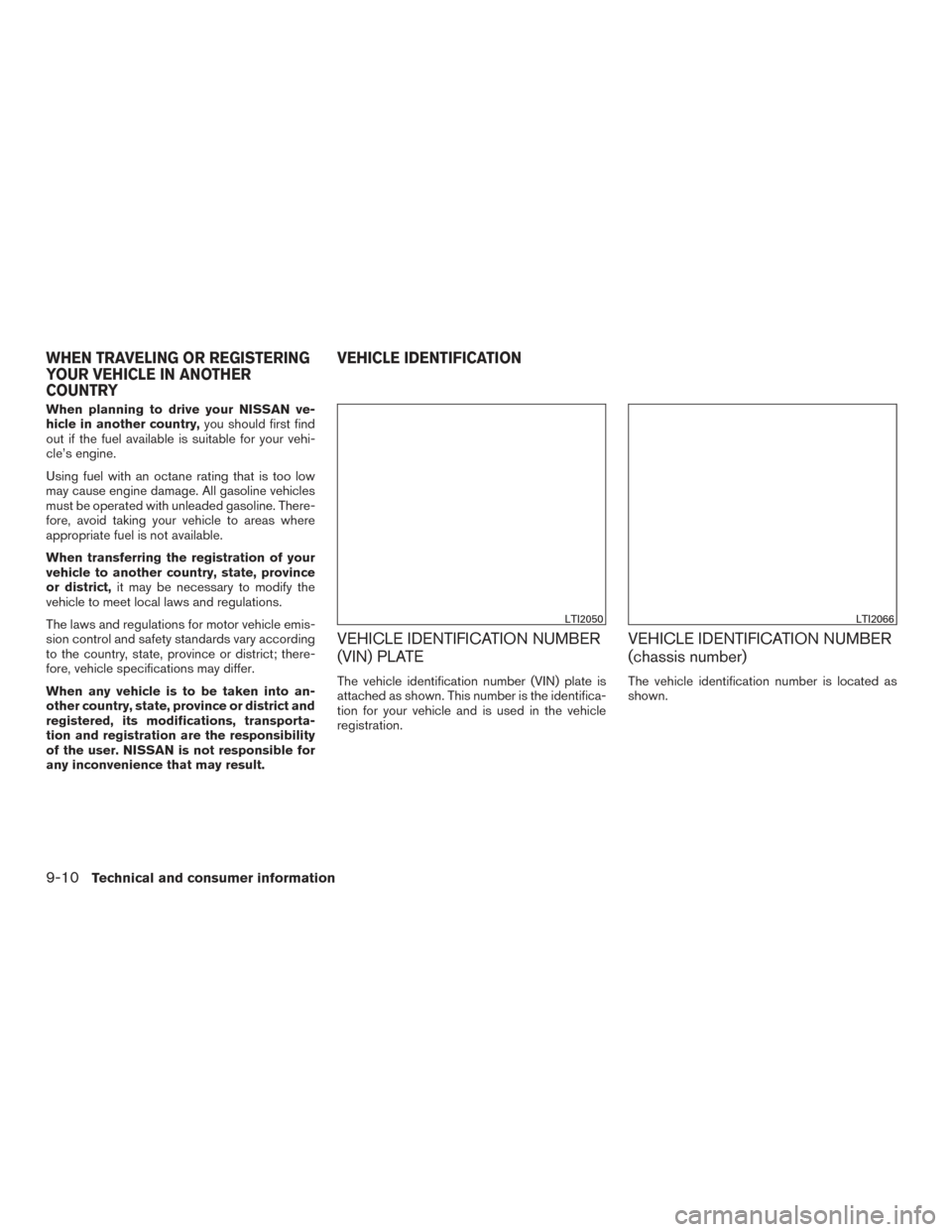
VEHICLE IDENTIFICATION NUMBER
(VIN) PLATE
The vehicle identification number (VIN) plate is
attached as shown. This number is the identifica-
tion for your vehicle and is used in the vehicle
registration.
VEHICLE IDENTIFICATION NUMBER
(chassis number)
The vehicle identification number is located as
shown.
LTI2050LTI2066
WHEN TRAVELING OR REGISTERING
YOUR VEHICLE IN ANOTHER
COUNTRY VEHICLE IDENTIFICATION
9-10Technical and consumer information
Page 377 of 384
C
Capacities and recommended fuel/lubricants . .9-2
Cargocover...................2-35
Cargo(Seevehicleloadinginformation)....9-13
Car phone or CB radio .............4-76
CD care and cleaning ..............4-72
CD player
(See audio system) .....4-42,4-47,4-52,4-59
Child restraints .......1-19,1-20,1-21,1-23
LATCH (Lower Anchors and Tethers for
CHildren) System ..............1-23
Precautions on child
restraints.........1-21,1-28,1-34,1-39
Top tether strap anchor point locations . .1-25
Child restraint with top tether strap .......1-25
Child safety rear door lock ............3-7
Chimes, audible reminders ...........2-21
Cleaningexteriorandinterior...........7-2
Clock.......................4-41 (models without navigation system) ....4-41
Clockset.....................4-41
Clock set/adjustment ...........4-7,4-45
Clock setting
(models with Navigation System) ........4-4
Clock setting
(models without Navigation System) ......4-41
C.M.V.S.S. certification label ..........9-11
Cold weather driving ...............5-32
Compact disc (CD)
player ............4-42,4-47,4-52,4-59
Continuously Variable Transmission (CVT) . . .5-15 Continuously Variable Transmission (CVT)
fluid ......................8-12 Driving with Continuously Variable
Transmission (CVT)
.............5-15
Control panel buttons ...............4-4
Brightness/contrast button ..........4-9
Enterbutton..................4-4
Setting button .............4-7,4-45
Controls Audio controls (steering wheel) .......4-72
Heater and air conditioner controls .....4-23
Coolant Capacities and recommended
fuel/lubricants .................9-2
Changingenginecoolant...........8-9
Checking engine coolant level ........8-9
Engine coolant temperature gauge .....2-8
Corrosion protection ...............7-5
Cruisecontrol..................5-21
Cupholders...................2-32
Curtain side-impact air bag system
(See supplemental side air bag and curtain
side-impact air bag system) ...........1-54
D
Daytime running light system (Canada only) . .2-26
Defroster switch Rear window defroster switch .......2-25
Dimensionsandweights.............9-9
Dimmer switch for instrument panel ......2-27
Display controls (see control panel buttons) . .4-4
Door locks .....................3-5
Door open warning light .............2-15
Doors ........................3-5
Drive belt .....................8-17 Driving
Cold weather driving .............5-32
Driving with Continuously Variable
Transmission (CVT) .............5-15
Driving with manual transmission ......5-18
Precautions when starting and driving ....5-2
Driving the vehicle ................5-15
E
Economy-fuel..................5-25
Emission control information label .......9-11
Emission control system warranty .......9-18
Engine Before starting the engine ..........5-13
Blockheater.................5-33
Capacities and recommended
fuel/lubricants.................9-2
Changing engine coolant ...........8-9
Changingengineoil.............8-10
Changing
engine oil filter ..........8-12
Checking engine coolant level ........8-9
Checking engine oil level ...........8-9
Engine compartment check locations ....8-7
Engine coolant temperature gauge .....2-8
Engine cooling system ............8-8
Engineoil ...................8-9
Engine oil and oil filter recommendation . . .9-6
Engine oil pressure warning light ......2-15
Engine oil viscosity ..............9-6
Engine serial number ............9-11
Engine specifications .............9-8
Starting the engine .............5-14
Engine coolant temperature gauge .......2-8
Enter button ....................4-4
10-2
Page 378 of 384
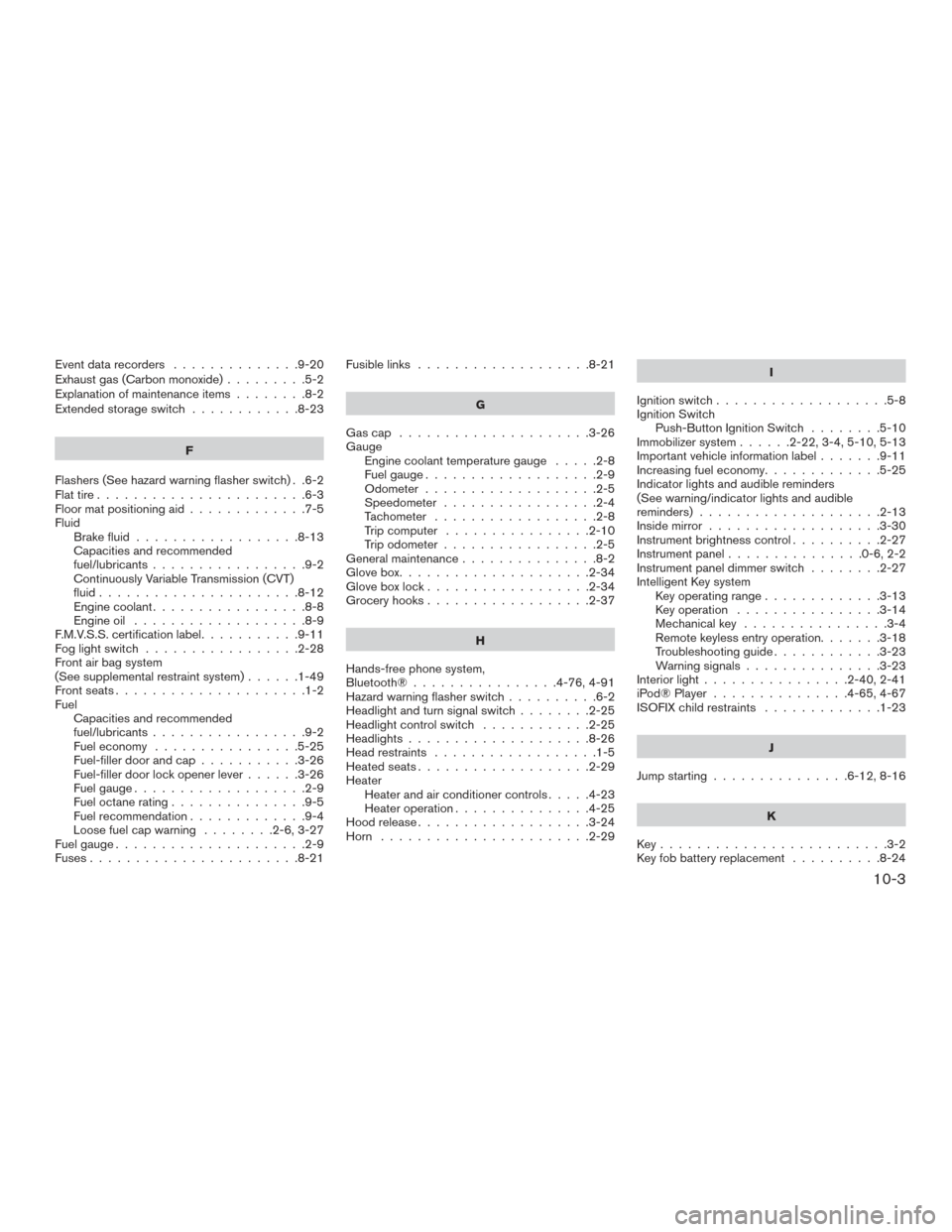
Event data recorders..............9-20
Exhaust gas (Carbon monoxide) .........5-2
Explanation of maintenance items ........8-2
Extendedstorageswitch ............8-23
F
Flashers (See hazard warning flasher switch) . .6-2
Flat tire .......................6-3
Floor mat positioning aid .............7-5
Fluid Brake fluid ..................8-13
Capacities and recommended
fuel/lubricants .................9-2
Continuously Variable Transmission (CVT)
fluid......................8-12
Engine coolant .................8-8
Engine oil ...................8-9
F.M.V.S.S. certification label ...........9-11
Foglightswitch .................2-28
Front air bag system
(See supplemental restraint system) ......1-49
Frontseats.....................1-2
Fuel Capacities and recommended
fuel/lubricants .................9-2
Fuel economy ................5-25
Fuel-filler door and cap ...........3-26
Fuel-filler door lock opener lever ......3-26
Fuel gauge ...................2-9
Fuel octane rating ...............9-5
Fuel recommendation .............9-4
Loose fuel cap warning ........2-6,3-27
Fuel gauge .....................2-9
Fuses.......................8-21 Fusiblelinks ...................8-21
G
Gascap .....................3-26
Gauge Engine coolant temperature gauge .....2-8
Fuel gauge ...................2-9
Odometer ...................2-5
Speedometer .................2-4
Tachometer ..................2-8
Trip computer ................2-10
Trip odometer .................2-5
General maintenance ...............8-2
Glovebox.....................2-34
Gloveboxlock..................2-34
Grocery hooks ..................2-37
H
Hands-free phone system,
Bluetooth®................4-76,4-91
Hazard warning flasher switch ..........6-2
Headlight and turn signal switch ........2-25
Headlight control switch ............2-25
Headlights ....................8-26
Head restraints ..................1-5
Heated seats ...................2-29
Heater Heater and air conditioner controls .....4-23
Heater operation ...............4-25
Hood release ...................3-24
Horn .......................2-29 I
Ignition switch ...................5-8
Ignition Switch Push-Button Ignition Switch ........5-10
Immobilizer system ......2-22,3-4,5-10,5-13
Important vehicle information label .......9-11
Increasing fuel economy .............5-25
Indicator
lights and audible reminders
(See warning/indicator lights and audible
reminders)....................2-13
Inside mirror ...................3-30
Instrument brightness control ..........2-27
Instrumentpanel...............0-6,2-2
Instrument panel dimmer switch ........2-27
Intelligent Key system Key operating range .............3-13
Key operation ................3-14
Mechanical key ................3-4
Remote keyless entry operation.......3-18
Troubleshooting guide ............3-23
Warning signals ...............3-23
Interior light ................2-40,2-41
iPod®Player ............... 4-65, 4-67
ISOFIX child restraints .............1-23
J
Jump starting ...............6-12,8-16
K
Key.........................3-2
Key fob battery replacement ..........8-24
10-3
Page 379 of 384
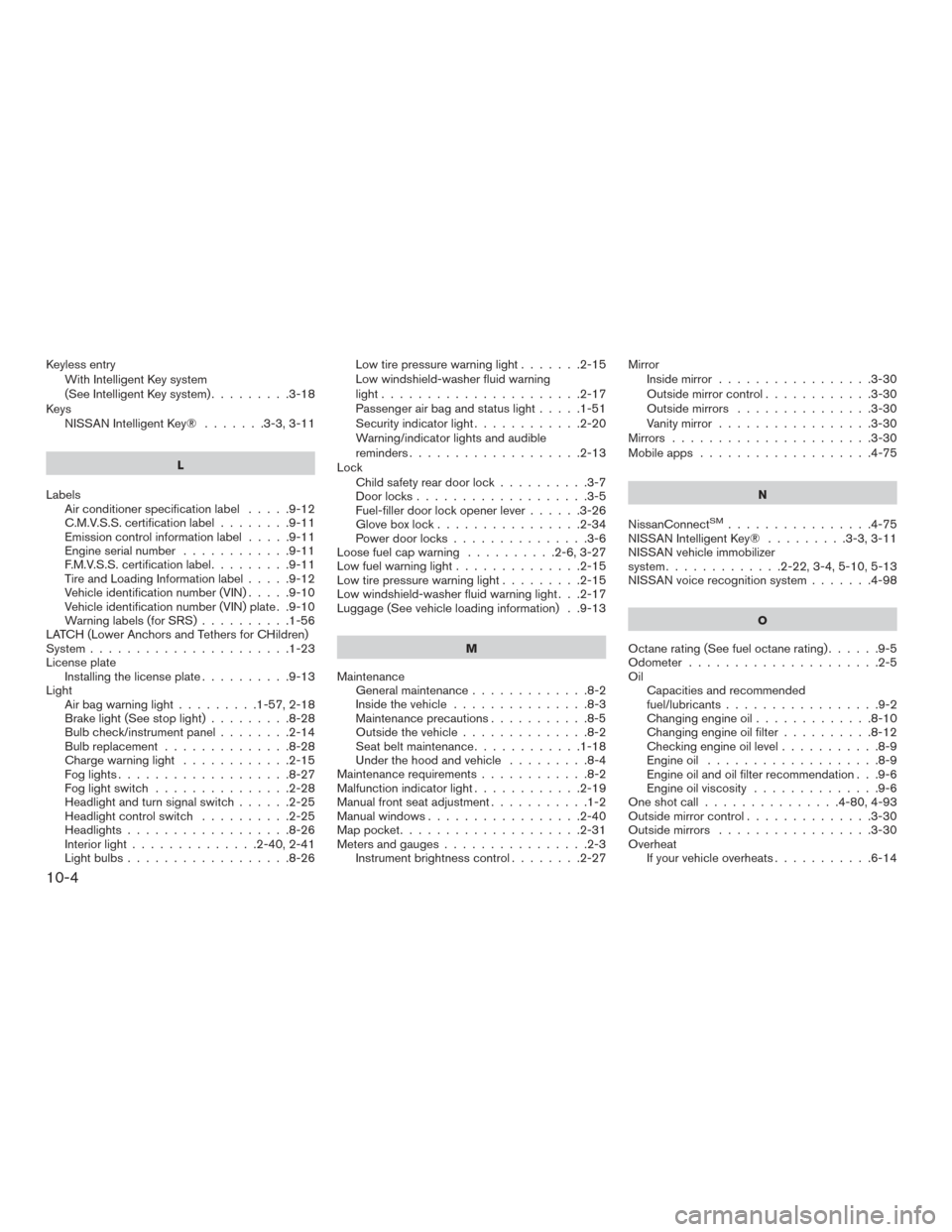
Keyless entryWith Intelligent Key system
(See Intelligent Key system) .........3-18
Keys NISSAN Intelligent Key® .......3-3,3-11
L
Labels Air conditioner specification label .....9-12
C.M.V.S.S. certification label ........9-11
Emissioncontrolinformationlabel.....9-11
Engine serial number ............9-11
F.M.V.S.S. certification label .........9-11
Tire and Loading Information label .....9-12
Vehicle identification number (VIN) .....9-10
Vehicle identification number (VIN) plate . .9-10
Warning labels (for SRS) ..........1-56
LATCH (Lower Anchors and Tethers for CHildren)
System ......................1-23
License plate Installing the license plate ..........9-13
Light Airbagwarninglight.........1-57,2-18
Brake light (See stop light) .........8-28
Bulb check/instrument panel ........2-14
Bulb replacement ..............8-28
Charge warning light ............2-15
Foglights...................8-27
Foglightswitch ...............2-28
Headlight and turn signal switch ......2-25
Headlight control switch ..........2-25
Headlights ..................8-26
Interiorlight..............2-40,2-41
Lightbulbs..................8-26 Low tire pressure warning light
.......2-15
Low windshield-washer fluid warning
light......................2-17
Passenger air bag and status light .....1-51
Security indicator light ............2-20
Warning/indicator lights and audible
reminders ...................2-13
Lock Child safety rear door lock ..........3-7
Door locks ...................3-5
Fuel-filler door lock opener lever ......3-26
Gloveboxlock................2-34
Power door locks ...............3-6
Loose fuel cap warning ..........2-6,3-27
Lowfuelwarninglight..............2-15
Low tire pressure warning light .........2-15
Low windshield-washer fluid warning light . . .2-17
Luggage (See vehicle loading information) . .9-13
M
Maintenance Generalmaintenance.............8-2
Insidethevehicle...............8-3
Maintenance precautions ...........8-5
Outside the vehicle ..............8-2
Seatbeltmaintenance............1-18
Underthehoodandvehicle .........8-4
Maintenancerequirements............8-2
Malfunction indicator light ............2-19
Manual front seat adjustment ...........1-2
Manual windows .................2-40
Map pocket ....................2-31
Meters and gauges ................2-3
Instrument brightness control ........2-27Mirror
Inside mirror .................3-30
Outside mirror control ............3-30
Outside mirrors ...............3-30
Vanity mirror .................3-30
Mirrors ......................3-30
Mobileapps ...................4-75
N
NissanConnect
SM................4-75
NISSAN Intelligent Key® .........3-3,3-11
NISSAN vehicle immobilizer
system .............2-22,3-4,5-10,5-13
NISSAN voice recognition system .......4-98
O
Octane rating (See fuel octane rating) ......9-5
Odometer .....................2-5
Oil Capacities and recommended
fuel/lubricants.................9-2
Changingengineoil.............8-10
Changing engine oil filter ..........8-12
Checking engine oil level ...........8-9
Engineoil ...................8-9
Engine oil and oil filter recommendation . . .9-6
Engine oil viscosity ..............9-6
Oneshotcall...............4-80,4-93
Outside mirror control ..............3-30
Outside mirrors .................3-30
Overheat If your vehicle overheats ...........6-14
10-4