tires NISSAN VERSA SEDAN 2018 Owner´s Manual
[x] Cancel search | Manufacturer: NISSAN, Model Year: 2018, Model line: VERSA SEDAN, Model: NISSAN VERSA SEDAN 2018Pages: 702, PDF Size: 8.98 MB
Page 676 of 702
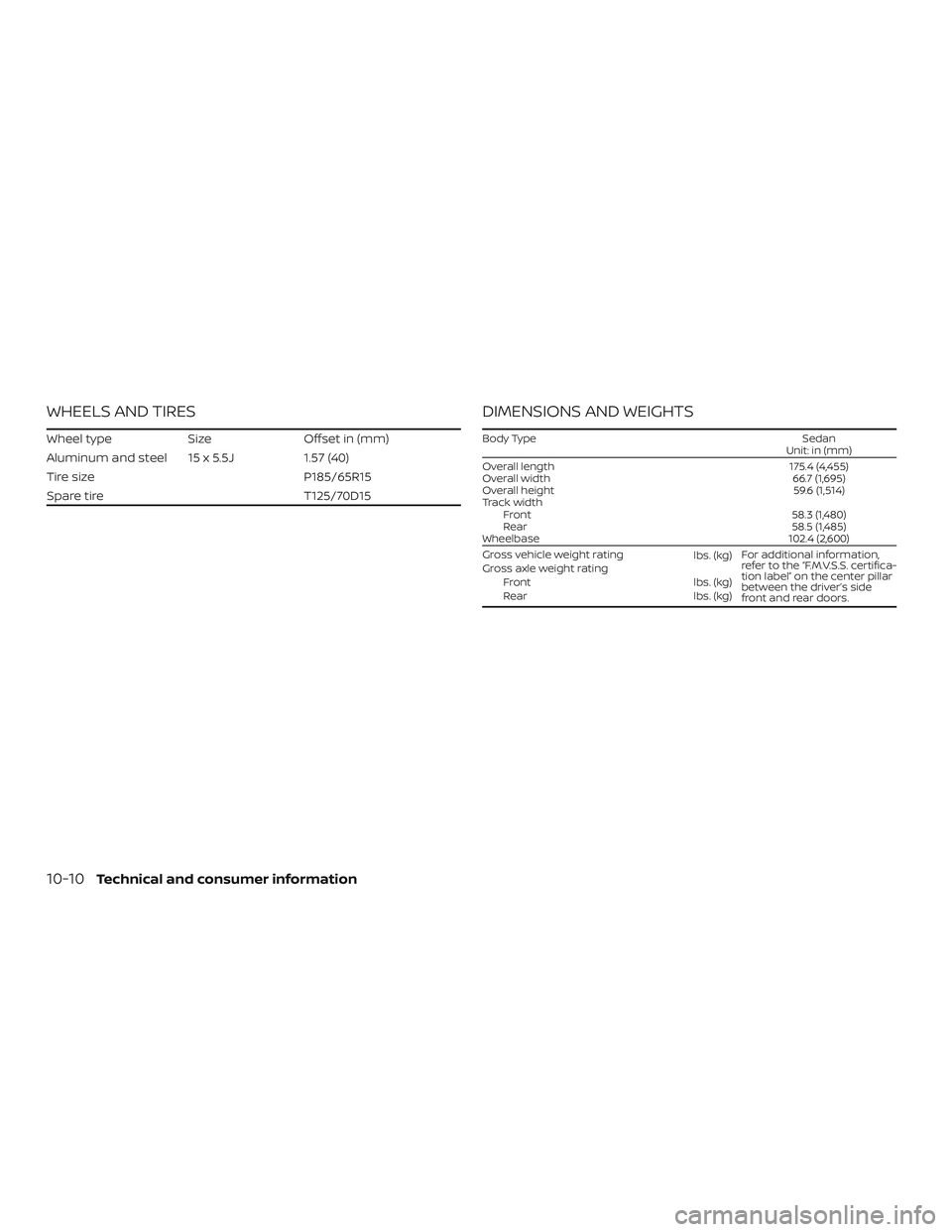
WHEELS AND TIRES
Wheel typeSizeOffset in (mm)
Aluminum and steel 15 x 5.5J 1.57 (40)
Tire size P185/65R15
Spare tire T125/70D15
DIMENSIONS AND WEIGHTS
Body Type Sedan
Unit: in (mm)
Overall length 175.4 (4,455)
Overall width 66.7 (1,695)
Overall height 59.6 (1,514)
Track width Front 58.3 (1,480)
Rear 58.5 (1,485)
Wheelbase 102.4 (2,600)
Gross vehicle weight rating lbs. (kg)For additional information,
refer to the “F.M.V.S.S. certifica-
tion label” on the center pillar
between the driver’s side
front and rear doors.
Gross axle weight rating
Front lbs. (kg)
Rear lbs. (kg)
10-10Technical and consumer information
Page 683 of 702
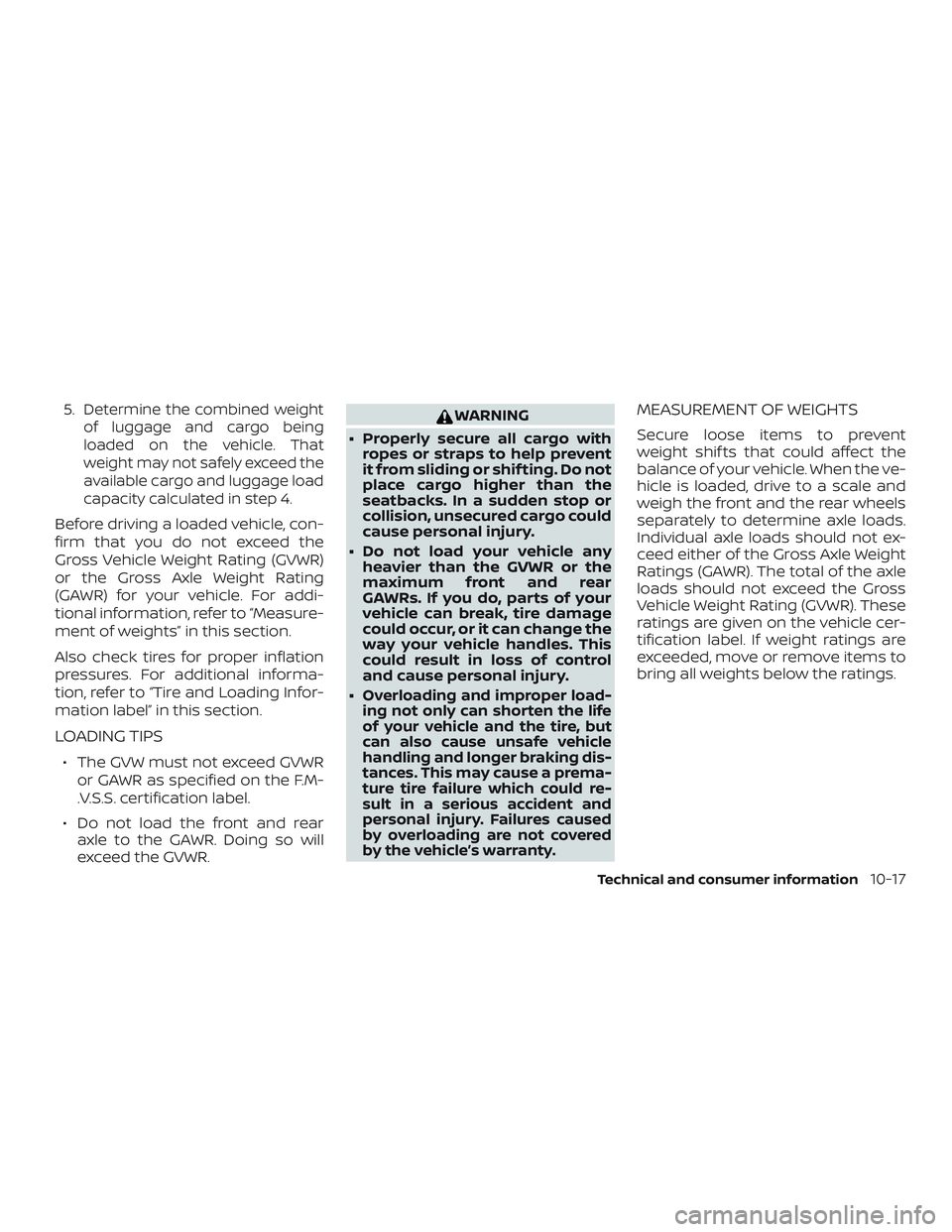
5.Determine the combined weight
of luggage and cargo being
loaded on the vehicle. That
weight may not safely exceed the
available cargo and luggage load
capacity calculated in step 4.
Before driving a loaded vehicle, con-
firm that you do not exceed the
Gross Vehicle Weight Rating (GVWR)
or the Gross Axle Weight Rating
(GAWR) for your vehicle. For addi-
tional information, refer to “Measure-
ment of weights” in this section.
Also check tires for proper inflation
pressures. For additional informa-
tion, refer to “Tire and Loading Infor-
mation label” in this section.
LOADING TIPS
∙ The GVW must not exceed GVWR or GAWR as specified on the F.M-
.V.S.S. certification label.
∙ Do not load the front and rear axle to the GAWR. Doing so will
exceed the GVWR.
WARNING
∙ Properly secure all cargo with ropes or straps to help prevent
it from sliding or shif ting. Do not
place cargo higher than the
seatbacks. In a sudden stop or
collision, unsecured cargo could
cause personal injury.
∙ Do not load your vehicle any heavier than the GVWR or the
maximum front and rear
GAWRs. If you do, parts of your
vehicle can break, tire damage
could occur, or it can change the
way your vehicle handles. This
could result in loss of control
and cause personal injury.
∙
Overloading and improper load-
ing not only can shorten the life
of your vehicle and the tire, but
can also cause unsafe vehicle
handling and longer braking dis-
tances. This may cause a prema-
ture tire failure which could re-
sult in a serious accident and
personal injury. Failures caused
by overloading are not covered
by the vehicle’s warranty.
MEASUREMENT OF WEIGHTS
Secure loose items to prevent
weight shif ts that could affect the
balance of your vehicle. When the ve-
hicle is loaded, drive to a scale and
weigh the front and the rear wheels
separately to determine axle loads.
Individual axle loads should not ex-
ceed either of the Gross Axle Weight
Ratings (GAWR). The total of the axle
loads should not exceed the Gross
Vehicle Weight Rating (GVWR). These
ratings are given on the vehicle cer-
tification label. If weight ratings are
exceeded, move or remove items to
bring all weights below the ratings.
Technical and consumer information10-17
Page 684 of 702
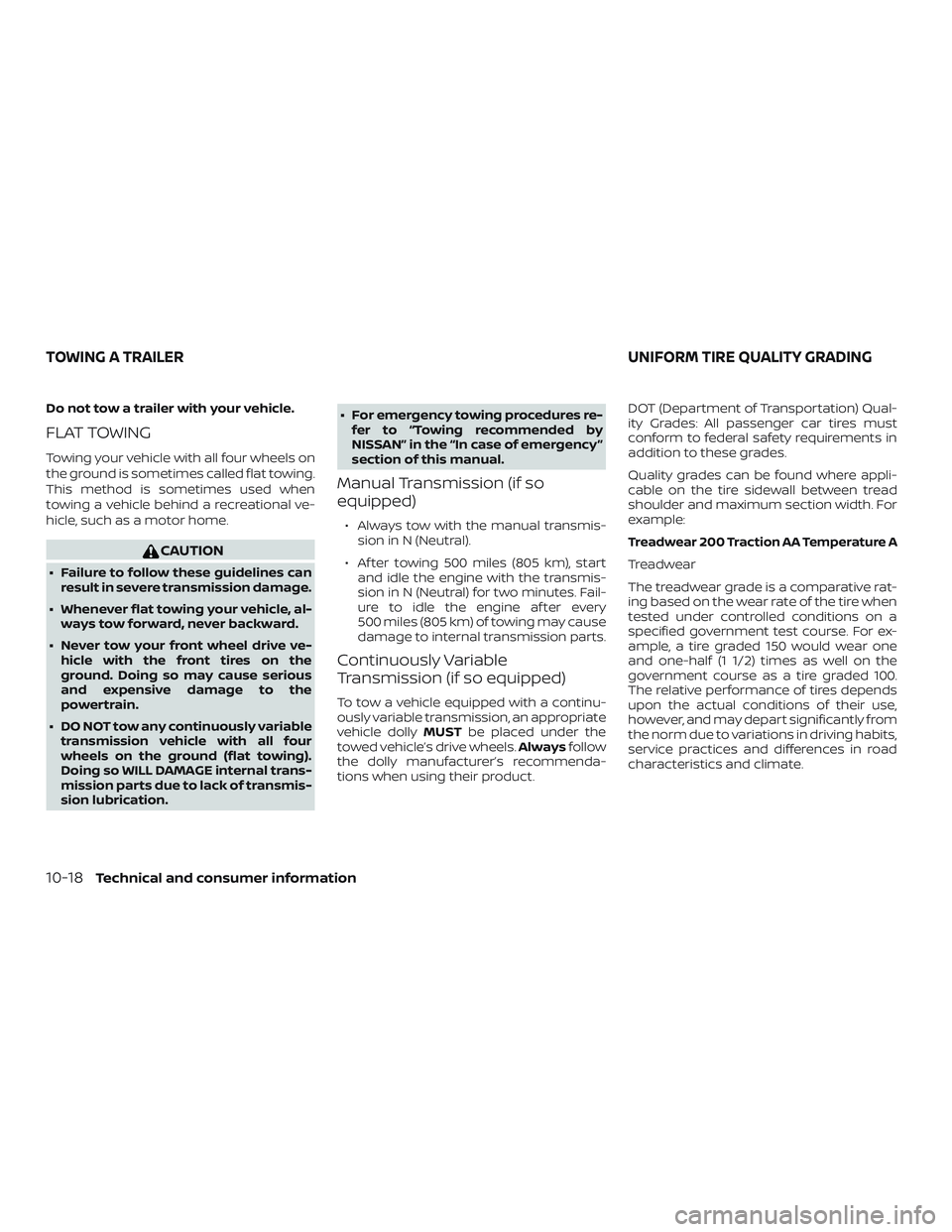
Do not tow a trailer with your vehicle.
FLAT TOWING
Towing your vehicle with all four wheels on
the ground is sometimes called flat towing.
This method is sometimes used when
towing a vehicle behind a recreational ve-
hicle, such as a motor home.
CAUTION
∙ Failure to follow these guidelines canresult in severe transmission damage.
∙ Whenever flat towing your vehicle, al- ways tow forward, never backward.
∙ Never tow your front wheel drive ve- hicle with the front tires on the
ground. Doing so may cause serious
and expensive damage to the
powertrain.
∙ DO NOT tow any continuously variable transmission vehicle with all four
wheels on the ground (flat towing).
Doing so WILL DAMAGE internal trans-
mission parts due to lack of transmis-
sion lubrication. ∙ For emergency towing procedures re-
fer to “Towing recommended by
NISSAN” in the “In case of emergency ”
section of this manual.
Manual Transmission (if so
equipped)
∙ Always tow with the manual transmis- sion in N (Neutral).
∙ Af ter towing 500 miles (805 km), start and idle the engine with the transmis-
sion in N (Neutral) for two minutes. Fail-
ure to idle the engine af ter every
500 miles (805 km) of towing may cause
damage to internal transmission parts.
Continuously Variable
Transmission (if so equipped)
To tow a vehicle equipped with a continu-
ously variable transmission, an appropriate
vehicle dolly MUSTbe placed under the
towed vehicle’s drive wheels. Alwaysfollow
the dolly manufacturer’s recommenda-
tions when using their product. DOT (Department of Transportation) Qual-
ity Grades: All passenger car tires must
conform to federal safety requirements in
addition to these grades.
Quality grades can be found where appli-
cable on the tire sidewall between tread
shoulder and maximum section width. For
example:
Treadwear 200 Traction AA Temperature A
Treadwear
The treadwear grade is a comparative rat-
ing based on the wear rate of the tire when
tested under controlled conditions on a
specified government test course. For ex-
ample, a tire graded 150 would wear one
and one-half (1 1/2) times as well on the
government course as a tire graded 100.
The relative performance of tires depends
upon the actual conditions of their use,
however, and may depart significantly from
the norm due to variations in driving habits,
service practices and differences in road
characteristics and climate.
TOWING A TRAILER
UNIFORM TIRE QUALITY GRADING
10-18Technical and consumer information
Page 685 of 702
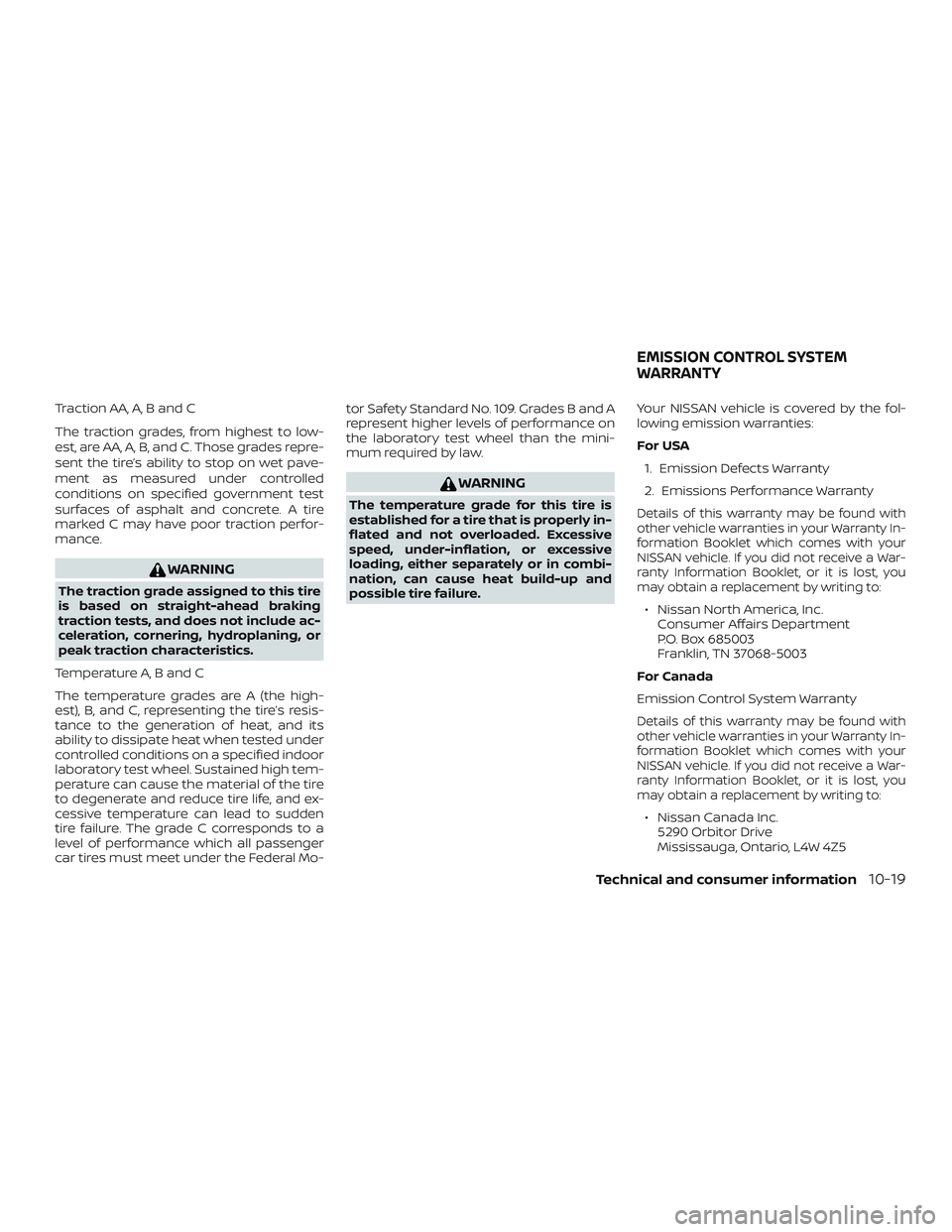
Traction AA, A, B and C
The traction grades, from highest to low-
est, are AA, A, B, and C. Those grades repre-
sent the tire’s ability to stop on wet pave-
ment as measured under controlled
conditions on specified government test
surfaces of asphalt and concrete. A tire
marked C may have poor traction perfor-
mance.
WARNING
The traction grade assigned to this tire
is based on straight-ahead braking
traction tests, and does not include ac-
celeration, cornering, hydroplaning, or
peak traction characteristics.
Temperature A, B and C
The temperature grades are A (the high-
est), B, and C, representing the tire’s resis-
tance to the generation of heat, and its
ability to dissipate heat when tested under
controlled conditions on a specified indoor
laboratory test wheel. Sustained high tem-
perature can cause the material of the tire
to degenerate and reduce tire life, and ex-
cessive temperature can lead to sudden
tire failure. The grade C corresponds to a
level of performance which all passenger
car tires must meet under the Federal Mo- tor Safety Standard No. 109. Grades B and A
represent higher levels of performance on
the laboratory test wheel than the mini-
mum required by law.
WARNING
The temperature grade for this tire is
established for a tire that is properly in-
flated and not overloaded. Excessive
speed, under-inflation, or excessive
loading, either separately or in combi-
nation, can cause heat build-up and
possible tire failure.
Your NISSAN vehicle is covered by the fol-
lowing emission warranties:
For USA
1. Emission Defects Warranty
2. Emissions Performance WarrantyDetails of this warranty may be found with
other vehicle warranties in your Warranty In-
formation Booklet which comes with your
NISSAN vehicle. If you did not receive a War-
ranty Information Booklet, or it is lost, you
may obtain a replacement by writing to:
∙ Nissan North America, Inc. Consumer Affairs Department
P.O. Box 685003
Franklin, TN 37068-5003
For Canada
Emission Control System Warranty
Details of this warranty may be found with
other vehicle warranties in your Warranty In-
formation Booklet which comes with your
NISSAN vehicle. If you did not receive a War-
ranty Information Booklet, or it is lost, you
may obtain a replacement by writing to:
∙ Nissan Canada Inc. 5290 Orbitor Drive
Mississauga, Ontario, L4W 4Z5
EMISSION CONTROL SYSTEM
WARRANTY
Technical and consumer information10-19
Page 694 of 702
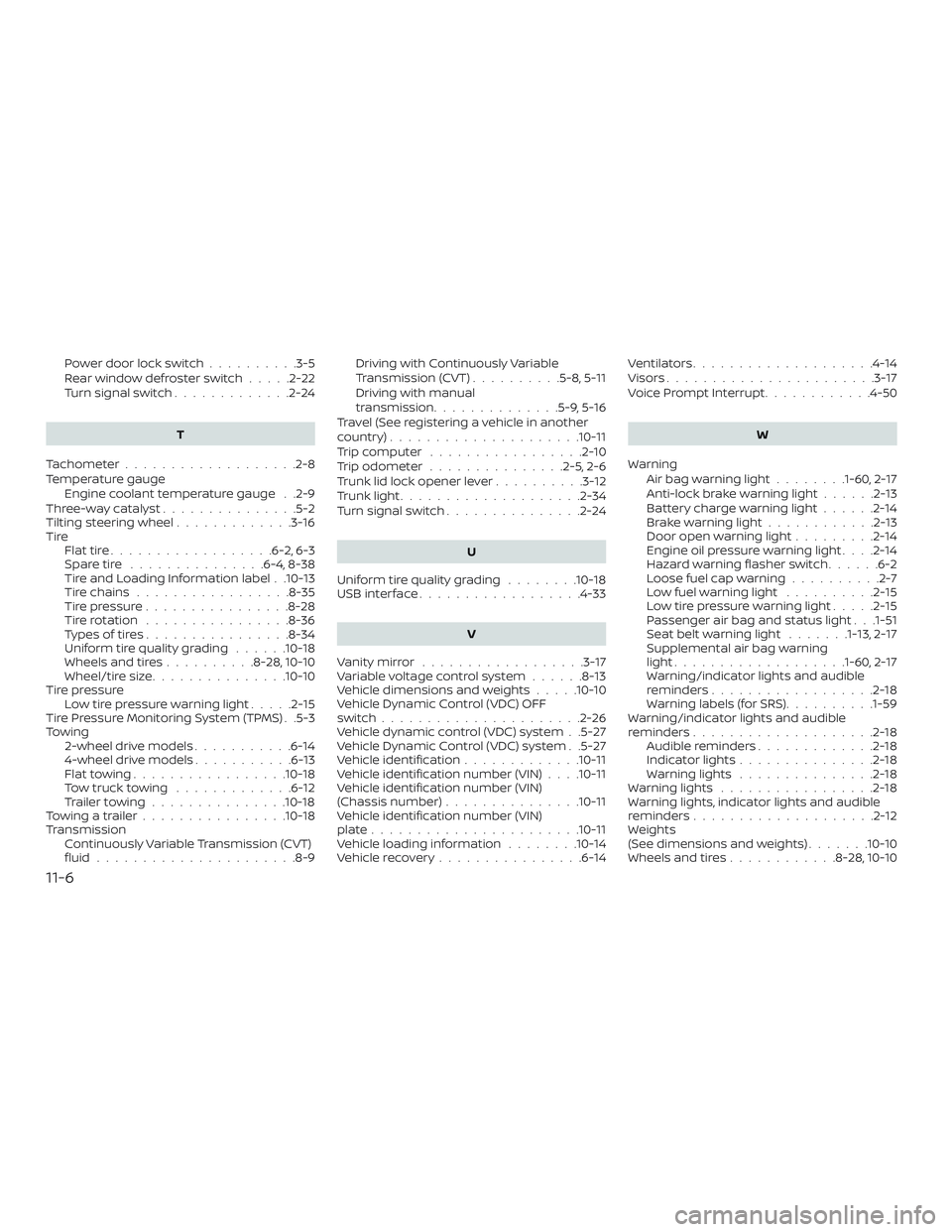
Power door lock switch..........3-5
Rearwindowdefrosterswitch.....2-22
Turn signal switch .............2-24
T
Tachometer ...................2-8
Temperature gauge Engine coolant temperature gauge . .2-9
Three-waycatalyst...............5-2
Tilting steering wheel .............3-16
Tire Flattire..................6-2,6-3
Spare tire ...............6-4,8-38
Tire and Loading Information label . .10-13
Tire chains .................8-35
Tire pressure ................8-28
Tirerotation ................8-36
Types of tires ................8-34
Uniform tire quality grading ......10-18
Wheels and tires ..........8-28,10-10
Wheel/tire size ...............10-10
Tire pressure Low tire pressure warning light .....2-15
Tire Pressure Monitoring System (TPMS) . .5-3
Towing 2-wheel drive models ...........6-14
4-wheel drive models ...........6-13
Flattowing.................10-18
Towtrucktowing .............6-12
Trailertowing...............10-18
Towingatrailer................10-18
Transmission Continuously Variable Transmission (CVT)
fluid......................8-9 Driving with Continuously Variable
Transmission (CVT)
..........5-8,5-11
Driving with manual
transmission ..............5-9,5-16
Travel (See registering a vehicle in another
country) .....................10-11
Trip computer .................2-10
Trip odometer ...............2-5,2-6
Trunk lid lock opener lever ..........3-12
Trunklight....................2-34
Turn signal switch ...............2-24
U
Uniform tire quality grading ........10-18
USBinterface..................4-33
V
Vanitymirror ..................3-17
Variablevoltagecontrolsystem......8-13
Vehicle dimensions and weights .....10-10
Vehicle Dynamic Control (VDC) OFF
switch......................2-26
Vehicle dynamic control (VDC) system . .5-27
Vehicle Dynamic Control (VDC) system . .5-27
Vehicle identification .............10-11
Vehicle identification number (VIN) . . . .10-11
Vehicle identification number (VIN)
(Chassis number) ...............10-11
Vehicle identification number (VIN)
plate.......................10-11
Vehicle loading information ........10-14
Vehiclerecovery................6-14 Ventilators
....................4-14
Visors.......................3-17
Voice Prompt Interrupt ............4-50
W
Warning Airbagwarninglight........1-60, 2-17
Anti-lock brake warning light ......2-13
Battery charge warning light ......2-14
Brakewarninglight............2-13
Door open warning light .........2-14
Engine oil pressure warning light ....2-14
Hazard warning flasher switch ......6-2
Loosefuelcapwarning..........2-7
Lowfuelwarninglight ..........2-15
Low tire pressure warning light .....2-15
Passenger air bag and status light . . .1-51
Seatbeltwarninglight .......1-13, 2-17
Supplemental air bag warning
light.................. .1-60, 2-17
Warning/indicator lights and audible
reminders ..................2-18
Warning labels (for SRS) ..........1-59
W
arning/indicator lights and audible
reminders ....................2-18
Audible reminders .............2-18
Indicatorlights...............2-18
Warninglights ...............2-18
Warninglights .................2-18
Warning lights, indicator lights and audible
reminders ....................2-12
Weights
(See dimensions and weights) .......10-10
Wheels and tires ............8-28,10-10
11-6
Page 700 of 702
COLD TIRE PRESSURE:
Refer to the Tire and Loading Information
label.
The label is typically located on the driver
side center pillar or on the driver’s door. For
additional information, refer to “Wheels and
tires” in the “Do-it-yourself ” section of this
manual.
RECOMMENDED NEW VEHICLE
BREAK-IN PROCEDURE:
During the first 1,200 miles (2,000 km) of
vehicle use, follow the break-in procedure
recommendations for the future reliability
and economy of your new vehicle. For ad-
ditional information, refer to “Break-in
schedule” in the “Starting and driving” sec-
tion of this manual. Failure to follow these
recommendations may result in vehicle
damage or shortened engine life.