alternator NISSAN X-TRAIL 2001 Service User Guide
[x] Cancel search | Manufacturer: NISSAN, Model Year: 2001, Model line: X-TRAIL, Model: NISSAN X-TRAIL 2001Pages: 3833, PDF Size: 39.49 MB
Page 429 of 3833
![NISSAN X-TRAIL 2001 Service User Guide TROUBLE DIAGNOSIS
EC-79
[QR25(WITH EURO-OBD)]
C
D
E
F
G
H
I
J
K
L
MA
EC
(continued on next page)
SYSTEM — ENGINE MECHANICAL & OTHER
SYMPTOM
Reference
page
HARD/NO START/RESTART (EXCP. HA)
ENGINE ST](/img/5/57405/w960_57405-428.png "NISSAN X-TRAIL 2001 Service User Guide TROUBLE DIAGNOSIS
EC-79
[QR25(WITH EURO-OBD)]
C
D
E
F
G
H
I
J
K
L
MA
EC
(continued on next page)
SYSTEM — ENGINE MECHANICAL & OTHER
SYMPTOM
Reference
page
HARD/NO START/RESTART (EXCP. HA)
ENGINE ST")
TROUBLE DIAGNOSIS
EC-79
[QR25(WITH EURO-OBD)]
C
D
E
F
G
H
I
J
K
L
MA
EC
(continued on next page)
SYSTEM — ENGINE MECHANICAL & OTHER
SYMPTOM
Reference
page
HARD/NO START/RESTART (EXCP. HA)
ENGINE STALL
HESITATION/SURGING/FLAT SPOT
SPARK KNOCK/DETONATION
LACK OF POWER/POOR ACCELERATION
HIGH IDLE/LOW IDLE
ROUGH IDLE/HUNTING
IDLING VIBRATION
SLOW/NO RETURN TO IDLE
OVERHEATS/WATER TEMPERATURE HIGH
EXCESSIVE FUEL CONSUMPTION
EXCESSIVE OIL CONSUMPTION
BATTERY DEAD (UNDER CHARGE)
Warranty symptom code AA AB AC AD AE AF AG AH AJ AK AL AM HA
Fuel Fuel tank
5
5FL-9
Fuel piping 5 5 5 5 5 5FL-3,EM-
32
Vapor lock—
Valve deposit
555555 5—
Poor fuel (Heavy weight gaso-
line, Low octane)—
Air Air duct
55555 5EM-14
Air cleanerEM-14
Air leakage from air duct
(Mass air flow sensor —electric
throttle control actuator)
5555EM-14
Electric throttle control actuatorEM-16
Air leakage from intake manifold/
Collector/GasketEM-16
Cranking Battery
111111 11SC-3
Alternator circuitSC-12
Starter circuit 3SC-20
Signal plate 6EM-73
PNP switch
4MT-12 or
AT- 11 5
Engine Cylinder head
55555 55 5EM-59
Cylinder head gasket 4 3
Cylinder block
66666 66 64
EM-73
Piston
Piston ring
Connecting rod
Bearing
Crankshaft
Page 821 of 3833
![NISSAN X-TRAIL 2001 Service User Guide TROUBLE DIAGNOSIS
EC-471
[QR25(WITHOUT EURO-OBD)]
C
D
E
F
G
H
I
J
K
L
MA
EC
SYSTEM — ENGINE MECHANICAL & OTHER
SYMPTOM
Reference
page
HARD/NO START/RESTART (EXCP. HA)
ENGINE STALL
HESITATION/SURGIN](/img/5/57405/w960_57405-820.png "NISSAN X-TRAIL 2001 Service User Guide TROUBLE DIAGNOSIS
EC-471
[QR25(WITHOUT EURO-OBD)]
C
D
E
F
G
H
I
J
K
L
MA
EC
SYSTEM — ENGINE MECHANICAL & OTHER
SYMPTOM
Reference
page
HARD/NO START/RESTART (EXCP. HA)
ENGINE STALL
HESITATION/SURGIN")
TROUBLE DIAGNOSIS
EC-471
[QR25(WITHOUT EURO-OBD)]
C
D
E
F
G
H
I
J
K
L
MA
EC
SYSTEM — ENGINE MECHANICAL & OTHER
SYMPTOM
Reference
page
HARD/NO START/RESTART (EXCP. HA)
ENGINE STALL
HESITATION/SURGING/FLAT SPOT
SPARK KNOCK/DETONATION
LACK OF POWER/POOR ACCELERATION
HIGH IDLE/LOW IDLE
ROUGH IDLE/HUNTING
IDLING VIBRATION
SLOW/NO RETURN TO IDLE
OVERHEATS/WATER TEMPERATURE HIGH
EXCESSIVE FUEL CONSUMPTION
EXCESSIVE OIL CONSUMPTION
BATTERY DEAD (UNDER CHARGE)
Warranty symptom code AA AB AC AD AE AF AG AH AJ AK AL AM HA
Fuel Fuel tank
5
5FL-9
Fuel piping 5 5 5 5 5 5FL-3,EM-
32
Vapor lock—
Valve deposit
555555 5—
Poor fuel (Heavy weight gaso-
line, Low octane)—
Air Air duct
55555 5EM-14
Air cleanerEM-14
Air leakage from air duct
(Mass air flow sensor —electric
throttle control actuator)
5555EM-14
Electric throttle control actuatorEM-16
Air leakage from intake manifold/
Collector/GasketEM-16
Cranking Battery
111111 11SC-3
Alternator circuitSC-12
Starter circuit 3SC-20
Signal plate 6EM-73
PNP switch
4MT-12 or
AT-349
Engine Cylinder head
55555 55 5EM-59
Cylinder head gasket 4 3
Cylinder block
66666 66 64
EM-73
Piston
Piston ring
Connecting rod
Bearing
Crankshaft
Va l v e
mecha-
nismTiming chain
55555 55 5EM-37
CamshaftEM-46
Intake valve
3EM-59
Exhaust valve
Page 1161 of 3833
![NISSAN X-TRAIL 2001 Service User Guide TROUBLE DIAGNOSIS
EC-811
[QR20(WITH EURO-OBD)]
C
D
E
F
G
H
I
J
K
L
MA
EC
SYSTEM — ENGINE MECHANICAL & OTHER
SYMPTOM
Reference
page
HARD/NO START/RESTART (EXCP. HA)
ENGINE STALL
HESITATION/SURGING/F](/img/5/57405/w960_57405-1160.png "NISSAN X-TRAIL 2001 Service User Guide TROUBLE DIAGNOSIS
EC-811
[QR20(WITH EURO-OBD)]
C
D
E
F
G
H
I
J
K
L
MA
EC
SYSTEM — ENGINE MECHANICAL & OTHER
SYMPTOM
Reference
page
HARD/NO START/RESTART (EXCP. HA)
ENGINE STALL
HESITATION/SURGING/F")
TROUBLE DIAGNOSIS
EC-811
[QR20(WITH EURO-OBD)]
C
D
E
F
G
H
I
J
K
L
MA
EC
SYSTEM — ENGINE MECHANICAL & OTHER
SYMPTOM
Reference
page
HARD/NO START/RESTART (EXCP. HA)
ENGINE STALL
HESITATION/SURGING/FLAT SPOT
SPARK KNOCK/DETONATION
LACK OF POWER/POOR ACCELERATION
HIGH IDLE/LOW IDLE
ROUGH IDLE/HUNTING
IDLING VIBRATION
SLOW/NO RETURN TO IDLE
OVERHEATS/WATER TEMPERATURE HIGH
EXCESSIVE FUEL CONSUMPTION
EXCESSIVE OIL CONSUMPTION
BATTERY DEAD (UNDER CHARGE)
Warranty symptom code AA AB AC AD AE AF AG AH AJ AK AL AM HA
Fuel Fuel tank
5
5FL-9
Fuel piping 5 5 5 5 5 5FL-3,EM-
32
Vapor lock—
Valve deposit
555555 5—
Poor fuel (Heavy weight gaso-
line, Low octane)—
Air Air duct
55555 5EM-14
Air cleanerEM-14
Air leakage from air duct
(Mass air flow sensor —electric
throttle control actuator)
5555EM-14
Electric throttle control actuatorEM-16
Air leakage from intake manifold/
Collector/GasketEM-16
Cranking Battery
111111 11SC-3
Alternator circuitSC-12
Starter circuit 3SC-20
Signal plate 6EM-73
PNP switch
4MT-12 or
AT- 11 5
Engine Cylinder head
55555 55 5EM-59
Cylinder head gasket 4 3
Cylinder block
66666 66 64
EM-73
Piston
Piston ring
Connecting rod
Bearing
Crankshaft
Va l v e
mecha-
nismTiming chain
55555 55 5EM-37
CamshaftEM-46
Intake valve
3EM-59
Exhaust valve
Page 1508 of 3833
![NISSAN X-TRAIL 2001 Service User Guide EC-1158
[QR20(WITHOUT EURO-OBD)]
TROUBLE DIAGNOSIS
SYSTEM — ENGINE MECHANICAL & OTHER
SYMPTOM
Reference
page
HARD/NO START/RESTART (EXCP. HA)
ENGINE STALL
HESITATION/SURGING/FLAT SPOT
SPARK KNOCK/D](/img/5/57405/w960_57405-1507.png "NISSAN X-TRAIL 2001 Service User Guide EC-1158
[QR20(WITHOUT EURO-OBD)]
TROUBLE DIAGNOSIS
SYSTEM — ENGINE MECHANICAL & OTHER
SYMPTOM
Reference
page
HARD/NO START/RESTART (EXCP. HA)
ENGINE STALL
HESITATION/SURGING/FLAT SPOT
SPARK KNOCK/D")
EC-1158
[QR20(WITHOUT EURO-OBD)]
TROUBLE DIAGNOSIS
SYSTEM — ENGINE MECHANICAL & OTHER
SYMPTOM
Reference
page
HARD/NO START/RESTART (EXCP. HA)
ENGINE STALL
HESITATION/SURGING/FLAT SPOT
SPARK KNOCK/DETONATION
LACK OF POWER/POOR ACCELERATION
HIGH IDLE/LOW IDLE
ROUGH IDLE/HUNTING
IDLING VIBRATION
SLOW/NO RETURN TO IDLE
OVERHEATS/WATER TEMPERATURE HIGH
EXCESSIVE FUEL CONSUMPTION
EXCESSIVE OIL CONSUMPTION
BATTERY DEAD (UNDER CHARGE)
Warranty symptom code AA AB AC AD AE AF AG AH AJ AK AL AM HA
Fuel Fuel tank
5
5FL-9
Fuel piping 555 55 5FL-3,EM-
32
Vapor lock—
Valve deposit
555555 5—
Poor fuel (Heavy weight gaso-
line, Low octane)—
Air Air duct
55555 5EM-14
Air cleanerEM-14
Air leakage from air duct
(Mass air flow sensor —electric
throttle control actuator)
5555EM-14
Electric throttle control actuatorEM-16
Air leakage from intake manifold/
Collector/GasketEM-16
Cranking Battery
111111 11SC-3
Alternator circuitSC-12
Starter circuit 3SC-20
Signal plate 6EM-73
PNP switch
4MT-12 or
AT- 3 4 9
Engine Cylinder head
55555 55 5EM-59
Cylinder head gasket 4 3
Cylinder block
66666 66 64
EM-73
Piston
Piston ring
Connecting rod
Bearing
Crankshaft
Va l v e
mecha-
nismTimin g c hain
55555 55 5EM-37
CamshaftEM-46
Intake valve
3EM-59
Exhaust valve
Page 1892 of 3833
![NISSAN X-TRAIL 2001 Service User Guide EC-1542
[YD]
DTC P1660 BATTERY VOLTAGE
DTC P1660 BATTERY VOLTAGE
PFP:AYBGL
On Board Diagnosis LogicEBS0035A
The ECM checks if battery voltage is within the tolerance range for the engine control syste](/img/5/57405/w960_57405-1891.png "NISSAN X-TRAIL 2001 Service User Guide EC-1542
[YD]
DTC P1660 BATTERY VOLTAGE
DTC P1660 BATTERY VOLTAGE
PFP:AYBGL
On Board Diagnosis LogicEBS0035A
The ECM checks if battery voltage is within the tolerance range for the engine control syste")
EC-1542
[YD]
DTC P1660 BATTERY VOLTAGE
DTC P1660 BATTERY VOLTAGE
PFP:AYBGL
On Board Diagnosis LogicEBS0035A
The ECM checks if battery voltage is within the tolerance range for the engine control system.
DTC Confirmation ProcedureEBS0035B
With CONSULT-II
1. Check the following.
–Jumper cables are connected for jump starting.
–Battery or alternator has been replaced.
If the result is “Yes” for one item or more, skip the following steps and go to EC-1542, "
Diagnostic Proce-
dure" .
2. Check that the positive battery terminal is connected to battery properly. If NG, reconnect it properly.
3. Check that the alternator functions properly. Refer to SC-12, "
CHARGING SYSTEM" .
4. Turn ignition switch “ON” and select “DATA MONITOR” mode with CONSULT-II.
5. Wait one minute.
6. If DTC is detected, go to EC-1542, "
Diagnostic Procedure" .
If DTC is not detected, go to next step.
7. Start engine and wait one minute at idle.
8. If DTC is detected, go to EC-1542, "
Diagnostic Procedure" .
Diagnostic ProcedureEBS0035C
1. INSPECTION START
Are jumper cables connected for the jump starting?
Ye s o r N o
Yes >> GO TO 3.
No >> GO TO 2.
2. CHECK BATTERY AND ALTERNATOR
Check that the proper type of battery and alternator is installed.
Refer to SC-3, "
BATTERY" , SC-12, "CHARGING SYSTEM" .
OK or NG
OK >> GO TO 5.
NG >> Replace with a proper one.
DTC Malfunction is detected when ... Check Items (Possible Cause)
P1660
●An abnormally high or low voltage from the battery
is sent to ECM.●Incorrect jump starting
●Battery
●Alternator
●ECM
Page 2876 of 3833
![NISSAN X-TRAIL 2001 Service User Guide BRC-92
[ESP/TCS/ABS]
TROUBLE DIAGNOSIS
●If a leak or oozing is detected on the ESP actuator body, wipe the applicable part with a clean cloth.
Then check again for leaks, and if th](/img/5/57405/w960_57405-2875.png "NISSAN X-TRAIL 2001 Service User Guide BRC-92
[ESP/TCS/ABS]
TROUBLE DIAGNOSIS
●If a leak or oozing is detected on the ESP actuator body, wipe the applicable part with a clean cloth.
Then check again for leaks, and if th")
BRC-92
[ESP/TCS/ABS]
TROUBLE DIAGNOSIS
●If a leak or oozing is detected on the ESP actuator body, wipe the applicable part with a clean cloth.
Then check again for leaks, and if there is still a leak or oozing, replace the ESP actuator body.
CAUTION:
Do not disassemble the actuator body.
3. Check the brake disc rotor and pads.
PRELIMINARY CHECK 2: (INSPECTION FOR LOOSE POWER SUPPLY TERMINAL)
Check the battery for looseness on the battery positive/negative terminals and ground connection. If loose-
ness is detected, tighten the piping to the specified torque. Check that the battery voltage does not drop and
the alternator is normal.
PRELIMINARY CHECK 3: (INSPECTION FOR ABS WARNING LAMP, ESP OFF INDICATOR
LAMP, AND SLIP INDICATOR LAMP)
1. Check that the ABS warning lamp is ON for Approx. 0.5 seconds when the ignition switch is turned ON. If
it does not turn on, check the ABS warning lamp and the circuit, and the combination meter.
2. Check that ESP OFF indicator lamp is ON for Approx. 0.5 seconds when the ignition switch is turned ON.
If it does not turn ON, check the ESP OFF indicator lamp and the circuit, and the combination meter.
3. Check that the SLIP indicator lamp is ON for Approx. 0.5 seconds when the ignition switch is turned ON. If
it does not turn ON, check the SLIP indicator lamp and the circuit.
4. With the engine running, check the ESP OFF indicator lamp turns ON and OFF when the ESP OFF
switch turns ON and OFF. If it dose not operate in accordance with the switch, check the ESP OFF switch
and the circuit.
5. Check that the ESP OFF indicator lamp turns OFF after Approx. 2 seconds delay when the ESP OFF
switch turned ON (The ESP/TCS system was not operated). If the ESP OFF indicator lamp does not turn
OFF in 10 seconds from the engine start, perform the self-diagnosis of ESP/TCS/ABS control unit.
Inspection 1 Wheel Sensor and CircuitEFS001AB
Inspection procedure
1. SELF-DIAGNOSIS RESULT CHECK 1
Check the self-diagnosis results.
Are any self-diagnosis result items above indicated?
>> GO TO 2.
2. CHECK THE CONNECTOR
Remove connectors of the wheel sensor which is malfunctioning and the ESP/TCS/ABS control unit. Check
whether the deformation of terminal, or incorporate connection of connectors. Then, connect connectors. In
addition, check if the wheel sensor cable is damaged due to friction.
Does ABS warning lamp is out when driving 30 km/h (19 MPH) for Approx. One minute?
YES >> Check is completed.
NO >> GO TO 3.
Self-diagnosis results
CONSULT-II indication item
ABS SENSOR [ABNORMAL SIGNAL]
FR RH SENSOR – 1
FR RH SENSOR – 2
FR LH SENSOR – 1
FR LH SENSOR – 2
RR RH SENSOR – 1
RR RH SENSOR – 2
RR LH SENSOR – 1
RR LH SENSOR – 2
Page 2892 of 3833
![NISSAN X-TRAIL 2001 Service User Guide BRC-108
[ESP/TCS/ABS]
TROUBLE DIAGNOSIS
5. ESP/TCS/ABS CONTROL UNIT POWER SUPPLY CIRCUIT INSPECTION 2
1. Check the fuse 10A.
2. Check for continuity between the battery positive terminal and
t](/img/5/57405/w960_57405-2891.png "NISSAN X-TRAIL 2001 Service User Guide BRC-108
[ESP/TCS/ABS]
TROUBLE DIAGNOSIS
5. ESP/TCS/ABS CONTROL UNIT POWER SUPPLY CIRCUIT INSPECTION 2
1. Check the fuse 10A.
2. Check for continuity between the battery positive terminal and
t")
BRC-108
[ESP/TCS/ABS]
TROUBLE DIAGNOSIS
5. ESP/TCS/ABS CONTROL UNIT POWER SUPPLY CIRCUIT INSPECTION 2
1. Check the fuse 10A.
2. Check for continuity between the battery positive terminal and
the ESP/TCS/ABS control unit (vehicle-side connector B111).
Is inspection result OK?
YES >> Check the battery for a loose terminal and low voltage or the alternator for abnormality.
NO >>
●Replace the fuse 10A.
●Harness disconnection
Inspection 12 When “EMERGENCY BRAKE” is indicated in the Self-Diagnosis
Results
EFS001AO
Inspection procedure
1. SELF-DIAGNOSIS RESULT CHECK
Check the self-diagnosis results.
When any items other than “EMERGENCY BRAKE” is displayed in the self-diagnosis results, follow the
instructions below.
CAUTION:
“EMERGENCY BRAKE” is indicated when the control unit itself is detected internal error. If this dis-
play item was indicated, replace the control unit.
Is
“EMERGENCY BRAKE” is indicated in the self-diagnosis results?
>> Replace the ESP/TCS/ABS control unit, and perform the self-diagnosis again.
Inspection 13 When “ST ANG SEN SIGNAL” is Indicated in the Self-Diagnosis
Results
EFS001AP
Inspection procedure
1. SELF-DIAGNOSIS RESULT CHECK 1
Check the self-diagnosis results.
When any items other than
“ST ANGLE SEN SIGNAL” is displayed in the self-diagnosis results:
YES >> Check and repair the applicable items. Perform the self-diagnosis again.
NO >> Perform the steering wheel angle sensor neutral position adjustment. GO TO 2.
SFIA0924E
ESP/TCS/ABS control unit
(Vehicle-side connector B111)Battery terminal Continuity
1 (G/R) positive Yes
Self-diagnosis results
CONSUL-II indication item
EMERGENCY BRAKE
Self-diagnosis results
CONSUL-II indication item
ST ANGLE SEN SIGNAL
Page 3409 of 3833
REFRIGERANT LINES
ATC-133
C
D
E
F
G
H
I
K
L
MA
B
AT C
WITH DIESEL ENGINE
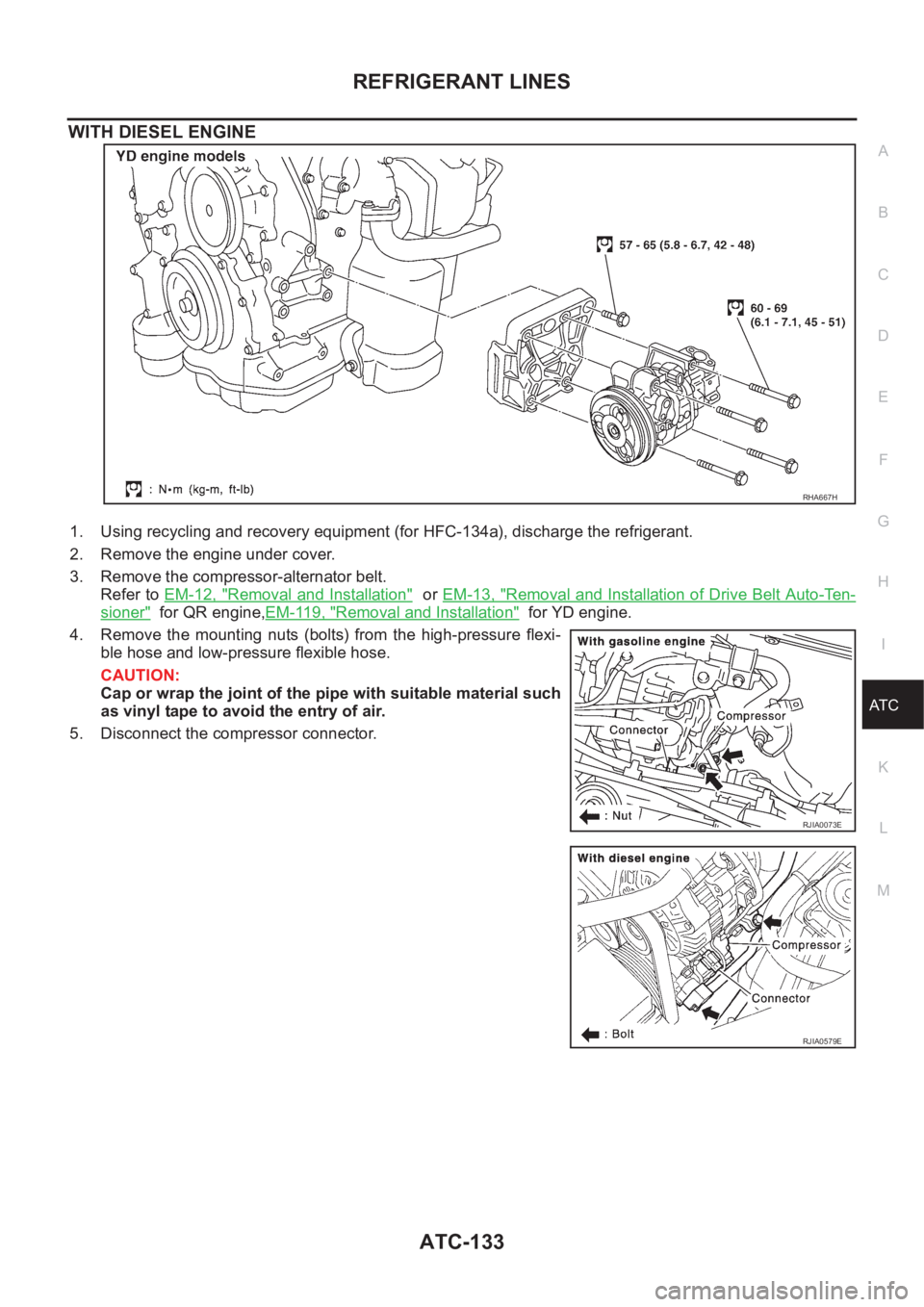
1. Using recycling and recovery equipment (for HFC-134a), discharge the refrigerant.
2. Remove the engine under cover.
3. Remove the compressor-alternator belt.
Refer to EM-12, "
Removal and Installation" or EM-13, "Removal and Installation of Drive Belt Auto-Ten-
sioner" for QR engine,EM-119, "Removal and Installation" for YD engine.
4. Remove the mounting nuts (bolts) from the high-pressure flexi-
ble hose and low-pressure flexible hose.
CAUTION:
Cap or wrap the joint of the pipe with suitable material such
as vinyl tape to avoid the entry of air.
5. Disconnect the compressor connector.
RHA667H
RJIA0073E
RJIA0579E
Page 3457 of 3833
SC-1
STARTING & CHARGING SYSTEM
K ELECTRICAL
CONTENTS
C
D
E
F
G
H
I
J
L
M
SECTION
A
B
SC
STARTING & CHARGING SYSTEM
PRECAUTIONS .......................................................... 2
Precautions for Supplemental Restraint System
(SRS) “AIR BAG” and “SEAT BELT PRE-TEN-
SIONER” .................................................................. 2
Wiring Diagrams and Trouble Diagnosis .................. 2
BATTERY .................................................................... 3
How to Handle Battery ............................................. 3
METHODS OF PREVENTING OVER-DIS-
CHARGE ............................................................... 3
CHECKING ELECTROLYTE LEVEL .................... 3
SPECIFIC GRAVITY CHECK ............................... 4
Battery Test and Charging Chart .............................. 5
CHART I ................................................................ 5
CHART II ............................................................... 6
A: SLOW CHARGE ............................................... 7
B: STANDARD CHARGE ...................................... 8
C: QUICK CHARGE ............................................ 10
Removal and Installation ......................................... 11
CHARGING SYSTEM ............................................... 12
System Description ................................................ 12
Wiring Diagram — CHARGE — ............................. 13
Trouble Diagnoses ................................................. 14
WITH IC REGULATOR ....................................... 14
MALFUNCTION INDICATOR .............................. 14
Removal and Installation ........................................ 15
REMOVAL (QR ENGINE MODELS) ................... 15
REMOVAL (YD ENGINE MODELS) ................... 15
INSTALLATION ................................................... 15
Disassembly and Assembly ................................... 16
Disassembly ........................................................... 17
REAR COVER .................................................... 17
REAR BEARING ................................................. 18Inspection ............................................................... 18
ROTOR CHECK .................................................. 18
BRUSH CHECK .................................................. 18
PULLEY CHECK(WITH CLUTCH TYPE) ............ 18
STATOR CHECK ................................................. 18
Assembly ................................................................ 19
RING FITTING IN REAR BEARING .................... 19
REAR COVER INSTALLATION ........................... 19
STARTING SYSTEM ................................................. 20
System Description ................................................. 20
M/T MODELS ...................................................... 20
A/T MODELS ....................................................... 20
Wiring Diagram — START —/M/T models ............. 21
Wiring Diagram — START —/A/T models .............. 22
Trouble Diagnoses ..............................................
... 23
Removal and Installation ........................................ 24
REMOVAL ........................................................... 24
INSTALLATION ................................................... 24
Disassembly and Assembly .................................... 25
Inspection ............................................................... 28
MAGNETIC SWITCH CHECK ............................. 28
PINION/CLUTCH CHECK ................................... 28
BRUSH CHECK .................................................. 28
YOKE CHECK ..................................................... 29
ARMATURE CHECK ........................................... 30
Assembly ................................................................ 31
PINION PROTRUSION LENGTH ADJUST-
MENT .................................................................. 31
SERVICE DATA AND SPECIFICATIONS (SDS) ...... 33
Battery .................................................................... 33
Starter ..................................................................... 33
Alternator ................................................................ 33
Page 3468 of 3833
SC-12
CHARGING SYSTEM
CHARGING SYSTEM
PFP:00011
System Description EKS00316
The alternator provides DC voltage to operate the vehicle's electrical system and to keep the battery charged.
The voltage output is controlled by the IC regulator.
Power is supplied at all times
●to alternator terminal 4 (S)
●through 10A fuse (No.34, located in the fuse and fusible link box)
●to alternator terminal B
●through 120A (Gasoline engine models) or 100A (Diesel engine models) fusible link (letter A, located in
the fuse and fusible link box).
Terminal B supplies power to charge the battery and operate the vehicle's electrical system. Output voltage is
controlled by the IC regulator at terminal 4 (S) detecting the input voltage. The charging circuit is protected by
the 120A (Gasoline engine models) or 100A (Diesel engine models) link.
The alternator is grounded to the engine block.
With the ignition switch in the ON or START position, power is supplied
●through 10A fuse [No. 11, located in the fuse block (J/B)]
●to combination meter terminal 46 (LHD models) or terminal 59 (RHD models) for the charge warning
lamp.
Ground is supplied with power and ground supplied
●to terminal 64 (LHD models) or terminal 54 ( RHD models) of the combination meter
●through terminal 3 (L) of the alternator
●to terminal E of the alternator
●through body ground E30.
The charge warning lamp will illuminate. When the alternator is providing sufficient voltage with the engine
running, the ground is opened and the charge warning lamp will go off.
If the charge warning lamp illuminates with the engine running, a malfunction is indicated.