warning NISSAN XTERRA 2015 N50 / 2.G Owners Manual
[x] Cancel search | Manufacturer: NISSAN, Model Year: 2015, Model line: XTERRA, Model: NISSAN XTERRA 2015 N50 / 2.GPages: 396, PDF Size: 3.51 MB
Page 379 of 396
WARNING
Properly adjust the weight distributing
hitch so the rear of the bumper is no
higher than the measured reference
height when the trailer is attached. If the
rear bumper is higher than the measured
reference height when loaded, the vehicle
may handle unpredictably which could
cause a loss of vehicle control and cause
serious personal injury or property
damage.
Sway control device
Sudden maneuvers, wind gusts, and buffeting
caused by other vehicles can affect trailer han-
dling. Sway control devices may be used to help
control these affects. If you choose to use one,
contact a reputable trailer hitch supplier to make
sure the sway control device will work with the
vehicle, hitch, trailer and the trailer’s brake sys-
tem. Follow the instructions provided by the
manufacturer for installing and using the sway
control device.
Class I hitch
Class I trailer hitch equipment (receiver, ball
mount and hitch ball) can be used to tow trailers
of a maximum weight of 2,000 lb (907 kg) .
Class II hitch
Class II trailer hitch equipment (receiver, ball
mount and hitch ball) can be used to tow trailers
of a maximum weight of 3,500 lb (1,587 kg).
Class III hitch
Class III trailer hitch equipment (receiver, ball
mount and hitch ball) can be used to tow trailers
of a maximum weight of 5,000 lb (2,268 kg).
CAUTION
●Special hitches which include frame re-
inforcements are required for towing
above 2,000 lb (907 kg) . Suitable genu-
ine NISSAN hitches, ball mounts and
hitch balls for pickup trucks and sport
utility vehicles are available at a
NISSAN dealer.
● The hitch should not be attached to or
affect the operation of the impact-
absorbing bumper.
● Do not use axle-mounted hitches.
● Do not modify the vehicle exhaust sys-
tem, brake system, etc. to install a
trailer hitch. ●
To reduce the possibility of additional
damage if your vehicle is struck from
the rear, where practical, remove the
receiver when not in use.
● After the hitch is removed, seal the bolt
holes to prevent exhaust fumes, water
or dust from entering the passenger
compartment.
● Regularly check that all trailer hitch
mounting bolts are securely mounted.Tire pressures
● When towing a trailer, inflate the ve-
hicle tires to the recommended cold
tire pressure indicated on the Tire
and Loading Information label.
● Trailer tire condition, size, load rating
and proper inflation pressure should
be in accordance with the trailer and
tire manufacturer’s specifications.
9-24
Technical and consumer information
Page 380 of 396
Safety chains
Always use suitable safety chains between your
vehicle and the trailer. The safety chains should
be crossed and should be attached to the hitch,
not to the vehicle bumper or axle. Be sure to leave
enough slack in the chains to permit turning
corners.
Trailer lights
CAUTION
When splicing into the vehicle electrical
system, a commercially available power-
type module/converter must be used to
provide power for all trailer lighting. This
unit uses the vehicle battery as a direct
power source for all trailer lights while
using the vehicle tail light, stoplight and
turn signal circuits as a signal source. The
module/converter must draw no more that
15 milliamps from the stop and tail lamp
circuits. Using a module/converter that
exceeds these power requirements may
damage the vehicle’s electrical system.
See a reputable trailer dealer to obtain the
proper equipment and to have it installed.
Trailer lights should comply with federal and/or
local regulations. For assistance in hooking up
trailer lights, contact a NISSAN dealer or repu- table trailer dealer. Vehicles equipped with the
optional trailer tow package are equipped with a
7-pin trailer harness connector. A NISSAN 7–pin
tow harness kit is available from your dealer. If
your trailer is equipped with a flat 4-pin connec-
tor, an adapter will be needed to connect the
trailer lights to the vehicle. Adapters are available
at auto parts stores and hitch retailers.
Trailer brakes
When towing a trailer load of 3,500 lbs.
(1,587 kg) or more, trailers with a brake
system MUST be used.
However, most states
require a separate braking system on trailers with
a loaded weight above a specific amount. Make
sure the trailer meets the local regulations and
the regulations where you plan to tow.
Several types of braking systems are available.
Surge Brakes - The surge brake actuator is
mounted on the trailer tongue with a hydraulic line
running to each trailer wheel. Surge brakes are
activated by the trailer pushing against the hitch
ball when the tow vehicle is braking. Hydraulic
surge brakes are common on rental trailers and
some boat trailers. In this type of system, there is
no hydraulic or electric connection for brake op-
eration between the tow vehicle and the trailer. Electric Trailer Brakes -
Electric braking sys-
tems are activated by an electronic signal sent
from a trailer brake controller (special brake-
sensing module) . If electric trailer brakes are
used, refer to “Electric trailer brake controller” in
this section.
Have a professional supplier of towing equip-
ment make sure the trailer brakes are properly
installed and demonstrate proper brake function
testing.
WARNING
Never connect a trailer brake system di-
rectly to the vehicle brake system.
Electric trailer brake controller
Trailers equipped with electric brakes may re-
quire the installation of an aftermarket trailer
brake controller.
A Genuine NISSAN jumper harness is available
that is specifically designed to be used when
installing an aftermarket brake controller.
Install the aftermarket electric trailer brake con-
troller according to the manufacturer’s instruc-
tions.
Technical and consumer information9-25
Page 381 of 396
Pre-towing tips
●Be certain your vehicle maintains a level
position when a loaded and/or unloaded
trailer is hitched. Do not drive the vehicle if it
has an abnormal nose-up or nose-down
condition; check for improper tongue load,
overload, worn suspension or other possible
causes of either condition.
● Always secure items in the trailer to prevent
load shift while driving.
●
Keep the cargo load as low as possible in the
trailer to keep the trailer center of gravity low.
● Load the trailer so approximately 60 percent
of the trailer load is in the front half and
40 percent is in the back half. Also make
sure the load is balanced side to side.
● Check your hitch, trailer tire pressure, ve-
hicle tire pressure, trailer light operation, and
trailer wheel lug nuts every time you attach a
trailer to the vehicle.
● Be certain your rearview mirrors conform to
all federal, state or local regulations. If not,
install any mirrors required for towing before
driving the vehicle.
● Determine the overall height of the vehicle
and trailer so the required clearance is
known.
Trailer towing tips
In order to gain skill and an understanding of the
vehicle’s behavior, you should practice turning,
stopping and backing up in an area which is free
from traffic. Steering stability and braking perfor-
mance will be somewhat different than under
normal driving conditions.
● Always secure items in the trailer to prevent
load shift while driving.
● Lock the trailer hitch coupler with a pin or
lock to prevent the coupler from inadver-
tently becoming unlatched.
● Avoid abrupt starts, acceleration or stops.
● Avoid sharp turns or lane changes.
● Always drive your vehicle at a moderate
speed.
● When backing up, hold the bottom of the
steering wheel with one hand. Move your
hand in the direction in which you want the
trailer to go. Make small corrections and
back up slowly. If possible, have someone
guide you when you are backing up.
Always block the wheels on both vehicle and
trailer when parking. Parking on a slope is not
recommended; however, if you must do so:
CAUTION
If you move the shift lever to the P (Park)
position before blocking the wheels and
applying the parking brake, transmission
damage could occur.
1. Apply and hold the brake pedal.
2. Have someone place blocks on the downhill side of the vehicle and trailer wheels.
3. After the wheel blocks are in place, slowly release the brake pedal until the blocks ab-
sorb the vehicle load.
4. Apply the parking brake.
5. Shift the transmission into P (Park) .
6. Make sure the
indicator light (if so
equipped) indicates the transfer case is in
4H, 4L, or 2H and that the ATP light is off. If
the
indicator light is flashing, or the
ATP light is ON, make sure the transmission
is in P (Park) (A/T) and turn the 4WD switch
to 2WD or 4H. Refer to, “Automatic trans-
mission park warning light” in the “Instru-
ments and controls” section and “Using four
wheel drive (4WD)” in the “Starting and
driving” section of this manual.
7. Turn off the engine.
9-26Technical and consumer information
Page 384 of 396
DOT (Department of Transportation) Quality
Grades: All passenger car tires must conform to
federal safety requirements in addition to these
grades.
Quality grades can be found where applicable on
the tire sidewall between tread shoulder and
maximum section width. For example:
Treadwear 200 Traction AA Temperature A
Treadwear
The treadwear grade is a comparative rating
based on the wear rate of the tire when tested
under controlled conditions on a specified gov-
ernment test course. For example, a tire graded
150 would wear one and one-half (1 1/2) times
as well on the government course as a tire graded
100. The relative performance of tires depends
upon the actual conditions of their use, however,
and may depart significantly from the norm due to
variations in driving habits, service practices and
differences in road characteristics and climate.
Traction AA, A, B and C
The traction grades, from highest to lowest, are
AA, A, B, and C. Those grades represent the
tire’s ability to stop on wet pavement as mea-
sured under controlled conditions on specified
government test surfaces of asphalt and con-
crete. A tire marked C may have poor traction
performance.WARNING
The traction grade assigned to this tire is
based on straight-ahead braking traction
tests, and does not include acceleration,
cornering, hydroplaning, or peak traction
characteristics.
Temperature A, B and C
The temperature grades are A (the highest) , B,
and C, representing the tire’s resistance to the
generation of heat, and its ability to dissipate heat
when tested under controlled conditions on a
specified indoor laboratory test wheel. Sustained
high temperature can cause the material of the
tire to degenerate and reduce tire life, and exces-
sive temperature can lead to sudden tire failure.
The grade C corresponds to a level of perfor-
mance which all passenger car tires must meet
under the Federal Motor Safety Standard No.
109. Grades B and A represent higher levels of
performance on the laboratory test wheel than
the minimum required by law.
WARNING
The temperature grade for this tire is es-
tablished for a tire that is properly inflated
and not overloaded. Excessive speed,
under-inflation, or excessive loading, ei-
ther separately or in combination, can
cause heat build-up and possible tire
failure.
UNIFORM TIRE QUALITY GRADING
Technical and consumer information9-29
Page 386 of 396
Additional information concerning motor
vehicle safety may be obtained from
Transport Canada’s Road Safety Informa-
tion Centre at 1-800-333-0371 or online
at www.tc.gc.ca/roadsafety (English
speakers) or
www.tc.gc.ca/securiteroutiere (French
speakers) .
To notify NISSAN of any safety concerns
please contact our Consumer Information
Centre toll-free at 1-800-387-0122.WARNING
A vehicle equipped with Four-Wheel Drive
(4WD) should never be tested using a two
wheel dynamometer (such as the dyna-
mometers used by some states for emis-
sions testing) , or similar equipment. Make
sure you inform the test facility personnel
that your vehicle is equipped with 4WD
before it is placed on a dynamometer.
Using the wrong test equipment may re-
sult in transmission damage or unex-
pected vehicle movement which could re-
sult in serious vehicle damage or personal
injury.
Due to legal requirements in some states and
Canadian Provinces, your vehicle may be re-
quired to be in what is called the “ready condi-
tion” for an Inspection/Maintenance (I/M) test of
the emission control system.
The vehicle is set to the “ready condition” when it
is driven through certain driving patterns. Usually,
the ready condition can be obtained by ordinary
usage of the vehicle. If a powertrain system component is repaired or
the battery is disconnected, the vehicle may be
reset to a “not ready” condition. Before taking the
I/M test, check the vehicle’s
inspection/maintenance test readiness condi-
tion. Place the ignition switch in the ON position
without starting the engine. If the Malfunction
Indicator Light (MIL) comes on steady for 20 sec-
onds and then blinks for 10 seconds , the I/M test
condition is “not ready”. If the MIL does not blink
after 20 seconds, the I/M test condition is
“ready”. Contact a NISSAN dealer to set the
“ready condition” or to prepare the vehicle for
testing.
READINESS FOR INSPECTION/
MAINTENANCE (I/M) TEST
Technical and consumer information9-31
Page 388 of 396
10 Index
4WDwarninglight...............2-17A
Active brake limited slip (ABLS) system . . .5-34
Air bag (See supplemental restraint
system) .....................1-47
Air bag system Front (See supplemental front impact
air bag system) ...............1-54
Airbagwarninglabels.............1-61
Airbagwarninglight...........1-62,2-19
Air cleaner housing filter ............8-18
Air conditioner Air conditioner operation ..........4-18
Air conditioner service ...........4-23
Air conditioner specification label .....9-12
Air conditioner system refrigerant and
oil recommendations .............9-7
Heater and air conditioner controls ....4-15
Servicing air conditioner ..........4-23
Airflowcharts..................4-19
Alarm system
(See vehicle security system) .........2-24
Anchor point locations .............1-30
Antenna .....................4-57
Anti-lock brake warning light ..........2-15
Anti-lock Braking System (ABS) ........5-33
Audible reminders ...............2-23
Audio system ..................4-23
Bluetooth®audio..............4-54
Compact disc (CD) player . .4-33, 4-37, 4-44 FM-AM radio with compact disc (CD)
player ....................4-31
FM/AM/SAT radio with compact disc (CD)
player.................4-35,4-39
Audio System iPod® Player .............4-49,4-51
Audio system Radio ....................4-23
Steering wheel audio control switch . . .4-56
USB interface ............4-45,4-47
Autolight switch .................2-29
Automatic Automatic power window switch .....2-49
Automatic transmission position indicator
light .....................2-20
Driving with automatic transmission ....5-13
Automatic anti-glare inside mirror .......3-15
Automatic door locks ..............3-5
AUXjack.................4-34,4-45
B
Battery ......................8-14
Chargewarninglight............2-16
Before starting the engine ...........5-12
Belt (See drive belt) ..............8-17
Block heater Engine ....................5-39
Bluetooth®audio................4-54
Bluetooth® hands-free phone
system ...............4-59,4-74,4-84
Boosterseats..................1-44 Brake
Anti-lock Braking System (ABS) ......5-33
Brake fluid ..................8-13
Brakelight(Seestoplight).........8-31
Brake system ................5-32
Brakewarninglight.............2-16
Brakewearindicators........2-23,8-23
Parking brake operation ..........5-19
Self-adjusting brakes ............8-23
Brakes ......................8-23
Break-inschedule ...............5-21
Brightness/contrast button ...........4-9
Brightness control Instrument panel ..............2-31
Bulb check/instrument panel ..........2-15
Bulbreplacement................8-31
C
Capacities and recommended
fuel/lubricants ...................9-2
Cargolight ...................2-51
Cargonet....................2-44
Cargo (See vehicle loading information) . . .9-12
Car phone or CB radio .............4-58
CDcareandcleaning .............4-55
CD player (See audio system) . .4-33, 4-37, 4-44
Check tire press .................2-5
Child restraints .......1-24,1-25,1-26,1-28
Precautions
on child
restraints ........1-26,1-33,1-39,1-44
Top tether strap anchor point locations . .1-30
Page 389 of 396
Child restraint with top tether strap.......1-30
Child safety rear door lock ............3-5
Chimes, audible reminders ...........2-23
Cleaningexteriorandinterior...........7-2
Clock.......................4-32 (models without navigation system) ....4-32
Clockset.....................4-32
Clutch Clutch fluid ..................8-13
Clutch interlock (clutch start) switch ......2-36
C.M.V.S.S. certification label ..........9-11
Cold weather driving ...............5-38
Compact disc (CD) player ....4-33,4-37,4-44
Compass display .................2-10
Consolebox...................2-39
Control panel buttons ...............4-4
Brightness/contrast button ..........4-9
Enterbutton..................4-4
Setting button .................4-7
Controls Audiocontrols(steeringwheel).......4-56
Heater and air conditioner controls .....4-15
Coolant Capacities and recommended
fuel/lubricants .................9-2
Changing engine coolant ...........8-8
Checking engine coolant level ........8-8
Engine coolant temperature gauge .....2-6
Corrosionprotection ...............7-6
Cruisecontrol..................5-20
Cupholders...................2-41
Curtain side-impact and rollover air bag ....1-59D
Daytime running light system (Canada only) . .2-30
Defroster switch Rear window and outside mirror defroster
switch.....................2-28
Dimensionsandweights.............9-9
Dimmer switch for instrument panel ......2-31
Display controls (see control panel buttons) . .4-4
Door locks .....................3-3
Door open warning light .............2-17
Drive belt .....................8-17
Driving Cold weather driving .............5-38
Driving with automatic transmission ....5-13
Driving with manual transmission ......5-17
Precautions when starting and driving ....5-2
E
Economy - fuel ..................5-23
Electronic locking rear differential (E-Lock)
system ......................5-29
Electronic locking rear differential (E-Lock)
system switch ..................2-35
Emission control information label .......9-11
Emission control system warranty .......9-30
Engine Before starting the engine ..........5-12
Block heater .................5-39
Capacities and recommended
fuel/lubricants .................9-2
Changingenginecoolant...........8-8
Changingengineoil.............8-10 Changing engine oil filter
..........8-11
Checking engine coolant level ........8-8
Checking engine oil level ...........8-9
Engine compartment check locations ....8-6
Engine coolant temperature gauge .....2-6
Engine cooling system ............8-7
Engineoil ...................8-9
Engine oil and oil filter recommendation . . .9-6
Engine oil pressure warning light ......2-17
Engine oil viscosity ............. .9-6
Engine
serial number ............9-10
Engine specifications .............9-8
Starting the engine .............5-12
Engine oil pressure gauge ............2-8
Enter button ....................4-4
Event data recorders ..............9-32
Exhaust gas (Carbon monoxide) .........5-2
Extended storage switch ............8-26
F
First aid kit .....................6-3
Flashers (See hazard warning flasher switch) . .6-2
Flat tire .......................6-3
Floor mat positioning aid .............7-5
Fluid Brake fluid ..................8-13
Capacities and recommended
fuel/lubricants.................9-2
Clutch fluid ..................8-13
Enginecoolant.................8-7
Engineoil ...................8-9
Power steering fluid .............8-12
Windshield-washer fluid ...........8-14
F.M.V.S.S. certification label ...........9-11
10-2
Page 390 of 396
Foglightswitch .................2-31
Front air bag system
(See supplemental restraint system)......1-54
Frontseats.....................1-2
Fuel Capacities and recommended
fuel/lubricants .................9-2
Fuel economy ................5-23
Fuel-filler door and cap ...........3-11
Fuel gauge ...................2-7
Fuel octane rating ...............9-5
Loose fuel cap warning ........2-5,3-11
Fuses.......................8-23
Fusible links ...................8-25
G
Gascap .....................3-11
Gauge Engine coolant temperature gauge .....2-6
Engine oil pressure gauge ..........2-8
Fuel gauge ...................2-7
Odometer ...................2-4
Speedometer .................2-4
Tachometer ..................2-6
Trip computer .................2-9
Trip odometer .................2-4
Voltmeter....................2-8
General maintenance ...............8-2
Glovebox.....................2-39 H
Hands-free phone system,
Bluetooth®.............4-59,4-74,4-84
Hazard warning flasher switch ..........6-2
Headlight and turn signal switch ........2-28
Headlight control switch ............2-28
Headlights ....................8-29
Head restraints ..................1-8
Heated seats ...................2-33
Heater Heater and air conditioner controls .....4-15
Heater operation ...............4-17
Hill descent control switch ...........2-34
Hill descent control system ...........5-36
Hill start assist system ..............5-37
Hood release ...................3-9
Hook Luggage hook ................2-42
Horn .......................2-32
I
Ignition switch ...................5-9
Immobilizer system .........2-25,3-2,5-11
Important vehicle information label .......9-11
In-cabin microfilter ................8-19
Increasing fuel economy .............5-23
Indicator lights and audible reminders
(See warning/indicator lights and audible
reminders) ....................2-14
Inside automatic anti-glare mirror ........3-15
Inside mirror ...................3-14
Instrument brightness control ..........2-31Instrumentpanel...............0-6,2-2
Instrument panel dimmer switch
........2-31
Interior light ....................2-50
iPod®Player ............... 4-49, 4-51
ISOFIX child restraints .............1-28
J
Jump
starting ...................6-10
K
Key.........................3-2
Keyfob battery replacement ...........8-27
Keyless entry system
(See remote keyless entry system) ........3-6
L
Labels Air conditioner specification label .....9-12
C.M.V.S.S. certification label ........9-11
Emission control information label .....9-11
Engine serial number ............9-10
F.M.V.S.S. certification label .........9-11
Tire and Loading Information label .....9-11
Vehicle identification number (VIN) plate . .9-10
Warning labels (for SRS) ..........1-61
LATCH (Lower Anchors and Tethers for CHildren)
System ......................1-28
License plate Installing the license plate ..........9-12
Lift gate ......................3-10
10-3
Page 391 of 396
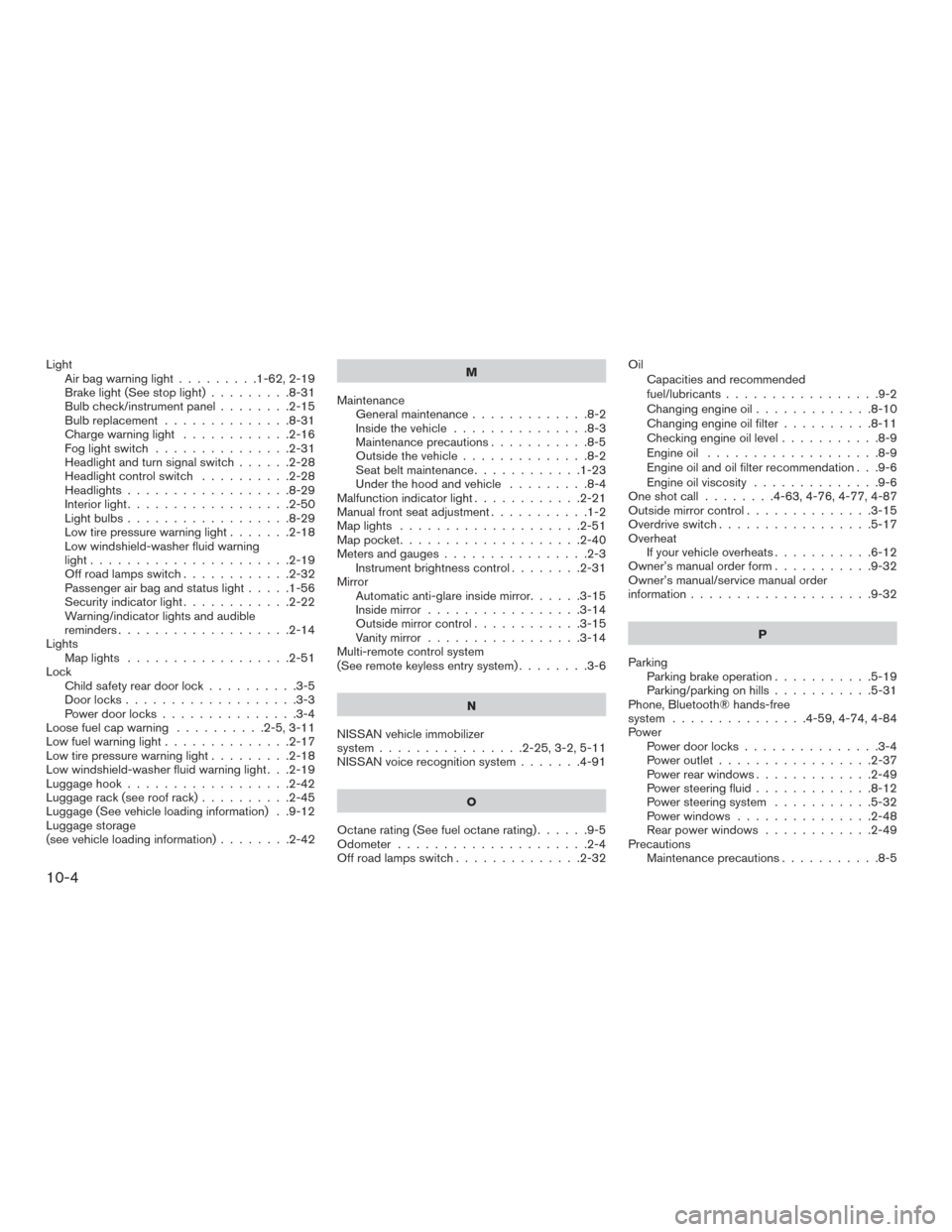
LightAirbagwarninglight.........1-62,2-19
Brake light (See stop light) .........8-31
Bulb check/instrument panel ........2-15
Bulb replacement ..............8-31
Charge warning light ............2-16
Foglightswitch ...............2-31
Headlight and turn signal switch ......2-28
Headlight control switch ..........2-28
Headlights ..................8-29
Interiorlight..................2-50
Lightbulbs..................8-29
Low tire pressure warning light .......2-18
Low windshield-washer fluid warning
light......................2-19
Offroadlampsswitch............2-32
Passenger air bag and status light .....1-56
Security indicator light ............2-22
Warning/indicator lights and audible
reminders ...................2-14
Lights Maplights ..................2-51
Lock Child safety rear door lock ..........3-5
Door locks ...................3-3
Power door locks ...............3-4
Loose fuel cap warning ..........2-5,3-11
Lowfuelwarninglight..............2-17
Low tire pressure warning light .........2-18
Low windshield-washer fluid warning light . . .2-19
Luggage hook ..................2-42
Luggage rack (see roof rack) ..........2-45
Luggage (See vehicle loading information) . .9-12
Luggage storage
(seevehicleloadinginformation)........2-42 M
Maintenance Generalmaintenance.............8-2
Insidethevehicle...............8-3
Maintenance precautions ...........8-5
Outside the vehicle ..............8-2
Seatbeltmaintenance............1-23
Underthehoodandvehicle .........8-4
Malfunction indicator light ............2-21
Manual front seat adjustment ...........1-2
Maplights ....................2-51
Map pocket ....................2-40
Meters and gauges ................2-3
Instrument brightness control ........2-31
Mirror Automatic anti-glare inside mirror ......3-15
Inside mirror .................3-14
Outside mirror control ............3-15
Vanity mirror .................3-14
Multi-remote control system
(See remote keyless entry system) ........3-6
N
NISSAN vehicle immobilizer
system ................2-25,3-2,5-11
NISSAN voice recognition system .......4-91
O
Octane rating (See fuel octane rating) ......9-5
Odometer .....................2-4
Offroadlampsswitch..............2-32 Oil
Capacities and recommended
fuel/lubricants.................9-2
Changingengineoil.............8-10
Changing engine oil filter ..........8-11
Checking engine oil level ...........8-9
Engineoil ...................8-9
Engine oil and oil filter recommendation . . .9-6
Engine oil viscosity ..............9-6
Oneshotcall........4-63,4-76,4-77,4-87
Outside mirror control ..............3-15
Overdrive switch .................5-17
Overheat If your vehicle overheats ...........6-12
Owner’s manual order form ...........9-32
Owner’s manual/service manual order
information ....................9-32
P
Parking Parking
brake operation ...........5-19
Parking/parking on hills ...........5-31
Phone, Bluetooth® hands-free
system ...............4-59,4-74,4-84
Power Power door locks ...............3-4
Poweroutlet.................2-37
Power rear windows .............2-49
Power steering fluid .............8-12
Power steering system ...........5-32
Power windows ...............2-48
Rear power windows ............2-49
Precautions Maintenance precautions ...........8-5
10-4
Page 392 of 396
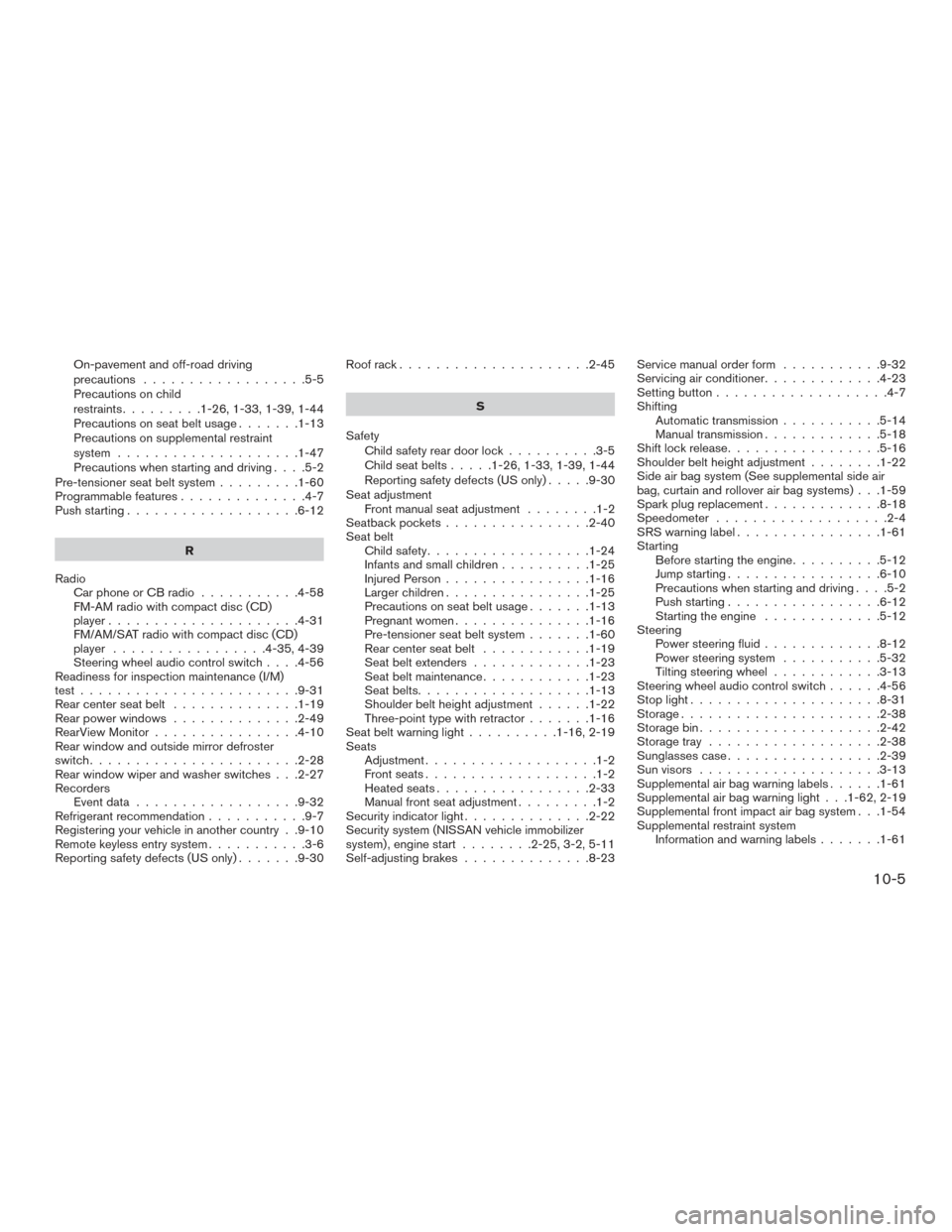
On-pavement and off-road driving
precautions ..................5-5
Precautions on child
restraints.........1-26,1-33,1-39,1-44
Precautionsonseatbeltusage.......1-13
Precautions on supplemental restraint
system ....................1-47
Precautions when starting and driving ....5-2
Pre-tensioner seat belt system .........1-60
Programmable features ..............4-7
Push starting ...................6-12
R
Radio Car phone or CB radio ...........4-58
FM-AM radio with compact disc (CD)
player .....................4-31
FM/AM/SAT radio with compact disc (CD)
player .................4-35,4-39
Steering wheel audio control switch ....4-56
Readiness for inspection maintenance (I/M)
test........................9-31
Rear center seat belt ..............1-19
Rear power windows ..............2-49
RearViewMonitor................4-10
Rear window and outside mirror defroster
switch.......................2-28
Rear window wiper and washer switches . . .2-27
Recorders Eventdata..................9-32
Refrigerant recommendation ...........9-7
Registering your vehicle in another country . .9-10
Remote keyless entry system ...........3-6
Reporting safety defects (US only) .......9-30Roof rack
.....................2-45
S
Safety Child safety rear door lock ..........3-5
Child seat belts .....1-26,1-33,1-39,1-44
Reporting safety defects (US only) .....9-30
Seat adjustment Frontmanualseatadjustment ........1-2
Seatback pockets ................2-40
Seat belt Child safety ..................1-24
Infantsandsmallchildren..........1-25
Injured Person ................1-16
Largerchildren................1-25
Precautions on seat belt usage .......1-13
Pregnant women ...............1-16
Pre-tensioner seat belt system .......1-60
Rear center seat belt ............1-19
Seatbeltextenders .............1-23
Seat belt maintenance ............1-23
Seatbelts...................1-13
Shoulder belt height adjustment ......1-22
Three-point type with retractor .......1-16
Seat belt warning light ..........1-16,2-19
Seats Adjustment...................1-2
Front seats ...................1-2
Heated seats .................2-33
Manual front seat adjustment .........1-2
Security indicator light ..............2-22
Security system (NISSAN vehicle immobilizer
system) , engine start ........2-25,3-2,5-11
Self-adjusting brakes ..............8-23 Service manual order form
...........9-32
Servicing air conditioner .............4-23
Setting button ...................4-7
Shifting Automatic transmission ...........5-14
Manual transmission .............5-18
Shiftlockrelease.................5-16
Shoulder belt height adjustment ........1-22
Side air bag system (See supplemental side air
bag, curtain and rollover air bag systems) . . .1-59
Sparkplugreplacement.............8-18
Speedometer ...................2-4
SRSwarninglabel................1-61
Starting Before starting the engine ..........5-12
Jump starting .................6-10
Precautions
when starting and driving ....5-2
Push starting .................6-12
Starting the engine .............5-12
Steering Power steering fluid .............8-12
Power steering system ...........5-32
Tilting steering wheel ............3-13
Steeringwheelaudiocontrolswitch......4-56
Stoplight.....................8-31
Storage......................2-38
Storagebin....................2-42
Storage tray ...................2-38
Sunglasses case .................2-39
Sun visors ....................3-13
Supplemental air bag warning labels ......1-61
Supplemental air bag warning light . . .1-62, 2-19
Supplemental front impact air bag system . . .1-54
Supplemental restraint system Information and warning labels .......1-61
10-5