light Oldsmobile Achieva 1995 s Owner's Guide
[x] Cancel search | Manufacturer: OLDSMOBILE, Model Year: 1995, Model line: Achieva, Model: Oldsmobile Achieva 1995Pages: 340, PDF Size: 16.99 MB
Page 118 of 340
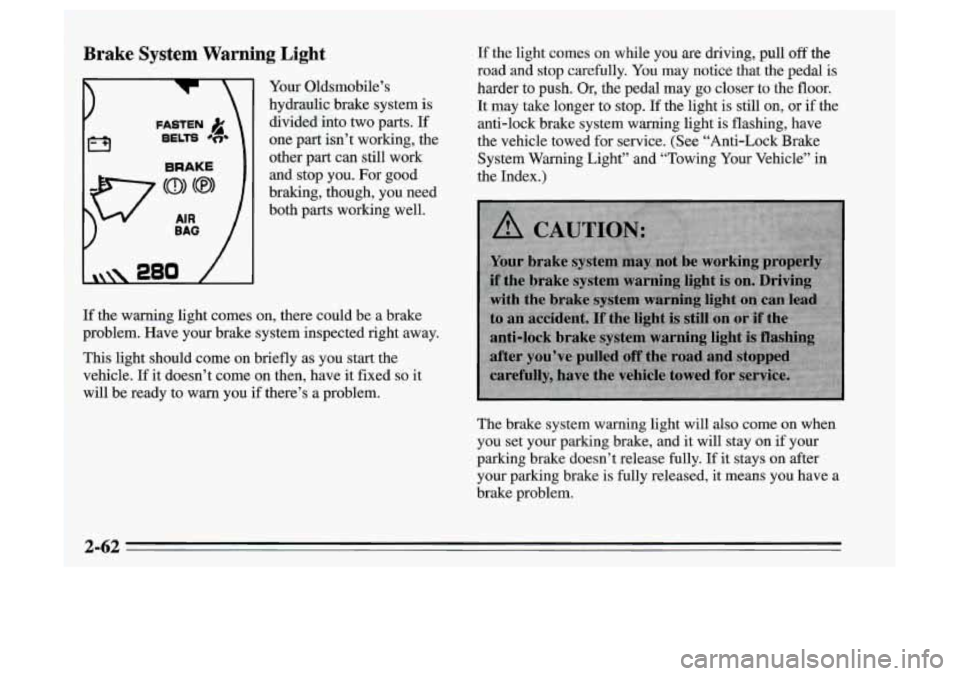
Brake System Warning Light
FASTEN )i
BELTS #e*
BRAKE
Your Oldsmobile’s
hydraulic brake system is
divided into two parts. If
one part isn’t working, the
other part can still work and stop you. For good
braking, though, you need
both parts working well. If the light comes
on while you are driving, pull off the
road
and stop carefully. You may notice that the pedal is
harder to push. Or, the pedal may go closer to the floor.
It may take longer to stop. If the light is still on, or if the
anti-lock brake system warning light is flashing, have
the vehicle towed for service. (See “Anti-Lock Brake
System Warning Light” and “Towing Your Vehicle” in
the Index.)
If the warning light comes on, there could be a brake
problem. Have your brake system inspected right away.
This light should come on briefly as you start the
vehicle. If
it doesn’t come on then, have it fixed so it
will be ready to warn you if there’s a problem.
The brake system warning light will also come
on when
you set your parking brake, and it will stay on
if your
parking brake doesn’t release fully.
If it stays on after
your parking brake is fully released, it means you have a
brake problem.
2-62
Page 119 of 340
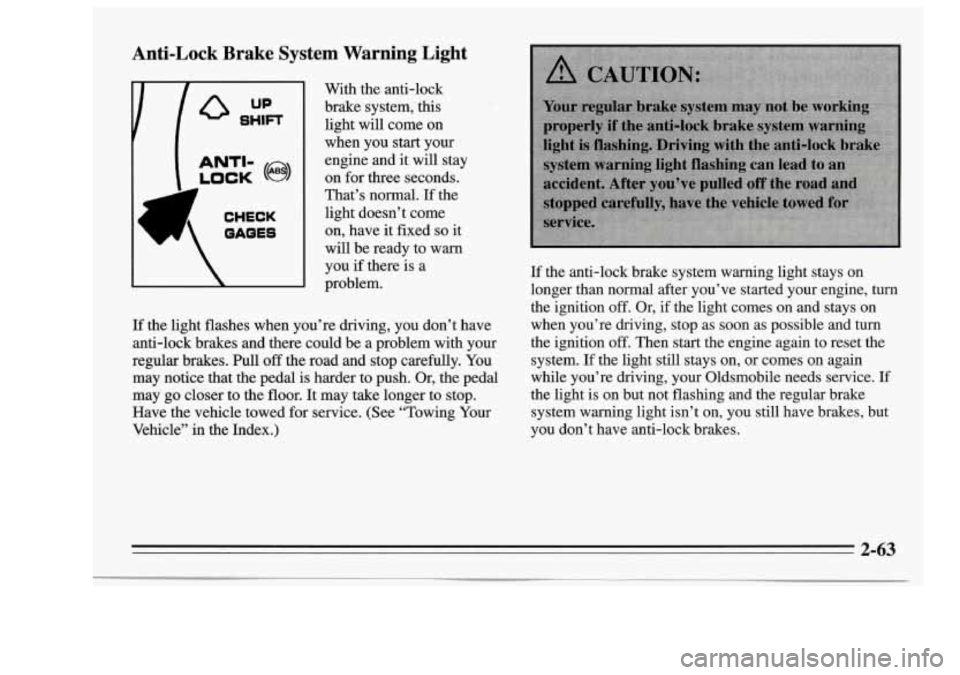
Anti-Lock Brake System Warning Light
‘A CHECK
OAQES
With the anti-lock
brake system,
this
light will come on
when you start your
engine and it will stay
on for
three seconds.
That’s normal.
If the
light doesn’t come
on, have it fiied
so it
will be ready to warn
you
if there is a
problem.
If the light flashes when you’re driving, you don’t have
anti-lock brakes and there could be a problem with your
regular brakes. Pull
off the road and stop carefully. You
may notice that the pedal is harder to push. Or, the pedal
may go closer to the floor. It may take longer to stop.
Have the vehicle towed for service. (See “Towing Your
Vehicle” in the Index.)
If the anti-lock brake system warning light stays on
longer than normal after you’ve started your engine,
turn
the ignition off. Or, if the light comes on and stays on
when you’re driving, stop as soon as possible and turn
the ignition
off. Then start the engine again to reset the
system.
If the light still stays on, or comes on again
while you’re driving, your Oldsmobile needs service.
If
the light is on but not flashing and the regular brake
system warning light isn’t on, you still have brakes, but
you don’t have anti-lock brakes.
2-63
Page 120 of 340
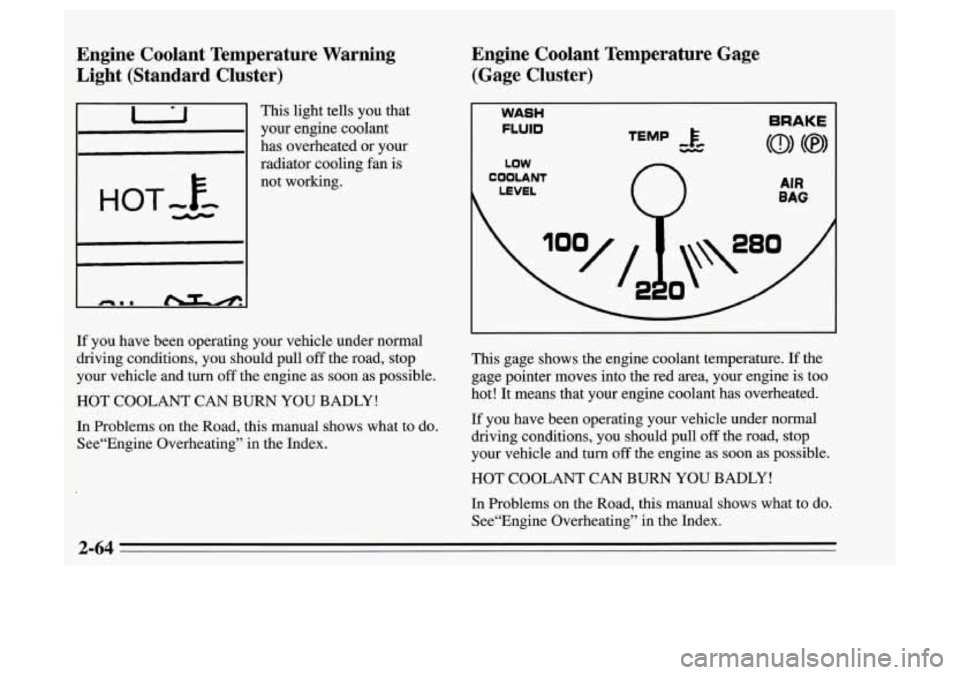
Engine Coolant Temperature Warning
Light (Standard Cluster) Engine Coolant Temperature Gage
(Gage Cluster)
This light tells you that
your engine coolant
has overheated or your
radiator cooling fan
is I
not working.
-
i you have been operating your vehicle under normal
~ driving conditions, you should pull off the road, stop
your vehicle and
turn off the engine as soon as possible.
HOT COOLANT CAN BURN YOU BADLY!
In Problems on the Road, this manual shows what to do.
1 See“Engine Overheating” in the Index.
TEMP
BRAKE WASH
FLUID
HN
LOW
COOLANT
LEVEL AIR
BAG
280
This gage shows the engine coolant temperature. If the
gage pointer moves into the red area, your engine is too
hot! It means that your engine coolant has overheated.
If you have been operating your vehicle under normal
driving conditions, you should pull
off the road, stop
your vehicle and
turn off the engine as soon as possible.
HOT COOLANT CAN BURN YOU BADLY!
In
Problems on the Road, this manual shows what to do.
See“Engine Overheating” in the Index.
Page 121 of 340
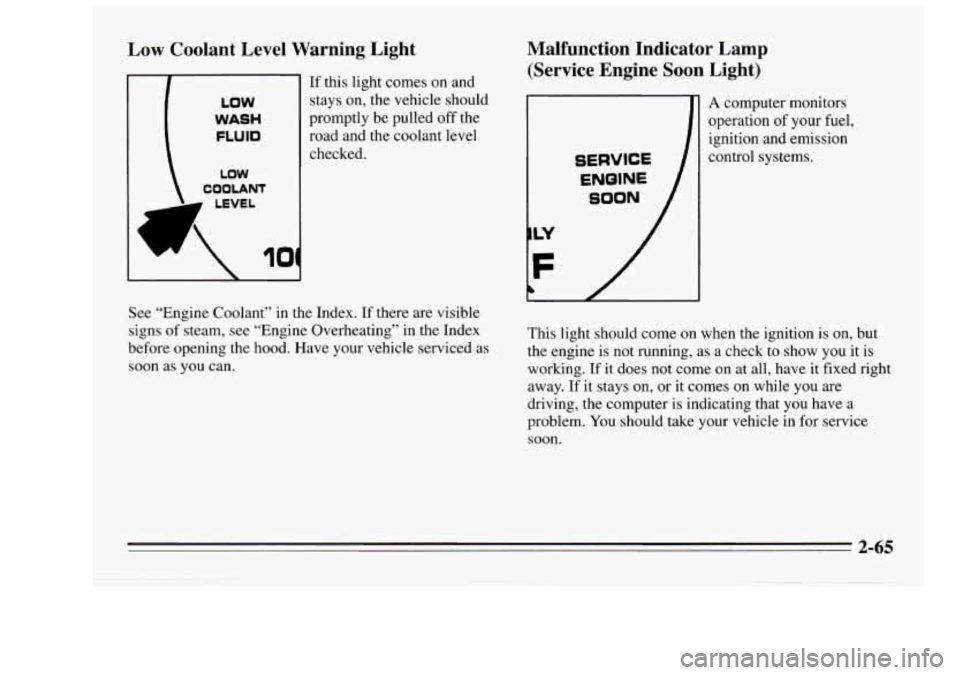
Low Coolant Level Warning Light
LOW
WASH
FLUID
LOW
COOLANT
1
If this light comes on and
stays on, the vehicle should
promptly be pulled off the
road and the coolant level
checked.
See “Engine Coolant”
in the Index. If there are visible
signs of steam, see “Engine Overheating” in the Index
before opening the hood. Have your vehicle serviced as
soon as you can.
Malfunction Indicator Lamp
(Service Engine Soon
Light)
I
LY
SERVICE
ENOINE
SOON
A computer monitors
operation of your fuel,
ignition and emission
control systems.
This light should come on when the ignition
is on, but
the engine is not running,
as a check to show you it is
working. If it does not come on at all, have it fixed right
away. If
it stays on, or it comes on while you are
driving, the computer is indicating that you have a
problem. You should take your vehicle in for service
soon.
2-65
Page 122 of 340
NOTICE:
If you keep driving your vehicle with this light
on, after a while the emission controls won’t
work as well, your fuel economy won’t be as good
and your engine may not run as smoothly. This
could lead to costly repairs not covered by your
warranty.
Check Gages Light (Gage Cluster)
9 ANTI-
CHECK
Q
OAOES
UI
E 4
This light will come
on briefly when you
are starting the engine.
If it stays on, or if
it
comes on and stays on
while you are driving,
check your various
gages to see if they are
in the warning zones.
Oil Pressure Gage (Gage Cluster)
UP
SHIFT
CHECK
OIL
The oil pressure gage shows the engine oil pressure in
psi (pounds per square inch) when the engine is running.
Canadian vehicles indicate pressure in kPa. Oil pressure
may vary with engine speed, outside temperature and oil
viscosity, but readings above the red warning zone
indicate the normal operating range.
A reading in the red zone may be caused by a
dangerously low oil level or other problem causing low
oil pressure. Have your vehicle serviced immediately.
2-66
Page 123 of 340
I NOTICE:
Damage to your engine from neglected oil
problems can be costly and is not covered by your
warranty.
Oil Warning Light (Standard Cluster)
If you have a low
engine
oil pressure
problem,
this light will
stay on after you start
your engine, or come on when you are driving.
This indicates that your
engine is not receiving
enough
oil. The engine
could be low on oil, or
could have some other
oil problem. Have it
fixed immediately.
The oil light could also come on in two other situations:
0
0 When the ignition is on but the engine is not running,
the light will come on as a test to show you it is
working, but the light will go out when you
turn the
ignition to START.
If it doesn’t come on with the
ignition on, you may have a problem with the fuse or
bulb. Have it fixed right away.
If you make a hard stop, the light may come on for a
moment. This is normal.
2-67
Page 124 of 340
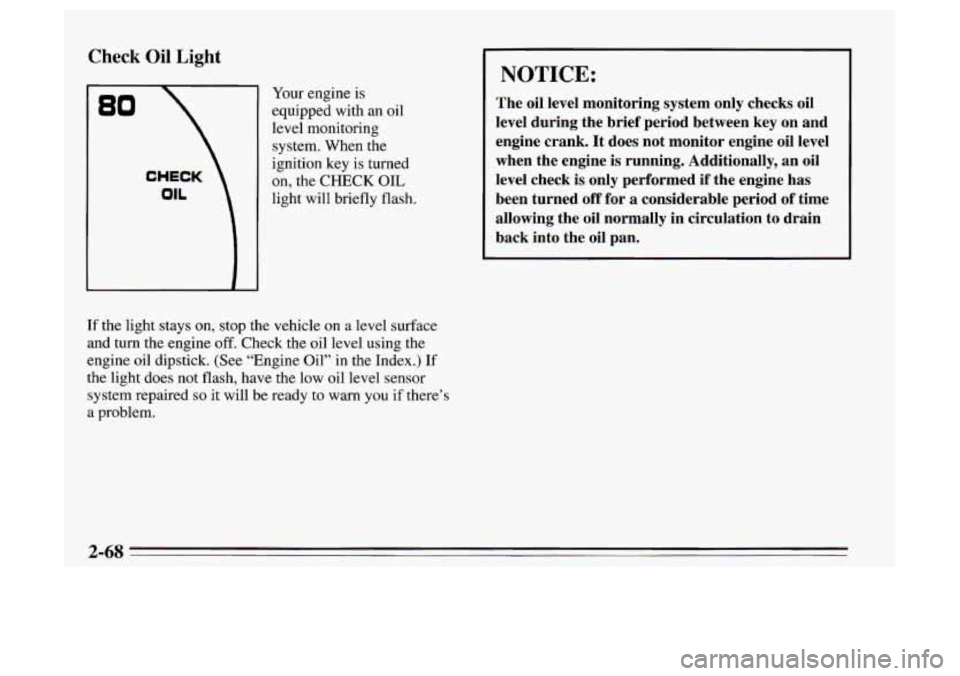
Check Oil Light
80
Your engine is
equipped with
an oil
level monitoring
system. When the
ignition key is turned
on, the CHECK
OIL
light will briefly flash.
If the light stays on, stop the vehicle on a level surface
and turn the engine
off. Check the oil level using the
engine oil dipstick. (See “Engine Oil” in the Index.)
If
the light does not flash, have the low oil level sensor
system repaired
so it will be ready to warn you if there’s
a problem.
I NOTICE:
The oil level monitoring system only checks oil
level during the brief period between key on and
engine crank.
It does not monitor engine oil level
when the engine is running. Additionally, an oil
level check is only performed if the engine has
been turned
off for a considerable period of time
allowing the oil normally in circulation to drain
back into the oil pan.
2-68
Page 126 of 340
Here are four things that some owners ask about. None
of these show a problem with your fuel gage:
0 At the service station, the gas pump shuts off before
It takes a little more or less fuel to fill up than the
the
gage reads
F (FULL).
gage indicated. For example, the gage may have
indicated the tank was half full, but it actually took a
little more or less than half the tank’s capacity to fill
the tank.
0 The gage moves a little when you turn a corner or
speed
up.
The gage doesn’t go back to E (EMPTY) when you
turn
off the ignition.
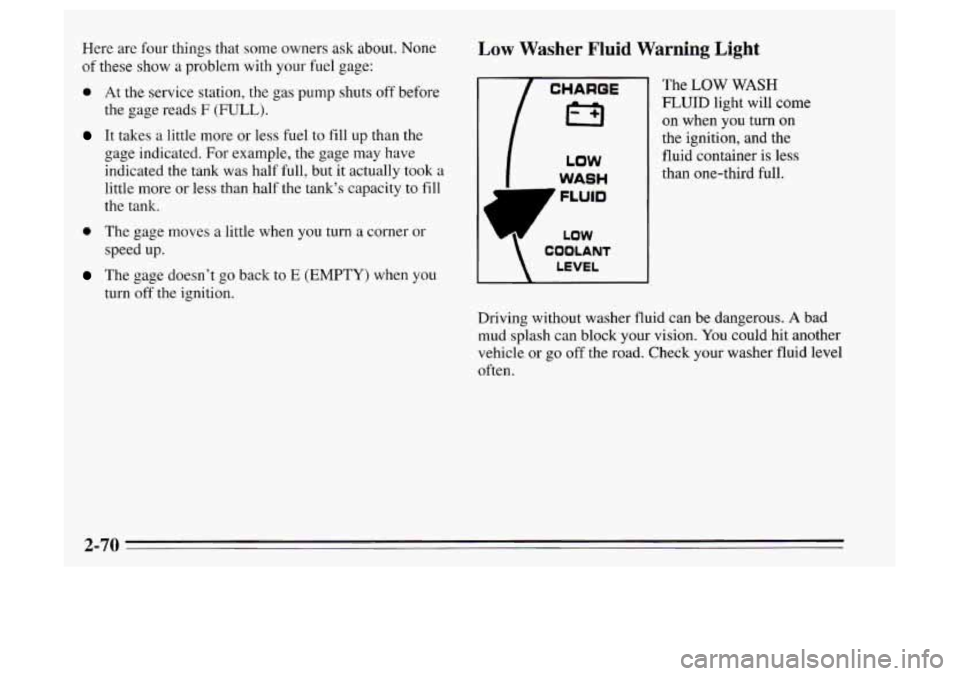
Low Washer Fluid Warning Light
1 CHAROE I
I3
LOW
WASH
LEVEL
COOLANT
The LOW WASH
FLUID light will come
on when you turn on
the ignition, and the
fluid container is less
than one-third full.
Driving without washer fluid can be dangerous.
A bad
mud splash can block your vision. You could hit another
vehicle or
go off the road. Check your washer fluid level
often.
Page 128 of 340
MODE CONTROL: The right control knob changes
the functions
of your system.
VENT: Use when outside temperatures are mild, and
little heating or cooling is needed. Air flow is through
the instrument panel outlets.
Set the center control knob
to the temperature desired.
BI-LEV: Use on cool, but sunny days. This setting
brings in the outside air, but directs it in two ways. The
cool air is directed to the upper portion of your body
through the instrument panel outlets, but slightly
warmer air is directed through the heater ducts and
defroster vents. At times this temperature difference
may be more apparent than others.
HEAT This setting brings heated air through the heater
ducts, and some through the windshield defroster vents.
If you have the optional engine coolant heater (engine
block heater) and
use it during cold weather, 0°F
(- 1 8’ C) or lower, your heating system will more quickly
provide heat because the engine coolant is already
warmed. See “Engine Coolant Heater (Engine Block
Heater)” in the Index.
DEFOG: This setting divides air flow equally between
the heater ducts and the windshield defroster vents.
DEF: This setting directs air through the
windshield defroster vents located on top
of the
instrument panel.
Defogging Windows
To defog the windshield, turn all three control knobs to
the far right.
3-2
Page 129 of 340
Air Conditioning System (Option)
The air conditioner and heater work best if you keep
your windows closed while using them. Your vehicle
also has the flow-through ventilation system described
later in this section.
Air Conditioning
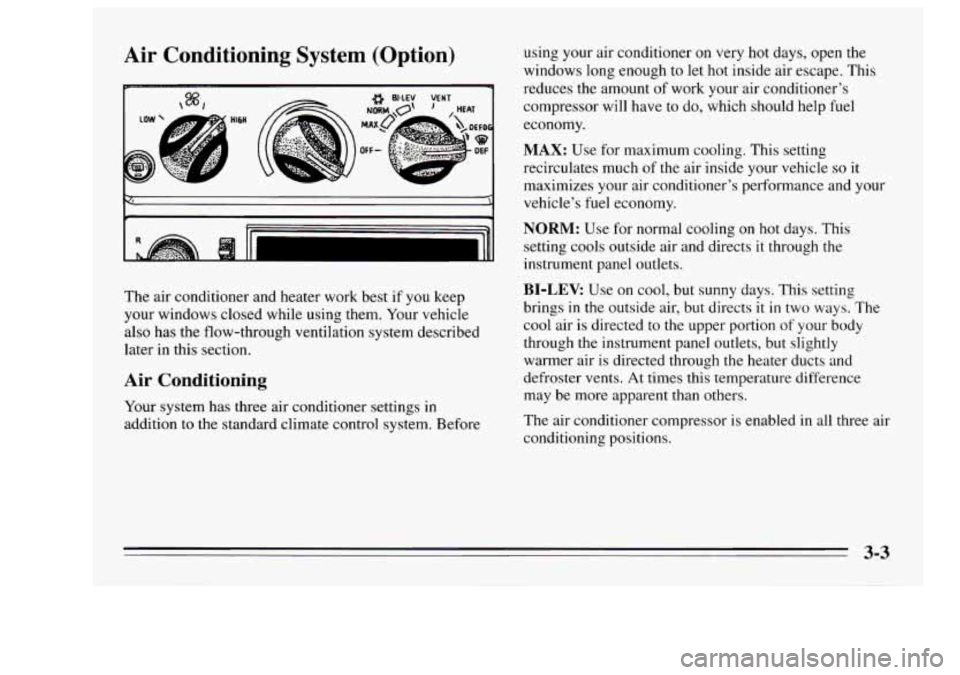
Your system has three air conditioner settings in
addition to the standard climate control system. Before using
your air conditioner
on very hot days, open the
windows long enough to let hot inside air escape. This
reduces the amount of work your air conditioner's
compressor will have
to do, which should help fuel
economy.
MAX: Use for maximum cooling. This setting
recirculates much of the air inside your vehicle
so it
maximizes your air conditioner's performance and your
vehicle's fuel economy.
NORM: Use for normal cooling on hot days. This
setting cools outside air and directs it through the
instrument panel outlets.
BI-LEV: Use on cool, but sunny days. This setting
brings
in the outside air, but directs it in two ways. The
cool air
is directed to the upper portion of your body
through the instrument panel outlets, but slightly
warmer air is directed through the heater ducts and
defroster vents. At times this temperature difference
may be more apparent than others.
The air conditioner compressor is enabled in all three air
conditioning positions.
3-3