warning Oldsmobile Achieva 1995 s Owner's Guide
[x] Cancel search | Manufacturer: OLDSMOBILE, Model Year: 1995, Model line: Achieva, Model: Oldsmobile Achieva 1995Pages: 340, PDF Size: 16.99 MB
Page 195 of 340
NOTICE:
If your engine catches fire because you keep
driving with no coolant, your vehicle can be
badly damaged. The costly repairs would not be
covered by your warranty.
If No Steam Is Coming From Your Engine
If you get the overheat warning but see or hear no
steam, the problem may
not be too serious. Sometimes
the engine can get a little too
hot when you:
Climb a long hill on a hot day.
0 Stop after high speed driving.
Idle for long periods in traffic.
Tow a trailer.
If you get the overheat warning with no sign of steam,
try this for a minute or
so:
1. If you have an air conditioner, turn it off.
2. Turn on your heater to full hot at the highest fan
speed and open the window as necessary.
3. If you’re in a traffic jam, shift to NEUTRAL (N);
otherwise, shift to the highest gear while driving --
AUTOMATIC OVERDRIVE (03) or DRIVE (D) for
automatic transaxles.
If you
no longer have the overheat warning, you can
drive. Just to be safe, drive slower for about ten minutes.
If the warning doesn’t come back on, you can drive
normally.
If the warning continues, pull over, stop, and park your
vehicle right away.
If there’s still no sign of steam, you can idle the engine
for two or three minutes while you’re parked, to see
if
the warning stops. But then, if you still have the
warning,
turn off the engine and get everyone out of the
vehicle
until it cools down.
You may decide not to lift the hood but to get service
help right away.
5-13
Page 202 of 340
If a Tire Goes Flat
It’s unusual for a tire to “blow out” while you’re driving,
especially if you maintain your tires properly. If air goes
out of a tire, it’s much more likely to leak out slowly.
But if you should ever have a “blowout,” here are a few
tips about what
to expect and what to do:
If a front tire fails, the flat tire will create a drag that
pulls the vehicle toward that side. Take your foot off the
accelerator pedal and grip the steering wheel firmly.
Steer to maintain lane position, then gently brake to a
stop well out of the traffic lane.
A rear blowout, particularly on a curve, acts much like a
skid and may require the same correction you’d use
in a
skid. In any rear blowout, remove your foot from the
accelerator pedal. Get the vehicle under control by
steering the way you want
the vehicle to go. It may be
very bumpy and noisy, but you can still steer. Gently
brake to a stop, well off the road if possible.
If a tire goes flat, the next part shows how
to use your
jacking equipment to change a flat tire safely.
Changing a Flat Tire
If a tire goes flat, avoid further tire and wheel damage
by driving slowly to a level place. Turn on your hazard
warning flashers.
5-20
-
Page 225 of 340
When to Change Engine Oil
See if any one of these is true for you:
0
0
0
0
Most trips are less than 5 to 10 miles (8 to 16 km).
This is particularly important when outside
temperatures are below freezing.
Most trips include extensive idling (such as frequent
driving in stop and go traffic).
Most trips are through dusty areas.
You frequently tow a trailer or use a carrier on top of
your vehicle.
If any one of these is true for your vehicle, then
you
need to change your oil and filter every 3,000 miles
(5 000 km) or 3 months -- whichever comes first.
If none of them is true, change
the oil and filter every
7,500 miles (12 500 km) or 12 months -- whichever
comes first.
Engine Coolant Heater
An engine coolant heater can be a big help if you have
to park outside
in very cold weather, 0 OF (- 18 O C) or
colder. If your vehicle has this option, see “Engine
Coolant Heater” in the Index.
What to Do with Used Oil
Did you know that used engine oil contains certain
elements that may be unhealthy for your skin and could
even cause cancer? Don’t let used oil stay on your skin
for very long. Clean your skin and nails with soap and
water, or
a good hand cleaner. Wash or properly throw
away clothing or rags containing used engine oil. (See
the manufacturer’s warnings about the use and disposal
of oil products.)
Used oil can be a real threat
to the environment. If you
change your own
oil, be sure to drain all free-flowing oil
from the filter before disposal. Don’t ever dispose of oil
by putting it in the trash, pouring it on the ground, into
sewers, or into streams or bodies of water. Instead,
recycle it by taking
it to a place that collects used oil. If
you have a problem properly disposing of your used oil,
ask your retailer, a service station or
a local recycling
center for help.
-
6-15
Page 231 of 340
Hydraulic Clutch
The hydraulic clutch linkage in your vehicle is
self-adjusting. The clutch master cylinder reservoir
is
filled with hydraulic clutch fluid.
It isn’t a good idea to “top off’ your clutch fluid. Adding
fluid won’t correct
a leak.
A fluid loss in this system could indicate a problem.
Have the system inspected and repaired.
When to Check and What to Use
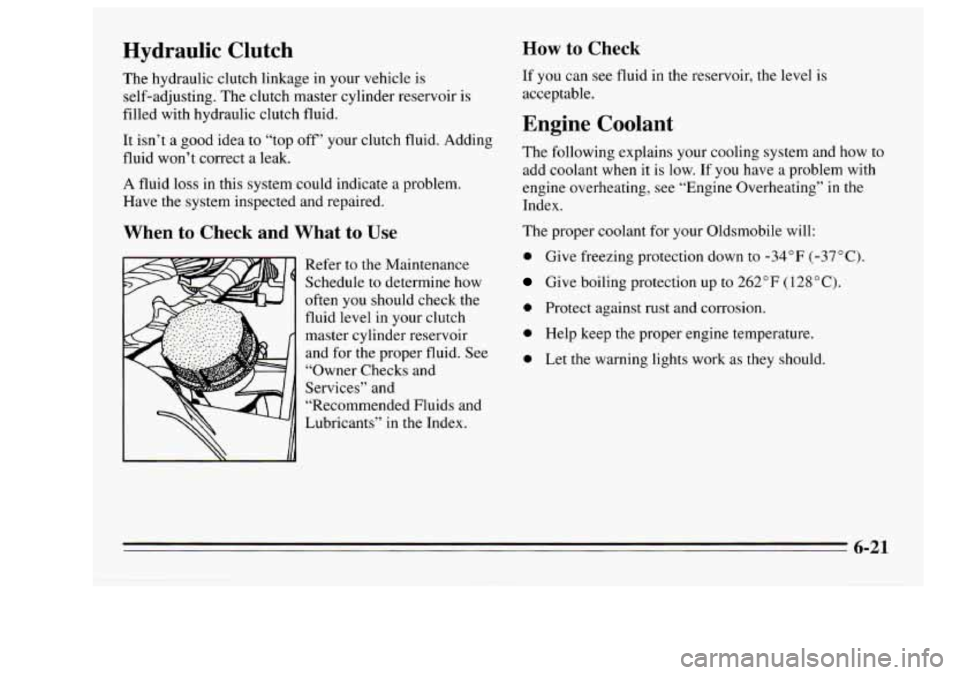
Refer to the Maintenance
Schedule to determine how
often you should check the
fluid level in your clutch
master cylinder reservoir
and for the proper fluid. See
“Owner Checks and
Services” and
“Recommended Fluids and
Lubricants” in the Index.
How to Check
If you can see fluid in the reservoir, the level is
acceptable.
Engine Coolant
The following explains your cooling system and how to
add coolant when it is low.
If you have a problem with
engine overheating, see “Engine Overheating”
in the
Index.
The proper coolant for your Oldsmobile will:
0 Give freezing protection down to -34°F (-37°C).
Give boiling protection up to 262°F ( 128 O C).
0 Protect against rust and corrosion.
0 Help keep the proper engine temperature.
0 Let the warning lights work as they should.
6-21
Page 237 of 340
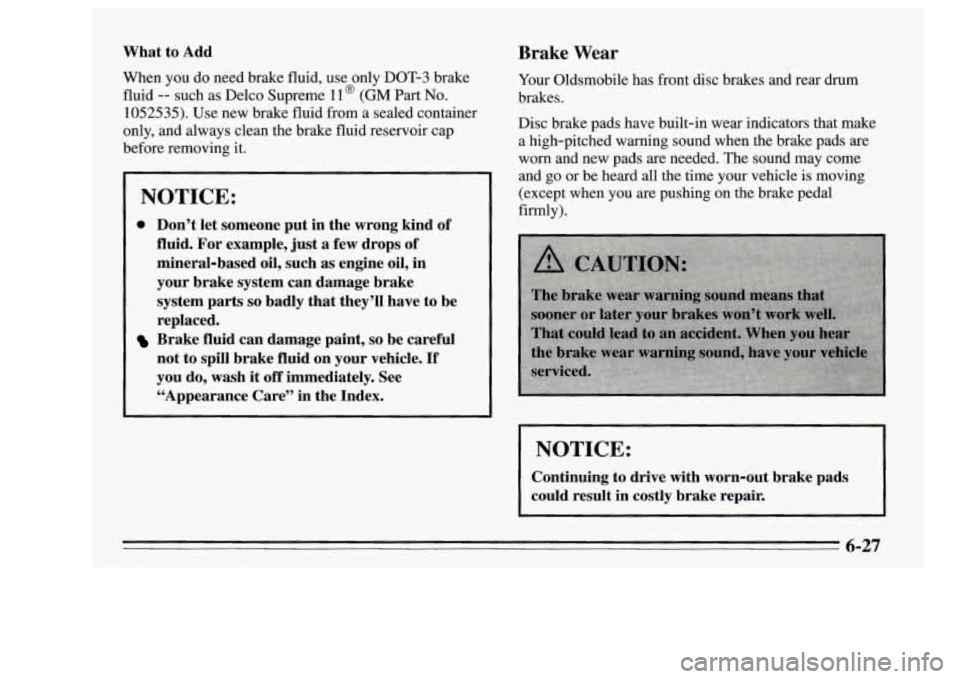
What to Add
When you do need brake fluid, use only DOT-3 brake
fluid
-- such as Delco Supreme 11 @ (GM Part No.
1052535). Use new brake fluid from a sealed container
only, and always clean the brake fluid reservoir cap
before removing it.
Brake Wear
Your Oldsmobile has front disc brakes and rear drum
brakes.
Disc brake pads have built-in wear indicators that make a high-pitched warning sound when the brake pads
are
worn and new pads are needed. The sound may come
and
go or be heard all the time your vehicle is moving
(except when you are pushing on the brake pedal
firmly). NOTICE:
0 Don’t let someone put in the wrong kind of
fluid. For example, just a few drops of
mineral-based oil, such as engine oil, in
your brake system can damage brake
system parts
so badly that they’ll have to be
replaced.
Brake fluid can damage paint, so be careful
not to spill brake fluid on your vehicle.
If
you do, wash it off immediately. See
“Appearance Care” in the Index.
I NOTICE:
Continuing to drive with worn-out brake pads
could result in costly brake repair.
6-27
Page 248 of 340
Treadwear Temperature - A, B, C
The treadwear grade is a comparative rating based on
the wear rate of the tire when tested under controlled
conditions on
a specified government test course. For
example, a tire graded
150 would wear one and a half
(1 1/2) times as well on the government course as a tire
graded 100. The relative performance
of tires depends
upon the actual conditions of their use, however, and
may depart significantly from the norm due
to variations
in driving habits, service practices and differences in
road characteristics and climate.
Traction - A, B, C
The traction grades, from highest to lowest are: A, B,
and C. They represent the tire’s ability to stop on wet
pavement as measured under controlled conditions on
specified government test surfaces of asphalt and
concrete.
A tire marked C may have poor traction
performance.
Warning: The traction grade assigned to this
tire is based
on braking (straight-ahead) traction tests and does not
include cornering (turning) traction. The
temperature grades are
A (the highest), B, and C,
representing the tire’s resistance to the generation of
heat and its ability to dissipate heat when tested under
controlled conditions on a specified indoor laboratory
test wheel. Sustained high temperature can cause the
material of the tire to degenerate and reduce tire life, and
excessive temperature can lead to sudden tire failure.
The grade
C corresponds to a level of performance
which all passenger car tires must meet under the
Federal Motor Vehicle Safety Standard
No. 109. Grades
B and A represent higher levels of performance on the
laboratory test wheel than the
ninimum required by law.
Warning:
The temperature grade for this tire is
established for a tire that is properly inflated and not
overloaded. Excessive speed, underinflation, or
excessive loading, either separately or
in combination,
can cause heat buildup and possible tire failure.
6-38
Page 251 of 340
Tire Chains
NOTICE:
If your Oldsmobile has P195/65R15 or
P205/55R16 size tires, don’t use tire chains; they
can damage your vehicle.
If you have other tires, use tire chains only where
legal and only when you must. Use only
SAE
Class “S” type chains that are the proper size for
your tires. Install them on the front tires and
tighten them
as tightly as possible with the ends
securely fastened. Drive slowly and follow the
chain manufacturer’s instructions. If you can
hear the chains contacting your vehicle, stop and
retighten them.
If the contact continues, slow
down until
it stops. Driving too fast or spinning
the wheels with chains on will damage your
vehicle.
Appearance Care
Remember, cleaning products can be hazardous. Some are toxic. Others can burst into flame if you strike a
match or get them on a hot
part of the vehicle. Some are
dangerous if you breathe their fumes in a closed space.
When you use anything from a container to clean your
Oldsmobile, be sure to follow the manufacturer’s warnings and instructions. And always open your doors
or windows when you’re cleaning the inside.
Never use these to clean your vehicle:
0 Gasoline
Benzene
Naphtha
0 Carbon Tetrachloride
0 Acetone
0 Paint Thinner
Turpentine
0 Lacquer Thinner
0 Nail Polish Remover
They can
all be hazardous -- some more than others -- and
they can all damage your vehicle, too.
6-41
-
Page 262 of 340
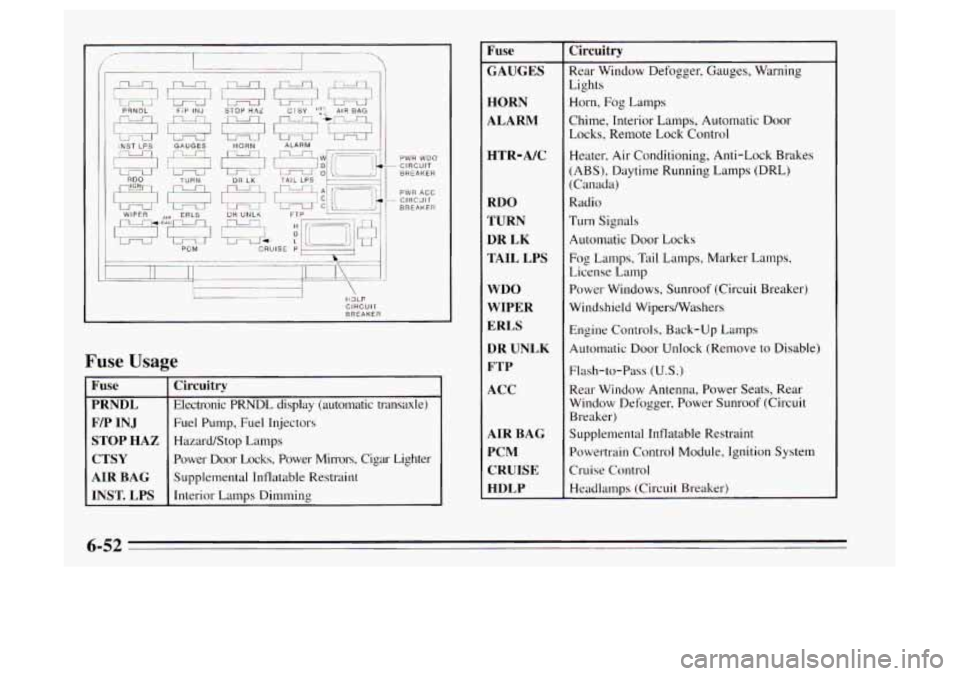
-L- El
F/P IN.1 e,
iNST LPS GAUGES
I I
H3LP CIRCUIT BREAKER
~ CIRCUIT PWR WDO
BREAKER
PWA ACC
BREAKEI? - CIRCUIT
Fuse Usage
PRNDL
F/P INJ
STOP HAZ
AIR BAG
INST. LPS Circuitry
Electronic PRNDL display (automatic transaxle)
Fuel
Pump, Fuel Injectors
Hazard/Stop Lamps
Power Door Locks, Power Mirrors, Cigar Lighter
Supplemental Inflatable Restraint
Interior Lamps Dimming
Fuse
GAUGES
HORN
ALARM
HTR-A/C
RDO
TURN DR
LK
TAIL LPS
WDO
WIPER
ERLS DR UNLK
FTP
ACC
AIR BAG PCM CRUISE
HDLP Circuitry
Rear Window Defogger,
Gauges, Warning
Lights
Horn, Fog Lamps
Chime, Interior Lamps, Automatic Door
Locks, Remote Lock Control
Heater, Air Conditioning, Anti-Lock Brakes
(ABS), Daytime Running Lamps (DRL)
(Canada)
Radio
Turn Signals
Automatic Door Locks
Fog Lamps, Tail Lamps, Marker Lamps,
License Lamp
Power Windows, Sunroof (Circuit Breaker)
Windshield Wipersmashers
Engine Controls, Back-up Lamps
Automatic Door Unlock (Remove
to Disable)
Flash-to-Pass
(U.S.)
Rear Window Antenna, Power Seats, Rear
Window Defogger, Power Sunroof (Circuit
Breaker)
Supplemental Inflatable Restraint
Powertrain Control Module, Ignition System
Cruise Control
Headlamps (Circuit Breaker)
6-52
Page 266 of 340
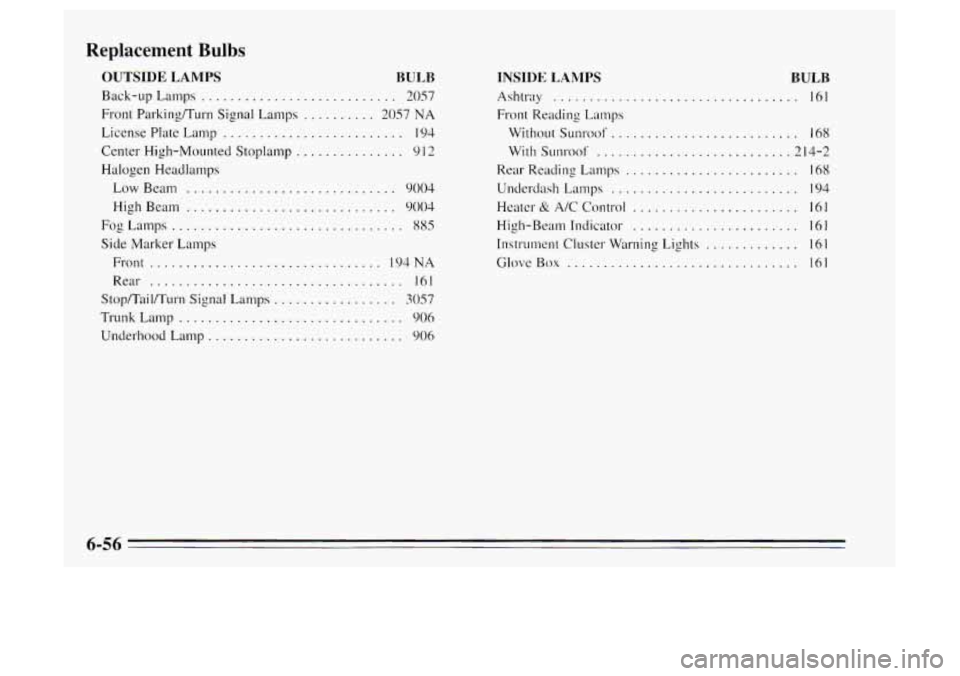
Replacement Bulbs
OUTSIDE LAMPS BULB
Back-up Lamps ........................... 2057
Front Parking/Turn Signal Lamps .......... 2057 NA
License Plate Lamp ......................... 194
Center High-Mounted Stoplamp ............... 9 12
Halogen Headlamps
Low Beam
............................. 9004
High Beam ............................. 9004
Fog Lamps ................................ 885
Side Marker Lamps
Front ................................ 194NA
Rear
................................... 161
Stop/TaiI/Turn Signal Lamps ................. 3057
Trunk Lamp ............................... 906
Underhood Lamp ........................... 906
INSIDE LAMPS BULB
Ashtray .................................. 161
Without Su11roof .......................... i68
With Sunroof ........................... 2 14-2
Front
Reading Lamps
Rear Reading Lamps
........................ 168
Underdash Lamps .......................... 194
Heater
& A/C Control ....................... 161
High-Beam Indicator ....................... 161
Instr~~ment Cluster Warning Lights ............. 161
Glove Box ................................ 161
6-56
Page 327 of 340
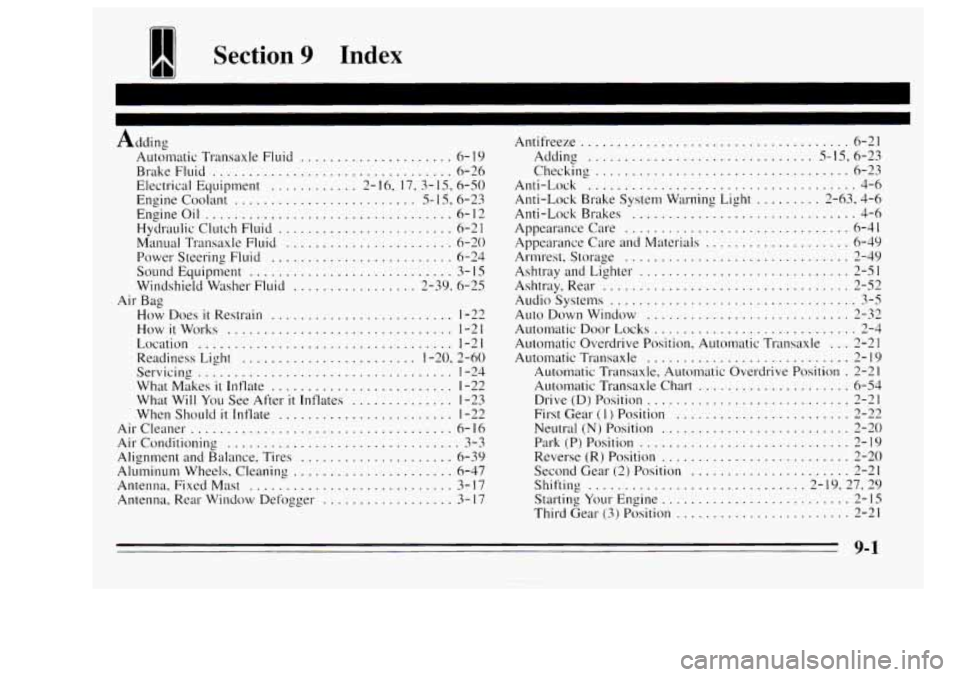
I Section 9 Index
Adding Automatic Transaxle Fluid
..................... 6- 19
Brake Fluid ................................. 6-26
Electrical Ecluipt-nent
............ 2- 16 . I7 . 3- I5 . 6-50
Engine Coolant
......................... 5- 15. 6-23
Engine Oil
.................................. 6- 12
Hycitwlic Clutch Fluid ........................ 6-2 1
Manual Transaxle Fluid ....................... 6-20
Power Steering Fluid
......................... 6-24
Sound Equipment
............................ 3- IS
Windshield Washer Fluid ................. 2-39 . 6-25
How Does it Restrain ......................... 1-22
How it Works ............................... 1-21
Location ................................... 1-2 1
Readiness Light ........................ 1-20 . 2-60
Servicing
................................... 1-24
What Makes
it Inflate ......................... 1-22
What Will You See After
it Inflates .............. 1-23
When Should
it Inl'late ........................ 1-22
Air Cleaner .................................... 6- I6
Air Conditioning ................................ 3-3
Aluminum Wheels. Cleaning ...................... 6-47
Antenna. Fixed Mast
............................ 3- 17
Antenna. Rear Window Defogger .................. 3- I7
Air Bag
Alignment and Balance . Tires ..................... 6-39 Antifreeze
..................................... 6-21
Adding
............................... 5- 15.6-23
Checking
................................... 6- 23
Anti-Lock
..................................... 4-6
Anti-Lock Brake System Warning Light ......... 2-63. 4-6
Anti-Lock Brakes ............................... 4-6
Appearance
Care and Materials .................... 6-49
Ashtray and Lighler
............................. 2-51
Audio Systems
.................................. 3-5
Auto Down Window ............................ 2-32
Automatic Door Locks
............................ 2-4
Automatic Overdrive Position
. Automatic Transaxle ... 2-21
Automatic Transaxle ............................ 2- 19
Automatic Transaxle . Automatic Overdrive Position . 2-2 I
Automatic Transaxle Chart ..................... 6-54
Drive (D) Position ............................ 2-21
First Gear ( 1 ) Position ........................ - 3-22
Neutral (N) Position .......................... 2-20
Park
(P) Position ............................. 2- 19
Reverse (R) Position .......................... 2-20
Second
Gear (2) Position ...................... 2-21
Shifting
.............................. 2- 19.27. 29
Starting Your Engine .......................... 2- IS
Third Gear (3) Position ........................ 2-21
AppeariInce
Ci1t.e
............................... 6-11
Armrest . Storage ............................... I 3 -49
Ashtray . Rear .................................. 2-52
9-1