brake Oldsmobile Achieva 1995 Owner's Manuals
[x] Cancel search | Manufacturer: OLDSMOBILE, Model Year: 1995, Model line: Achieva, Model: Oldsmobile Achieva 1995Pages: 340, PDF Size: 16.99 MB
Page 7 of 340

Vehicle Symbols
These are some of the symbols you may find on your vehicle.
For example,
these symbols
are used on an
original battery:
POSSIBLE A
CAUTION
INJURY
PROTECT EYES BY
SHIELDING
CAUSTIC
ACID COULD BATTERY
CAUSE
BURNS
AVOID
SPARKS
OR
FLAMES
SPARK
OR ,\I/,
COULD FLAME
EXPLODE BATTERY
These symbols
are important
for you and
your passengers
whenever your
vehicle
is
driven:
DOOR LOCK
UNLOCK
FASTEN SEAT
BELTS
POWER
WINDOW
These symbols
have to do with
your lights:
SIGNALS e e
TURN
FOG LAMPS
$0
These symbols
are on some of
your controls:
WINDSHIELD
WIPER
WINDSHIELD DEFROSTER
WINDOW
DEFOGGER
VENTILATING FAN
These symbols are used on
warning and
indicator lights:
COOLANT F-
TEMP --
ENGINE
CHARGING
I-1
BATTERY SYSTEM
BRAKE
(a)
FUEL
ENGINE OIL
PRESSURE
Wd
TEMP OIL 9b
ANTI-LOCK (@)
BRAKE
Here are some
other symbols
you may see:
FUSE -%-
RELEASE
RADIO
VOLUME
CONDITIONING
A'R 43
RELEASE TRUNK e
LIGHTER n
HORN )tr
SPEAKER
b
V
Page 63 of 340
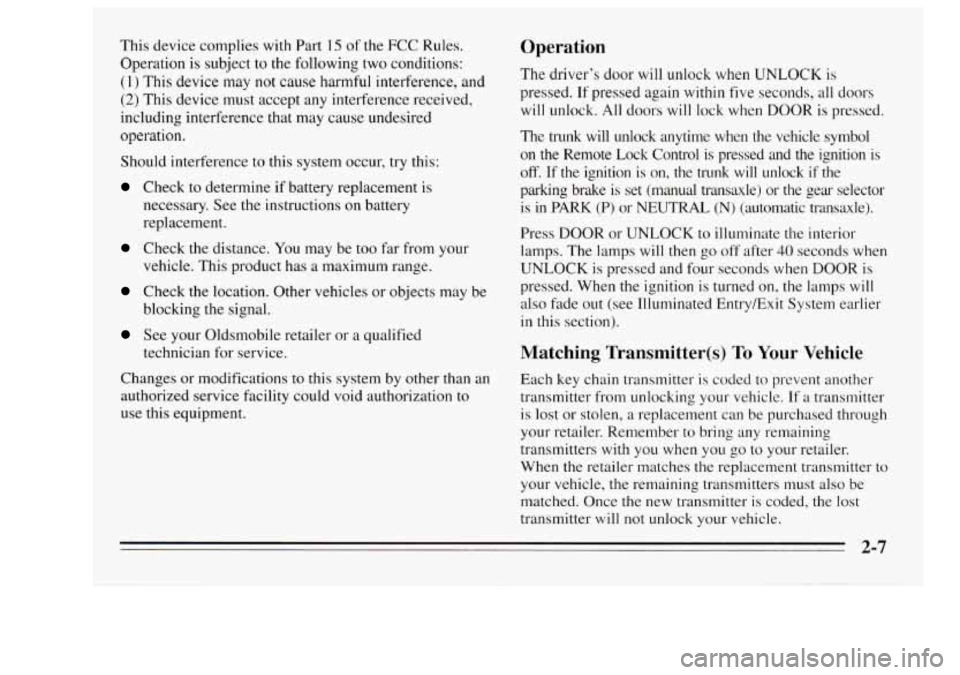
This device complies with Part 15 of the FCC Rules.
Operation
is subject to the following two conditions:
(1) This device may not cause harmful interference, and
(2) This device must accept any interference received,
including interference that may cause undesired
operation.
Should interference to this system occur, try this:
Check to determine if battery replacement is
necessary. See the instructions on battery
replacement.
Check the distance. You may be too far from your
vehicle. This product has a maximum range.
Check the location. Other vehicles or objects may be
blocking the signal.
See your Oldsmobile retailer or a qualified
technician for service.
Changes or modifications to
this system by other than an
authorized service facility could void authorization to
use this equipment.
Operation
The driver’s door will unlock when UNLOCK is
pressed.
If pressed again within five seconds, all doors
will unlock. All doors will lock when
DOOR is pressed.
The trunk will unlock anytime when the vehicle symbol
on the Remote
Lock Control is pressed and the ignition is
off. If the ignition is on, the trunk will unlock if the
parking brake is set (manual transaxle) or
the gear selector
is in PARK
(P) or NEUTRAL, (N) (automatic transaxle).
Press
DOOR or UNLOCK to illuminate the interior
lamps. The lamps will then
go off after 40 seconds when
UNLOCK is pressed and four seconds when
DOOR is
pressed. When the ignition is turned on, the lamps will
also fade out (see Illuminated EntryExit System earlier
in this section).
Matching Transmitter(s) To Your Vehicle
Each key chain transmitter is coded to prevent another
transmitter from unlocking your vehicle.
If a transmitter
is lost or stolen,
a replacement can be purchased through
your retailer. Remember to bring any remaining
transmitters with you when you
go to your retailer.
When the retailer matches the replacement transmitter to
your vehicle, the remaining transmitters must also be
matched. Once the new transmitter
is coded, the lost
transmitter will not unlock your vehicle.
2-7
Page 68 of 340
New Vehicle 4LBreak-In” Parking at Night
Park in a lighted spot, close all windows and lock your
vehicle. Remember to keep your valuables out
of sight.
Put them
in a storage area, or take them with you.
, Parking Lots
If you park in a lot where someone will be watching
your vehicle, it’s best to lock it up and take your keys.
But what
if you have to leave your ignition key? What if
you have to leave something valuable in your vehicle?
0 Put your valuables in a storage area, like your trunk
or glove box.
0 Lock the glove box.
0 Lock all the doors except the driver’s.
0 Then take the door key with you.
NOTICE:
Your modern Oldsmobile doesn’t need an
elaborate “break-in.” But
it will perform better
in the long run
if you follow these guidelines:
0 Don’t drive at any one speed -- fast or
slow
-- for the first 500 miles (804 km).
Don’t make full-throttle starts.
200 miles (322 km) or so. During this time
your new brake linings aren’t yet broken
in. Hard stops with new linings
can mean
premature wear and earlier replacement.
Follow this “breaking-in” guideline every
time you get new brake linings.
0 Don’t tow a trailer during “break-in.” See
(‘Towing
a Trailer’’ in the Index for more
information.
0 Avoid making hard stops for the first
2-12
-5 T
Page 76 of 340
Ensure the shift lever is fully in PARK (P) range before
starting the engine. Your Oldsmobile has a
brake-transaxle shift interlock. You have to
apply your
regular brakes
before you can shift from PARK (P)
when the ignition key is in the RUN position. If you
cannot shift out of
PARK (P), ease pressure on the shift
lever
-- push the shift lever all the way into PARK (P) --
as you maintain brake application. Then move the shift
lever into the gear you wish. (Press the shift lever button
before moving the shift lever.) See “Shifting Out of
PARK (P)” later in this section.
REVERSE (R): Use this gear to back up.
NOTICE:
Shifting to REVERSE (R) while your vehicle is
moving forward could damage your transaxle.
Shift to REVERSE
(R) only after your vehicle is
stopped.
To rock your vehicle back and forth to get out of snow,
ice or sand without damaging your transaxle, see
“If
You’re Stuck: In Sand, Mud, Ice or Snow” in the Index.
NEUTRAL (N): In this position, your engine doesn’t
connect with the wheels.
To restart when you’re already
moving, use
NEUTRAL (N) only. Also, use NEUTRAL
(N) when your vehicle is being towed.
I NOTICE: I
Damage to your transaxle caused by shifting out
of
PARK (P) or NEUTRAL (N) with the engine
racing isn’t covered by your warranty.
2-20
Page 77 of 340
AUTOMATIC OVERDRIVE (a): If your automarlc
transaxle has
AUTOMATIC OVERDRIVE, this position
is for normal driving. If you need more power for
passing, and you’re:
Going less than 35 mph (55 km/h), push your
accelerator pedal about halfway down.
Going about 35 mph (55 km/h) or more, push the
accelerator all the way down. You’ll shift down
to
the next gear and have more power.
NOTICE:
This NOTICE applies only if you have an
Automatic Overdrive transaxle.
If your vehicle is
so equipped and if it seems to start up rather
slowly,
or if it seems not to shift gears as you go
faster, something may be wrong with a transaxle
system sensor. If you drive very
far that way,
your vehicle can be damaged.
So, if this happens,
have your vehicle serviced right away. Until
then, you can use SECOND
(2) when you are
driving less than
35 mph (55 kmk) and
OWRDRIVE
(0) for higher speeds.
DRIVE (D) or THIRD (3): If your automatic transaxle
does not have OVERDRIVE, this position is for normal
driving, at
all speeds, in most street and highway
situations.
If your automatic transaxle has OVERDRIVE (@),
THIRD (3) is like OVERDRIVE (@), but you never go
into OVERDRIVE
(@).
Here are some times you might choose THIRD (3)
instead of OVERDRIVE (a):
When driving on hilly, winding roads.
When towing a trailer, so there is less shifting
between gears.
When going down a steep hill.
SECOND (2): This position gives you more power but
lower
fuel economy. You can use SECOND (2) on hills.
It can help control your speed as you go down steep
mountain roads, but then you would also want to use
your brakes
off and on.
2-21
Page 78 of 340
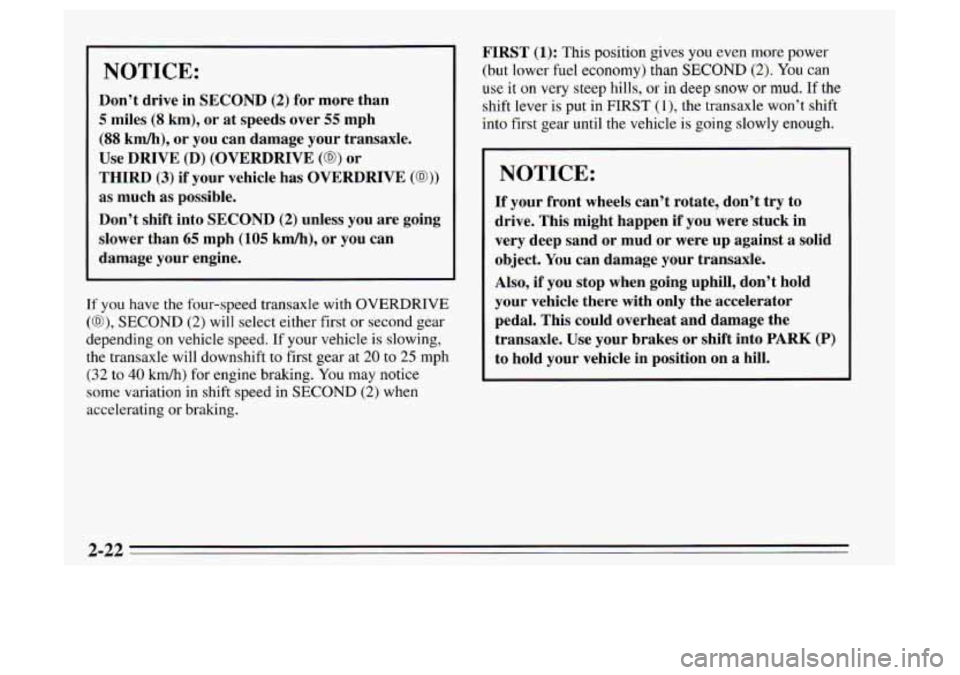
NOTICE:
Don’t drive in SECOND (2) for more than
5 miles (8 km), or at speeds over 55 mph
(88 km/h), or you can damage your transaxle.
Use DRIVE (D) (OVERDRIVE
(0) or
THIRD
(3) if your vehicle has OVERDRIVE (0))
as much as possible.
Don’t shift into SECOND
(2) unless you are going
slower than
65 mph (105 km/h), or you can
damage your engine.
If you have the four-speed transaxle with OVERDRIVE
(a), SECOND (2) will select either first or second gear
depending on vehicle speed. If your vehicle is slowing,
the transaxle will downshift to first gear at
20 to 25 mph
(32 to 40 kdh) for engine braking. You may notice
some variation in shift speed in SECOND
(2) when
accelerating or braking.
FIRST (1): This position gives you even more power
(but lower fuel economy)
than SECOND (2). You can
use
it on very steep hills, or in deep snow or mud. If the
shift lever is put in FIRST
(I), the transaxle won’t shift
into first gear until the vehicle is going slowly enough.
I NOTICE:
If your front wheels can’t rotate, don’t try to
drive. This might happen if you were stuck in
1 very deep sand or mud or were up against a solid
object. You can damage your transaxle.
Also, if you stop when going uphill, don’t hold
your vehicle there with only
the accelerator
, pedal. This could overheat and damage the
1 transaxle. Use your brakes or shift into PARK (P)
~ to hold your vehicle in position on a hill.
2-22
Page 80 of 340
SECOND (2): Press the clutch pedal as you let up 011
the accelerator pedal and shift into SECOND (2). Then
slowly let
up on the clutch pedal as you press the
accelerator pedal.
THIRD (3), FOURTH (4) and FIFTH (5): Shift into
THIRD (3), FOURTH (4) and FIFTH (5) the same way
you do for SECOND (2). Slowly let up on the clutch
pedal as you press the accelerator pedal.
To stop, let up on the accelerator pedal and press the brake
pedal. Just before the vehicle stops, press the clutch pedal
and the brake pedal, and shift into NEUTRAL (N).
NEUTRAL (N): Use this position when you start or
idle your engine.
REVERSE (R): To back up, press down the clutch
pedal and shift into REVERSE
(R). Let up on the clutch
pedal slowly while pressing the accelerator pedal.
NOTICE:
Shift to REVERSE (R) only after your vehicle is
stopped. Shifting to REVERSE (R) while your
vehicle
is moving could damage your transaxle.
Also, use REVERSE (Rj, along with the parking brake,
for parking your vehicle.
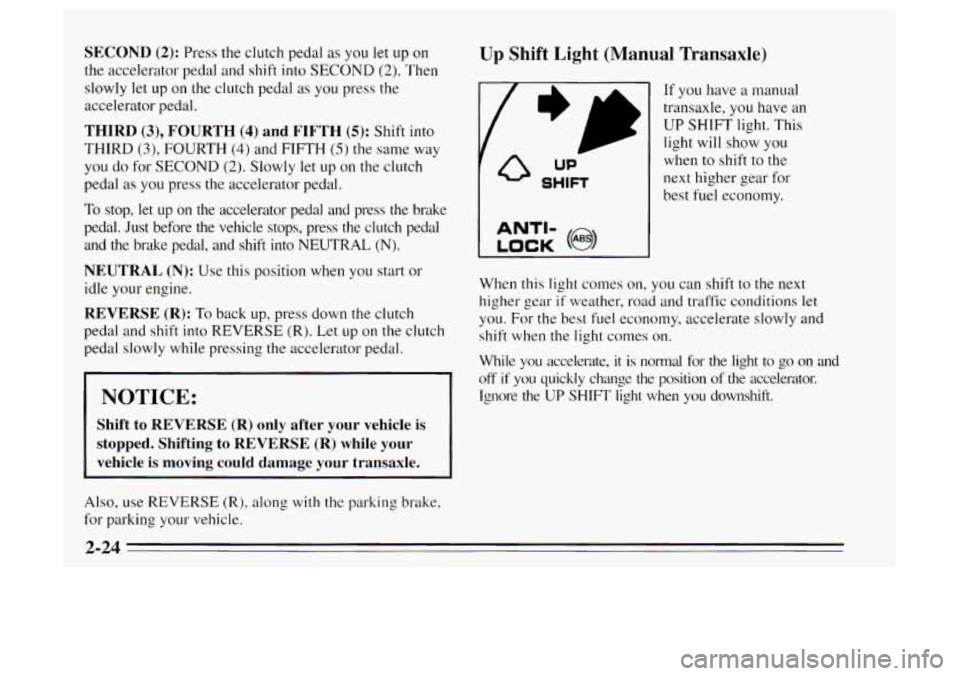
Up Shift Light (Manual Transaxle)
If you have a manual
transaxle, you have an
UP
SHIFT light. This
light
will show you
when
to shift to the
next higher gear for
best fuel economy.
When this light comes on, you can shift to the next
higher gear
if weather, road and traffic conditions let
you. For the best fuel economy, accelerate slowly and
shift when the light comes on.
While you accelerate,
it is normal for the light to go on and
off if you quickly change the position of the accelerator.
Ignore the UP SHIFT light when
you downshift.
2-24
Page 82 of 340
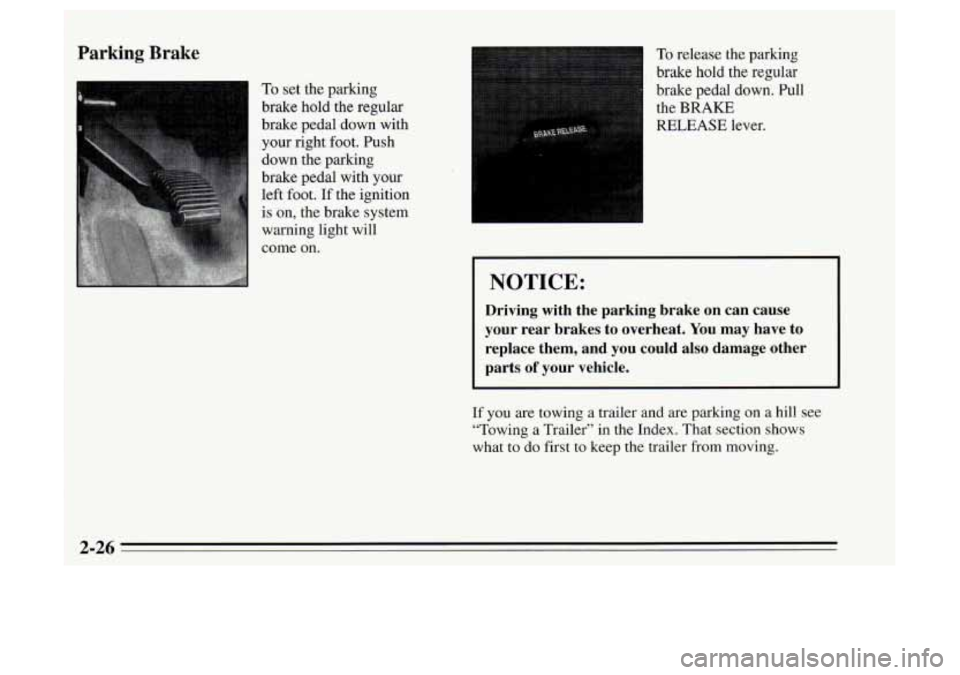
Parking Brake
To set the parking
brake hold the regular
brake pedal down with
your right foot. Push
down the parking
brake pedal with your
left foot.
If the ignition
is on, the brake system
warning light will
come on.
To release the parking
brake
hold the regular
brake pedal down. Pull
the
BRAKE
RELEASE lever.
I NOTICE:
Driving with the parking brake on can cause
your rear brakes to overheat. You may have to
replace them, and you could also damage other
parts
of your vehicle.
If you are towing a trailer and are parking on a hill see
“Towing a Trailer” in the Index. That section shows
what to do first to keep the trailer
from moving.
2-26
Page 83 of 340
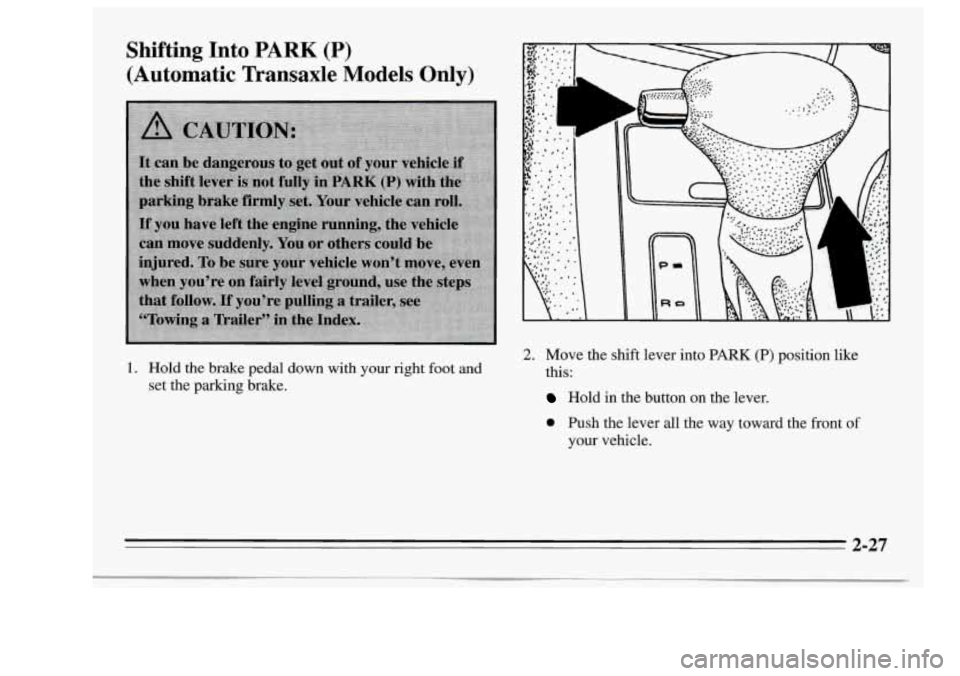
Shifting Into PARK (P)
(Automatic Transaxle Models Only)
1. Hold the brake pedal down with your right foot and
set the parking brake.
2. Move the shift lever into PARK (P) position like
this:
Hold in the button on the lever.
0 Push the lever all the way toward the front of
your vehicle.
2-27
Page 84 of 340
3.
4.
Move the key to LOCK.
Remove the key and take it with you. If you can
walk away
from your vehicle with the key in your
hand, your vehicle is in PARK
(P).
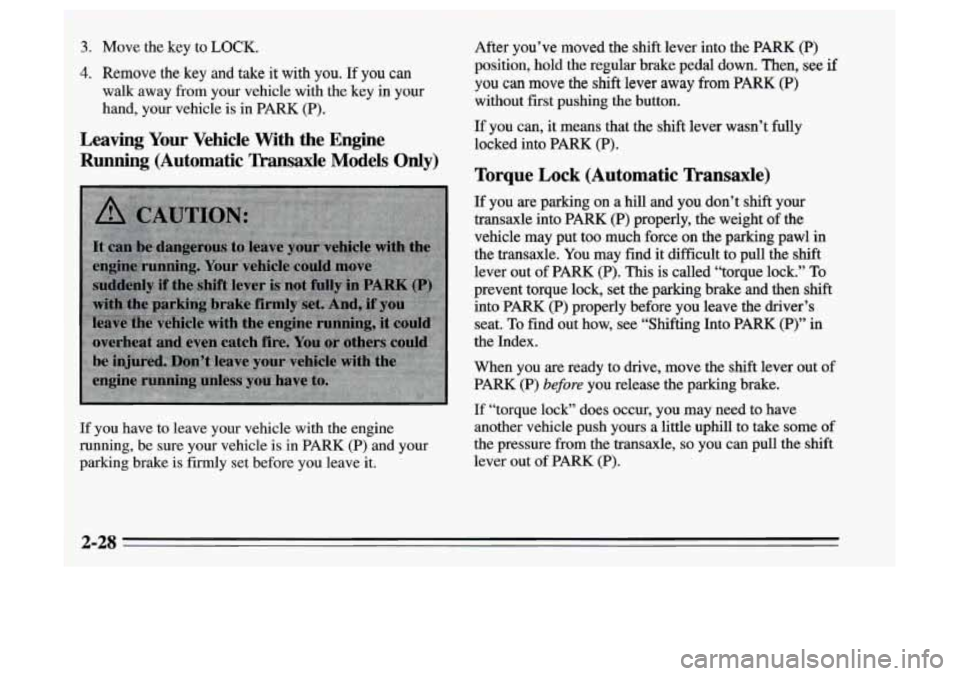
Leaving Your Vehicle With the Engine
Running (Automatic ’Ramaxle Models Only)
If you have to leave your vehicle with the engine
running, be sure your vehicle is in
PARK (P) and your
parking brake is firmly
set before you leave it. After you’ve moved
the shift lever
into the PARK (P)
position, hold the regular brake pedal down. Then, see if
you can move the shift lever away from PARK (P)
without first pushing the button.
If you can, it means that the shift lever wasn’t fully
locked into
PARK (P).
Torque Lock (Automatic Transaxle)
If you are parking on a hill and you don’t shift your
transaxle into
PARK (P) properly, the weight of the
vehicle may put too much force on the parking pawl
in
the transaxle. You may find it diffkult to pull the shift
lever out of PARK
(P). This is called “torque lock.” To
prevent torque lock, set the parking brake and then shift
into PARK (P) properly before you leave the driver’s
seat.
To find out how, see “Shifting Into PARK (P)” in
the Index.
When you
are ready to drive, move the shift lever out of
PARK (P)
before you release the parking brake.
If “torque lock” does occur, you may need to have
another vehicle push yours a little uphill to take some of
the pressure from the transaxle,
so you can pull the shift
lever out of
PARK (P).
2-28