brakes Oldsmobile Achieva 1995 Owner's Manuals
[x] Cancel search | Manufacturer: OLDSMOBILE, Model Year: 1995, Model line: Achieva, Model: Oldsmobile Achieva 1995Pages: 340, PDF Size: 16.99 MB
Page 76 of 340
Ensure the shift lever is fully in PARK (P) range before
starting the engine. Your Oldsmobile has a
brake-transaxle shift interlock. You have to
apply your
regular brakes
before you can shift from PARK (P)
when the ignition key is in the RUN position. If you
cannot shift out of
PARK (P), ease pressure on the shift
lever
-- push the shift lever all the way into PARK (P) --
as you maintain brake application. Then move the shift
lever into the gear you wish. (Press the shift lever button
before moving the shift lever.) See “Shifting Out of
PARK (P)” later in this section.
REVERSE (R): Use this gear to back up.
NOTICE:
Shifting to REVERSE (R) while your vehicle is
moving forward could damage your transaxle.
Shift to REVERSE
(R) only after your vehicle is
stopped.
To rock your vehicle back and forth to get out of snow,
ice or sand without damaging your transaxle, see
“If
You’re Stuck: In Sand, Mud, Ice or Snow” in the Index.
NEUTRAL (N): In this position, your engine doesn’t
connect with the wheels.
To restart when you’re already
moving, use
NEUTRAL (N) only. Also, use NEUTRAL
(N) when your vehicle is being towed.
I NOTICE: I
Damage to your transaxle caused by shifting out
of
PARK (P) or NEUTRAL (N) with the engine
racing isn’t covered by your warranty.
2-20
Page 77 of 340
AUTOMATIC OVERDRIVE (a): If your automarlc
transaxle has
AUTOMATIC OVERDRIVE, this position
is for normal driving. If you need more power for
passing, and you’re:
Going less than 35 mph (55 km/h), push your
accelerator pedal about halfway down.
Going about 35 mph (55 km/h) or more, push the
accelerator all the way down. You’ll shift down
to
the next gear and have more power.
NOTICE:
This NOTICE applies only if you have an
Automatic Overdrive transaxle.
If your vehicle is
so equipped and if it seems to start up rather
slowly,
or if it seems not to shift gears as you go
faster, something may be wrong with a transaxle
system sensor. If you drive very
far that way,
your vehicle can be damaged.
So, if this happens,
have your vehicle serviced right away. Until
then, you can use SECOND
(2) when you are
driving less than
35 mph (55 kmk) and
OWRDRIVE
(0) for higher speeds.
DRIVE (D) or THIRD (3): If your automatic transaxle
does not have OVERDRIVE, this position is for normal
driving, at
all speeds, in most street and highway
situations.
If your automatic transaxle has OVERDRIVE (@),
THIRD (3) is like OVERDRIVE (@), but you never go
into OVERDRIVE
(@).
Here are some times you might choose THIRD (3)
instead of OVERDRIVE (a):
When driving on hilly, winding roads.
When towing a trailer, so there is less shifting
between gears.
When going down a steep hill.
SECOND (2): This position gives you more power but
lower
fuel economy. You can use SECOND (2) on hills.
It can help control your speed as you go down steep
mountain roads, but then you would also want to use
your brakes
off and on.
2-21
Page 78 of 340
NOTICE:
Don’t drive in SECOND (2) for more than
5 miles (8 km), or at speeds over 55 mph
(88 km/h), or you can damage your transaxle.
Use DRIVE (D) (OVERDRIVE
(0) or
THIRD
(3) if your vehicle has OVERDRIVE (0))
as much as possible.
Don’t shift into SECOND
(2) unless you are going
slower than
65 mph (105 km/h), or you can
damage your engine.
If you have the four-speed transaxle with OVERDRIVE
(a), SECOND (2) will select either first or second gear
depending on vehicle speed. If your vehicle is slowing,
the transaxle will downshift to first gear at
20 to 25 mph
(32 to 40 kdh) for engine braking. You may notice
some variation in shift speed in SECOND
(2) when
accelerating or braking.
FIRST (1): This position gives you even more power
(but lower fuel economy)
than SECOND (2). You can
use
it on very steep hills, or in deep snow or mud. If the
shift lever is put in FIRST
(I), the transaxle won’t shift
into first gear until the vehicle is going slowly enough.
I NOTICE:
If your front wheels can’t rotate, don’t try to
drive. This might happen if you were stuck in
1 very deep sand or mud or were up against a solid
object. You can damage your transaxle.
Also, if you stop when going uphill, don’t hold
your vehicle there with only
the accelerator
, pedal. This could overheat and damage the
1 transaxle. Use your brakes or shift into PARK (P)
~ to hold your vehicle in position on a hill.
2-22
Page 82 of 340
Parking Brake
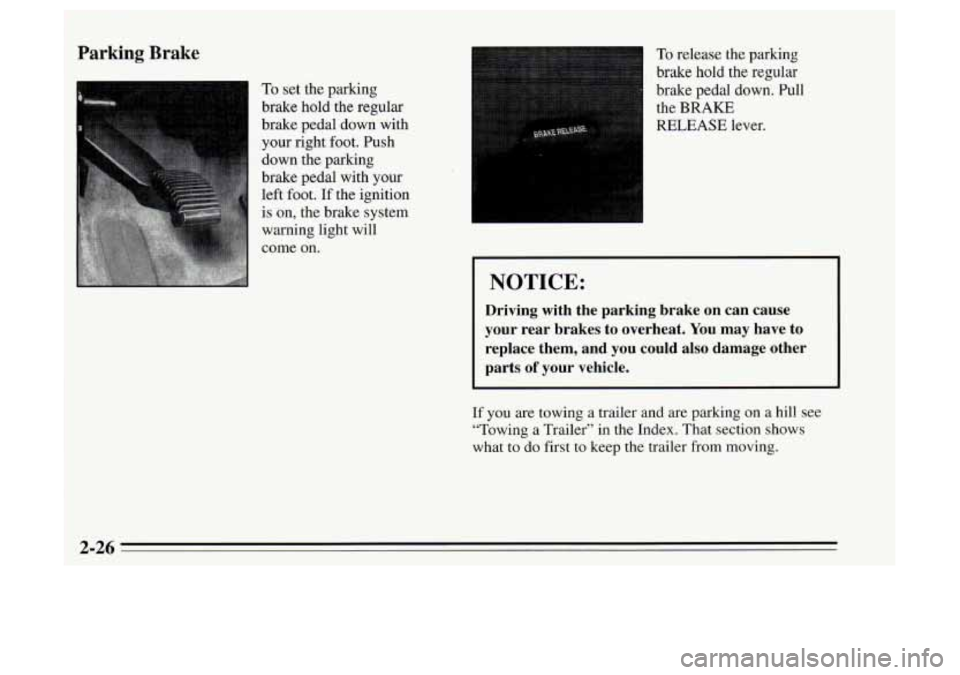
To set the parking
brake hold the regular
brake pedal down with
your right foot. Push
down the parking
brake pedal with your
left foot.
If the ignition
is on, the brake system
warning light will
come on.
To release the parking
brake
hold the regular
brake pedal down. Pull
the
BRAKE
RELEASE lever.
I NOTICE:
Driving with the parking brake on can cause
your rear brakes to overheat. You may have to
replace them, and you could also damage other
parts
of your vehicle.
If you are towing a trailer and are parking on a hill see
“Towing a Trailer” in the Index. That section shows
what to do first to keep the trailer
from moving.
2-26
Page 85 of 340
Shifting Out of PARK (P)
(Automatic Transaxle)
Your Oldsmobile has a brake-transaxle shift interlock.
You have to apply your regular brakes before you can
shift from PARK (P) when the ignition is in the
RUN
position. See “Automatic Transaxle” in the Index.
If you cannot shift out of PARK (P), ease pressure on
the shift lever
-- push the shift lever all the way into
PARK (P)
-- as you maintain brake application. Then
move the shift into the gear you wish. (Press the shift
lever button before moving the shift lever.)
3. Shift to NEUTRAL (N).
4. Start the vehicle and then shift to the drive gear you
want.
5. Have the vehicle fixed as soon as you can.
Parking Your Vehicle (Manual Transaxle)
Before you get out of your vehicle, put your manual
transaxle in REVERSE (R) and firmly apply the parking
brake.
If your vehicle is equipped to tow a trailer,
see “Towing
a Trailer” in the Index.
If you ever hold the brake pedal down but still can’t
shift out of PARK (P), try this:
1. Turn the key to OFF, not LOCK.
2. Apply and hold the regular brake until the end of
step
4.
2-29
Page 119 of 340
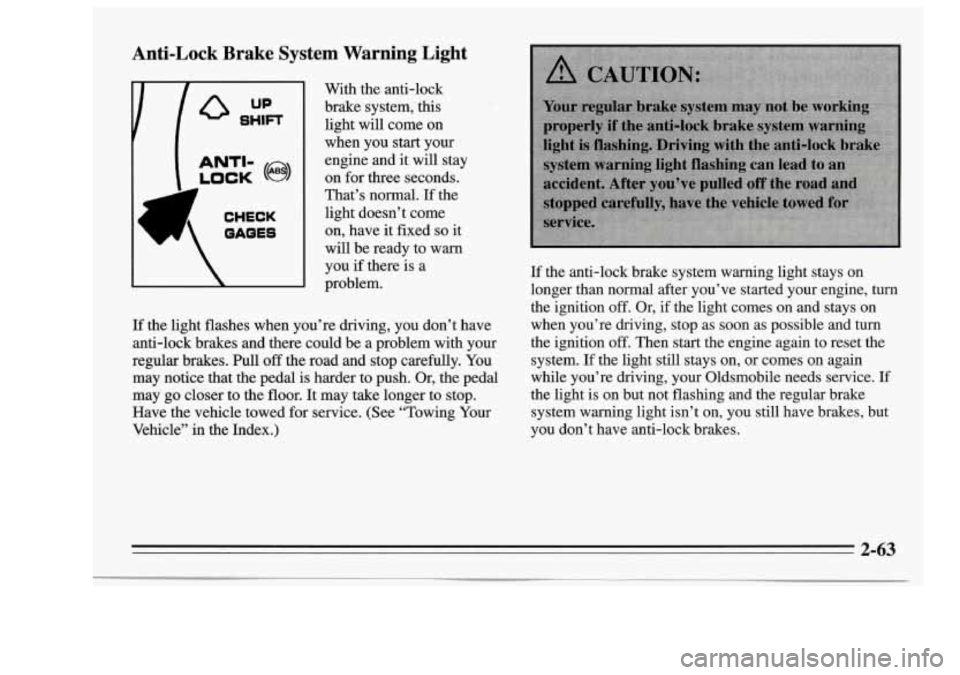
Anti-Lock Brake System Warning Light
‘A CHECK
OAQES
With the anti-lock
brake system,
this
light will come on
when you start your
engine and it will stay
on for
three seconds.
That’s normal.
If the
light doesn’t come
on, have it fiied
so it
will be ready to warn
you
if there is a
problem.
If the light flashes when you’re driving, you don’t have
anti-lock brakes and there could be a problem with your
regular brakes. Pull
off the road and stop carefully. You
may notice that the pedal is harder to push. Or, the pedal
may go closer to the floor. It may take longer to stop.
Have the vehicle towed for service. (See “Towing Your
Vehicle” in the Index.)
If the anti-lock brake system warning light stays on
longer than normal after you’ve started your engine,
turn
the ignition off. Or, if the light comes on and stays on
when you’re driving, stop as soon as possible and turn
the ignition
off. Then start the engine again to reset the
system.
If the light still stays on, or comes on again
while you’re driving, your Oldsmobile needs service.
If
the light is on but not flashing and the regular brake
system warning light isn’t on, you still have brakes, but
you don’t have anti-lock brakes.
2-63
Page 149 of 340
Control of a Vehicle
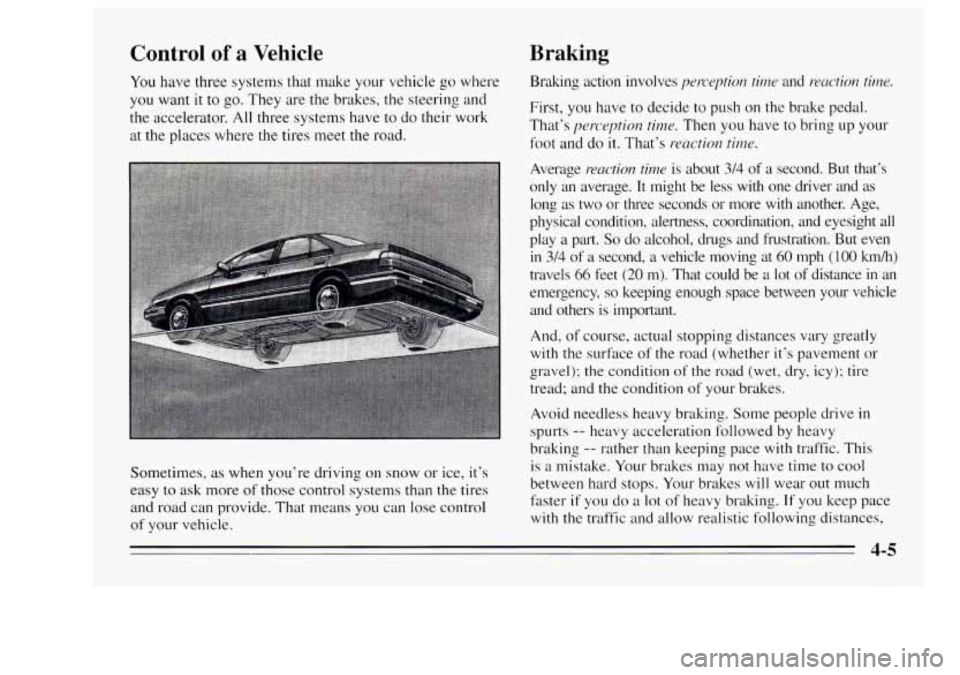
You have three systems that make your vehicle go where
you want
it to go. They are the brakes, the steering and
the accelerator.
All three systems have to do their work
at the places where the tires meet the road.
Sometimes,
as when you’re driving on snow or ice, it’s
easy to ask more
of those control systems than the tires
and road can provide. That means you can lose control
of your vehicle.
Braking
Braking action involves perception tir7z.e and rzaction time.
First, you have to decide to push on the brake pedal.
That’s
perception time. Then you have to bring up your
foot and do
it. That’s reaction time.
Average reaction time is about 34 of a second. But that’s
only an average. It might be less with one driver and as
long as two or three seconds or more with another. Age,
physical condition, alertness, coordination, and eyesight all
play a
part. So do alcohol, drugs and frustration. But even
in 3/4 of a second, a vehicle moving at 60 mph ( 100 kmh)
travels
66 feet (20 m). That could be a lot of distance in an
emergency,
so keeping enough space between your vehicle
and others is important.
And, of course, actual stopping distances vary greatly
with the surface
of the road (whether it’s pavement or
gravel); the condition of the road (wet, dry, icy); tire
tread; and the condition of your brakes.
Avoid needless heavy braking. Some people drive in
spurts
-- heavy acceleration followed by heavy
braking
-- rather than keeping pace with traffic. This
is
a mistake. Your brakes may not have time to cool
between hard stops. Your brakes will wear out much
faster
if you do a lot of heavy braking. If you keep pace
with the traffic and allow realistic following distances,
4-5
Page 150 of 340
you will eliminate a lot of unnecessary braking. That
means better braking and longer brake life.
If your engine ever stops while you’re driving, brake
normally but don‘t pump your brakes.
If you do, the
pedal may get harder
to push down. If your engine
stops, you
will still have some power brake assist. But
you will use it when you brake. Once the power assist is
used up,
it may take longer to stop and the brake pedal
will
be harder to push.
Anti-Lock Brakes (ABS)
Your Oldsrnobile has an advanced electronic braking
system that
will help prevent a braking skid.
I LOCK @)
ANTI-
CHECK
OABES
This light on the
instrument panel
will
come on briefly when
you start your vehicle. When you
start yo~~r vehicle, or when
you begin to drive
away, you may hear a momentary motor or clicking
noise. And you may even notice that your brake pedal
moves a little while this is going on.
This is the ABS
system testing itself.
If there’s a problem with the
anti-lock brake system, the anti-lock brake system
warning light
will stay on or flash.
See “Anti-Lock Brake System Warning Light”
in the
Index.
4-6
Page 151 of 340
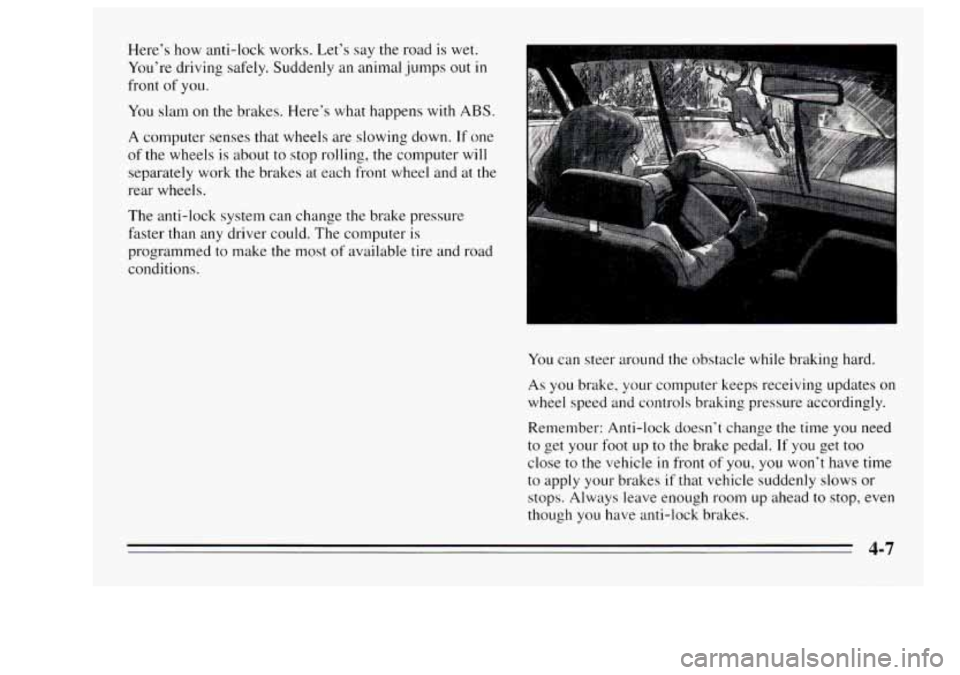
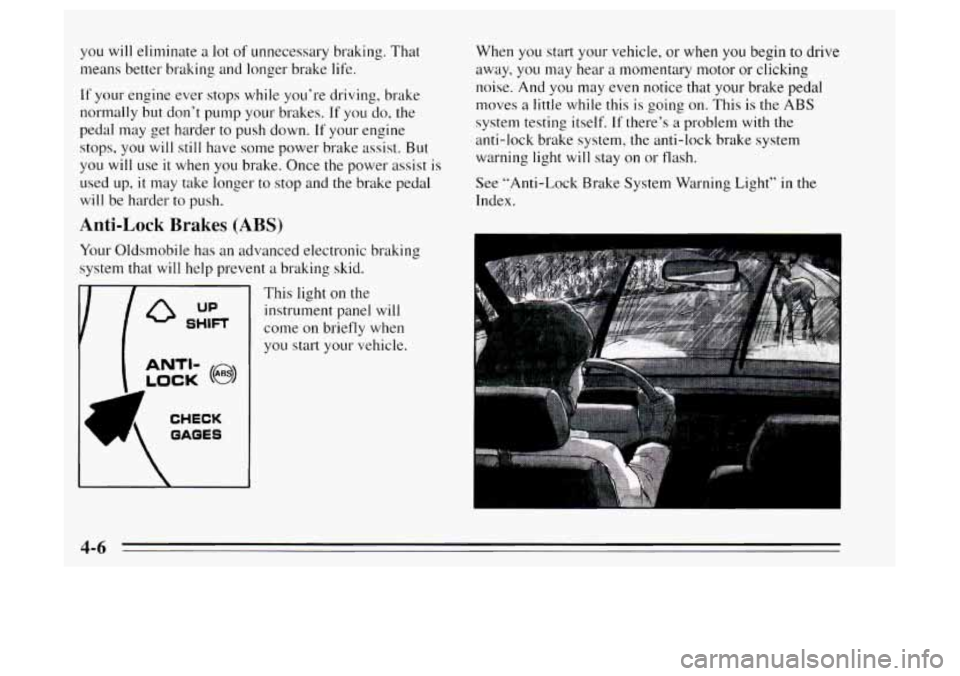
Here’s how anti-lock works. Let’s say the road is wet.
You’re driving safely. Suddenly an animal jumps
out in
front of you.
You slam on the brakes. Here’s what happens with
ABS.
A computer senses that wheels are slowing down. If one
of the wheels is about to stop rolling, the computer will
separately work the brakes
at each front wheel and at the
rear wheels.
The anti-lock system can change the brake pressure
faster than any driver could. The computer is
programmed to make the most of available tire and road
conditions.
You can steer around the obstacle while braking hard.
As you brake, your computer keeps receiving updates on
wheel speed and controls braking pressure accordingly.
Remember: Anti-lock doesn’t change the time you need
to get your foot up to the brake pedal. If you get too
close to the vehicle
in front of you, you won’t have time
to apply your brakes
if that vehicle suddenly slows or
stops. Always leave enough room up ahead to stop, even
though you have anti-lock brakes.
4- I
Page 152 of 340
To Use Anti-Lock
Don’t pump the brakes. Just hold the brake pedal down
and
let anti-lock work for you. You may feel the system
working, or you may notice some noise, but this is
normal.
Braking in Emergencies
Use your anti-lock braking system when you need to.
With anti-lock, you can steer and brake at the same
time.
In many emergencies, steering can help you more
than even the very best braking.
Steering
Power Steering
If you lose power steering assist because the engine
stops or
the system is not functioning, you can steer but
it will take much more effort.
Steering Tips
Driving on Curves
It’s important to take curves at a reasonable speed.
A lot of the “driver lost control” accidents mentioned on
the news happen on curves. Here’s why: Experienced driver or beginner, each
of us is subject to
the same laws
of physics when driving on curves. The
traction
of the tires against the road surface makes it
possible for the vehicle to change its path when YOLI turn
the front wheels. If there’s no traction, inertia will keep
the vehicle going in the same direction.
If you’ve ever
tried to steer
a vehicle on wet ice, you’ll understand this.
The traction you can get
in a curve depends on the
condition of your tires and the road surface, the angle at
which the curve is banked, and your speed. While
you’re
in a curve, speed is the one factor you can
control.
Suppose you’re steering through
a sharp curve. Then
you suddenly accelerate. Both control systems
--
steering and acceleration -- have to do their work where
the tires meet the road. Adding the sudden acceleration
can demand too much of those places. You can lose
control.
What should you do
if this ever happens? Ease up on the
accelerator pedal, steer the vehicle the way you want
it
to go, and slow down.
Speed limit signs near curves warn
that you should
adjust your speed. Of course, the posted speeds are
based on
good weather and road conditions. Under less
favorable conditions you’ll want to
go slower.
4-8