engine Oldsmobile Achieva 1997 s Manual Online
[x] Cancel search | Manufacturer: OLDSMOBILE, Model Year: 1997, Model line: Achieva, Model: Oldsmobile Achieva 1997Pages: 372, PDF Size: 18.52 MB
Page 250 of 372
To get the right reading, the fluid should be at normal
operating temperature, which is 180°F to 200"
F
(82°C to 93°C).
Get the vehicle warmed up by driving about 15 miles
(24
km) when outside temperatures are above 50°F
(10°C). If it's colder than 50°F (lO"C), you may have
to drive 1Qnger.
the Fluil
Park your vehicle on a level place. Keep the
engine running.
With the parking brake applied, place the shift lever
in
PARK (P).
With your foot on the brake pedal, move the shift
lever through each gear range, pausing
for about
three seconds in each range. Then, position the shift
lever in PARK
(P).
Let the engine run at idle for three to five minutes. Then, without shutting
off the engine, follow these steps:
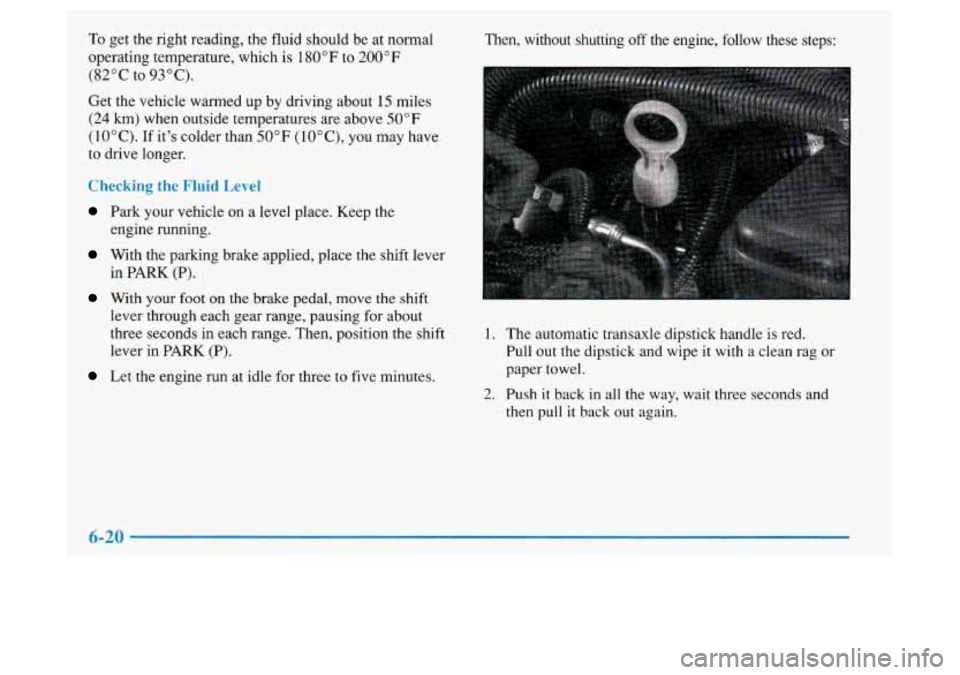
1. The
automatic transaxle dipstick handle is red.
Pull out the dipstick and wipe it with a clean rag or
paper towel.
2. Push it back in all the way, wait three seconds and
then pull
it back out again.
Page 252 of 372
Manual Transaxle Fluid
When to Check
A good time to have it checked is when the engine oil is
changed. However, the fluid in your manual transaxle
doesn’t require changing.
How to Check
Because this operation can be a little difficult, you may
choose
to have this done at your Oldsmobile retail
facility Service Department.
E you do it yourself, be sure to follow all the instructions
here, or you could get a false reading on the dipstick.
I NOTICE:
Too much or too little fluid can damage your
transaxle.
Too much can mean that some of the
fluid could come out and fall
on hot engine parts
or exhaust system parts, starting a fire. Be sure to
get an accurate reading if you check your
transaxle fluid.
Check the fluid level only when your engine is off, the
vehicle is parked
on a level place and the transaxle is cool
enough for you to rest your fingers on the
transaxle case.
Then, follow these steps:
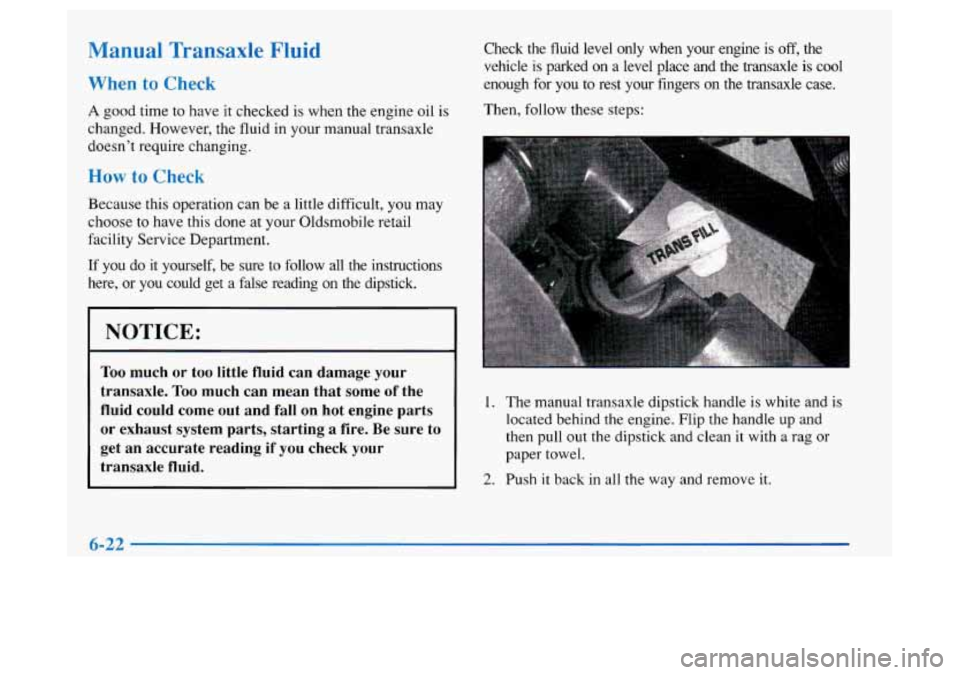
1. The manual transaxle dipstick handle is white and is
located behind the engine. Flip
the handle up and
then pull
out the dipstick and clean it with a rag or
paper towel.
2. Push it back in all the way and remove it.
Page 254 of 372
When to Check and What to Use
Refer to the Maintenance
Schedule to determine how
often you should check the
fluid level
in your clutch
master cylinder reservoir
and for the proper fluid.
See “Owner Checks
and Services” and
“Recommended Fluids and
Lubricants” in the Index.
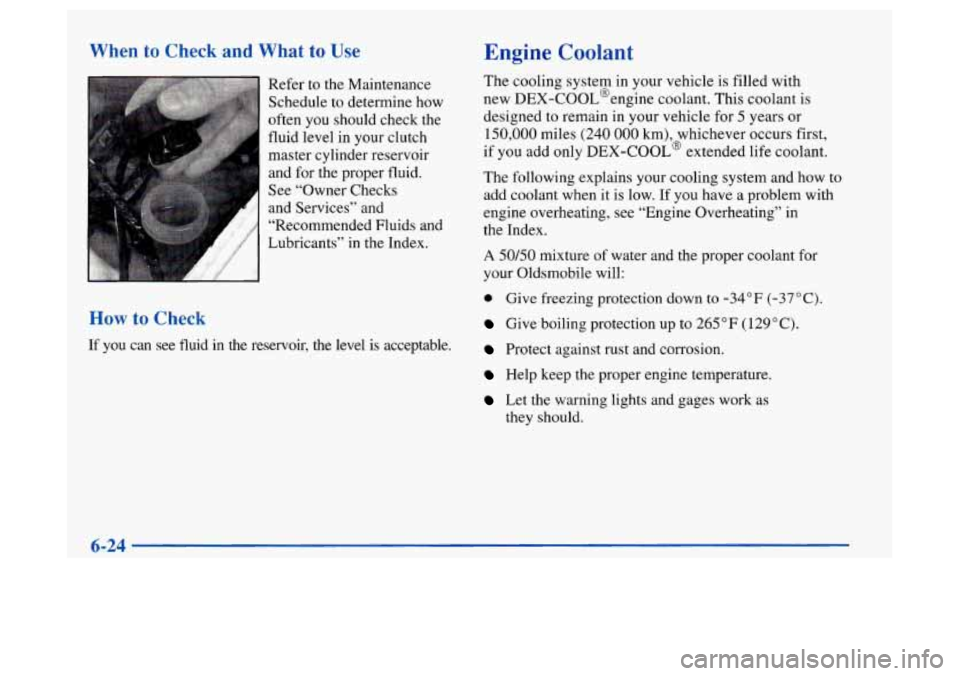
How to Check
If you can see fluid in the reservoir, the level is acceptable.
Engine Coolant
The cooling system in your vehicle is filled with
new DEX-COOL@engine coolant. This coolant is
designed to remain in your vehicle for
5 years or
150,000 miles (240
000 km), whichever occurs first,
if you add only DEX-COOL@ extended life coolant.
The following explains your cooling system and how
to
add coolant when it is low. If you have a problem with
engine overheating, see “Engine Overheating’’ in
the Index.
A 50150 mixture of water and the proper coolant for
your Oldsmobile will:
0 Give freezing protection down to -34°F (-37°C).
Give boiling protection up to 265 “F (129°C).
Protect against rust and corrosion.
Help keep the proper engine temperature.
Let the warning lights and gages work as
they should.
Page 255 of 372
NOTICE:
When adding coolant, it is important that you use
only
DEX-COOL@ (silicate-free) coolant.
If coolant is other than DEX-COOL@ is added to
the system, premature engine, heater core or
radiator corrosion may result. In addition, the
engine coolant will require change sooner
-- at
30,000 miles (50 000 km) or 24 months,
whichever occurs first. Damage caused by the use
of coolant other than DEX-COOL’ is not
covered by our new vehicle warranty.
What to Use
Use a mixture of one-half clean water (preferably
distilled) and one-half
DEX-COOL@ coolant which
won’t damage aluminum parts.
If you use this mixture,
you don’t need
to add anything else.
Adding only plain water to your cooling system can be dangerous. Plain water, or some other
liquid like alcohol, can boil before the proper
coolant mix will. Your vehicle’s coolant warning
system is set for the proper coolant mix. With
plain water or the wrong mix, your engine could
get too hot but you wouldn’t get the overheat
warning. Your engine could catch fire and you or
others could be burned. Use
a 50/50 mix of clean
water and DEX-COOL%oolant.
Page 256 of 372
NOTICE:
If you use an improper coolant mix, your engine
could overheat and be badly damaged. The
repair cost wouldn't be covered
by your
warranty.
Too much water in the mix can freeze
and crack the engine, radiator, heater core and
other parts.
If you have to add coolant more than four times a yea,
have your retailer check your cooling system.
I NOTICE:
If you use the proper coolant, you don't have to
add extra inhibitors or additives which claim to
improve the system. These can be harmful.
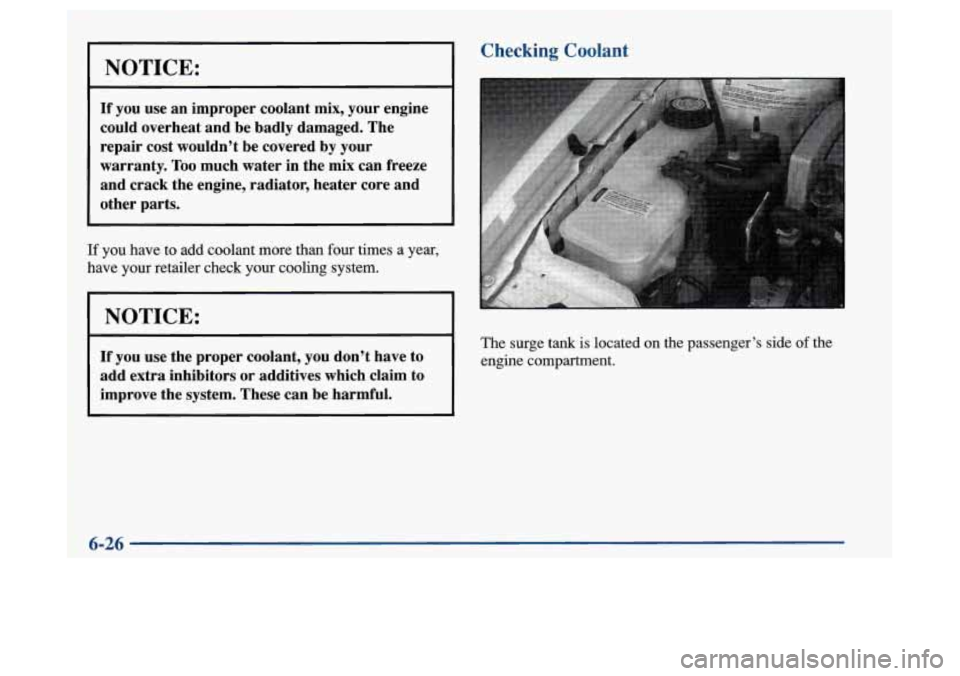
Checking Coolant
The surge tank is located on the passenger's side of the
engine compartment.
6-26
Page 257 of 372
*N:
r
Turning 1 su -e tank pressure cap when the
engine and radiator are hot can allow steam and
scalding liquids to blow out and burn you badly.
Never turn the surge tank pressure cap
-- even a
little
-- when the engine and radiator are hot.
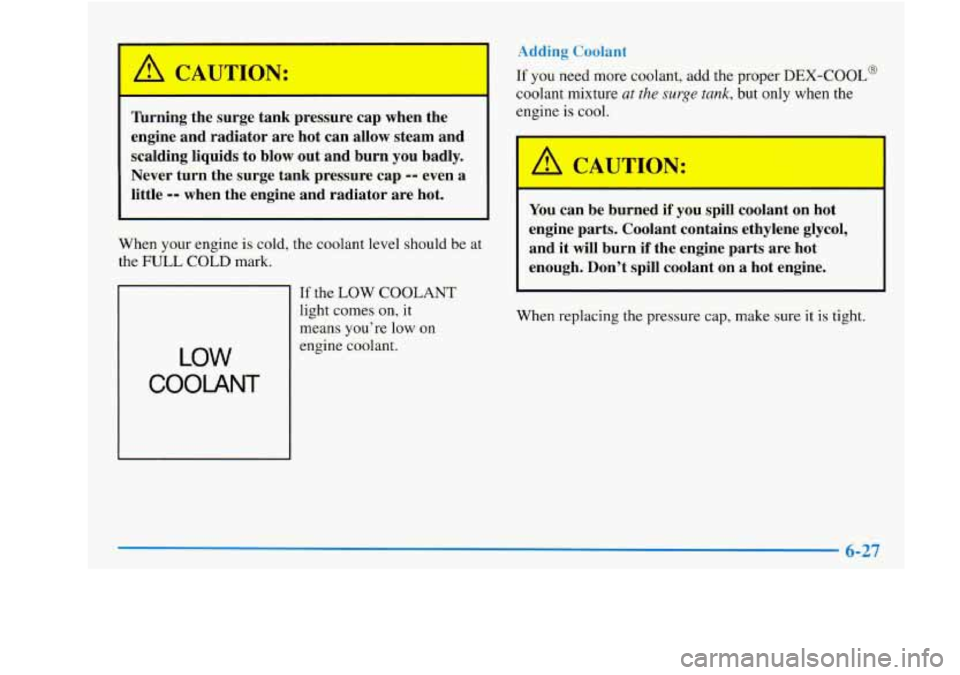
When your engine
is cold, the coolant level should be at
the
FULL COLD mark.
If the LOW COOLANT
light comes on,
it
means you’re low on
LOW
COOLANT
Adding Coolant
If you need more coolant, add the proper DEX-COOL@
coolant mixture at the surge tank, but only when the
engine is cool.
You can be burned if you spill coolant on hot
engine parts. Coolant contains ethylene glycol,
and it will burn if the engine parts are hot
enough. Don’t spill coolant on a hot engine.
When replacing the pressure cap, make sure
it is tight.
Page 258 of 372
Surge Tank Pressure Cap
NOTICE: ~
Your pressure cap is an 15 psi (105 kPa)
pressure-type cap and must be tightly installed to
prevent coolant loss and possible engine damage
from overheating.
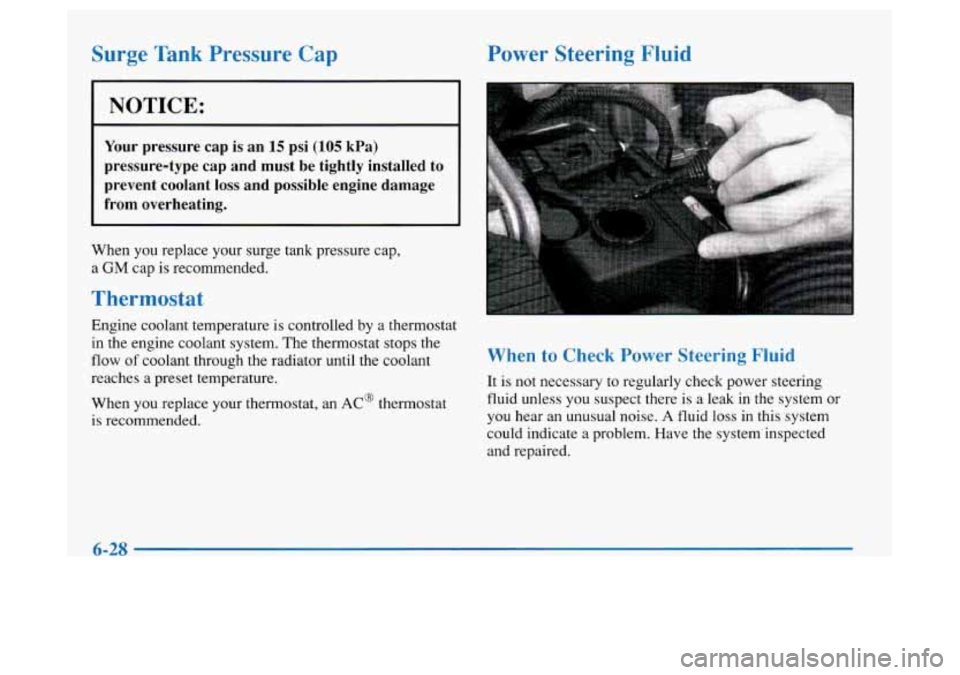
When y'6u &place your surge tank pressure cap,
a
GM cap is recommended.
Thermostat
Engine coolant temperature is controlled by a thermostat
in the engine coolant system. The thermostat stops the
flow of coolant through the radiator until the coolant
reaches a preset temperature.
When you replace your thermostat, an
AC' thermostat
is recommended.
Power Steering Fluid
When to Check Power Steering Fluid
It is not necessary to regularly check power steering
fluid unless you suspect there
is a leak in the system or
you hear an unusual noise.
A fluid loss in this system
could indicate
a problem. Have the system.inspected
and repaired.
Page 259 of 372
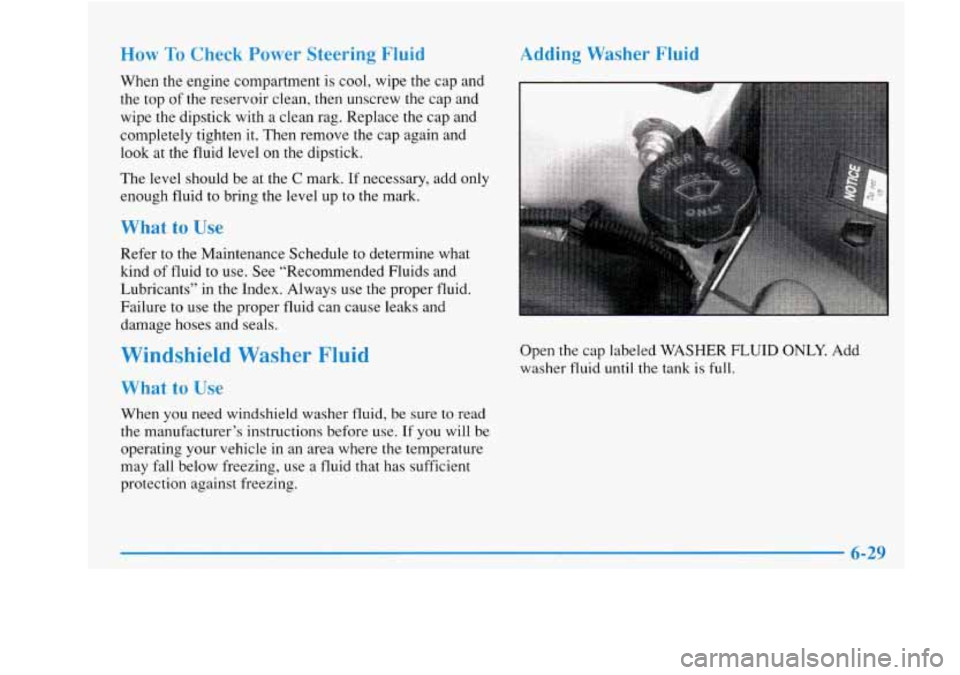
How To Check Power Steering Fluid
When the engine compartment is cool, wipe the cap and
the top of the reservoir clean, then unscrew the cap and
wipe the dipstick with a clean rag. Replace the cap and
completely tighten it. Then remove the cap again and
look at the fluid level on the dipstick.
The level should be at the
C mark. If necessary, add only
enough fluid to bring the level up to the mark.
What to Use
Refer to the Maintenance Schedule to determine what
kind
of fluid to use. See “Recommended Fluids and
Lubricants” in the Index. Always use the proper fluid.
Failure to use the proper fluid can cause leaks and
damage hoses and seals.
Windshield Washer Fluid
What to Use
When you need windshield washer fluid, be sure to read
the manufacturer’s instructions before use.
If you will be
operating your vehicle in an area where
the temperature
may fall below freezing, use a fluid that has sufficient
protection against freezing.
Adding Washer Fluid
Open the cap labeled WASHER FLUID ONLY. Add
washer fluid
until the tank is full.
6-29
.- ._ -
Page 261 of 372
There are only two reasons why the brake fluid level in the
reservoir might go down. The first is that the brake fluid
goes down to an acceptable level during normal brake
lining wear. When new linings are put in, the fluid level
goes back up. The other reason is that fluid is leaking out
of the brake system.
If it is, you should have your brake
system fixed, since a leak means that sooner or later your
brakes won’t work well, or won’t work at
all.
So, it isn’t a good idea to “top off’ your brake fluid.
Adding brake fluid won’t correct
a leak. If you add fluid
when your linings
are worn, then you’ll have too much
fluid when you get new brake linings.
You should add
(or remove) brake fluid, as necessary, only when work is
done
on the brake hydraulic system.
If you have too much brake fluid, it can spill
on the engine. The fluid will burn if the engine
is hot enough. You or others could be burned,
and your vehicle could be damaged. Add brake
fluid only when work
is done on the brake
hydraulic system.
BRAKE
U.S. Canada
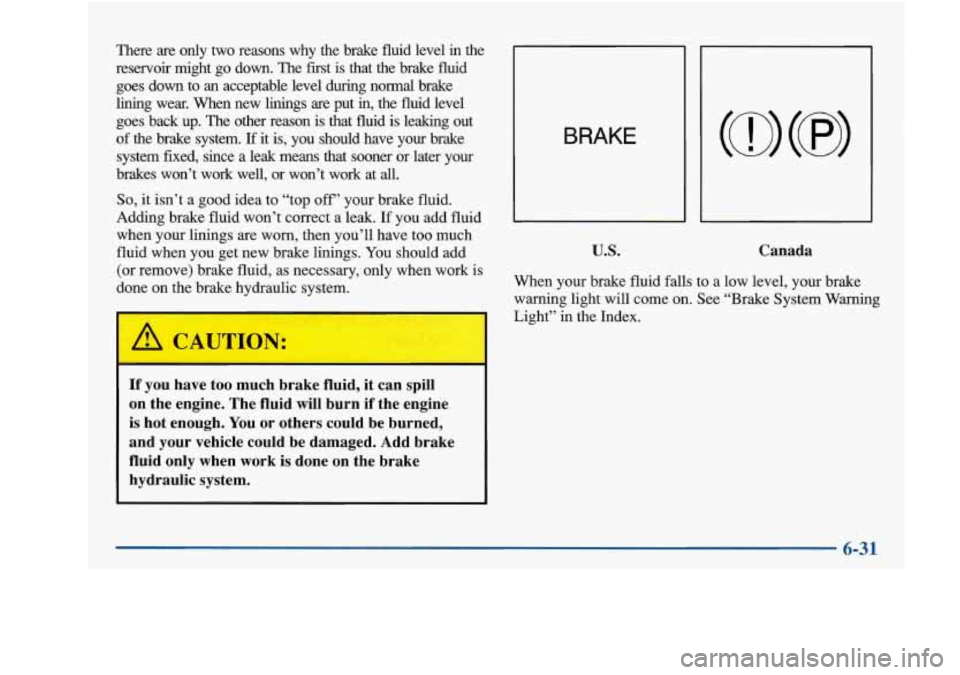
When your brake fluid falls to a low level, your brake
warning light will come on. See “Brake System Warning
Light” in the Index.
6-31
Page 262 of 372
When you do need brake fluid, use only DOT-3 brake
fluid
-- such as Delco Supreme 11 @ (GM Part
No. 12377967). Use new brake fluid from a sealed
container
only.
Always clean the brake fluid reservoir cap and the area
around the cap before removing it. This
will help keep
dirt from entering the reservoir.
A CAUTION:
With the wrong kind of fluid in your brake
system, your brakes may not work well, or they
may not even work at
all. This could cause a
crash. Always use the proper brake fluid.
NOTICE:
0
0
Using the wrong fluid can badly damage
brake system parts. For example, just
a few
drops of mineral-based oil, such
as engine
oil, in your brake system can damage brake
system parts
so badly that they’ll have to be
replaced. Don’t let someone put in the
wrong kind of fluid.
If you spill brake fluid on your vehicle’s
painted surfaces, the paint finish can be
damaged. Be careful not to spill brake fluid
on your vehicle.
If you do, wash it off
immediately. See “Appearance Care” in
the Index.
6-32