lock Oldsmobile Achieva 1998 s Owner's Guide
[x] Cancel search | Manufacturer: OLDSMOBILE, Model Year: 1998, Model line: Achieva, Model: Oldsmobile Achieva 1998Pages: 356, PDF Size: 18.04 MB
Page 78 of 356
L-OCK (B): Before you put the key into the ignition
switch, the switch
is in LOCK. It is also the only
position in which you can remove the key.
This locks
your steering wheel, ignition and transaxle
(on
automatic transaxle models).
OFF (C): This position unlocks the steering wheel and
ignition, but does not send electrical power to any
accessories. Use this position if your vehicle must be
pushed or towed, but never try to push-start your
vehicle. A warning chime will sound if you open the
driver’s door when the ignition is off and the key is
in the ignition.
RUN (D): This position is where the key returns after
you start your engine and release the switch. The switch
stays in the RUN position when the engine is running.
But even when the engine is not running, you can use
RUN to operate your electrical power accessories, and
to display some instrument panel warning lights.
START (E): This position starts the engine. When the
engine starts, release the key. The ignition switch will
return to
RUN for normal driving.
Note that even
if the engine is not running, the positions
ACCESSORY and RUN are on positions that allow you
to operate your electrical accessories, such as the radio.
NOTICE:
If your key seems stuck in LOCK and you can’t
turn it, be sure you are using the correct key; if
so, is it all the way in? If it is, then turn the
steering wheel left and right while you turn the
key hard. But, turn the key only with your hand.
Using
a tool to force it could break the key or the
ignition switch.
If none of this works, then your
vehicle needs service.
Starting Your Engine
Move your shift lever to PARK (P) or NEUTRAL (N).
Your engine won’t start in any other position
-- that’s a
safety feature.
To restart when you’re already moving,
use NEUTRAL (N) only.
NOTICE:
Don’t try to shift to PARK (P) if your Oldsmobile
is moving. If you do, you could damage the
transaxle. Shift to
PARK (P) only when your
vehicle is stopped.
2-14
Page 82 of 356
! To Use the Engine Coolant Heater
1. Turn off the engine.
1 2. Open the hood and unwrap the electrical cord.
3. Plug it into a normal, grounded 11 0-volt AC oatlet.
Plugging the cord into an ungrounded outlet
could cause an electrical shock. Also, the wrong
kind of extension cord could overheat and cause
a fire. You could be seriously injured. Plug the
cord
into a properly grounded three-prong
110-volt
AC outlet. If the cord won’t reach, use
a heavy-duty three-prong extension cord rated
for
at least 15 amps.
I
How long should you keep the coolant heater plugged
in? The answer depends on the outside temperature, the
kind of oil you have, and some other things. Instead of
trying to list.everyhng here, we ask that you contact
your retailer in the area where you’ll be parking your
vehicle. The retailer can give you the best advice for
that particular area.
Automatic Transaxle Operation
P
R
N
ID1
3
2
1
Your automatic transaxle
has a
shift lever located
on the console between
the seats.
4. Before starting the engine, be sure to unplug
and store the cord as it was before to keep it away
from moving engine parts.
If you don’t, it could
be damaged.
PARK (P): This locks your front wheels. It’s the best
position
to use when you start your engine because your
vehicle can’t move easily.
2-18
Page 83 of 356
/! CAUTION:
It is dangerous to get out of your vehicle if the
shift lever is not fully in
PARK (P) with the
parking brake firmly set. Your vehicle can roll.
Don’t leave your vehicle when the engine is
running unless you have to. If you have left the
engine running, the vehicle can move suddenly.
You or others could be injured. To be sure your
vehicle won’t move, even when you’re on fairly
level ground, always set your parking brake and
move the shift lever to
PARK (P).
See “Shifting Into PARK (P)” in the Index. If
you’re pulling a trailer, see “Towing a Trailer”
in the Index.
Ensure the shift lever is fully in PARK (P) range
before starting the engine. Your vehicle has a
Brake-Transaxle Shift Interlock (BTSI). You have to
apply your regular brake before you can shift from
PARK (P) when the ignition key
is in the RUN position.
If
you cannot shift out of PARK (P), ease pressure on
the shift lever
-- push the shift lever all the way into
PARK (P)
-- as you maintain brake application. Then
move the shift lever into the gear you wish.
(Press the
shift lever button before moving the shift lever.) See
“Shifting Out of PARK (P)” later in this section.
2-19
Page 88 of 356
Shifting Into PARK (P)
A CAUTION:
It can be dangerous to get out of your vehicle if
the shift lever is not fully in PARK (P) with the
parking brake
firmly set. Your vehicle can roll. If
you have left the engine running, the vehicle can
move suddenly. You or others could be injured.
To be sure your vehicle won’t move, even when
you’re on fairly level ground, use the steps that
follow.
If you’re pulling a trailer, see “Towing a
Trailer” in the Index.
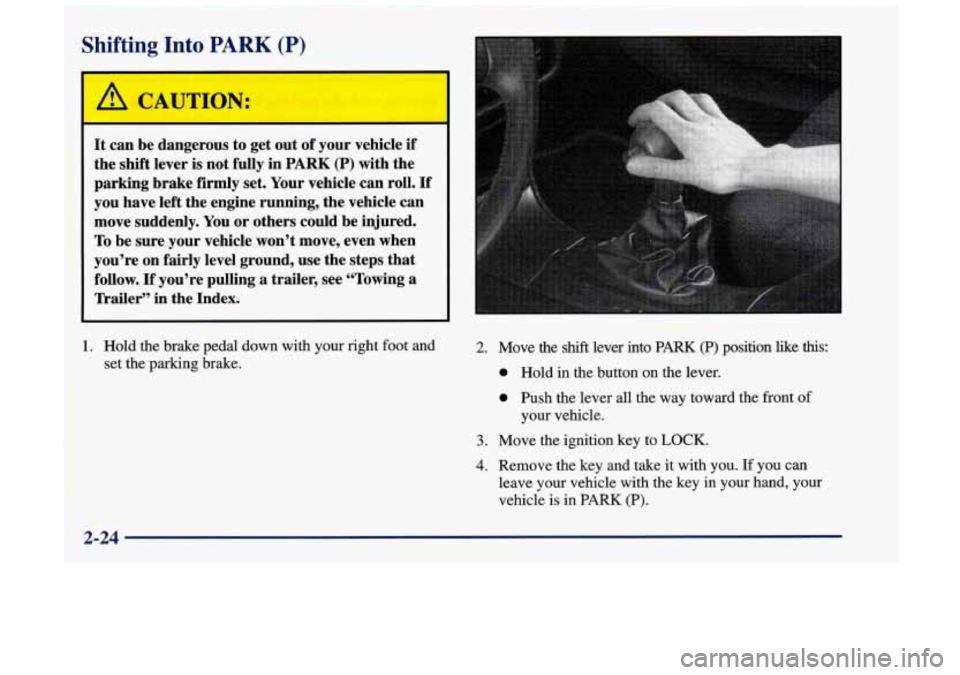
1. Hold the brake pedal down with your right foot and
set the parking brake.
I
2. Move the shift lever into PARK (P) position like this:
a Hold in the button on the lever.
a Push the lever all the way toward the front of
your vehicle.
3. Move the ignition key to LOCK.
4. Remove the key and take it with you. If you can
leave your vehicle with the key in your hand, your
vehicle is in PARK (P).
2-24
Page 89 of 356
Leaving Your Vehicle With the
Engine Running
It can be dangerous to leave your vehicle with
the engine running. Your vehicle could move
suddenly if the shift lever is not fully in PARK
(P)
with the parking brake firmly set. And, if you
leave the vehicle with the engine running, it could
overheat and even catch fire. You or others could
be injured. Don’t leave your vehicle with the
engine running unless you have to.
If you have to leave your vehicle with the engine
running, be sure your vehicle is in PARK
(P) and your
parking brake is firmly set before you leave it. After
you’ve moved the shift lever into the PARK
(P)
position, hold the regular brake pedal down. Then, see if
you can move the shift lever away from PARK (P)
without first pushing the button.
If you can, it means that the shift lever wasn’t fully
locked into PARK
(P).
Torque Lock
If you are parking on a hill and you don’t shift your
transaxle into PARK (P) properly, the weight of the
vehicle may put too much force on the parking pawl in
the transaxle. You may find it difficult to pull the shift
lever out of PARK
(P). This is called “torque lock.” To
prevent torque lock, set the parking brake and then shift
into
PARK (P) properly before you leave the driver’s
seat. To find out how,
see “Shifting Into PARK (P)” in
the Index.
When you are ready to drive, move the shift lever out
of PARK (P) before you release the parking brake.
If torque lock does occur, you may need to have another
vehicle push yours a little uphill to take some of the
pressure from the parking pawl in the transaxle,
so
you can pull the shift lever out of PARK (P).
Page 90 of 356
Sh '"ting Out of PARK (P)
Your vehicle has a brake-transaxle shift interlock. You
have to apply your regular brake before you can shift
from
PARK (P) when the ignition is in the RUN
position. See "Automatic Transaxle" in the Index.
If you cannot shift out of PARK (P), ease pressure on
the shift lever
-- push the shift lever all the way into
PARK (P) -- as you maintain brake application. Then
move the shift lever into the gear you wish. (Press the
shift lever button before moving the shift lever.)
If you ever hold the brake pedal down but still can't
shift out of PARK
(P), try this:
1.
2.
3.
4.
5.
Remove the ignition key.
There
is a small cap on the passenger's side of
the center console. Gently remove it with a
small screwdriver.
Insert the ignition key into this opening until
it contacts with a small paddle. This is the
override feature.
While pushing forward on the paddle, press the shift
lever button, then pull the shift lever from PARK
(P).
Have the vehicle fixed as soon as you can.
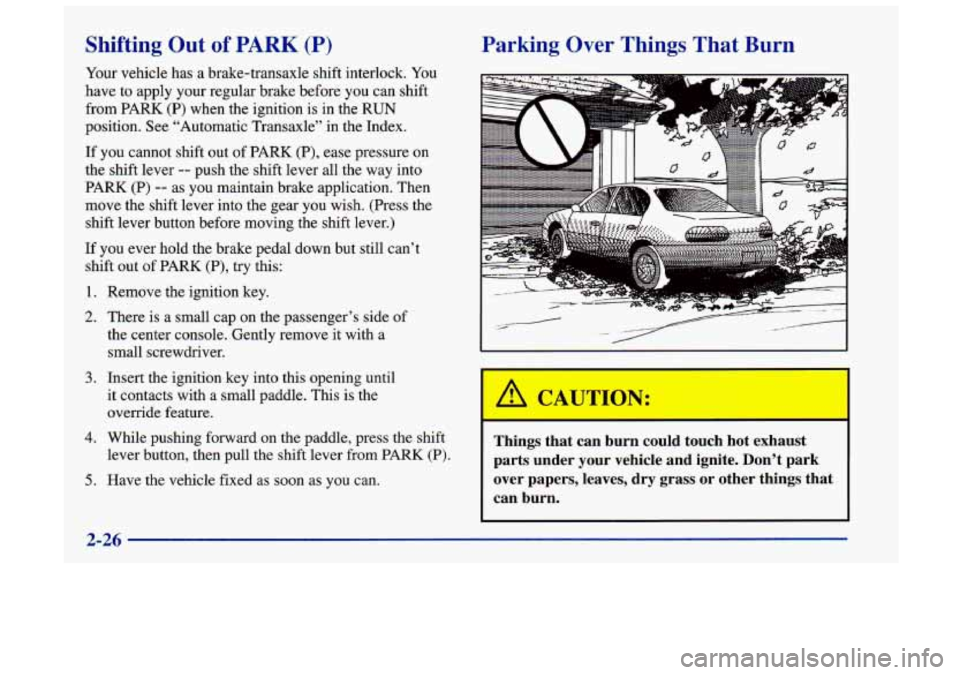
Parking Over Things That Burn
I
Things that can burn could touch hot exhaust
parts under your vehicle and ignite. Don't park
over papers, leaves, dry grass or other things that
can burn.
Page 93 of 356
Auto-Down Feature Tilt Wheel
The driver's window switch has an auto-down feature.
This switch is labeled AUTO. Tap the switch back, and
the driver's window will open a small amount. If the
switch is moved all the way back, the window will go
all the way down.
To stop the window while it is lowering, move the
switch forward. To raise the window, move and hold
the switch forward.
Lock-Out Switch
The driver's power window controls also include a
lock-out switch. Press
LOCK to stop front and rear
passengers from using their window switches. The
driver can still control all the windows with the lock on.
Press the other side
of the LOCK button for normal
window operation.
Horn
You can sound the horn by pressing the horn symbol on
your steering wheel.
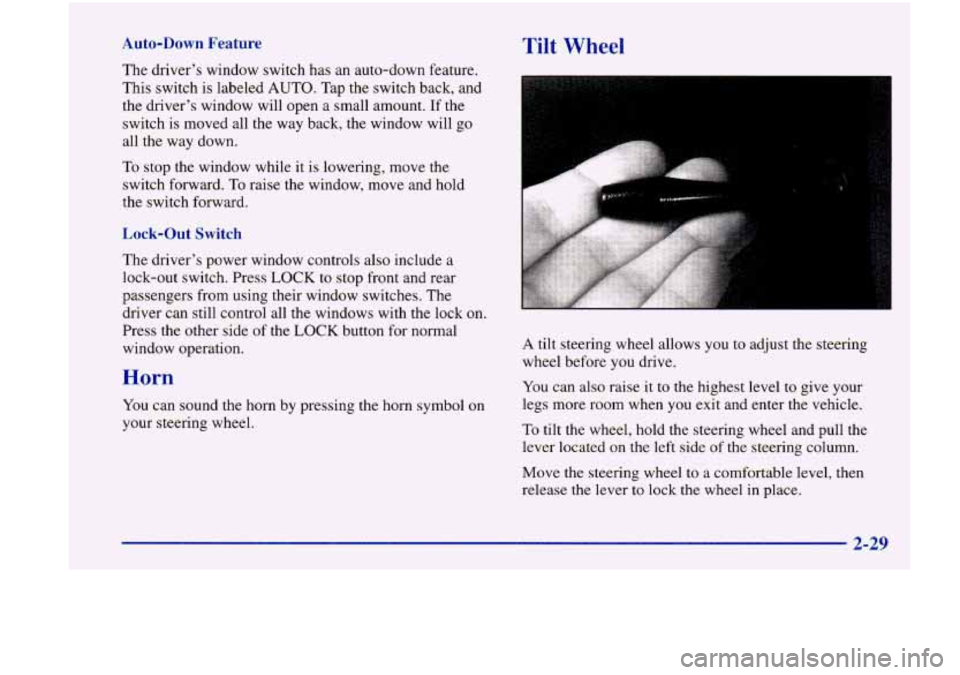
A tilt steering wheel allows you to adjust the steering
wheel before you drive.
You can also raise it to the highest level to give your
legs more room when you exit and enter the vehicle.
To tilt the wheel, hold the steering wheel and pull the
lever located on the left side of the steering column.
Move the steering wheel to a comfortable level, then
release the lever to lock
the wheel in place.
Page 97 of 356
Cruise Control
In freezing weather, don’t use your washer until
the windshield is warmed. Otherwise the washer
fluid can form ice on the windshield, blocking
your vision.
When you release the stalk, the washers will stop. The
wipers will continue wiping
for about three cycles and
will either stop or will resume
the speed you were
using before.
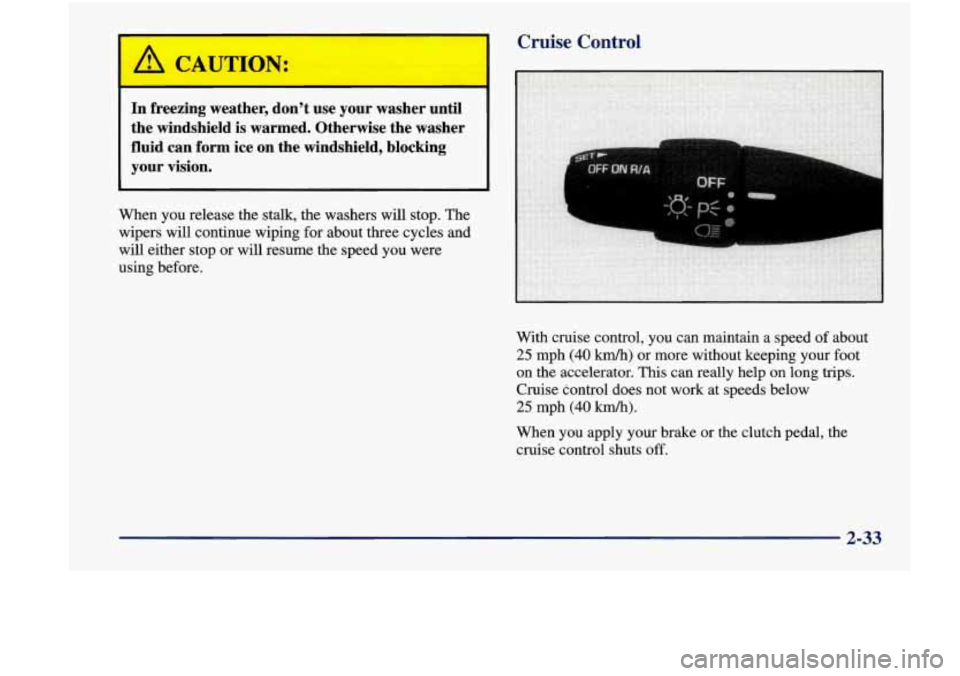
With cruise control, you can maintain a speed of about
25 mph
(40 km/h) or more without keeping your foot
on the accelerator. This can really help on long trips.
Cruise Control does not work at speeds below
25
rnph (40 km/h).
When you apply your brake or the clutch pedal, the
cruise control shuts
off.
2-33
Page 104 of 356
Illuminated Entry System
When you lift the outside handle of either front door or
open either rear door, the lamps inside your vehicle will
go on. These lamps will fade out after about
40 seconds,
or when the ignition is turned on after all doors have
been closed. If the ignition was recently turned off, the
lamps will fade out after four seconds. These lamps will
also
go on when you press the DOOR or UNLOCK
button on the optional remote lock control transmitter.
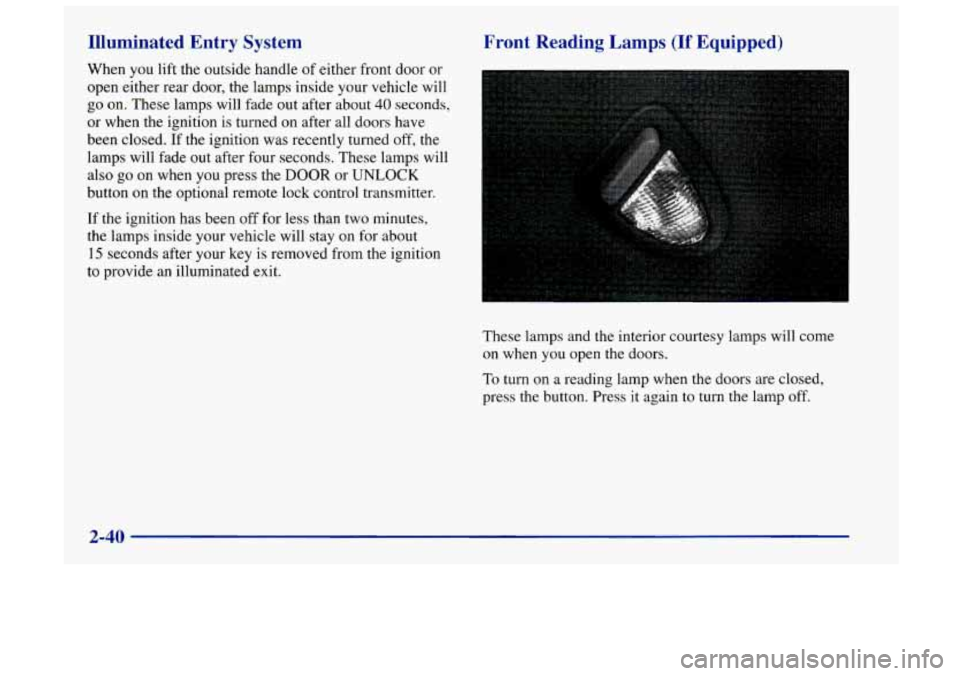
Front Reading Lamps (If Equipped)
If the ignition has been off for less than two minutes,
the lamps inside your vehicle will stay on for about
15 seconds after your key is removed from the ignition
to provide an illuminated exit.
These lamps and the interior courtesy lamps will come
on when you open the doors.
To turn on a reading lamp when the doors are closed,
press the button. Press it again to turn the lamp off.
2-40
Page 107 of 356

Storage Compartments
Glove Box
Use one of the vehicle’s keys to lock and unlock
the glove box.
To open, pull the glove box handle
toward you.
Center Console Storage Area
The armrest opens into a storage area for cassette tapes,
gloves, etc.
To open it, lift up on driver’s side front portion
of the armrest. A tissue holder is located under
the lid
of the armrest. There is also an accessory power
outlet located in the front storage armrest.
To use the
accessory power outlet, see “Accessory Power Outlet”
later in this section.
Center Console Cupholder
The console provides space for holding a cup or soft
drink. To access the cupholder, pull the lid forward.
Sunglasses Storage
Place your sunglasses in the open area located above
you in the overhead console, or front compartment in
the center console.
Rear Seat Cupholder
The rear seat cupholder is located on the back of the
center console. To access the rear seat cupholder, pull
the door down.
2-43