cooling Oldsmobile Alero 2003 s User Guide
[x] Cancel search | Manufacturer: OLDSMOBILE, Model Year: 2003, Model line: Alero, Model: Oldsmobile Alero 2003Pages: 354, PDF Size: 16.74 MB
Page 245 of 354
Heater a _.__ . -ldiatoL -.oses, and other engine
parts, can be very hot. Don’t touch them. If you
do, you can be burned.
Don’t run the engine if there
is a leak. If you
run the engine, it could lose all coolant. That
could cause an engine fire, and you could be
burned. Get any leak fixed before you drive the
vehicle.
If there seems to be no leak, with the engine on, check
to see if the electric engine cooling fans are running.
If the engine is overheating, both fans should be
running.
If they aren’t, your vehicle needs service.
Notice: Engine damage from running your engine
without coolant isn’t covered by your warranty.
Notice: When adding coolant, it is important that
you use only
DEX-COOL@ (silicate-free) coolant.
If coolant other than DEX-COOL
is added to
the system, premature engine, heater core or
radiator corrosion may result. In addition, the engine
coolant will require change sooner
- at 30,000 miles
(50 000 km) or 24 months, whichever occurs first.
Damage caused by the use of coolant other
than DEX-COOL@ is not covered by your new vehicle
warranty.
How to Add Coolant to the Coolant
Surge Tank
Notice: This vehicle has a specific coolant fill
procedure. Failure to follow this procedure could
cause your engine to overheat and be severely
damaged.
If you haven’t found a problem yet, check to see
if
coolant is visible in the surge tank. If coolant is visible
but the coolant level isn’t at or above the
FULL
COLD mark, add a 50/50 mixture of clean, drinkable
water
and DEX-COOL@ coolant at the coolant
surge tank, but be sure the cooling system, including
the coolant surge tank pressure cap,
is cool before you
do it. See Engine Coolant on page 5-23 for more
information.
5-30
Page 246 of 354
If no coolant is visible in the surge tank, add coolant
as
follows:
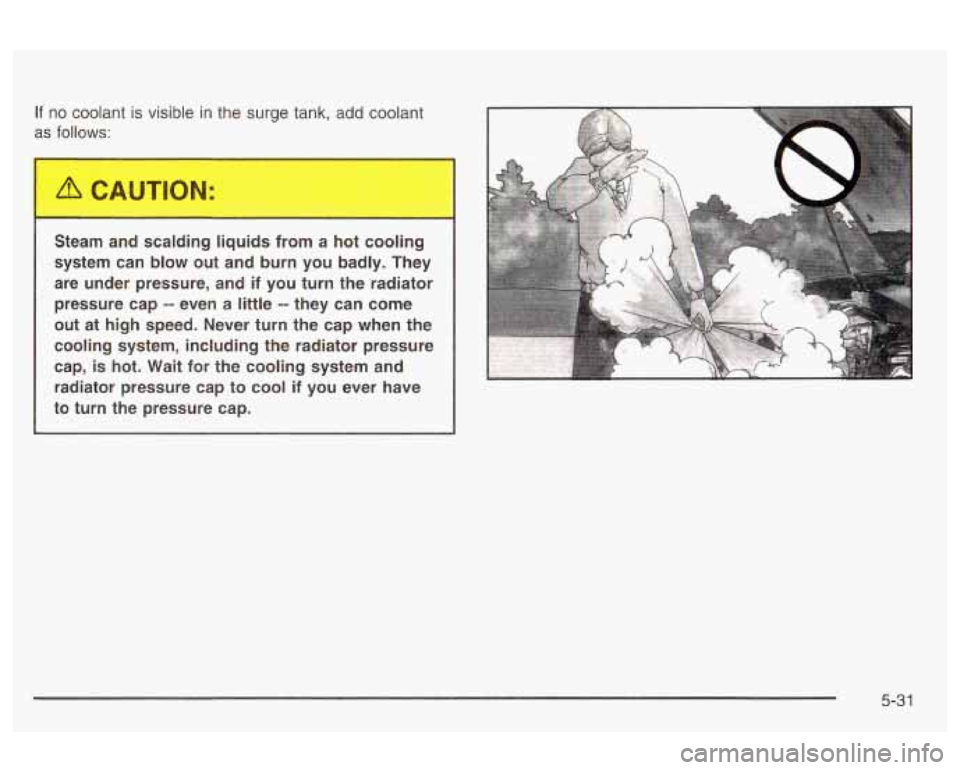
Steam and scalding liquids from a hot cooling
system can blow out and burn you badly. They
are under pressure, and if you turn the radiator
pressure cap
-- even a little -- they can come
out at high speed. Never turn the cap when the
cooling system, including the radiator pressure
cap, is hot. Wait for the cooling system and
radiator pressure cap
to cool if you ever have
to turn the pressure cap.
5-31
Page 248 of 354
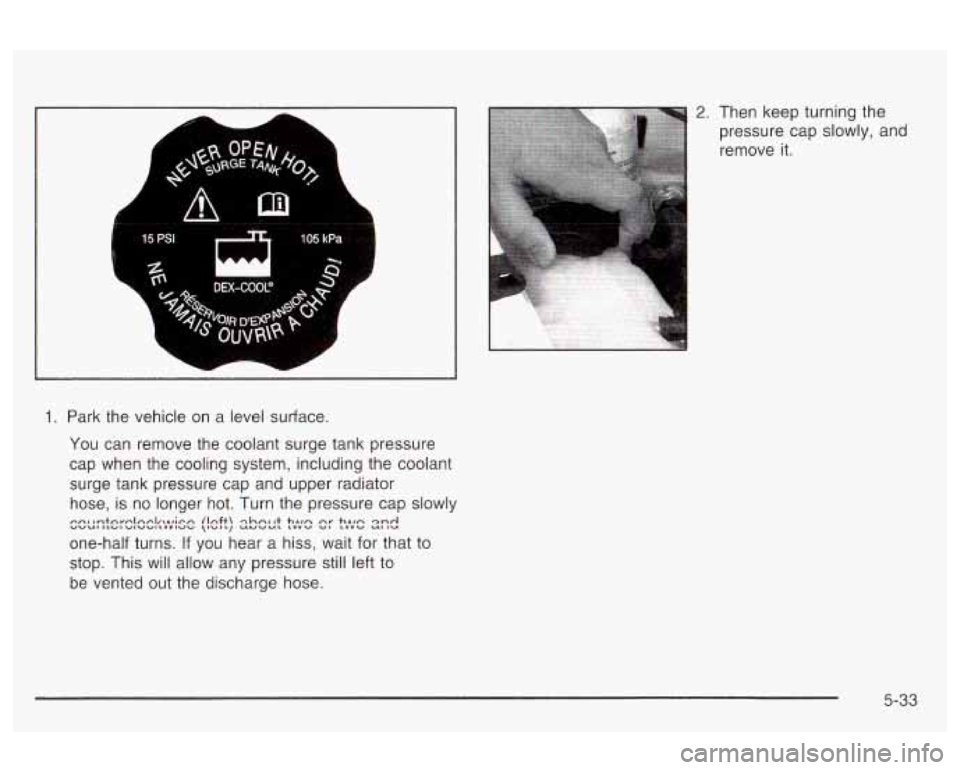
1. Park the vehicle on a level surface.
You can remove the coolant surge tank pressure
cap when the cooling system, including the coolant
surge tank pressure cap and upper radiator
hose, is no longer hot. Turn the pressure cap slowly
one-half turns. If you hear a hiss, wait for that to
stop. This will allow any pressure still left
to
be vented out the discharge hose.
t-nn rntnrt-lnt-btnricn /loft ghnt It hrrn nr t\Arn Qnrl "wL4,nb-,"#-U,\"",.J- \'UtL, UUVUL LllV VI ,""V UIIU
.. - , ",' ..... . . ., 2. Then keep turning the
pressure cap slowly, and
remove
it.
5-33
Page 249 of 354
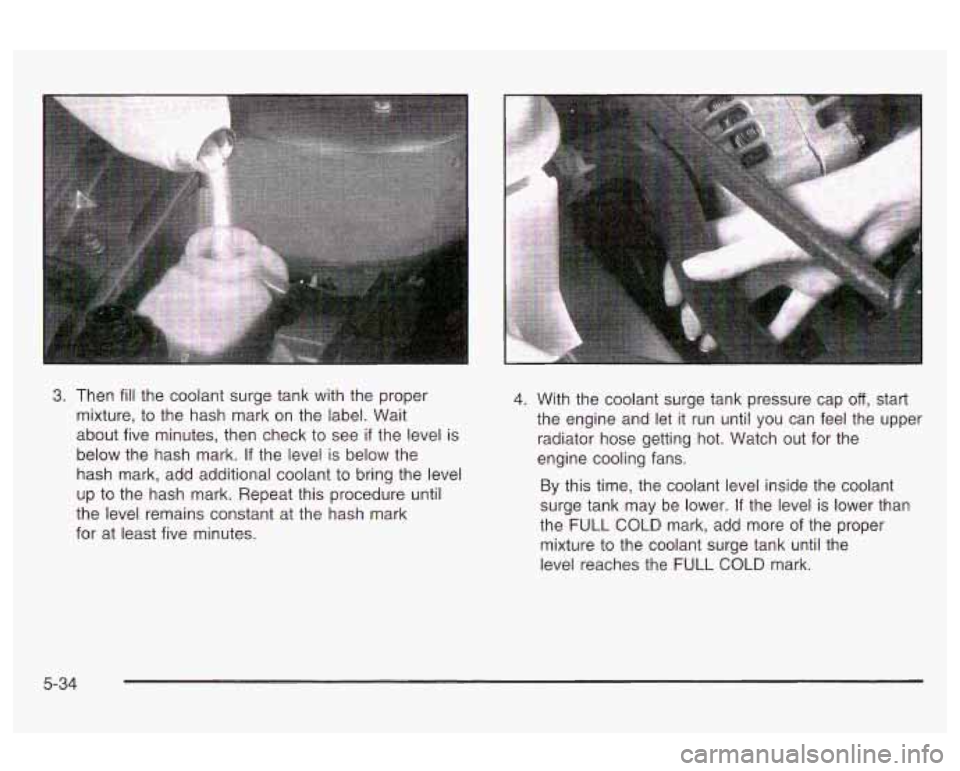
3. Then fill the coolant surge tank with the proper
mixture, to the hash mark on the label. Wait
about five minutes, then check to see
if the level is
below the hash mark.
If the level is below the
hash mark, add additional coolant to bring the level
up to the hash mark. Repeat this procedure until
the level remains constant at the hash mark
for at least five minutes. 4.
With the coolant surge tank pressure cap
off, start
the engine and let it run until you can feel the upper
radiator hose getting hot. Watch out for the
engine cooling fans.
By this time, the coolant level inside the coolant
surge tank may be lower. If the level is lower than
the FULL COLD mark, add more of the proper
mixture to the coolant surge tank until the
level reaches the FULL COLD mark.
5-34
Page 274 of 354
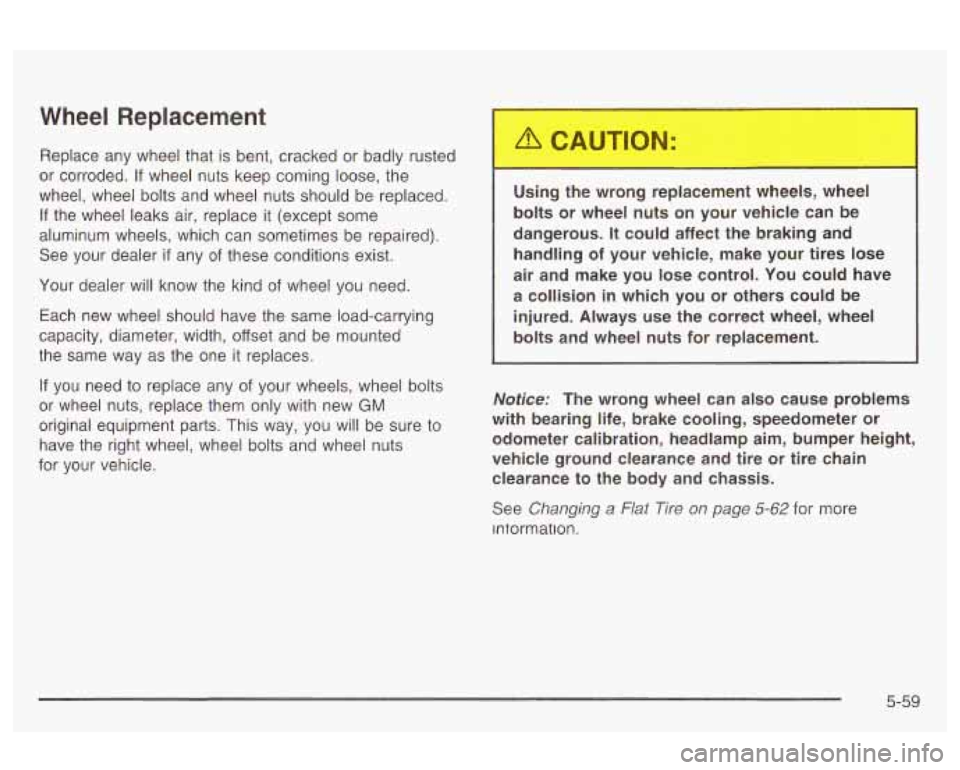
Wheel Replacement
Replace any wheel that is bent, cracked or badly rusted
or corroded. If wheel nuts keep coming loose, the
wheel, wheel bolts and wheel nuts should be replaced.
If the wheel leaks air, replace it (except some
aluminum wheels, which can sometimes be repaired).
See your dealer
if any of these conditions exist.
Your dealer will know the kind of wheel you need.
Each new wheel should have the same load-carrying
capacity, diameter, width, offset and be mounted
the same way as the one it replaces.
If you need to replace any of your wheels? wheel bolts
or wheel nuts, replace them only with new
GM
original equipment parts. This way, you will be sure to
have the right wheel, wheel bolts and wheel nuts
for your vehicle. Using the wrong replacement wheels, wheel
bolts or
wheel
nuts on your vehicle can be
dangerous.
It could affect the braking and
handling
of your vehicle, make your tires lose
air and make you lose control. You could have
a collision in which you or others could be injured. Always use the correct wheel, wheel
Notice: The wrong wheel can also cause problems
with bearing life, brake cooling, speedometer or
odometer calibration, headlamp aim, bumper height,
vehicle ground clearance and tire or tire chain clearance to the body and chassis.
See
Changing a Flat Tire on page 5-62 for more
mtormatlon.
5-59
Page 299 of 354
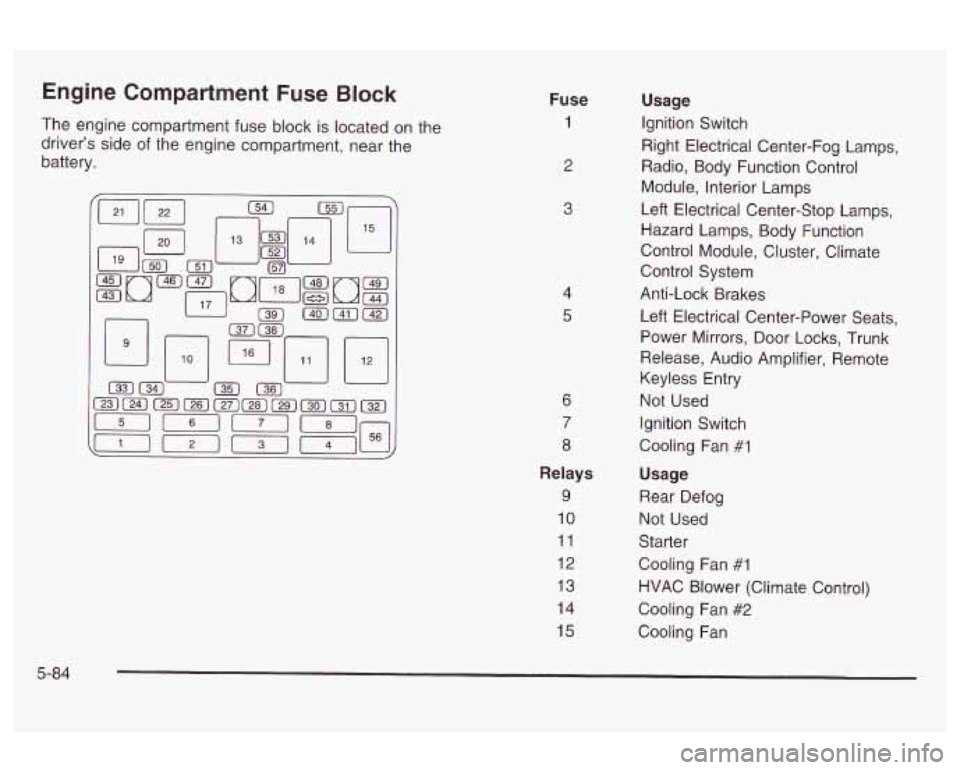
Engine Compartment Fuse Block
The engine compartment fuse block is located on the
driver’s side of the engine compartment, near the
battery. Fuse 1
2
3
4
5
6
7
8
Relays
9
10
11
12
13
14
15
Usage
Ignition Switch
Right Electrical Center-Fog Lamps,
Radio, Body Function Control
Module, Interior Lamps
Left Electrical Center-Stop Lamps,
Hazard Lamps, Body Function
Control Module, Cluster, Climate
Control System
Anti-Lock Brakes
Left Electrical Center-Power Seats,
Power Mirrors, Door Locks, Trunk
Release, Audio Amplifier, Remote
Keyless Entry
Not Used
Ignition Switch
Cooling Fan
#I
Usage
Rear Defog
Not Used
Starter
Cooling Fan
#1
HVAC Blower (Climate Control)
Cooling Fan
#2
Cooling Fan
5-84
Page 300 of 354
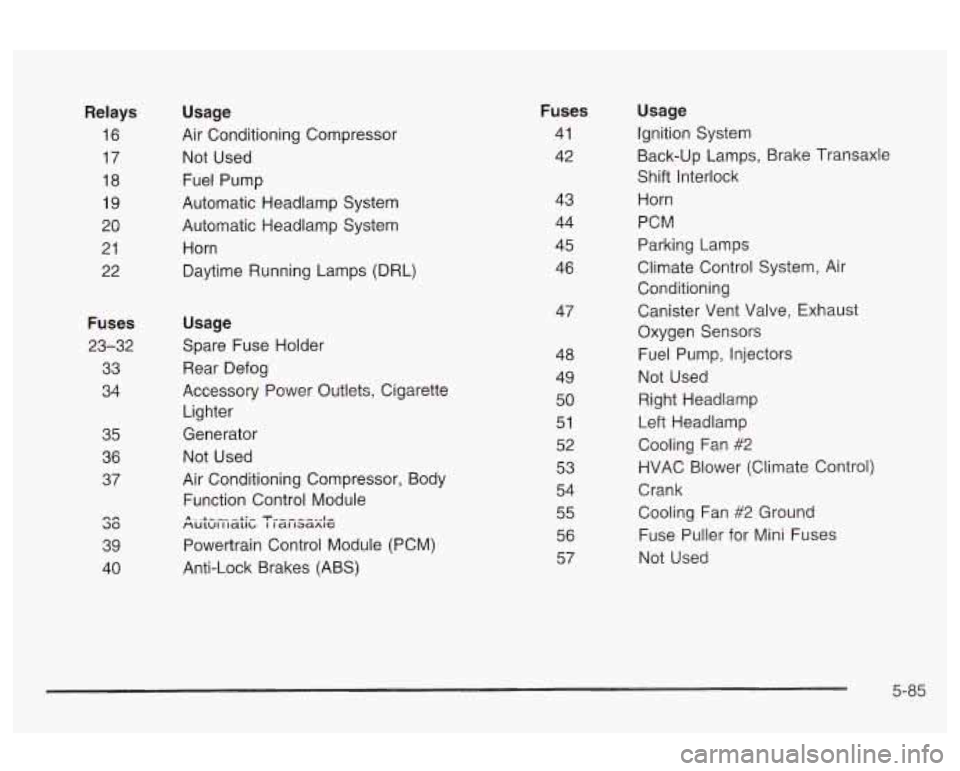
Relays 16
17
18
19
20 21
22
Fuses
23-32 33
34
35
36
37
36
39
40 Usage
Air Conditioning Compressor
Not Used
Fuel Pump
Automatic Headlamp System
Automatic Headlamp System
Horn
Daytime Running Lamps (DRL)
Usage
Spare Fuse Holder
Rear Defog
ACC~SSGP~ Power Outlets, Cigarette
Lighter
Generator Not Used
Air Conditioning Compressor, Body
Function Control Module
Powertrain Control Module (PCM)
Anti-Lock Brakes (ABS)
A ..I -._-- +:- T --.---., I, r\ULUI I Idllb I I C€l13C€AlG
Fuses 41
42
43
44
45
46 47
48 49
50
51
52
53
54
55
56
57 Usage
Ignition System
Back-up Lamps, Brake Transaxle
Shift Interlock
Horn
PCM
Parking Lamps
Climate Control System, Air
Conditioning
Canister Vent Valve, Exhaust
Oxygen Sensors
Fuel Pump, Injectors
Not Used
Right Headlamp
Left Headlamp
Cooling Fan
#2
HVAC Blower (Climate Control)
Crank Cooling Fan
#2 Ground
Fuse Puller for Mini Fuses
Not Used
5-85
Page 301 of 354
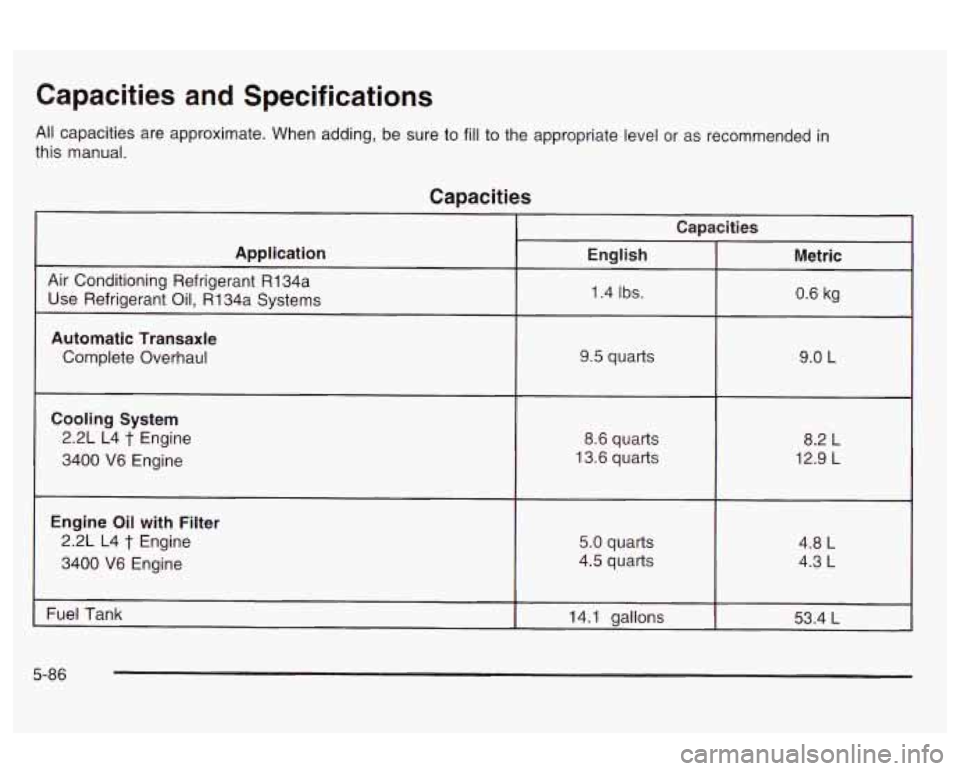
Capacities and Specifications
Capacities
Automatic Transaxle
Complete Overhaul
Cooling System
2.2L L4
t Engine
3400 V6 Engine
Engine Oil with Filter
2.2L L4
t Engine
3400 V6 Engine 8.6
quarts
13.6 quarts 8.2
L
12.9 L 5.0 quarts
4.5 quarts 4.8
L
4.3 L
5-86
Page 304 of 354
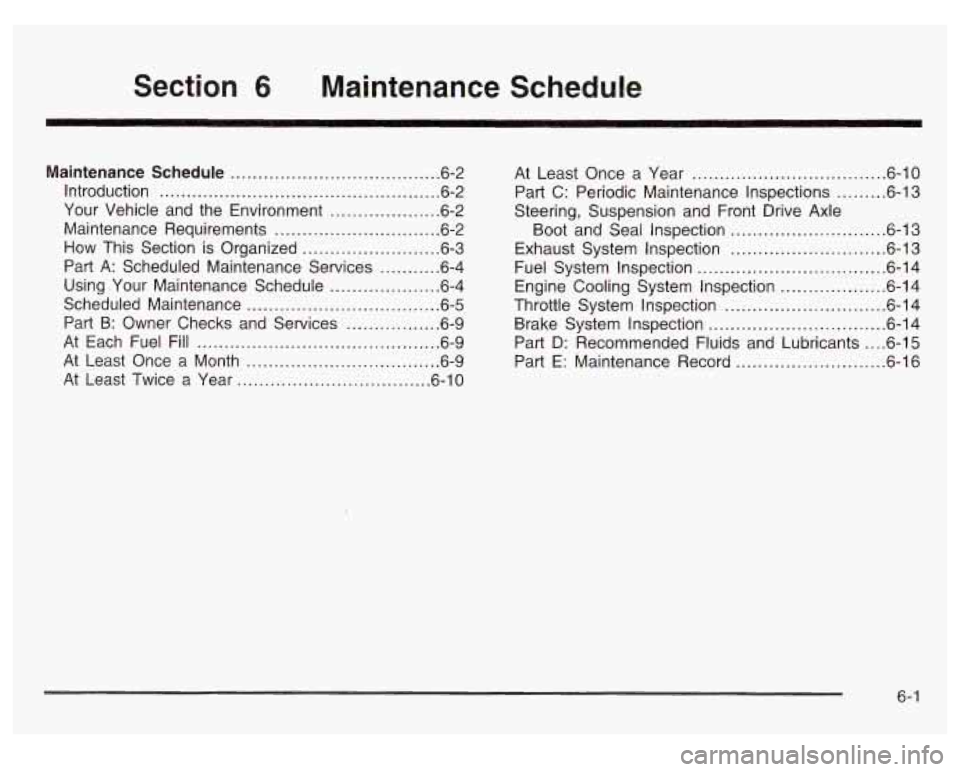
Section 6 Maintenance Schedule
Maintenance Schedule ...................................... 6.2
Introduction
................................................... 6.2
Your Vehicle and the Environment
.................... 6-2
Maintenance Requirements
.............................. 6-2
How This Section
is Organized ......................... 6-3
Part A: Scheduled Maintenance Services
........... 6-4
Using Your Maintenance Schedule
.................... 6-4
Scheduled Maintenance
................................... 6-5
Part B: Owner Checks and Services
................. 6-9
At Each Fuel Fill ............................................ 6-9
At Least Once a Month ................................... 6-9
At Least Twice a Year ................................... 6-10 At
Least Once a Year
................................... 6.10
Part C: Periodic Maintenance inspections
......... 6.13
Steering, Suspension and Front Drive Axle
Boot and Seal inspection
............................ 6.13
Exhaust System Inspection
............................ 6.13
Fuel System Inspection
.................................. 6.14
Engine Cooling System Inspection
................... 6.14
Throttle System Inspection
............................. 6.14
Brake System inspection
................................ 6.14
Part D: Recommended Fluids and Lubricants
.... 6-15
Part E: Maintenance Record
........................... 6.16
6- 1
Page 311 of 354
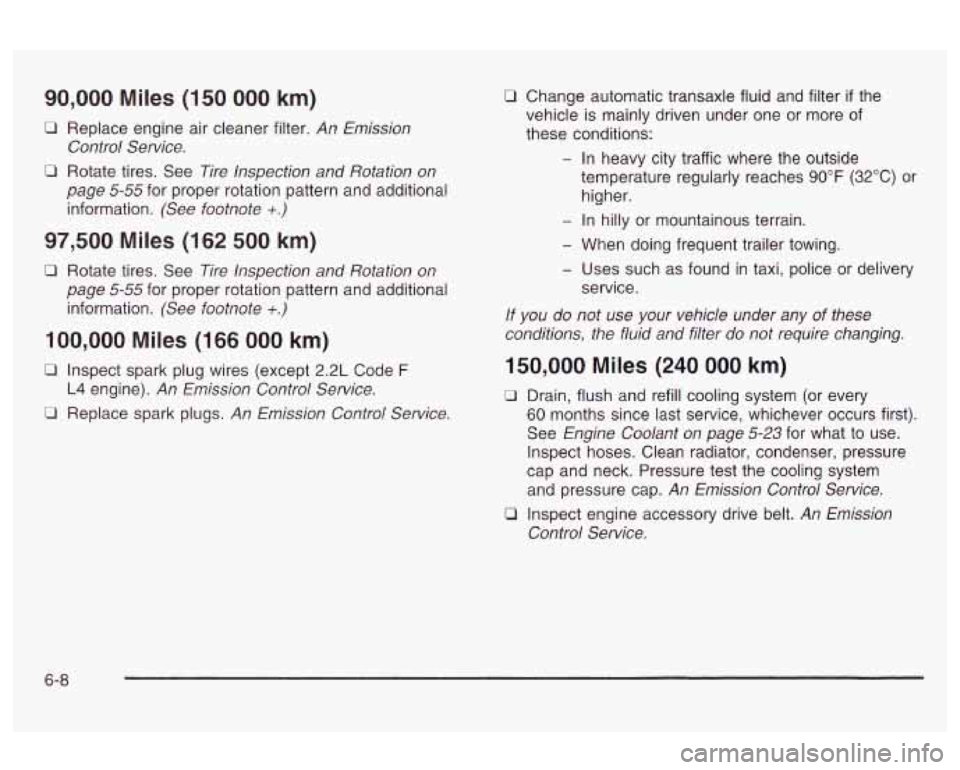
90,000 Miles (150 000 km)
0 Replace engine air cleaner filter. An Emission
0 Rotate tires. See Tire Inspection and Rotation on
Control Service.
page
5-55 for proper rotation pattern and additional
information.
(See footnote +.)
97,500 Miles (162 500 km)
0 Rotate tires. See Tire Inspection and Rotation on
page
5-55 for proper rotation pattern and additional
information.
(See footnote +.)
100,000 Miles (166 000 km)
0 Inspect spark plug wires (except 2.2L Code F
L4 engine). An Emission Control Service.
0 Replace spark plugs. An Emission Control Service.
0 Change automatic transaxle fluid and filter if the
vehicle
is mainly driven under one or more of
these conditions:
- In heavy city traffic where the outside
temperature regularly reaches
90°F (32°C) or
higher.
- In hilly or mountainous terrain.
- When doing frequent trailer towing.
- Uses such as found in taxi, police or delivery
service.
If you do not use your vehicle under any of these
conditions, the fluid and filter do not require changing.
150,000 Miles (240 000 km)
0 Drain, flush and refill cooling system (or every
60 months since last service, whichever occurs first).
See
Engine Coolant on page 5-23 for what to use.
Inspect hoses. Clean radiator, condenser, pressure
cap and neck. Pressure test the cooling system
and pressure cap.
An Emission Control Service.
0 Inspect engine accessory drive belt. An Emission
Control Service.
6-8