reset Oldsmobile Aurora 1997 s Owner's Guide
[x] Cancel search | Manufacturer: OLDSMOBILE, Model Year: 1997, Model line: Aurora, Model: Oldsmobile Aurora 1997Pages: 404, PDF Size: 20.75 MB
Page 266 of 404
Engine Oil Additives
Don’t add anything to your oil. Your Aurora retailer is
ready to advise
if you think something should be added.
When to Change Engine Oil
If any one of these is true for you, use the short trip/city
maintenance schedule:
0
0
0
0
0
Most trips are less than 5 to 10 miles (8 to 16 km).
This is particularly important when outside
temperatures are below freezing.
Most trips include extensive idling (such
as frequent
driving in stop-and-go traffic).
Most trips are through dusty areas.
You frequently tow a trailer or use a carrier on top of
your vehicle.
The vehicle is used for delivery service, police, taxi
or other commercial application. Driving under
these conditions causes engine oil to
break down sooner.
If any one of these is true for your
vehicle, then you need
to change your oil and filter
every
3,000 miles (5 000 km) or 3 months -- whichever
occurs first. (See “Change Oil Message’’ in the Index.)
If
the CHANGE OIL NOW message appears in the Driver
Information Center, you should change your oil.
If none of them is
true, use the long triphighway
maintenance schedule. Change the oil and filter every
7,500 miles ( 12 500 km) or 12 months -- whichever
occurs first. Driving a vehicle with a
fully warmed
engine under highway conditions causes engine oil to
break down slower.
(See “Change Oil Message” in the Index.) Always reset
the engine oil life to 100% after every oil change.
6-14
Page 277 of 404
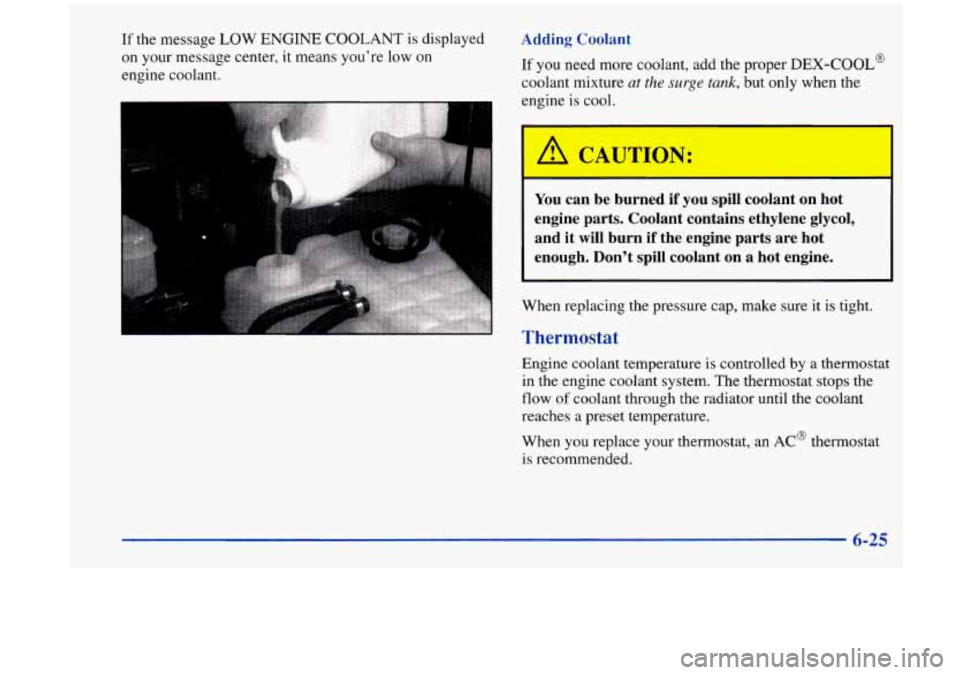
If the message LOW ENGINE COOLANT is displayed
on your message center,
it means you’re low on
engine coolant.
Adding Coolant
If you need more coolant, add the proper DEX-COOL’
coolant mixture
at the surge tank, but only when the
engine is cool.
I A CAUTION: I
You can be burned if you spill coolant on hot
engine parts. Coolant contains ethylene glycol,
and it will burn if the engine parts are hot
enough. Don’t spill coolant on
a hot engine.
When replacing the pressure cap, make sure it is tight.
Thermostat
Engine coolant temperature is controlled by a thermostat
in the engine coolant system. The thermostat stops the
flow
of coolant through the radiator until the coolant
reaches a preset temperature.
When you replace your thermostat, an AC@ thermostat
is recommended.
6-25
Page 302 of 404

Temperature -- A, B, C Wheel Alignment and Tire Balance
The temperature grades are A (the highest), B, and C,
representing the tire’s resistance to the generation of
heat and its ability to dissipate heat when tested under
controlled conditions on a specified indoor laboratory
test wheel. Sustained high temperature can cause the
material
of the tire to degenerate and reduce tire life, and
excessive temperature can lead to sudden tire failure.
The grade
C corresponds to a level of performance
which all passenger car tires must meet under the
Federal Motor Vehicle Safety Standard
No. 109. Grades
B and A represent higher levels of performance on the
laboratory test wheel than the minimum required by law.
Warning: The temperature grade for this tire is
established for a tire that
is properly inflated and not
overloaded. Excessive speed, underinflation, or
excessive loading, either separately or in combination,
can cause heat buildup and possible tire failure. The
wheels on your vehicle were aligned and balanced
carefully at the factory to give you the longest tire life
and best overall performance.
Scheduled wheel alignment and wheel balancing are not
needed. However, if you notice unusual tire wear or
your vehicle pulling one way or the other, the alignment
may need to be reset.
If you notice your vehicle
vibrating when driving on a smooth road, your wheels
may need to be rebalanced.
Wheel Replacement
Replace any wheel that is bent, cracked, or badly rusted
or corroded. If wheel nuts keep coming loose, the wheel,
wheel bolts and wheel nuts should be replaced. If the
wheel leaks air, replace it (except some aluminum
wheels, which can sometimes be repaired). See your
Aurora retailer if any of these conditions exist.
Your retailer will know the kind
of wheel you need.
6-50
Page 335 of 404
Short TripKity Maintenance Schedule
The services shown in this schedule up to 100,000 miles
(166
000 krn) should be performed after 100,000 miles
(166
000 km) at the same intervals. The services shown
at 150,000 miles (240
000 km) should be performed at
the same interval after 150,000 miles (240
000 km).
See “Owner Checks and Services” and “Periodic
Maintenance Inspections” following.
Footnotes
-f The U.S. Environmental Protection Agency or the
California Air Resources Board has determined that the
failure to perform this maintenance item will not nullify
the emission warranty or limit recall liability prior to the
completion of the vehicle’s useful life. We, however,
urge that all recommended maintenance services be
performed at the indicated intervals and the maintenance
be recorded.
# Lubricate the suspension and steering linkage,
transaxle shift linkage, parking brake cable guides and
underbody contact points and linkage.
* Your vehicle has an Engine Oil Life Monitor. This
monitor will show
you when to change the oil -- usually
between
3,000 miles (5 000 km) and 7,500 miles
(12
500 km) since your last oil change. Under severe
conditions, the indicator may come on before
3,000 miles (5 000 km). Never drive your vehicle
more than
7,500 miles (12 500 krn) or 12 months,
(whichever occurs first), without an oil change.
The system won’t detect dust in the oil.
So if you
drive in a dusty area be sure to change your oil every
3,000 miles (5 000 km) or sooner if the CHANGE OIL
light comes on. Remember to reset the Oil Life Monitor
when the oil has been changed. For more information, see “Engine Oil Life Monitor” in the Index.
+ A good time to check your brakes is during tire
rotation. See “Brake System Inspection’’ under “Periodic
Maintenance Inspection” in Part
C of this schedule.
7-7
Page 356 of 404
Long Tripmighway Maintenance Schedule
The services shown in this schedule up to 100,000 miles
(166 000 km) should be performed after 100,000 miles
(166
000 km) at the same intervals. The services shown
at 150,000 miles
(240 000 km) should be performed at
the same interval after 150,000 miles
(240 000 km).
See “Owner Checks and Services” and “Periodic
Maintenance Inspections’’ following.
Footnotes
The U.S. Environmental Protection Agency or the
California Air Resources Board has determined that the
failure to perform this maintenance item will not nullify
the emission warranty or limit recall liability prior to the
completion of the vehicle’s useful life. We, however,
urge that all recommended maintenance services be
performed at the indicated intervals and the maintenance
be recorded.
# Lubricate the suspension and steering linkage,
transaxle shift linkage, parking brake cable guides and
underbody contact points and linkage.
* Your vehicle has an Engine Oil Life Monitor. This
monitor will show you when
to change the oil -- usually
between
3,000 miles (5 000 km) and 7,500 miles
(12
500 km) since your last oil change. Under severe
conditions,
the indicator may come on before
3,000 miles (5 000 km). Never drive your vehicle more
than
7,500 miles (12 500 km) or 12 months without an
oil change.
The system won’t detect dust in the oil.
So if you drive
in a dusty area, be sure to change your oil every
3,000 miles (5 000 km) or sooner if the CHANGE OIL
light comes on. Remember to reset the Oil Life Monitor
when the oil has been changed. For more information,
see “Engine Oil Life Monitor” in the Index.
+ A good time to check your brakes is during tire
rotation. See “Brake System Inspection” under “Periodic
Maintenance Inspections” in Part
C of this schedule.
7-28
Page 394 of 404
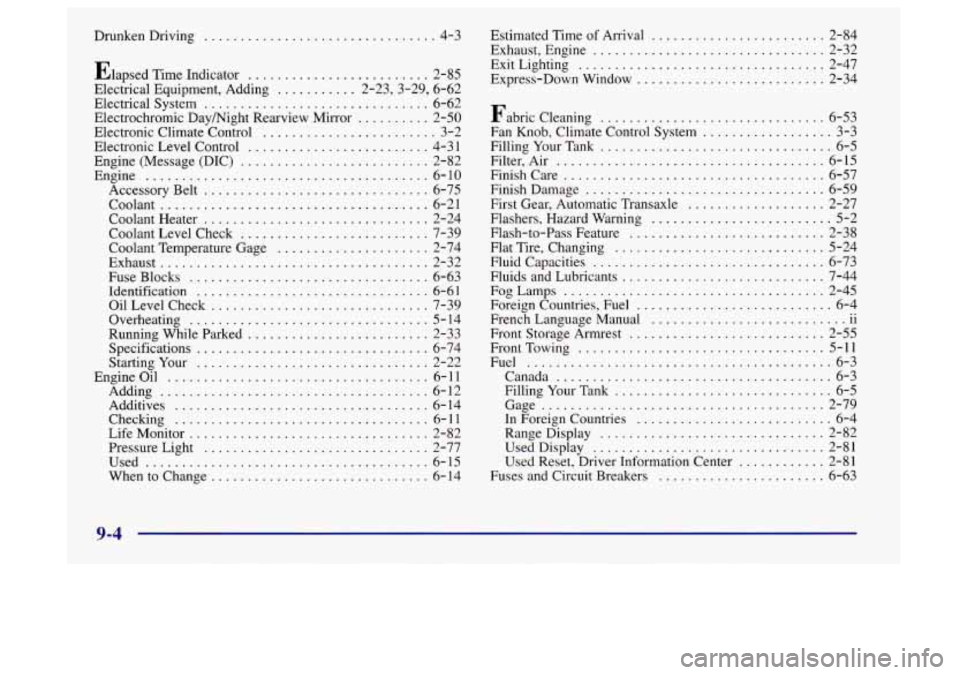
Drunken Driving ................................ 4-3
Elapsed Time Indicator
......................... 2-85
Electrical Equipment. Adding
........... 2.23. 3.29. 6-62
Electrical System
............................... 6-62
Electrochromic Daymight Rearview Mirror
.......... 2-50
Electronic Climate Control
........................ 3-2
Electronic Level Control
......................... 4-3 1
Engine (Message (DIC)
.......................... 2-82
Engine
....................................... 6-10
Accessory Belt
............................... 6-75
Coolant
..................................... 6-21
Coolant Heater
............................... 2-24
Coolant Level Check
.......................... 7-39
Coolant Temperature Gage
..................... 2-74
Exhaust
..................................... 2-32
FuseBlocks
................................. 6-63
Identification
................................ 6-6 1
OilLevelCheck .............................. 7-39
Overheating
................................. 5-14
Running While Parked
......................... 2-33
Specifications
................................ 6-74
StartingYour
................................ 2-22
Engineoil
.................................... 6-11
Adding
..................................... 6-12
Additives
................................... 6-14
Checking
................................... 6-11
Life Monitor ................................. 2-82
Pressure Light
............................... 2-77
Used
....................................... 6-15
Whentochange
.............................. 6-14 Estimated Time
of Arrival
........................ 2-84
Exit Lighting
.................................. 2-47
Express-Down Window
.......................... 2-34
Exhaust. Engine
................................ 2-32
Fabric Cleaning
............................... 6-53
Fan Knob. Climate Control System
.................. 3-3
Filling Your Tank
................................ 6-5
Filter. Air
..................................... 6-15
Finish Care
.................................... 6-57
Finish Damage
................................. 6-59
First Gear. Automatic Transaxle
................... 2-27
Flashers. Hazard Warning
......................... 5-2
Flash-to-Pass Feature
........................... 2-38
Flat Tire. Changing
............................. 5-24
Fluid Capacities
................................ 6-73
Fluids and Lubricants
............................ 7-44
FogLamps
.................................... 2-45
Foreign Countries. Fuel
........................... 6-4
FrenchLanguageManual
11
FrontTowing .................................. 5-11
Fuel .......................................... 6-3
Canada
...................................... 6-3
Filling
Your Tank .............................. 6-5
Gage
....................................... 2-79
RangeDisplay
............................... 2-82
UsedDisplay
................................ 2-81
Used Reset. Driver Information Center
............ 2-81
Fuses and Circuit Breakers
....................... 6-63
.. ...........................
Front Storage Armrest ........................... 2-55
In Foreign Countries
........................... 6-4
9-4