ignition Oldsmobile Aurora 1997 s Repair Manual
[x] Cancel search | Manufacturer: OLDSMOBILE, Model Year: 1997, Model line: Aurora, Model: Oldsmobile Aurora 1997Pages: 404, PDF Size: 20.75 MB
Page 171 of 404

Unlocking the Theft-Deterrent Feature After a
Power
Loss
Enter your secret code as follows; pause no more than
15 seconds between steps:
1. LOC appears when the ignition is on.
2. Press MN and 000 will appear on the display.
3. Press MN again to make the last two digits agree
4. Press HR to make the first one or two digits agree
with
your code.
with your code.
5. Press AM-FM after you have confirmed that the
code matches the secret code you have written down.
The display will show SEC, indicating the radio is
now operable and secure.
If you enter the wrong code eight times, INOP will
appear
on the display. You will have to wait an hour
with the ignition on before you can try again. When you
try again, you will only have three chances to enter the
correct code before INOP appears.
If you lose or forget your code, contact your retailer.
Disabling the Theft-Deterrent Feature
1. Turn the ignition to ACCESSORY or RUN.
2. Turn the radio off.
3. Press the 1 and 4 buttons together. Hold them down
until SEC shows on the display.
4. Press MN and 000 will appear on the display.
5. Press MN again to make the last two digits agree
with your code.
6. Press HR to make the first one or two digits agree
with your code.
7. Press AM-FM after you have confirmed that the
code matches the secret code you have written down.
The display will show
---, indicating that the radio is
no longer secured.
If the code entered is incorrect, SEC will appear on the
display. The radio will remain secured until the correct
code is entered.
When battery power is removed and later applied to a
secured radio, the radio won’t turn
on and LOC will
appear on the display.
To unlock a secured radio,
see “Unlocking the
Theft-Deterrent Feature After a Power
Loss” earlier in
this section.
Enter your secret code as follows; pause no more than
15 seconds between steps:
3-27
Page 175 of 404

Power Antenna Mast Care
Your power antenna will look its best and work
well if it’s cleaned from time to time.
To clean the
antenna mast:
1, Turn on the ignition and radio to raise the antenna.
2. Dampen a clean cloth with mineral spirits or
3. Wipe the cloth over the mast sections, removing
equivalent solvent.
any
dirt.
4. Wipe dry with a clean cloth.
5. Make the antenna go up and down by turning the
radio or ignition off and on.
6. Repeat if necessary.
NOTICE:
Don’t lubricate the power antenna. Lubrication
could damage it.
NOTICE:
Before entering an automatic car wash, turn off
your radio to make the power antenna go down.
This will prevent the mast from possibly getting
damaged.
If the antenna does not go down when
you turn the radio off, it may be damaged or
need to be cleaned. In either case, lower the
antenna
by hand by carefully pressing the
antenna down.
If the mast portion of your antenna is damaged, you can
easily replace it. See your retailer for a replacement kit
and follow the instructions in the kit.
3-31
Page 201 of 404
0
0
If you drive regularly in steep country, or if you’re
planning to visit there, here are some tips that can make
your trips safer and more enjoyable.
Keep your vehicle in good shape. Check all fluid
levels and also the brakes, tires, cooling system
and transaxle. These parts can work hard on
mountain roads.
Know how to
go down hills. The most important
thing to know is this: let your engine do some of the
slowing down. Shift
to a lower gear when you go
down a steep or long hill.
~ If you don’t shift down, your brakes could get so
hot that they wouldn’t work well. You would then
have poor braking or even none going down
a
hill. You could crash. Shift down to let your
engine assist your brakes on
a steep
downhill slope.
I
Coasting downhill in NEUTRAL (N) or with
the ignition off is dangerous. Your brakes will
have to
do all the work of slowing down. They
could get
so hot that they wouldn’t work well.
You would then have poor braking or even none
going down
a hill. You could crash. Always have
your engine running and your vehicle in gear
when you go downhill.
0
0
0
0
0
Know how to go uphill. Drive in the highest gear possible.
In hilly terrain, you may want to switch to the
POWER mode for better performance.
Stay in your own lane when driving on two-lane
roads
in hills or mountains. Don’t swing wide or cut
across the center of the road. Drive at speeds that let
you stay
in your own lane.
As you go over the top of a hill, be alert. There could be
something in your lane, like a stalled car or
an accident.
You may see highway signs on mountains that warn of
special problems. Examples are long grades, passing or
no-passing zones, a falling rocks area or winding roads.
Be alert
to these and take appropriate action.
Page 220 of 404
2. Get the vehicles close enough so the jumper cables
can reach, but be sure the vehicles aren’t touching
each other.
If they are, it could cause a ground
connection you don’t want. You wouldn’t be able to
start your Aurora, and the bad grounding could
damage the electrical systems.
To avoid the possibility
of the vehicles rolling, set
the parking brake firmly on both vehicles involved in
the jump start procedure. Put an automatic transaxle
in
PARK (P) before setting the parking brake.
3. Turn off the ignition on both vehicles. Unplug
unnecessary accessories plugged into the cigarette
lighter or accessory power outlet.
Turn off all lamps
that aren’t needed as well as radios. This will avoid
sparks and help save both batteries. In addition, it
could save your radio.
NOTICE:
If you leave your radio on, it could be badly
damaged. The repairs wouldn’t be covered by
your warranty.
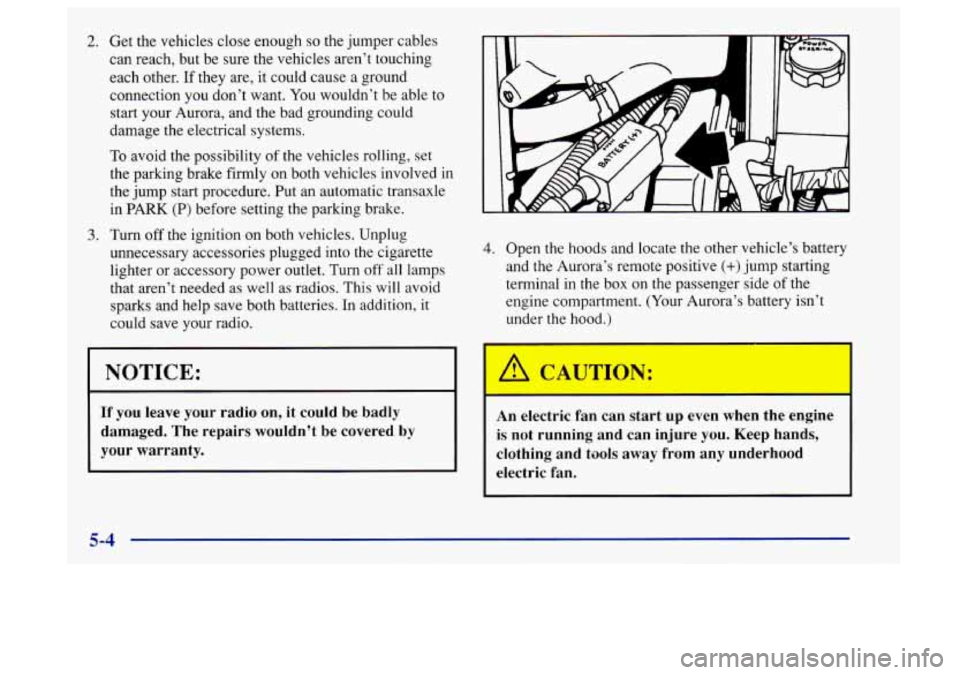
4. Open the hoods and locate the other vehicle’s battery
and the Aurora’s remote positive
(+) jump starting
terminal in the box on the passenger side
of the
engine compartment.
(Your Aurora’s battery isn’t
under the hood.)
An electric fan can start up even when the engine
is not running and can injure you. Keep hands,
clothing and tsols away from any underhood
electric fan.
5-4
Page 226 of 404

A vehicle can fall from a car carrier if it isn’t
adequately secured. This can cause
a collision,
serious personal injury and vehicle damage. The
vehicle should be tightly secured with chains or
steel cables before it is transported.
Don’t use substitutes (ropes, leather straps,
canvas webbing, etc.) that can be cut by sharp
edges underneath the towed vehicle. Always use
T-hooks inserted in the T-hook slots. Never use
J-hooks. They will damage drivetrain and
suspension components. When
your vehicle
is being towed, have the ignition key
turned to
OFF. The steering wheel should be clamped in
a straight-ahead position, with a clamping device
designed for towing service. Do not use the vehicle’s
steering column lock for this. The transaxle should be in
NEUTRAL (N) and the parking brake released.
Don’t have your vehicle towed on the drive wheels, unless you must.
If the vehicle must be towed on the
drive wheels, be sure to follow the speed and distance
restrictions later in this section or your transaxle will be
damaged.
If these limitations must be exceeded, then the
drive wheels have
to be supported on a dolly.
5-10
Page 257 of 404
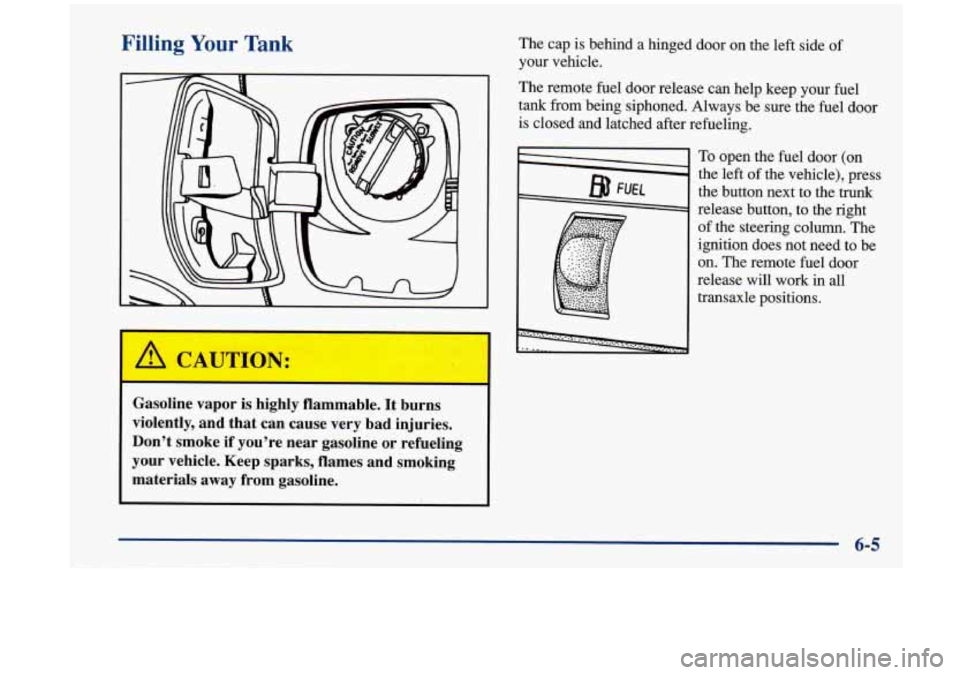
Filling Your Tank The cap is behind a hinged door on the left side of
your vehicle.
Gasoline vapor is highly flammable. It burns
violently, and that can cause very bad injuries.
Don’t smoke if you’re near gasoline or refueling
your vehicle. Keep sparks, flames and smoking
materials away from gasoline.
The remote fuel door release can help keep your fuel
tank from being siphoned. Always be sure the fuel door
is closed and latched after refueling.
To open the fuel door
(on
the left of the vehicle), press
the button next to the
trunk
release button, to the right
of the steering column. The
ignition does not need to be
on. The remote fuel door
release will work
in all
transaxle positions.
6-5
Page 316 of 404
/ INSTRUMENT PANEL
FUSE BLOCK
I1 I 12
I
1 l7 DIS
21 HVAC
RELAY
OXYGEN
LAMPS
J
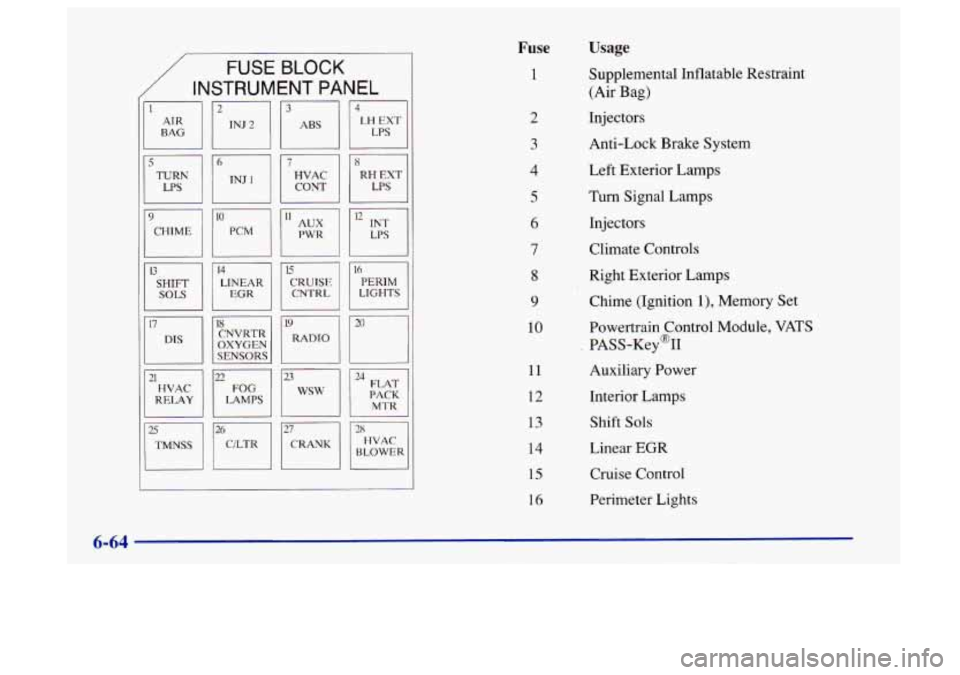
Fuse
1
2
3
4
5
6
7
8
9
10
11
12
13
14
15
16
Usage
Supplemental Inflatable Restraint
(Air Bag)
Injectors
Anti-Lock Brake System
Left Exterior Lamps
Turn Signal Lamps
Injectors Climate Controls
Right Exterior Lamps
Chime (Ignition
l), Memory Set
Powertrain Control Module,
VATS
, PASS-Key@II Auxiliary Power
Interior Lamps
Shift Sols
Linear EGR
Cruise Control
Perimeter Lights
6-64
Page 321 of 404
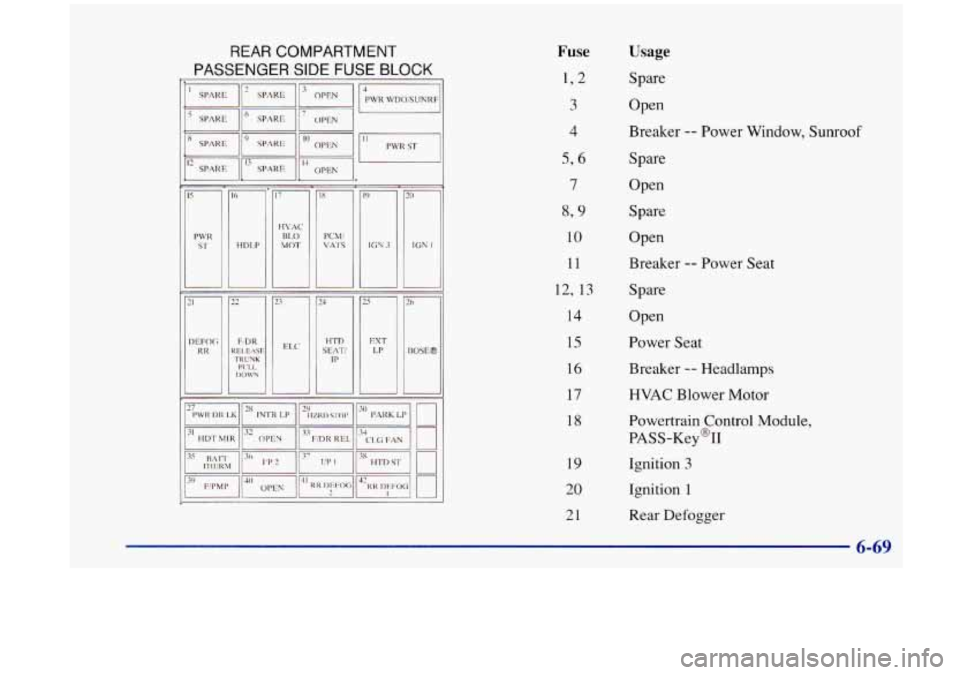
REAR COMPARTMENT
PASSENGER
SIDE FUSE BLOCK
OPEN
IS
PWR s-1-
r- DEFOG R IZ
IS I 1)
ICN 3
20
ltiN I
?h
ROSEQ
Fuse
172
3
4
5,6
7
839
10
11
12, 13
14
15
16
17
18
19
20
21
Usage
Spare
Open
Breaker
-- Power Window, Sunroof
Spare
Open
Spare
Open
Breaker
-- Power Seat
Spare
Open
Power Seat
Breaker
-- Headlamps
HVAC Blower Motor
Powertrain Control Module,
PASS-Key@II
Ignition
3
Ignition 1
Rear Defogger
6-69
Page 370 of 404

Ignition Transaxle Lock Check While parked, and with
the parking brake set, try to turn
the ignition key to
LOCK in each shift lever position.
The key should turn to LOCK only when the shift
lever
is in PARK (P).
0 The key should come out only in LOCK.
Parking Brake and Automatic Transaxle PARK (P)
Mechanism Check
When you are doing this check, your vehicle
could begin to move.
You or others could be
injured and property could be damaged. Make
sure there
is room in front of your vehicle in case
it begins
to roll. Be ready to apply the regular
brake at once should the vehicle begin to move. Park
on
a fairly steep hill, with the vehicle facing
downhill. Keeping your foot on the regular brake, set the
parking brake.
0 To check the parking brake’s holding ability: With
the engine running and transaxle in NEUTRAL
(N),
slowly remove foot pressure from the regular brake
pedal.
Do this until the vehicle is held by the parking
brake only.
To check the PARK (P) mechanism’s holding ability:
With the engine running, shift to
PARK (P). Then
release all brakes.
Underbody Flushing Service At least every spring, use plain water to
flush any
corrosive materials from the underbody. Take care to
clean thoroughly any areas where mud and other debris
can collect.
7-42
Page 395 of 404
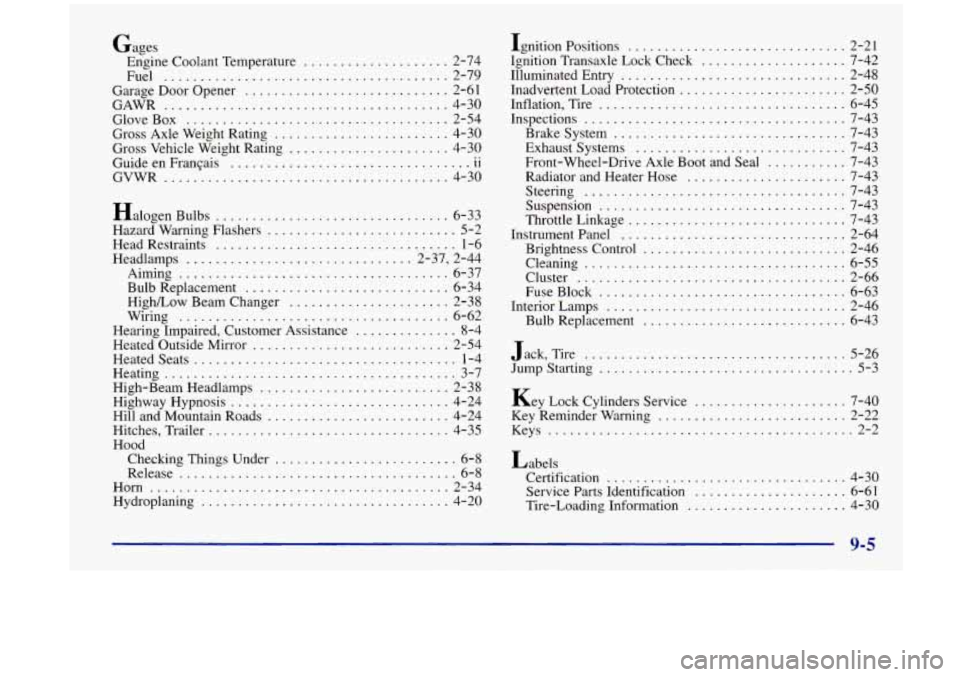
Gages Engine Coolant Temperature
.................... 2-74
Fuel
....................................... 2-79
Garage
Door Opener ............................ 2-61
GAWR
....................................... 4-30
GloveBox
.................................... 2-54
Gross Axle Weight Rating
........................ 4-30
Gross Vehicle Weight Rating
...................... 4-30
Guide en FranCais
11 .. .................................
GVWR ....................................... 4-30
Halogen Bulbs
................................ 6-33
Hazard Warning Flashers
.......................... 5-2
Head Restraints
................................. 1-6
Headlamps
............................... 2-37. 2-44
Aiming
..................................... 6-3 7
Bulb Replacement
............................ 6-34
HigWLow Beam Changer
...................... 2-38
Wiring
..................................... 6-62
Hearing Impaired. Customer Assistance
.............. 8-4
Heated Outside Mirror
........................... 2-54
Heatedseats
.................................... 1-4
Heating ........................................ 3-7
High-Beam Headlamps
.......................... 2-38
Highway Hypnosis
.............................. 4-24
Hill and Mountain Roads
......................... 4-24
Hitches. Trailer
................................. 4-35
Hood Checking Things Under
......................... 6-8
Release
...................................... 6-8
Horn
......................................... 2-34
Hydroplaning
.................................. 4-20 Ignition
Positions
.............................. 2-21
Illuminated Entry
............................... 2-48
Inadvertent Load Protection
....................... 2-50
Inflation, Tire
.................................. 6-45
Inspections
.................................... 7-43
Brakesystem
................................ 7-43
Exhaust Systems
............................. 7-43
Front-Wheel-Drive Axle Boot and Seal
........... 7-43
Radiator and Heater Hose
...................... 7-43
Steering
.................................... 7-43
Suspension
.................................. 7-43
Throttle Linkage
.............................. 7-43
Instrument Panel
............................... 2-64
Brightness Control
............................ 2-46
Cleaning
.................................... 6-55
Cluster
..................................... 2-66
FuseBlock
.................................. 6-63
Interior Lamps
................................. 2-46
Bulb Replacement
............................ 6-43
Ignition Transaxle
Lock Check
.................... 7-42
Jack. Tire
.................................... 5-26
Jump Starting ................................... 5-3
Key Lock Cylinders Service ..................... 7-40
Key Reminder Warning
.......................... 2-22
Keys
.......................................... 2-2
Labels Certification
................................. 4-30
Service Parts Identification ..................... 6-61
Tire-Loading Information
...................... 4-30