oil level OLDSMOBILE AURORA 2003 User Guide
[x] Cancel search | Manufacturer: OLDSMOBILE, Model Year: 2003, Model line: AURORA, Model: OLDSMOBILE AURORA 2003Pages: 387, PDF Size: 18.05 MB
Page 255 of 387

Automatic Transaxle Fluid
When to Check and Change
A good time to check your automatic transaxle fluid
level is when the engine oil is changed.
Change both the fluid and filter every
50,000 miles
(83
000 km) if the vehicle is mainly driven under one or
more
of these conditions:
In heavy city traffic where the outside temperature
In hilly or mountainous terrain.
regularly reaches
90°F (32°C) or
higher.
When doing frequent trailer towing.
Uses such as found in taxi, police or delivery
If you do not use your vehicle under any of these
conditions, change the fluid and filter at
100,000 miles
(1 66 000 km).
service.
See
Part A: Scheduled Maintenance Services on
page
6-4 for automatic transaxle fluid change intervals.
How to Check
Because this operation can be a little difficult, you may
choose to have this done at the dealership service
department.
If you do it yourself, be sure to follow all the instructions
here, or you could get a false reading
on the dipstick.
Notice: Too much or too little fluid can damage
your transaxle.
Too much can mean that some of the
fluid could come out and fall on hot engine or
exhaust system parts, starting a fire.
Too little fluid
could cause the transaxle to overheat.
Be sure
to get an accurate reading
if you check your
transaxle fluid.
Wait at least 30 minutes before checking the transaxle
fluid level
if you have been driving:
When outside temperatures are above 90°F (32°C).
At high speed for quite a while.
In heavy traffic - especially in hot weather.
While pulling a trailer.
To get the right reading, the fluid should be at normal
operating temperature, which is
180°F to 200°F
(82°C to 93°C).
Get the vehicle warmed up by driving about
15 miles
(24 km) when outside temperatures are above
50°F
(10°C). If it's colder than 50°F (lO"C), you may have to
drive longer.
5-22
ProCarManuals.com
Page 257 of 387

How to Add Fluid Engine Coolant
Refer to the Maintenance Schedule to determine what
kind of transaxle fluid to use. See
Part D:
Recommended Fluids and Lubricants on page 6-15.
If the fluid level is low, add only enough of the proper
fluid to bring the level into the cross-hatched area on the
dipstick.
1, Pull out the dipstick.
2. Using a long-neck funnel, add enough fluid at the
dipstick hole to bring it to the proper level.
It doesn’t take much fluid, generally less than one
pint
(0.5 L). Don’t overfill.
Notice: We recommend you use only fluid labeled
DEXRON@-Ill, because fluid with that label is
made especially for your automatic transaxle.
Damage caused by fluid other than DEXRON@-Ill is
not covered by your new vehicle warranty.
3. After adding fluid, recheck the fluid level as
described under “How to Check,” earlier in this
section. The
cooling system in your vehicle is filled with
DEX-COOL@ engine coolant. This coolant is designed
to remain in your vehicle for
5 years or 150,000 miles
(240
000 km), whichever occurs first, if you add
only extended life coolant.
The following explains your cooling system and how to
add coolant when it is
low. If you have a problem
with engine overheating, see
Engine Overheating on
page
5-28.
A 50/50 mixture of clean, drinkable water and
DEX-COOL@ coolant will:
Give freezing protection down to -34°F (-37°C).
Give boiling protection up to 265°F (129°C).
Protect against rust and corrosion.
Help keep the proper engine temperature.
Let the warning lights and gages work as they
should.
4. When the correct fluid level is obtained, push the
dipstick back in all the way.
5-24
ProCarManuals.com
Page 265 of 387
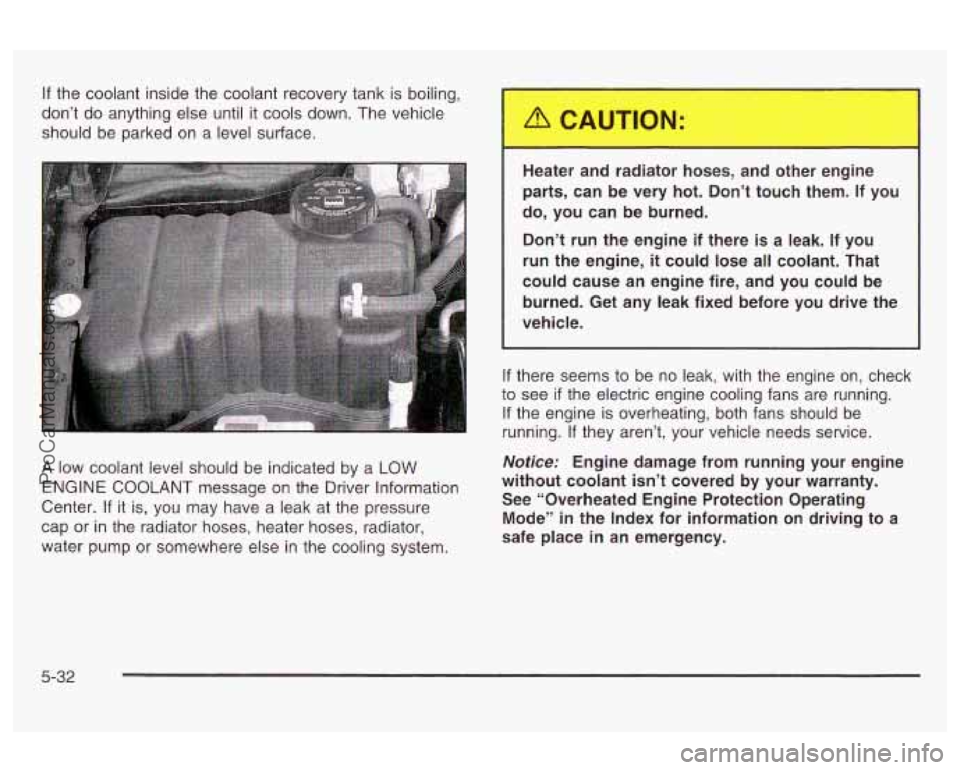
If the coolant inside the coolant recovery tank is boiling,
don’t do anything else until it cools down. The vehicle
should be parked on a level surface.
A low coolant level should be indicated by a LOW
ENGINE COOLANT message on the Driver Information
Center.
If it is, you may have a leak at the pressure
cap or
in the radiator hoses, heater hoses, radiator,
water pump or somewhere else in the cooling system. Heater
and radiator hoses, and other engine
parts, can be very hot. Don’t touch them.
If you
do, you can be burned.
Don’t run the engine if there is a leak. If you
run the engine,
it could lose all coolant. That
could cause an engine fire, and you could be
burned. Get any leak fixed before you drive the
vehicle.
If there seems to be no leak, with the engine on, check
to see
if the electric engine cooling fans are running.
If the engine is overheating, both fans should be
running.
If they aren’t, your vehicle needs service.
Notice: Engine damage from running your engine
without coolant isn’t covered by your warranty.
See “Overheated Engine Protection Operating
Mode’’ in the Index for information on driving to a
safe place
in an emergency.
5-32
ProCarManuals.com
Page 333 of 387

Capacities and Specifications
The following approximate capacities are given in
English and metric conversions. Please refer to Part
D:
Recommended Fluids and Lubricants on page 6- 15
for more information.
Capacities
I I Capacities
Application Metric
English
I Automatic Transaxle I 11 quarts I 10.4 L
I Engine Cooling System 13.0 quarts 12.3 L
Engine Oil with Filter
All capacities are approximate. When adding, be sure to fill to the appropriate level, as recommended in this
140
N*m 100 Ib-ft
Wheel Nut Torque
1.0 kg
2.2 Ibs
Air Conditioning Refrigerant R134a
70.0 L 18.5 gallons
Fuel
Tank 6.7 L
7.0 quarts
manual.
Engine Specifications
Engine Firing Order
Spark Plug Gap
Transmission
Vin Code
~ ~___~~____~~
va (~47) 1-2-7-3-4-5-6-8 0.050 inch
(1.27 mm)
Automatic
C
5-1
00
ProCarManuals.com
Page 337 of 387

Maintenance Schedule
Introduction
IMPORTANT:
KEEP ENGINE OIL
AT THE PROPER
LEVEL AND CHANGE AS'.
RECOMMENDED
.
Have you purchased the GM Protection Plan? The Plan
supplements your new vehicle warranties. See your
Warranty and Owner Assistance booklet or your dealer
for details.
Your Vehicle and the Environment
Proper vehicle maintenance not only helps to keep your
vehicle in good working condition, but also helps the
environment.
All recommended maintenance procedures
are important. Improper vehicle maintenance can
even affect the quality of the air we breathe. Improper
fluid levels or the wrong tire inflation can increase
the level of emissions from your vehicle.
To help protect
our environment, and to keep your vehicle in good
condition, please maintain your vehicle properly.
Maintenance Requirements
Maintenance intervals, checks, inspections and
recommended fluids and lubricants as prescribed in this
manual are necessary to keep your vehicle in good
working condition. Any damage caused
by failure
to follow recommended maintenance may not be
covered by warranty.
6-2
ProCarManuals.com
Page 340 of 387
Scheduled Maintenance
The services shown in this schedule up to 100,000 miles
(166 000 km) should be repeated after
100,000 miles
(166
000 km) at the same intervals for the life of
this vehicle. The services shown at 150,000 miles
(240 000 km) should be repeated at the same interval
after 150,000 miles
(240 000 km) for the life of this
vehicle.
See
Part 5: Owner Checks and Services on page 6-9
and Part C: Periodic Maintenance Inspections on
page
6- 13.
Footnotes
t The U.S. Environmental Protection Agency or the
California Air Resources Board has determined that the
failure to perform this maintenance item will not nullify
the emission warranty or limit recall liability prior to
the completion of the vehicle
's useful life. We, however,
urge that all recommended maintenance services be
periormea at tne inuicateti intervais anti tne
maintenance be recorded.
@ Whenever the tires are rotated, the Check Tire
Pressure System must be reset.
+A good ti.me to check your brakes is duri.ng tire
rotation. See Brake System Inspection on page 6-14.
Engine Oil Scheduled Maintenance
Change engine oil and filter as indicated by the GM
Oil Life SystemTM (or every 12 months, whichever
occurs first). Reset the system.
Your vehicle has a computer system that lets you know
when to change the engine oil and filter. This is
based on engine revolutions and engine temperature,
and not on mileage. Based on driving conditions,
the mileage at which an oil change will be indicated can
vary considerably. For the oil life system to work
properly, you must reset the system every time the oil is
changed.
When the system has calculated that oil life has been
diminished, it will indicate that an oil change is
necessary. A CHANGE
OIL SOON light will come on.
Change your oil as
soon as possible within the next two
times you stop for fuel.
It is possible that, if you are
driving under the best conditions, the oil life system may
not indicate that an oil change is necessary for over a
year. However, your engine oil and filter must be
must be reset. It is
also important to check your oil
regularly and keep it at the proper level.
If the system is ever reset accidentally, you must
change your oil at
3,000 miles (5 000 km) since your
last oil change. Remember to reset the
oil life system
whenever the oil is changed. See
Engine Oil on
page
5-15 for information on resetting the system.
nh-nnnr-4 qt Inrrrt nnnn q
nqv Qnrl rrt thio t;-m th- rrnrrrtmm WI IUI uyuu UL IUUUL VI lWcI u yuul UI IU UL LI Ilr) tIIIIc, LI Ic, G)yr)LOIl1
6-5
ProCarManuals.com
Page 344 of 387
Part B: Owner Checks and Services
Listed in this part are owner checks and services
which should be performed at the intervals specified to
help ensure the safety, dependability and emission
control performance of your vehicle.
Be sure any necessary repairs are completed at once.
Whenever any fluids or lubricants are added to your
vehicle, make sure they are the proper ones, as shown
in Part
D.
At Each Fuel Fill
It is important for you or a service station attendant to
perform these underhood checks at each fuel fill.
Engine Oil Level Check
Check the engine oil level and add the proper oil if
necessary. See Engine Oil on page 5-15 for further
details.
Engine Coolant Level Check
Check the engine coolant level and add DEX-COOL@
coolant mixture if necessary. See Engine Coolant
on page
5-24 for further details.
Windshield Washer Fluid Level Check
Check the windshield washer fluid level in the windshield
washer tank and add the proper fluid
if necessary.
See
Windshield Washer Fluid on page 5-38 for further
details.
At Least Once a Month
Tire Inflation Check
Make sure tries are inflated to the correct pressures.
Don't forget to check your spare tire. See
Tires on
page
5-60 for further details.
Cassette Tape Player Service
c;eai-l c-&sei;e idPt: Ciearri1-,y S;-,"&j st: du,
every 50 hours of tape play. See Audio Systern(s)
on page
3-59 for further details.
6-9
ProCarManuals.com
Page 366 of 387

Care of
Care of Your
Safety
Belts
........... ... 5-84
Cassette Tape Player
................................... 3-74
CD Player
.................................................. 3-76
Cassette Tape Messages
................................. 3-66
Cassette Tape Player Service
............................. 6-9
CD Changer, Trunk-Mounted
............................ 3-70
Chains, Tires
.................................................. 5-70
Check Engine Light
............................................... 3-39
Tire Pressure System
................................... 5-62
Check Engine Light
......................................... 3-39
Checking Coolant
............................................ 5-26
Checking Engine Oil
........................................ 5-16
Checking Things Under the Hood
...................... 5-12
Checking Your Restraint Systems
...................... 1-55
Chemical Paint Spotting
................................... 5-87
Child Restraints
Child Restraint Systems
............................... 1-34
Infants and Young Children
........................... 1-30
Lower Andlorayes arid Tup Teiilers ior
Children (LATCH System) .......................... 1-40
Older Children
............................................. 1-28
Securing a Child Restraint Designed for the
LATCH System
........................................ 1-42
Securing a Child Restraint
in a Rear Seat
Position
.............................................. 1-42
CDS
.......................................................... 3-75
Child Restraints
(cont.)
Securing a Child Restraint in the Right Front
Seat Position
........................................... 1-44
Top Strap
................................................... 1-38
Top Strap Anchor Location
............................ 1-39
Where to Put the Restraint
........................... 1-37
Cigarette Lighter
............................................. 3-22
Cleaning Inside of Your Vehicle
.................................. 5-82
Outside of Your Vehicle
................................ 5-85
Underbody Maintenance
............................... 5-87
Weatherstrips
.............................................. 5-84
Cleaning Exterior LampdLenses
....................... 5-85
Climate Control System
Automatic
................................................... 3-23
Climate Controls Personalization
.................... 3-29
Outlet Adjustment
........................................ 3-27
Chime
Level Adjustment
.................................. 3-76
Steering Wheel Controls
............................... 3-28
Compact Disc Errors
....................................... 3-72
Compact Disc Messages
.................................. 3-68
Compact Spare Tire
........................................ 5-81
Compass Calibration
....................................... 2-35
Compass Operation
......................................... 2-35
Compass Variance
.......................................... 2-36
Control of a Vehicle
.......................................... 4-5
Convenience Net ............................................ 2-46
3
ProCarManuals.com
Page 368 of 387
Driver Information Center (DIC) ___ ....... 3-45
DIC Vehicle Personalization .......................... 3-52
DIC Warnings and Messages .......... ....... 3-50
At Night ..................................................... 4-16
City ........................................................... 4-21
Defensive ..................................................... 4-2
Drunken ....................................................... 4-2
Freeway ..................................................... 4-22
Hill and Mountain Roads .............................. 4-24
In Rain and on Wet Roads ........................... 4-18
Winter ........................................................ 4-26
Driving On Grades .......................................... 4-42
Driving Through Deep Standing Water ............... 4-20
Driving Through Flowing Water ...................... 4-20
Driving with a Trailer .................................... 4-40
Driving
Driving on Snow or Ice
.................................... 4-28
E
Electrical System
Add-on Equipment
............................... 5-91
Fuses and Circuit Breakers ........................... 5-92
Headlamp Wiring ......................................... 5-91
Power Windows and Other Power Options ...... 5-91
Removing the Rear Seat Cushion .................. 5-95
Windshield Wiper Fuses ............................... 5-91
Emergency Trunk Release Handle ..................... 2-1 6
Emissions Inspection and Maintenance
Programs
................................................... 3-42
Engine
Air Cleaner/Filter
......................................... 5-21
Battery ....................................................... 5-42
Check and Service Engine Soon Light ............ 3-39
Coolant ...................................................... 5-24
Coolant Heater ............................................ 2-25
Coolant Temperature Gage ........................... 3-38
Cooling System Inspection ............................ 6-14
Engine Compartment Overview ...................... 5-14
Exhaust ..................................................... 2-33
Oil ............................................................. 5-15
Overheating ................................................ 5-28
Starting ...................................................... 2-24
Engine Compartment Fuse Block ...................... 5-92
Engine Coolant Level Check .............................. 6-9
Engine Cooling When Trailer Towing .................. 4-43
Engine Oil Additives ........................................ 5-19
Engine Oil Level Check ..................................... 6-9
Engine Oil Scheduled Maintenance ..................... 6-5
Engine Specifications ..................................... 5-1 00
Engiishiivietric ................................................. 3-45
Entry Lighting ................................................. 3-18
Erasing HomeLink@ Buttons .............................. 2-44
Express-Down Window .................................... 2-18
Extender, Safety Belt ....................................... 1-27
Exterior Lamps ............................................... 3-14
Exterior Lighting Battery Saver .......................... 3-17
5
ProCarManuals.com
Page 379 of 387

When to Change Engine Oil
When to Check
.............................................. 5-61
When
to Check and Change ............................ 5-22
When to Check Power Steering Fluid
................ 5-37
When You Are Ready to Leave After Parking on
a Hill
......................................................... 4-43
Where to Put the Restraint
............................... 1-37
Window Lock Out
................................... 2-18, 3-55
Windows
....................................................... 2-1 7
Power ........................................................ 2-18
Windshield and Wiper Blades
........................... 5-86
Windshield Washer
......................................... 3-1 0
Fluid .......................................................... 5-38
(GM Oil Life SystemTM) ................................ 5-19
Why Safety Belts Work
..................................... 1-9 Windshield
Washer Fluid Level Check
................. 6-9
Windshield Wiper
Blade Replacement
.................................. 5-59
Fuses ........................................................ 5-91
Windshield Wipers
............................................ 3-8
Winter Driving
................................................ 4-26
Wiper Blade Check
......................................... 6-10
Wiper-Activated Headlamps
.............................. 3-15
Wood Panels
................................................. 5-84
Your Vehicle and the Environment ....................... 6-2
16
ProCarManuals.com