parking brake OLDSMOBILE AURORA 2003 User Guide
[x] Cancel search | Manufacturer: OLDSMOBILE, Model Year: 2003, Model line: AURORA, Model: OLDSMOBILE AURORA 2003Pages: 387, PDF Size: 18.05 MB
Page 223 of 387

Dolly Towing Loading Your Vehicle
TIRE-LOADING INFORMATION
1 OCCUPANTS VEHICLE CAP. deA
In U
U OT, ADD 28KPA(4PSI)
'S MANUAL FOR MORE INFORMATION
Your vehicle can be towed using a dolly. To tow your
vehicle using a dolly, follow these steps:
1. Put the front wheels on the dolly.
2. Put the vehicle in PARK (P).
3. Set the parking brake and then remove the key.
4. Clamp the steering wheel in a straight-ahead
position.
5. Release the parking brake.
Two labels on your vehicle show how much weight it
may properly carry. The Tire-Loading Information
label found on the rear edge of the driver's door tells
you the proper size, speed rating and recommended
inflation pressures for the tires on your vehicle. It also
gives you important information about the number
of people that can be in your vehicle and the total weight
that you can carry. This weight is called the Vehicle
Capacity Weight and includes the weight of all
occupants, cargo and all nonfactory-installed options.
4-34
ProCarManuals.com
Page 231 of 387

Driving On Grades
Reduce speed and shift to a lower gear before you start
down a long or steep downgrade.
If you don’t shift
down, you might have to use your brakes
so much that
they would get hot and
no longer work well.
r-Irking on Hills
You really should not park your vehicle, with a
trailer attached, on
a hill. If something goes
wrong, your rig could start to move. People
can be injured, and both your vehicle and the
trailer can be damaged. But
if you
ever have to park your rig on a hill, here’s
how to do it:
1. Apply your regular brakes, but don’t shift into
PARK (P) yet.
2. Have someone place chocks under the trailer
wheels.
3. When the wheel chocks are in place, release the
regular brakes until the chocks absorb the load.
4. Reapply the regular brakes. Then apply your
parking brake, and then shift to PARK (P).
5. Release the regular brakes.
4-42
ProCarManuals.com
Page 232 of 387

When You Are Ready to Leave After
Parking on
a Hill
1. Apply your regular brakes and hold the pedal down
while you:
start your engine,
shift into a gear, and
release the parking brake.
2. Let up on the brake pedal.
3. Drive slowly until the trailer is clear of the chocks.
4. Stop and have someone pick up and store the
chocks.
Maintenance When Trailer Towing
Your vehicle will need service more often when you’re
pulling a trailer. See the Maintenance Schedule for more
on this. Things that are especially important in trailer
operation are automatic transaxle fluid (don’t overfill),
engine oil, drive belt, cooling system
and brake system.
Each of these
is covered in this manual, and the
Index will help you find them quickly.
If you’re trailering,
it’s
a good idea to review this information before you
start your trip.
Check periodically to see that all hitch nuts and bolts
are tight.
Engine Cooling When Trailer Towing
Your cooling system may temporarily overheat during
severe operating conditions. See
Engine Overheating on
page
5-28.
4-43
ProCarManuals.com
Page 234 of 387

Section 5 Service and Appearance Care
Service ............................................................ 5-3
Doing Your Own Service Work
........................ -5-4
Adding Equipment to the Outside of Your
Vehicle
...................................................... 5-4
Fuel
................................................................ 5-5
Gasoline Octane
............................................ 5-5
Gasoline Specifications
.................................... 5-5
California Fuel
............................................... 5-6
Additives
......................................... ...... 5-6
Fuels in Foreign Countries
........................... 5-7
Filling Your Tank
........................................ 5-7
Filling a Portable Fuel Container
..... . 5-11
the Hood
.................................................... 5-12
Hood Release
.............................................. 5-13
Engine Compartment Overview
....................... 5-14
Engine Oil
................................................... 5-15
Engine Air Cleaner/Filter
................................ 5-21
P,L!tSrn2.tlC Tr2!ns2x!n !=!!lid ............................. .- E;-33 --
Engine Coolant ............................................. 5-24
Coolant Surge Tank Pressure Cap
.................. 5-28
Engine Overheating
....................................... 5-28
Cooling System
............................................ 5-31
.W indshieid .Washer Fiuid 5-36
Checking Things Under
Power Steering Fluid
..................................... 5-37 ~ ................................
Brakes ........................................................ 5.39
Battery
........................................................ 5.42
Jump Starting
............................................... 5-44
Headlamp Aiming
.............................. ...... 5-50
Bulb Replacement ......................................... -5-54
Halogen Bulbs
............................................. -5-54
Headlamps
................................................. -5-55
Front Turn Signal and Parking Lamps
.......... 5-57
Taillamps, Turn Signal, Stoplamps and
Back-up Lamps
..................................... 5-58
Replacement Bulbs
....................................... 5-58
Windshield Wiper Blade Replacement
.............. 5-59
Tires
.............................................................. 5-60
Inflation
-- Tire Pressure ................................ 5-60
Check Tire Pressure System
.......................... 5-62
Tire Inspection and Rotation
........................... 5-63
When It Is Time for New Tires
....................... 5-65
Buying New Tires
......................................... 5-66
UIIIIUIIII I Ilt: Uudllly uldullly d-UI
Wheel Alignment and Tire Balance .................. 5-68
Wheel Replacement
...................................... 5-68
Tire Chains
................................................. -5-70
If a Tire Goes Flat ........................................ 5-70
Changing a Flat Tire
..................................... 5-71
Compact Spare Tire
5-81
I I.-:+- T. n . ._I.&. . n.-- -I:__ _. re7 ..........................
- ......................................
5- 1
ProCarManuals.com
Page 256 of 387
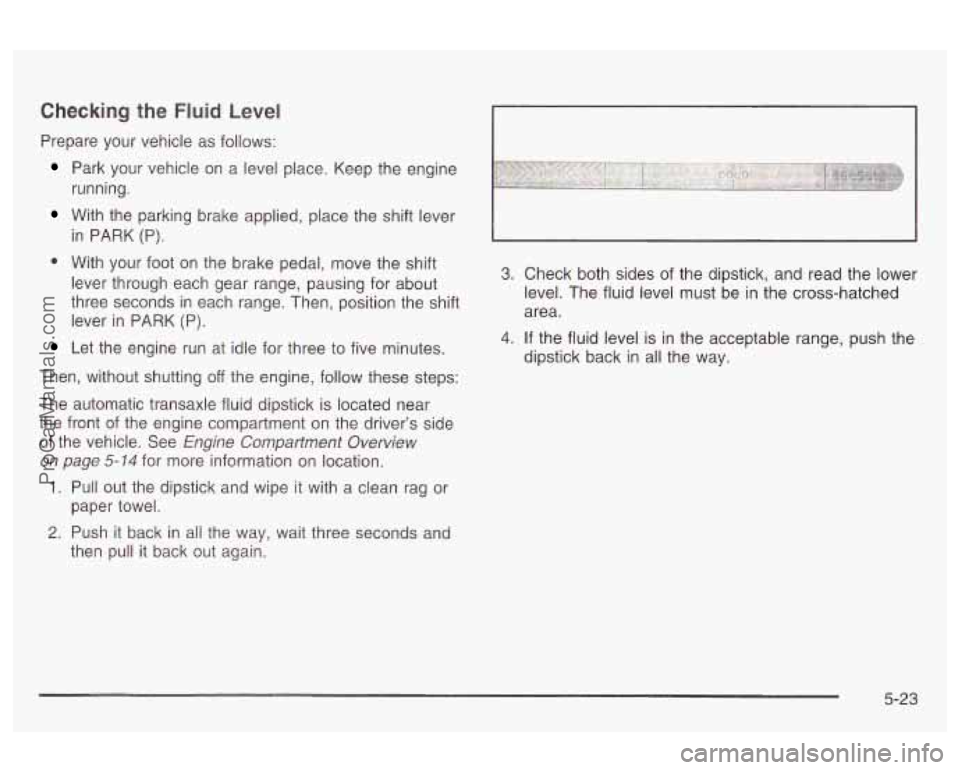
Checking the Fluid Level
Prepare your vehicle as follows:
Park your vehicle on a level place. Keep the engine
running.
With the parking brake applied, place the shift lever
in PARK
(P).
e With your foot on the brake pedal, move the shift
lever through each gear range, pausing for about
three seconds in each range. Then, position the shift
lever in PARK (P).
Let the engine run at idle for three to five minutes.
Then, without shutting
off the engine, follow these steps:
The automatic transaxle fluid dipstick is located near
the front of the engine compartment on the driver’s side
of the vehicle. See
Engine Compartment Overview
on page
5-74 for more information on location.
1. Pull out the dipstick and wipe it with a clean rag or
2. Push it back in all the way, wait three seconds and
paper towel.
then pull
it back out again.
I
3. Check both sides of the dipstick, and read the lower
level. The fluid level must be in the cross-hatched
area.
4. If the fluid level is in the acceptable range, push the
dipstick back
in all the way.
5-23
ProCarManuals.com
Page 277 of 387

Jump Starting
If your battery has run down, you may want to use
another vehicle and some jumper cables to start your
vehicle. Be sure to follow the steps below to
d t safely.
Batteries can hurt you. They can be
d gerous
because:
They contain acid that can burn you.
They contain gas that can explode or
They contain enough electricity to
ignite.
burn you.
1 If you don’t follow these steps exactly, some
~ or all of these things can hurt you.
Notice: Ignoring these steps could result in costly
damage to your vehicle that wouldn’t be covered
by your warranty.
Trying to start your vehicle by pushing or pulling
it
won’t work, and it could damage your vehicle.
1. Check the other vehicle. It must have a 12-volt
battery with a negative ground system.
Notice: If the other system isn’t a 12-volt system
with a negative ground, both vehicles can be
damaged.
2. Get the vehicles close enough so the jumper cables
can reach, but be sure the vehicles aren’t touching
each other.
If they are, it could cause a ground
connection you don’t want.
You wouldn’t be able to
start your vehicle, and the bad grounding could
damage the electrical systems.
To avoid the possibility
of the vehicles rolling, set
the parking brake firmly on both vehicles involved in
the jump start procedure. Put an automatic
transaxle In
PARK (P) or a manual transaxle in
NEUTRAL before setting the parking brake.
Notice: If you leave your radio on, it could be badly
damaged. The repairs wouldn’t be covered by
your warranty.
3. Turn off the ignition on both vehicles. Unplug
unnecessary accessories plugged into the cigarette
lighter or in the accessory power outlet. Turn
off
the radio and all lamps that aren’t needed. This will
avoid sparks and help save both batteries. And it
could save your radio!
5-44
ProCarManuals.com
Page 304 of 387

A rear blowout, particularly on a curve, acts much like a
skid and may require the same correction you’d use
in a skid. In any rear blowout, remove your foot from the
accelerator pedal. Get the vehicle under control by
steering the way
you want the vehicle to go. It may be
very bumpy and noisy, but you can still steer. Gently
brake to a stop
- well off the road if possible.
If a tire goes flat, the next part shows how to use your
jacking equipment
to change a flat tire safely.
Changing a Flat Tire
If a tire goes flat, avoid further tire and wheel damage
by driving slowly to
a level place. Turn on your
hazard warning flashers. Changing a tire can cause an in-
y. The
vehicle can
slip off the jack and roll over you
or other people. You and they could be badly injured. Find a level place to change your tire.
To help prevent the vehicle from moving:
1. Set the parking brake firmly.
2. Put the shift lever in PARK (P).
3. Turn off the engine.
To be even more certain the vehicle won’t move, you can put blocks at the front and
rear of the tire farthest away from the one
being changed. That would be the tire on
the other side of the vehicle, at the
opposite end.
5-7 1
ProCarManuals.com
Page 331 of 387

Fuses 35
36
37
38
Relays 39
40
41
42 43
44 Usage
Anti-lock Brake System (ABS)
Turn SignaVHazard HVAC Battery
Dimmer
Usage Fuel Pump
Parking Lamp
Ignition
1
Rear Fog Lamp
Not Used Park Relays
45
46
47
4%
49
50
51
52
53
54 55 Usage
Reverse
Retained Accessory Power (RAP)
Fuel Tank Door Lock
Not Used
Ignition 3
Fuel Tank Door Release
Interior Lamps
Trunk Release
Front Courtesy Lamps
Not Used Electronic Level Control (ELC)
5-98
ProCarManuals.com
Page 346 of 387

Starter Switch Cher':
When you are doing this check, the vehicle
could move suddenly.
If it does, you or others
could be injured. Follow the steps below.
1. Before you start, be sure you have enough room
around the vehicle.
2. Firmly apply both the parking brake and the regular
brake. See
Parking Brake on page 2-29 if
necessary.
Do not use the accelerator pedal, and be ready to
turn
off the engine immediately if it starts.
3. Try to start the engine in each gear. The starter
should work only in PARK (P) or NEUTRAL (N).
ii ihe siarier works in any oiiler pvsiiivrl, your
vehicle needs service.
Automatic Transaxle Shift Lock Control
!- stem Check
When you are doing this check, the vehicle
could move suddenly.
If it does, you or others
could be injured.
Follow the steps below.
1. Before you start, be sure you have enough room
around the vehicle. It should be parked on a level
surface.
2. Firmly apply the parking brake. See Parking Brake
on
page 2-29 if necessary.
Be ready to apply the regular brake immediately
if
the vehicle begins to move.
but don't start the engine. Without applying the
regular brake, try to move the shift lever out
of PARK (P) with normal effort. If the shift lever
moves out
of PARK (P), your vehicle needs service.
3. With the engine off, turn the key to the ON position,
6-1 1
ProCarManuals.com
Page 347 of 387

Ignition Transaxle Lock Check
While parked, and with the parking brake set, try to turn
the ignition key to OFF in each shift lever position.
The key should turn to OFF only when the shift lever
The key should come out only in OFF.
is in
PARK (P).
Parking Brake and Automatic Transaxle
Park
‘n’ “lech-ism Check
When you are doing this check, your vehicle
could begin to move. You or others could be
injured and property could be damaged. Make
sure there is room in front of your vehicle in
case it begins to roll. Be ready to apply the
regular brake at once should the vehicle begin
to move. Park
on a fairly steep hill, with the vehicle facing
downhill. Keeping your foot on the regular brake, set the
parking brake.
To check the parking brake’s holding ability: With
the engine running and transaxle in NEUTRAL
(N), slowly remove foot pressure from the regular
brake pedal.
Do this until the vehicle is held by the
parking brake only.
ability: With the engine running, shift to PARK (P).
Then release the parking brake followed by the
regular brake.
To check the PARK (P) mechanism’s holding
Underbody Flushing Service
At least every spring, use plain water to flush any
corrosive materials from the underbody. Take care to
clean thoroughly any areas where mud and other debris
can collect.
6-1 2
ProCarManuals.com