parking brake OLDSMOBILE AURORA 2003 Owners Manual
[x] Cancel search | Manufacturer: OLDSMOBILE, Model Year: 2003, Model line: AURORA, Model: OLDSMOBILE AURORA 2003Pages: 387, PDF Size: 18.05 MB
Page 64 of 387
Section 2 Features and Controls
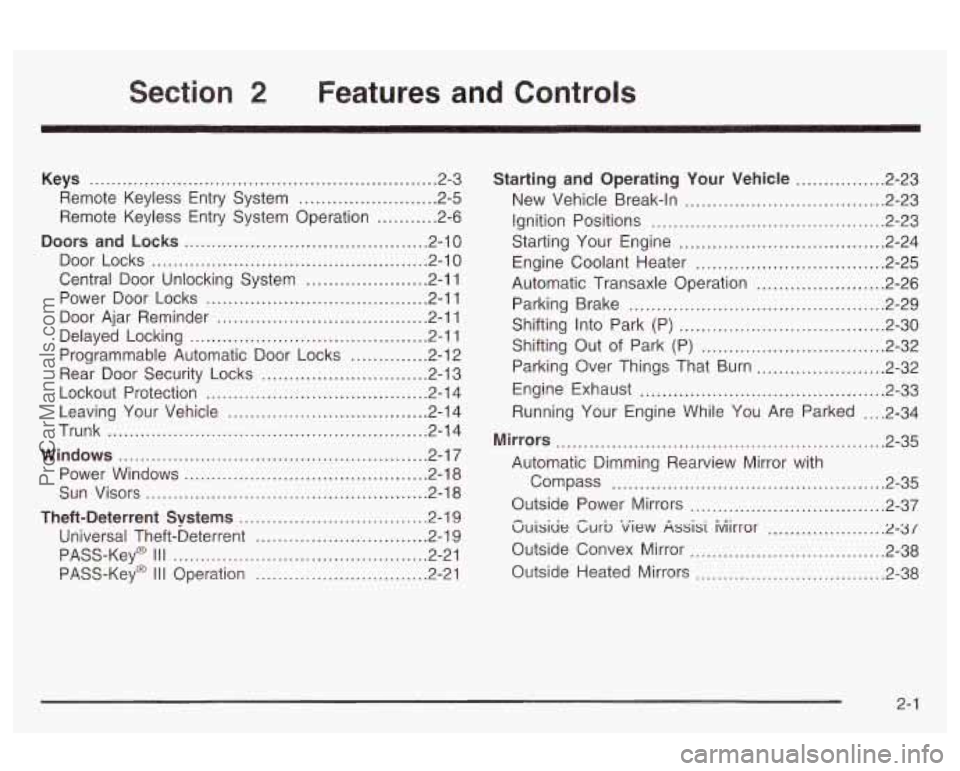
Keys ............................................................... 2-3
Remote Keyless Entry System
......................... 2.5
Remote Keyless Entry System Operation
........... 2.6
Doors and Locks
............................................ 2.10
Door Locks
.................................................. 2-10
Central Door Unlocking System
...................... 2-1 1
Power Door Locks
........................................ 2-1 1
Door Ajar Reminder
...................................... 2-1 1
Delayed Locking
........................................... 2-1 1
Programmable Automatic Door Locks
.............. 2-12
Rear Door Security Locks
.............................. 2-13
Lockout Protection
........................................ 2-14
Leaving Your Vehicle
.................................... 2-14
Trunk
.......................................................... 2-14
Windows
........................................................ 2-17
Power Windows
............................................ 2-18
Sun Visors
................................................... 2-18
Theft-Deterrent Svstems
................................. -2-1 9
Universal Theft-Deterrent
........ ........ 2-19
PASS-Key@
Ill Operation .................... .... 2-21
PASS-Key@
III ............................... .... 2-21 Starting and Operating
Your Vehicle
................ 2.23
New Vehicle Break-In
.................................... 2.23
Ignition Positions
.......................................... 2-23
Starting Your Engine
..................................... 2-24
Engine Coolant Heater
.................................. 2-25
Automatic Transaxle Operation
....................... 2-26
Parking Brake
.............................................. 2-29
Shifting Into Park (P)
..................................... 2-30
Shifting Out of Park (P)
................................. 2-32
Parking Over Things That Burn
....................... 2-32
Engine Exhaust
............................................ 2-33
Running Your Engine While You Are Parked
.... 2-34
Mirrors
.......................................................... -2-35
Automatic Dimming Rearview Mirror with
Compass
................................................. 2-35
Outside Power Mirrors
................................... 2-37
Outside Convex Mirror
................................... 2-38
Outside Heated Mirrors
.................................. 2-38
Guisiue Curb View Assist iviirror ..................... 2-31
2- 1
ProCarManuals.com
Page 89 of 387
How long should you keep the coolant heater plugged
in? The answer depends on the outside temperature, the
kind of oil you have, and some other things. Instead
of trying to list everything here, we ask that you contact
your dealer in the area where you’ll be parking your
vehicle. The dealer can give you the best advice for that
particular area.
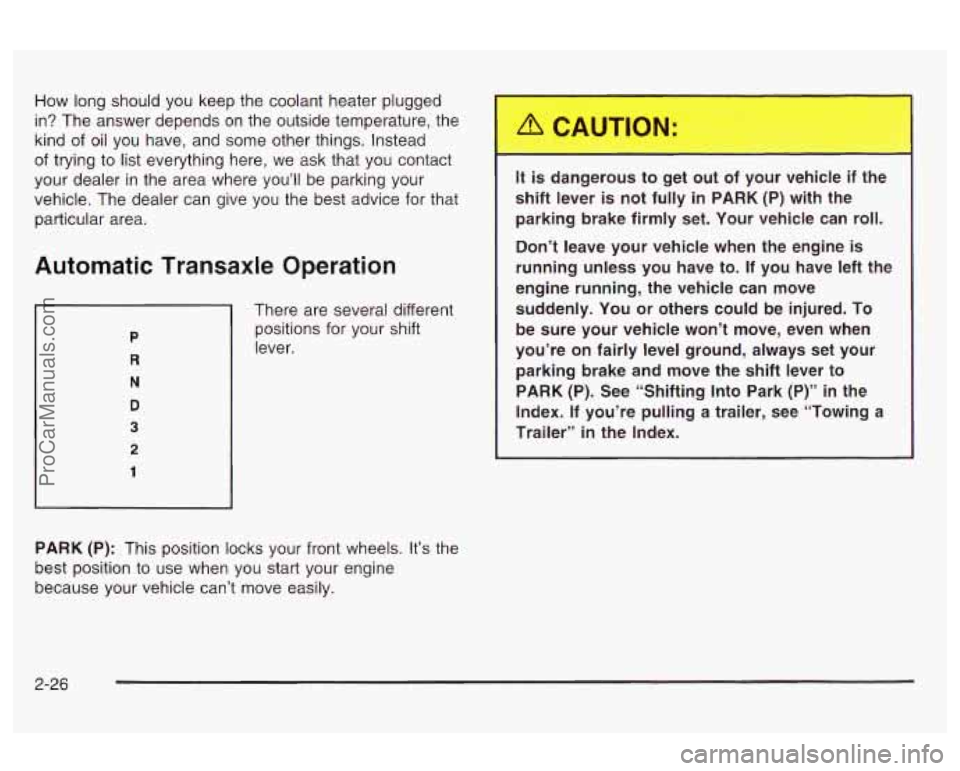
Automatic Transaxle Operation
There are several different
positions for your shift
lever.
__ js dangerous to get 01 of your veh f the
shift lever is not fully in PARK (P) with the
parking brake firmly set. Your vehicle can roll.
Don’t leave your vehicle when the engine
is
running unless you have to. If you have left the
engine running, the vehicle can move suddenly.
You or others could be injured. To
be sure your vehicle won’t move, even when
you’re on fairly level ground, always set your
parking brake and move the shift lever to
PARK (P). See “Shifting Into Park
(P)” in the
Index. If you’re pulling a trailer, see “Towing a
Trailer”
in the Index.
PARK (P): This position locks your front wheels. It’s the
best position to use when
you start your engine
because your vehicle can’t move easily.
2-26
ProCarManuals.com
Page 92 of 387
Parking Brake
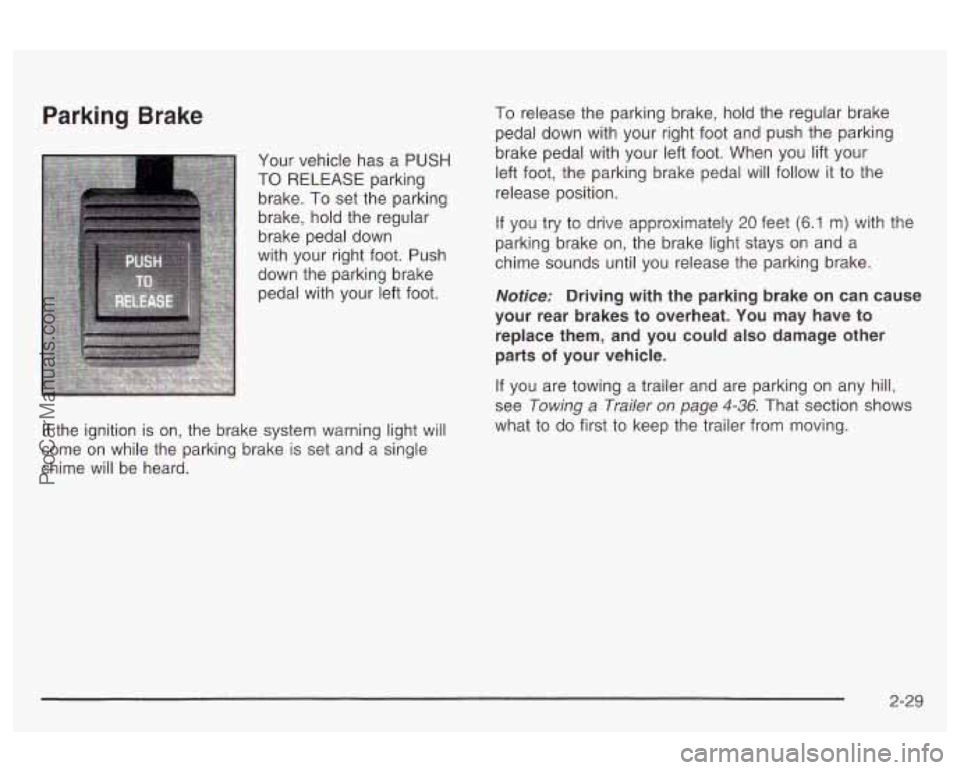
Your vehicle has a PUSH
TO RELEASE parking
brake. To set the parking
brake, hold the regular
brake pedal down
with your right foot. Push
down the parking brake pedal with your left foot.
If the ignition is on, the brake system warning light will
come on while the parking brake is set and a single
chime will be heard.
To release the parking brake, hold the regular brake
pedal down with your right foot and push the parking
brake pedal with your left foot. When you lift your
left foot, the parking brake pedal will follow it to the
release position.
if you try to drive approximately 20 feet (6.1 m> with the
parking brake on, the brake light stays on and a
chime sounds until you release the parking brake.
Notice: Driving with the parking brake on can cause
your rear brakes to overheat. You may have to
replace them, and you could
also damage other
parts
of your vehicle.
If you are towing a trailer and are parking on any hill,
see
Towing a Trailer on page 4-36. That section shows
what to do first to keep the trailer from moving.
2-29
ProCarManuals.com
Page 93 of 387

It can be dangerous to get out of your vehicle
if the shift lever is not fully in
PARK (P) with
the parking brake firmly set. Your vehicle can
roll. If you have left the engine
running, the
vehicle can move suddenly. You or others
could be injured. To be sure your vehicle won’t
move, even when you’re on fairly level ground,
use the steps that follow. If you’re pulling a
trailer, see “Towing a Trailer” in the Index.
1. Hold the brake pedal down with your right foot and
set the parking brake by pushing down the parking
brake pedal with your left foot.
3. Turn the ignition key to OFF.
4. Remove the key and take it with you. If you can
leave your vehicle with the ignition key in your
hand, your vehicle is in
PARK (P).
2. Move the shift lever into PARK (P) by pushing the
lever all the way forward.
2-30
ProCarManuals.com
Page 94 of 387

Leaving Your Vehicle With the Engine
Running
It can be dangerous to leave your vehicle with
the engine running. Your vehicle could move
suddenly if the shift lever is not fully in
PARK (P) with the parking brake firmly set.
And, if you leave the vehicle with the engine
running, it could overheat and even catch fire.
You or others could be injured. Don’t leave
your vehicle with the engine running.
If you have to leave your vehicle with the engine
running, be sure your vehicle is in PARK (P) and your
parking brake is firmly set before you leave it. After
the regular brake pedal down. Then, see
if you can
move the shift lever away from PARK
(P).
)’3L!’\!P mc?‘erl fhP shift !eve!- intc P.A.!?K (P), hn!d
Torque Lock
If you are parking on a hill and you don’t shift your
transaxle into PARK (P) properly, the weight of
the vehicle may put too much force on the parking pawl
in the transaxle. You may find it difficult to pull the
shift lever out
of PARK (P). This is called “torque lock.”
To prevent torque lock, set the parking brake and
then shift into PARK (P) properly before you leave the
driver’s seat. To find out how, see “Shifting Into
PARK (P)” previously in this section.
When you are ready to drive, move the shift lever out of
PARK (P)
before you release the parking brake.
If torque lock does occur, you may need to have another
vehicle push yours a little uphill
to take some of the
pressure from the parking pawl in the transaxle, so you
can pull the shift lever‘out
of PARK (P).
If you can, it means the shift lever wasn’t fully locked
into PARK (P).
2-31
ProCarManuals.com
Page 95 of 387

Shifting Out of Park (P)
Your vehicle has an automatic transaxle shift lock
control system. You have to fully apply your regular
brake before you can shift from PARK (P) when
the ignition is in ON. See
Automatic Transaxle Operation
on page 2-26.
If you cannot shift out of PARK (P), ease pressure on
the shift lever
- push the shift lever all the way into
PARK (P) as you maintain brake application. Then move
the shift lever into the gear you want. If you ever hold
the brake pedal down but still can't shift out of PARK (P),
try the following:
1. Turn the key to the OFF ignition position.
2. Apply and hold the brake until the end of Step 4.
3. Shift to NEUTRAL (N).
4. Start the vehicle and then shift to the drive gear you
want.
Parking Over Things That Burn
5. Take your vehicle to an authorized service center
as soon as you can.
2-32
ProCarManuals.com
Page 97 of 387

Running Your Engine While You
Are Parked
It’s better not to park with the engine running. But if you
ever have
to, here are some things to know.
Idling the engine with the climate control
system
off could allow dangerous exhaust into
your vehicle. See the earlier Caution under
“Engine Exhaust.’’
Also, idling
in a closed-in place can let deadly
carbon monoxide (CO) into your vehicle even
if
the fan is at the highest setting. One place this
can happen
is a garage. Exhaust - with
CO
- can come in easily. NEVER park in a
garage with the engine
running.
Another closed-in place can be a blizzard. See
“Winter Driving” in the Index.
I
It can be dangerous to get out of your vehicle
if the
shift lever is not fully in PARK (P) with
the parking brake firmly set. Your vehicle can
roll. Don’t leave your vehicle when the engine
is running unless you have to.
If you’ve left the
engine running, the vehicle can move suddenly. You or others could be injured.
To
be sure your vehicle won’t move, even when
you’re on fairly level ground, always set your parking brake and move the shift lever to
PARK (P).
Follow the proper steps to be sure your vehicle won’t
move. See Shifting Into Park (P) on page 2-30.
If you are parking on a hill and if you’re pulling a trailer,
also see
Towing a Trailer on page 4-36.
2-34
ProCarManuals.com
Page 116 of 387
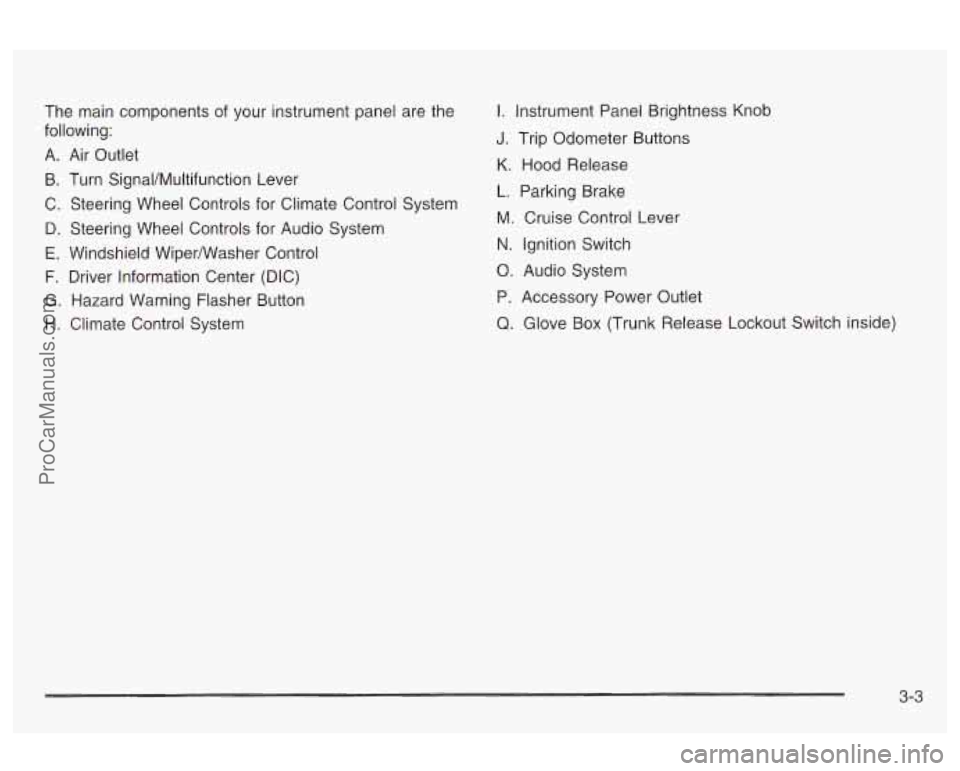
The main components of your instrument panel are the
following:
A. Air Outlet
B. Turn SignaVMultifunction Lever
C. Steering Wheel Controls for Climate Control System
D. Steering Wheel Controls for Audio System
E. Windshield Wiperwasher Control
F. Driver information Center (DIC)
G. Hazard Warning Flasher Button
H. Climate Control System
I. Instrument Panel Brightness Knob
J. Trip Odometer Buttons
K. Hood Release
L. Parking Brake
M. Cruise Control Lever
N. ignition Switch
0. Audio System
P. Accessory Power Outlet
Q. Glove Box (Trunk Release Lockout Switch inside)
3-3
ProCarManuals.com
Page 148 of 387
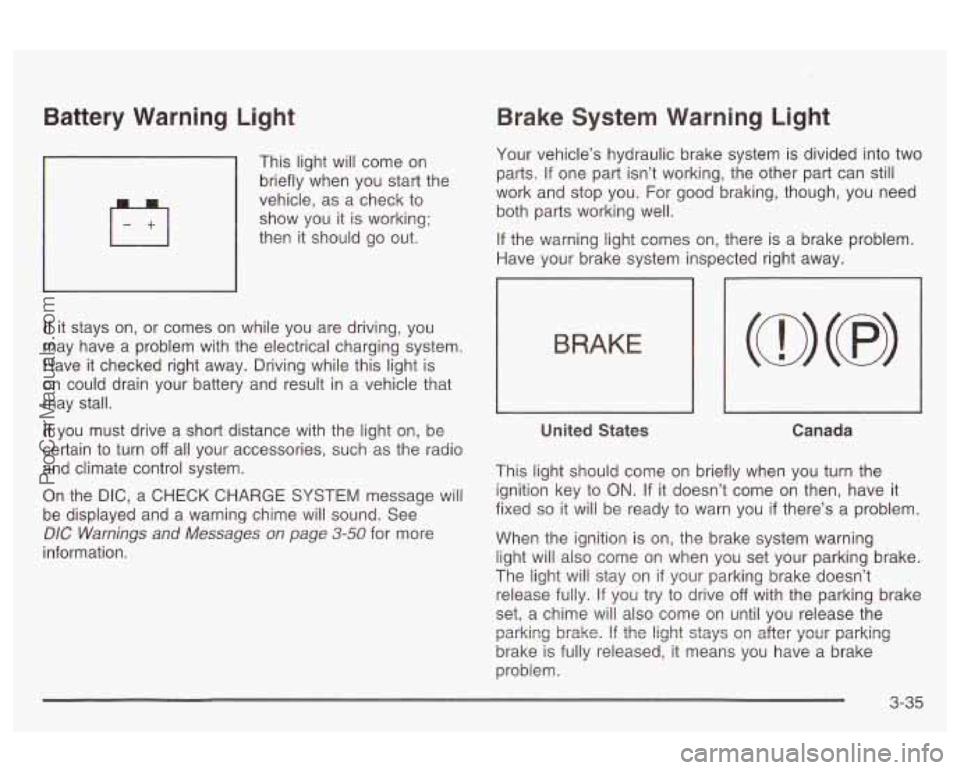
Battery Warning Light
’ This light will come on
briefly when you start the
vehicle, as a check to
show you it
is working;
then it should go out.
If it stays on, or comes on while you are driving, you
may have a problem with the electrical charging system.
Have it checked right away. Driving while this light is
on could drain your battery and result in a vehicle that
may stall.
If you must drive a short distance with the light on, be
certain
to turn off all your accessories, such as the radio
and climate control system.
On the DIC, a CHECK CHARGE SYSTEM message will
be displayed and a warning chime will sound. See
DIC Warnings and Messages on page 3-50 for more
information.
Brake System Warning Light
Your vehicle’s hydraulic brake system is divided into two
parts. If one part isn’t working, the other part can
still
work and stop you. For good braking, though, you need
both parts working well.
If the warning light comes on, there is a brake problem.
Have your brake system inspected right away.
1
BRAKE
United States Canada
This light should come on briefly when you turn the
ignition key to
ON. If it doesn’t come on then, have it
fixed
so it will be ready to warn you if there’s a problem.
When the ignition is on, the brake system warning
light will also come on when you set your parking brake.
The light will stay on
if your parking brake doesn’t
release fully. If you try to drive
off with the parking brake
set, a chime will also come on until you release the
brake is fully released, it means you have a brake
problem. parking
brake. If the light stays Gn after yGu: parking
3-35
ProCarManuals.com
Page 149 of 387
A PARK BRAKE SET message will be displayed on the
Driver Information Center (DIC) while the parking
brake is set and the vehicle is moving. The message
will not come on
if the transaxle is in PARK (P).
If the light comes on while you are driving, pull
off the
road and stop carefully. You may notice that the pedal is
harder
to push. Or, the pedal may go closer to the
floor. It may take longer
to stop. If the light is still on,
have the vehicle towed for service. See
Towing
Your Vehicle
on page 4-33.
Your brake system may not be working
properly
if the brake system warning light is
on. Driving with the brake system warning light
on can lead to an accident.
If the light is still
on after you’ve pulled
off the road and stopped
carefully, have the vehicle towed for service.
Anti-Lock Brake System Warning
Light
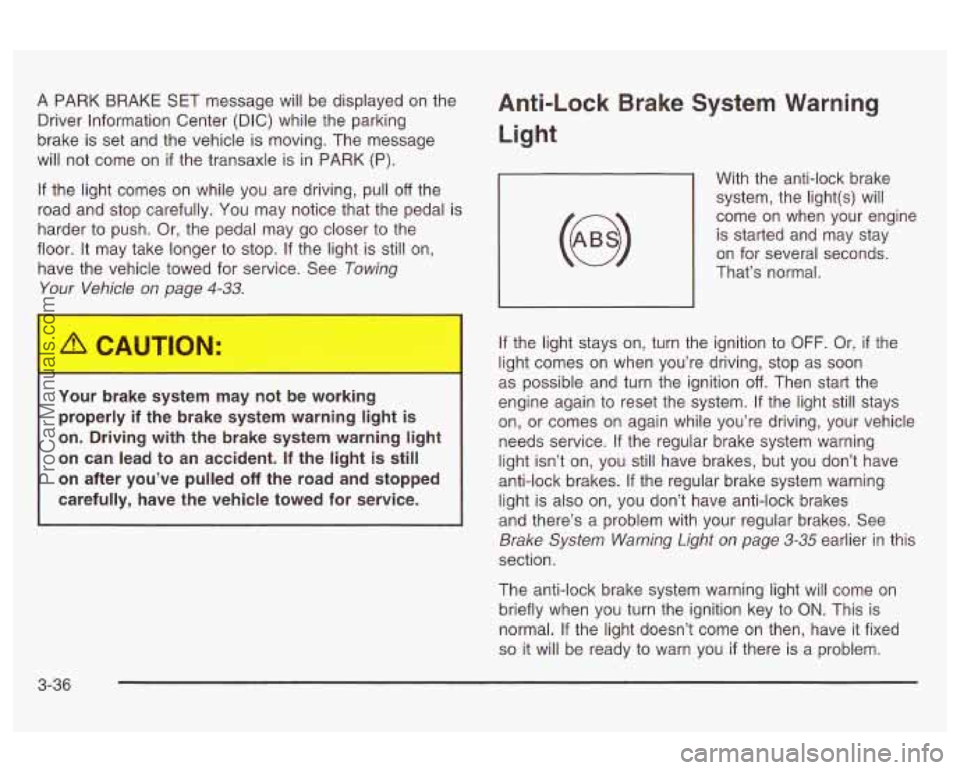
With the anti-lock brake
system, the light(s) will
come on when your engine is started and may stay
on for several seconds.
That’s normal.
If the light stays on, turn the ignition to
OFF. Or, if the
light comes on when you’re driving, stop as soon
as possible and turn the ignition
off. Then start the
engine again to reset the system.
If the light still stays
on, or comes on again while you’re driving, your vehicle
needs service.
If the regular brake system warning
light isn’t on, you still have brakes, but you don’t have
anti-lock brakes.
If the regular brake system warning
light is also on, you don’t have anti-lock brakes
and there’s a problem with your regular brakes. See
Brake System Warning Light on page 3-35 earlier in this
section.
The anti-lock brake system warning light will come on
briefly when you turn the ignition key to
ON. This is
normal.
If the light doesn’t come on then, have it fixed
so it will be ready to warn you if there is a problem.
3-36
ProCarManuals.com