spare wheel OLDSMOBILE AURORA 2003 Owners Manual
[x] Cancel search | Manufacturer: OLDSMOBILE, Model Year: 2003, Model line: AURORA, Model: OLDSMOBILE AURORA 2003Pages: 387, PDF Size: 18.05 MB
Page 234 of 387

Section 5 Service and Appearance Care
Service ............................................................ 5-3
Doing Your Own Service Work
........................ -5-4
Adding Equipment to the Outside of Your
Vehicle
...................................................... 5-4
Fuel
................................................................ 5-5
Gasoline Octane
............................................ 5-5
Gasoline Specifications
.................................... 5-5
California Fuel
............................................... 5-6
Additives
......................................... ...... 5-6
Fuels in Foreign Countries
........................... 5-7
Filling Your Tank
........................................ 5-7
Filling a Portable Fuel Container
..... . 5-11
the Hood
.................................................... 5-12
Hood Release
.............................................. 5-13
Engine Compartment Overview
....................... 5-14
Engine Oil
................................................... 5-15
Engine Air Cleaner/Filter
................................ 5-21
P,L!tSrn2.tlC Tr2!ns2x!n !=!!lid ............................. .- E;-33 --
Engine Coolant ............................................. 5-24
Coolant Surge Tank Pressure Cap
.................. 5-28
Engine Overheating
....................................... 5-28
Cooling System
............................................ 5-31
.W indshieid .Washer Fiuid 5-36
Checking Things Under
Power Steering Fluid
..................................... 5-37 ~ ................................
Brakes ........................................................ 5.39
Battery
........................................................ 5.42
Jump Starting
............................................... 5-44
Headlamp Aiming
.............................. ...... 5-50
Bulb Replacement ......................................... -5-54
Halogen Bulbs
............................................. -5-54
Headlamps
................................................. -5-55
Front Turn Signal and Parking Lamps
.......... 5-57
Taillamps, Turn Signal, Stoplamps and
Back-up Lamps
..................................... 5-58
Replacement Bulbs
....................................... 5-58
Windshield Wiper Blade Replacement
.............. 5-59
Tires
.............................................................. 5-60
Inflation
-- Tire Pressure ................................ 5-60
Check Tire Pressure System
.......................... 5-62
Tire Inspection and Rotation
........................... 5-63
When It Is Time for New Tires
....................... 5-65
Buying New Tires
......................................... 5-66
UIIIIUIIII I Ilt: Uudllly uldullly d-UI
Wheel Alignment and Tire Balance .................. 5-68
Wheel Replacement
...................................... 5-68
Tire Chains
................................................. -5-70
If a Tire Goes Flat ........................................ 5-70
Changing a Flat Tire
..................................... 5-71
Compact Spare Tire
5-81
I I.-:+- T. n . ._I.&. . n.-- -I:__ _. re7 ..........................
- ......................................
5- 1
ProCarManuals.com
Page 297 of 387

Don’t include the compact spare tire in your tire rotation.
After the tires have been rotated, adjust the front and
rear inflation pressures as shown on the Tire-Loading
Information label.
Reset the Check Tire Pressure System. See
Check Tire
Pressure System on page
5-62.
Make certain that all wheel nuts are properly tightened.
See Wheel Nut Torque in
Capacities and Specifications
on page
5- 100.
I 1 Rust or dirt on a wheel, or on the parts to
which
it is fastened, can make wheel nuts
become loose after a time. The wheel could
come
off and cause an accident. When you
change a wheel, remove any rust or dirt from
places where the wheel attaches to the vehicle
In an emergency, you can use a cloth or a
paper towel to do this; but be sure to use a
scraper or wire brush later,
if you need to, to
get all the rust or dirt
off. See “Changing a Flal
Tire” in the Index.
5-64
ProCarManuals.com
Page 299 of 387

Buying New Tires
To find out what kind and size of tires you need, look at
the Tire-Loading Information label.
The tires installed on your vehicle when it was new had
a Tire Performance Criteria Specification (TPC Spec)
number on each tire's sidewall. When you get new tires,
get ones with that same TPC Spec number. That way
your vehicle will continue to have tires that are designed
to give proper endurance, handling, speed rating,
traction, ride and other things during normal service on
your vehicle.
If your tires have an all-season tread
design, the TPC number will be followed by an
"MS" (for
mud and snow).
If you ever replace your tires with those not having a
TPC Spec number, make sure they are the same size,
load range, speed rating and construction type (bias,
bias-belted or radial) as your original tires.
IL....; tires could cause yo^ .o lose control
while driving.
If you mix tires of different sizes
or types (radial and bias-belted tires), the
vehicle may not handle properly, and you
could have a crash. Using tires of different
sizes may also cause damage to your vehicle. Be sure to use the same size and type tires on
all wheels.
It's all right to drive with your
compact spare, though.
It was developed for
use on your vehicle.
If you use bias-ply tires
a lr vehicle, the
wheel rim flanges could develop cracks after
many miles
of driving. A tire and/or wheel
could fail suddenly, causing a crash. Use only
radial-ply tires with the wheels on your vehicle.
I
5-66
ProCarManuals.com
Page 306 of 387

2. Remove the wheel wrench and jack from the jack
3. Remove the compact spare tire from the trunk.
container.
A
The tools you’ll
be using include the jack (A) and wheel
wrench
(B).
Removing the Wheel Covers
insert the hooked end of the wheel wrench in one of the
two small notches in the center cover and pry the
cover
off. Do not drop the cover or lay it face down, as
it could be scratched or damaged.
5-73
ProCarManuals.com
Page 307 of 387

Removing the Flat Tire and Installing
the Spare Tire
1. Position the wheel wrench securely over the wheel
nuts and turn the wrench counterclockwise to
loosen the wheel nuts, but don't remove them.
3. Turn the wheel wrench counterclockwise by hand to
lower the jack head until it fits under the vehicle.
2. Attach the wheel wrench to the bolt on the end of
the jack to create a jack handle.
5-74
ProCarManuals.com
Page 308 of 387
I I
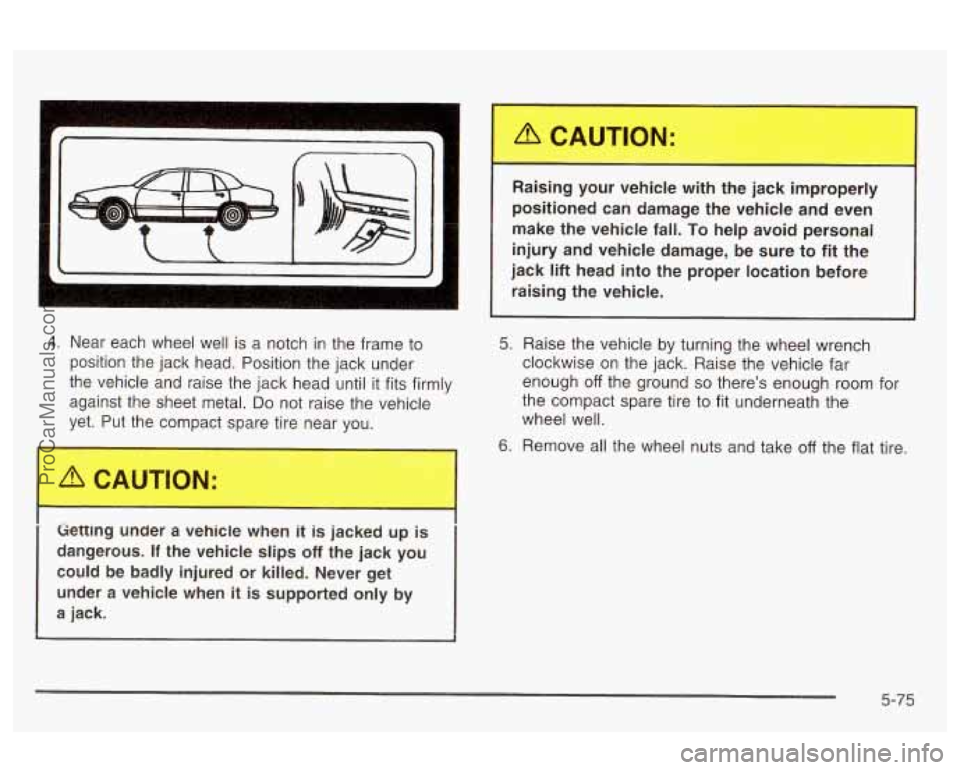
4. Near each wheel well is a notch in the frame to
position the jack head. Position the jack under
the vehicle and raise the jack head until it fits firmly
against the sheet metal.
Do not raise the vehicle
yet. Put the compact spare tire near you.
.
Getting u..-er a vehicle when it is ja,..ed up is
dangerous. If the vehicle slips
off the jack you
could be badly injured or killed. Never get
under
a vehicle when it is supported only by
a jack. Raising
, -ur vehic-- ____ h the jack imk.
Jpe..,
positioned can damage the vehicle and even
make the vehicle fall.
To help avoid personal
injury and vehicle damage, be sure to
fit the
jack
lift head into the proper location before
raising the vehicle.
5. Raise the vehicle by turning the wheel wrench
clockwise on the jack. Raise the vehicle far
enough
off the ground so there’s enough room for
the compact spare tire to fit underneath the
wheel well.
6. Remove all the wheel nuts and take off the flat tire.
5-75
ProCarManuals.com
Page 309 of 387

7. Remove any rust or dirt
from the wheel bolts,
mounting surfaces
and spare wheel.
Rust or dirt on the wheel, or on the parts to
which
it is fastened, can make the wheel nuts
become loose after a time. The wheel could
come
off and cause an accident. When you
change a wheel, remove any rust or
dirt from
the places where the wheel attaches to the vehicle.
In an emergency, you can use a cloth
or a paper towel to do this; but be sure to use
a scraper or wire brush later, if you need to, to
get all the
rust or dirt off.
Never use oil or grease on studs or nuts. If
you do, the nuts might come loose. Your wheel
could fall
off, causing a serious accident.
I I
8. Place the compact spare tire on the wheel-mounting
surface.
5-76
ProCarManuals.com
Page 311 of 387

11. Using the wheel
wrench, tighten the
wheel nuts firmly in a
crisscross sequence as
shown.
Incorrect wheel nuts or improperly tightened
wheel nuts can cause the wheel to come loose
and even come
off. This could lead to an
accident. Be sure to use the correct wheel
nuts. If you have to replace them, be sure to
get new GM original equipment wheel nuts.
Stop somewhere as soon as you can and have
the nuts tightened with a torque wrench to the
proper torque specification. See ”Capacities
and Specifications”
in the Index for wheel nut
torque specification.
Nofice: Improperly tightened wheel nuts can lead
to brake pulsation and rotor damage. To avoid
expensive brake repairs, evenly tighten
the wheel
nuts in the proper sequence and to the proper
torque specification. See “Capacities and
Specifications”
in the index for the wheel nut torque
specification.
12. When the flat tire has been repaired or replaced,
reinstall the wheel cover. Be sure to position the
alignment pin on the cover with the notch in
the wheel. Apply pressure around the edge
of the
cap to snap it in place.
Do not use a hammer
or mallet to reinstall the cover.
Store the wheel cover in the trunk until you have
replaced the compact spare tire with
a regular tire.
Notice: Wheel covers won’t fit on your compact
spare. If you try to put a wheel cover on your
compact spare, you could damage the cover or the
spare.
5-78
ProCarManuals.com
Page 314 of 387

Compact Spare Tire
Although the compact spare tire was fully inflated when
your vehicle was new, it can lose air after a time.
Check the inflation pressure regularly. It should be
60 psi (420 kPa).
After installing the compact spare
on your vehicle, you
should stop as soon as possible and make sure
your spare tire is correctly inflated. The compact spare
is made to perform well at speeds up
to 65 mph
(IO5 km/h) for distances up to 3,000 miles (5 000 km),
so you can finish your trip and have your full-size
tire repaired or replaced where you want. You must
calibrate the Check Tire Pressure System after installing
or removing the compact spare. See
Check Tire
Pressure
System on page 5-62. Of course, it's best to
replace your spare with a full-size tire as soon as
you can. Your spare will last longer and be in good
shape in case you need it again.
Notice: When the compact spare is installed, don't
take your vehicle through an automatic car wash
VYlLlI yu1ue 14113. I IIC LwrlllJdLL SlJ"'t: Gar1 ye1 Cauy~ll
on the rails. That can damage the tire and wheel,
and maybe other parts of your vehicle.
... :&I, -_ .:A - -_:I - TL - - --- __ - -I - __ - __ - - - __ -. - I - . . -. n- I
Don't use your compact spare on other vehicles.
And don't mix your compact spare tire or wheel with
other wheels or tires. They won't fit. Keep your compact
spare tire and its wheel together.
Notice; Tire chains won't fit your compact spare.
Using
them can damage your vehicle and can
damage the chains too. Don't use tire chains on
your compact spare.
5-81
ProCarManuals.com
Page 366 of 387

Care of
Care of Your
Safety
Belts
........... ... 5-84
Cassette Tape Player
................................... 3-74
CD Player
.................................................. 3-76
Cassette Tape Messages
................................. 3-66
Cassette Tape Player Service
............................. 6-9
CD Changer, Trunk-Mounted
............................ 3-70
Chains, Tires
.................................................. 5-70
Check Engine Light
............................................... 3-39
Tire Pressure System
................................... 5-62
Check Engine Light
......................................... 3-39
Checking Coolant
............................................ 5-26
Checking Engine Oil
........................................ 5-16
Checking Things Under the Hood
...................... 5-12
Checking Your Restraint Systems
...................... 1-55
Chemical Paint Spotting
................................... 5-87
Child Restraints
Child Restraint Systems
............................... 1-34
Infants and Young Children
........................... 1-30
Lower Andlorayes arid Tup Teiilers ior
Children (LATCH System) .......................... 1-40
Older Children
............................................. 1-28
Securing a Child Restraint Designed for the
LATCH System
........................................ 1-42
Securing a Child Restraint
in a Rear Seat
Position
.............................................. 1-42
CDS
.......................................................... 3-75
Child Restraints
(cont.)
Securing a Child Restraint in the Right Front
Seat Position
........................................... 1-44
Top Strap
................................................... 1-38
Top Strap Anchor Location
............................ 1-39
Where to Put the Restraint
........................... 1-37
Cigarette Lighter
............................................. 3-22
Cleaning Inside of Your Vehicle
.................................. 5-82
Outside of Your Vehicle
................................ 5-85
Underbody Maintenance
............................... 5-87
Weatherstrips
.............................................. 5-84
Cleaning Exterior LampdLenses
....................... 5-85
Climate Control System
Automatic
................................................... 3-23
Climate Controls Personalization
.................... 3-29
Outlet Adjustment
........................................ 3-27
Chime
Level Adjustment
.................................. 3-76
Steering Wheel Controls
............................... 3-28
Compact Disc Errors
....................................... 3-72
Compact Disc Messages
.................................. 3-68
Compact Spare Tire
........................................ 5-81
Compass Calibration
....................................... 2-35
Compass Operation
......................................... 2-35
Compass Variance
.......................................... 2-36
Control of a Vehicle
.......................................... 4-5
Convenience Net ............................................ 2-46
3
ProCarManuals.com