maintenance OLDSMOBILE BRAVADA 1994 User Guide
[x] Cancel search | Manufacturer: OLDSMOBILE, Model Year: 1994, Model line: BRAVADA, Model: OLDSMOBILE BRAVADA 1994Pages: 248, PDF Size: 14.54 MB
Page 179 of 248

To Check the Fluid Hot or Cold:
Park your vehicle on a level place.
With the parking brake applied, place
With your foot on the brake pedal,
the
shift lever in
P (Park).
move the shift lever through each gear
range, pausing for about three
seconds in each range. Then, position
the shift lever in
P (Park).
minutes or more.
Let the engine run at idle for three Then, Without Shutting off the
Engine, Follow These Steps:
1. Flip the handle up and then pull out
the dipstick and wipe it with a clean
rag or paper towel.
2. Push it back in all the way, wait three
seconds and then pull it back
out
again.
3. Check both sides of the dipstick, and
read the lower level. The fluid level
must be in the
COLD area for a cold
check or in the
HOT area or cross-
hatched area for a hot check.
4. If the fluid level is in the acceptable
range, push the dipstick back in all
the way; then flip the handle down to
lock the dipstick in place.
How to Add FIuid
Refer to the Maintenance Schedule to
determine what kind
of transmission
fluid to use. See
Recommended Fluids
G Lubricants in the index.
If the fluid level is low, add only enough
of the proper fluid to bring the level up
to the COLD area for a cold check or
the HOT area for a hot check. It doesn’t
take much fluid, generally less than a
pint
(OSL) . Don’t overfill. We
recommend you use only fluid labeled
DEXRONB-I11 or DEXRONB-IIE,
because fluids with that label are made
especially for your automatic
transmission. Damage caused by fluid
other than DEXRONB-I11 or
DEXRONB-IIE is not covered by your
new vehicle warranty.
I 73
ProCarManuals.com
Page 180 of 248

Service & Appearance Care
I
1 74
After adding fluid, recheck the fluid
level as described under
How to
Check.
obtained, push the dipstick back in all
the way.
When the correct fluid level is
I Rear Axle
When to Check and Change
Lubricant
Refer to the Maintenance Schedule to
determine how often to check the
lubricant and when to change it. See
Scheduled Maintenance Services in
the
Index.
How to Check Lubricant
If the level is below the bottom of the
filler plug hole, you’ll need to add some
lubricant. Add enough lubricant to
raise the level to the bottom of the filler
plug hole.
What to Use
Refer to the Maintenance Schedule to
determine what kind of lubricant to use.
See
Recommended Fluids E. Lubricants
in the Index.
I All-Wheel Drive
Transfer Case
When to Check Lubricant
Refer to the Maintenance Schedule to
determine how often to check the
lubricant. See
Periodic Maintenance
Inspections
in the Index.
How to Check Lubricant
If the level is below the bottom of the
filler plug hole, you’ll need to add some
lubricant. Add enough lubricant to
raise the level to the bottom of the filler
plug hole.
What to Use
Refer to the Maintenance Schedule to
determine what kind of lubricant to use.
See
Recommended Fluids G Lubricants
in the Index.
Front Axle
When to Check and Change
Lubricant
Refer to the Maintenance Schedule to
determine how often to check the
lubricant and when to change it. See
Scheduled Maintenance Services in the
Index.
How to Check Lubricant
If the level is below the bottom of the
filler plug hole, you’ll need to add some
lubricant. Add enough lubricant to raise
the level to the bottom of the filler plug
hole.
What to Use
Refer to the Maintenance Schedule to
determine what kind of lubricant to use.
See
Recommended Fluids G Lubricants
in the Index.
I Engine Coolant
The following explains your cooling
system and how to add coolant when it
is low. If you have a problem with
engine overheating, see
Engine
Overheating
in the Index.
The proper coolant for your Oldsmobile
will:
Give freezing protection down to
Give boiling protection up to 258°F
Protect against rust and corrosion.
Help keep the proper engine
-34°F (-37°C).
(125°C).
temperature.
I
ProCarManuals.com
Page 183 of 248
What to Add
Refer to the Maintenance Schedule to
determine what kind of fluid to use. See
Recommended Fluids G Lubricants in
the
Index.
NOTICE:
When adding power steering fluid
or malting a complete fluid change,
always use the proper fluid. Failure
to use the proper fluid can cause
leaks and damage hoses and seals.
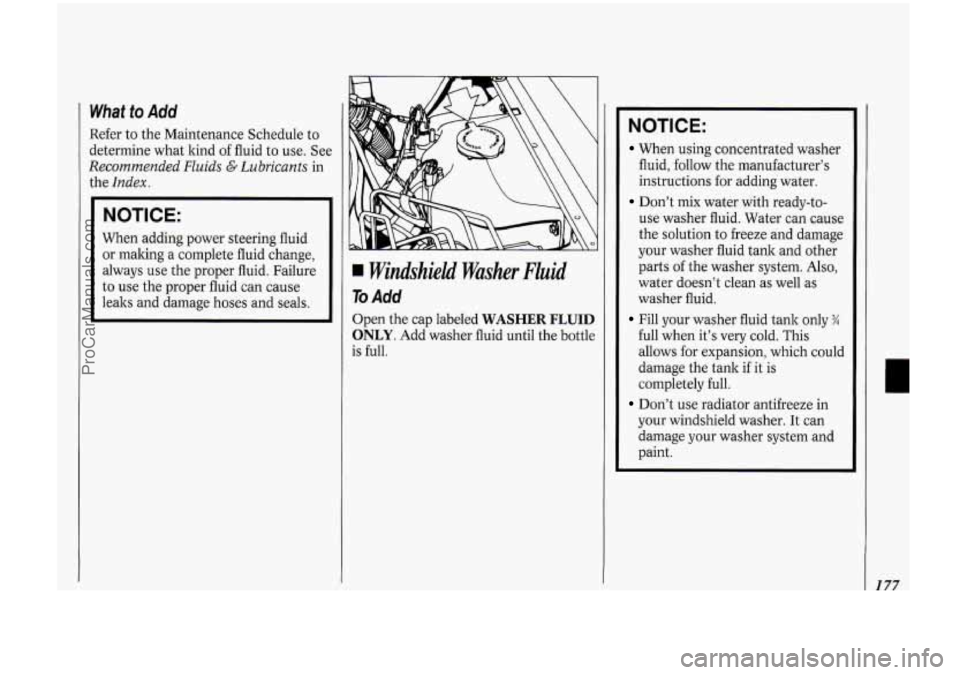
Windshield Washer Fluid
To Add
Open the cap labeled WASHER FLUID
ONLY. Add washer fluid until the bottle
is full.
NOTICE:
When using concentrated washer
fluid, follow the manufacturer’s
instructions for adding water.
Don’t mix water with ready-to-
use washer fluid. Water can cause
the solution to freeze and damage
your washer fluid tank and other
parts of the washer system. Also,
water doesn’t clean as well as
washer fluid.
Fill your washer fluid tank only %
full when it’s very cold. This
allows for expansion, which could
damage the tank if it is
completely full.
Don’t use radiator antifreeze in
your windshield washer. It can
damage your washer system and
paint.
n
I77
ProCarManuals.com
Page 184 of 248

Service & Appearance Care
1 78
~-
Brakes
Brake Master Cylinder
Your brake master cylinder is here. It is
filled with DOT-3 brake fluid.
There are only two reasons why the
brake fluid level in your master cylinder
might go down. The first is that the
brake fluid goes down to an acceptable
level during normal brake lining wear.
When new linings are put in, the fluid
level goes back
up. The other reason is
that fluid is leaking
out of the brake
system.
If it is, you should have your
brake system fixed, since a leak means
that sooner or later your brakes won’t
work well, or won’t work at all.
So, it
isn’t a good idea to “top
off’ your brake
fluid. Adding brake fluid won’t correct a leak.
If you add fluid when your linings
are worn, then you’ll have too much
fluid when you get new brake linings.
You should add (or remove) brake
fluid, as necessary, only when work is
done on the brake hydraulic system.
Refer to the Maintenance Schedule to
determine when to check your brake
fluid. See
Periodic Maintenance
Inspections
in the Index.
To Check Brake Fluid
You can check the brake fluid without
taking
off the cap. Just look at the
windows on the brake fluid reservoir.
The fluid levels should be above
MIN. If
they aren’t, have your brake system
checked to see
if there is a leak.
After work is done on the brake
hydraulic system, make sure the levels
are above
MIN and below the top of
each window.
What to Add
When you do need brake fluid, use only
DOT-3 brake fluid
- such as Delco
Supreme
11s (GM Part No.1052535).
Use new brake fluid from a sealed
container only, and always clean the
brake fluid reservoir cap before
removing it.
ProCarManuals.com
Page 191 of 248

Accelerator Control System
Your Maintenance Schedule will tell
you how often the accelerator linkage
pivot points must be lubricated and
what type of lubricant to use.
Accelerator cables and cruise control
cables should not be lubricated. Any
cables that are worn or are hard to pull
should be replaced.
Hood Latches and Hood
Hinge
Your Maintenance Schedule will tell
you how to lubricate the hood latch and
hood hinge assembly.
Lock Cylinders
To be sure your locks operate properly,
they must be lubricated. Your
Maintenance Schedule will tell you how
often to lubricate them and what type of
lubricant to use.
You should not use penetrating oils
because they could wash out the factory
installed lubricant and cause the lock to
bind. De-icers which contain alcohol could
also wash away the lubricant,
so
be sure to lubricate the lock after using
a de-icer of this type.
Tailgate-Mounted Spare Tire
Carrier
The spare tire carrier must be lubricated
to keep it operating smoothly. Your
Maintenance Schedule
will tell you
what type of lubricant to use.
Tires
We don’t make tires. Your new vehicle
comes with high quality tires made by a
leading tire manufacturer. These tires
are warranted by the tire manufacturers
and their warranties are delivered with
every new Oldsmobile. If your spare tire
is a different brand than your road tires,
you will have a tire warranty folder from
each of these manufacturers.
185
ProCarManuals.com
Page 193 of 248

rire Inspection and Rotation
To make your tires last longer, have
:hem inspected and rotated at the
nileages recommended in the
Maintenance Schedule.
See Scheduled
Maintenance Services
in the Index.
Use this rotation pattern.
[f your vehicle has front tires with
iifferent load ratings or tread designs
(such as all season vs.
on/off road) than
the rear tires, don’t rotate your tires
kont to rear.
Mer the tires have been rotated, adjust
;he front and rear inflation pressure as
shown on the Certificatioflire label.
Make certain that all wheel nuts are
?roperly tightened. See
Wheel Nut
l’orque in the Index.
TREAD WEAR INDICATORS
When It’s Time for New Tires
3ne way to tell when it’s time for new
:ires is to check the treadwear
.ndicators, which will appear when your
tires have only
2/32 inch (1.6 mm) or
less
of tread remaining.
You need a new tire if
You can see the indicators at three or
more places around the tire.
You can see cord or fabric showing
through the tire’s rubber.
The tread or sidewall is cracked, cut
or snagged deep enough to show cord
or fabric.
The tire has a bump, bulge or split.
I87
ProCarManuals.com
Page 200 of 248
Sewice & Appearance Care
194
Aluminum Wheels
Your aluminum wheels have a
protective coating similar to the painted
surface of your truck. Don’t use strong
soaps, chemicals, chrome polish,
abrasive cleaners or abrasive cleaning
brushes on them because you could
damage this coating. After rinsing
thoroughly, a wax may be applied.
NOTICE:
Don’t use an automatic vehicle
wash that has hard silicon carbide
cleaning brushes. These brushes
can take off the protective coating.
1 Weatherstrips
Silicone grease on weatherstrips will
make them last longer, seal better, and
not stick or squeak. Apply silicone
grease with
a clean cloth at least every
six months. During very cold, damp
weather more frequent application may
be required. (See
Recommended Fluids
G Lubricants in the Index.)
Sheet Metal Damage
If your vehicle is damaged and requires
sheet metal repair or replacement,
make sure the body repair shop applies
anti-corrosion material to the parts
repaired or replaced to restore
corrosion protection.
Foreign Material
Calcium chloride and other salts, ice
melting agents, road oil and tar, tree sap,
bird droppings, chemicals
from
industrial chimneys, and other foreign
matter can damage your vehicle’s finish
if they remain on painted surfaces. Use
cleaners that are marked safe for painted
surfaces to remove foreign matter.
Finish Damage
Any stone chips, fractures or deep
scratches in the finish should be
repaired right away. Bare metal will
corrode quickly and may develop into a
major repair expense.
Minor chips and scratches can be
repaired with touch-up materials available from your dealer or
other
service outlets. Larger areas of finish
damage can be corrected in your
dealer’s body and paint shop.
Underbody Maintenance
Chemicals used for ice and snow
removal and dust control can collect on
the underbody.
If these are not
removed, accelerated corrosion (rust)
can occur on the underbody parts such
as fuel lines, frame, floor pan, and
exhaust system even though they have
corrosion protection.
At least every spring, flush these
materials from the underbody with plain
water. Clean any areas where mud and
other debris can collect. Dirt packed in
closed areas of the frame should be
loosened before being flushed. Your
dealer or an underbody vehicle washing
system can do this for you.
Chemical Paint Spotting
Some weather and atmospheric
conditions can create a chemical fallout.
Airborne pollutants can fall upon and
attack painted surfaces on your vehicle.
This damage can take two forms:
ProCarManuals.com
Page 206 of 248

Service & Appearance Care
200
Engine Specifications
4.3L V6 Engine
VIN Engine Code ................................................................. W
Type ........................................................................\
.............. V6
Displacement
....................................................................... \
4.3 Liters
Compression Ratio
............................................................... 9.1 : 1
Firing Order ........................................................................\
. 1-6-5-4-3-2
Thermostat Temperature Specification
............................... 195°F (91OC)
Normal Maintenance Replacement Parts
Air Cleaner Element .................................................................. AC Type A1 163C
Engine Oil Filter
........................................................................\
AC Type PF-51
Fuel Filter
........................................................................\
.......... GF481
PCV Valve
........................................................................\
......... AC Type CV-892C
Spark Plugs
........................................................................\
........ AC Type oCR43TSM
Gap: 0.045 inch (1.14
rnm)
ProCarManuals.com
Page 209 of 248

This part covers the maintenance
required for
your Oldsmobile. Your
vehicle needs these services to retain
its safety, dependability and emission
control performance.
r
Have you purchased the
GM Protection Plan?
The Plan supplements your new vehicle warranties.
See your Oldsmobile dealer for details.
Part 7
Maintenance Schedule
Section
Introduction
A Word About Maintenance ................................................................... 204
Your Vehicle and the Environment
........................................................ 204
How This Part is Organized ................................................................... 204
Using
Your Maintenance Schedules ....................................................... 205
Selecting the Right Schedule
.................................................................. 205
Schedule
........................................................................\
......................... 206
Schedule
I1 ........................................................................\
....................... 208
Explanation
of Scheduled Maintenance Services . ...... . . . .... . . .. .. .. . ... . . . .. .. . 210
At Each Fuel
........................................................................\
.................. 212
At Least Once a Month
........................................................................\
... 2i2
A. Scheduled Maintenance Services
B. Owner Checks & Services
At Least Once a Ye ........................................................................\
........ 213
C. Periodic Maintenance Inspections ............................................................. 215
D. Recommended Fluids & Lubricants.. . . .. . . . . ... . .. .. . . .. .. .. . . . .. . . .. .... .. . ... . . . ... . ... ... 21 7
E. Maintenance Record ........................................................................\
............ 219 203
ProCarManuals.com
Page 210 of 248
Maintenance Schedule
I
j i
204
Introduction
A Word About Maintenance
We at General Motors want to help you
keep your vehicle in good working
condition. But we don’t laow exactly
how you’ll drive it. You may drive very
short distances only a few times a week.
Or you may drive long distances all the
time in very hot, dusty weather.
You
may use your vehicle in making
deliveries. Or you may drive it to work,
to do errands or in many other ways.
Because
of all the different ways people
use their GM vehicles, maintenance
needs vary. You may even need more
frequent checks and replacements than
you will find
in the schedules in this
part.
So please read this part and note
how you drive. If you have any
questions on how to keep your vehicle
in good condition, see your Oldsmobile
dealer, the place many GM owners
choose to have their maintenance work
done. Your dealer can be relied upon to
use proper parts and practices.
Your Vehicle and the Environmen
Proper vehicle maintenance not only
helps to keep your vehicle in good
working condition, but also helps the
environment. All recommended
maintenance procedures are important.
Improper vehicle maintenance or the
removal of important components can
significantly affect the quality of the air
we breathe. Improper fluid levels or
even the
wrong tire inflation can
increase the level
of emissions from
your vehicle.
To help protect our
environment, and to help keep your
vehicle in good condition, please
maintain your vehicle properly.
How This Part is Organized
The remainder of this part is divided
into five sections:
“Section A: Scheduled Maintenance
Services” shows what to have done and
how often. Some of these services can
be complex,
so unless you are
technically qualified and have the
necessary equipment, you should let
your dealer’s service department or
another qualified service center
do
these jobs. If
you are skulled enough to do some
work on your vehicle, you will probably
want
to get the service information GM
publishes. You will find a list of
publications and how to get them in
this manual. See
Service Publications
in the Index.
“Section B: Owner Checks and
Services” tells you what should be
checked whenever you stop for fuel. It
also explains what you can easily do to
help keep your vehicle in good
condition.
ProCarManuals.com