lights OLDSMOBILE BRAVADA 1994 Owner's Manual
[x] Cancel search | Manufacturer: OLDSMOBILE, Model Year: 1994, Model line: BRAVADA, Model: OLDSMOBILE BRAVADA 1994Pages: 248, PDF Size: 14.54 MB
Page 132 of 248
Your Driving and the Road
126
Hydroplaning
Hydroplaning is dangerous. So much
water can build up under your tires that
they can actually ride on the water. This
can happen
if the road is wet enough
and you’re going fast enough. When
your vehicle is hydroplaning, it has little
or no contact with the road.
Hydroplaning doesn’t happen often.
But it can
if your tires haven’t much
tread or
if the pressure in one or more is
low. It can happen
if a lot of water is
standing on the road.
If you can see
reflections
horn trees, telephone poles,
or other vehicles, and raindrops
“dimple” the water’s surface, there
could be hydroplaning.
Hydroplaning usually happens at higher
speeds. There just isn’t a hard and fast
rule about hydroplaning. The best advice
is to
slow down when it is raining.
Some Other Rainy Weather Tips
Turn on your low-beam headlights -
not just your parking lights - to help
make you more visible to others.
Besides slowing down, allow some
extra following distance. And be
especially careful when you pass
another vehicle. Allow yourself more
clear room ahead, and be prepared to
have your view restricted by road
spray.
Have good tires with proper tread
depth. (See
Tires in the Index.)
A , ”
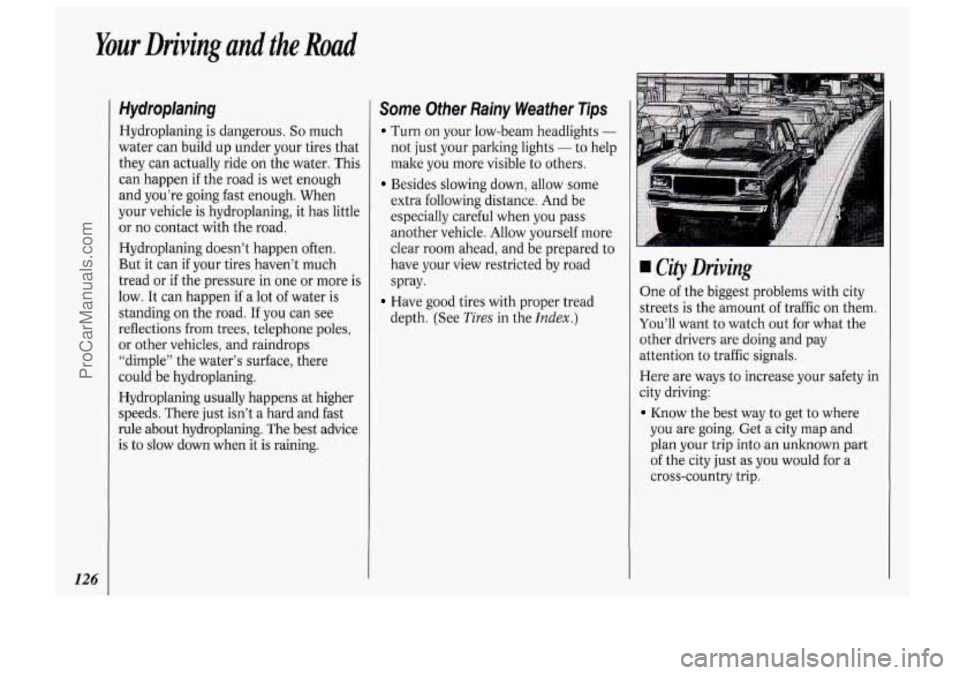
I City Driving
One of the biggest problems with city
streets is the amount
of traffic on them.
You’ll want
to watch out for what the
other drivers are doing and pay
attention to traffic signals.
Here are ways to increase your safety in
city driving:
Know the best way to get to where
you are going. Get a city map and
plan your trip into an unknown part
of the city just as you would for a
cross-country trip.
ProCarManuals.com
Page 134 of 248
Your Driving und the Road
128
The exit ramp can be curved, sometimes
quite sharply.
The exit speed is usually posted.
Reduce your speed according to your
speedometer, not to your sense of
motion. After driving for any distance at
higher speeds, you may tend to think you
are going slower than you actually are.
I Before Leaving on a Long
Tip
Make sure you’re ready. Try to be well
rested. If
you must start when you’re
not fresh
- such as after a day’s work
- don’t plan to make too many miles
that first part of the journey. Wear
comfortable clothing and shoes you can
easily drive in.
Is your vehicle ready for a long trip? If
you keep it serviced and maintained, it’s
ready to go.
If it needs service, have it
done before starting out.
Of course,
you’ll find experienced and able service
experts in Oldsmobile dealerships all
across North America. They’ll be ready
and willing to help if you need it.
Here are some things you can check
before a trip:
Windshield Washer Fluid Is the
reservoir full? Are all windows clean
inside and outside?
shape?
you checked all levels?
Wiper Blades: Are they in good
Fuel, Engine Oil, Other Fluids: Have
Lights: Are they all working? Are the
lenses clean?
Tires: They are vitally important to a
safe, trouble-free trip. Is the tread
good enough for long-distance
driving? Are the tires all inflated to
the recommended pressure?
Weather Forecasts: What’s the
weather outlook along your route?
Should you delay your trip a short
time to avoid a major storm system?
Maps: Do you have up-to-date maps?
Highway Hypnosis
Is there actually such a condition as
“highway hypnosis”? Or is it just plain
falling asleep at the wheel? Call it
highway hypnosis, lack
of awareness, or
whatever.
There is something about an easy
stretch of road with the same scenery, along
with the hum of the tires on the
road, the drone of the engine, and the
rush of the wind against the vehicle that
can make you sleepy. Don’t let it
happen
to you! If it does, your vehicle
can leave the road in
less than a
second, and you could crash and be
injured.
What can you do about highway
hypnosis? First, be aware that it can
happen.
Then here are some tips:
Make sure your vehicle is well
ventilated, with a comfortably cool
interior.
Keep your eyes moving. Scan the road
ahead and to the sides. Check your
mirrors and your instruments
frequently.
If you get sleepy, pull off the road into
a rest, service, or parking area and
take a nap, get some exercise, or both.
For safety, treat drowsiness on the
highway as an emergency.
ProCarManuals.com
Page 137 of 248

If You’re Caught in a Blizzard
If you are stopped by heavy snow, you
could be in a serious situation.
You
should probably stay with your vehicle
unless you know for sure that you are
near help and you can hike through the
snow. Here are some things to do to
su~nmon help and keep yourself and
your passengers safe: Turn on your
hazard flashers. Tie a red cloth to your
vehicle to alert police that you’ve been
stopped by the snow. Put on extra
clothing or wrap a blanket around you.
If
you have no blankets or extra clothing,
make body insulators from newspapers,
burlap bags, rags, floor mats
- anything
you can wrap around yourself or tuck
under
your clothing to keep warm.
You can run the engine to keep warm,
but be careful.
~ .--- . . .. . . .. ~ ~ ~, L
Run your engine only as long as you
must. This saves fuel. When
you run the
engine, make
it go a little faster than just
idle. That is, push the accelerator
slightly. This uses less fuel for the heat
that you get and it keeps the battery
charged.
You will need a well-charged
battery to restart the vehicle, and
possibly for signaling later on with your
headlights. Let the heater run for awhile.
Then, shut the engine
off and close the
window almost all the way to preserve
the heat. Start the engine again and
repeat this only when you feel really
uncomfortable from the cold.
But do it
as little as possible. Preserve the fuel as
long as you can. To help keep warm,
you can get out of the vehicle and do
some fairly vigorous exercises every half
hour or
so until help comes.
3
131
ProCarManuals.com
Page 141 of 248
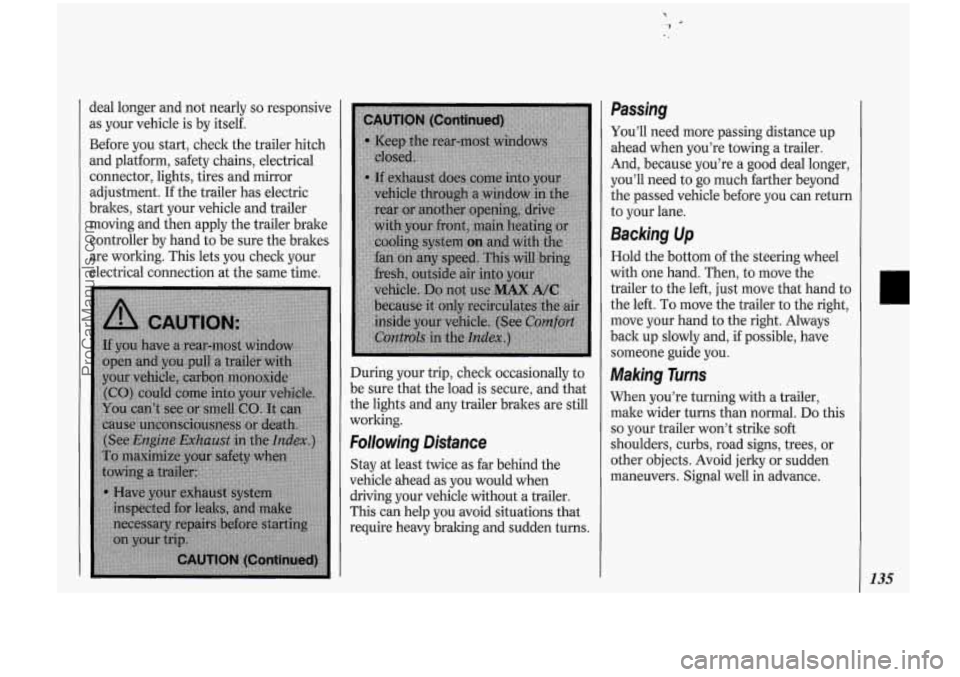
deal longer and not nearly so responsive
as your vehicle is by itself.
Before you start, check the trailer hitch
and platform, safety chains, electrical
connector, lights, tires and mirror
adjustment.
If the trailer has electric
brakes, start your vehicle and trailer
moving and then apply the trailer brake
controller by hand to be sure the brakes
are working. This lets you check your
electrical connection at the same time.
During your trip, check occasionally to
be sure that the load is secure, and that
the lights and any trailer brakes are still
working.
following Distance
Stay at least twice as far behind the
vehicle ahead as you would when
driving your vehicle without a trailer.
This can help
you avoid situations that
require heavy braking and sudden turns.
Passing
You’ll need more passing distance up
ahead when you’re towing a trailer.
And, because you’re a good deal longer,
you’ll need to go much farther beyond
the passed vehicle before you can return
to your lane.
Backing Up
Hold the bottom of the steering wheel
with one hand. Then, to move the
trailer to the left, just move that hand to
the left. To move the trailer to the right,
move your hand to the right. Always
back up slowly and, if possible, have
someone guide you.
Making Turns
When you’re turning with a trailer,
make wider turns than normal. Do this
so your trailer won’t strilte soft
shoulders, curbs, road signs, trees, or
other objects. Avoid jerky or sudden
maneuvers. Signal well in advance.
LI
ProCarManuals.com
Page 142 of 248

Your Driving and the Road
Turn Signals When Towing a
Trailer
When you tow a trailer, your vehicle has
to have a different turn signal flasher
and extra wiring. The green arrows on
your instrument panel will flash
whenever you signal a turn or lane
change. Properly hooked up, the trailer
lights will also flash, telling other
drivers you’re about to turn, change
lanes or stop.
When towing a trailer, the green arrows
on your instrument panel will flash for
turns even if the bulbs on the trailer are
burned out. Thus, you may think
drivers behind you are seeing your
signal when they are not, It’s important
to check occasionally to be sure the
trailer bulbs are still working.
Driving On Grades
Reduce speed and shift to a lower gear
before you start down a long or steep
downgrade. If you don’t shift
down, you
might have to use your brakes
so much
that they would get hot and no longer
work well. On
a long uphill grade, shift down and
reduce your speed
to around 45 mph
(70 km/h) to reduce the possibility of
engine and transmission overheating.
If you are towing a trailer that weighs
more than
3,000 pounds (1 350 kg), it’s
best to drive in
D instead of Overdrive
(or, as you need to, a lower gear). This
will minimize heat build-up and extend
the life of your transmission.
Parking on Hills
You really should not park your vehicle,
with a trailer attached, on a hill.
If
something goes wrong, your rig could
start to move. People can be injured,
and both your vehicle and the trailer
can be damaged.
But if you ever have to park your rig on
a hill, here’s how to do it:
1. Apply your regular brakes, but don’t
shift into
P (Park) yet.
2. Have someone place chocks under
the trailer wheels.
3. When the wheel chocks are in place,
release the regular brakes until the
chocks absorb the load.
4. Reapply the regular brakes. Then
apply your parking brake and then
shift to
P (Park).
5. Release the regular brakes.
When You Are Ready to Leave
After Parking on
a Hill
1. Apply your regular brakes and hold
the pedal down while you:
Start your engine;
Shift into a gear; and
Release the parking brake.
2. Let up on the brake pedal.
3. Drive slowly until the trailer is clear
4. Stop and have someone pick up and
of
the chocks.
store the chocks.
Maintenance When Trailer Towing
Your vehicle will need service more
often when you’re pulling a trailer. See
the Maintenance Schedule for more on
this. Things that are especially
important in trailer operation are
automatic transmission fluid (don’t
overfill), engine oil, axle lubricant, belt,
cooling system, and brake adjustment.
Each of these is covered in this manual,
ProCarManuals.com
Page 146 of 248

Probkms on the Road
140
I Hazard Warning Flashers
Your hazard warning flashers let you
warn others. They also let police know
you have a problem. Your front and rear
turn signal lights will flash on and off.
But they won’t flash if you’re braking. Press
the button in to make your front
md rear turn signal lights flash on and
3ff.
Your hazard warning flashers work no
natter what position your key is in, and
wen if the key isn’t in.
To turn off the flashers, pull out on the
collar.
When the hazard warning flashers are
on, your turn signals won’t work.
Other Warning Devices
If you carry reflective triangles, you can
set one up at the side of the road about
300 feet (1 00 m) behind your vehicle.
Jump Starting
If your battery has run down, you may
want to use another vehicle and some
jumper cables to start your Oldsmobile.
But please follow the steps below to do
it safely.
ProCarManuals.com
Page 147 of 248

NOTICE:
~~
Ignoring these steps could result in
costly damage to your vehicle that
wouldn’t be covered by your
warranty. Trying to start your
Oldsmobile by pushing or pulling it
won’t work, and it could damage
your vehicle.
To Jump Start Your Oldsmobile:
1. Check the other vehicle. It must have
a 12-volt battery with a negative
ground system.
NOTICE:
If the other system isn’t a 12-volt
system with a negative ground,
both vehicles can be damaged.
2. Get the vehicles close enough so the
jumper cables can reach, but be sure
the vehicles aren’t touching each
other. If they are, it could cause a
ground connection you don’t want.
You wouldn’t be able to start your
Oldsmobile, and the bad grounding
could damage the electrical systems.
You could be injured if the vehicles roll.
Set the parking brake
firmly on each
vehicle. Put an automatic transmission
in P (Park) or a manual transmission in
N (Neutral).
3. Turn off the ignition on both
vehicles. Turn
off all lights that aren’t
needed, and radios. This will avoid
sparks and help save both batteries.
And it could save your radio!
NOTICE:
If you leave your radio on, it could
be badly damaged. The repairs
wouldn’t be covered by your
warranty.
4. Open the hoods and locate the
batteries. Find the positive
(+) and
negative
(-) terminals on each
battery.
II
141
ProCarManuals.com
Page 181 of 248

Let the warning lights and gages work
What to Use
Use a mixture of one-half clean water
(preferably distilled) and one-half
antifreeze that meets
“GM Specification
6038-M,” which won’t damage
aluminum parts. If you use this mixture,
you don’t need
to add anything else.
as
they should.
NOTICE:
If you use an improper coolant mix,
your engine could overheat and be
badly damaged. The repair cost
wouldn’t be covered by your
warranty. Too much water in the
mix can freeze and crack the
engine, radiator, heater core and
other parts.
Some conditions, such as air trapped in
the cooling system, can affect the
coolant level in the radiator. Check the
coolant level when the engine is cold
and follow the steps under
Adding
Coolant for the proper way to add
coolant.
If you have to add coolant more than
four times a year, have your dealer
check your cooling system.
NOTICE:
If you use the proper coolant, you
don’t have to add extra inhibitors
or additives which claim to improve
the system. These can be harmful.
~~
Adding Coolant
To Check Coolant
When your engine is cold, the coolant
level should be at
ADD, or a little
higher. When your engine is warm, the
level should be up to
FULL HOT, or a
little higher.
L
175
ProCarManuals.com
Page 203 of 248

INST LPS PWR ACC
HORNIDM IGNIGAU BRAKE STOPIHAZ
h TAIL LPS TURNIBU HTR A/C RADIO
%se Usage
Position
INST LPS
PWR ACC
HORN/DM
IGN/GAU BRAKE
STOP/HAZ
TAIL LPS
TURNDU HTR A/C RADIO
ECM B
ECM I
PWR WDO
WIPER
CRANK
TRAILER*
Rating
(AMP.)
5
30
20
20
15
15
20
15
25
15
15
10
30
25
3
30
UNDERHOOD':' 4
CD PLAYER 10
"In-line fuse.
Circuitry
Instrument Panel Lights, Headlight Warning Buzzer, Heater
Light, Ashtray Light, Radio Illumination Light, Rear Wiper
Switch Light
Power Door Locks, Rear Defogger, Console Accessory
Receptacles, CD Player
Horn, Dome Lights, Glove
Box Light, Clock, Lighter, Lighted
Vanity Mirror, Outside Rearview Mirror, Courtesy Lights
Indicator Lights and Gages, Rear Defogger Relay, Cruise
Control, Rear Defogger Switch, Seat Belt Timer
Four Wheel Anti-lock Brake Module, Digital Ratio Adapter
Module (Speedometer)
Stop Lights, Hazard Warning Lights, Chime Module, Center
High Mounted Stop Light (CHMSL)
Light Switch, TaiVPark Lights, Electronic Cluster, License Light
Turn Signals
& Back-up Lights
Heating and Air Conditioning
Radio, Inside Rearview Mirror Map Lights, Rear Wiper, Rear
Washer, Compass
Electronic Control Module, Fuel Pump
Electronic Control Module
Power Windows
Windshield Wipers and Washer
Electronic Control Module
Trailer Wiring Harness
Underhood Light
CD Player (attached to fuse block)
197
ProCarManuals.com
Page 204 of 248

Service & Appearance Care
198
Headlight Wiring
The headlight wiring is protected by a
circuit breaker in the light switch. An
electrical overload will cause the lights
to go on and off, or in some cases to
remain off. If this happens, have your
headlight system checked right away.
Trailer Wiring Harness
The seven-wire trailer wiring harness is
protected by an in-line fuse in the
battery feed wire. This fuse is near the
junction block. See the
Index under
Trailer Wiring Harness.
Windshield Wipers
The windshield wiper motor is
protected by a circuit breaker and a
fuse.
If the motor overheats due to
heavy snow, etc., the wiper will stop
until the motor cools.
If the overload is
caused by some electrical problem, have
it fixed.
Power Windows and Other Power
Accessories
Circuit breakers in the fuse panel
protect the power windows and other
power accessories. When the current
load is too heavy, the circuit breaker
opens and closes, protecting the circuit
until the problem is fixed or goes away.
Before you wire any other electrical
accessories into your fuse block, please
check with your Oldsmobile dealer.
ProCarManuals.com