lights OLDSMOBILE BRAVADA 1994 User Guide
[x] Cancel search | Manufacturer: OLDSMOBILE, Model Year: 1994, Model line: BRAVADA, Model: OLDSMOBILE BRAVADA 1994Pages: 248, PDF Size: 14.54 MB
Page 70 of 248

Features di Controli
64
Overhead Console
The front overhead console has reading
lights, a center dome light, a compass
and outside temperature display, and
storage compartments-including one
for your garage door opener and one for
sunglasses.
Temperature and Compass
Display
The outside air temperature and the
compass are displayed at the front
of
the overhead console. The control
switches are located to the left
of the
display.
Turn the display on or
off by pressing
the
ON/OFF switch. Display the
temperature in either degrees
Fahrenheit (English)
or Celsius (metric)
by pressing the
US/MET switch.
Before you turn on the ignition and move
the vehicle, the temperature indicated
will be the last outside temperature
recorded with the ignition on. If
the outside temperature is
37°F (3°C)
or lower when you turn on the ignition,
ICE will appear on the display. It's a
caution to the driver that road
conditions may be icy, and that
appropriate precautions should be
taken.
Compass Calibration:
The compass is self-calibrating, so it
does not need to be manually set.
However, when your Bravada is new,
the compass may function erratically.
If
it does, CAL (Calibration) will appear
on the display.
To correct the problem,
drive in a complete
360" circle three
times, and the compass will function
normally.
ProCarManuals.com
Page 73 of 248
m
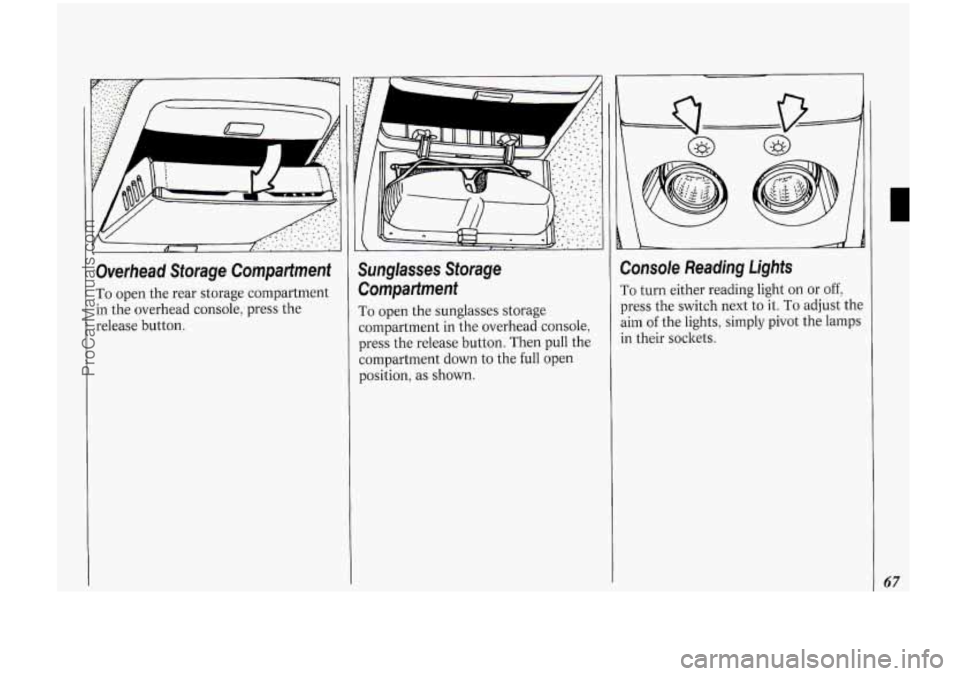
Overhead Storage Compartment I
To open the rear storage compartment
in the overhead console, press the
release button.
Sunglasses Storage
Compartment
To open the sunglasses storage
compartment in the overhead console,
press the release button. Then pull the
compartment down
to the full open
position, as shown.
Console Reading Lights
To turn either reading light on or off,
press the switch next to it. To adjust the
aim
of the lights, simply pivot the lamps
in their sockets.
67
ProCarManuals.com
Page 74 of 248

Feahres & Controls
68
I I
111
Center Dome Light
Located in the center of your vehicle,
this light has no switch of its
own. It
will go
on each time you open the
doors.
You can also turn it on by
turning the Instrument Panel Intensity
Control to the right until it cliclts.
L
9ont Reading Lights
rhese lights are part of the rearview
nirror, and may be operated in two
ways:
b With the ignition on, turn each light
on and off with its switch.
With the ignition
off, open any door.
These lights will come
on for about 15
seconds, then turn off. If you turn on
the ignition during this delay, the
lights will turn off immediately.
To avoid draining your vehicle battery’s
Qower, be sure to turn
off all interior
lights when leaving your vehicle. But
remember that the mirror reading lights
will still come on for about
15 seconds,
then turn
off.
Rear Dome Light
The rear dome light will come on with
the center dome light each time you
open the doors. It also has a switch. Be
sure to turn it
off when you are finished
using it.
ProCarManuals.com
Page 75 of 248

.. ...... .... --
Sun Visors
To block out glare, you can swing down
the visors.
You can also remove them
from the center mount and swing them
to the side, while the auxiliary sunshade
remains to block glare from the front.
To extend the visors at the sides, pull
out the sunshade.
Lighted Visor Vanity Mirrors
Open the
covers to expose the vanity
mirror.
The lights come on when you open the
cover. These can even be used for
reading.
hide DaylNight Rearview Mirror
To reduce glare from lights behind you,
pull the lever toward you to the night
position.
For information on this mirror's reading
lights, see the
Index under Front
Reading Lights.
69
ProCarManuals.com
Page 84 of 248

Features & Controls
78
1 Instrument Panel Clusters
You have one of these instrument panel clusters, which include indicator warning lights and gages that are explained on the
following pages. Be sure
to read about those that apply to the instrument panel cluster for your Oldsmobile.
STANDARD CLUSTER
t
r
50 60 70 F L
UNLEADED
(loo1253l 12 5 3u RN@JD21]
ProCarManuals.com
Page 86 of 248

Features & Controls
80
I Warning Lights, Gages and
Indicators
This section describes the warning
lights and gages that may be on your
vehicle. The pictures will help you
locate them.
Warning lights and gages can signal that
something is wrong before it becomes
serious enough to cause an expensive
repair or replacement. Paying attention
to your warning lights and gages could
also save you or others from injury.
Warning lights go on when there may
be or is a problem with one of your
vehicle's functions.
As you will see in
the details on the next few pages, some
warning lights come on briefly when
you turn the ignition key just to let you
know they're working.
If you are
familiar with this section, you should
not be alarmed when this happens. Gages
can indicate when there may be
or is a problem with one of your
vehicle's functions. Often gages and
warning lights work together to let you
know when there's a problem with
your vehicle.
When one of the warning lights comes
on and stays on when you are driving,
or when one of the gages shows there
may be a problem, check the section
that tells you what to do about it.
Please follow the manual's advice.
Waiting to do repairs can be costly
-
and even dangerous. So please get to
know your warning lights and gages.
They're a big help.
F I
I
I' I Speedometer (STANDARD CLUSTER)
our speedometer lets you see your
jeed in both miles per hour (mph) and
ilometers per hour (ldh).
ProCarManuals.com
Page 119 of 248

Passing
The driver of a vehicle about to pass
another on a two-lane highway waits for
just the right moment, accelerates,
moves around the vehicle ahead, then
goes back into the right lane again.
A
simple maneuver?
Not necessarily! Passing another vehicle
on a two-lane highway is a potentially
dangerous move, since the passing
vehicle occupies the same lane as
oncoming traffic for several seconds.
A
miscalculation, an error in judgment, or
a brief surrender to frustration or anger
can suddenly put the passing driver face
to face with the worst of all traffic
accidents
- the head-on collision.
So here are some tips for passing:
“Drive ahead.” Look down the road,
to the sides, and to crossroads for
situations that might affect your
passing patterns. If you have any
doubt whatsoever about making a
successful pass, wait for a better time.
markings, and lines. If you can see a
sign up ahead that might indicate a
turn or an intersection, delay your
Watch for traffic signs, pavement pass.
A broken
center line usually
indicates it’s all right to pass
(providing the road ahead
is clear).
Never cross a solid line on your side
of the lane or a double solid line, even
if the road seems empty of
approaching traffic.
Do not get too close to the vehicle you
want to pass while you’re awaiting an
opportunity. For one thing, following
too closely reduces your area of vision,
especially
if you’re following a larger
vehicle.
Also, you won’t have
adequate space
if the vehicle ahead
suddenly slows or stops. Keep back a
reasonable distance.
When it looks like a chance to pass is
coming up, start to accelerate but stay
in the right lane and don’t get too close.
Time your move
so you will be
increasing speed as the time comes to
move into the other lane. If the way is
clear to pass, you
will have a “running
start” that more than makes up for the
distance you would lose by dropping
back. And
if something happens to
cause you to cancel your pass, you need
only slow down and drop back again
and wait for another opportunity.
If other cars are lined up to pass a
slow vehicle, wait your turn. But take
care that.someone isn’t trying to pass
you as you pull out to pass the slow
vehicle. Remember to glance over your
shoulder and check the blind spot.
Check your mirrors, glance over your
shoulder, and start your left lane
change signal before moving out of the
right lane to pass. When you are far
enough ahead of the passed vehicle to
see its front in your inside mirror,
activate your right lane change signal
and move back into the right lane.
(Remember that your right outside
mirror is convex. The vehicle you just
passed may seem to be farther away
from
you than it really is.)
Try not to pass more than one vehicle
at a time on two-lane roads. Reconsider
before passing the next vehicle.
Don’t overtake a slowly moving
vehicle
too rapidly. Even though the
brake lights are not flashing, it may be
slowing down or starting to turn.
If you’re being passed, make it easy
for the following driver to get ahead of
you. Perhaps you can ease a little to
the right.
113
ProCarManuals.com
Page 123 of 248

Controlling your vehicle is the key to
successful off-road driving. One of the
best ways to control your vehicle is to
control your speed. Here are some
things to keep in mind. At higher
speeds:
you approach things faster and you
have less time to scan the terrain for
obstacles.
you have less time to react.
you have more vehicle bounce when
you drive over obstacles.
you’ll need more distance for braking,
especially since you’re on an unpaved
surface.
Scanning the Terrain
Off-road driving can take you over
many different kinds of terrain.
You
need to be familiar with the terrain and
its many different features. Here are
some things to consider.
Surface Conditions
Off-roading can take you over hard-
packed
dirt, gravel, rocks, grass, sand,
mud, snow or ice. Each
of these surfaces
affects the steering, acceleration, and
braking of your vehicle in different ways.
Depending upon the kind of surface you
are on, you may experience slipping,
sliding, wheel spinning, delayed
acceleration, poor traction, and longer
braking distances.
Surface Obstacles
Unseen or hidden obstacles can be
hazardous. A rock, log, hole, rut, or
bump can startle you
if you’re not
prepared for them. Often these obstacles
are hidden by grass, bushes, snow or
even the rise and
fall of the terrain itself.
Here are some things to consider:
Is the path ahead clear?
Will the surface texture change
Does the travel take you uphill or
abruptly
up ahead?
downhill? (There’s more discussion of
these subjects later.)
change direction quickly?
Will you have to stop suddenly or
When you drive over obstacles or rough
terrain, keep a firm grip on the steering
wheel. Ruts, troughs, or other surface
features can jerk the wheel out of your
hands
if you’re not prepared.
When you drive over bumps, rocks, or
other obstacles, your wheels can leave
the ground. If this happens, even with
one or two wheels, you can’t control the
vehicle as well or at all.
Because you will be on an unpaved
surface, it’s especially important to
avoid sudden acceleration, sudden
turns, or sudden braking.
In a way, off-road driving requires a
different kind of alertness from driving
on paved roads and highways. There are
no road signs, posted speed limits or
signal lights.
You have to use your own
good judgment about what is safe and
what isn’t.
117
ProCarManuals.com
Page 125 of 248

Driving Uphi//
Once you decide you can safely drive
up the hill, you need to take some
special steps.
Use a low gear and get a firm grip on
the steering wheel.
Get a smooth start up the hill and try
to maintain your speed. Don’t use
more power than you need, because
you don’t want your wheels to start
spinning or sliding.
Try to drive straight up the hill if at all
possible. If the path twists and turns,
you might want to find another route.
Ease up on your speed as you
approach the top of the.hill..
Attach a flag to the vehicle to make
you more visible to approaching
traffic on trails or hills.
Sound the horn as you approach the
top of the hill to let opposing traffic
know you’re there.
Use your headlights even during the
day. They make you more visible to
oncoming traffic.
Q: What should I do if my vehicle
stalls,
or is about to stall, and I
can’t make it up the hill?
A: If this happens, there are some
things you should
do, and there are
some things you must not do. First,
here’s what you
should do:
Push the brake pedal to stop the
vehicle and keep it from rolling
backwards. Also, apply the parking
brake.
the transmission into reverse,
release the parking brake, and
slowly back down the hill in reverse.
If your engine has stopped running,
you’ll need
to restart it. With the
brake pedal depressed and the
parking brake still applied, shift the
transmission to
P (Park) and
restart the engine. Then, shift to
reverse, release the parking brake,
and slowly back down the hill as
straight as possible in reverse.
As you are backing down the hill,
put
your left hand on the steering
wheel at the
12 o’clock position.
This way, you’ll be able to tell if
your wheels are straight and
maneuver
as you back down. It’s
best that you back down the hill
with your wheels straight rather
than in the left or right direction.
Turning the wheel too far
to the
left or right will increase the
possibility
of a rollover.
If your engine is still running, shift
119
ProCarManuals.com
Page 130 of 248

Your Driving and the Road
124
Driving at Night
Night driving is more dangerous than
day driving. One reason is that some
drivers are likely to be impaired
- by
alcohol or drugs, with night vision
problems, or by fatigue.
Here are some tips on night driving.
Drive defensively.
Don’t drink and drive.
Adjust your inside rearview mirror to
reduce the glare from headlights
behind you.
Since you can’t see as well, you may
need to slow down and keep more
space between you and other vehicles.
Slow down, especially on higher
speed roads. Your headlights can light
up only
so much road ahead.
In remote areas, watch for animals.
If you’re tired, pull off the road in a
safe place and rest.
Night Vision
No one can see as well at night as in the
daytime. But as we get older these
differences increase. A 50-year-old
driver may require at least twice as
much light to see the same thing at
night as
a 20-year-old.
What you do in the daytime can also
affect your night vision. For example, if
you spend the day in bright sunshine
you are wise to wear sunglasses. Your
eyes will have less trouble adjusting to
night. But if you’re driving, don’t wear
sunglasses at night. They may cut down
on glare from headlights, but they also
make a lot of things invisible.
You can be temporarily blinded by
approaching lights. It can take a second
or two, or even several seconds, for your eyes
to readjust to the dark. When
you are faced with severe glare (as from
a driver who doesn’t lower the high
beams, or a vehicle with misaimed
headlights), slow down a little. Avoid
staring directly into the approaching
lights.
Keep your windshield and
all the glass
on your vehicle clean
- inside and out.
Glare
at night is made much worse by
dirt on the glass. Even the inside of the
glass can build up a film caused by
dust.
Dirty glass makes lights dazzle and
flash more than clean glass would,
malting the pupils of your eyes contract
repeatedly.
Remember that your headlights light up
far less of a roadway when
you are in a
turn or curve. Keep your eyes moving;
that way, it’s easier to pick out dimly
lighted objects. Just as your headlights
should be checked regularly for proper
aim,
so should your eyes be examined
regularly. Some drivers suffer from
night blindness
- the inability to see in
dim light
- and aren’t even aware of it.
ProCarManuals.com