tires OLDSMOBILE BRAVADA 1994 Owner's Manual
[x] Cancel search | Manufacturer: OLDSMOBILE, Model Year: 1994, Model line: BRAVADA, Model: OLDSMOBILE BRAVADA 1994Pages: 248, PDF Size: 14.54 MB
Page 191 of 248

Accelerator Control System
Your Maintenance Schedule will tell
you how often the accelerator linkage
pivot points must be lubricated and
what type of lubricant to use.
Accelerator cables and cruise control
cables should not be lubricated. Any
cables that are worn or are hard to pull
should be replaced.
Hood Latches and Hood
Hinge
Your Maintenance Schedule will tell
you how to lubricate the hood latch and
hood hinge assembly.
Lock Cylinders
To be sure your locks operate properly,
they must be lubricated. Your
Maintenance Schedule will tell you how
often to lubricate them and what type of
lubricant to use.
You should not use penetrating oils
because they could wash out the factory
installed lubricant and cause the lock to
bind. De-icers which contain alcohol could
also wash away the lubricant,
so
be sure to lubricate the lock after using
a de-icer of this type.
Tailgate-Mounted Spare Tire
Carrier
The spare tire carrier must be lubricated
to keep it operating smoothly. Your
Maintenance Schedule
will tell you
what type of lubricant to use.
Tires
We don’t make tires. Your new vehicle
comes with high quality tires made by a
leading tire manufacturer. These tires
are warranted by the tire manufacturers
and their warranties are delivered with
every new Oldsmobile. If your spare tire
is a different brand than your road tires,
you will have a tire warranty folder from
each of these manufacturers.
185
ProCarManuals.com
Page 192 of 248

Service & Appearance Care
186
Inflation-Tire Pressure
The Certification/Tire label which is
on the rear edge
of the driver’s door
shows the correct inflation pressures
for your tires, when they’re cold.
“Cold” means your vehicle has been
sitting for at least three hours or driven
no more than
a mile. Also see
Capacities G Specifications in the
Index.
NOTICE:
Don’t let anyone tell you that
underinflation
or overinflation is all
right. It’s not. If your tires don’t
have enough air (underinflation)
you can get:
Too much flexing
Too much heat
Tire overloading
Bad wear
Bad handling
Bad fuel economy.
If your tires have too much air
(overinflation)
) you can get:
Unusual wear
Bad handling
Rough ride
Needless damage from road
hazards.
When to Check
Check your tires once a month or more.
Also, check the tire pressure
of the
spare tire.
How to Check
Use a good quality pocket-type gage to
check tire pressure. Simply looking at
the tires will not tell you the pressure,
especially if you have radial tires
-
which may look properly inflated even if
they’re underinflated.
If your tires have valve caps, be sure to
put them back on. They help prevent
leaks by keeping out dirt and moisture.
ProCarManuals.com
Page 193 of 248

rire Inspection and Rotation
To make your tires last longer, have
:hem inspected and rotated at the
nileages recommended in the
Maintenance Schedule.
See Scheduled
Maintenance Services
in the Index.
Use this rotation pattern.
[f your vehicle has front tires with
iifferent load ratings or tread designs
(such as all season vs.
on/off road) than
the rear tires, don’t rotate your tires
kont to rear.
Mer the tires have been rotated, adjust
;he front and rear inflation pressure as
shown on the Certificatioflire label.
Make certain that all wheel nuts are
?roperly tightened. See
Wheel Nut
l’orque in the Index.
TREAD WEAR INDICATORS
When It’s Time for New Tires
3ne way to tell when it’s time for new
:ires is to check the treadwear
.ndicators, which will appear when your
tires have only
2/32 inch (1.6 mm) or
less
of tread remaining.
You need a new tire if
You can see the indicators at three or
more places around the tire.
You can see cord or fabric showing
through the tire’s rubber.
The tread or sidewall is cracked, cut
or snagged deep enough to show cord
or fabric.
The tire has a bump, bulge or split.
I87
ProCarManuals.com
Page 194 of 248
Service & Appearance Care
188
The tire has a puncture, cut, or other
damage that can’t be repaired well
because of the size or location of the
damage.
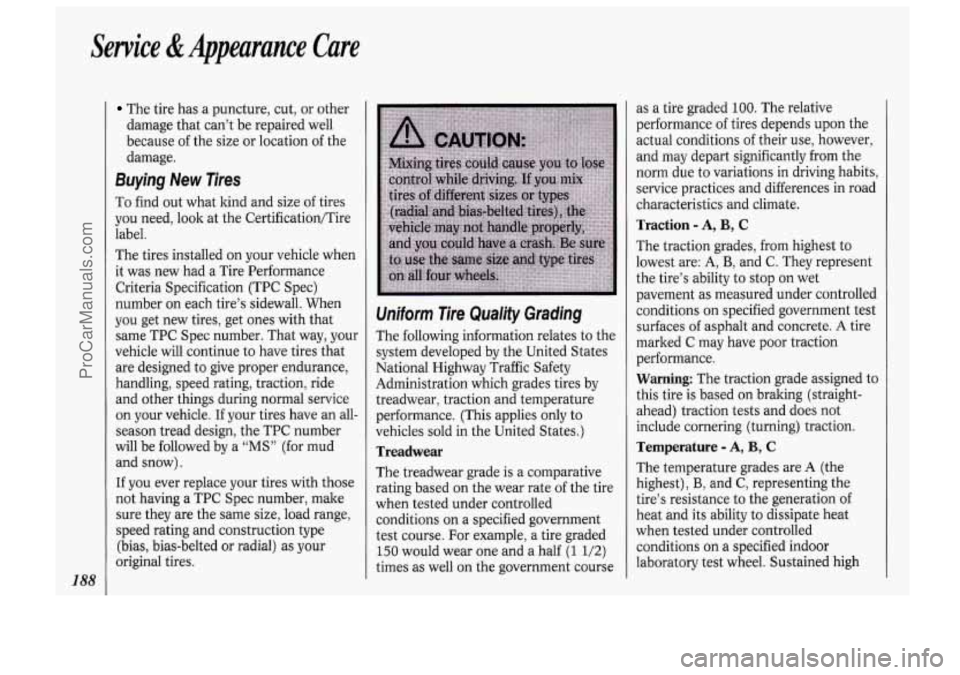
Buying New Tires
To find out what kind and size of tires
you need, look at the Certificationnire
label.
The tires installed on your vehicle when
it was new had a Tire Performance
Criteria Specification (TPC Spec)
number on each tire’s sidewall. When
you get new tires, get ones with that
same TPC Spec number. That way, your
vehicle will continue to have tires that
are designed to give proper endurance,
handling, speed rating, traction, ride
and other things during normal service
on your vehicle.
If your tires have an all-
season tread design, the TPC number
will be followed by a
“MS” (for mud
and snow).
If you ever replace your tires with those
not having a TPC Spec number, make
sure they are the same size, load range,
speed rating and construction type
(bias, bias-belted or radial) as your
original tires.
Uniform Tire Qualify Grading
The following information relates to the
system developed by the United States
National Highway Traffic Safety
Administration which grades tires by
treadwear, traction and temperature
performance. (This applies only to
vehicles sold in the United States.)
Treadwear
The treadwear grade is a comparative
rating based on the wear rate of the tire
when tested under controlled
conditions on a specified government
test course. For example, a tire graded
150 would wear one and a half (1 1/2)
times as well on the government course as
a tire graded
100. The relative
performance of tires depends upon the
actual conditions of their use, however,
and may depart significantly from the
norm due to variations in driving habits,
service practices and differences in road
characteristics and climate.
Traction - A, B, C
The traction grades, from highest to
lowest are: A,
B, and C. They represent
the tire’s ability to stop on wet
pavement as measured under controlled
conditions
on specified government test
surfaces of asphalt and concrete.
A tire
marked C may have poor traction
performance.
Warning: The traction grade assigned to
this tire is based on braking (straight-
ahead) traction tests and does not
include cornering (turning) traction.
Temperature - A, B, C
The temperature grades are A (the
highest),
B, and C, representing the
tire’s resistance to the generation of
heat and its ability to dissipate heat
when tested under controlled
conditions on a specified indoor
laboratory test wheel. Sustained high
ProCarManuals.com
Page 195 of 248

temperature can cause the material of
the tire to degenerate and reduce tire
life, and excessive temperature can lead
to sudden tire failure. The grade
C
corresponds to a level of performance
which all passenger car tires must meet
under the Federal Motor Vehicle Safety
Standard
No. 109. Grades B and A
represent higher levels of performance
on the laboratory test wheel than the
minimum required by law.
Warning: The temperature grade for
this tire is established for a tire that is
properly inflated and not overloaded.
Excessive speed, underinflation, or
excessive loading, either separately or in
combination, can cause heat buildup
and possible tire failure.
These grades are molded
on the
sidewalls of passenger car tires.
While the tires available as standard
or
optional equipment on General Motors
vehicles may vary with respect to these
grades,
all such tires meet General
Motors performance standards and have
been approved for use
on General Motors
vehicles.
All passenger type (P Metric)
tires must conform to Federal safety
requirements
in addition to these grades.
Wheel Alignment and Tire
Balance
The wheels on your vehicle were
aligned and balanced carefully at the
factory to give you the longest tire life
and best overall performance.
In most cases, you will not need to have
your wheels aligned again. However, if
you notice unusual tire wear or your
vehicle pulling one way or the other, the
alignment may need to be reset. If you
notice your vehicle vibrating when
driving
on a smooth road, your wheels
may need to be rebalanced.
Wheel Replacement
Replace any wheel that is bent, cracked
or badly rusted. If wheel nuts keep
coming loose, the wheel, wheel bolts,
and wheel nuts should be replaced. If
the wheel leaks air, replace it (except
some aluminum wheels, which can
sometimes be repaired). See your
Oldsmobile dealer if any of these
conditions exist.
Your dealer will know the kind of wheel
you need. Each new
wheel should have the same
load carrying capacity, diameter, width,
offset, and be mounted the same way as
the one it replaces.
If you need to replace any of your
wheels, wheel bolts, or wheel nuts,
replace them only with new GM
original equipment parts. This way, you
will be sure to have the right wheel,
wheel bolts, and wheel nuts for your
Oldsmobile model.
189
ProCarManuals.com
Page 216 of 248

210
Explanation of Scheduled
Maintenance Services
Below are explanations of the services
listed in Schedule I and Schedule 11.
The proper fluids and lubricants to use
are listed in Section
D. Make sure
whoever services your vehicle uses
these. All parts should be replaced and
all necessary repairs done before you or
anyone else drives the vehicle.
ITEM SERVICE
NO.
1. Engine Oil and Filter Change* -
Always use SH or SG Energy
Conserving I1 oils of proper viscosity.
The
“SH” or “SG” designation may be
shown alone or in combination with
others, such as “SH/CD,”
“SH, SG,
CD,” “SG/CD,” etc. To determine the
preferred viscosity for your vehicle’s engine (e.g., SAE 5W-30 or SAE 1OW-
30), see the Index under Engine Oil.
2. Chassis Lubrication - Lubricate the
transmission shift linkage, parking
brake cable guides, underbody contact points and linkage. Lubricate the front
suspension and steering linkage.
3. Tire and Wheel Rotation and
Inspection
- For proper wear and
maximum tire life, rotate your tires
following the instructions
in this
manual. See
Tires, Inspection G.
Rotation in the Index. Check the
tires for uneven wear or damage. If
you see irregular or premature wear,
check the wheel alignment. Check for
damaged wheels also.
Inspection - Inspect the drive belt
for cracks, fraying, wear and proper
tension. Replace as needed.
5. Cooling System Service‘: - Drain,
flush and refill the system with new
or approved recycled coolant
conforming to
GM Specification
6038-M. Keep coolant at the proper
mixture as specified. See
CooZant in
the
Index. This provides proper
freeze and boil protection, corrosion
inhibitor level and maintains proper
engine operating temperature.
Inspect hoses and replace if they are
cracked, swollen or deteriorated.
Tighten screw-type hose clamps. Clean the outside of the radiator and
air conditioning condenser. Wash the
pressure cap and neck.
4. Engine Accessory Drive Belt
To help ensure proper operation, we
recommend
a pressure test of both the
cooling system and the pressure cap.
6. Transmission Service - Change
both the fluid and filter every 15,000
miles
(25 000 lun) if the vehicle is
mainly driven under one or more of
these conditions:
In heavy city traffic where the
outside temperature regularly
reaches
90°F (32°C) or higher.
In hilly or mountainous terrain.
When doing frequent trailer towing.
Uses such as found in taxi, police
If you do not use your vehicle under
any of these conditions, change both
the fluid and filter every
100,000
miles (166 000 lun) .
Replace spark plugs with the proper
type. See
Replacement Parts in the
Index.
8. Spark Plug Wire Inspection‘%t -
Inspect for burns, cracks or other
damage. Check the boot
fit at the
coils and at the spark plugs. Replace
wires as needed.
car
or delivery service.
7. Spark Plug Replacement” -
ProCarManuals.com
Page 218 of 248

Maintenunce Schedule
212
4 Section B: Owner Checks and Services
Listed below are owner checks and services which should be performed at the intervals specified to help ensure the safety,
dependability and emission control performance of your vehicle.
Be sure any necessary repairs are completed at once. Whenever any fluids or lubricants are added to your vehicle, make sure
they are the proper ones, as shown in Section
D.
At Each Fuel Fill (/t is important for you or a service station attendant to perform these underhood checks at each fuel fi//-)
CHECK
OR SERVICE WHAT TO DO
Engine Oil Level
Check
the engine oil level and add the proper oil if necessary. See Engine Oil in the Index for
further details.
Engine Index for further details.
Windshield Washer Check the windshield washer fluid level in the windshield washer tank and add the proper fluid if
Fluid Level necessary. See
WindshieZd Washer Fluid in the Index for further details.
Check
the engine coolant level and add the proper coolant mix
if necessary. See CooZant in the
Least Once a Month
CHECK
OR SERVICE
I WHAT TO DO
Tire Inflation Check
tire inflation. Make sure they are inflated to the pressures specified on the Certification/
Tire label located on the rear edge of the driver’s door. See Tires in the Index for further details.
Cassette Deck Clean
cassette deck. Cleaning should be done every
15 hours of tape play. See Audio Systems in
the
Index for further details.
ProCarManuals.com
Page 242 of 248
Index
236
Replacement Bulb .......................... 202
Wiring
............................................. 198
Heater (see
Comfort Controls)
Heater. Engine Block ................. 47. 170
High Beams
........................................ 62
Highway Hypnosis
........................... 128
Hill and Mountain Roads
......... 118. 129
Hood Release
.................................... 165
Safety Warning
............................... 166
Warning. Overheated
Engine
.......................... 145. 147. 148
Horn
.................................................... 54
Hot Engine. Safety
Hydroplaning
.................................... 126
Identification Number. Vehicle
..... 195
Idling Your Engine ....................... 52. 54
If You’re Stuck in Sand. Mud.
Ice or Snow
.................................... 158
Ignition Key
.................................................... 38
Positions ........................................... 45
Warnings
........................ 145. 147.
148
Indicator Lights (see
Warning Lights )
Infant Restraint (see Child Restraints )
Inflation. Tires .................................. 186
Inside Rearview Mirror
...................... 69
Instrument Panel
................................ 77
Instrument Panel Clusters
.................. 78
Instrument Panel Intensity Control
... 63 Instrument
Panel Warning Lights
...... 80
Jack. Tire
........................................ 152
Keys
................................................. 38
Lane Change Indicator
................... 56
Jump
Starting
.................................... 140
Lap-Shoulder Belt
.............................. 18
Front ........................................... 18, 21
Rear
................................................... 22
Use by Children
................................ 25
Lighter
................................................. 73
Lights Center Dome
.................................... 68
Fog
.................................................... 63
Headlights
........................................ 62
Interior
............................................. 67
Reading
....................................... 67, 68
Rear Dome
....................................... 68
Replacement Bulbs
........................ 202
Turn Signal
....................................... 56
Removing
& Replacing Bulbs ........ 181
Taillights ......................................... 182
Underhood
..................................... 166
Warning
............................................ 80
Loading Your Vehicle
.............. 116, 183
Lock, Tailgate ............................. 42, 185
Locks, Door
................................ 39, 185
Locks, Power
...................................... 40 Long
Distance Driving
..................... 128
Low Battery
...................................... 140
Low Oil Pressure Warning
........... 84. 86
Luggage Carrier
.................................. 74
Lumbar Controls
................................ 12
Maintenance Record
................... 219
Maintenance Schedule
..................... 206
Malfunction Indicator Lamp
.............. 89
Manual Front Seat
.............................. 13
Methanol in Gasoline
....................... 163
Mileage Indicator
(see
Odometer)
Mirrors Convex Outside
............................... 70
Power Remote Control
.................... 70
Visor Vanity
..................................... 69
Mountain Driving
..................... 118, 129
Inside
Manual Day/Night
................ 69
New Vehicle “Break-In”
......... 44. 132
Night Driving
.................................... 124
Octane Requirements
Odometer and Trip Odometer
..... 81. 82
Off-Road Driving
...................... 115. 123
(see
Fuel
Requirements)
Oil. Engine ........................................ 168
Capacity
.......................................... 199
Disposing
of Used Oil .................... 170
ProCarManuals.com
Page 243 of 248
Pressure Gage ............................ 84, 86
Quality
............................................ 169
Thickness
....................................... 169
When to Change
............................. 170
Operating Off-Road
.......................... 115
Operation of Lights ............................ 56
Outside Rearview Mirrors
.................. 70
Overhead Console
.............................. 64
Overheated Engine
Warnings
........ 145, 147, 148, 175, 176
Overheated Engine Coolant
Warning
......... 145, 147, 148, 175, 176
Owner Checks
& Services ............... 212
Outside
Temperature Display
............ 64
park. Shifting Into
.......................... 51
Parking
Over Things That Burn
.................... 53
With the Engine Running
.......... 52. 54
Parking Brake
..................................... 51
Passenger Belts (see Safety Belts )
Passing .............................................. 113
Payload .............................................. 184
Periodic Maintenance Inspections
... 215
Polishing and Waxing
Power Door Locks
.............................. 40
Power Mirrors ..................................... 70
(see
Appearance Care )
Power Outlets,
Accessory .................. 71
Power Seat, Driver’s ........................... 12 Power Steering
................................. 11
1
Power Steering Fluid ................ 176. 201
Power Windows .......................... 55. 198
Pregnancy. Use of Safety Belts
During
.............................................. 21
Problems on the Road ...................... 139
Publications (see
Service Publications )
Radiator Overheating
(see
Overheated En&e )
Radio (see Audio Systems)
Rain. Driving in the .......................... 125
Reading Lights
.............................. 67. 68
Rear Axle
.......................................... 174
Radiator
Pressure Cap
..... 146. 148. 176
Rear Seat. Folding
.............................. 14
Rear Window Defogger
...................... 94
Rear Window Wiper and Washer
....... 59
Rearview Mirror ................................. 69
Reclining Front Seatbacks
................. 13
Recommended Fluids
& Lubricants .......................... 201. 217
Remote Lock Control
......................... 40
Replacement Bulbs
........................... 202
Replacement Fuses
........................... 197
Replacement Parts ............................ 200
Replacing Bulbs
........................ 181. 182
Replacing Safety Belts
........................ 34
Replacing Tires
................................. 188
Replacing Wheels .............................. 189
Restraints. Child
................................. 26
Roads. Hill and Mountain
................ 129
Roadside Assistance Program
.......... 225
Rocking Your Vehicle
.............. 158. 159
Rotation. Tire 187
....................................
S afety Belts ...................................... 14
Center Passenger Position
............... 24
Adults
............................................... 18
Checking ........................................... 34
Children
...................................... 25. 32
Child Restraints
............................... 26
Child Restraints. How to Install
...... 26
Child Restraints. Where to Put
........ 27
Cleaning
......................................... 192
Driver Position
................................. 18
Extender ........................................... 34
How to Wear
.................................... 18
Lap-Shoulder Belt ............................ 18
Larger Children ................................ 32
Passenger Belts
................................ 21
Rear Safety Belts
.............................. 22
Pregnancy. Use
During
.................... 21
Questions
& Answers ..... 17. 19.20. 35
Rear Seat Passengers
....................... 22
Reminder Light
................................ 17
Replacement
..................................... 34
Right Front. Adult Passenger .......... 21
Smaller Children and Babies
........... 25
3
237
ProCarManuals.com
Page 244 of 248

238
Top Strap ......................................... 27
Torn
.................................................. 35
Twisted
............................................. 20
Why
You Should Wear
Safety Belts
.................................... 14
Safety Defects. Reporting
................. 224
Scheduled Maintenance Services
.... 205
Seat Adjustment
................................. 12
Seat Belts (see
Safety Belts)
Seat Controls ...................................... 12
Lumbar Controls
.............................. 12
Manual Front Seat
........................... 13
Power Front Seat ............................. 12
Rear Seat. Folding
............................ 14
Reclining Seatback ........................... 13
Service Engine Soon Light
................. 89
Service Information
.......................... 162
Service Parts Identification Label
.... 195
Service Publications
......................... 225
Service Station Information
............. 240
Setting the Clock
................................ 95
Setting the Trip Odometer
........... 81. 82
Shifting Into Park
............................... 5 1
Single Belt Accessory Drive ............. 184
Skidding
............................................ 114
Snowstorm. If You’re Caught in a
... 131
Sockets. Accessory Power .................. 71
Shifting
the Automatic Transmission
.... 48
Sound Equipment. Adding
................. 95
Sound System (see
Audio Systems)
Spare Tire ................................... 43. 152
Inside-Mounted
.............................. 152
Tailgate-Mounted
........................... 154
Spare Tire Carrier
............................... 43
Spark Plugs
....................................... 200
Specifications
& Capacities ............. 199
Speed Control (see
Cruise Control )
Speedometer ................................. 80. 81
Stains. Removing .............................. 193
Stalling on an Incline
....................... 122
Starting Your Engine
.......................... 45
Starting Your Vehicle
if the Battery
Steering is
“Dead”
(see Jump Starting)
In Emergencies ............................... 112
Off-Road Recovery ......................... 112
Tips
................................................. 111
Steering Wheel. Tilt ............................ 55
Stereo Sound System
Storage (see
Audio
Systems )
Console ............................................. 71
Door Compartment/Coin Holder
.... 72
Garage Door Opener
....................... 65
Glove Box
......................................... 44
Luggage Carrier
................................ 74
Overhead
.......................................... 67
Sunglasses
........................................ 67
Storing Your Vehicle
........................ 180
Cup Holder ....................................... 71 Stuck.
If
You Are .............................. 158
Sun Visors ........................................... 69
T achometer ...................................... 83
Tailgate ......................................... 42. 43
Tape Player (see
Audio Systems)
Technical Facts & Specifications
Bulbs
............................................... 202
Electrical Equipment. Add-on
................................. 46. 95. 196
Fluid Capacities
& Types ...... 199. 201
Fuses
& Circuit Breakers .............. 196
Service Parts Identification
Label
............................................ 195
Vehicle Identification Number
(VIN)
........................................... 195
Temperature Warning
.................. 85. 88
Theft .................................................... 42
Thermostat
........................................ 176
Tilt Steering Wheel
............................. 55
Time. Setting the ................................ 95
Tires
.................................................. 185
Blow Out ........................................ 151
Buying New .................................... 188
Chains ............................................. 190
Flat. Changing
................................ 151
Inflation .......................................... 186
Inspection
& Rotation ................... 187
Loading
.......................................... 185
Pressure .......................................... 186
ProCarManuals.com