brake OLDSMOBILE BRAVADA 1994 Owner's Guide
[x] Cancel search | Manufacturer: OLDSMOBILE, Model Year: 1994, Model line: BRAVADA, Model: OLDSMOBILE BRAVADA 1994Pages: 248, PDF Size: 14.54 MB
Page 141 of 248
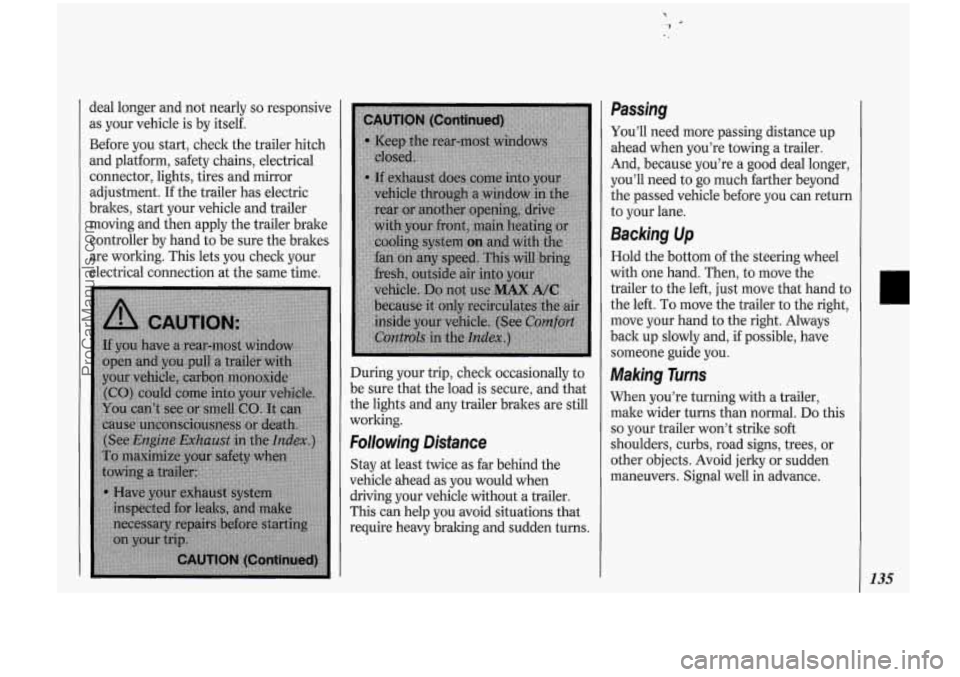
deal longer and not nearly so responsive
as your vehicle is by itself.
Before you start, check the trailer hitch
and platform, safety chains, electrical
connector, lights, tires and mirror
adjustment.
If the trailer has electric
brakes, start your vehicle and trailer
moving and then apply the trailer brake
controller by hand to be sure the brakes
are working. This lets you check your
electrical connection at the same time.
During your trip, check occasionally to
be sure that the load is secure, and that
the lights and any trailer brakes are still
working.
following Distance
Stay at least twice as far behind the
vehicle ahead as you would when
driving your vehicle without a trailer.
This can help
you avoid situations that
require heavy braking and sudden turns.
Passing
You’ll need more passing distance up
ahead when you’re towing a trailer.
And, because you’re a good deal longer,
you’ll need to go much farther beyond
the passed vehicle before you can return
to your lane.
Backing Up
Hold the bottom of the steering wheel
with one hand. Then, to move the
trailer to the left, just move that hand to
the left. To move the trailer to the right,
move your hand to the right. Always
back up slowly and, if possible, have
someone guide you.
Making Turns
When you’re turning with a trailer,
make wider turns than normal. Do this
so your trailer won’t strilte soft
shoulders, curbs, road signs, trees, or
other objects. Avoid jerky or sudden
maneuvers. Signal well in advance.
LI
ProCarManuals.com
Page 142 of 248

Your Driving and the Road
Turn Signals When Towing a
Trailer
When you tow a trailer, your vehicle has
to have a different turn signal flasher
and extra wiring. The green arrows on
your instrument panel will flash
whenever you signal a turn or lane
change. Properly hooked up, the trailer
lights will also flash, telling other
drivers you’re about to turn, change
lanes or stop.
When towing a trailer, the green arrows
on your instrument panel will flash for
turns even if the bulbs on the trailer are
burned out. Thus, you may think
drivers behind you are seeing your
signal when they are not, It’s important
to check occasionally to be sure the
trailer bulbs are still working.
Driving On Grades
Reduce speed and shift to a lower gear
before you start down a long or steep
downgrade. If you don’t shift
down, you
might have to use your brakes
so much
that they would get hot and no longer
work well. On
a long uphill grade, shift down and
reduce your speed
to around 45 mph
(70 km/h) to reduce the possibility of
engine and transmission overheating.
If you are towing a trailer that weighs
more than
3,000 pounds (1 350 kg), it’s
best to drive in
D instead of Overdrive
(or, as you need to, a lower gear). This
will minimize heat build-up and extend
the life of your transmission.
Parking on Hills
You really should not park your vehicle,
with a trailer attached, on a hill.
If
something goes wrong, your rig could
start to move. People can be injured,
and both your vehicle and the trailer
can be damaged.
But if you ever have to park your rig on
a hill, here’s how to do it:
1. Apply your regular brakes, but don’t
shift into
P (Park) yet.
2. Have someone place chocks under
the trailer wheels.
3. When the wheel chocks are in place,
release the regular brakes until the
chocks absorb the load.
4. Reapply the regular brakes. Then
apply your parking brake and then
shift to
P (Park).
5. Release the regular brakes.
When You Are Ready to Leave
After Parking on
a Hill
1. Apply your regular brakes and hold
the pedal down while you:
Start your engine;
Shift into a gear; and
Release the parking brake.
2. Let up on the brake pedal.
3. Drive slowly until the trailer is clear
4. Stop and have someone pick up and
of
the chocks.
store the chocks.
Maintenance When Trailer Towing
Your vehicle will need service more
often when you’re pulling a trailer. See
the Maintenance Schedule for more on
this. Things that are especially
important in trailer operation are
automatic transmission fluid (don’t
overfill), engine oil, axle lubricant, belt,
cooling system, and brake adjustment.
Each of these is covered in this manual,
ProCarManuals.com
Page 143 of 248
and the Index will help you find them
quickly. If you’re trailering, it’s a good
idea to review these sections before
you
start your trip.
Check periodically to see that all hitch
nuts and bolts are tight.
See the next section,
Trailer Wiring
Harness.
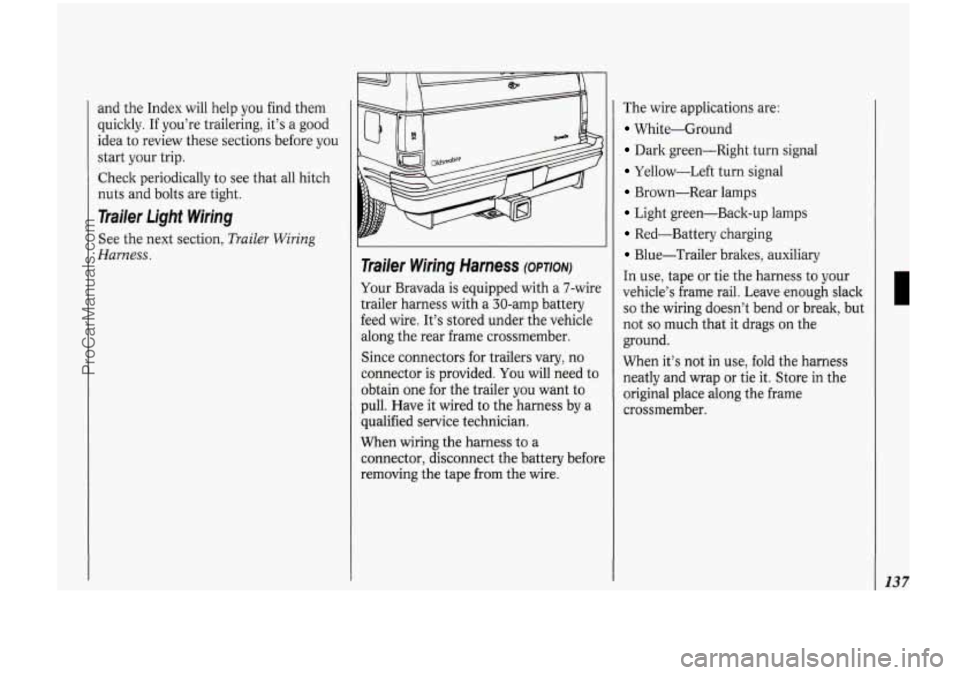
Trailer Wiring Harness (OPTION)
Your Bravada is equipped with a 7-wire
trailer harness with a 30-amp battery
feed wire. It’s stored under the vehicle
along the rear frame crossmember.
Since connectors for trailers vary, no
connector is provided.
You will need to
obtain one for the trailer
you want to
pull. Have it wired to the harness by a
qualified service technician.
When wiring the harness to a
connector, disconnect the battery before
removing the tape from the wire. The
wire applications are:
White-Ground
Dark green-Right turn signal
Yellow-Left turn signal
Brown-Rear lamps
Light green-Back-up lamps
Red-Battery charging
Blue-Trailer brakes, auxiliary
In use, tape or tie the harness to your
vehicle’s frame rail. Leave enough slack
so the wiring doesn’t bend or break, but
not
so much that it drags on the
ground.
When it’s not in use, fold the harness
neatly and wrap or tie it. Store in the
original place along the frame
crossmember.
137
ProCarManuals.com
Page 147 of 248

NOTICE:
~~
Ignoring these steps could result in
costly damage to your vehicle that
wouldn’t be covered by your
warranty. Trying to start your
Oldsmobile by pushing or pulling it
won’t work, and it could damage
your vehicle.
To Jump Start Your Oldsmobile:
1. Check the other vehicle. It must have
a 12-volt battery with a negative
ground system.
NOTICE:
If the other system isn’t a 12-volt
system with a negative ground,
both vehicles can be damaged.
2. Get the vehicles close enough so the
jumper cables can reach, but be sure
the vehicles aren’t touching each
other. If they are, it could cause a
ground connection you don’t want.
You wouldn’t be able to start your
Oldsmobile, and the bad grounding
could damage the electrical systems.
You could be injured if the vehicles roll.
Set the parking brake
firmly on each
vehicle. Put an automatic transmission
in P (Park) or a manual transmission in
N (Neutral).
3. Turn off the ignition on both
vehicles. Turn
off all lights that aren’t
needed, and radios. This will avoid
sparks and help save both batteries.
And it could save your radio!
NOTICE:
If you leave your radio on, it could
be badly damaged. The repairs
wouldn’t be covered by your
warranty.
4. Open the hoods and locate the
batteries. Find the positive
(+) and
negative
(-) terminals on each
battery.
II
141
ProCarManuals.com
Page 151 of 248

When your vehicle is being towed, have
the ignition key off. The steering wheel
should be clamped in a straight-ahead
position, with a clamping device
designed for towing service.
Do not use
the vehicle’s steering column lock for
this. The transmission should be in
P (Park) and the parking brake
released.
Don’t have your Bravada towed with
the wheels in contact with the ground.
If your vehicle is being towed with
sling-type or wheel-lift equipment,
either the front or rear wheels must be
supported on a dolly.
If towing your Bravada with a car
carrier, block supports may be required
to prevent damage to the vehicle.
Engine Overheating
You will find a coolant temperature
;age and the warning light about
a hot
mgine on your Oldsmobile’s instrument
)anel.
If Steam Is Coming From Your
Engine
!45
ProCarManuals.com
Page 157 of 248

Engine Fan Noise
This vehicle has a clutched engine
cooling fan. When the clutch is engaged,
the fan spins faster to provide more air
to cool the engine. In most everyday
driving conditions the clutch is not
engaged. This improves fuel economy
and reduces fan noise. Under heavy
vehicle loading, trailer towing and/or
high outside temperatures, the fan speed
increases when the clutch engages.
So
you may hear an increase in fan noise.
This is normal and should not be
mistaken as the transmission slipping or
making extra shifts. It is merely the
cooling system functioning properly.
The fan will slow down when additional
cooling is not required and the clutch
disengages. You may also hear this fan
noise when you start the engine. It will
go away
as the fan clutch disengages.
I Ifa Tire Goes Flat
It’s unusual for a tire to “blow out”
while you’re driving, especially if you
maintain your tires properly. If air goes
out of a tire, it’s much more likely to
leak out slowly. But if you should ever
have a “blowout,” here are a few tips
about what to expect and what to do:
If a front tire fails, the flat tire
will
create a drag that pulls the vehicle
toward that side. Take your foot
off the
accelerator pedal and grip the steering
wheel firmly. Steer to maintain lane
position, then gently brake to a stop
well out of the traffic lane.
A rear blowout, particularly on a curve,
acts much like a skid and may require
the same correction you’d use in a skid.
In any rear blowout, remove your foot
from the accelerator pedal. Get the
vehicle under control by steering the
way you want the vehicle to go. It may
be very bumpy and noisy, but you can
still steer. Gently brake to a stop, well
off the road if possible.
If a tire goes
flat, the next section shows
how to use your jacking equipment to
change a flat tire safely.
I Changing a Flat Tire
If a tire goes flat, avoid further tire and
wheel damage by driving slowly to a
level place. Turn
on your hazard
warning flashers.
151
ProCarManuals.com
Page 167 of 248

Part 6
Sewice &Appearance Care
Service ........................................................................\
............................................. 162
Fuel
........................................................................\
.................................................. 163
Hood Release
........................................................................\
................................... 165
Engine Oil
........................................................................\
........................................ 168
Air Cleaner
........................................................................\
...................................... 171
Transmission Fluid ........................................................................\
.......................... 172
Axles/Transfer Case
........................................................................\
........................ 174
Engine Coolant
........................................................................\
................................ 174
Power Steering Fluid
........................................................................\
....................... 176
Windshield Washer Fluid ........................................................................\
................
177
Brakes ........................................................................\
.............................................. 178
Battery ........................................................................\
............................................. 180
Bulb Replacement
........................................................................\
........................... 181
Windshield Wiper Blade Replacement ................................................................... 182
..
Loading Your Vehicle ........................................................................\
..................... 183
Tires ........................................................................\
................................................. 185
Appearance Care ........................................................................\
............................. 190
Vehicle Identification Number (VIN)
.................................................................... 195
Add-on Electrical Equipment
........................................................................\
........ 196
Fuses
& Circuit Breakers ........................................................................\
................ 196
Capacities
& Specifications ........................................................................\
............ 199
Normal Maintenance Replacement Parts
............................................................... 200
Fluids & Lubricants ........................................................................\
........................ 201
Replacement Bulbs
........................................................................\
.......................... 202
.
161
ProCarManuals.com
Page 173 of 248

4.3L V6 Engine (CODE w)
When you open the hood, you’ll see:
1. Engine Coolant Recovery Tank
2. Automatic Transmission Dipstick
3. Engine Oil Fill Cap
4. Brake Fluid Reservoir
5. Windshield Washer Fluid Reservoir
6. Air Cleaner
7. Power Steering Fluid Reservoir
8. Engine Oil Dipstick
9. Radiator Pressure Cap
IO. Battery
a
167
ProCarManuals.com
Page 179 of 248

To Check the Fluid Hot or Cold:
Park your vehicle on a level place.
With the parking brake applied, place
With your foot on the brake pedal,
the
shift lever in
P (Park).
move the shift lever through each gear
range, pausing for about three
seconds in each range. Then, position
the shift lever in
P (Park).
minutes or more.
Let the engine run at idle for three Then, Without Shutting off the
Engine, Follow These Steps:
1. Flip the handle up and then pull out
the dipstick and wipe it with a clean
rag or paper towel.
2. Push it back in all the way, wait three
seconds and then pull it back
out
again.
3. Check both sides of the dipstick, and
read the lower level. The fluid level
must be in the
COLD area for a cold
check or in the
HOT area or cross-
hatched area for a hot check.
4. If the fluid level is in the acceptable
range, push the dipstick back in all
the way; then flip the handle down to
lock the dipstick in place.
How to Add FIuid
Refer to the Maintenance Schedule to
determine what kind
of transmission
fluid to use. See
Recommended Fluids
G Lubricants in the index.
If the fluid level is low, add only enough
of the proper fluid to bring the level up
to the COLD area for a cold check or
the HOT area for a hot check. It doesn’t
take much fluid, generally less than a
pint
(OSL) . Don’t overfill. We
recommend you use only fluid labeled
DEXRONB-I11 or DEXRONB-IIE,
because fluids with that label are made
especially for your automatic
transmission. Damage caused by fluid
other than DEXRONB-I11 or
DEXRONB-IIE is not covered by your
new vehicle warranty.
I 73
ProCarManuals.com
Page 184 of 248

Service & Appearance Care
1 78
~-
Brakes
Brake Master Cylinder
Your brake master cylinder is here. It is
filled with DOT-3 brake fluid.
There are only two reasons why the
brake fluid level in your master cylinder
might go down. The first is that the
brake fluid goes down to an acceptable
level during normal brake lining wear.
When new linings are put in, the fluid
level goes back
up. The other reason is
that fluid is leaking
out of the brake
system.
If it is, you should have your
brake system fixed, since a leak means
that sooner or later your brakes won’t
work well, or won’t work at all.
So, it
isn’t a good idea to “top
off’ your brake
fluid. Adding brake fluid won’t correct a leak.
If you add fluid when your linings
are worn, then you’ll have too much
fluid when you get new brake linings.
You should add (or remove) brake
fluid, as necessary, only when work is
done on the brake hydraulic system.
Refer to the Maintenance Schedule to
determine when to check your brake
fluid. See
Periodic Maintenance
Inspections
in the Index.
To Check Brake Fluid
You can check the brake fluid without
taking
off the cap. Just look at the
windows on the brake fluid reservoir.
The fluid levels should be above
MIN. If
they aren’t, have your brake system
checked to see
if there is a leak.
After work is done on the brake
hydraulic system, make sure the levels
are above
MIN and below the top of
each window.
What to Add
When you do need brake fluid, use only
DOT-3 brake fluid
- such as Delco
Supreme
11s (GM Part No.1052535).
Use new brake fluid from a sealed
container only, and always clean the
brake fluid reservoir cap before
removing it.
ProCarManuals.com