coolant temperature OLDSMOBILE BRAVADA 1994 Owners Manual
[x] Cancel search | Manufacturer: OLDSMOBILE, Model Year: 1994, Model line: BRAVADA, Model: OLDSMOBILE BRAVADA 1994Pages: 248, PDF Size: 14.54 MB
Page 16 of 248

How to Use this Manual
These symbols are on some of your
controls: These symbols
are used on warning
and indicator lights: Here
are some other symbols you
may see:
Windshield Wipers
Engine Coolant
Temperature Fuse
w Windshield
Washer
Battery Charging
System Tailgate Window
Windshield Defroster Lighter
Fuel
Rear Window Defogger Horn
Speaker
Engine
Oil Pressure
Rear Window Wiper
Brake
Hood Release
Rear Window
WiperlWasher Anti-Lock Brakes
Ventilating Fan
Power Window
10
ProCarManuals.com
Page 89 of 248

U
E/M sw&h (ELECTRONIC CLUSTER)
To change your electronic display from
English to metric units, or from metric
co English, press this switch down. The
gages affected are:
Speedometer
Odometer
Trip Odometer
Oil Pressure
Engine Coolant Temperature
mn-irrnrIII
The tachometer displays the engine
speed in revolutions per minute (rpm)
.
NOTICE:
Do not operate the engine with the
tachometer in the red area, or
engine
damage may occur.
4"' UNLEADED FUEL ONLY c
he/ Gage (STANDARD CLUSTER)
Your fuel gage tells you about how
much fuel you have left, when the
ignition is on. When the indicator nears
E (Empty), you will have a little fuel left
but should get more soon.
Here are four things that some owners
ask about. None of these show a
problem with your fuel gage:
At the service station, the gas pump
shuts off before the gage reads
F (Full) .
83
ProCarManuals.com
Page 91 of 248

VOLTS
Voltmeter (STANDARD CLUSTER)
Your charging system gage will show
the rate of charge when the engine is
running. When the engine is not
running but the ignition is on (in the
Run position), the display measures thc
voltage output of your battery.
The reading will change as the rate
of
charge changes (with engine speed,
etc.), but readings between the warning
zones indicate the normal operating
range. Readings in either warning zone
indicate a possible problem with your
charging system. Have your Oldsmobilc
serviced immediately.
-100
Engine Coolant Temperature
Gage
(STANDARD CLUSTER)
This gage shows the engine coolant
temperature. If the gage pointer moves
into the red area, your engine is too
hot!
It means that your engine coolant
has overheated.
If you have been operating your vehicle
under normal driving conditions, you
should pull
off the road, stop your
vehicle and turn off the engine as soon
as possible.
HOT COOLANT CAN BURN
YOU
BADLY!
In
Problems on the Road, this manual
shows what to do. See the
Index under
Engine Overheating.
0
0
0
Fuel Gage (ELECTRONIC CLUSTER)
Your fuel gage bars light up when the
ignition is on
to show you about how
much fuel you have left.
When the gage first indicates empty,
you still have
a little fuel left, but you
should get more soon.
A box around the gas pump symbol wil:
flash when your tank is
1/8 full or less.
Here are five things that some owners
ask about. None of these show
a
problem with your fuel gage:
At the service station, the gas pump
shuts
off before the gage reads full.
The top bar does not go out until you
have driven a long distance-about
3r
miles (48 kilometers).
51
85
ProCarManuals.com
Page 94 of 248

Features & Controk
88
Engine Coolant Temperature Gage
pcmoNIc CLUSTER)
This gage has bars that show the engine
coolant temperature.
A box around the temperature symbol
will flash when your engine
is too hot.
It means that your engine coolant has
overheated. If you have been operating
your vehicle under normal driving
conditions, you should pull
off the road,
stop your vehicle and turn
off the
engine as soon as possible.
HOT COOLANT
CAN BURN YOU
BADLY!
In ProbZems on the Road, this manual
shows what to do. See the
Index under
Engine Overheating.
~
Brake System Warning Light
Your Oldsmobile’s hydraulic brake
system is divided into two parts.
If one
part isn’t working, the other part can
still work and stop you. For good
braking, though, you need both parts
working well.
If the warning light comes on, there
could be a brake problem. Have your
brake system inspected right away.
This light should come on as you start
the vehicle. If it doesn’t come on then,
have it fixed
so it will be ready to warn
you
if there’s a problem.
If the light comes on while you are
driving, pull off the road and stop
carefully.
You may notice that the pedal
is harder to push. Or, the pedal may go closer
to the floor. It may take longer to
stop.
If the light is still on, have the
vehicle towed for service. (See
Towing
Your Truck in the Index.)
The brake system warning light will also
come on when you set your parking
brake, and it will stay on
if your parking
brake doesn’t release fully. If it stays
on
after your parking brake is fully released,
it means you have a brake problem.
ProCarManuals.com
Page 99 of 248

ducts at your feet. At times this
temperature difference may be more
apparent than others.
VENT: The vent setting brings in
outside air through the instrument
panel outlets and at your front side
windows.
HTR The heater setting brings in most
heated air through the heater ducts, and
some through the defroster vents.
If you have the optional engine coolant
heater and use it during cold weather,
20°F (-8°C) or lower, your heating
system will more quickly provide heat
because the engine coolant is already
warmed. See the
Index under Engine
Coolant Heater.
most of the warmed air to the
windshield and side windows. Some
will also
go to the floor vents.
The air conditioner will also run in this
setting to remove moisture from the air
when the temperature is above
40°F
(4°C). Adjust the temperature control
as desired.
(Defrost): This setting directs
Defogging and Defrosting
To rapidly defrost the windshield, slide
the temperature control lever all the
way up and select the
(j@ setting.
Adjust the fan to the highest speed.
To rapidly defog the side windows,
select the
BI-LEV AfC setting and
adjust the fan to the highest speed. Aim
the side vents toward the side windows.
For increased air flow to the side vents,
close the center vents.
r
93
ProCarManuals.com
Page 151 of 248

When your vehicle is being towed, have
the ignition key off. The steering wheel
should be clamped in a straight-ahead
position, with a clamping device
designed for towing service.
Do not use
the vehicle’s steering column lock for
this. The transmission should be in
P (Park) and the parking brake
released.
Don’t have your Bravada towed with
the wheels in contact with the ground.
If your vehicle is being towed with
sling-type or wheel-lift equipment,
either the front or rear wheels must be
supported on a dolly.
If towing your Bravada with a car
carrier, block supports may be required
to prevent damage to the vehicle.
Engine Overheating
You will find a coolant temperature
;age and the warning light about
a hot
mgine on your Oldsmobile’s instrument
)anel.
If Steam Is Coming From Your
Engine
!45
ProCarManuals.com
Page 180 of 248

Service & Appearance Care
I
1 74
After adding fluid, recheck the fluid
level as described under
How to
Check.
obtained, push the dipstick back in all
the way.
When the correct fluid level is
I Rear Axle
When to Check and Change
Lubricant
Refer to the Maintenance Schedule to
determine how often to check the
lubricant and when to change it. See
Scheduled Maintenance Services in
the
Index.
How to Check Lubricant
If the level is below the bottom of the
filler plug hole, you’ll need to add some
lubricant. Add enough lubricant to
raise the level to the bottom of the filler
plug hole.
What to Use
Refer to the Maintenance Schedule to
determine what kind of lubricant to use.
See
Recommended Fluids E. Lubricants
in the Index.
I All-Wheel Drive
Transfer Case
When to Check Lubricant
Refer to the Maintenance Schedule to
determine how often to check the
lubricant. See
Periodic Maintenance
Inspections
in the Index.
How to Check Lubricant
If the level is below the bottom of the
filler plug hole, you’ll need to add some
lubricant. Add enough lubricant to
raise the level to the bottom of the filler
plug hole.
What to Use
Refer to the Maintenance Schedule to
determine what kind of lubricant to use.
See
Recommended Fluids G Lubricants
in the Index.
Front Axle
When to Check and Change
Lubricant
Refer to the Maintenance Schedule to
determine how often to check the
lubricant and when to change it. See
Scheduled Maintenance Services in the
Index.
How to Check Lubricant
If the level is below the bottom of the
filler plug hole, you’ll need to add some
lubricant. Add enough lubricant to raise
the level to the bottom of the filler plug
hole.
What to Use
Refer to the Maintenance Schedule to
determine what kind of lubricant to use.
See
Recommended Fluids G Lubricants
in the Index.
I Engine Coolant
The following explains your cooling
system and how to add coolant when it
is low. If you have a problem with
engine overheating, see
Engine
Overheating
in the Index.
The proper coolant for your Oldsmobile
will:
Give freezing protection down to
Give boiling protection up to 258°F
Protect against rust and corrosion.
Help keep the proper engine
-34°F (-37°C).
(125°C).
temperature.
I
ProCarManuals.com
Page 182 of 248

Service & Appearance Care
1 76
To Add Coolant
If you need more coolant, add the proper
mix
at the coolant recovery tank.
Add coolant mix at the recovery tank,
but be careful not
to spill it.
I Radiator Pressure Cap
NOTICE:
Your radiator cap is a 15 psi
(105 1tPa) pressure-type cap and
must be tightly installed
to prevent
coolant
loss and possible engine
damage from overheating. Be sure
the arrows on the cap line up with
the overflow tube
on the radiator
filler neck.
When you replace your radiator
pressure cap, an AC@ cap
is
recommended.
Thermostat
Engine coolant temperature is
controlled by a thermostat in the engine
coolant system. The thermostat stops
the flow
of coolant through the radiator
until the coolant reaches a preset
temperature.
When you replace your thermostat, an
AC@ thermostat is recommended.
I Power Steering Fluid
How To Check Power Steering
Fluid
Unscrew the cap and wipe the dipstick
with a clean rag. Replace the cap and
completely tighten it. Then remove the
cap again and look at the fluid level on
the dipstick.
. When the engine compartment is hot,
the level should be
at the HOT mark.
When the engine compartment is
cool, the level should be at the
FULL
COLD mark.
ProCarManuals.com
Page 216 of 248

210
Explanation of Scheduled
Maintenance Services
Below are explanations of the services
listed in Schedule I and Schedule 11.
The proper fluids and lubricants to use
are listed in Section
D. Make sure
whoever services your vehicle uses
these. All parts should be replaced and
all necessary repairs done before you or
anyone else drives the vehicle.
ITEM SERVICE
NO.
1. Engine Oil and Filter Change* -
Always use SH or SG Energy
Conserving I1 oils of proper viscosity.
The
“SH” or “SG” designation may be
shown alone or in combination with
others, such as “SH/CD,”
“SH, SG,
CD,” “SG/CD,” etc. To determine the
preferred viscosity for your vehicle’s engine (e.g., SAE 5W-30 or SAE 1OW-
30), see the Index under Engine Oil.
2. Chassis Lubrication - Lubricate the
transmission shift linkage, parking
brake cable guides, underbody contact points and linkage. Lubricate the front
suspension and steering linkage.
3. Tire and Wheel Rotation and
Inspection
- For proper wear and
maximum tire life, rotate your tires
following the instructions
in this
manual. See
Tires, Inspection G.
Rotation in the Index. Check the
tires for uneven wear or damage. If
you see irregular or premature wear,
check the wheel alignment. Check for
damaged wheels also.
Inspection - Inspect the drive belt
for cracks, fraying, wear and proper
tension. Replace as needed.
5. Cooling System Service‘: - Drain,
flush and refill the system with new
or approved recycled coolant
conforming to
GM Specification
6038-M. Keep coolant at the proper
mixture as specified. See
CooZant in
the
Index. This provides proper
freeze and boil protection, corrosion
inhibitor level and maintains proper
engine operating temperature.
Inspect hoses and replace if they are
cracked, swollen or deteriorated.
Tighten screw-type hose clamps. Clean the outside of the radiator and
air conditioning condenser. Wash the
pressure cap and neck.
4. Engine Accessory Drive Belt
To help ensure proper operation, we
recommend
a pressure test of both the
cooling system and the pressure cap.
6. Transmission Service - Change
both the fluid and filter every 15,000
miles
(25 000 lun) if the vehicle is
mainly driven under one or more of
these conditions:
In heavy city traffic where the
outside temperature regularly
reaches
90°F (32°C) or higher.
In hilly or mountainous terrain.
When doing frequent trailer towing.
Uses such as found in taxi, police
If you do not use your vehicle under
any of these conditions, change both
the fluid and filter every
100,000
miles (166 000 lun) .
Replace spark plugs with the proper
type. See
Replacement Parts in the
Index.
8. Spark Plug Wire Inspection‘%t -
Inspect for burns, cracks or other
damage. Check the boot
fit at the
coils and at the spark plugs. Replace
wires as needed.
car
or delivery service.
7. Spark Plug Replacement” -
ProCarManuals.com
Page 240 of 248
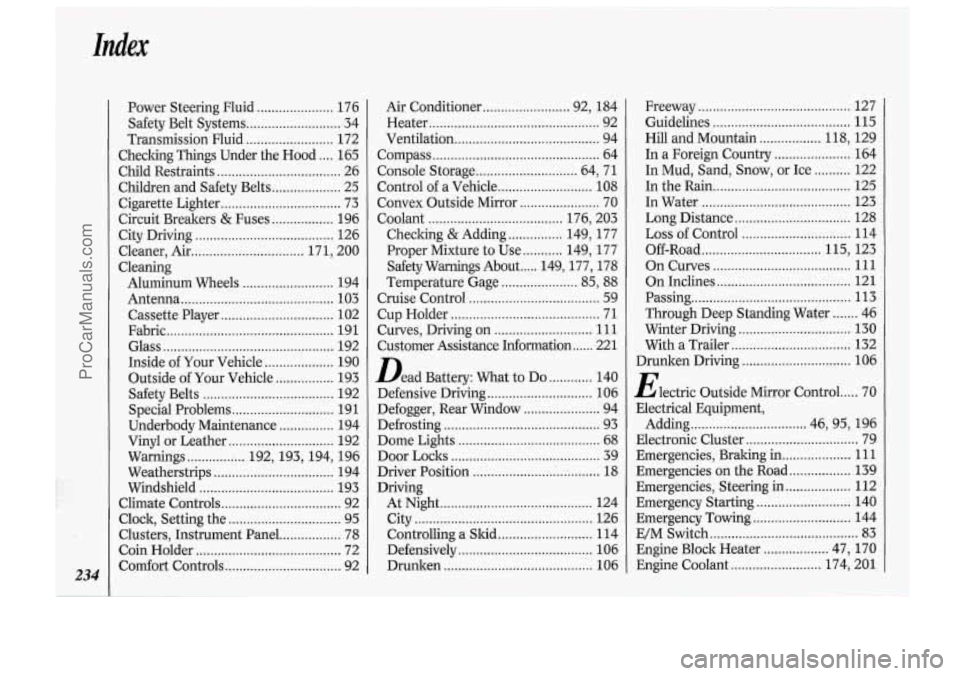
234
Power Steering Fluid ..................... 176
Safety Belt Systems
.......................... 34
Transmission Fluid
........................ 172
Child Restraints
.................................. 26
Children and Safety Belts
................... 25
Cigarette Lighter
................................. 73
Circuit Breakers
& Fuses ................. 196
Checking Things Under
the Hood
.... 165
City Driving
...................................... 126
Cleaner. Air
............................... 171. 200
Cleaning Aluminum Wheels
......................... 194
Antenna
.......................................... 103
Cassette Player
............................... 102
Fabric .............................................. 191
Glass
............................................... 192
Inside
of Your Vehicle ................... 190
Outside
of Your Vehicle ................ 193
Safety Belts
.................................... 192
Special Problems
............................ 191
Vinyl or Leather
............................. 192
Warnings
................ 192. 193. 194. 196
Weatherstrips
................................. 194
Underbody
Maintenance
............... 194
Windshield
..................................... 193
Climate Controls
................................. 92
Clock. Setting the
............................... 95
Clusters. Instrument Panel
................. 78
Coin Holder
........................................ 72
Comfort Controls
................................ 92 Air Conditioner
........................ 92.
184
Heater
............................................... 92
Ventilation 94 .. ........................................
Compass .............................................. 64
Control
of a Vehicle .......................... 108
Convex Outside Mirror
...................... 70
Coolant
..................................... 176. 203
Console
Storage
............................ 64. 71
Checking
& Adding ............... 149. 177
Proper Mixture to
Use ........... 149. 177
Safety Warnings About ..... 149.177. 178
Temperature Gage ..................... 85. 88
Cruise Control .................................... 59
Curves. Driving on
........................... 111
Customer Assistance Information ...... 221
Cup
Holder
......................................... 71
Dead Battery: What to Do
............ 140
Defensive Driving
............................. 106
Defogger. Rear Window
..................... 94
Defrosting
........................................... 93
Dome Lights
....................................... 68
Door Locks
......................................... 39
Driver Position
...................... ............ 18
Driving At Night
.......................................... 124
City
................................................. 126
Controlling a Slid
.......................... 114
Defensively
..................................... 106
Drunken
......................................... 106 Freeway
.......................................... 127
Guidelines
...................................... 115
Hill and Mountain ................. 118. 129
In a Foreign Country
..................... 164
In Mud. Sand. Snow. or Ice
.......... 122
In the Rain
...................................... 125
In Water
......................................... 123
Loss of Control
.............................. 114
Off-Road
................................. 115. 123
On Curves
...................................... 111
On Inclines ..................................... 121
Through Deep Standing Water
....... 46
Winter Driving
............................... 130
With a Trailer
................................. 132
Drunken Driving
.............................. 106
Long
Distance
................................ 128
Passing.,
.......................................... 113
Electric Outside Mirror Control ..... 70
Electrical Equipment.
Adding
................................ 46. 95. 196
Electronic Cluster
............................... 79
Emergencies on the Road
................. 139
Emergencies. Braking
in
................... 111
Emergencies. Steering in .................. 112
Emergency Starting
.......................... 140
Emergency Towing
........................... 144
Engine Coolant
......................... 174. 201
E/M Switch ......................................... 83
Engine Block Heater
.................. 47. 170
.
ProCarManuals.com