fuel OLDSMOBILE BRAVADA 1994 Owners Manual
[x] Cancel search | Manufacturer: OLDSMOBILE, Model Year: 1994, Model line: BRAVADA, Model: OLDSMOBILE BRAVADA 1994Pages: 248, PDF Size: 14.54 MB
Page 16 of 248

How to Use this Manual
These symbols are on some of your
controls: These symbols
are used on warning
and indicator lights: Here
are some other symbols you
may see:
Windshield Wipers
Engine Coolant
Temperature Fuse
w Windshield
Washer
Battery Charging
System Tailgate Window
Windshield Defroster Lighter
Fuel
Rear Window Defogger Horn
Speaker
Engine
Oil Pressure
Rear Window Wiper
Brake
Hood Release
Rear Window
WiperlWasher Anti-Lock Brakes
Ventilating Fan
Power Window
10
ProCarManuals.com
Page 52 of 248

Features & Controh
46
1. Without pushing the accelerator
pedal, turn your ignition key to
Start.
When the engine starts, let go of the
key. The idle speed will go down as
your engine gets warm.
NOTICE:
Holding your key in Start for longer
than
15 seconds at a time will cause
your battery to be drained much
sooner. And the excessive heat can
damage your starter motor.
2. If it doesn’t start right away, hold your
key in
Start. If it doesn’t start in three
seconds, push the accelerator pedal
about one-quarter of the way down for
12 more seconds, or until it starts,
3. If your engine still won’t start (or
starts but then stops), it could be
flooded with too much gasoline. Try
this: Wait
15 seconds to let the
starter motor cool down. Then push
your accelerator pedal all the way to
the floor. Hold it there. Then,
hold
the key in Start for no more than ten
seconds. This clears the extra
gasoline from the engine. If
the engine still doesn’t start, wait
another
15 seconds and do it all again.
When the engine starts, let go of the
key and the accelerator pedal.
NOTICE:
Your engine is designed to work
with the electronics in your vehicle.
If you add electrical parts or
accessories, you could change the
way the fuel injection system
operates. Before adding electrical
equipment, check with your dealer.
If
you don’t, your engine might not
perform properly. If you ever have
to have your vehicle towed, see the
part of this manual that tells how to
do it without damaging your
vehicle. See
Towing Your Truck in
the
Index.
Driving llzrough Deep
Standing Water
NOTICE:
If you drive too quickly through
deep puddles or standing water,
water can come in through your
engine’s air intake and badly damage
your engine. If you can’t avoid deep
puddles or standing water, drive
through them very slowly.
ProCarManuals.com
Page 53 of 248

Engine Coolant Heater (Engine
Block Heater)
(OPTION)
In very cold weather, 0°F (-18°C) or
colder, the engine coolant heater can
help.
You’ll get easier starting and
better fuel economy during engine
warm-up. Usually, the coolant heater
should be plugged in a minimum of four
hours prior to starting your vehicle.
To use the coolant heater:
1. Turn off the engine.
2. Open the hood and unwrap the
3. Plug it into a normal, grounded 110-
electrical cord.
volt outlet.
NOTICE:
After you’ve used the coolant
heater, be sure to store the cord as
it was before to keep it away from
moving engine parts. If you don’t, it
could be damaged. How long
should you keep the coolant
warmer plugged in? The answer
depends on the weather, the kind of oil
you have, and some other things.
Instead of trying to list everything here,
we ask that you contact an Oldsmobile
dealer
in the area where you’ll be
parking your vehicle. The dealer can
give you the best advice for that
particular area. I
ProCarManuals.com
Page 56 of 248

Features & Controls
50
Forward Gears
ID1 (Automatic Overdrive): This
position is for normal driving.
If you
need more power for passing, and
you’re:
Going less than 35 mph (56 km/h),
push your accelerator pedal about
halfway down.
Going about 35 mph (56 ltm/h) or
more, push the accelerator pedal all
the way down.
You’ll shift down to the next gear and
have more power.
D (Third Gear): This position is like
(Dl, but you never go into Overdrive.
Here are some times you might choose
D instead of [D):
When driving on hilly, winding roads.
When towing a trailer, so there is less
When going down a steep hill.
2 (Second Gear): This position gives
you more power but lower fuel
economy.
You can use 2 on hills. It can
help control your speed as you go down
steep mountain roads, but then you
would also want to use your brakes off
and on.
1 (First Gear): This position gives you
even more power (but lower fuel
economy) than
2. You can use it on
very steep hills, or in deep snow or
mud.
If the shift lever is put in 1, the
transmission won’t shift into first gear
until the vehicle
is going slowly enough.
shifting between gears.
NOTICE:
If
your rear wheels can’t rotate,
don’t try to drive. This might
happen if you were
stuck in very
deep sand or mud or were up
against a solid object.
You could
damage your transmission or
transfer case or both. Also, if you
stop when going uphill, don’t hold
your vehicle there with only the
accelerator pedal. This could
overheat and damage the
transmission.
Use your brakes or
shift into P (Park) to hold your
vehicle in position on
a hill.
Locking Rear Axle
Your rear axle can give you additional
traction on snow, mud, ice, sand or
gravel. It works like a standard axle
most
of the time, but when one of the
rear wheels has no traction and the
other does, the locking feature will
allow the wheel with traction to move
the vehicle.
ProCarManuals.com
Page 83 of 248

The Instrument Panel-Your
Information System
Your instrument panel is designed to let
you know at a glance how your vehicle
is running. You’ll know how fast you’re
going, how much fuel you’re using, and
many other things you’ll need to drive
safely and economically.
The main components
of your
instrument panel are:
1. Side Vents
2. Side Window Defogger
3. Rear Window Wipermasher
4. Rear Window Defogger
5. Light Controls
6. Tilt Steering Wheel Lever
7. Instrument Cluster
8. Gearshift Lever
9. Climate Controls
IO. Lighter
11. Center Vents
12. Glove Box
13. Side Window Defogger
14. Side Vents
15. Audio System
16. Ashtray
17. Tailgate Window Release
18. Power Remote Control Mirrors
19. Ignition Switch
20. Hazard Warning Flashers Switch
21. Horn
22. Fuse Panel (under instrument
panel)
23. Hood Release
24. Turn Signal/Multifunction Lever
25. Parking Brake Release
77
ProCarManuals.com
Page 85 of 248
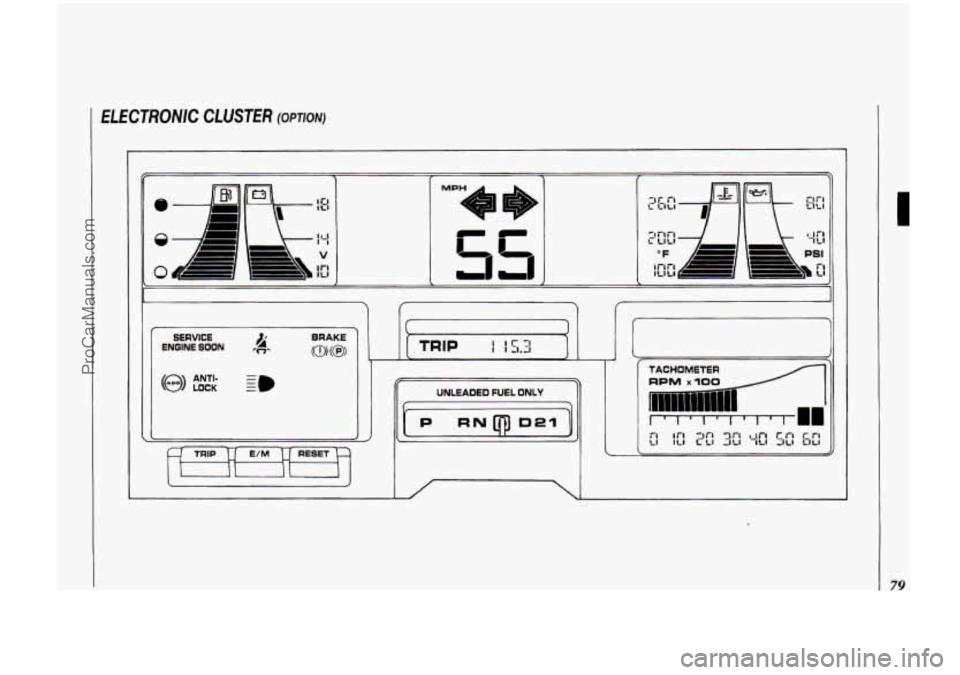
ELECTRONIC CLUSTER (OPTION)
3-
1
UNLEADED FUEL ONLY
II L .
"F
TACHoMETERl~ RPM x100
I/ I
I
79
ProCarManuals.com
Page 88 of 248

82
ll
UNLEADED FUEL ONLY
Odometer and Trip
Odometer (ELECTRONIC CLUSTER)
Your odometer shows how far your
vehicle has been driven, in either miles
(used in the
U.S.) or kilometers (used
in Canada). Your trip odometer tells
how far you have driven since you last
reset it.
kE.GE+ F ELONLY
Trip mileage appears in place of the
regular odometer reading when you
press the
TRIP switch down. To
change back to the regular odometer,
press the TRIP switch again.
Your Oldsmobile has
a tamper
resistant odometer. The odometer will
read
ERROR if someone has tampered
with it.
You may wonder what happens
if your
vehicle needs a new odometer installed.
If the new one can be set to the mileage
total of the old odometer, then it must
be. But
if it can’t, then it’s set at zero
and a label must be put on the driver’s
door to show the old mileage reading
when the new odometer was installed.
To set the trip odometer to zero, press
:he
TRIP switch to display the trip
ldometer. Then, press the
RESET
;witch.
ProCarManuals.com
Page 89 of 248

U
E/M sw&h (ELECTRONIC CLUSTER)
To change your electronic display from
English to metric units, or from metric
co English, press this switch down. The
gages affected are:
Speedometer
Odometer
Trip Odometer
Oil Pressure
Engine Coolant Temperature
mn-irrnrIII
The tachometer displays the engine
speed in revolutions per minute (rpm)
.
NOTICE:
Do not operate the engine with the
tachometer in the red area, or
engine
damage may occur.
4"' UNLEADED FUEL ONLY c
he/ Gage (STANDARD CLUSTER)
Your fuel gage tells you about how
much fuel you have left, when the
ignition is on. When the indicator nears
E (Empty), you will have a little fuel left
but should get more soon.
Here are four things that some owners
ask about. None of these show a
problem with your fuel gage:
At the service station, the gas pump
shuts off before the gage reads
F (Full) .
83
ProCarManuals.com
Page 90 of 248

Features & Conlroh
84
It takes a little more or less fuel to fill
up than the gage indicated. For
example, the gage may have indicated
the tank was half full, but it actually
took a little more or less than half the
tank’s capacity to fill the tank.
The gage moves a little when you turn
a corner or speed up.
The gage doesn’t go back to E when
you turn
off the ignition.
For your fuel tank capacity, see
Service
Station
Information on the last page of
this manual.
Oil Pressure Gage (STANDARD
CLUSTER)
Your oil pressure gage shows the oil
pressure in psi (pounds per
square
inch) when the engine is running. Oil
pressure may vary with engine speed,
outside temperature and oil viscosity.
Driving your vehicle with low oil
pressure can cause extensive engine
damage. Have your vehicle serviced
immediately.
NOTICE:
Damage to your engine Gom
neglected
oil problems can be costly
and is not covered by your warranty.
ProCarManuals.com
Page 91 of 248

VOLTS
Voltmeter (STANDARD CLUSTER)
Your charging system gage will show
the rate of charge when the engine is
running. When the engine is not
running but the ignition is on (in the
Run position), the display measures thc
voltage output of your battery.
The reading will change as the rate
of
charge changes (with engine speed,
etc.), but readings between the warning
zones indicate the normal operating
range. Readings in either warning zone
indicate a possible problem with your
charging system. Have your Oldsmobilc
serviced immediately.
-100
Engine Coolant Temperature
Gage
(STANDARD CLUSTER)
This gage shows the engine coolant
temperature. If the gage pointer moves
into the red area, your engine is too
hot!
It means that your engine coolant
has overheated.
If you have been operating your vehicle
under normal driving conditions, you
should pull
off the road, stop your
vehicle and turn off the engine as soon
as possible.
HOT COOLANT CAN BURN
YOU
BADLY!
In
Problems on the Road, this manual
shows what to do. See the
Index under
Engine Overheating.
0
0
0
Fuel Gage (ELECTRONIC CLUSTER)
Your fuel gage bars light up when the
ignition is on
to show you about how
much fuel you have left.
When the gage first indicates empty,
you still have
a little fuel left, but you
should get more soon.
A box around the gas pump symbol wil:
flash when your tank is
1/8 full or less.
Here are five things that some owners
ask about. None of these show
a
problem with your fuel gage:
At the service station, the gas pump
shuts
off before the gage reads full.
The top bar does not go out until you
have driven a long distance-about
3r
miles (48 kilometers).
51
85
ProCarManuals.com