fuel cap OLDSMOBILE BRAVADA 1994 Owners Manual
[x] Cancel search | Manufacturer: OLDSMOBILE, Model Year: 1994, Model line: BRAVADA, Model: OLDSMOBILE BRAVADA 1994Pages: 248, PDF Size: 14.54 MB
Page 90 of 248

Features & Conlroh
84
It takes a little more or less fuel to fill
up than the gage indicated. For
example, the gage may have indicated
the tank was half full, but it actually
took a little more or less than half the
tank’s capacity to fill the tank.
The gage moves a little when you turn
a corner or speed up.
The gage doesn’t go back to E when
you turn
off the ignition.
For your fuel tank capacity, see
Service
Station
Information on the last page of
this manual.
Oil Pressure Gage (STANDARD
CLUSTER)
Your oil pressure gage shows the oil
pressure in psi (pounds per
square
inch) when the engine is running. Oil
pressure may vary with engine speed,
outside temperature and oil viscosity.
Driving your vehicle with low oil
pressure can cause extensive engine
damage. Have your vehicle serviced
immediately.
NOTICE:
Damage to your engine Gom
neglected
oil problems can be costly
and is not covered by your warranty.
ProCarManuals.com
Page 92 of 248

Features & Con&olk
86
It takes a little more or less fuel to fill
up than the gage indicated. For
example, the gage may have indicated
the tank was half full, but it actually
took a little more or less than half the
tank's capacity to fill the tank.
The gage moves a little when you turn
a corner or speed up.
The tank is not necessarily empty
when the last bar goes out. There is a
1 to 1.5 gallon (4 to 5.6 L) fuel
reserve.
For your fuel tank capacity, see
Service
Station Information on the last page of
this manual.
E
I
Oil Pressure Gage (ELECTRONIC
J 1
CLUSTER)
Your oil pressure gage shows the oil
pressure in psi (pounds per square
inch) when the engine is running. Oil
pressure may vary with engine speed,
outside temperature and oil viscosity.
If you have a problem with your oil, the
box around the oil pressure symbol may
begin to flash
after you start your
engine, or when
you are driving. This
indicates that oil is not going through
your engine quickly enough to keep it
cool. The engine could be low on oil, or
could have
some other oil problem.
Have it
fixed right away.
NOTICE:
Damage to your engine fcom
neglected oil problems can be costly
and is not covered by your warranty.
ProCarManuals.com
Page 98 of 248

Comfort Cont'rok &Audio Systems
LO HI
Climate Control System
Your vehicle's heater and air
conditioner work best
if you keep your
windows closed. Your vehicle also has
flow-through ventilation, described later
in this section, to bring outside air into
your vehicle.
3f Fan Lever: The lever at the top has
four positions. Move it toward
HI to
increase the air flow. To decrease the
air flow, move it toward
LO.
Temperature Lever: Slide the lever on
the left to control the temperature of the
air flow into the vehicle. Move the lever
up for warmer air, down for cooler air.
Function Lever: Slide the lever on the
right to select the function desired. The
air conditioner compressor will operate
in all settings except
VENT and HTR
(Heater) when the outside temperature
is above freezing. When the air
conditioner compressor cycles
on, you
may sometimes notice slight changes in
your vehicle's engine performance and
power. This is normal, because the
system is designed to keep the desired
cooling level and help fuel economy. There are
three air conditioning
settings:
MAX A/C, NORM A/C, and
BI-LEV A/C. On very hot days, your
vehicle will cool down more quickly and
economically in any of these settings
if
you open the windows long enough to
let hot inside air escape. For all settings,
adjust the temperature control lever and
fan speed as desired.
MAX A/C: Select this setting to get
maximum cooling or quick cool-down
on very hot days. This setting
recirculates much of the air inside your
vehicle. It should not be used for long
periods
of time because the air may
become too cold and dry.
Also slide the temperature control lever
down to the coolest setting and adjust
the fan speed as desired.
NORM A/C: Use this setting for
normal cooling on hot days. This setting
cools outside air and directs it through
the instrument panel outlets.
BI-LEV A/C: Use on cool but sunny
days. This setting brings in outside air,
but directs it two ways-through the
instrument panel outlets and the heater
ProCarManuals.com
Page 121 of 248

Driving Guidelines
This multipurpose passknger vehicle is
defined as a utility vehicle in Consumer
Information Regulations issued by the
National Highway Traffic Safety
Administration (NHTSA) of the United
States Department of Transportation.
Utility vehicles have higher ground
clearance and a narrower track to make
them capable of performing in a wide
variety of off-road applications. Specific
design characteristics give them a
higher center of gravity than ordinary
cars. An advantage of the higher ground
clearance is a better view of the road
allowing you to anticipate problems.
They are not designed for cornering at
the same speeds as conventional
2-
wheel drive vehicles any more than low-
slung sports cars are designed to
perform satisfactorily under off-road
conditions.
If at all possible, avoid sharp
turns or abrupt maneuvers. As with
other vehicles of this type, failure to
operate this vehicle correctly may result
in loss of control or vehicle rollover.
3perating Your Bravada Off
Paved Roads
Many of the same design features that
help make Bravada responsive on paved
roads during poor weather conditions
-
features like the locking rear axle and all-
wheel drive - help make it much better
suited for off-road use than a
conventional passenger
car. Its higher
ground clearance also helps Bravada step
over some off-road obstacles. But
Bravada doesn’t have features like special
underbody shielding and a transfer case
low gear range, things that are usually
thought necessary for extended or severe
off-road service.
This guide is for
operating your Bravada off paved roads.
Also, see Anti-Lock Brakes in the Index.
Off-road driving can be great fun. But it
does have some definite hazards. The
greatest of these is the terrain itself.
“Off-roading” means you’ve left the
great North American road system
behind. Traffic lanes aren’t marked.
Curves aren’t banked. There are no
road signs. Surfaces can be slippery,
rough, uphill or downhill. In short,
you’ve gone right back to nature.
Off-road driving involves some new
skills. And that’s why it’s very
important that
you read this guide.
You’ll find many driving tips and
suggestions. These will help malte your
off-road driving safer and more
enjoyable.
Before You Go Ofi-Roading
There are some things to do before you
go out. For example, be sure to have all
necessary maintenance and service
work done. Be sure you read all the
information about your all-wheel drive
vehicle in this manual.
Is there enough
fuel? Is the spare tire fully inflated? Are
the fluid levels up where they should
be? What are the local laws that apply
to off-roading where you’ll be driving?
115
ProCarManuals.com
Page 167 of 248

Part 6
Sewice &Appearance Care
Service ........................................................................\
............................................. 162
Fuel
........................................................................\
.................................................. 163
Hood Release
........................................................................\
................................... 165
Engine Oil
........................................................................\
........................................ 168
Air Cleaner
........................................................................\
...................................... 171
Transmission Fluid ........................................................................\
.......................... 172
Axles/Transfer Case
........................................................................\
........................ 174
Engine Coolant
........................................................................\
................................ 174
Power Steering Fluid
........................................................................\
....................... 176
Windshield Washer Fluid ........................................................................\
................
177
Brakes ........................................................................\
.............................................. 178
Battery ........................................................................\
............................................. 180
Bulb Replacement
........................................................................\
........................... 181
Windshield Wiper Blade Replacement ................................................................... 182
..
Loading Your Vehicle ........................................................................\
..................... 183
Tires ........................................................................\
................................................. 185
Appearance Care ........................................................................\
............................. 190
Vehicle Identification Number (VIN)
.................................................................... 195
Add-on Electrical Equipment
........................................................................\
........ 196
Fuses
& Circuit Breakers ........................................................................\
................ 196
Capacities
& Specifications ........................................................................\
............ 199
Normal Maintenance Replacement Parts
............................................................... 200
Fluids & Lubricants ........................................................................\
........................ 201
Replacement Bulbs
........................................................................\
.......................... 202
.
161
ProCarManuals.com
Page 171 of 248
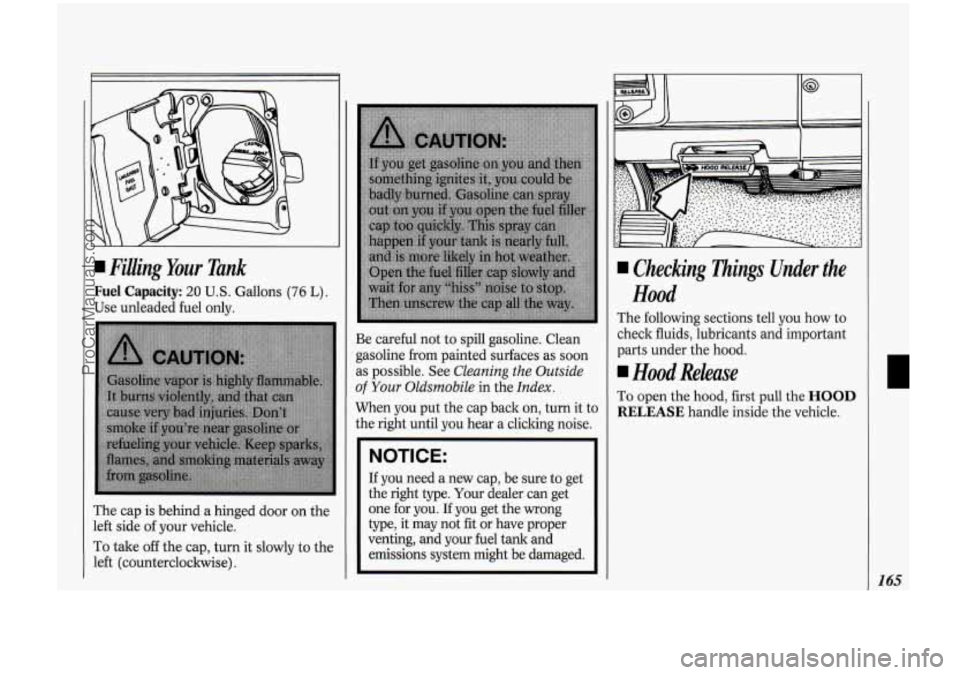
Filling Your Tank
Fuel Capacity: 20 U.S. Gallons (76 L)
Use unleaded fuel only.
The cap is behind a hinged door on the
left side
of your vehicle.
To take
off the cap, turn it slowly to the
left (counterclockwise). Be
careful not to spill gasoline. Clean
gasoline from painted surfaces as soon
as possible. See
Cleaning the Outside
of Your Oldsmobile in the Index.
When you put the cap back on, turn it to
the right until you hear a clicking noise.
NOTICE:
If you need a new cap, be sure to get
the right type.
Your dealer can get
one for you. If you get the wrong
type, it may not fit
or have proper
venting, and your fuel tank and
emissions system might be damaged.
rn I IP I
I Checking fiings Under the
Hood
The following sections tell you how to
check fluids, lubricants and important
parts under the hood.
Hood Release
To open the hood, first pull the HOOD
RELEASE handle inside the vehicle.
165
ProCarManuals.com
Page 174 of 248

Service & Appearance Care
168
Engine Oil
It’s a good idea to check your engine oil
every time you get fuel. In order to get
an accurate reading, the oil must be
warm and the vehicle must be on level
ground.
Turn off the engine and give the oil a
few minutes to drain back into the oil
pan.
If you don’t, the oil dipstick might
not show the actual level.
To Check Engine Oil
Pull out the dipstick and clean it with a
paper towel or cloth, then push it back
in all the way. Remove it again, keeping
the tip lower.
When to Add Oil
If the oil is at or below the ADD line,
then you’ll need to add some oil. But
you must use the right kind. This
section explains what kind of oil to use.
For crankcase capacity, see
Capacities
G. Specifications in the Index.
NOTICE:
Don’t add too much oil. If your
engine has
so much oil that the oil
level gets above the cross-hatched
area that shows the proper operating
range, your engine could be damaged.
~~
Just fill it enough to put the level
somewhere in the proper operating
range. Push the dipstick all the way
back in when you’re through.
ProCarManuals.com
Page 189 of 248

I
1
1
1
1
1
i 1
i
i
i
1
MFD BY GENERAL MOTORS COW XXlKx
c- GAWRFRT CAWRRR
THIS VEHICLE CONFORMS TO ALL APPLICABLE US. FEDERAL
OF MANUPACTURE SwOwN ABOVE. MOTOR w1ICLE SAFEl’Y STANDARDS IN EPFECT ON TAE DATE
MODEL:
WAX
RR FRT
SPA LmG
SERIAL
NUMBER M.P.V.
SPEED PAYLOAD
TIRESIZE
RTC RIM PSVWA (COLD)
SEE
OWNER’S MANUAL POR ADDITIONAL INPORMATlON
Loading Your Vehicle
The Certificatioflire label is found on
the rear edge of the driver’s door. The
label shows the size of your original
tires and the inflation pressures needed
to obtain the
gross weight capacity of
your vehicle.
This is called the GVWR
(Gross Vehicle Weight Rating). The
GVWR includes the weight of the
vehicle, all occupants, fuel and cargo.
The Certificationnire label also tells
you the maximum weights for the front
md rear axles, called Gross Axle
Weight Rating (GAWR). To find out the
3ctual loads on your front and rear
des, you need to go to a weigh station
md weigh your vehicle. Your dealer can
help
you with this. Be sure to spread out
your load equally on both sides of
the centerline.
Never exceed the GVWR for your
vehicle, or the Gross Axle Weight
Rating (GAWR) for either the front or
rear axle.
And,
if you do have a heavy load, you
should spread it out. Using heavier
suspension components
to get added durability might not
change your weight ratings. Ask your
dealer to help you load your vehicle the
right way. NOTICE:
Your warranty does not cover parts
or components that fail because of
overloading.
If you put things inside your vehicle -
like suitcases, tools, packages, or
anything else
- they will go as fast as
the vehicle goes. If you have to stop or
turn quickly, or
if there is a crash,
they’ll keep going.
183
ProCarManuals.com
Page 190 of 248

Sewice & Appearance Care
Payload
The Payload Capacity is shown on the
Certificationflire label. This is the
maximum load capacity that your
vehicle can carry. Be sure to include the
weight of the people inside as part of
your load. If you added any accessories
or equipment after your vehicle left the
factory, remember to subtract the weight
of these things from the payload.
Your dealer can help you with this.
Trailering Package
If your vehicle comes with the trailering
package, there is also a load rating
which includes the weight of the vehicle
and the trailer it tows. This rating is
called the Gross Combination Weight
Rating (GCWR)
.
When you weigh your trailer, be sure to
include the weight of everything you put
in it. And, remember to figure the weight
of the people inside as part
of your load.
Your dealer can help you determine
your GCWR.
Add-on Equipment
When you carry removable items, you
may need to put a limit on how many
people you carry inside your vehicle. Be
sure to weigh your vehicle before you
buy and install the new equipment.
NOTICE:
Your warranty doesn’t cover parts
or components that fail because of
overloading.
I Single Belt Accessory Drive
Your new vehicle uses a serpentine belt
that is lighter, more durable and fuel
efficient than systems with several belts.
The belt runs over or around the pulleys
on the engine.
A tensioner is used to
keep the belt tight at all times. The
tensioner also makes replacing the belt
easier.
If you need to replace the belt, be
sure to get the correct replacement belt.
Your dealership or parts supplier can
help you with this. The Accessory Drive
Belt Routing label on your vehicle will
show you how to route the belt your
vehicle uses.
I Air Conditioning
Every now and then have your
dealership check your air conditioning
system to be sure it has not lost any
cooling ability. If you think the system
is not working properly, have your
dealership check it out as soon as
possible.
The air conditioning will not work when
the temperature is below
40°F (4°C).
ProCarManuals.com
Page 192 of 248

Service & Appearance Care
186
Inflation-Tire Pressure
The Certification/Tire label which is
on the rear edge
of the driver’s door
shows the correct inflation pressures
for your tires, when they’re cold.
“Cold” means your vehicle has been
sitting for at least three hours or driven
no more than
a mile. Also see
Capacities G Specifications in the
Index.
NOTICE:
Don’t let anyone tell you that
underinflation
or overinflation is all
right. It’s not. If your tires don’t
have enough air (underinflation)
you can get:
Too much flexing
Too much heat
Tire overloading
Bad wear
Bad handling
Bad fuel economy.
If your tires have too much air
(overinflation)
) you can get:
Unusual wear
Bad handling
Rough ride
Needless damage from road
hazards.
When to Check
Check your tires once a month or more.
Also, check the tire pressure
of the
spare tire.
How to Check
Use a good quality pocket-type gage to
check tire pressure. Simply looking at
the tires will not tell you the pressure,
especially if you have radial tires
-
which may look properly inflated even if
they’re underinflated.
If your tires have valve caps, be sure to
put them back on. They help prevent
leaks by keeping out dirt and moisture.
ProCarManuals.com