transmission OLDSMOBILE BRAVADA 1996 Owner's Manual
[x] Cancel search | Manufacturer: OLDSMOBILE, Model Year: 1996, Model line: BRAVADA, Model: OLDSMOBILE BRAVADA 1996Pages: 340, PDF Size: 17.49 MB
Page 209 of 340

Return the jack, wheel wrench and wheel blocks to the
proper location
in your vehicle’s rear area. Secure the
items and replace the
jack cover.
L
A. Retainer E Wheel Blocks
B. Rubber Band G. Hub Cap
(Some Models) Removal
Tool
C.
Work Gloves H. Wheel Wrench
D. Mat I. Jack
E. Jack Storage Cover J. Jacking Instructions
If You’re Stuck: In Sand, Mud,
Ice or Snow
r vehicle is stuck is What you don’t want to do wne
to spin your wheels too fast. The method known as
“rocking” can help you get out when you’re stuck, but
you must use caution.
If you let your tires spin at high speed, they can
explode, and you or others could be injured.
And, the transmission or other parts
of the
vehicle can overheat. That could cause an engine
compartment fire or other damage. When you’re stuck, spin the wheels as little as possible. Don’t
spin the wheels above 35 mph
(55 kmh) as shown
on the speedometer.
ProCarManuals.com
Page 210 of 340
I NOTICE:
Spinning your wheels can destroy parts of your
vehicle as well as the tires.
If you spin the wheels
too fast while shifting your transmission back
and forth, you can destroy your transmission.
For information about using tire chains on your vehicle,
see “Tire Chains” in the Index.
Rocking your vehicle to get it out:
First, turn your steering wheel left and right. That will
clear the area around your front wheels. Then shift back
and forth between REVERSE (R) and a forward gear,
spinning the wheels as little as possible. Release the
accelerator pedal while you shift, and press lightly on
the accelerator pedal when the transmission is in gear. If
that doesn’t get you out after a few tries, you may need
to be towed out. Or, you can use your recovery hooks if
your vehicle has them.
If you do need to be towed out,
see “Towing Your Vehicle” in the Index.
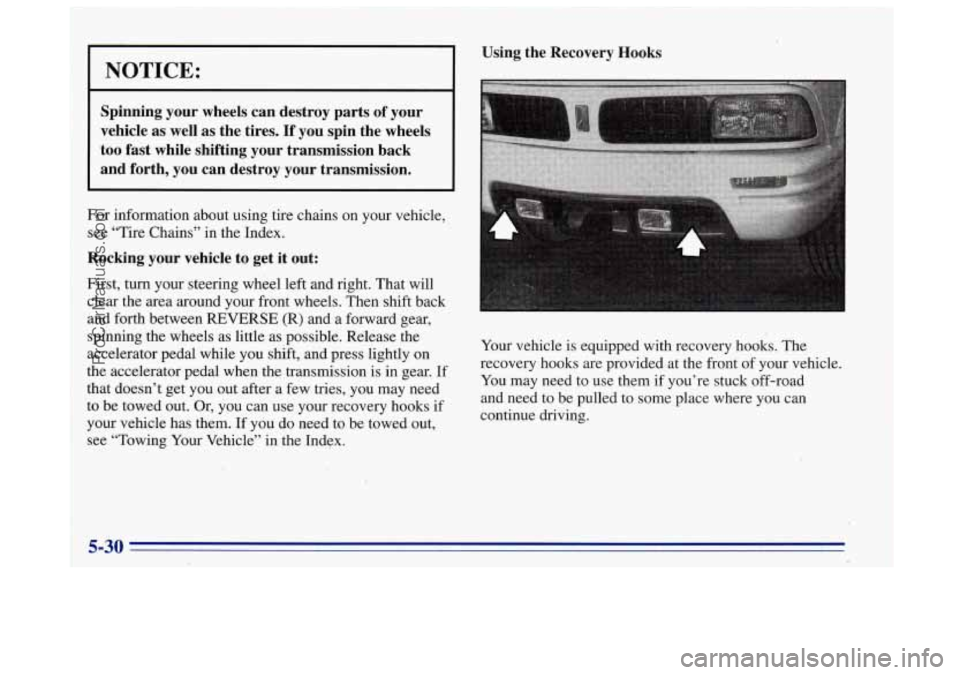
Using the Recovery Hooks
Your vehicle is equipped with recovery hooks. The
recovery hooks are provided at the front
of your vehicle.
You may need to use them if you’re stuck off-road
and need
to be pulled to some place where you can
continue driving.
ProCarManuals.com
Page 220 of 340
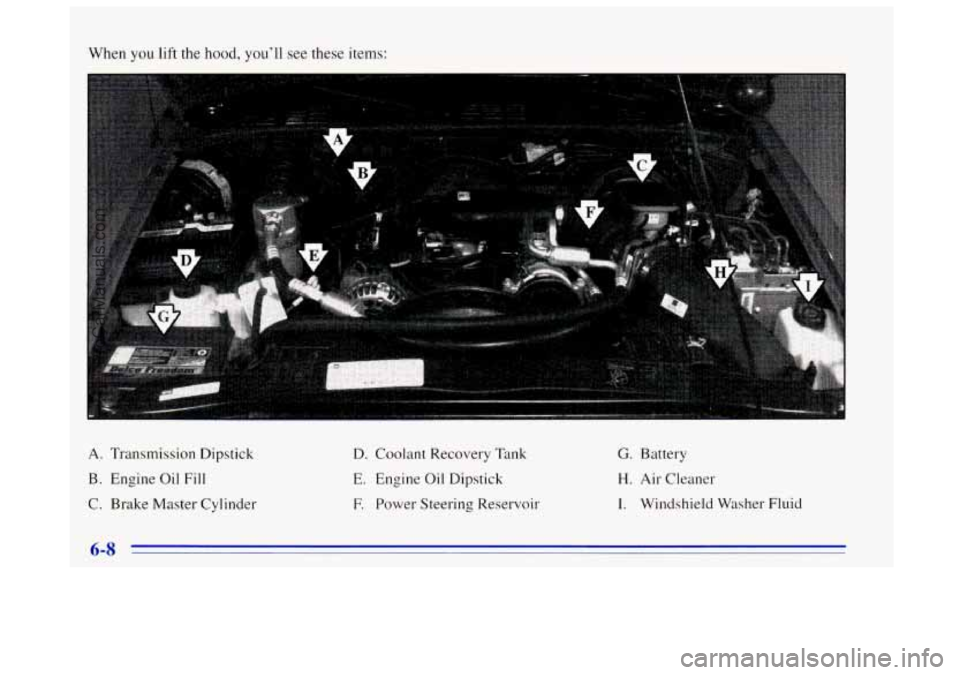
When you lift the hood, you’ll see these items:
A. Transmission Dipstick
B. Engine Oil
Fill
C. Brake Master Cylinder D.
Coolant Recovery Tank
E. Engine Oil Dipstick
E Power Steering Reservoir
G. Battery
H. Air Cleaner
I. Windshield Washer Fluid
6-8
ProCarManuals.com
Page 226 of 340

Automatic Transmission Fluid
When to Check and Change
A good time to check your automatic transmission fluid
level is when the engine oil is changed.
Change both the fluid and filter every
50,000 miles
(83 000 km) if the vehicle is mainly driven under one or
more
of these conditions:
In heavy city traffic where the outside temperature
regularly reaches
90°F (32°C) or higher.
In hilly or mountainous terrain.
0 When doing frequent trailer towing.
Uses such as found in taxi, police or delivery service.
If you do not use your vehicle under any of these
conditions,
the fluid and filter do not require changing.
See “Scheduled Maintenance Services” in the Index.
How to Check
Because this operation can be a little difficult, you may
choose to have this done at your Oldsmobile retail
facility Service Department.
If you do it yourself, be sure to follow all the instructions
here, or you could get a false reading on the dipstick.
I NOTICE:
- ~~
Too much or too little fluid can damage your
transmission.
Too much can mean that some of
the fluid could come out and fall on hot engine
parts
or exhaust system parts, starting a fire. Be
sure to get an accurate reading if you check your
transmission fluid.
Wait at least 30 minutes before checking the
transmission fluid level
if you have been driving:
0 When outside temperatures are above 90°F (32°C).
0 At high speed for quite a while.
0 In heavy traffic -- especially in hot weather.
0 While pulling a trailer.
To get the right reading, the fluid should be at normal
operating temperature, which
is 180°F to 200°F
(82°C to
93°C).
ProCarManuals.com
Page 227 of 340
Checking Transmission Fluid Hot
Get the vehicle warmed up by driving about 15 miles
(24 km) when outside temperatures are above 50°F
(10°C). If it's colder than 50°F (lO"C), drive the
vehicle in THIRD
(3) until the engine temperature gage
moves and then remains steady for
10 minutes. Then
follow the hot check procedures.
Checking Transmission Fluid Cold
A cold check is made after the vehicle has been sitting
for eight hours or more with the engine off and
is used
only
as a reference. Let the engine run at idle for
five minutes
if outside temperatures are 50°F (10°C)
or more. If it's colder than 50°F (lO"C), you may have
to idle the engine longer. Should the fluid level be low
during a cold check, you must perform a hot check
before adding fluid. This will give
you a more accurate
reading of
the fluid level.
Checking the Fluid Hot or Cold
0 Park your vehicle on a level place. Keep the
engine running.
0 With the parking brake applied, place the shift lever
in PARK
(P).
0 With your foot on the brake pedal, move the shift
lever through each gear range, pausing for about
three seconds
in each range. Then, position the shift
lever
in PARK (P).
Let the engine run at idle for three minutes or more.
ProCarManuals.com
Page 229 of 340

How to Add Fluid All-Wheel Drive
Refer to the Maintenance Schedule to determine what
kind
of transmission fluid to use. See “Recommended
Fluids and Lubricants”
in the Index.
Add fluid only after checking the transmission fluid
HOT. (A COLD check is used only as a reference.) If
the fluid level is low, add only enough of the proper
fluid
to bring the level up to the HOT area for a hot
check.
It doesn’t take much fluid, generally less than a
pint
(0.5 L). Don’t overfill. We recommend you use only
fluid labeled DEXRON@-111, because fluid with that
label is made especially for your automatic transmission.
Damage caused by fluid other than DEXRON-I11 is not
covered by your new vehicle warranty.
Transfer Case
When to Check Lubricant
Refer to the Maintenance Schedule to determine how
often
to check the lubricant. See “Periodic Maintenance
Inspections“
in the Index.
How to Check Lubricant
After adding fluid, recheck the fluid level as
described under
“How to Check.”
When the correct fluid level is obtained, push the
dipstick back in all the way; then flip the handle
down
to lock the dipstick in place.
If the level is below the bottom of the filler plug hole,
you’ll need
to add some lubricant. Add enough lubricant
to raise the level to the bottom of the filler plug hole.
6-17
.~ --
ProCarManuals.com
Page 267 of 340

Fuse/Circuit Usage Breaker
6 Blower Motor, Temperature Door
Motor, HI Blower Relay Coil
7
8
9
10
11
12
13
14
15
Power Auxiliary Outlets, Assembly
Line Diagnostic Link
Rear Window Defogger
PCM/VCM Battery, ABS Battery
PCM/VCM Ignition, Injectors, Crank
Sensor, Coil Driver Module
Radio, Inside Rearview Mirror Map
Lamp, Overhead Console Reading
Lamps, Rear Wiper, Rear Washer,
Overhead Console Display
DRAC, Anti-Lock Braking System,
Clock, Radio, Battery,
CD Player
A/C Compressor Battery Feed
Daytime Running Lamps,
Fog Lamps,
Fog Lamp Relay
VCM
IGN-3
FuseKircuit Usage
Breaker
16
17
19
20
21
22
24
Turn Signals and Back-up Lamps,
Brake-Transmission Shift
Interlock Solenoid
Windshield Washer, Windshield
Wiper Motor
Not Used
Crank Signal, Air Bag System
Cluster Illumination, Radio
Illumination, Heater Lamp, Chime
Module,
Fog Lamp Illumination,
Rear Wiper Switch, Rear Defog
Switch Illumination, Liftglass Release
Switch Illumination, Overhead
Console Illumination
Air Bag System
PRNDL Power, 4L60E Automatic
Transmission
ProCarManuals.com
Page 269 of 340

Capacities and Specifications
Engine Description ............ “VORTEC” 4300
Type
.................................... V6
VINCode
................................. W
Firing Order
...................... 1-6-5-4-3-2
Horsepower
................... 190 at 4,400 rpm
Thermostat Specification
........... 195°F (9 1 “C)
Spark Plug Gap
.......... 0.045 inches (0.114 cm)
Wheels and Tires
Wheel Nut Torque ............ 95 Ib-ft (1 30 Nem)
Tire Pressure ...................... Look at the
CertificatiodTire label.
See “Loading Your Vehicle” in
the Index.
Normal Maintenance Replacement Parts
Replacement part numbers listed in this section are
based on the latest information available at the time of
printing, and are subject to change.
If a part listed in this
manual is not the same as the part used in your vehicle
when
it was built, or if you have any questions, please
contact your retailer.
Oil Filter..
............................. PF52
Air Cleaner Filter
...................... A 1 163C
PCV Valve
.......................... CV746C
Automatic Transmission Filter
Kit ...... 24200796
Spark Plugs
.......................... .41-932
Fuel Filter
............................. GF48 1
Windshield Wiper Blade
, . Trico (20 inched50.8 cm) .
Backglass Wiper Blade ... Trico (14 inched35.6 cm)
6-57
ProCarManuals.com
Page 270 of 340

Capacities (Approximate)
Cooling System* ............. 11.7 quarts (1 1.1 L)
Crankcase with Filter* .......... 4.5 quarts (4.3 L)
Automatic Transmission
(Drain and Refill)*
........... 5.0 quarts (4.7 L)
Differential Fluid (Rear) ......... 4.0 pints ( 1.9 L)
Differential Fluid (Front) ......... 2.6 pints (1.2 L)
Fuel Tank ..................... 18 gallons (68 L)
A/C Refrigerant ........ 30 oz. or 2 lbs. (0.9 kg) of
R- 134a
*After refill, the level
must be checked.
A- I Co:~ ~ Jitioning Refrigerants
not all air conditioning refrigerants are the same.
If the air conditioning system in your vehicle needs
refrigerant, be sure the proper refrigerant is used.
If you’re
not sure, ask your Oldsmobile retailer.
Vehicle Dimensions*
Wheelbase .............. 107.0 inches (271.8 cm)
Length
................. 180.9 inches (459.5 cm)
Height ................... 63.2 inches (160.5 cm)
Width ................... 67.6 inches (17 1.7 cm)
Front Tread
............... 57.3 inches (145.4 cm)
Rear Tread
............... 55.1 inches (139.9 cm)
*Figures reflect base equipment
only.
ProCarManuals.com
Page 274 of 340

Maintenance Schedule
Short Trip/City Definition
Follow the Short Trip/City Maintenance Schedule if any
one
of these conditions is true for your vehicle:
0
0
0
0
0
Most trips are less than 5 to 10 miles (8 to 16 km).
This is particularly important when outside
temperatures are below freezing.
Most trips include extensive idling (such as frequent
driving in stop-and-go traffic).
You operate your vehicle
in dusty areas or off-road
frequently.
You frequently tow a trailer
or use a carrier on top of
your vehicle.
If the vehicle is used for delivery service, police, taxi
or other commercial application.
One of the reasons you shouldjollow this schedule if
you operate your vehicle under any of these conditions
is that these conditions cause engine
oil to break
down sooney:
Short Trip/City Intervals
Every 3,000 Miles (5 000 km): Engine Oil and Filter
Change
(or 3 months, whichever occurs first). Chassis
Lubrication
(or 3 months, whichever occurs first). Drive
Axle Service (or
3 months, whichever occurs first).
At 6,000 Miles (10 000 km) -- Then Every
12,000 Miles (20 000 km): Tire Rotation.
Every 15,000 Miles (25 000 km): Air Cleaner Filter
Inspection,
if driving in dusty conditions. Front Wheel
Bearing Repack (or at each brake relining, whichever
occurs first).
Every 30,000 Miles (50 000 km): Ah- Cleaner Filter
Replacement. Fuel Filter Replacement.
Every 50,000 Miles (83 000 km): Automatic
Transmission Service (severe conditions only).
Every 60,000 Miles (100 000 km): Engine Accessory
Drive Belt Inspection. Fuel T'ank, Cap and Lines Inspection.
Every 100,000 Miles (166 000 km): Cooling System
Service
(or every 60 months, whichever occurs first).
Spark Plug Wire Inspection. Spark Plug Replacement.
Positive Crankcase Ventilation (PCV) Valve Inspection.
These intervnls only sumnnrize rnnintenunce services.
Be sure to.follocv the complete maintenance schedule on
the.fo1lowing pages.
I
7-4
ProCarManuals.com