change wheel OLDSMOBILE BRAVADA 1997 User Guide
[x] Cancel search | Manufacturer: OLDSMOBILE, Model Year: 1997, Model line: BRAVADA, Model: OLDSMOBILE BRAVADA 1997Pages: 358, PDF Size: 18.02 MB
Page 193 of 358

12. Remove the cables in reverse order to prevent
electrical shorting. Take care that they don’t touch
each other or any other metal. Towing Your Vehicle
Try to have a GM retailer or a professional towing
service tow your vehicle. See “Roadside Assistance”
in
the Index.
If your vehicle has been changed since it was factory-new
by adding things like
fog lamps, aero skirting, or special
tires and wheels, these instructions may not be conect.
Before you do anything, turn on the hazard
warning flashers.
When you call, tell the towing service:
That your vehicle has all-wheel drive.
The make, model and year of your vehicle.
Whether you can move the shift lever for the
transmission.
A. Heavy Metal Engine Part
B. Good Battery
C. Dead Battery
If there was an accident, what was damaged.
When the towing service arrives, let the tow operator
know that this manual contains these towing
instructions.
The operator may want to see them.
5-7
ProCarManuals.com
Page 207 of 358

If a Tire Goes Flat
It’s Llnusual for a tire to ”blow out.’ while you’re driving,
especially
if you maintain your tires properly. If air goes
out of a tire, it’s much more likely to leak out slowly.
But
if you should ever have a “blowout,” here are a few
tips about what to expect and what to do:
If a front tire fails, the flat tire will create a drag that
pulls the vehicle toward that side. Take your
f-bot off the
accelerator pedal and grip the steering wheel
firmly.
Steer to maintain lane position, and then gently brake to
a stop well out of the traffic lane.
A rear blowout. particularly on a curve, acts much like a
skid and may require the same conxxtion you’d use in a
skid. In any rear blowout, remove your foot from the
accelerator pedal. Get the vehicle under control by
steering the way
you want the vehicle to go. It may be
very bumpy and noisy, but
YOLI can still steer. Gently
brake to
a stop -- well off the road if possible.
If a tire goes flat, the next part shows how to use your
jacking equipment to change a flat tire safely.
Changing a Flat Tire
If a tire goes flat, avoid further tire and wheel damage
by driving slowly to
a level place. Turn on your hazard
warning flashers.
c
A CAUTION:
Changing a tire can cause an injury. The vehicle
can slip off the jack and roll over you
or other
people. You and they could be badly injured.
Find a level place to change your tire.
To help
prevent the vehicle from moving:
1. Set the parking brake firmly.
2. Put the shift lever in PARK (P).
3. Turn off the engine.
To be even more certain the vehicle won’t move,
you can put blocks at the front and rear of the
tire farthest away from the one being changed.
That would be the tire on the other side of the
vehicle, at the opposite end.
The following steps
will tell you how to use the jack and
change
a tire.
5-21
ProCarManuals.com
Page 212 of 358
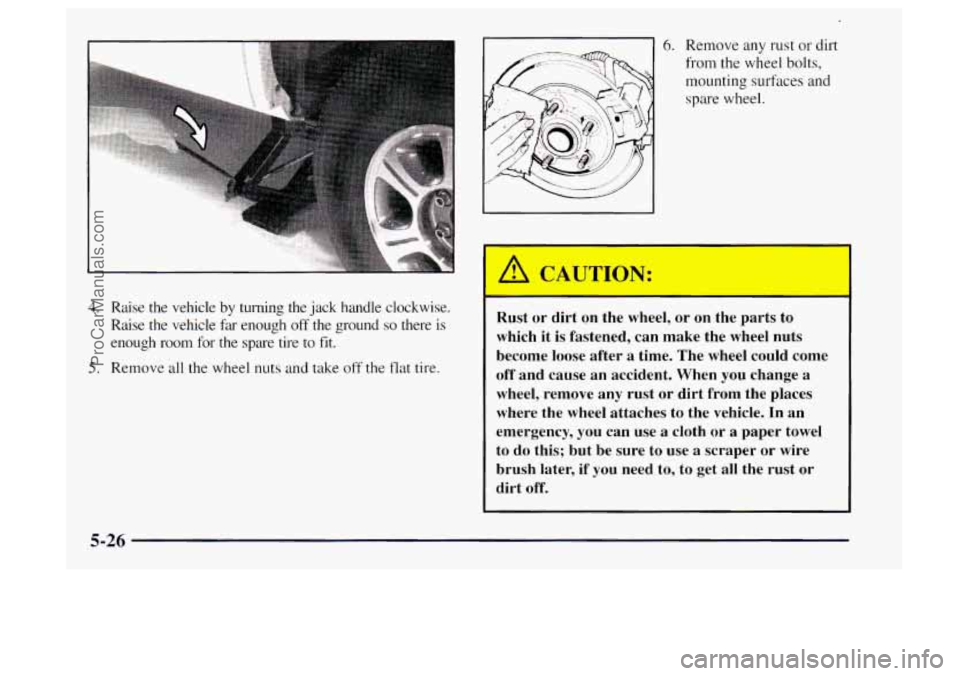
4. Raise the vehicle by turning the jack handle clockwise.
Raise the vehicle
far enough off the ground so there is
enough
room for the spare tire to fit.
5. Remove all the wheel nuts and take off the flat tire.
6. Remove any rust or dirt
from the wheel bolts,
mounting surfaces and
spare wheel.
'
A CAUT 3%
I
Rust or dirt on the wheel, or on the parts to
which it is fastened, can make the wheel nuts
become loose after a time. The wheel could come
off and cause an accident. When
you change a
wheel, remove any rust or dirt from the places
where the wheel attaches to the vehicle.
In an
emergency, you can use a cloth or a paper towe
to do this; but be sure to use a scraper or wire
brush later,
if you need to, to get all the rust or
dirt
off.
!I
5-26
ProCarManuals.com
Page 238 of 358
All-Wheel Drive
Transfer Case
When to Check Lubricant
Refer to the Maintenance Schedule to determine how
often to check the lubricant. See “Periodic Maintenance
Inspections”
in the Index.
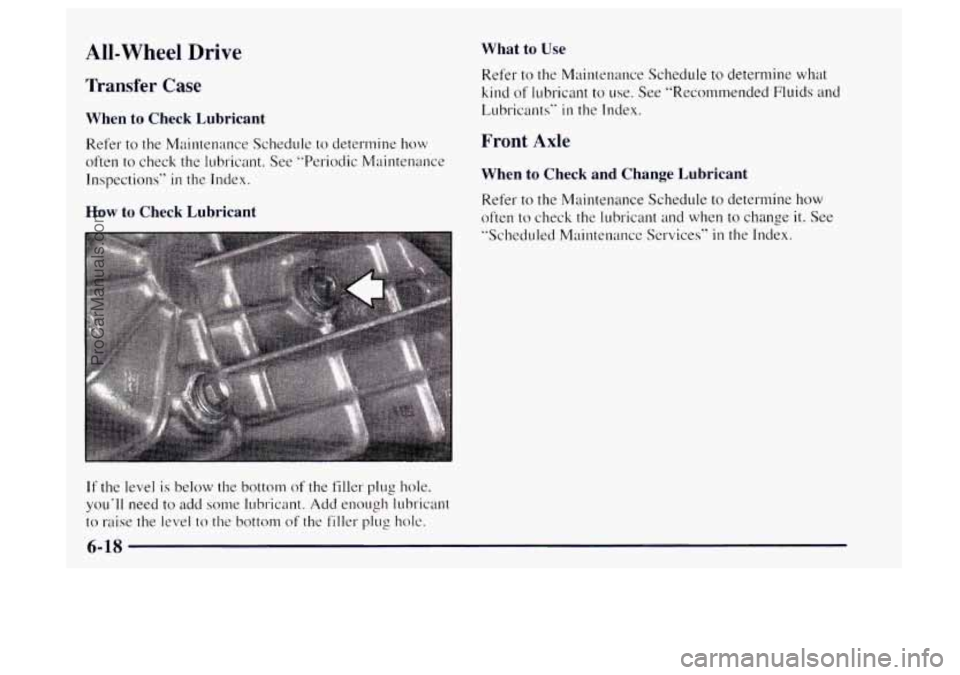
How to Check Lubricant
If the level is below the bottom of the filler plug Ilole,
you‘ll need
to add some lubricant. Add enough lubricant
to raise the level to the bottom of the filler plug hole.
What to Use
Refer to the Maintenance Schedule to determine what
kind
of lubricant to use. See “Reco~n~~~ended Fluids and
Lubricants“
in the Index.
Front Axle
When to Check and Change Lubricant
Refer to the Maintenance Schedule to determine how
often to check the lubricant and when
to change it. See
“Scheduled Maintenance Services”
in the Index.
ProCarManuals.com
Page 258 of 358
Tire Inspection and Rotation
Tires should be rotated every 6,000 to 8,000 miles
( 10 000 to 13 000 km). Any time you notice unusual
wear, rotate your tires
as soon as possible and check
wheel alignment. Also check for damaged tires or
wheels. See “When It’s Time for New Tires” and
“Wheel Replacement” later
in this section for
more information.
The purpose of regular rotation
is to achieve more
uniform wear for all tires on the vehicle. The first
rotation
is the most important. See “Scheduled
Maintenance Services”
in the Index for scheduled
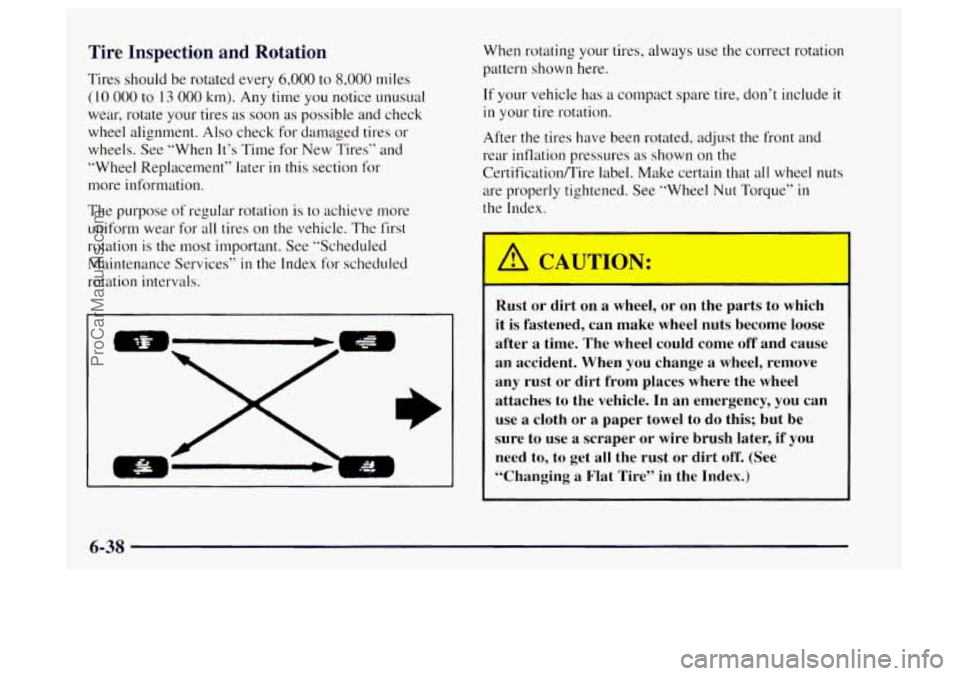
rotation intervals. When rotating your tires, always
use the correct rotation
pattern shown here.
If your vehicle has a compact spare
tire, don’t include it
in your tire rotation.
After the tires have been rotated, adjust the front and
rear inflation pressures
as shown on the
Certificationmire label. Make certain that all wheel nuts
are properly tightened. See
“Wheel Nut Toraue” in
the Index.
Rust or dirt on a wheel, or on the parts to which
it is fastened, can make wheel nuts become loose
after a time. The wheel could come off and cause
an accident. When you change a wheel, remove
any rust or dirt from places where the wheel
attaches to the vehicle. In an emergency, you can
use a cloth or a paper towel to do this; but be
sure to use a scraper or wire brush later,
if you
need to, to get all the rust or dirt off. (See
“Changing a Flat Tire” in the Index.)
6-38
ProCarManuals.com
Page 280 of 358

Capacities and Specifications
Engine Description ............ “VORTEC” 4300
Type
.................................... V6
VINCode ................................. W
Horsepower
................... 190 at 4,400 rpm
Thermostat Specification
........... 195 “F (9 1 “C)
Spark Plug
Gap .......... 0.045 inches (0.1 I4 cm)
Firing Order
...................... 1-6-5-4-3-2
Wheels and Tires
Wheel Nut Torque ............ 95 lb-ft (130 N-m)
Tire Pressure ...................... Look at the
Certificationnire label. See
“Loading Your Vehicle” in the Index.
Normal Maintenance Replacement Parts
Replacement part numbers listed in this section are
based
on the latest information available at the time of
printing, and are subject to change.
If a part listed in this
manual is not the same as the part used in your vehicle
when
it was built, or if you have any questions, please
contact your retailer.
Oil Filter.
.............................. PFS2
Air Cleaner Filter ...................... A1163C
PCV Valve
.......................... CV746C
Automatic Transmission Filter Kit
...... 24200796
Spark Plugs
.......................... ,41-932
Fuel Filter
............................. GF48 1
Windshield Wiper Blade . . Trico (20 inched50.8 cm)
Backglass Wiper Blade
... Trico (14 inched35.6 cm)
6-60
ProCarManuals.com
Page 326 of 358

Throttle Linkage Inspection
Inspect the throttle linkage for interference or binding,
and for damage or missing parts. Replace parts
as
needed. Replace any cables that have high effort or
excessive wear.
Do not lubricate accelerator and cruise
control cables.
Drive Axle Service
Check rear/front axle fluid level and add as needed.
Check constant velocity joints and axle seals for leaking.
Transfer Case (All-Wheel Drive) Inspection
Every 12 months or at oil change intervals, check front
axle and transfer case and
add lubricant when necessary.
Oil the control lever pivot point and
all exposed control
linkage. Check vent hose at transfer case
for kinks and
proper installation.
Brake System Inspection
Inspect the complete system. Inspect brake lines and
hoses for proper hook-up, binding, leaks, cracks,
chafing, etc. Inspect disc brake pads for wear and rotors
for surface condition. Inspect other brake parts,
including calipers, parking brake, etc. Check parking
brake adjustment.
You may need to have your brakes
inspected more often
if your driving habits or conditions
result
in frequent braking.
7-44
ProCarManuals.com