door lock OLDSMOBILE BRAVADA 1997 User Guide
[x] Cancel search | Manufacturer: OLDSMOBILE, Model Year: 1997, Model line: BRAVADA, Model: OLDSMOBILE BRAVADA 1997Pages: 358, PDF Size: 18.02 MB
Page 65 of 358

Parking at Night
Park in a lighted spot, close all windows and lock your
vehicle. Remember to keep your valuables out
of sight.
Put them
in a storage area, or take them with you.
Parking Lots
If you park in a lot where someone will be watching
your vehicle, it’s best to lock
it up and take your keys.
But
what if you have to leave your ignition key? What if
you have to leave something valuable
in your vehicle?
Put your valuables in a storage area, like your
glove
box.
0 Lock all the doors except the driver’s.
New Vehicle “Break-In”
-
NOTICE:
-
Your modern Oldsmobile doesn’t need an
elaborate “break-in.’’ But it will perform better
in the long run if you follow these guidelines:
0
0
0
0
Keep your speed at 55 mph (88 kmk) or
less for the first
500 miles (805 km).
Don’t drive at any one speed
-- fast or
slow
-- for the first 500 miles (805 km).
Don’t make full-throttle starts. Avoid making hard stops for the first
200 miles (322 km) or so. During this time
your new brake linings aren’t yet broken
in. Hard stops with new linings can mean
premature wear and earlier replacement.
Follow this breaking-in guideline every
time you get new brake linings.
Don’t tow a trailer during break-in. See
“Towing a Trailer” in the Index for
more information.
2-11
ProCarManuals.com
Page 78 of 358
Windows
Power Windows
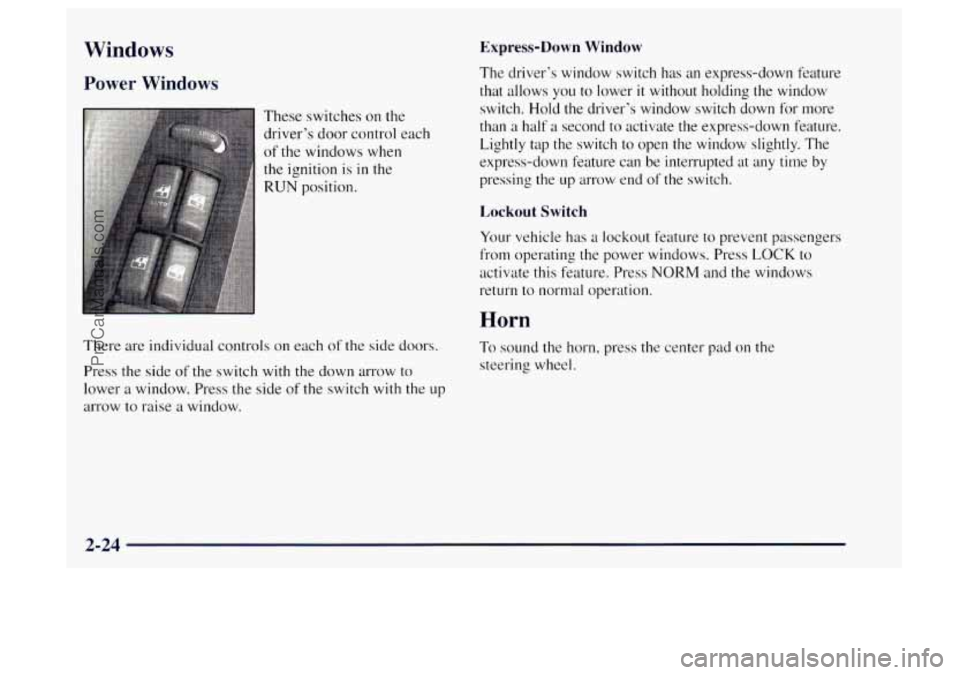
These switches on the
driver’s door control each
of the windows when
the ignition is in the
RUN position.
There are individual controls on each of the side doors.
Press the side of the switch with the down arrow to
lower a window. Press the side of the switch
with the up
arrow to raise a window.
Express-Down Window
The driver’s window switch has an express-down feature
that allows you to lower
it without holding the window
switch.
Hold the driver’s window switch down for more
than a half a second to activate the express-clown feature.
Lightly tap the switch to open the window slightly. The
express-down feature can be interrupted
at any time by
pressing the up arrow end of the switch.
Lockout Switch
Your vehicle has a lockout feature to prevent passengers
from operating the power windows. Press LOCK to
activate this feature. Press
NORM and the windows
return to normal operation.
Horn
To sound the horn, press the center pad on the
steering wheel.
2-24
ProCarManuals.com
Page 96 of 358
Ashtrays and Cigarette Lighter
To use the lighter, press it in all the way, and let go.
When it’s ready, it will pop back by itself.
I NOTICE:
Don’t hold a cigarette lighter in with your hand
while it is heating.
If you do, it won’t be able to
back away from the heating element when it’s
ready. That can make it overload, damaging the
lighter and the heating element.
The front ashtray must be completely pulled out to the
open position before the ashtray cover opens and
smoking material can be deposited.
NOTICE:
Don’t put papers and other things that burn into
your ashtray.
If you do, cigarettes or other
smoking materials could set them on fire,
causing damage.
To remove the front ashtray,
lift the release tab as high
as possible, then remove the tray.
There are smaller ashtrays inside the rear doors. Press
PUSH to turn an ashtray around for use.
Sun Visors
To block out glare, you can swing down the top and
bottom
visors. You can also swing the bottom visor from
side to side. Your visors may have an extension that can
be pulled out for additional glare protection and a strap
for holding small items, such as maps.
2-42
ProCarManuals.com
Page 225 of 358

Filling Your Tank
The fuel cap is behind a
hinged door
on the driver’s
side
of your vehicle.
’
I A CAUTION: I
Gasoline vapor is highly flammable. It burns
violently, and that can cause very bad injuries.
Don’t smoke
if you’re near gasoline or refueling
your vehicle. Keep sparks, flames and smoking
materials away from gasoline.
To take off the cap,
turn
it slowly to the left
(counterclockwise). The cap
has a spring in it; if you let
go of the cap too soon, it
will
spring back to the right.
I A CAUTION:
If you get gasoline on yourself and then
something ignites it, you could be badly burned.
Gasoline can spray out on you if you open the
fuel filler cap too quickly. This spray can happen
if your tank is nearly full, and is more likely in
hot weather. Open the fuel filler cap slowly and
wait for any “hiss” noise to stop. Then unscrew
the cap
all the way.
ProCarManuals.com
Page 232 of 358
Engine Oil Additives
Don’t add anything to your oil. Your Oldsrnobile retailer
is ready to advise
if you think something should
be added.
When to Change Engine Oil
If any one of these is true for you, use the short tripkity
maintenance schedule:
a
a
a
a
a
Most trips are less than 5 to 10 miles (8 to 16 km).
This
is particularly important when outside
temperatures are below freezing.
Most trips include extensive idling (such
as frequent
driving
in stop-and-go traffic).
You operate your vehicle in dusty areas or
off-road frequently.
You frequently tow a trailer or use a carrier on top of
your vehicle.
The vehicle is used for delivery service, police, taxi
or other commercial application. Driving under these conditions causes
engine
oil to
break down sooner.
If any one of these is true for your
vehicle, then you need
to change your oil and filter
every
3,000 miles (5 000 km) or 3 months -- whichever
occurs first.
If none of them is true, use the long trip/highway
maintenance schedule. Change the oil and filter every
7,500 miles (1 2 500 km) or 12 months -- whichever
occurs first. Driving a vehicle with a
fully warmed
engine under highway conditions causes engine oil to
break down slower.
Remote Oil Filter
The access door for the remote oil filter is in the steering
linkage shield assembly located under the radiator
support. Twist the screw to unlock
or lock the door.
Make sure
if you open the door, it is securely closed
when
you are finished.
ProCarManuals.com
Page 273 of 358

Vehicle Identification Number (VIN)
I I1 11111111 1111 111 111111 111 111111 I1 111111111111 111111111 II J 0
SAMPLE4UXVM072675 I
IIIIIIIIIIIII 11l11111111l11 IIIIIIIIIIIIIIIIIIIIIIIIIIIIIIII
CODE MODEL YEAR PLANT
This is the legal identifier for your Oldsmobile. It appears
on a plate in the front corner of the instrument panel, on
the driver’s side. You can see it if you look through the
windshield from outside your vehicle. The VIN also appears
on the Vehicle Certification and Service Parts
labels and the certificates of title and registration.
Engine Identification
The 8th character in your VIN is the engine code. This
code will help you identify your engine, specifications
and replacement parts.
Service Parts Identification Label
You’ll find this label on the driver’s door lock pillar. It’s very
helpful if you eves need to order parts.
On this label is:
your VIN,
the model designation,
paint information and
a list of all production options and
special equipment.
Be sure that this label is not removed from the vehicle.
6-53
ProCarManuals.com
Page 276 of 358

I
ACCY
d
FuseKircuit Breaker
Usage
A
B
Power Door Locks, Power Seat,
Power Seat Lumbar, Remote
Keyless Entry
Power-Windows, Sunroof Module/Motor
FuseKircuit Breaker Usage
1
2
3
Stoplamps, Hazard Lamps, Chime,
Center High-Mounted Stoplamp
Relay, Center High-Mounted
Stoplamp
Dome Lamps, Cargo Lamps, Visor
Vanity Mirror, Cigarette Lighter,
Inside Rearview Mirror Lamp,
Overhead Console Lamps, Glove
Box
Lamp, Horns, Horn Relay, IP
Courtesy Lamps, Power Outside
Rearview Mirror, Liftglass Release
Motor, Illuminated Entry Module
Parking Lamps, License Plate Lamps, Electric Shift Transfer Case Module,
Underhood Lamp, Rear Wiper, Fog
Lamp Relay, Door Switch Lamp,
Ashtray Lamp, Headlamp Switch
ProCarManuals.com
Page 277 of 358

FuseKircuit Breaker Usage
4
5
6
7
A/C Compressor Relay, Cluster
Chime Module, DRL Relay Coil,
Four-Wheel-Drive Indicator Lamp,
DRL Module, Rear Defog Timer,
Transfer Case Control Module Ignition, SIR Redundant Ignition,
RKE Ignition, Fuel Sender Module
Oxygen Sensor Heater, Exhaust Gas
Recirculation, Cam Sensor, CANN.
Purge, Canister Vent Solenoid, Mass
Airflow Sensor, Cam Shaft Sensor
Blower Motor, Temperature Door
Motor, HI Blower Relay Coil
Power Auxiliary Outlets, Assembly
Line Diagnostic Link
FuseKircuit
Breaker Usage
8
9
10
11
12
13
14
15
Rear Window Defogger
PCMNCM Battery, Fuel Pump
PCMNCM Ignition, Injectors, Crank
Sensor, Coil Driver Module
Radio, Inside Rearview Mirror Map
Lamp, Overhead Console Reading
Lamps, Rear Wiper, Rear Washer,
Overhead Console Display
Anti-Lock Braking System,
VCM IGN-3
Clock, Radio Battery, CD Player
A/C Compressor Battery Feed
Daytime Running Lamps, Fog Lamps,
Fog Lamp Relay
6-57
ProCarManuals.com
Page 322 of 358
At Least Twice a Year At Least Once a Year
Restraint System Check
Make sure the safety belt reminder light and all your
belts, buckles, latch plates, retractors and anchorages are
working properly.
Look for any other loose or damaged
safety belt system parts.
If you see anything that might
keep a safety belt system from doing its job, have
it
repaired. Have any torn or frayed safety belts replaced.
Also look for any opened or broken air bag coverings,
and have them repaired or replaced. (The
air bag system
does not need regular maintenance.)
Wiper Blade Check Key Lock Cylinders Service
Lubricate the
key lock cylinders with the lubricant
specified in Part
D.
Body Lubrication Service
Lubricate all body door hinges, the body hood, fuel door
hinges, endgate hinges, latches and locks and
any
moving seat hardware. Lubricate the hood safety lever
pivot and prop rod pivot. Part
D tells you what to use.
More frequent lubrication may be required when
exposed to a corrosive environment.
Inspect wiper blades for wear or cracking. Replace blade
inserts that appear worn
or damaged or that streak or
miss areas of the windshield.
Also see “Wiper Blades,
Cleaning”
in the Index.
Automatic Transmission Check
Check the transmission fluid level; add if needed. See
“Automatic Transmission”
in the Index. A fluid loss
may indicate
a problem. Check the system and repair
if needed.
7-40
ProCarManuals.com
Page 345 of 358

Climate Control System ........................... 3-2
Clock.Setting
................................... 3-6
Comfort Controls
................................ 3- 1
Compact Disc Care ............................. 3- 16
Compass
...................................... 2-37
Control of a Vehicle
.............................. 4-6
Convenience Net
............................... 2-40
Convex Outside Mirror
.......................... 2-35
Coolant
....................................... 6-20
Coolant Heater. Engine .......................... 2- 14
Courtesy Transportation
........................... 8-6
Cruise Control
................................. 2-28
Customer Assistance Information
................... 8- 1
Customer Satisfaction Procedure .................... 8-2
Damage. Finish
............................... 6-51
Damage. Sheet Metal
............................ 6-50
Daytime Running Lamps
......................... 2-32
Indicator Light
............................... 2-60
Dead Battery ................................... 5-3
Defects. Reporting Safety
......................... 8-8
Defensive Driving
............................... 4-2
Defogging and Defrosting
......................... 3-5
Dimensions. Vehicle
............................ 6-6 1
Dome Lamps .................................. 2-34 Door
Locks ....................................... 2-4
Storage
..................................... 2-39
Driver Info~-mation System
....................... 2-37
Driver Position ................................. 1 . 12
Driving
........................................ 4-1
Cily ........................................ 4-33
Defensive
.................................... 4-2
Drunken
..................................... 4-3
Foreign Countries
.............................. 6-4
Freeway .................................... 4-34
Guidelines
.................................. 4-15
Hill and Mountain Roads
....................... 4-36
In a Blizzard ................................. 4-40
Night ...................................... 4-28
On Curves
.......................... : ........ 4-9
Rainy Conditions
............................. 4-30
Snowy and Icy Conditions
...................... 4-38
Through Deep Standing Water
................... 4-32
WetRoads
.................................. 4-30
Winter
...................................... 4-38
With
a Trailer ................................ 4-49
Driving On Grades While Towing
a Trailer ........... 4-51
Drunken Driving
................................ 4-3
Off-Road
................................... 4-15
ProCarManuals.com