ignition OLDSMOBILE BRAVADA 1997 User Guide
[x] Cancel search | Manufacturer: OLDSMOBILE, Model Year: 1997, Model line: BRAVADA, Model: OLDSMOBILE BRAVADA 1997Pages: 358, PDF Size: 18.02 MB
Page 74 of 358

2. hlove the shift lever into PARK (P) position like this: Leaving Your Vehicle With the
Engine Running
It can be dangerous to leave your vehicle with the
engine running.
Your vehicle could move
suddenly if the shift lever
is not fully in PARK (P)
with the parking brake firmly set. And, if you
leave the vehicle with the engine running, it could
overheat and even catch fire.
You or others could
be injured. Don’t leave your vehicle with the
engine running unless you have to.
0 Hold in the button on the lever.
Push the lever all the way toward the front of
the vehicle.
3. TLIIII the ignition key to LOCK.
4. Remove the key and take it with YOLI. If you can
remove the key and
leave your vehicle, your vehicle
is in PARK (P).
If you have to leave your vehicle. with the engine
running,
be s111-e to firndy set your parking brake and
shifi into PARK (P) before you leave it. After you’ve
n~oved the shift lever into the PARK (P) position, hold
the reg~~lar brake pedal ckwn. Then, see if you can move
the shift lever away from PARK (P) without first pulling
it toward you. If you can, it means that the shift lever
wasn’t
FLIIIY locked into PARK (P).
2-20
ProCarManuals.com
Page 75 of 358

Torque Lock
If you are parking on a hill and you don’t shift your
transmission into PARK
(P) properly, the weight of the
vehicle may put too much force
on the parking pawl in
the transmission. You may find it difficult to pull the
shift lever out of PARK (P). This is called “torque lock.”
To prevent torque lock, set the parking brake and then
shift into PARK
(P) properly before you leave the
driver’s seat.
To find out how, see “Shifting Into
PARK (P)” in the Index.
When you are ready
to drive, move the shift lever out of
PARK (P) h
vehicle push yo~~rs
a little uphill to take some of the
pressure from
the parking pawl in the transmission, so
you can pull the shift lever out of PARK (P).
Shifting Out of PARK (P)
Your vehicle has a brake-transmission shift interlock.
You have to fully apply your regular brake before you
can shift from PARK
(P) when the ignition is in the
RUN position. See “Automatic Transmission Operation”
in the Index.
If you cannot shift out of PARK (P), ease pressure on
the shift lever -- push the shift lever all the way into
PARK
(P) as you maintain brake application. Then press
the shift lever button and move the shift lever into the
gear you want.
If you ever hold the brake pedal down but still can’t
shift
out of PARK (P), try this:
1. Turn the key to OFF.
2. Apply and hold the brake until the end of Step 4.
3. Shift to NEUTRAL(N).
4. Start the vehicle and then shift to the drive gear
you want.
5. Have the vehicle fixed as soon as you can.
* 2-21
ProCarManuals.com
Page 78 of 358
Windows
Power Windows
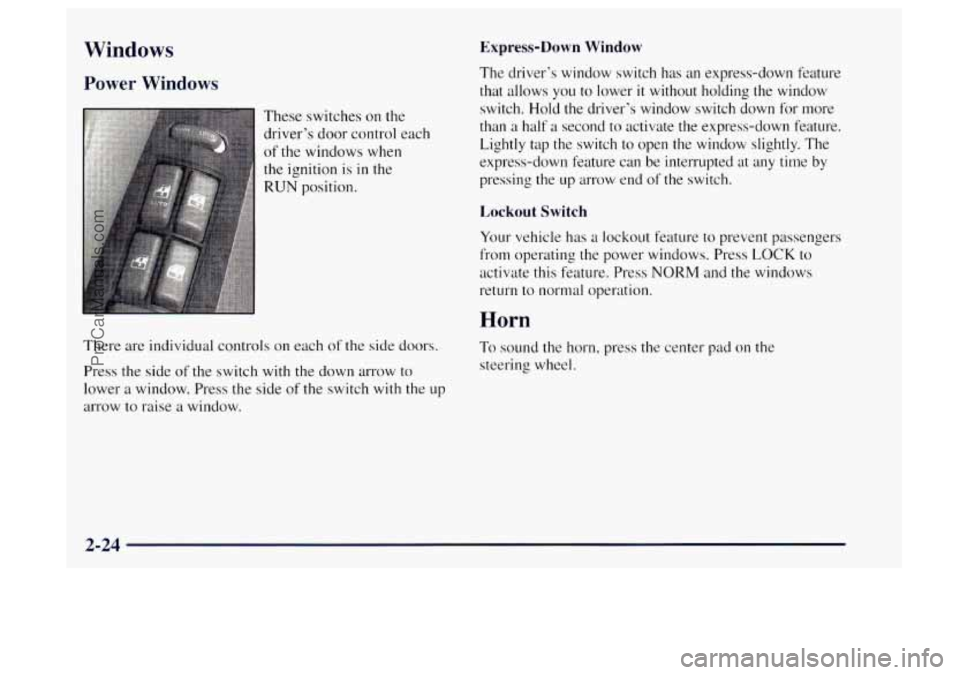
These switches on the
driver’s door control each
of the windows when
the ignition is in the
RUN position.
There are individual controls on each of the side doors.
Press the side of the switch with the down arrow to
lower a window. Press the side of the switch
with the up
arrow to raise a window.
Express-Down Window
The driver’s window switch has an express-down feature
that allows you to lower
it without holding the window
switch.
Hold the driver’s window switch down for more
than a half a second to activate the express-clown feature.
Lightly tap the switch to open the window slightly. The
express-down feature can be interrupted
at any time by
pressing the up arrow end of the switch.
Lockout Switch
Your vehicle has a lockout feature to prevent passengers
from operating the power windows. Press LOCK to
activate this feature. Press
NORM and the windows
return to normal operation.
Horn
To sound the horn, press the center pad on the
steering wheel.
2-24
ProCarManuals.com
Page 85 of 358

Using Cruise Control on Hills
How well your cruise control will work on hills depends
upon your speed,
load and the steepness of the hills.
When going up steep hills, you may want to step on the
accelerator pedal to maintain your speed. When going
downhill, you may have to brake
or shift to a lower gear
to keep your speed down.
Of course, applying the brake
takes
you out of cruise control. Many drivers find this to
be too much trouble and don’t use cruise control on
steep hills.
Ending Cruise Control
There are two ways to turn off the cruise control:
Step lightly on the brake pedal.
Move the cruise switch to OFF.
Erasing Speed Memory
When you turn off the cruise control or the ignition,
your cruise control set speed memory
is erased.
Lamps
The switches are on the left side of your instrument panel.
Press the top switch with the parking lamps symbol on
it
to turn on:
Parking Lamps
Sidernarker Lamps
Taillamps
License Plate Lamps
Instrument Panel Lights
2-3 1
ProCarManuals.com
Page 86 of 358

Press the bottom switch with the master lamps symbol on
it to turn on all the lamps listed as well as the headlamps.
Press the side of the switch marked
OFF to turn off
your lamps.
Lamps On Reminder
A reminder tone will sound when your headlamps or
parking lamps are turned on and your ignition is
in OFF,
LOCK or ACCESSORY. To turn the tone off, press the
OFF switch.
Daytime Running Lamps
Daytime Running Lamps (DRL) can make it easier for
others to see the front of your vehicle during the day.
DRL can be helpful in many different driving
conditions, but they can be especially helpful in the
short periods after dawn and before sunset.
The DRL system
will make your headlamps come on at
reduced brightness when:
the ignition is on,
the headlalnp switch is off and
0 the parking brake is released. When
the DRL are
on, only your headlamps will be on.
The taillamps, sidemarker and other lamps won’t be
on.
The instrument panel won’t be lit up either.
When
it begins to get dark, your DRL indicator light
is a reminder to turn your headlamp switch on. The
other lamps that come
on with your headlamps will also
come on.
When you
turn the headlamp switch off, the regular
lamps will go off. and your headlamps
will change to
the reduced brightness of DRL.
To idle your vehicle with the DRL off, set the parking
brake. The DRL
will stay off until you release the
parking brake.
As with any vehicle, you should turn on the regular
headlamp system when you need
it.
2-32
ProCarManuals.com
Page 91 of 358

Driver Information System
This system displays the outside air temperature, compass
direction and trip information in the overhead console.
The USNET (United States/metric) button allows you to
switch the display between the English and metric system.
The MODE button can be used to toggle between three
modes of operation:
OFF, COMPREMP and TRIP.
OFF: This turns the system off.
COMP/TEMP: The display provides the outside
temperature and one of eight compass readings to
indicate the direction the vehicle is facing.
Before you turn on the ignition and move the vehicle,
the temperature indicated will be the last outside
temperature recorded with the ignition on. If the outside
temperature is
37 "F (3 " C) or lower, the display will
toggle between the word ICE and the current
temperature every eight seconds. This is a warning to
the driver that road conditions may be icy, and that
appropriate precautions should be taken. The
compass is self-calibrating,
so it does not need to be
manually set. However,
if C (Calibration) is displayed, the
compass will need to
be calibrated. You may also place the
compass in a noncalibrated mode by pressing and holding
the MODE and USMET buttons simultaneously while
in
the COMPmEMP mode. After about 10 seconds, the
compass will display
C and you can release the buttons.
Drive the vehicle in a complete 360" circle three times at
a speed of less than
5 mph (8 km/h), and the compass will
function normally. Once the calibration is complete, the
display will return to
a compass reading.
2-37
ProCarManuals.com
Page 107 of 358

Air Bag Readiness Light
There is an air bag readiness light on the instrument
panel, which shows
AIR BAG. The system checks the
air bag’s electrical system for malfunctions. The light
tells
you if there is an electrical problem. The system
check includes
the air bag sensors, the air bag module,
the wiring and the diagnostic module.
For more
information on the air bag system, see
“Air Bag” in
the Index.
AIR
BAG
This light will come on
when you start your engine,
and
it will flash for a few
seconds. Then the light
should go out. This means
the system is ready.
If the air bag readiness light stays on after you start the
engine or comes on when you are driving, your air bag
system may
not work properly. Have your vehicle
serviced right away. The air
bag readiness light should flash for a few
seconds when you turn the ignition key to
RUN. If the
light doesn’t come on then, have
it fixed so it will be
ready
to warn you if there is a problem.
Charging System Indicator Light
The charging system light
will come on briefly when
you turn on the ignition, but
the engine is not running,
as a check
to show you it
is working.
It should go out once the engine is running. If it stays
on, or comes
on while you are driving, you may have a
problem with the charging system.
It could indicate that
you have problems with a generator drive belt, or
another electrical problem. Have
it checked right away.
Driving while this light is on could drain your battery.
If you must drive a short distance with the light on, be
certain to turn off all your accessories, such as the radio
and air conditioner.
ProCarManuals.com
Page 108 of 358

Voltmeter Gage
fl u VOLTS
When your engine is not
running, but the ignition
is
on (in the RUN position),
this gage shows your
battery’s state of charge in
DC volts.
When the engine
is running, the gage shows the
condition
of the charging system. Readings between the
low and high warning zones indicate the normal
operating range. Readings
in the low
warning zone may occur when a
large number
of electrical accessories are operating in
the vehicle and the engine is left at
an idle for an
extended period. This condition
is normal since the
charging system
is not able to provide full power at
engine idle.
As engine speeds are increased, this
condition should correct itself as higher engine speeds
allow the charging system to create maximum power.
You can only drive for a short time with the reading in
either warning zone.
If you must drive, turn off all
unnecessary accessories.
Readings in either warning zone indicate
a possible
problem in the electrical system. Have
the vehicle
serviced
as soon as possible.
2-54
ProCarManuals.com
Page 109 of 358
Brake System Warning Light
Your Oldsmobile’s hydraulic brake system is divided
into two parts.
If one part isn’t working, the other part
can still work and stop you. For good braking, though,
you need both parts working well.
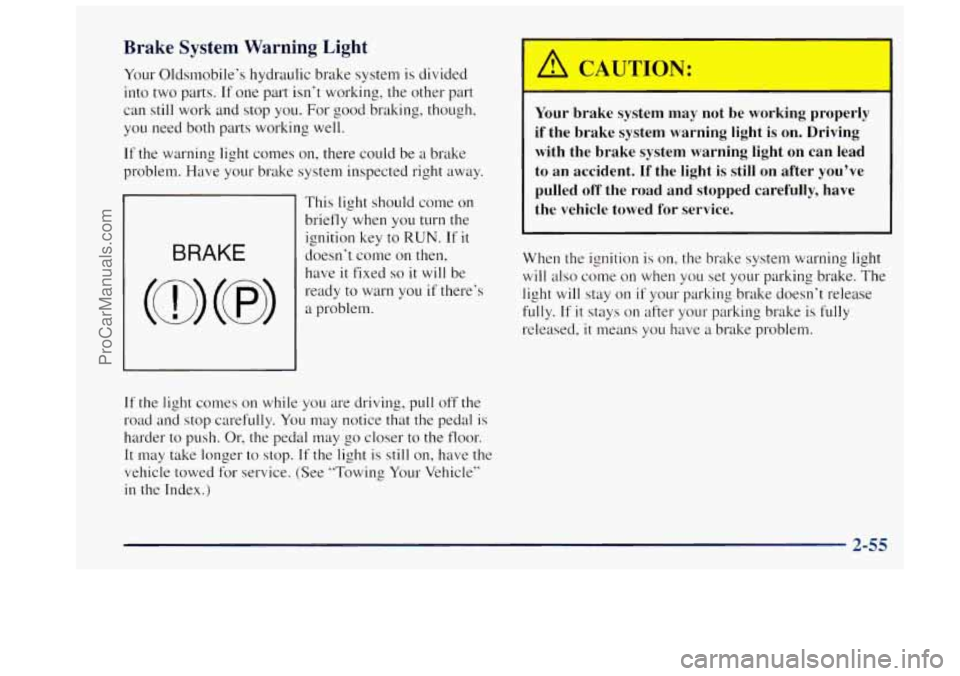
If the warning light comes on, there could be a brake
problem. Have
your brake system inspected right away.
This light should come on
briefly when you
turn the
ignition key to
RUN. If it
doesn’t come on then,
have
it fixed so it will be
ready
to warn you if there’s
a problem.
A CAUTION:
-
Your brake system may not be working properly
if the brake system warning light is on. Driving
with the brake system warning light on can lead
to an accident. If the light
is still on after you’ve
pulled off the road and stopped carefully, have
the vehicle towed
for service.
When the ignition is on, the brake system warning light
will also come on when you set your parking brake. The
light
will stay on if your parking brake doesn’t release
fully.
If it stays on after your parking brake is fully
released, it means you have a brake problem.
If the light comes on
while you are driving, pull off the
road and stop carefully. You may notice that the pedal is
harder to push. Or, the pedal may go closer to the floor.
It may take longer to stop. If the light is still on, have the
vehicle towed for service. (See “Towing Your Vehicle”
in the Index.)
2-55
ProCarManuals.com
Page 110 of 358

Anti-Lock Brake System Warning Light
With the anti-lock brake
system, this light
will come
on when you start your
ANTI - LOCK engine and may stay on for I
If the light stays on, or comes on when you’re driving,
your Oldsmobile needs service.
If the regular brake
system warning light isn’t on, you still have brakes, but
you don’t have anti-lock brakes. If the regular brake
system warning light is also
on, you don’t have anti-lock
brakes and there’s a problem with
your regular brakes.
See “Brake System Warning Light” earlier in
this section.
The anti-lock brake system warning light should come
on briefly when you turn
the ignition key to RUN. If the
light doesn’t corne on then, have
it fixed so it will be
ready to warn you
if there is a problem.
Engine Coolant Temperature Gage
I
This gage shows the engine
coolant temperature.
If the
gage pointer moves into the
red area, your engine
is
too hot!
TEMP
It means that your engine coolant has overheated. If you
have been operating your vehicle under normal driving
conditions, you should pull off the road, stop your
vehicle and turn
off the engine as soon as possible.
In “Problems on the Road,” this manual shows you what
to do. See ”Engine Overheating’‘
in the Index.
2-56
ProCarManuals.com